
West of the Pecos (1945)
Directed by Edward Killy
RKO Radio Pictures
After recently seeing early performances by Robert Mitchum in two top-notch World War II films, Thirty Seconds Over Tokyo (1944) and Story of G.I. Joe (1945), I was a little disappointed by his starring role in West of the Pecos. Mitchum is one of my favorite actors, and he’s always interesting to watch, but this movie is hard to take very seriously.
After small roles in a variety of films (including some Hopalong Cassidy westerns), and a larger role in William Castle’s B noir When Strangers Marry, Mitchum was signed to a contract by RKO, who needed a B western star in the Tim Holt mold. I haven’t seen the first western Mitchum made for RKO, Nevada (1944), which is based on a Zane Grey novel, but if it’s anything like West of the Pecos, I don’t think I’m missing too much. Like Nevada, West of the Pecos is also based on a Grey novel, and is typical “romance of the West” malarkey. In terms of plot and character development, it has more in common with 19th-century stage drama than anything else.
In West of the Pecos, Barbara Hale plays a young Chicagoan named Rill Lambeth, whose father, Col. Lambeth (Thurston Hall), is ordered out west for his health. The two of them travel by stagecoach to Texas with their French maid, Suzanne (Rita Corday). In the course of their travels, they cross paths with Pecos Smith (Mitchum), an outlaw who’s seeking revenge against the corrupt vigilantes who killed his best friend. There are plenty of western tropes in West of the Pecos, like shootouts and unconvincing portrayals of Mexican bandits (Richard Martin plays their leader), but at its heart it’s a light-hearted romance and cross-dressing farce. Soon after her arrival in Texas, Hale decides to dress as a boy to dissuade all the nasty cowboys she meets from sassing her. To say she makes an unconvincing fellow would be an understatement. Her long, flowing hair is simply piled up and pinned under a ten-gallon hat, and all she does to hide her pretty face is rub a little dirt on it.
Part of the problem is Mitchum. Even here, in one of his first roles, he’s simply too world-weary and knowing. Consequently, it’s hard to tell most of the time if his character is supposed to be convinced by Hale’s drag, or if he’s just playing along for his own amusement, like when he rubs her face and says, “You’re just a kid! I bet you haven’t even started shaving. How old are you, anyhow?” Hale petulantly responds, “Old enough.”
Their relationship is based on kidding around, but it’s so flirtatious that I was actually surprised at the end when Mitchum’s character acted shocked when he found out Hale was really a young woman. He plays all their scenes together as if he has every idea what’s going on. Take, for instance, the scene by the campfire in which Mitchum tries to convince Hale to get in his bedroll with him on account of the nighttime chill. He rolls over on his side, faces her, and throws the blanket aside.
“C’mon, kid, get in,” he says.
“But … I want to sleep alone,” she responds.
“Ah, no you don’t. C’mon. Get in and cuddle.”
“Cuddle?!?”
“Sure. Keep each other warm. And I hope you haven’t got cold feet.”
“Cold feet?” she says, too quietly for him to hear. “I got ’em right now.”
It’s interesting to see Mitchum in this type of role. Not too long after appearing in this film, he would receive the only Oscar nomination of his career, for his role in the much better film The Story of G.I. Joe. After that, his days of starring in movies like this were pretty much over. Not every picture he made was great (some of them were even pretty bad), but by 1946 he was on his way to becoming an A-list actor, and eventually a Hollywood legend.
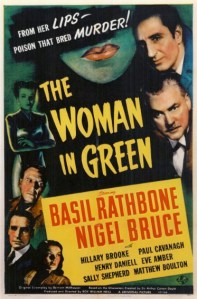 Roy William Neill’s The Woman in Green is the eleventh film Basil Rathbone and Nigel Bruce made together in which they played Sherlock Holmes and Dr. Watson, respectively. It’s perhaps not the best in the series, but it presents an excellent mystery, and offers everything fans of the previous Sherlock Holmes films will look for. There are gruesome yet puzzling clues, a pretty young woman who comes to Holmes for help, a bewitching femme fatale, a clever blackmailing scheme that involves hypnosis, and Professor Moriarty behind it all.
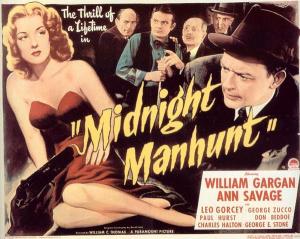 Ann Savage and William Gargan play competing newspaper reporters in this mercifully brief bottom-of-the-bill B mystery from Pine-Thomas Productions. Distributed by Paramount Pictures, Midnight Manhunt has the look and feel of a P.R.C. cheapie, right down to its minimal sets and poorly handled mixture of comedy and suspense.
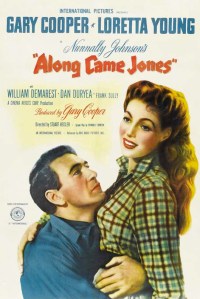 Along Came Jones is a silly little western that verges on being a spoof of the genre, but it’s worth seeing for a couple of reasons. Gary Cooper pokes fun at his stalwart image without devolving into parody, and the gender reversals in some of the action scenes are still surprising.
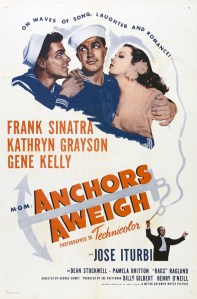 I don’t generally like musicals, but I loved Anchors Aweigh. It probably doesn’t hurt that I really like both Frank Sinatra and Gene Kelly, and this movie uses both of them to wonderful effect. Kelly’s dance sequences are all high points, and even Sinatra comports himself well in the one dance in which he has to match Kelly step-for-step. Although I can only imagine how many takes it took to get it right. Unlike today’s hyperkinetic editing styles, most of the dance sequences in Anchors Aweigh are done in what appear to be one take, or just a few at most.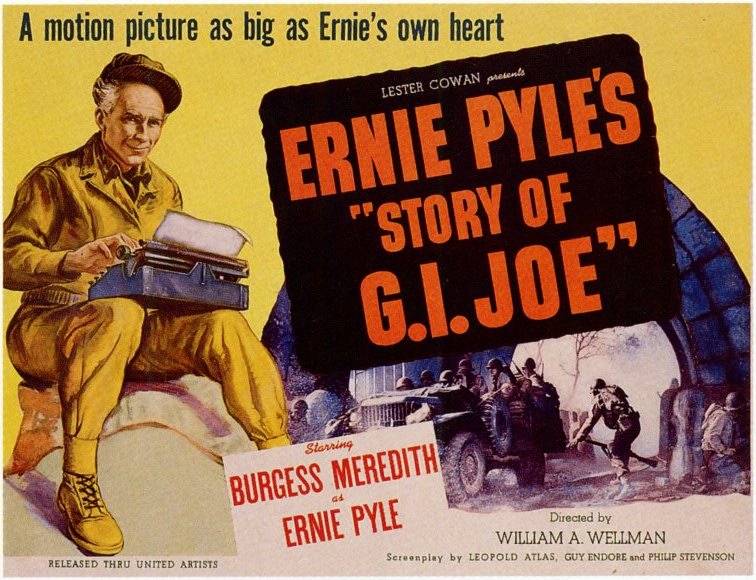
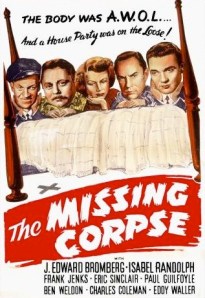 This movie is sort of like Weekend at Bernie’s, if the object in that film had been to keep Bernie’s body hidden and constantly on the move so no one could find it.
 Media tie-ins are nothing new. Radio’s Boston Blackie, a long-running syndicated show about a (mostly) reformed jewel thief and amateur sleuth, got its start as a series of short stories, then silent films, then talkies, before being adapted for radio. And big-screen adaptations of radio series were commonplace. The Whistler, The Great Gildersleeve, Fibber McGee & Molly, The Green Hornet, The Lone Ranger, and I Love a Mystery all led to multiple film adaptations, not to mention the many radio series that were adapted from other media, like dime novels or the daily comic strips, that went on to be films.
 OCD Viewer