Author Archives: Adam Lounsbery

Midnight Manhunt (July 27, 1945)

MidnightManhuntAnn Savage and William Gargan play competing newspaper reporters in this mercifully brief bottom-of-the-bill B mystery from Pine-Thomas Productions. Distributed by Paramount Pictures, Midnight Manhunt has the look and feel of a P.R.C. cheapie, right down to its minimal sets and poorly handled mixture of comedy and suspense.

The film begins promisingly, with the great George Zucco (playing a hitman named Jelke) shooting a man in a hotel room, then taking a cool quarter of a million in diamonds from the corpse’s inside jacket pocket. It’s a great sequence; wordless and thick with atmosphere (although the lack of any sound when Zucco fires his revolver is strange). Unfortunately, Zucco doesn’t show up again for awhile, and the film quickly settles into a series of shenanigans at a wax museum where Leo Gorcey works the night shift. Gorcey’s character and trademark malapropisms will both be familiar to anyone who saw him in any of the innumerable Dead End Kids/East Side Kids/Bowery Boys movies he appeared in. When the feisty girl reporter (Savage) who lives on the second floor of the wax museum discovers the body of the dead man, she recognizes him as an infamous gangster who had disappeared years earlier. Wanting the scoop for herself, she hides the body by setting it up in one of the wax museum’s displays. Gargan plays her ex-boyfriend and rival reporter. A lot transpires in the film’s short running time (an hour and four minutes), but none of it adds up to much. Savage and Gargan have good chemistry, and I would have rather the film just focused on their characters. Zucco is also good, but he doesn’t get much screen time.

Midnight Manhunt isn’t a terrible film, but it’s all over the place. It’s also really stagy and a lot of the humor is dated. If, however, lines like “I think he’s havin’ optical delusions” and “I figgered it out through a process of mental reduction” give you a chuckle, then it’s probably worth a look.

Along Came Jones (July 19, 1945)

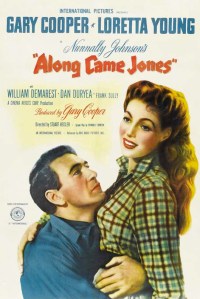
AlongCameJonesAlong Came Jones is a silly little western that verges on being a spoof of the genre, but it’s worth seeing for a couple of reasons. Gary Cooper pokes fun at his stalwart image without devolving into parody, and the gender reversals in some of the action scenes are still surprising.

Cooper plays a singing cowboy (sort of), named Melody Jones. This in itself is funny, because Cooper can barely sing. He’s halfway between a hum and a grumble in the few scenes when he’s called upon to croon a ditty. Along with his crotchety old sidekick, George Fury (played by William Demarest), Jones rolls into the town of Payneville, where he’s mistaken for vicious outlaw Monte Jarrad (played by vicious little squirt Dan Duryea), because his monogrammed saddle has the same initials, “M.J.” The only problem is, it’s not a charade he can keep up very long. Although Jones is tough enough, and can dish out haymakers with the best of them, he can’t handle a gun to save his life (which, by the end of the film, he will be called upon to do more than once). It’s not just that Jones can’t shoot straight, he literally can’t get his revolver out of its holster without it flying out of his hand. At one point, the real Monte Jarrad’s girlfriend, Cherry de Longpre (played by Loretta Young), calls Jones a “butterfingered gun juggler,” and it’s an apt term of derision.

The interesting thing about this film is that Jones never gets any better at handling a gun. Yes, he eventually manages to hold it steady, but he still can’t hit the broad side of a barn. Cherry, on the other hand, is a crack shot who could give Annie Oakley a run for her money. In the climactic showdown, she becomes a distaff John Wayne in The Man Who Shot Liberty Valance (1962), and the effect is stunning. Nevertheless, Cooper never comes off as unmanly, especially since he’s willing to stand up to overwhelming odds with absolutely no shooting skills whatsoever. And he twice kisses Young in what has to be the most macho way I’ve ever seen in a movie. I don’t want to give anything away. Just see it.

Anchors Aweigh (July 14, 1945)

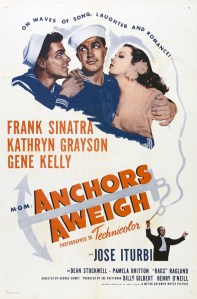
AnchorsAweighI don’t generally like musicals, but I loved Anchors Aweigh. It probably doesn’t hurt that I really like both Frank Sinatra and Gene Kelly, and this movie uses both of them to wonderful effect. Kelly’s dance sequences are all high points, and even Sinatra comports himself well in the one dance in which he has to match Kelly step-for-step. Although I can only imagine how many takes it took to get it right. Unlike today’s hyperkinetic editing styles, most of the dance sequences in Anchors Aweigh are done in what appear to be one take, or just a few at most.

In Anchors Aweigh, Sinatra and Kelly play sailors who are granted a four-day shore leave in Los Angeles due to extraordinary bravery. Kelly is a ladykiller with a woman in every port, while Sinatra is a dope when it comes to love. Kelly just wants to hook up with his beloved Lola, while Sinatra just wants a girl … any girl. Their amorous plans hit a snag, however, when they’re charged with the care of a Navy-worshipping runaway played by the very cute child actor Dean Stockwell. (Viewers familiar with Stockwell’s film and television work as an adult might wonder while watching this movie … what the hell happened to the guy?) Sinatra falls for the boy’s young aunt (Kathryn Grayson), while Kelly find himself drawn to her as well, which he resists, since his buddy has already spoken for her. But the draw is mutual. What’s a guy to do? Not to worry. With the help of orchestra leader José Iturbi (playing himself), everything will turn out O.K. in the end.

Sinatra gets top billing, even though Kelly is clearly the more seasoned performer. Sinatra may have been one of the most popular crooners in the country, but this was only his third real acting role on screen. At points he looks like a kid in a high school play who doesn’t know what to do with his hands. If you’d told anyone in 1945 that he’d win an Academy Award for Best Supporting Actor just eight years later they probably wouldn’t have believed you. But his natural charisma makes up for a lot. Iturbi is clearly not a professional actor, either, but the few scenes in which he has to perform (and not just conduct), he’s charming and fun to watch. He has a wonderful sense of comic timing, and projects warmth and empathy when he needs to.

Clocking in at two hours and 20 minutes, Anchors Aweigh is the kind of candy-colored fantasy that Hollywood just doesn’t make anymore. Everything but the kitchen sink is thrown in … there’s even a fantasy dance sequence in which Kelly dances in a cartoon world with an animated mouse (Jerry of Tom & Jerry fame). Its Bollywood-sized ambitions might turn off some modern viewers, but I thought it was great. At no point was I bored. I was entranced and delighted throughout.

Ernie Pyle’s “Story of G.I. Joe” (July 13, 1945)

StoryGIJoe
The Story of G.I. Joe (1945)
Directed by William A. Wellman
United Artists

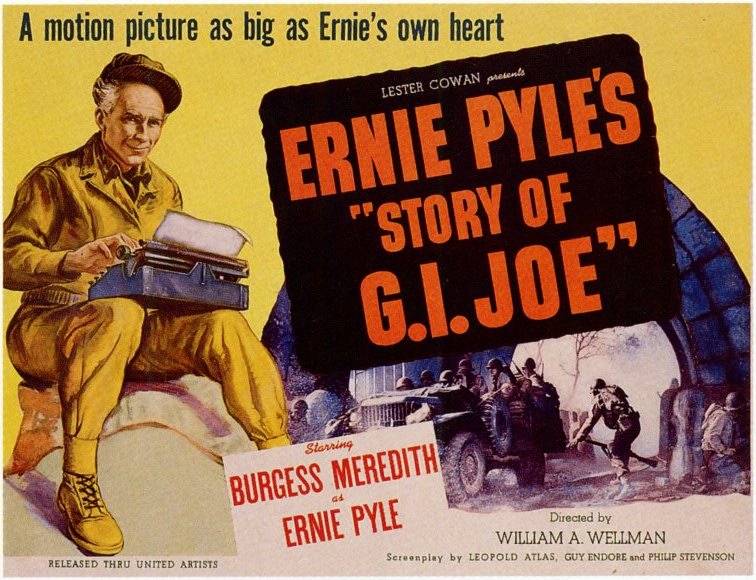
Ernie Pyle was a journalist for the Scripps-Howard newspaper chain. Long before the term “embedded journalist” entered the national consciousness, Pyle traveled with servicemen, writing about the war from their perspective. He had a conversational writing style, and attracted a huge following during World War II. He won the Pulitzer Prize in 1944 for his work as a war correspondent. He was killed in combat in 1945.

William A. Wellman’s film Ernie Pyle’s “Story of G.I. Joe” stars Burgess Meredith as Pyle, and co-stars Robert Mitchum as Lt. (later Capt.) Bill Walker and Freddie Steele as Sgt. Steve Warnicki.

Gen. Dwight D. Eisenhower said it was the finest war film he had ever seen, and I tend to agree with him. Wellman is a superior craftsman. Not only is The Story of G.I. Joe one of the best war movies I’ve seen, its gripping scenes of combat have yet to be improved upon. For all the credit that Saving Private Ryan (1998) got for ushering in a new era of realism to the World War II film, watching this film reminded me that the horrors of war don’t necessarily need to be depicted in gruesome detail to be affecting. The first combat scene comes early in the film, when a German plane attacks the company on the ground, strafing them as they return fire with mounted machine guns and BARs. After the dust has cleared, there’s a low-angle shot of the men looking down, dejected and stunned, followed by Walker brusquely saying, “All right men, in the truck. Come on, make it snappy, the medics’ll take care of him.” As the men disperse, he says to Pyle, “First death’s always the worst.” The corpse is never even shown on the screen, but the impact is huge.

The battle scenes in the film are gripping. Walker and his men fight amidst bombed-out rubble, in close quarters, in the destroyed towns and cities of Italy. But the focus of the film is on the day-to-day lives of the men in the infantry. For most of the film, Warnicki carries a phonograph recording of his baby boy’s voice that he received in the mail, but he can’t ever seem to find a record player. The living conditions of infantrymen are unglamorous. The men are nearly always unshaven, wet, filthy, tired, and underfed. Mud, rain, and fatigue are a few of the running themes. Pvt. Robert “Wingless” Murphy (played by Jack Reilly) is constantly falling asleep on his feet. His sleepiness provides a few comic moments, but not without some sadness. When he marries a WAC and they go the “bridal suite” (a truck), he passes out immediately.

Meredith is the first actor billed, and a large part of the film is about Pyle’s relationship with the men he writes about. When a G.I. asks Pyle his age, he says, “Forty-three,” and crosses himself. The G.I. responds, “I’m twenty-six. If I knew I’d live to be forty-three, I wouldn’t have a worry in the world.” Pyle says, “Oh yes you would. You’d be just like me. Worrying about whether you’d get to be forty-four.” Meredith was actually 37 years old when he made this picture, but with his dyed white hair and bald pate, he looks older. He has a natural rapport with the men, but he doesn’t try too hard to be anyone’s buddy. In fact, in most scenes, he’s almost aloof. He’s also more soft-spoken than the real Pyle, who had a blunt, straightforward style, at least in the single piece of newsreel footage I’ve seen of him.

Pyle’s ordinariness is stressed. He learns that he has been awarded the Pulitzer from a couple of servicemen during mail call. He shrugs off their praise, then sits down at his typewriter to eulogize a man who has just died, and whom he thought of as a friend. “He was just a plain Hoosier boy,” Pyle writes. “You couldn’t imagine him ever killing anybody.”

I liked Mitchum in his supporting role in the 1944 film Thirty Seconds Over Tokyo (another excellent World War II film), but he’s even better here. The Story of G.I. Joe received four Oscar nominations, including one for Mitchum for best supporting actor. It was the only Academy Award nomination he would ever receive. He never won an Oscar. In The Story of G.I. Joe he displays effortless star power, even though the film is not a star vehicle for him.

Director Wellman was a fighter pilot in World War I, where he earned the nickname “Wild Bill.” Like many pilots, he had no use for the infantry, and originally had no interest in making this film. Producer Lester Cowan went to great lengths to cajole Wellman into being his director, but Wellman only agreed to take on the job after meeting Pyle and spending time with him.

An aura of tragedy and sadness pervades the film. Pyle acted as technical advisor on the film. The extras were all American combat veterans of the campaigns in North Africa, Sicily, and Italy. Most of them were in the process of being transferred from active duty in the war in Europe to the war in the Pacific. And many of them were killed fighting in Okinawa, the battle in which Pyle himself was killed.

The Missing Corpse (June 1, 1945)

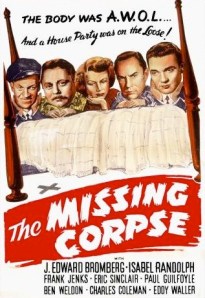
MissingCorpseThis movie is sort of like Weekend at Bernie’s, if the object in that film had been to keep Bernie’s body hidden and constantly on the move so no one could find it.

J. Edward Bromberg, a hard-working character actor, gets a rare chance to star in a film. He plays an upstanding newspaper publisher named Henry Kruger who threatens rival publisher Andy McDonald (played by Paul Guilfoyle) after McDonald splashes a tawdry story about Kruger’s daughter all over the front page of his daily paper. McDonald turns out to also be a blackmail magnate, and when one of his victims rubs him out, his body winds up in the trunk of Kruger’s car. Most of the film involves the increasingly perplexed Kruger’s attempts to deep-six the body so he won’t be accused of a crime he didn’t commit. The only problem is, the body won’t stay in one place for very long. Who’s moving it? And why?

The Missing Corpse is a fun mix of comedy and suspense. Like most of the output from P.R.C., it’s a quick, low-budget diversion, and little more, but it’s still a light-hearted and fun hour and one minute. As far as MacGuffins go, a dead body is a pretty good one, and P.R.C. certainly released worse films into theaters in the ’40s.

The Frozen Ghost (June 1, 1945)

FrozenGhostMedia tie-ins are nothing new. Radio’s Boston Blackie, a long-running syndicated show about a (mostly) reformed jewel thief and amateur sleuth, got its start as a series of short stories, then silent films, then talkies, before being adapted for radio. And big-screen adaptations of radio series were commonplace. The Whistler, The Great Gildersleeve, Fibber McGee & Molly, The Green Hornet, The Lone Ranger, and I Love a Mystery all led to multiple film adaptations, not to mention the many radio series that were adapted from other media, like dime novels or the daily comic strips, that went on to be films.

The radio drama Inner Sanctum Mysteries, which was produced by Himan Brown, premiered in 1941 and ran for more than 10 years. An anthology thriller program, its scripts weren’t quite as clever as The Whistler, and it didn’t regularly feature A-list Hollywood talent like Suspense, but it was an effective show. While rarely out-and-out supernatural, it tended more toward the macabre than other programs of its type. Its jealous husbands, scheming wives, and escaped lunatics were flesh and blood, but its settings — crumbling churchyards, decrepit mansions, and dark and stormy nights — could have done double duty in horror stories.

One of the things that made the show stand out was its host, Raymond Edward Johnson (who simply went by the name “Raymond” on the show), and the memorable sound effect of a creaking door that opened each program. Raymond prefigured TV horror hosts like Zacherley, Elvira, and Ghoulardi with his macabre, tongue-in-cheek humor. A typical program began like this:

“Good evening, friends. This is your host, Raymond. Welcome to the inner sanctum. Come in, won’t you? What are you staring at? The walls? Well, you know that old saying about walls having ears? Well, these walls have eyes, and a nice assortment of fingers and hands. One of them has a heart, but you can’t beat that. Don’t mind me, friends, in my old age I’m getting to be a bit of a gore.”

Raymond’s mocking delivery made it clear that none of it was meant to be taken seriously. Part of the pleasure of listening to the programs in 1945 and 1946, when Lipton Tea was the sponsor, was listening to the host’s exchanges with Mary, the Lipton Tea and Lipton Soup girl, whose sunny disposition he frequently ridiculed, and who in turn expressed shock and dismay at the gloomy goings-on the show dramatized. (When Raymond left the show in May 1945 to serve in the Army, he was replaced with Paul McGrath, who never stated his name. The format of the show and his relationship with Mary, however, were pretty much the same as Raymond’s.)

From 1943 to 1945, Universal Pictures released six “Inner Sanctum Mysteries.” They were all low-budget B pictures starring Lon Chaney, Jr., all clocking in at under 70 minutes, each designed to be the second half of a double bill. Calling Dr. Death (1943) was followed by Weird Woman (1944), Dead Man’s Eyes (1944), and The Frozen Ghost. All of these films are entertaining (especially Weird Woman), but compared with the radio show, they’re missing some of the ghoulish fun. They’re always introduced the same way … not by Raymond or someone like him, but by a head floating in a crystal ball that speaks as though its owner is on a heavy dose of Thorazine.

The Frozen Ghost features Chaney as a famous mentalist who watches a man die during his act. He believes he caused the man’s death with his hypnotic gaze, and goes into seclusion to a wax museum, of all places. When a woman dies after a hypnosis session there, he’s convinced he’s a psychic killer, but then her body disappears. What gives? Unlike the first three films in the Inner Sanctum series, The Frozen Ghost is a bit of a mess, but scream queen Evelyn Ankers is always a welcome sight, and at one hour and one minute, the picture doesn’t really overstay its welcome.

Chaney was born Creighton Chaney, but started being billed as “Lon Chaney, Jr.” in 1935. As an actor, he is the antithesis of his father, who was one of the most brilliant chameleons in film history, and one of the finest actors of the silent era. Chaney, Jr., on the other hand, acted exactly the same in every movie, like a hulking man-child who appeared to be staggeringly hungover in every scene. I enjoy plenty of films he appears in, but he’s not a great actor. To its credit, the Inner Sanctum series makes good use of him. In the four films I’ve seen so far, he always plays a character who is at the mercy of forces outside of his control, which requires him to appear bewildered, upset, and terrified, which he’s pretty good at doing.
Back to Bataan (May 31, 1945)

BackBataan
Back to Bataan (1945)
Directed by Edward Dmytryk
RKO Radio Pictures

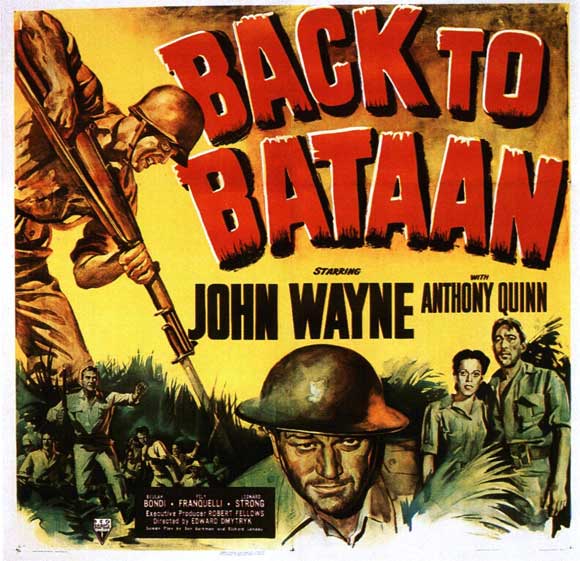
Yes, Back to Bataan is flag-waving agitprop. Yes, it features Anthony Quinn as a Filipino. But under the direction of Edward Dmytryk it’s all done really well. There are a number of gripping battle sequences, and John Wayne in his late 30s was still a lean, mean, ass-kicking machine. The human drama is a little stilted and the politics are simplistic, but when the bullets are flying, Back to Bataan delivers the goods.

The film begins with a battle sequence that depicts the raid at Cabanatuan, a Japanese POW camp, that took place on January 30, 1945. At the time the film was made, the raid was a current event, and was one of the big Allied successes in the Pacific theater. (Filipino guerrillas, Alamo Scouts, and US Army Rangers liberated more than 500 prisoners of war.) After the big opening battle, the film moves back in time to 1942, and tells the story leading up to the raid and the freeing of the POWs. Col. Joseph Madden (Wayne), voluntarily stays in the Philippines after Gen. Douglas MacArthur and his armies pull out. Madden teams up with Filipino guerrilla forces, training them and organizing them. One of his officers, Capt. Andrés Bonifácio (Quinn) is struggling to live up to the reputation of his grandfather, who was a national hero and liberator of the Philippines from Spanish colonial rule. And if that weren’t enough, Capt. Bonifácio’s former fiancée, Dalisay Delgado (Fely Franquelli) has apparently turned traitor, since she now makes regular radio broadcasts radio for the Japanese. Every time he’s near a radio, Capt. Bonifácio has to hear his sweetheart’s mellifluous voice spouting ugly Axis propaganda. Madden, of course, knows that Delgado is actually passing code through these broadcasts, but he’s ordered by his superiors not to tell Bonifácio, so Madden must use all of his skills as a commander to whip Bonifácio into shape and make him a leader of men, no matter how much Bonifácio’s heart may be breaking.

There are conflicting reports of how well Wayne got along with director Dmytryk and screenwriter Ben Barzman, both of whom had communist views. According to Barzman’s wife, they had a humorously antagonistic relationship due to their very different politic views, jokingly calling each other “goddamned communist” and “fascist.” Apparently Barzman and Dmytryk also enjoyed tormenting Wayne, who refused to use a stunt double, by devising scenes that would test his limits. Whether or not this was a friendly game, the results are sometimes stunning. There’s a scene in which Wayne is hugging the ground. A shell explodes right next to him, and his body is flung high into the air and dropped at least 20 feet away. If you rewatch the scene, you can see the wires attached to Wayne’s body, but during the first viewing, when you’re not expecting it, it’s a stunning effect.

The film ends with triumphant footage of some of the real men who were prisoners of war at Cabanatuan. They march together, filmed at low angles, while their names, ranks, and cities of origin are displayed on the screen. After seeing so many Hollywood actors playing soldiers in World War II, it’s interesting to see some of the real men who served. Some of them are handsome enough to have played in the movies. Some aren’t. Almost all of them look relieved and happy, but close to being emaciated. All of them, that is, except for one guy from Chicago who’s really fat and looked deliriously happy. I wonder what his secret was.

The Body Snatcher (May 25, 1945)

BodySnatcher
The Body Snatcher (1945)
Directed by Robert Wise
RKO Radio Pictures

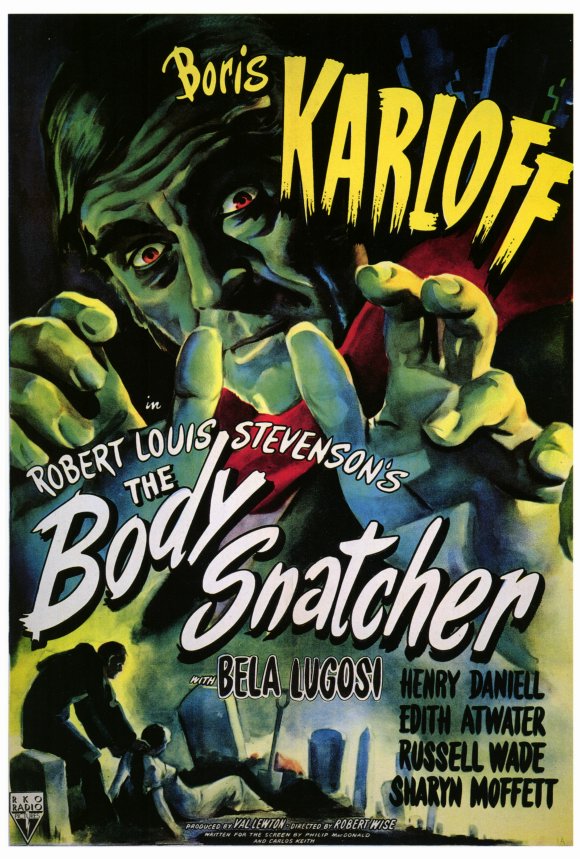
The Body Snatcher is based on Scottish author Robert Louis Stevenson’s short story of the same name, which was first published in December 1884. Stevenson’s story was inspired by a crime well-known to Scots to this day; the Burke and Hare murders. Burke and Hare were two Irish immigrants who sold corpses to Dr. Robert Knox for use in his dissection experiments in 1827 and 1828, and were symptomatic of a time when scientific curiosity was outpacing social and religious squeamishness. Prior to the Anatomy Act 1832, the only bodies that doctors could legally dissect were those of executed criminals. There were simply not enough executed criminals to fill the needs of medical schools, however, especially with the decline in executions in the early 19th century, so doctors and anatomy students frequently turned to sellers of corpses on the black market. Most of these sellers simply dug up freshly buried bodies, but Burke and Hare went an extra step, saving time by smothering people to death and selling their bodies. In the film, set in Edinburgh in 1831, the “Dr. K.” of the story becomes Dr. Wolfe MacFarlane (played by Henry Daniell), a respected surgeon who relies on the ghoulish cabman John Gray (played by Boris Karloff) to provide him with the corpses he needs to experiment on before he can cure crippling ailments. In a typical move for a film of this time, there is also a blandly handsome young doctor (played by Russell Wade), who adds little to the proceedings, merely existing to show the idealistic, humane, and optimistic face of medicine. The meat of the film is the twisted and symbiotic relationship between Gray and Dr. MacFarlane, whom Gray constantly calls “Toddy,” an old nickname that the doctor hates.

The Body Snatcher was produced by Val Lewton, who is one of the few producers to have survived the advent of the Auteur theory and emerge better remembered than many of the men who directed his films. A novelist, screenwriter, and producer, Lewton was a talented purveyor of horror and dread. He methods were suggestion and atmosphere, and he avoided cheap shocks and grotesque makeup. His monsters didn’t look like monsters, and the terror his films conveyed was largely psychological. And when horrific events did occur in his films, they did so mostly off screen. They delivered chills through the power of suggestion, and occasionally a stream of blood flowing under a door.

Prior to making The Body Snatcher, which was directed by Robert Wise, Lewton had a string of low-budget horror hits for RKO, all of which are currently available on DVD and are considered minor classics; Cat People (1942, directed by Jacques Tourneur), I Walked With a Zombie (1943, dir. Jacques Tourneur), The Leopard Man (1943, dir. Jacques Tourneur), The Seventh Victim (1943, dir. Mark Robson), The Ghost Ship (1943, dir. Mark Robson), and The Curse of the Cat People (1944, dir. Gunther von Fritsch and Robert Wise), which was originally supposed to be called Amy and Her Friend, and has only a tangential connection to the original Cat People. He had also produced two non-horror films, Mademoiselle Fifi (1944, dir. Robert Wise) and Youth Runs Wild (1944, dir. Mark Robson).

Lewton was under a few strict edicts from RKO when making his famous horror films; each had to come in at under 80 minutes long, each had to cost no more than $150,000, and the title of each would be provided by Lewton’s supervisors, which could explain why an intelligent, understated, and artful film like I Walked With a Zombie has the lurid title that it does. After the success of Cat People, however, which was made for $134,000 and grossed nearly $4 million, the studio interfered little with Lewton’s scripts and productions, generally allowing him to make exactly the kind of picture he wanted, as long as he brought it in under budget. I’ve felt for a long time that Lewton, who was a mostly unsuccessful novelist and journalist before he got into the movie business, felt as if he was better than the cheapjack films he produced. He may have been a master of the power of suggestion, but sometimes his films just feel too removed from the world of horror that they depict. I’m not saying that Lewton’s pictures would be better if they were awash in blood and guts, but sometimes they feel clinical and distant.

Along with I Walked With a Zombie, The Body Snatcher is one of my favorite Lewton pictures, due in no small part to Karloff’s brilliant performance. While the film itself can be stagy, Karloff’s performance is not. Each line he speaks drips with malevolence, while still showing the twisted humanity hidden somewhere deep inside. Gray is a man past redemption. One of the first things he does in the film is use a shovel to kill a little dog who is guarding its young master’s grave. That Karloff can create a somewhat sympathetic character from what he’s given is nothing short of phenomenal. I can think of few actors who are able to do what Karloff does with monstrous characters. (Anthony Hopkins in The Silence of the Lambs is the only person who immediately springs to mind.) Part of the success of Karloff’s performance lies in its nuances. He interacts with nearly every character in the film–Dr. MacFarlane, his young assistant, a little crippled girl (played by Sharyn Moffett), a pathetic servant named Joseph (played by Bela Lugosi)–and is a subtly different person in each scene.

The Clock (May 25, 1945)

TheClockThe Clock is the first film Judy Garland made in which she did not sing. She had specifically requested to star in a dramatic role, since the strenuous shooting schedules of lavish musicals were beginning to fray her nerves. Producer Arthur Freed approached her with the script for The Clock (also known as Under the Clock), which was based on an unpublished short story by Paul and Pauline Gallico. Originally Fred Zinnemann was set to direct, but Garland felt they had no chemistry, and she was disappointed by early footage. Zinnemann was removed from the project, and she requested that Vincente Minnelli be brought in to direct.
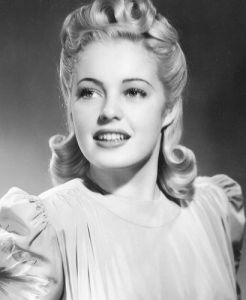
The Clock is the second film that Minnelli directed that starred Garland. The first was Meet Me in St. Louis (1944), which is one of the great American musicals, a big, Technicolor production with memorable songs and fine performances. It’s worth seeing, even if you’re not crazy about musicals. Minnelli and Garland were involved romantically during the filming of Meet Me in St. Louis, and they were married on June 15, 1945, shortly after The Clock was released.

The Clock seems like a deliberate attempt to make a film as different from Meet Me in St. Louis as Minnelli was capable of making. Filmed in crisp, luminous black and white, The Clock is an intimate story of two people. Cpl. Joe Allen (Robert Walker) is on leave in New York City for the weekend. While trying to find his way around Pennsylvania Station, he meets Alice Mayberry (Garland), a Manhattan “girl next door” who works in an office and isn’t initially thrilled that Joe takes in interest in her. She breaks her heel and he offers to help her, but he’s so pushy that it’s a bit of a turn-off. He refuses to take “no” for an answer, following her onto a bus, questioning her incessantly, and attempting to arrange to see her again. He also does it in such a naïve, corn-pone manner that it’s obvious that a polite girl like Alice would have a really hard time just telling him to shove off. Part of the problem, for me at least, is that Walker just doesn’t have the necessary charisma to pull off the “aw shucks” persona the script calls for and get away with it. In any case, after some indecision (and after ignoring her roommate’s advice that the young serviceman she met is “just looking for a pick-up”), she goes back to the Astor Hotel to meet him under the clock where they first met. They spend the entire night together, exploring New York City, and even end up helping a milkman (James Gleason) make his appointed rounds after a drunk (Keenan Wynn) punches him in the face, partially blinding him. Over the course of the night, they fall in love, but are separated on a busy subway the next morning. How will they ever find each other in a city of seven million people? (I don’t want to give anything away, but the way they find each other again won’t come as a surprise to anyone who’s been paying attention.) After they reconnect, Joe asks Alice to marry him, and she accepts his proposal, but they have to run through a mess of red tape to get the necessary documentation to get married immediately, before Joe has to ship out again.

The Clock has a lot to recommend it. Garland looks beautiful, and her performance is natural and engaging. Walker only has one mode, “wanting Alice,” but Garland wonderfully expresses confusion, excitement, and ambivalence on her path to falling in love. Also, the film does a good job of playing through the stages of love, from initial infatuation to full-blown romantic love, marriage, and even the quiet vicissitude of the “morning after.” The film looks fantastic. Minnelli recreated New York City on the MGM backlots in Culver City, California, mixing sets with stock footage, but I never realized this while watching the movie, and I live in New York. He reportedly spend almost $70,000 recreating Penn Station, and it certainly doesn’t look like a set. (The original Penn Station was torn down before I was born so I can’t say if it’s perfectly accurate, but it certainly fooled me.) I liked The Clock, and would recommend it to anyone who likes old movies, especially anyone who loves tales of wartime romance, but a more interesting actor than Walker in the lead role might have elevated it to a truly great film.

This is a love story, but it’s a melancholy one, especially during its second half. I’m not sure if the sense of sadness that pervades the film is by design, or is due to the fact that both stars were plagued with personal problems throughout filming. Garland became increasingly addicted to the prescription drugs the studio gave her to control her weight and perk her up, and Walker had recently found out that his wife, actress Jennifer Jones, had been cheating on him with producer David O. Selznick and wanted a divorce. Reportedly, Garland would often find Walker drunk in L.A. bars during filming and she would help him sober up during the night so he could appear in front of the cameras the next day.

The Lady Confesses (May 16, 1945)

HughesMary Beth Hughes appeared in dozens of films from 1939 onward as a second- or third-billed actress (including films in the Charlie Chan, Cisco Kid, and Michael Shayne series), but in director Sam Newfield’s P.R.C. production The Lady Confesses she gets to strut her limited but charming stuff in a lead role. A natural redhead, Hughes usually appeared onscreen as a platinum blonde. Her round cheeks, big eyes, and moxie made up for what she lacked as a thespian.

When The Lady Confesses begins, Vicki McGuire (Hughes) receives a visit from a woman named Norma (Barbara Slater), who turns out to be the wife of Vicki’s fiancé, Larry Craig (Hugh Beaumont). Norma has been missing for seven years and was presumed dead. Nasty Norma tells little sweetheart Vicki that she won’t let anyone marry her Larry, even though she doesn’t care for him one bit. Vicki runs off to find Larry, who has been stumbling around a nightclub, three sheets to the wind, generally making an ass of himself. When she finds him and wakes him up, they go to Norma’s apartment to sort things out with her. When they arrive, however, the place is lousy with cops, and Norma lies dead, strangled with a piece of wire. To convince the police of his innocence, Larry takes them to the club where he had been dead drunk for the past several hours. Everyone there admits having seen him, except for the club owner, the shady Lucky Brandon (Edmund MacDonald), who denies having seen Larry, even though Larry had talked to him and asked him for permission to sleep it off in his office. Later, under police questioning, Brandon admits he knew the dead woman, and that she had lent him $10,000 to start up the club, and had recently returned to collect interest on the loan. Suspicious of Brandon, Vicki goes undercover in his club. She waits tables, sings a few songs, and even begins to feel herself falling under his dangerous sway.

The Lady Confesses is an average bottom-of-the-bill noir, but it moves at a nice clip and Hughes is cute. Also, you get to see Beaumont (who would go on to play everyone’s favorite sitcom dad, Ward Cleaver) act totally wasted for the first 10 minutes, which is fun.

A note on the title of the film; contextually it makes no sense. Both Ladies of the Night and Undercover Girl were considered. The first might have implied that the film was about prostitutes. The second actually would have been fitting. But I suppose the point is to get asses in the seats, not to give people an accurate idea of what they’re going to be seeing, especially when it’s a Poverty Row production.