Author Archives: Adam Lounsbery

The Southerner (April 30, 1945)

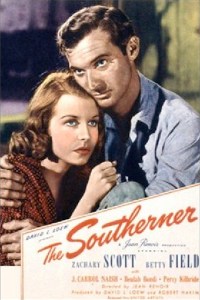
SouthernerFrench director Jean Renoir directed this adaptation of George Sessions Perry’s novel Hold Autumn in Your Hand, which won the first National Book Award in 1941. (The novel was adapted by screenwriter Hugo Butler, with uncredited contributions from Nunnally Johnson and William Faulkner.)

Zachary Scott, in a role originally intended for Joel McCrea, plays a Texas cotton picker named Sam Tucker who decides he doesn’t want to be a sharecropper anymore. He wants to grow his own cotton, harvest it, and be responsible for his own destiny. So he buys a piece of land and a ramshackle little house, and moves his wife (played by Betty Field), his children, and their crotchety grandmother onto it. Once there, the Tuckers must valiantly struggle against nature, disease, and their fellow humans to make a go of it.

The Southerner received three Academy Award nominations, including one for best director. Renoir didn’t win, but he was named best director by the National Board of Review, which also named The Southerner the third best film of 1945, after the World War II documentary The True Glory and Billy Wilder’s The Lost Weekend (which won the Oscar for best picture). Despite all these accolades, I was lukewarm about this picture. Scott is good in his role. His acting is understated, and he embodies “quiet dignity.” J. Carrol Naish is also very good as the villain of the piece, Tucker’s neighbor who seeks to destroy Tucker merely because of his inchoate hatred for anyone who tries to rise from his station in life. In fact, all the actors are good, except for perhaps Beulah Bondi, who hams it up a bit as Granny, a prickly pear if ever there was one. (Also, it might be hard for modern viewers to see her sitting in her rocking chair in the bed of a slow-moving pickup truck along with all the family’s worldly possessions and not think of The Beverly Hillbillies, which is unfortunate, since this film strives to be a realistic human drama.) My tepid reaction to the film is not related to any of the particulars, but rather to the overall feeling I had at the end. I just felt as if something was missing. Some essential component that would make me care about the characters and their situation more than I did.

Renoir is today best known for his French-language films like Grand Illusion (1937) and The Rules of the Game (1939), but he made a few English-language films besides this one. The first was Swamp Water (1941), which, like The Southerner, is about simple rural Americans. Perhaps my cool reaction to this film was due to the fact that I don’t find simple people as compelling as complicated people. Or maybe it’s just because the print I saw was kind of crummy. If the visual beauty of the countryside were allowed to shine through, maybe I would have liked it more. I’ve read that Renoir considered this his favorite American-made film. And, as I mentioned above, it was very successful with critics. So if this sounds like the kind of film you enjoy, then by all means you should see it. Meanwhile, I’ll be next door, watching a late ’40s film noir set in a big city about paranoid, sweaty people who aren’t quietly dignified in the slightest.

Tarzan and the Amazons (April 29, 1945)

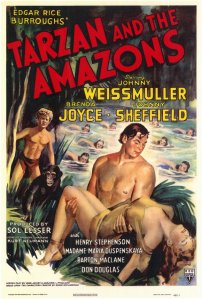
TarzanAmazonsOn August 8, 1944, The Hollywood Reporter announced that director Kurt Neumann was looking for 48 athletic, six-feet tall women to portray Amazons in the next Tarzan movie.

He found ’em. Tarzan and the Amazons is the ninth film that stars Johnny Weissmuller as Tarzan. While it’s far from the best of the series, the Amazons really are something else. If you like sexy, tough women who can kick a little ass, this is the movie for you. Sure, there are a few butterfaces in the bunch, but mostly it’s like watching dozens of stunt doubles for Wonder Woman stand around looking sultry before they break into action. And I don’t think the group’s collective resemblance to Wonder Woman is accidental.

Wonder Woman made her debut in All Star Comics in December 1941, and by 1942 was a well-established character. Wonder Woman may have been what most Americans thought of in 1945 when they thought of an “Amazon,” since the metal tiaras, metal wrist- and armbands, gladiator sandals, and above-the-knee skirts look as if they owe more to DC Comics than they do to classical Hellenic representations of Amazon warriors. (Although the warrior women in Tarzan and the Amazons are more partial to leopard print than Wonder Woman ever was.)

Apparently producer Sol Lesser’s previous Tarzan film, Tarzan’s Desert Mystery (1943), had been unpopular with both critics and audiences, so he brought back the character of Jane, who had been absent from the last few Tarzan movies. The dark-haired, petite Maureen O’Sullivan, who had played Jane opposite Weissmuller in his first six Tarzan films, did not return for the role. Instead, Jane was played by Brenda Joyce, a sexy blonde and former model who looks nothing like O’Sullivan. (It’s explained in this film that Jane was performing nursing work in England during World War II.) Joyce would go on to play Jane in four more Tarzan movies, three with Weissmuller and one with Lex Barker. Also, the dependable Johnny Sheffield makes his sixth appearance as “Boy.” I think the introduction of Boy in the fourth Weissmuller Tarzan film, Tarzan Finds a Son (1939) marked a downturn in the series, but his scenes with Tarzan’s chimp companion Cheeta are pretty cute. He also can handle a bow and arrow, and when he dives into the water, it looks as if he’s been taking a few lessons from Weissmuller, who was an Olympic swimming champion.

The plot of Tarzan and the Amazons kicks into gear when an Amazon hunter named Athena (played by Shirley O’Hara) is attacked by a panther. Tarzan saves her, but in the course of the attack one of her golden bracelets falls off. Cheeta finds it and gives it to Jane as a gift. A group of explorers see the bracelet and convince Boy to lead them to the secret world of the Amazons. A child raised by Tarzan really should know better, but I suppose there wouldn’t be a movie here if Boy didn’t do something dopey. Tarzan gets to show off his sage side, however, when Boy asks him why he refuses to lead the scientists and explorers to the Amazons’ land himself. “Not good for man to look straight into sun,” Tarzan says. “What’s the sun got to do with it?” Boy asks, to which Tarzan responds, “Sun like gold. Too much sun make people blind.” So perhaps Boy’s actions are not so much dopey as they are an attempt to defy his adoptive father and his raised-by-apes-but-strangely-Confucian wisdom.

The inevitable violent clash between cultures is done well, even though the RKO Tarzan pictures never had the budgets of the earlier and more prestigious MGM productions. Also, if you watch carefully, you’ll see the same few Amazons firing arrows in shot after shot, since apparently only a few of the towering “glamazons” cast by the producers could convincingly handle a bow and arrows.

Weissmuller wasn’t the first actor to play Tarzan, but he was by far the most successful and may still be the most well-known. By 1945, however, he was no longer the trim, leonine lord of the jungle seen in Tarzan the Ape Man (1932) and Tarzan and His Mate (1934). If you’ve never seen Weissmuller in action, those two are the ones to see. Aside from the fact that they’re great, albeit dated, adventure pictures, watched in succession the two films offer the pleasure of seeing O’Sullivan’s Jane transform from a prim, fully clothed Englishwoman into a scantily clad lover of the jungle god, living with him in the treetops, swinging from vines, and swimming in the nude. In fact, Tarzan and His Mate would be the last film in which O’Sullivan appeared in such states of undress. By the third Weissmuller film, Tarzan Escapes! (1936), O’Sullivan’s skimpy two-piece costume became a more concealing one-piece outfit, and she even started wearing shoes. By the fourth film in the series, the two adopted a son and lived together in a jungle tree house as a family unit, which satisfied bourgeois sensibilities, but wasn’t nearly as sexy or exciting as when it was just the two of them, fighting wild animals and bad guys in between outdoor lovemaking sessions.

Blood on the Sun (April 26, 1945)

BloodSunJames Cagney made a big splash in William A. Wellman’s The Public Enemy (1931). It was his first starring role. Some people claim that when Cagney first walked on screen in that picture, it was the beginning of “modern acting.” Whether or not you believe that claim, there’s no denying the impact Cagney had on Hollywood, especially gangster films. The scene in which he shoves a grapefruit half into Mae Clarke’s face is iconic. Late in his life, Cagney claimed that people still sent grapefruits to his table in restaurants, with a wink and a nod. The Public Enemy ushered in a new era of onscreen violence, and an icon was born.

Cagney would go on to play many criminals, gangsters, and con men, in films like Smart Money (1931), Blonde Crazy (1931), Hard to Handle (1933), Picture Snatcher (1933), The Mayor of Hell (1933), Lady Killer (1933), He Was Her Man (1934), Angels With Dirty Faces (1938), Each Dawn I Die (1939), and The Roaring Twenties (1939). He was so good in these roles that when a lot of people hear the name “Jimmy Cagney,” they can only think of a sneering mug with a gat clenched in his fist and a cigarette dangling from his lower lip. But Cagney was a versatile actor. He also played cops, G-men, servicemen, and comedic roles, as well as singing and dancing in musicals. In fact, the only Academy Award he ever won was for his role in Michael Curtiz’s Yankee Doodle Dandy (1942), a drama and musical that told the life of George M. Cohan.

I think Cagney is a great actor with a unique style and personality. Anything he appears in is worth watching. Blood on the Sun was directed by Frank Lloyd, a Hollywood veteran who’d been making pictures since the silent era. It’s a wartime potboiler with a dubious MacGuffin; the Tanaka Memorial, an alleged strategic document from 1927 in which Prime Minister Baron Tanaka Giichi created for Emperor Showa a strategy to take over the world. It is believed by many historians to have been a forgery. In the ’30s and ’40s, however, the document was widely accepted as true. It was mentioned in Frank Capra’s agitprop documentary series, Why We Fight, and translations were published in Chinese and American periodicals. Of course, one reason why it was widely regarded to be an actual document is because Japan’s actions so closely mirrored the strategy that the Tanaka Memorial outlined; the conquest of Manchuria and Mongolia, followed by the invasion of China, the establishment of bases in the Pacific, and the eventual conquest of the United States. So although General MacArthur’s armies were unable to uncover any original Japanese-language versions of the Tanaka plan after World War II, perhaps its authenticity is beside the point.

In Blood on the Sun, which takes place in Tokyo in the late ’20s, Cagney plays an American reporter named Nick Condon. Condon writes for the Tokyo Chronicler, which is essentially a mouthpiece for the Japanese government, and is aimed at the Western business community. When Condon writes and publishes an article about a secret plan that outlines Japan’s plans for world domination, his editor tells him to print a retraction. He refuses, and the Japanese secret police plant a false story in the newspaper designed to discredit Condon. When Condon still refuses to back down, the Japanese secret police raise the stakes by murdering two of Condon’s friends, whom they believe are smuggling a copy of the Tanaka plan out of the country. Eventually, the film becomes a cat-and-mouse espionage thriller, with Condon on the run with a “half-breed” named Iris Hilliard, played by Sylvia Sidney, who is originally sent by the secret police to ingratiate herself to Condon and find out if he has a copy of the Tanaka plan. (Since Sidney is a white actress in yellowface makeup, I wasn’t clear for awhile which two races she was supposed to be descended from. One is Chinese, but I could have sworn that at one point, another character described her as being half Japanese/half Chinese. Her surname, however, implies that her father was British or American. So I must have misheard the line of dialogue.) Besides the questionable historical accuracy of Blood on the Sun, the white actors playing Japanese roles will probably be the hardest thing for modern audiences to swallow. John Emery, who plays Tanaka, and Robert Armstrong, who plays Col. Hideki Tojo, are not the worst examples of yellowface I’ve ever seen, but with their indeterminate, lisping accents, they’re still pretty bad. Blood on the Sun isn’t a particularly racist film, however, especially when one considers the context in which it was made. All of its villains are representatives of the Japanese government, which committed horrifying atrocities during World War II, and with whom the United States was still at war when this film was made. Several of the actors in smaller roles are actually Asians (although it’s unlikely that too many, if any, are actually Japanese).

The main reasons to see this film today, aside from historical curiosity, are the performance of Cagney and the well-choreographed fight scenes. Blood on the Sun won a single Oscar at the 18th Academy Awards in 1946, for best art direction in a black and white film, but it should have won for “most awesome martial arts battle in an American film.” Sadly, such a category did not exist. How could it? Martial arts were new to Hollywood. Some people cite John Frankenheimer’s The Manchurian Candidate (1962) as having the first real martial arts fight scene in an American film, which is clearly not the case. Frank Sinatra and Henry Silva’s karate chops were fine, but they pale in comparison to the brutal judo smackdown that crowns Blood on the Sun. Cagney studied judo for this film, and liked it so much he kept it up for most of his life. How could he not? A born-and-bred brawler, Cagney clearly took to martial arts like a fish to water. The combination of judo throws and boxing as he fights the leader of the secret police, Capt. Oshima, played by Jack Sergel (who acted under the stage name “John Halloran”), is fairly basic by today’s standards, but it’s still impressive. Cagney and Sergel go to the ground several times, and the chokeholds and arm bars look as if they hurt. So do the throat punches. Sergel was actually my favorite actor in the film after Cagney. He’s tall, menacing, and has a shaved head and black mustache. He doesn’t look particularly Japanese, but he’s more convincing as an Asian than any of the other white actors in the film. Sergel was a former LAPD officer who had been investigated by the FBI because of his involvement with the sport of judo, including his participation in at least one judo tournament that was held in a Japanese internment camp. Even though he was a Los Angeles police sergeant and loyal American citizen, his admiration for Japanese culture and sport was seen as suspicious by federal and local authorities, and he ended up resigning from the LAPD in 1944. Cagney spends a lot of his time in this film punching, kicking, and throwing the bad guys who come after him, but his fight with Sergel is the high point. Cagney was a small man, and Sergel towers over him, but Cagney’s sheer physicality makes you believe they’re evenly matched.
Son of Lassie (April 20, 1945)

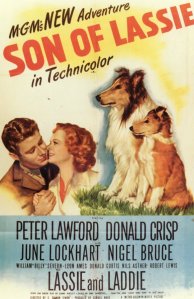
SonofLassieSon of Lassie could just as easily have been called Laddie Goes to War! In this follow-up to Lassie Come Home (1943), which starred Roddy McDowall and Elizabeth Taylor, Lassie has a son, named Laddie. Laddie grows ups, as does young Joe Carraclough, who was played by McDowall in the first film, but is here replaced by future Rat Pack member and Kennedy spouse Peter Lawford, whose slightly deformed arm kept him out of World War II. Joe joins the army, and Laddie tries to join up with him, but he cringes the first time blank cartridges are fired at his face, which disqualifies him as a canine soldier. When Joe is taken prisoner of war in Norway, however, Laddie … well, I don’t want to give anything away. (But if you’ve ever seen a “boy and his dog” movie before, you can probably predict what will happen.)
Various locations in Canada and the Colorado Rockies were used to replicate Norway. Never having been to Norway, I can’t say how well the substitutions work, but they are gorgeous, and look like something out of a storybook. If all you’re looking for is a beautiful Technicolor travelogue, Son of Lassie fits the bill.

I, on the other hand, was looking for something more. I am a huge dog lover, but I found Laddie to be a charmless buffoon. Also, all collies look alike to me, so his scenes with his mother Lassie were really confusing. Interestingly–and I didn’t know this until after I saw this movie–both Lassie and Laddie were played by the same dog, Pal, the male collie who played Lassie in Lassie Come Home. (For the scenes in this film in which Laddie appears with his mother, another collie filled in as Lassie.) Apparently every single dog who has played Lassie on film has been a descendant of Pal. Perhaps Laddie’s general dopiness isn’t Pal’s fault. It could just be the way the character is written. The same could be said for Joe, who also comes off as a bit of a dope. On the other hand, they are well suited for each other. Both are naive and somewhat incompetent, not to mention the fact that they sleep together, eat together, and share a bond that would be homoerotic if they weren’t from different species. Son of Lassie is a decent flick for kids, especially kids who love dogs, but the flat acting and bad dialogue don’t make it a first choice to rent for adults.

Strange Illusion (March 31, 1945)

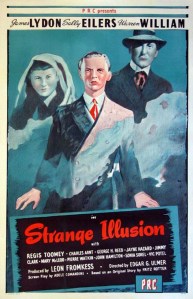
StrangeIllusionEdgar G. Ulmer was born in 1904 in Olmütz, Moravia, Austria-Hungary (now part of the Czech Republic). Like a number of talented German and Austrian directors, he moved to the United States in the ’20s and began working in Hollywood. Unlike better-known directors like Billy Wilder or Fritz Lang, however, Ulmer toiled in obscurity for most of his career, cranking out no-budget films. At least part of this was due to the fact that he was blackballed after he had an affair with Shirley Castle, who was the wife of B-picture producer Max Alexander, a nephew of powerful Universal president Carl Laemmle. Castle divorced Alexander and married Ulmer (becoming Shirley Ulmer), but the damage to Ulmer’s career was done. He spent most of the rest of his career churning out product for P.R.C. (Producers Releasing Corporation) Studios, one of the financially strapped Hollywood studios collectively referred to as “Poverty Row.”
Today, Ulmer is best known for two films, The Black Cat (1934) and Detour (1945). I’ve seen the former, but not the latter. The Black Cat stars Boris Karloff and Bela Lugosi, and is one of the more memorable and strange Universal horror pictures. It was a big box-office success, too. I haven’t seen Detour yet, but it has a reputation as one of the best low-budget noirs.

Strange Illusion, which Ulmer made for P.R.C. early in 1945, is a mixed bag. Ulmer’s ideas are clearly larger than the short shooting schedule, low budget, and B-grade actors can support. James “Jimmy” Lydon (on loan from Paramount) plays a young man named Paul Cartwright, whose late father was once the governor of California. The film opens with a stunning, Freudian dream sequence in which Paul walks with his young, attractive mother through clouds of smoke. A menacing, dark man whose face cannot be seen walks with them. He seems to have designs on Paul’s mother. Then the mysterious automobile accident in which Paul’s father died is replayed. It’s a fantastic sequence, and grabs the viewer right away. Much of what follows is prosaic, but not bad. There are a lot of great shots of Paul and other characters that incorporate an enormous portrait of the late Mr. Cartwright, towering over his survivors as though he is passing judgment on them from the afterlife. Warren William is very good as Paul’s mother’s fiancé, and he brings the right balance of charm and menace to his role. Lydon, on the other hand, really irritated me, and some of the youthful “jive” talk he has with his girlfriend is pretty stilted and painful. There’s also a little too much plot for the film’s brief running time. If by the end of this picture you haven’t figured out that this is Ulmer’s teen-oriented take on “Hamlet,” then, brother, you never took a comp lit class. Overall, Strange Illusion isn’t bad, but it’s recommended only if you really enjoy B movies from the ’40s.

Horror fans are encouraged to check out The Black Cat, as well as Bluebeard, a dreamy and beautiful horror movie Ulmer made for P.R.C. in 1944. It stars John Carradine as a homicidal puppeteer in 19th century Paris.

Utah (March 21, 1945)

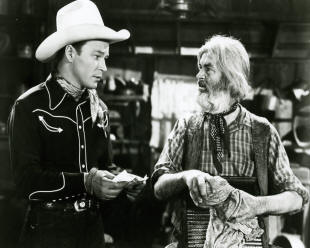
RoyGabbyThe western genre may be moribund, but it refuses to kick the bucket. Singing cowboys, on the other hand, are deader than vaudeville. There was a time, however, when Gene Autry and Roy Rogers were two of the biggest film stars in America.
I saw bits and pieces of Rogers’s movies on TV when I was younger, but to be honest, his horse Trigger made more of an impression on me than he did. And I still have never seen a Gene Autry movie. As part of my obsessive-compulsive project of watching old movies in the order they were released, however, I added Utah to my Netflix queue. It stars the holy trinity of hokey singing-cowboy movies: Rogers, Dale Evans, and Gabby Hayes. I was surprised by how charismatic I found Rogers in this movie. Sure, he’s corny, but he’s charming and handsome. At a time in America when a muffin-faced hayseed like Van Johnson was considered the height of attractiveness by a lot of bobby-soxers, Rogers is refreshingly dark; almost Eurasian looking. And Dale Evans looked fantastic. I’m used to seeing her and Rogers in publicity stills from the ’50s, when they were both middle-aged, but here, at the age of 32, she looks about 19. (Rogers, too, looks younger than his 33 years.)

Utah has a predictable plot. Rogers and his singing group, the Sons of the Pioneers, work as ranch hands (along with the crotchety Hayes) on the Bar X Ranch. Meanwhile, Evans and her singing and dancing troupe of ladies are performing in Chicago when they learn their financial backing has fallen through. Fortuitously, Evans’s grandfather bequeathed her a ranch in Utah, which she realizes she can sell to make enough money to keep her show going. Guess which ranch it is?

Evans and her distaff posse have to visit Utah to take care of business (natch), and hijinks ensue. Roy and Gabby attempt some elaborate trickery to convince Evans not to sell the ranch, and there are some black hats who want the ranch for themselves. Even in black and white, the Utah landscape is rugged and beautiful, and there are a lot of musical numbers and fistfights to keep the film moving. This isn’t a great movie, but it’s enjoyable, especially if you like singing-cowboy music.

By the time he made Utah, Rogers had already starred in more than 40 films. His first lead role was in Under Western Stars (1938), when he replaced Gene Autry, who had walked out on his contract. Born Leonard Slye, he rechristened himself “Roy Rogers” for this starring role, and a matinee idol was born. After his first marriage ended in divorce, he married Arline Wilkins. They had three children together, and he was still married to her when he and Evans started making movies together. Wilkins died in November 1946, shortly after the birth of Roy Rogers, Jr., from complications due to a Caesarean section. Rogers and Evans, of course, eventually married, in December 1947. Together they adopted four children, and they remained married until his death in 1998.

The House of Fear (March 16, 1945)

Even when it’s pretty easy to figure out the solution to the mystery, as is the case here, the Sherlock Holmes pictures starring Basil Rathbone and Nigel Bruce are well-oiled machines; exceedingly well-made, and a joy to watch. Directed by Roy William Neill, The House of Fear is loosely based on Sir Arthur Conan Doyle’s story “The Five Orange Pips,” and is the tenth film that Rathbone and Bruce made together in the Sherlock Holmes series. It tells the farfetched story of a group of curmudgeonly old friends who call themselves “The Good Comrades,” and spend most of their time together as a club in a remote area of Scotland (in a creepy old castle, natch). After one man receives a single orange seed in an envelope at dinner one night, he is murdered. And then it happens again to another member of the club. And again. Oh, and did I mention that each member of The Good Comrades has an insurance policy with all the other members listed as beneficiaries? Sounds like a job for Sherlock Holmes…

The Hound of the Baskervilles (1939) was the first film that featured Rathbone as Holmes and Bruce as his faithful sidekick Dr. Watson, and it set the tone for the series beautifully. If you’re a fan of English mysteries, I can’t recommend it highly enough (even though it’s an American production, it gets most of the details right). Their second film, The Adventures of Sherlock Holmes (1939) is also a doozy. It’s probably my favorite in the series, owing in no small part to George Zucco’s brilliant performance as the cunning Professor Moriarty. After the first two, I found the next few Rathbone/Bruce films, Sherlock Holmes and the Voice of Terror (1942), Sherlock Holmes and the Secret Weapon (1943), and Sherlock Holmes in Washington (1943), a bit of a letdown. The setting was changed to the present day, and the films contained a good amount of World War II-era propaganda. Worst of all, someone decided that Rathbone’s hair should be combed forward. This might seem like a minor detail, but Rathbone, with his aquiline nose and intense gaze, is the very embodiment of Holmes when his hair is slicked back. With his hair combed forward he looks as if he’s wearing a curly pageboy wig.

The series hit its stride again with Sherlock Holmes Faces Death (1943). Not only was Rathbone’s hair restored to its full Holmesian glory, the Conan Doyle story “The Adventure of the Musgrave Ritual” was adapted to a more temporally indeterminate setting. It may have been “the present day,” but the wartime propaganda was jettisoned, and aside from automobiles and telephones, it could have been the Victorian era. Holmes was Holmes again. This film and the three that followed in 1944, The Spider Woman, The Scarlet Claw, and The Pearl of Death, are all fantastic.

In total, Rathbone and Bruce made 14 full-length features together as Holmes and Watson, and they appeared together for years on the Sherlock Holmes radio show. For many people, Rathbone and Bruce simply are Holmes and Watson. Rathbone was often cast as the villain, a role he played well (e.g., in The Adventures of Robin Hood [1938] opposite Errol Flynn), but when I think of Rathbone, I think of a brave, brilliant, and heroic detective.

Hangover Square (Feb. 7, 1945)

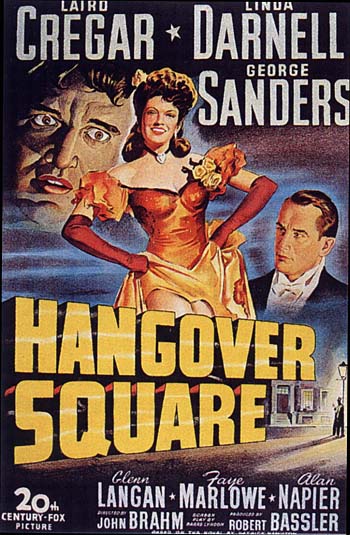
Hangover_square
Hangover Square (1945)
Directed by John Brahm
20th Century-Fox

Laird Cregar’s is a sad story. A brilliant character actor, Cregar died in December of 1944 as a result of a crash diet that most likely included amphetamines. Cregar shed approximately 100 pounds in a short space of time in an attempt to reinvent himself. Reinvention is a hard business, and no more so than in the studio-controlled Hollywood of the ’40s. Firmly established as a towering, 300-pound, sympathetic (and often childlike) heavy, Cregar’s notion that he could shed his tonnage, get plastic surgery, and reinvent himself as a romantic leading man was delusional.

Hangover Square is a follow-up of sorts to The Lodger (1944), in which Cregar played a highly fictionalized version of Jack the Ripper. Both films were directed by John Brahm, and both feature sympathetic depictions of mentally ill characters who are compelled to kill. In Hangover Square, Cregar plays a composer named George Harvey Bone, a man who is struggling to complete his masterpiece (an effective if not totally convincing concerto composed by Bernard Herrmann, who also composed the film’s incidental music). However, Bone suffers from a bizarre condition that causes him to black out when he hears loud, discordant noises. In these fugue states he may or may not be committing murders. His energy and creativity are reinvigorated, however, when he meets a beautiful singer, played by Linda Darnell. Unsurprisingly, she leads him on and then does him wrong, which frays his last shred of sanity to the breaking point.

Hangover Square was based on a novel by Patrick Hamilton. The novel was published in 1941 and took place in the late ’30s. I’ve never read it, but apparently it’s a black comedy, and there’s a lot of thematic material about the rise of fascism in Europe. Not much of that stuff made it into the film. Originally the film was supposed to be set in the present day, but it was changed to the late Victorian era, presumably to capitalize on the success Brahm and Cregar had had with The Lodger. Both films are very good, and worth seeing, but Hangover Square is more of a mess than its predecessor. Herrmann’s score, as well as the music he writes that’s meant to be composed by Bone, makes the film feel very contemporary, and the Victorian setting isn’t handled very well. What Hangover Square does have going for it, besides Cregar’s performance, are a couple of incredibly striking scenes, both involving fire, that will stick with a lot of viewers.

It’s a shame that Cregar died when he did. He hadn’t even hit 30 when he passed away (although he could play much older). Even in minor roles he always made an impression. Had he lived, would he have been the gay (or at least gayish) Orson Welles? We’ll never know. In his last role, he’s not what anyone would call “svelte,” but the weight he had lost is noticeable. He appears diminished, haunted, and on the verge of being destroyed. It’s a masterful performance in a pretty good film, and one worth seeing.

Objective, Burma! (Jan. 26, 1945)

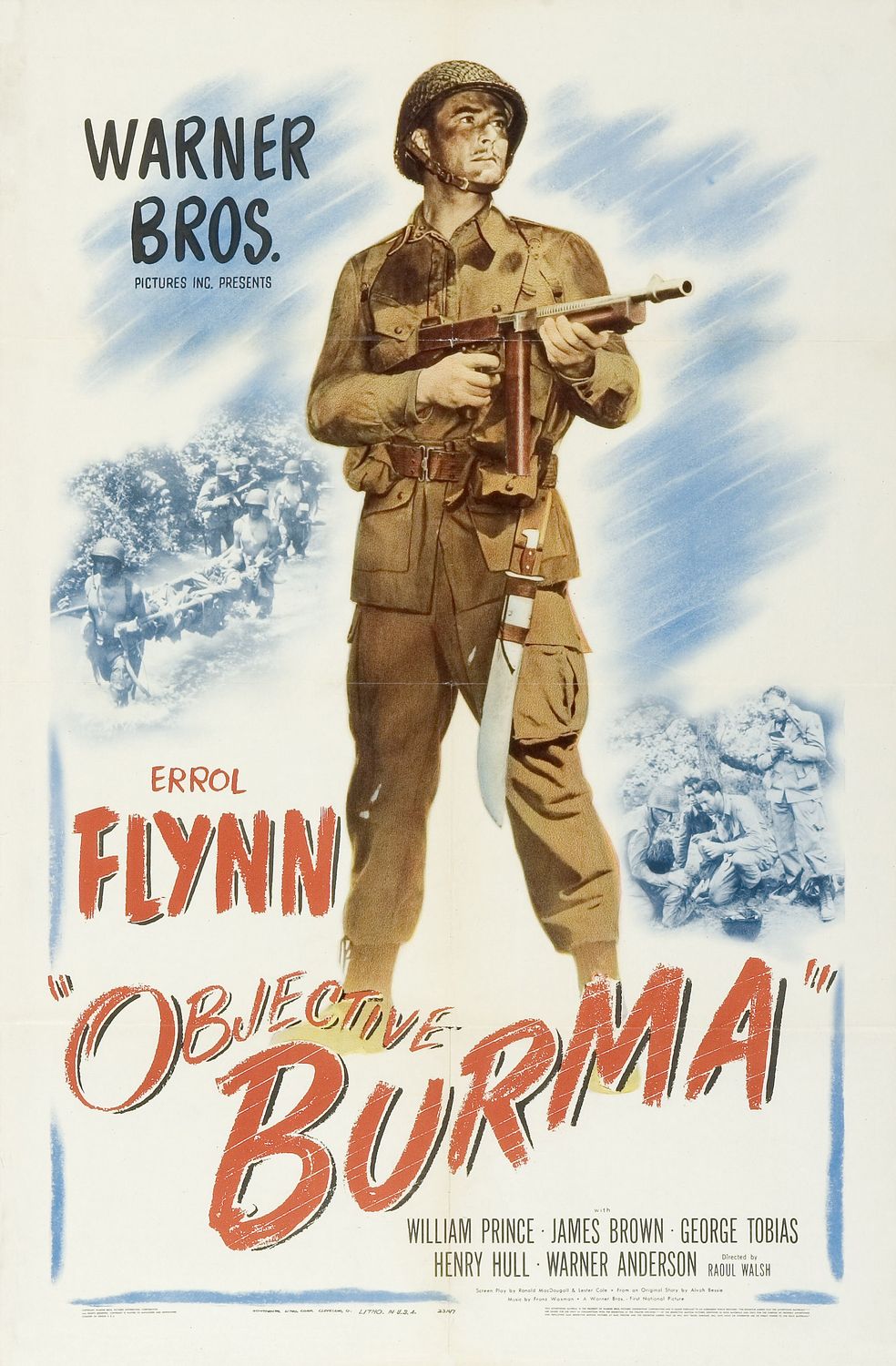
objective_burma_xlg
Objective, Burma! (1945)
Directed by Raoul Walsh
Warner Bros.

Errol Flynn was rejected for military service due to his enlarged heart, tuberculosis, morphine addiction, and bouts of malaria. But that didn’t stop him from making some kick-ass war movies.

Raoul Walsh, who made a number of fine films, directed this patriotic World War II action film starring Flynn as an Army Captain named Nelson. World War II junkies will enjoy the fact that Objective, Burma! features weapons, gear, and uniforms that are all original and accurate.

Of course, the story itself is not all that accurate. The British apparently objected when the film was released, since it took the basic story of an operation by British Chindits and retold it as an American operation. (Flynn, an Australian, seems to be playing an American in the film, though his accent is hard to place.) One of the producers, however, said that the film was also largely inspired by the 1940 film Northwest Passage, which took place during the French and Indian War. So, like a lot of Hollywood productions, it’s a war film that could just as easily have been a Western.

If you’re looking for historical accuracy (or, for that matter, Japanese soldiers who don’t look suspiciously Filipino and Chinese) look elsewhere, but if you’re looking for a gritty war movie that delivers the goods, Objective, Burma! fits the bill.

The Jade Mask (Jan. 26, 1945)

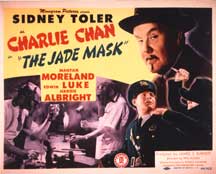
Phil Rosen directed this rather strange entry in the rather strange Charlie Chan series. The mystery writer Earl Derr Biggers created the Chan character as a Chinese-American, Honolulu-based police detective. The character was in some ways a corrective to “yellow peril” characters like Fu Manchu who represented only menace and danger.

Chan was a benevolent figure, but he was still a neutered, sycophantic “other,” the yellowface equivalent of the “good slave” archetype. The Swedish actor Warner Oland starred in a number of successful Chan films in the ’30s. I’ve only seen one of them, Charlie Chan in London, from 1934, and aside from the strange, stereotypical, “ah so” performance by Oland as a Chinese detective, the film is a typical drawing-room mystery with static camerawork and a predictable “whodunit” plot.

In 1938, Sidney Toler took over the role, and his portrayal of Chan (at least in the films I’ve seen) is more interesting than Oland’s Chan. He is less sycophantic to white authority and his humor has an edge. He’s still a white man in yellowface makeup, though, and the faux Confucian aphorisms are still stupid. Also, Mantan Moreland’s performance as Chan’s black driver, Birmingham Brown, is pretty stereotypical, and may offend modern viewers. Moreland is actually black and none of his scenes are meant to be mean-spirited, but a scene in which he outruns a moving car because he’s that afraid of ghosts is still kind of offensive.

Oh, and The Jade Mask is a seriously strange film aside from all the racist anachronisms. The plot concerns a scientist who has discovered a way to make wood as strong as steel. Naturally, the world’s superpowers want to get their hands on his secret, and his murder is what draws Chan in to the case.

This film has some great set pieces, such as corpses strung up and manipulated like mannequins, but there are a few things that are hard to figure out, such as the numerous billowing clouds of supposedly poisonous gas that the characters blithely stand around in while investigating the mystery. Oh, and Edwin Luke plays Chan’s “Number 4 Son,” and doesn’t make much of an impression.