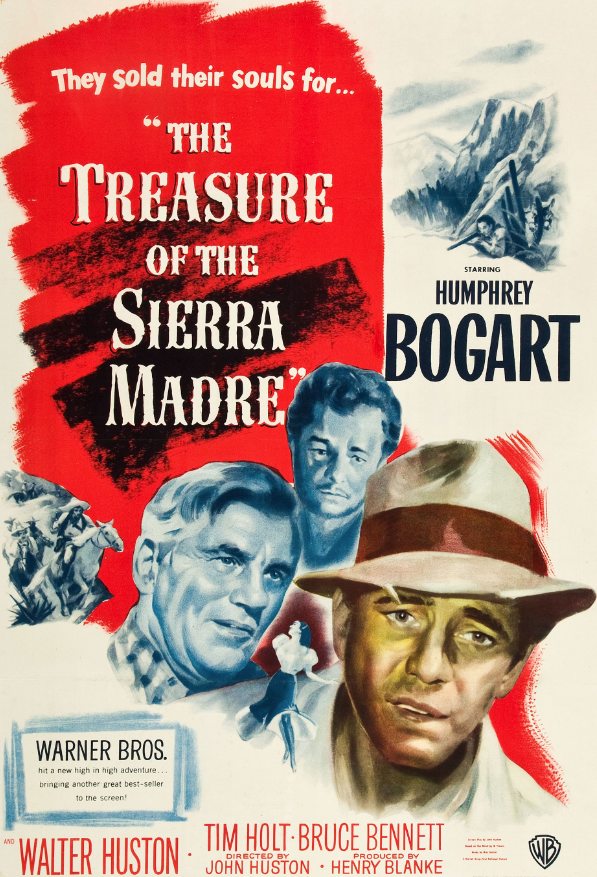
The Treasure of the Sierra Madre (1948)
Directed by John Huston
Warner Bros.
In his review of Elmore Leonard’s 1995 novel Riding the Rap, Martin Amis wrote that “Mr. Leonard has only one plot. All his thrillers are Pardoner’s Tales, in which Death roams the land — usually Miami or Detroit — disguised as money.”
The same could be said of John Huston’s The Treasure of the Sierra Madre, but instead of the duffel bags full of cash found in Leonard’s hard-boiled crime novels, money in this film takes the form of gold.
The gold in The Treasure of the Sierra Madre isn’t just a disguise for death, either; it’s the impetus for all manner of human striving and weakness, and brings out the best and the worst in the men who seek it.
As for the film itself, it mostly brings out the best in all of its actors. Neither Humphrey Bogart nor Tim Holt are completely able to shed their well-worn personas, but the same cannot be said of Walter Huston, the director’s father, who is pitch-perfect in his role. (Also, it’s likely that many people who watch The Treasure of the Sierra Madre today will have never seen Tim Holt in any of his countless B westerns and therefore have little trouble accepting him in his role.)
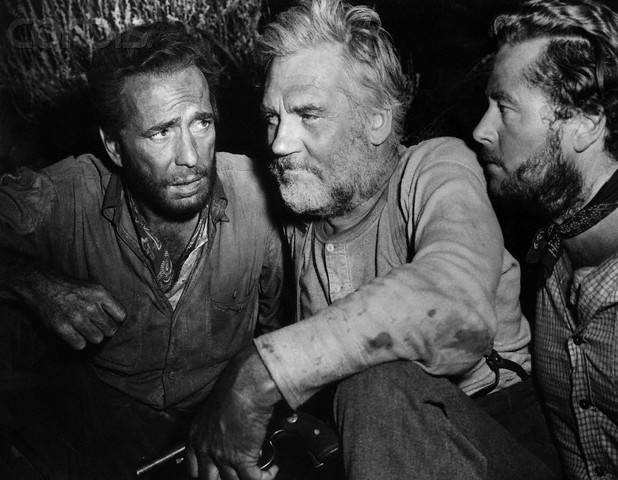
Bogart plays Fred C. Dobbs, a man who finds himself penniless in Tampico, Mexico. He meets fellow American drifter Bob Curtin (Holt) and together they get jobs working in the oilfields, but their unscrupulous employer runs off without paying them, leaving them back where they started. However, luck smiles on them, and after winning a little money they hook up with an old prospector named Howard (Walter Huston) and head for the Sierra Madre mountains to mine their fortune. Howard warns Dobbs and Curtin of the dangers of “gold fever,” but they both claim they’ll deal with their windfalls sensibly if they strike it rich.
No points will be awarded first-time viewers who correctly predict that the protagonists will both strike it rich and succumb to greed and paranoia.
The Treasure of the Sierra Madre is based on the 1927 novel by the mysterious author “B. Traven.” Little is known about the possibly German-born novelist who probably lived most of his life in Mexico, which is where most of his fiction is set. According to the February 2, 1948, issue of Time, Traven was paid $5,000 for the screen rights to his novel. Traven was such a mysterious figure that although director Huston frequently corresponded with him, when it came time to meet Traven, a nervous translator named “Hal Croves” showed up in his place, claiming to be a close friend of Traven’s. Huston hired Croves as a technical adviser on the film, paying him $150 a week. Huston strongly suspected (but could never conclusively determine) that “Croves” was really Traven.
The Treasure of the Sierra Madre was nominated for four Oscars — best picture, best director, best supporting actor for Walter Huston, and best screenplay. It won every Academy Award for which it was nominated except for best picture.
The Treasure of the Sierra Madre is a great film. It’s also one of those rare movies — like Casablanca — that even people who “don’t like old movies” will usually enjoy. It has excellent pacing, an involving story, and believable characters, but most importantly, it has authenticity. It was filmed mostly on location in Mexico, and the Mexican characters actually speak Spanish. It’s ironic that this is the movie that gave us the most enduringly stereotypical “Mexican” line — “I don’t have to show you any steenking batches!” — because it’s one of the few films from the ’40s in which Mexican characters actually speak Spanish, and without even subtitles to make things easier on a gringo audience.
 OCD Viewer