Tag Archives: Action-Adventure

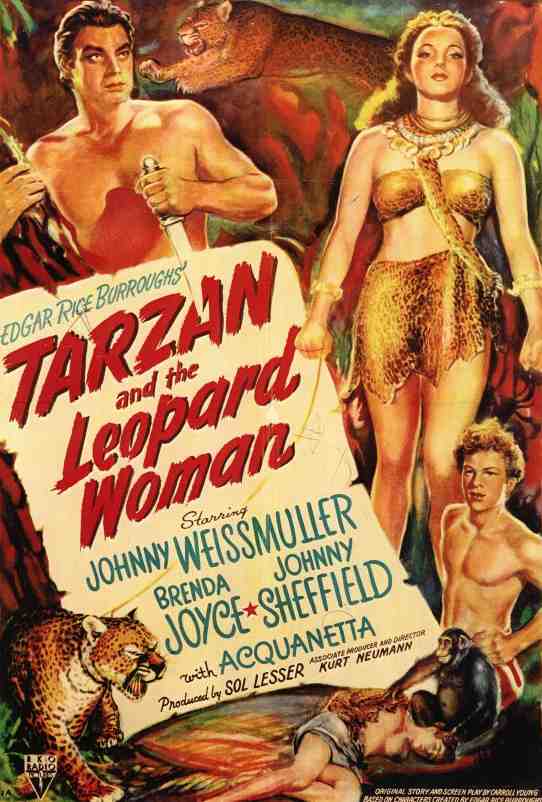
Tarzan and the Leopard Woman (January 1946)

A lot of fans of Johnny Weissmuller’s work as Tarzan in the MGM series of the ’30s like to beat up on the RKO Radio Pictures Tarzan pictures of the ’40s. They’re campier, the production values are cheaper, and Weissmuller was older when he made them. I say, so what? They’re still great Saturday-matinee entertainment, especially this one. Tarzan and the Leopard Woman moves at a good pace, it’s loony without being over-the-top, and Weissmuller is in better shape than he was in the previous few entries in the series.

Weissmuller was a big guy; 6’3″ and 190 pounds in his prime. Like a lot of athletes, he had a tendency to gain weight when he wasn’t competing professionally (when he was making the Jungle Jim series in the ’50s, he was reportedly fined $5,000 for every pound he was overweight). In Tarzan and the Leopard Woman, however, he was 41 years old, and looked better than he had in years. His face looks older and his eyes are a little pouchy, but three divorces (including one from the physically abusive Lupe Velez) will do that do a guy. Even though he was nearing middle age when he made this picture, Weissmuller was still a sight to behold. When he jumps into a river to save four winsome Zambesi maidens (played by Iris Flores, Helen Gerald, Lillian Molieri, and Kay Solinas) from crocodiles, he knifes through the water, and it’s not hard to see why he won five Olympic gold medals for swimming, and was the first man to swim the 100-meter freestyle in less than a minute.

When Tarzan and the Leopard Woman begins, the local commissioner (Dennis Hoey) is speaking to Dr. Ameer Lazar (Edgar Barrier), a native who has been educated and “civilized.” The commissioner is concerned about a spate of attacks by what seem to be leopards. Dr. Lazar appears to share his concern, but we soon learn that Lazar is a wolf in sheep’s clothing. Privately he spouts anti-Western doctrine that sounds suspiciously like Marxism, and is the leader of a tribe of men who worship leopards and wear their skins. Tarzan believes that the “leopard” attacks are really the work of men, so to throw off suspicion, Lazar releases a trio of actual leopards as cannon fodder. Their attack against the caravan is repelled, the leopards are killed, and everyone is satisfied that the terror has passed. Everyone, that is, except Tarzan, who still smells a rat.

The original shooting title of Tarzan and the Leopard Woman was Tarzan and the Leopard Men, which is probably a more accurate title, but definitely a less sexy one, especially once you see the leopard men. The eponymous leopard woman is Dr. Lazar’s sister, Lea, high priestess of the leopard cult. Played by the exotic-looking actress Acquanetta, Lea makes a few memorable appearances in the beginning of the film with her voluptuous breasts barely concealed behind a gauzy wrap, but after the halfway mark she wears a more concealing leopard-print dress, and spends most of her time standing on an altar, goading on the leopard men’s dastardly acts. For the most part, the leopard men are paunchy, pigeon-chested, middle-aged men whose poorly choreographed ritual “dancing” never stops being unintentionally hilarious.

Acquanetta was born Mildred Davenport in Ozone, Wyoming, in 1921. She changed her name to “Burnu Acquanetta,” then to just “Acquanetta,” and starred in films like Rhythm of the Islands (1943), Captive Wild Woman (1943), and Jungle Woman (1944). The raison d’être of most island pictures and jungle movies in the ’40s was to show a whole lot more skin than was considered appropriate in any other genre of the ’40s, and on that count, Tarzan and the Leopard Woman succeeds. Weissmuller’s loincloth is as skimpy as it ever was, and the scene in which he’s scratched all over by the leopard men’s metal claws, then tied tightly to a pillar and menaced by Lea surely excited plenty of future little sadomasochists in the audience.

Former model Brenda Joyce, in her second outing as Jane, has really grown into the role, and looks great. I missed Maureen O’Sullivan when she left the franchise, but Joyce has really grown on me since Tarzan and the Amazons (1945). She’s pretty and charming, not to mention stacked.

There’s a subplot in Tarzan and the Leopard Woman that I’m going to call “Battle of the Boys.” Johnny Sheffield is still playing Tarzan and Jane’s adopted son, “Boy,” but he’s quickly outgrowing the moniker. Sheffield was 14 when he made this film, but he looks older. Unlike a lot of cute child stars to whom puberty was unkind, Sheffield looks like he’s in better shape than anyone else in the movie, and he’s good-looking. Unfortunately, the same cannot be said for Tommy Cook, who’s a year older than Sheffield, but looks younger and weirder. The last time I saw Cook, he played the cute little sidekick named “Kimbu” in the 1941 Republic serial The Jungle Girl. Here, in an enormous thespic stretch, he plays Lea’s younger brother “Kimba,” who insinuates himself into the lives of Tarzan, Jane, and Boy. He might as well have been named “Bad Boy,” since he’s Boy’s evil doppelgänger. Jane takes pity on Kimba and cares for him, but his true intention is to cut out her heart in order to become a full-fledged warrior among the leopard men.

I don’t think I’ll be giving anything away if I say that Tarzan, Jane, Boy, and their pet chimp Cheetah make it through the proceedings relatively unscathed, while the bad guys all die horrible, gruesome deaths. Tarzan and the Leopard Woman might not be the greatest entry in the Tarzan franchise, but it’s far from the worst, and packs plenty of action and thrills into its 72-minute running time.
Dick Tracy (Dec. 1, 1945)

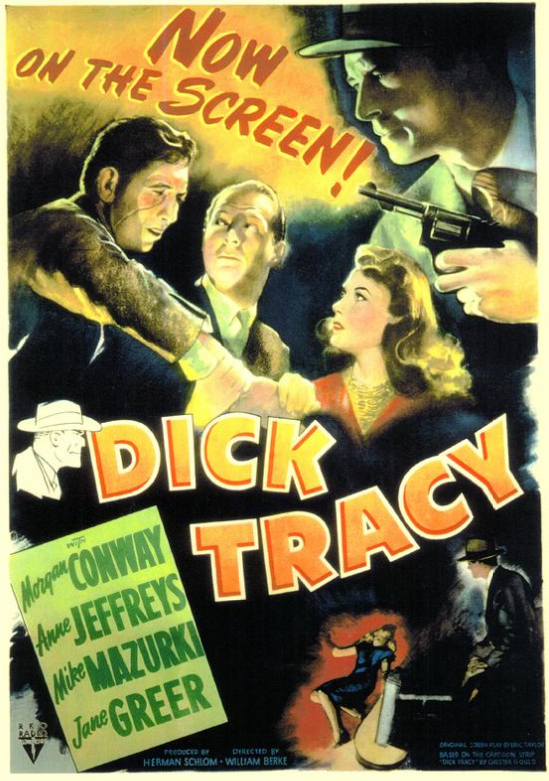
Dick Tracy, directed by William Berke and starring Morgan Conway as Dick Tracy, wasn’t the first filmed adaptation of the most famous detective in the funny pages. There had been four serials prior to it, all of which starred Ralph Byrd; Dick Tracy (1937), Dick Tracy Returns (1938), Dick Tracy’s G-Men (1939), and Dick Tracy vs. Crime Inc. (1941). The first one was also re-edited into a feature in 1937, which was a fairly common practice. These were B pictures, after all. If you had the footage, why not repackage it?

This film, however, took the character in a new direction. Played by Morgan Conway, Tracy is more believable as a real person than the way Byrd played him. Both embody aspects of the character, but they look nothing like each other. Byrd literally looked like a cartoon character. He had small, perfect features and intense eyes. But for me, his voice was too high and his nose too small to really convey the toughness of the character. Conway, on the other hand, is ugly and tough as nails. He looks like what I imagine Tracy might look like if he were a real person, although his nose is more of a “schnoz” than Tracy’s “beak.” He’s decent and brave, but still not above underhanded tricks to get his man. When we’re introduced to him, he’s interrogating a sweaty suspect named Johnny (Tommy Noonan). Tracy makes Johnny believe his mother has been killed so he’ll agree to roll over on someone. After Johnny spills the beans, Tracy admits to having tricked him. “It was the only way I could get you to talk and clear yourself at the same time,” he says. “All right boys, clean up Johnny and send him home.”

This film also features the full supporting cast of characters from Chester Gould’s daily newspaper strip, many of whom had been missing from earlier adaptations; Tracy’s sidekick Pat Patton (Lyle Latell), his best girl Tess Trueheart (Anne Jeffreys), his adopted son Junior (Mickey Kuhn), and Chief Brandon (Joseph Crehan). Gould’s violent, gruesome world is handled well in this film. Its opening may be the darkest of any film based on a comic strip character made before 1970. A high-angle shot shows a man with his back to the camera, leaning against a light pole in a quiet, suburban neighborhood at night, smoking a cigarette. When a bus stops and a single, female passenger (Mary Currier) disembarks, he moves into the shadows. A tracking shot follows her as she walks across the street, then cuts to a static shot of the man’s shadow on a wall, and the viewer can see from the movement of his shadow that he is reaching into his breast pocket for something. This is followed by a tracking shot of the woman with the camera directly behind her, presumably showing his point of view. The woman walks down the sidewalk, her heels clacking. She looks nervous. She turns around. There is no one behind her. She keeps walking. Suddenly, a shadow falls across her and she screams. The man attacks her. There is a cut to a long shot of the street, which shows her body lying on the sidewalk and the man running away.

Dick Tracy discovers a note on the woman’s viciously mutilated body, demanding that $500 in small bills be left in a street sweeper’s trash can on the corner of Lakeview and Ash. The note is signed “Splitface.” The next morning, the mayor of the city (William Halligan) receives a similar note, demanding that $10,000 be paid out or the mayor will be “slashed to pieces.”

The murdered schoolteacher, the mayor, and another man who was killed by Splitface seemingly have nothing to connect them. Tracy and Patton investigate, and Tracy comes to the conclusion that Splitface is motivated by something other than money, since the murdered woman didn’t pay, but the murdered man did.

Dick Tracy has plenty of action, with Dick and Pat chasing down suspects on foot and in cars, but it doesn’t skimp on the investigations that lead them there. It’s not rigorous enough to qualify as a police procedural, but it doesn’t gloss over any details, and Conway’s acting style and line delivery are not unlike Jack Webb’s on Dragnet.

Devotees of the daily strip will probably quibble with details, but I thought this picture did a nice job of balancing the violence with over-the-top characters. There is a loony astronomer and fortune teller named Professor Starling (Trevor Bardette), a ghoulish undertaker named Deathridge (Milton Parsons), and of course the great character actor Mike Mazurki as the villain.

Dick Tracy is a one-hour programmer, and there’s no question that it’s a B movie, but it’s an expertly directed, fast-paced, and thoroughly enjoyable one.

Captain Kidd (Nov. 22, 1945)

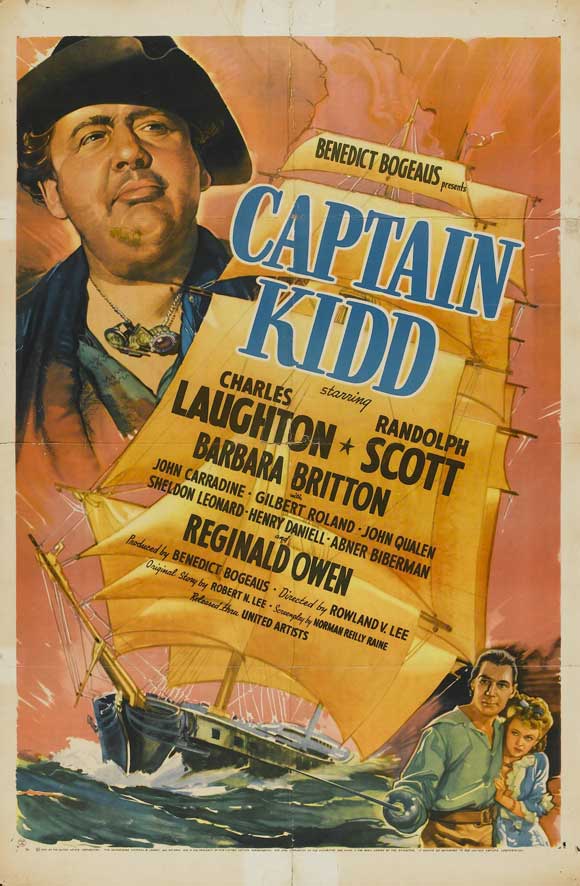
Released on Thanksgiving day in 1945, director Rowland V. Lee’s Captain Kidd is a pretty good swashbuckler, even though it’s not exactly a history lesson.

The real William Kidd was hanged for piracy in 1701, but there is still debate about the extent of his crimes on the high seas, and whether or not he should even be considered a pirate, as opposed to a privateer; someone employed by a nation to attack foreign shipping during time of war. But no matter how unjust his execution might have been, the name “Captain Kidd” and rumors of his buried treasure have passed into pirate legend along with names like Blackbeard and Calico Jack.

The film’s prologue shows the “ruthless” (according to the narrator) Captain William Kidd (Charles Laughton) and his pirate crew reduce the English galleon The Twelve Apostles to a smoking ruin near Madagascar and sneak off to a cove to bury their booty before high tide. His band of cutthroats includes B-movie stalwarts John Carradine and Gilbert Roland (playing characters named Orange Povey and José Lorenzo, respectively). When there is a dispute over the spoils, Kidd shoots one of his crew and buries him with the treasure. The impromptu eulogy he says over the grave is a masterpiece of irony.

The action moves forward to London, 1699. Kidd is receiving instructions on how to be a gentleman from a man named Shadwell (Reginald Owen), such as “A gentleman never sucks his teeth” and “A gentleman never pays his domestics high wages.” Kidd’s lust for gold is clearly matched by his lust for power. When he is granted an audience with King William III (Henry Daniell), he convinces the king that he is the right man to sail to India and give a treasure-laden ship called the Quedagh Merchant safe passage through the pirate-infested waters of Madagascar. In exchange he wants a castle and the title of a lord.

William III in this movie is pretty easily manipulated, because he also agrees to Kidd’s insane demand that he be given a crew of condemned pirates. Kidd claims the irreedeemable brigands will be loyal as long as they know a royal pardon awaits them at the completion of a successful mission. Along with some of his old mates from Newgate Prison, Kidd frees a wild card; a tall, well-spoken man named Adam Mercy (Randolph Scott), who was the master gunner to another pirate, Captain Avery. Mercy’s motives are mysterious, but it should come as no surprise to the audience when the stalwart and handsome Scott steps into the role of protagonist.

Scott is best known for his many roles in westerns. His physical appearance and his acting style were the Platonic ideal of a western hero, but he makes a decent swashbuckler, too. Scott doesn’t try too hard to hide his American accent in this movie, but he has a patrician bearing that makes up for it, and the scene in which he locks swords with Roland (who went on to play the Cisco Kid in a number of pictures) is exciting and masterfully directed. And the fact that he does it to protect Lady Anne Dunstan (Barbara Britton) from Roland’s unwanted advances should delight people who like to read into a scene’s Freudian undertones. (Scott and Roland are the two most virile men on the ship, and as they sword fight, the camera keeps cutting back to Britton, who gasps at each clash of steel on steel.)

Laughton and Scott were the same age, but they might as well have been from different species. While Scott was heroic and laconic, Laughton was a grotesque, blubbery-lipped character actor, and much of the pleasure in watching this film comes from his fantastic performance. No one else can deliver a line like, “Of all the slummocky blackguards!” and sound genuinely appalled while at the same time disgusting the viewer with his own loathsomeness.

Secret Agent X-9 (13 chapters) (July 24-Oct. 16, 1945)

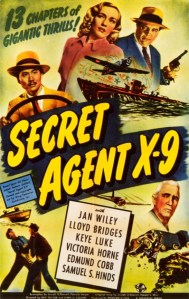
Secret Agent X-9Republic Pictures is the unassailable king of the cliffhangers after the silent era. Most of the best chapterplays of the ’30s and ’40s were Republic productions. Dick Tracy (1937), The Lone Ranger (1938), Zorro’s Fighting Legion (1939), Adventures of Red Ryder (1940), Mysterious Doctor Satan (1940), Adventures of Captain Marvel (1941), Jungle Girl (1941), Spy Smasher (1942), Perils of Nyoka (1942), The Masked Marvel (1943), and Captain America (1944) are just a few of the more than sixty serials produced by Republic Pictures, most of which are still incredibly entertaining. The best Republic serials combined wild action and elaborate stunts with nicely paced stories that could be strung out over 12 to 15 weekly installments with a few subplots here and there, but nothing too complicated or that viewers couldn’t pick up with in the middle. Each chapter ended with a cliffhanger (like Captain Marvel flying toward a woman falling off a dam, or a wall of fire rushing down a tunnel toward Spy Smasher). The next week’s chapter would begin with a minute or two of the previous week’s climax and the resolution, and the cycle would repeat until the final chapter.
Columbia Pictures and Universal Pictures were the two other major producers of serials in the sound era. Universal ceased production of serials in 1946, leaving only Columbia and Republic to duke it out into the ’50s. One of the last serials made by Universal was Secret Agent X-9, released into theaters starting in July 1945. It was based on a daily newspaper strip created by writer Dashiell Hammett (the author of The Maltese Falcon and The Thin Man) and artist Alex Raymond (who worked on Flash Gordon). Both creators left the project soon after its inception, and the King Features strip continued under various hands, vacillating between espionage and private eye stories.

X-9The first film serial featuring Secret Agent X-9 was made by Universal in 1937, and starred Scott Kolk as Agent X-9, a.k.a. “Dexter,” who sought to recover the crown jewels of Belgravia from a master thief called “Blackstone.” The second featured a boyish-looking 32-year-old Lloyd Bridges as Agent X-9, a.k.a. “Phil Corrigan.” Made toward the end of World War II, the 1945 iteration of the character focused on wartime intrigue and Corrigan’s cat-and-mouse games with Axis spies. Taking a cue from Casablanca (1942), the serial was set in a neutral country called “Shadow Island,” in which Americans, Japanese, Chinese, French, Germans, Australians, and the seafaring riffraff of the world freely intermingle. A fictional island nation off the coast of China, “Shadow Island” has a de facto leader named “Lucky Kamber” (Cy Kendall) who owns a bar called “House of Shadows” and has a finger in every pie, including gambling and espionage. Various German and Japanese military officers, secret agents, and thugs run amuck in this serial, but the one who most stands out is the unfortunately made-up and attired Victoria Horne as “Nabura.” In her role as a Japanese spymaster, Horne is outfitted with eyepieces that cover her upper eyelids, appearing to drag them down from sheer weight. She doesn’t look Asian, she just looks as if her eyes are closed.
While Nabura is played by a white actress in yellowface makeup, the main Chinese character is actually played by a Chinese actor, which was typical in World War II-era Hollywood. Keye Luke, surely one of the hardest working Chinese-American actors in Hollywood history, plays “Ah Fong,” Corrigan’s faithful sidekick. Corrigan is also aided by an Australian double agent named Lynn Moore, played by American actress Jan Wiley. Wiley does nothing to alter her accent, which was also typical for American actors who played Aussies in Hollywood productions during the war.

Secret Agent X-9 has good production values and special effects. The stock footage that shows up in nearly every serial is judiciously used, and integrated well into the newly filmed material. Where this Universal serial just doesn’t measure up to the best Republic offerings is in the pacing and action departments. Republic serials featured stuntwork that still impresses (e.g., Spy Smasher leaping through the air, landing on a mechanic’s creeper chest-first, rolling under a car, and grabbing a goon’s ankles before he can escape). Secret Agent X-9 features ho-hum shootouts, fistfights, and car chases.

Also, instead of a plot that evolves naturally over the course of the series, there is a simple story that seems as if it’s been stretched from a 90-minute feature into 13 chapters, most of which are longer than 20 minutes. Secret Agent X-9 also suffers from poor timing. When the first installment was released, V-E Day had already passed, but the United States was still at war with Japan. By the time the final installment was released, atomic bombs had been dropped on Hiroshima and Nagasaki, Japan had surrendered to the Allies, and a new phase in world history had begun. Secret Agent X-9 is set in 1943, so it’s never out of date, per se, but its MacGuffin, a substitute for aviation fuel called “722,” which everyone in the film is scrambling to secure for themselves, seems like small beer after the advent of the Atomic Age.

White Pongo (Oct. 10, 1945)

WhitePongo

White Pongo (1945)
Directed by Sam Newfield
Sigmund Neufeld Productions / Producers Releasing Corporation (P.R.C.)

If you needed a giant primate in Hollywood in the ’40s, Ray “Crash” Corrigan was your go-to guy. Corrigan would put on any ape costume for a paycheck. And if you didn’t have a particular vision of what your giant primate should look like, Corrigan was happy to wear his own fitted ape suit that was covered with “fur” made of human hair. He even did children’s parties and reportedly terrified some kids.

Nicknamed “Crash” for the way he tackled other football players and for his fighting skills, Corrigan got his start in Hollywood as a physical trainer to the stars, as well as performing stuntwork and acting in bit parts, such as his appearances in an ape costume in Tarzan and His Mate (1934) and as an “Orangopoid” in the Flash Gordon serial (1936). He got his big break playing a human when he was picked to star in the Republic serial Undersea Kingdom in 1936, after which he was signed as a term player for Republic Pictures. He eventually left over a pay dispute and went to Monogram Pictures.

He appeared in more than 50 movies in the late ’30s and early ’40s (including 24 outings as “Tucson Smith” in Republic’s “Three Mesquiteers” series and 20 appearances as “Crash Corrigan” in Monogram’s “Range Busters” series), but even during this fertile period of his career playing humans, he frequently found himself in monkey suits. And no, that’s not a euphemism for tuxedos.

He appeared as a gorilla or ape in Round-Up Time in Texas (1937), the Three Stooges short “Three Missing Links” (1938), the Boris Karloff horror film The Ape (1940), Law of the Jungle (1942), The Strange Case of Doctor Rx (1942), Dr. Renault’s Secret (1942), Captive Wild Woman (1943), She’s for Me (1943), Nabonga (1944), The Monster Maker (1944), and The Monster and the Ape (1945). He even did double duty in some films. In the Three Mesquiteers film Three Texas Steers (1939), he appeared not only as his recurring character Tucson Smith, but also as “Willie the Gorilla.” And in The White Gorilla (1945), he played not only the hero, but also “Konga,” the white gorilla whom the hero fights.

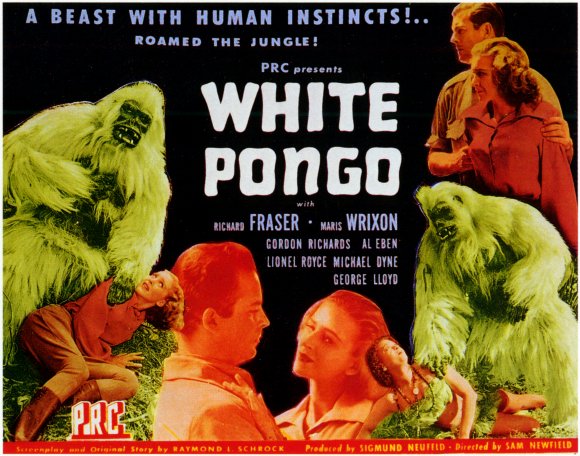
He also appeared as the eponymous White Pongo in this P.R.C. cheapie directed by Sam Newfield. It premiered in Los Angeles on Wednesday, October 10, 1945, and was released nationwide a month later, on Friday, November 2nd. The film is one of the poorer examples of a jungle adventure I’ve seen. After the credits finish rolling over an image of Africa, a pointer stick appears, insouciantly circling an enormous section of the southwestern coast of the continent as the narrator says, “Stretching north and south of the equator in west Africa are vast areas of dense forests and swamplands as yet unexplored by white men. A virgin territory penetrated only by the great Congo river and its tributaries. Here in this wild, steaming portion of the Dark Continent is the home of the ‘ponga,’ native name for the gorilla. It was here on the fringe of gorilla territory, in a nameless native village inhabited by a tribe of fierce Negritos, an incident occurred which was destined to startle the civilized world.”

There’s so much to work with already I don’t know where to start. The combination of the verb “penetrate” with the noun “virgin territory,” the fact that “Negritos” are ethnic groups in Southeast Asia, the idea that any village inhabited by humans would be “nameless.” The only thing the film sort of gets right is the general location where gorillas live. Once the wielder of the pointer calms down and focuses on the area where the Atlantic Ocean feeds into the Congo, that is.

The plot of the film, such as it is, involves a crew of scientists and hunters who are hot to find the white ponga because if he turns out not to be a hoax, he could be the “missing link that will prove Darwin’s theory.” Why they believe this despite having no direct contact with the creature is not explained. Because he has white fur? The mind reels. The leader of the expedition, Sir Harry Bragdon (Gordon Richards), of course brings along his beautiful blond daughter, Pamela (Maris Wrixon). The most watchable scenes in White Pongo are the ones she shares with the great white hunter of the expedition, Geoffrey Bishop (Richard Fraser), who’s believable in his role as a tall, lean, Rhodesian rifleman (even though he’s a Scot with an accent that sounds British). Unfortunately, there’s also an unnecessary triangle involving a twit named Clive Carswell (Michael Dyne) who fancies himself in love with Pamela, even though she has no interest in him.

At just under 72 minutes, the film still drags. There seems to be more stock footage, travelling scenes, and establishing shots than there are scenes that advance the story. Things don’t really pick up until the last 15 minutes, which are fairly brisk, though still not what I would call “action-packed.” For a guy who made wearing an ape costume a vocation, Corrigan doesn’t really move or act like a primate, making his large role in the climax more laughable than anything else. And the frequently interspersed stock footage of actual monkeys doesn’t help. Unless you have a fetish for humans in gorilla suits, you can pass this one up with a clear conscience.

http://www.youtube.com/watch?v=mkQODrJ8wSY

Blood on the Sun (April 26, 1945)

BloodSunJames Cagney made a big splash in William A. Wellman’s The Public Enemy (1931). It was his first starring role. Some people claim that when Cagney first walked on screen in that picture, it was the beginning of “modern acting.” Whether or not you believe that claim, there’s no denying the impact Cagney had on Hollywood, especially gangster films. The scene in which he shoves a grapefruit half into Mae Clarke’s face is iconic. Late in his life, Cagney claimed that people still sent grapefruits to his table in restaurants, with a wink and a nod. The Public Enemy ushered in a new era of onscreen violence, and an icon was born.

Cagney would go on to play many criminals, gangsters, and con men, in films like Smart Money (1931), Blonde Crazy (1931), Hard to Handle (1933), Picture Snatcher (1933), The Mayor of Hell (1933), Lady Killer (1933), He Was Her Man (1934), Angels With Dirty Faces (1938), Each Dawn I Die (1939), and The Roaring Twenties (1939). He was so good in these roles that when a lot of people hear the name “Jimmy Cagney,” they can only think of a sneering mug with a gat clenched in his fist and a cigarette dangling from his lower lip. But Cagney was a versatile actor. He also played cops, G-men, servicemen, and comedic roles, as well as singing and dancing in musicals. In fact, the only Academy Award he ever won was for his role in Michael Curtiz’s Yankee Doodle Dandy (1942), a drama and musical that told the life of George M. Cohan.

I think Cagney is a great actor with a unique style and personality. Anything he appears in is worth watching. Blood on the Sun was directed by Frank Lloyd, a Hollywood veteran who’d been making pictures since the silent era. It’s a wartime potboiler with a dubious MacGuffin; the Tanaka Memorial, an alleged strategic document from 1927 in which Prime Minister Baron Tanaka Giichi created for Emperor Showa a strategy to take over the world. It is believed by many historians to have been a forgery. In the ’30s and ’40s, however, the document was widely accepted as true. It was mentioned in Frank Capra’s agitprop documentary series, Why We Fight, and translations were published in Chinese and American periodicals. Of course, one reason why it was widely regarded to be an actual document is because Japan’s actions so closely mirrored the strategy that the Tanaka Memorial outlined; the conquest of Manchuria and Mongolia, followed by the invasion of China, the establishment of bases in the Pacific, and the eventual conquest of the United States. So although General MacArthur’s armies were unable to uncover any original Japanese-language versions of the Tanaka plan after World War II, perhaps its authenticity is beside the point.

In Blood on the Sun, which takes place in Tokyo in the late ’20s, Cagney plays an American reporter named Nick Condon. Condon writes for the Tokyo Chronicler, which is essentially a mouthpiece for the Japanese government, and is aimed at the Western business community. When Condon writes and publishes an article about a secret plan that outlines Japan’s plans for world domination, his editor tells him to print a retraction. He refuses, and the Japanese secret police plant a false story in the newspaper designed to discredit Condon. When Condon still refuses to back down, the Japanese secret police raise the stakes by murdering two of Condon’s friends, whom they believe are smuggling a copy of the Tanaka plan out of the country. Eventually, the film becomes a cat-and-mouse espionage thriller, with Condon on the run with a “half-breed” named Iris Hilliard, played by Sylvia Sidney, who is originally sent by the secret police to ingratiate herself to Condon and find out if he has a copy of the Tanaka plan. (Since Sidney is a white actress in yellowface makeup, I wasn’t clear for awhile which two races she was supposed to be descended from. One is Chinese, but I could have sworn that at one point, another character described her as being half Japanese/half Chinese. Her surname, however, implies that her father was British or American. So I must have misheard the line of dialogue.) Besides the questionable historical accuracy of Blood on the Sun, the white actors playing Japanese roles will probably be the hardest thing for modern audiences to swallow. John Emery, who plays Tanaka, and Robert Armstrong, who plays Col. Hideki Tojo, are not the worst examples of yellowface I’ve ever seen, but with their indeterminate, lisping accents, they’re still pretty bad. Blood on the Sun isn’t a particularly racist film, however, especially when one considers the context in which it was made. All of its villains are representatives of the Japanese government, which committed horrifying atrocities during World War II, and with whom the United States was still at war when this film was made. Several of the actors in smaller roles are actually Asians (although it’s unlikely that too many, if any, are actually Japanese).

The main reasons to see this film today, aside from historical curiosity, are the performance of Cagney and the well-choreographed fight scenes. Blood on the Sun won a single Oscar at the 18th Academy Awards in 1946, for best art direction in a black and white film, but it should have won for “most awesome martial arts battle in an American film.” Sadly, such a category did not exist. How could it? Martial arts were new to Hollywood. Some people cite John Frankenheimer’s The Manchurian Candidate (1962) as having the first real martial arts fight scene in an American film, which is clearly not the case. Frank Sinatra and Henry Silva’s karate chops were fine, but they pale in comparison to the brutal judo smackdown that crowns Blood on the Sun. Cagney studied judo for this film, and liked it so much he kept it up for most of his life. How could he not? A born-and-bred brawler, Cagney clearly took to martial arts like a fish to water. The combination of judo throws and boxing as he fights the leader of the secret police, Capt. Oshima, played by Jack Sergel (who acted under the stage name “John Halloran”), is fairly basic by today’s standards, but it’s still impressive. Cagney and Sergel go to the ground several times, and the chokeholds and arm bars look as if they hurt. So do the throat punches. Sergel was actually my favorite actor in the film after Cagney. He’s tall, menacing, and has a shaved head and black mustache. He doesn’t look particularly Japanese, but he’s more convincing as an Asian than any of the other white actors in the film. Sergel was a former LAPD officer who had been investigated by the FBI because of his involvement with the sport of judo, including his participation in at least one judo tournament that was held in a Japanese internment camp. Even though he was a Los Angeles police sergeant and loyal American citizen, his admiration for Japanese culture and sport was seen as suspicious by federal and local authorities, and he ended up resigning from the LAPD in 1944. Cagney spends a lot of his time in this film punching, kicking, and throwing the bad guys who come after him, but his fight with Sergel is the high point. Cagney was a small man, and Sergel towers over him, but Cagney’s sheer physicality makes you believe they’re evenly matched.