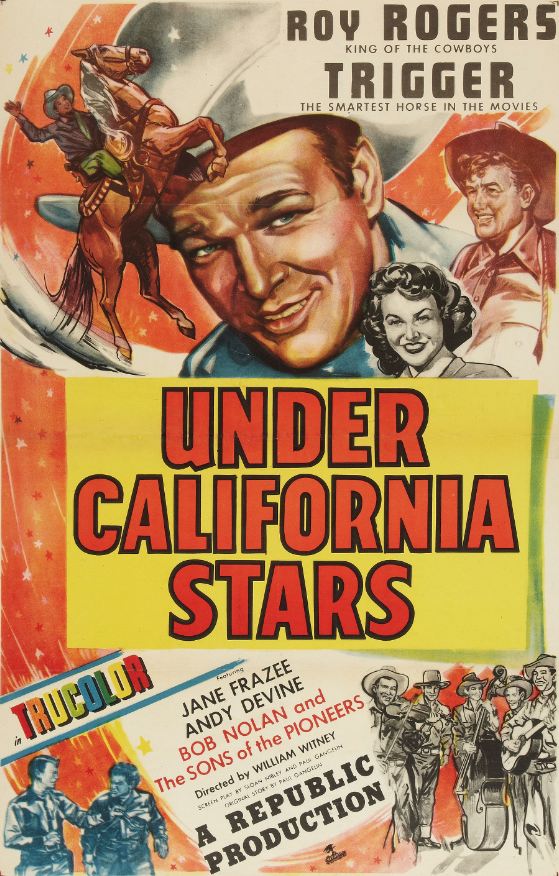
 Under California Stars is one of those “Trigger in peril” pictures in which Roy Rogers’s faithful palomino Trigger, “the smartest horse in movies,” faces terrible danger, and only his best friend Roy Rogers can make things right … with plenty of help from Trigger himself, of course. (Another “Trigger in peril” film, The Golden Stallion, was the subject of a NY Times piece in which Quentin Tarantino waxed rhapsodic about the film’s director. It’s a great article, and you can read it by clicking on this sentence.)
Like most Roy Rogers movies made in the post-war ’40s, Under California Stars was directed by William Witney, a veteran B-movie director born in 1915 who had nearly 40 westerns and serials under his belt by 1948.
Witney was a brilliant director of action. He was reportedly inspired by watching Busby Berkeley direct big musical numbers in which different takes were designed to be cut together for a coherent whole.
Before Witney’s innovative work on action serials, most directors would just train the camera on the stuntmen and let them do their thing, but Witney took a more active role, arranging action set pieces that incorporated elegant camera movements and effective cutting between actors and their stuntmen doubles.
The serials he directed for Republic Pictures were done on a tight budget and an even tighter timeline, so Witney often directed the action segments while his frequent collaborator John English handled the dialogue scenes. (Witney and English directed Adventures of Captain Marvel [1941], which I consider the greatest serial ever made.) Witney’s film work is a far cry from today’s hyperactive, chopped-to-hell action movies, but in many ways he is the father of the modern action movie.
Under California Stars isn’t wall-to-wall action, but the fight scenes are well-done, and like most Witney joints, it’s a classic example of good B filmmaking.
Like most Roy Rogers movies from the ’40s, Under California Stars blurs the line between Roy’s on-screen persona and his real life. He plays a character named “Roy Rogers,” who, when the film begins, is being told by his director, “Roy, you can be mighty proud of your ten years in pictures.” (Roy’s first starring role was in the film Under Western Stars, which was released on April 20, 1938.)
The action quickly shifts from Hollywood to the Double R Ranch, where Trigger and Roy are met by foreman Cookie Bullfincher (Andy Devine), as well as Bob Nolan and the Sons of the Pioneers, who sing a hymn to Roy’s good-natured greatness. Roy is also presented with a 10-year anniversary cake and does a radio broadcast from the Double R in which he sings “Dust,” one of the songs that made him famous.
But not everyone is thrilled to pieces about Roy Rogers and his marvelous horse. Lige McFarland (Wade Crosby) and his henchman Ed (House Peters Jr.) resent the handsome do-gooder and hatch a scheme to kidnap Trigger and ransom him for $100,000 … or else.
Under California Stars is a brisk, well-made Saturday matinee western with good songs and hard-hitting action. The whole film is currently uploaded to YouTube, and you can watch it by clicking on the link below. It’s also currently available to download from archive.org.
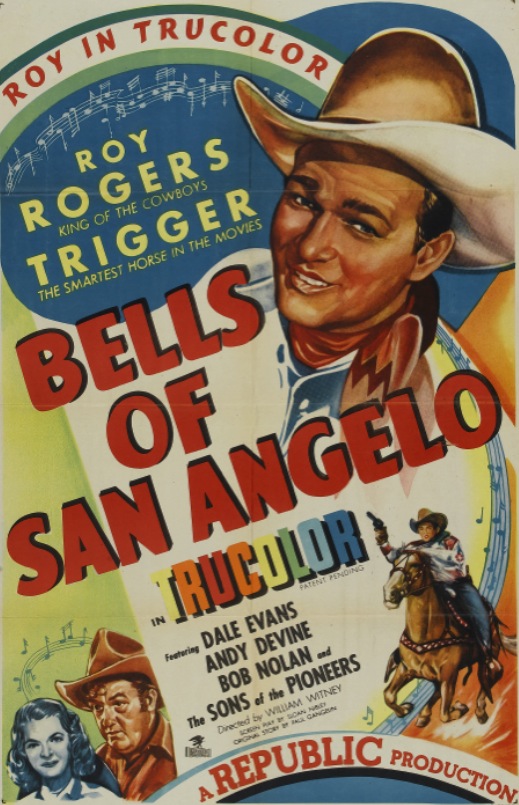
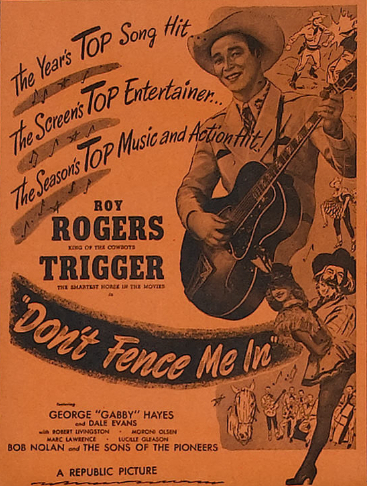
 A lot of men were drafted during World War II. Roy Rogers was one of them. With a 1-A classification, he expected to be shipped out in the spring of 1945. Consequently, screenwriter John K. Butler (working from a story by Leon Abrams) came up with a script to showcase Rogers’s leading lady, Dale Evans. When V-E Day rolled around, however, the draft board exempted men over the age of 30 who had children, so Rogers never had to serve. Director Frank McDonald’s Sunset in El Dorado ended up starring both “The King of the Cowboys” and “The Queen of the West,” but Evans is still the central figure, and it’s a great showcase for her sunny persona.
 There are no Navajos to be found in this run-of-the-mill Roy Rogers picture, or American Indians of any tribe, for that matter. The title comes from a popular song that was written by Dick Charles (a.k.a. Richard Charles Krieg), Larry Markes, and Edgar De Lange in 1945, and is sung by Rogers, Dale Evans, and the rest of the gang to close the picture. No, the only people of color in Along the Navajo Trail are Spanish-speaking Gypsies, who are portrayed in much the same way Mexicans were in Hollywood westerns except that they wear funny clothes, travel in wagons, and the men wear gold hoop earrings. They also provide George “Gabby” Hayes’s character with a series of comic interludes in which he attempts to cheat the Gypsies, and is in turn cheated himself. These horse trades don’t add much to the plot, but they do result in Hayes sputtering the memorable line, “I sure have gypped that gyppin’ Gypsy!”
 OCD Viewer