Tag Archives: Drama

The Clock (May 25, 1945)

TheClockThe Clock is the first film Judy Garland made in which she did not sing. She had specifically requested to star in a dramatic role, since the strenuous shooting schedules of lavish musicals were beginning to fray her nerves. Producer Arthur Freed approached her with the script for The Clock (also known as Under the Clock), which was based on an unpublished short story by Paul and Pauline Gallico. Originally Fred Zinnemann was set to direct, but Garland felt they had no chemistry, and she was disappointed by early footage. Zinnemann was removed from the project, and she requested that Vincente Minnelli be brought in to direct.

The Clock is the second film that Minnelli directed that starred Garland. The first was Meet Me in St. Louis (1944), which is one of the great American musicals, a big, Technicolor production with memorable songs and fine performances. It’s worth seeing, even if you’re not crazy about musicals. Minnelli and Garland were involved romantically during the filming of Meet Me in St. Louis, and they were married on June 15, 1945, shortly after The Clock was released.

The Clock seems like a deliberate attempt to make a film as different from Meet Me in St. Louis as Minnelli was capable of making. Filmed in crisp, luminous black and white, The Clock is an intimate story of two people. Cpl. Joe Allen (Robert Walker) is on leave in New York City for the weekend. While trying to find his way around Pennsylvania Station, he meets Alice Mayberry (Garland), a Manhattan “girl next door” who works in an office and isn’t initially thrilled that Joe takes in interest in her. She breaks her heel and he offers to help her, but he’s so pushy that it’s a bit of a turn-off. He refuses to take “no” for an answer, following her onto a bus, questioning her incessantly, and attempting to arrange to see her again. He also does it in such a naïve, corn-pone manner that it’s obvious that a polite girl like Alice would have a really hard time just telling him to shove off. Part of the problem, for me at least, is that Walker just doesn’t have the necessary charisma to pull off the “aw shucks” persona the script calls for and get away with it. In any case, after some indecision (and after ignoring her roommate’s advice that the young serviceman she met is “just looking for a pick-up”), she goes back to the Astor Hotel to meet him under the clock where they first met. They spend the entire night together, exploring New York City, and even end up helping a milkman (James Gleason) make his appointed rounds after a drunk (Keenan Wynn) punches him in the face, partially blinding him. Over the course of the night, they fall in love, but are separated on a busy subway the next morning. How will they ever find each other in a city of seven million people? (I don’t want to give anything away, but the way they find each other again won’t come as a surprise to anyone who’s been paying attention.) After they reconnect, Joe asks Alice to marry him, and she accepts his proposal, but they have to run through a mess of red tape to get the necessary documentation to get married immediately, before Joe has to ship out again.

The Clock has a lot to recommend it. Garland looks beautiful, and her performance is natural and engaging. Walker only has one mode, “wanting Alice,” but Garland wonderfully expresses confusion, excitement, and ambivalence on her path to falling in love. Also, the film does a good job of playing through the stages of love, from initial infatuation to full-blown romantic love, marriage, and even the quiet vicissitude of the “morning after.” The film looks fantastic. Minnelli recreated New York City on the MGM backlots in Culver City, California, mixing sets with stock footage, but I never realized this while watching the movie, and I live in New York. He reportedly spend almost $70,000 recreating Penn Station, and it certainly doesn’t look like a set. (The original Penn Station was torn down before I was born so I can’t say if it’s perfectly accurate, but it certainly fooled me.) I liked The Clock, and would recommend it to anyone who likes old movies, especially anyone who loves tales of wartime romance, but a more interesting actor than Walker in the lead role might have elevated it to a truly great film.

This is a love story, but it’s a melancholy one, especially during its second half. I’m not sure if the sense of sadness that pervades the film is by design, or is due to the fact that both stars were plagued with personal problems throughout filming. Garland became increasingly addicted to the prescription drugs the studio gave her to control her weight and perk her up, and Walker had recently found out that his wife, actress Jennifer Jones, had been cheating on him with producer David O. Selznick and wanted a divorce. Reportedly, Garland would often find Walker drunk in L.A. bars during filming and she would help him sober up during the night so he could appear in front of the cameras the next day.
The Southerner (April 30, 1945)

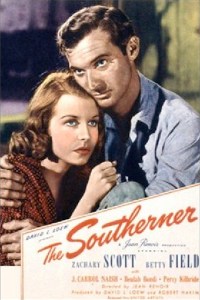
SouthernerFrench director Jean Renoir directed this adaptation of George Sessions Perry’s novel Hold Autumn in Your Hand, which won the first National Book Award in 1941. (The novel was adapted by screenwriter Hugo Butler, with uncredited contributions from Nunnally Johnson and William Faulkner.)

Zachary Scott, in a role originally intended for Joel McCrea, plays a Texas cotton picker named Sam Tucker who decides he doesn’t want to be a sharecropper anymore. He wants to grow his own cotton, harvest it, and be responsible for his own destiny. So he buys a piece of land and a ramshackle little house, and moves his wife (played by Betty Field), his children, and their crotchety grandmother onto it. Once there, the Tuckers must valiantly struggle against nature, disease, and their fellow humans to make a go of it.

The Southerner received three Academy Award nominations, including one for best director. Renoir didn’t win, but he was named best director by the National Board of Review, which also named The Southerner the third best film of 1945, after the World War II documentary The True Glory and Billy Wilder’s The Lost Weekend (which won the Oscar for best picture). Despite all these accolades, I was lukewarm about this picture. Scott is good in his role. His acting is understated, and he embodies “quiet dignity.” J. Carrol Naish is also very good as the villain of the piece, Tucker’s neighbor who seeks to destroy Tucker merely because of his inchoate hatred for anyone who tries to rise from his station in life. In fact, all the actors are good, except for perhaps Beulah Bondi, who hams it up a bit as Granny, a prickly pear if ever there was one. (Also, it might be hard for modern viewers to see her sitting in her rocking chair in the bed of a slow-moving pickup truck along with all the family’s worldly possessions and not think of The Beverly Hillbillies, which is unfortunate, since this film strives to be a realistic human drama.) My tepid reaction to the film is not related to any of the particulars, but rather to the overall feeling I had at the end. I just felt as if something was missing. Some essential component that would make me care about the characters and their situation more than I did.

Renoir is today best known for his French-language films like Grand Illusion (1937) and The Rules of the Game (1939), but he made a few English-language films besides this one. The first was Swamp Water (1941), which, like The Southerner, is about simple rural Americans. Perhaps my cool reaction to this film was due to the fact that I don’t find simple people as compelling as complicated people. Or maybe it’s just because the print I saw was kind of crummy. If the visual beauty of the countryside were allowed to shine through, maybe I would have liked it more. I’ve read that Renoir considered this his favorite American-made film. And, as I mentioned above, it was very successful with critics. So if this sounds like the kind of film you enjoy, then by all means you should see it. Meanwhile, I’ll be next door, watching a late ’40s film noir set in a big city about paranoid, sweaty people who aren’t quietly dignified in the slightest.

Blood on the Sun (April 26, 1945)

BloodSunJames Cagney made a big splash in William A. Wellman’s The Public Enemy (1931). It was his first starring role. Some people claim that when Cagney first walked on screen in that picture, it was the beginning of “modern acting.” Whether or not you believe that claim, there’s no denying the impact Cagney had on Hollywood, especially gangster films. The scene in which he shoves a grapefruit half into Mae Clarke’s face is iconic. Late in his life, Cagney claimed that people still sent grapefruits to his table in restaurants, with a wink and a nod. The Public Enemy ushered in a new era of onscreen violence, and an icon was born.
Cagney would go on to play many criminals, gangsters, and con men, in films like Smart Money (1931), Blonde Crazy (1931), Hard to Handle (1933), Picture Snatcher (1933), The Mayor of Hell (1933), Lady Killer (1933), He Was Her Man (1934), Angels With Dirty Faces (1938), Each Dawn I Die (1939), and The Roaring Twenties (1939). He was so good in these roles that when a lot of people hear the name “Jimmy Cagney,” they can only think of a sneering mug with a gat clenched in his fist and a cigarette dangling from his lower lip. But Cagney was a versatile actor. He also played cops, G-men, servicemen, and comedic roles, as well as singing and dancing in musicals. In fact, the only Academy Award he ever won was for his role in Michael Curtiz’s Yankee Doodle Dandy (1942), a drama and musical that told the life of George M. Cohan.

I think Cagney is a great actor with a unique style and personality. Anything he appears in is worth watching. Blood on the Sun was directed by Frank Lloyd, a Hollywood veteran who’d been making pictures since the silent era. It’s a wartime potboiler with a dubious MacGuffin; the Tanaka Memorial, an alleged strategic document from 1927 in which Prime Minister Baron Tanaka Giichi created for Emperor Showa a strategy to take over the world. It is believed by many historians to have been a forgery. In the ’30s and ’40s, however, the document was widely accepted as true. It was mentioned in Frank Capra’s agitprop documentary series, Why We Fight, and translations were published in Chinese and American periodicals. Of course, one reason why it was widely regarded to be an actual document is because Japan’s actions so closely mirrored the strategy that the Tanaka Memorial outlined; the conquest of Manchuria and Mongolia, followed by the invasion of China, the establishment of bases in the Pacific, and the eventual conquest of the United States. So although General MacArthur’s armies were unable to uncover any original Japanese-language versions of the Tanaka plan after World War II, perhaps its authenticity is beside the point.

In Blood on the Sun, which takes place in Tokyo in the late ’20s, Cagney plays an American reporter named Nick Condon. Condon writes for the Tokyo Chronicler, which is essentially a mouthpiece for the Japanese government, and is aimed at the Western business community. When Condon writes and publishes an article about a secret plan that outlines Japan’s plans for world domination, his editor tells him to print a retraction. He refuses, and the Japanese secret police plant a false story in the newspaper designed to discredit Condon. When Condon still refuses to back down, the Japanese secret police raise the stakes by murdering two of Condon’s friends, whom they believe are smuggling a copy of the Tanaka plan out of the country. Eventually, the film becomes a cat-and-mouse espionage thriller, with Condon on the run with a “half-breed” named Iris Hilliard, played by Sylvia Sidney, who is originally sent by the secret police to ingratiate herself to Condon and find out if he has a copy of the Tanaka plan. (Since Sidney is a white actress in yellowface makeup, I wasn’t clear for awhile which two races she was supposed to be descended from. One is Chinese, but I could have sworn that at one point, another character described her as being half Japanese/half Chinese. Her surname, however, implies that her father was British or American. So I must have misheard the line of dialogue.) Besides the questionable historical accuracy of Blood on the Sun, the white actors playing Japanese roles will probably be the hardest thing for modern audiences to swallow. John Emery, who plays Tanaka, and Robert Armstrong, who plays Col. Hideki Tojo, are not the worst examples of yellowface I’ve ever seen, but with their indeterminate, lisping accents, they’re still pretty bad. Blood on the Sun isn’t a particularly racist film, however, especially when one considers the context in which it was made. All of its villains are representatives of the Japanese government, which committed horrifying atrocities during World War II, and with whom the United States was still at war when this film was made. Several of the actors in smaller roles are actually Asians (although it’s unlikely that too many, if any, are actually Japanese).

The main reasons to see this film today, aside from historical curiosity, are the performance of Cagney and the well-choreographed fight scenes. Blood on the Sun won a single Oscar at the 18th Academy Awards in 1946, for best art direction in a black and white film, but it should have won for “most awesome martial arts battle in an American film.” Sadly, such a category did not exist. How could it? Martial arts were new to Hollywood. Some people cite John Frankenheimer’s The Manchurian Candidate (1962) as having the first real martial arts fight scene in an American film, which is clearly not the case. Frank Sinatra and Henry Silva’s karate chops were fine, but they pale in comparison to the brutal judo smackdown that crowns Blood on the Sun. Cagney studied judo for this film, and liked it so much he kept it up for most of his life. How could he not? A born-and-bred brawler, Cagney clearly took to martial arts like a fish to water. The combination of judo throws and boxing as he fights the leader of the secret police, Capt. Oshima, played by Jack Sergel (who acted under the stage name “John Halloran”), is fairly basic by today’s standards, but it’s still impressive. Cagney and Sergel go to the ground several times, and the chokeholds and arm bars look as if they hurt. So do the throat punches. Sergel was actually my favorite actor in the film after Cagney. He’s tall, menacing, and has a shaved head and black mustache. He doesn’t look particularly Japanese, but he’s more convincing as an Asian than any of the other white actors in the film. Sergel was a former LAPD officer who had been investigated by the FBI because of his involvement with the sport of judo, including his participation in at least one judo tournament that was held in a Japanese internment camp. Even though he was a Los Angeles police sergeant and loyal American citizen, his admiration for Japanese culture and sport was seen as suspicious by federal and local authorities, and he ended up resigning from the LAPD in 1944. Cagney spends a lot of his time in this film punching, kicking, and throwing the bad guys who come after him, but his fight with Sergel is the high point. Cagney was a small man, and Sergel towers over him, but Cagney’s sheer physicality makes you believe they’re evenly matched.

Son of Lassie (April 20, 1945)

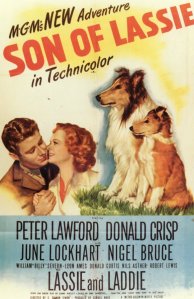
SonofLassieSon of Lassie could just as easily have been called Laddie Goes to War! In this follow-up to Lassie Come Home (1943), which starred Roddy McDowall and Elizabeth Taylor, Lassie has a son, named Laddie. Laddie grows ups, as does young Joe Carraclough, who was played by McDowall in the first film, but is here replaced by future Rat Pack member and Kennedy spouse Peter Lawford, whose slightly deformed arm kept him out of World War II. Joe joins the army, and Laddie tries to join up with him, but he cringes the first time blank cartridges are fired at his face, which disqualifies him as a canine soldier. When Joe is taken prisoner of war in Norway, however, Laddie … well, I don’t want to give anything away. (But if you’ve ever seen a “boy and his dog” movie before, you can probably predict what will happen.)
Various locations in Canada and the Colorado Rockies were used to replicate Norway. Never having been to Norway, I can’t say how well the substitutions work, but they are gorgeous, and look like something out of a storybook. If all you’re looking for is a beautiful Technicolor travelogue, Son of Lassie fits the bill.

I, on the other hand, was looking for something more. I am a huge dog lover, but I found Laddie to be a charmless buffoon. Also, all collies look alike to me, so his scenes with his mother Lassie were really confusing. Interestingly–and I didn’t know this until after I saw this movie–both Lassie and Laddie were played by the same dog, Pal, the male collie who played Lassie in Lassie Come Home. (For the scenes in this film in which Laddie appears with his mother, another collie filled in as Lassie.) Apparently every single dog who has played Lassie on film has been a descendant of Pal. Perhaps Laddie’s general dopiness isn’t Pal’s fault. It could just be the way the character is written. The same could be said for Joe, who also comes off as a bit of a dope. On the other hand, they are well suited for each other. Both are naive and somewhat incompetent, not to mention the fact that they sleep together, eat together, and share a bond that would be homoerotic if they weren’t from different species. Son of Lassie is a decent flick for kids, especially kids who love dogs, but the flat acting and bad dialogue don’t make it a first choice to rent for adults.

Hangover Square (Feb. 7, 1945)

Hangover_square
Hangover Square (1945)
Directed by John Brahm
20th Century-Fox

Laird Cregar’s is a sad story. A brilliant character actor, Cregar died in December of 1944 as a result of a crash diet that most likely included amphetamines. Cregar shed approximately 100 pounds in a short space of time in an attempt to reinvent himself. Reinvention is a hard business, and no more so than in the studio-controlled Hollywood of the ’40s. Firmly established as a towering, 300-pound, sympathetic (and often childlike) heavy, Cregar’s notion that he could shed his tonnage, get plastic surgery, and reinvent himself as a romantic leading man was delusional.

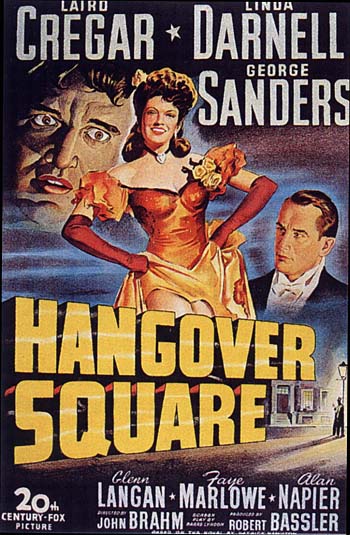
Hangover Square is a follow-up of sorts to The Lodger (1944), in which Cregar played a highly fictionalized version of Jack the Ripper. Both films were directed by John Brahm, and both feature sympathetic depictions of mentally ill characters who are compelled to kill. In Hangover Square, Cregar plays a composer named George Harvey Bone, a man who is struggling to complete his masterpiece (an effective if not totally convincing concerto composed by Bernard Herrmann, who also composed the film’s incidental music). However, Bone suffers from a bizarre condition that causes him to black out when he hears loud, discordant noises. In these fugue states he may or may not be committing murders. His energy and creativity are reinvigorated, however, when he meets a beautiful singer, played by Linda Darnell. Unsurprisingly, she leads him on and then does him wrong, which frays his last shred of sanity to the breaking point.

Hangover Square was based on a novel by Patrick Hamilton. The novel was published in 1941 and took place in the late ’30s. I’ve never read it, but apparently it’s a black comedy, and there’s a lot of thematic material about the rise of fascism in Europe. Not much of that stuff made it into the film. Originally the film was supposed to be set in the present day, but it was changed to the late Victorian era, presumably to capitalize on the success Brahm and Cregar had had with The Lodger. Both films are very good, and worth seeing, but Hangover Square is more of a mess than its predecessor. Herrmann’s score, as well as the music he writes that’s meant to be composed by Bone, makes the film feel very contemporary, and the Victorian setting isn’t handled very well. What Hangover Square does have going for it, besides Cregar’s performance, are a couple of incredibly striking scenes, both involving fire, that will stick with a lot of viewers.

It’s a shame that Cregar died when he did. He hadn’t even hit 30 when he passed away (although he could play much older). Even in minor roles he always made an impression. Had he lived, would he have been the gay (or at least gayish) Orson Welles? We’ll never know. In his last role, he’s not what anyone would call “svelte,” but the weight he had lost is noticeable. He appears diminished, haunted, and on the verge of being destroyed. It’s a masterful performance in a pretty good film, and one worth seeing.

I’ll Be Seeing You (Jan. 5, 1945)

I'll Be Seeing You
I’ll Be Seeing You (1944)
Directed by William Dieterle and George Cukor
Selznick International Pictures / United Artists

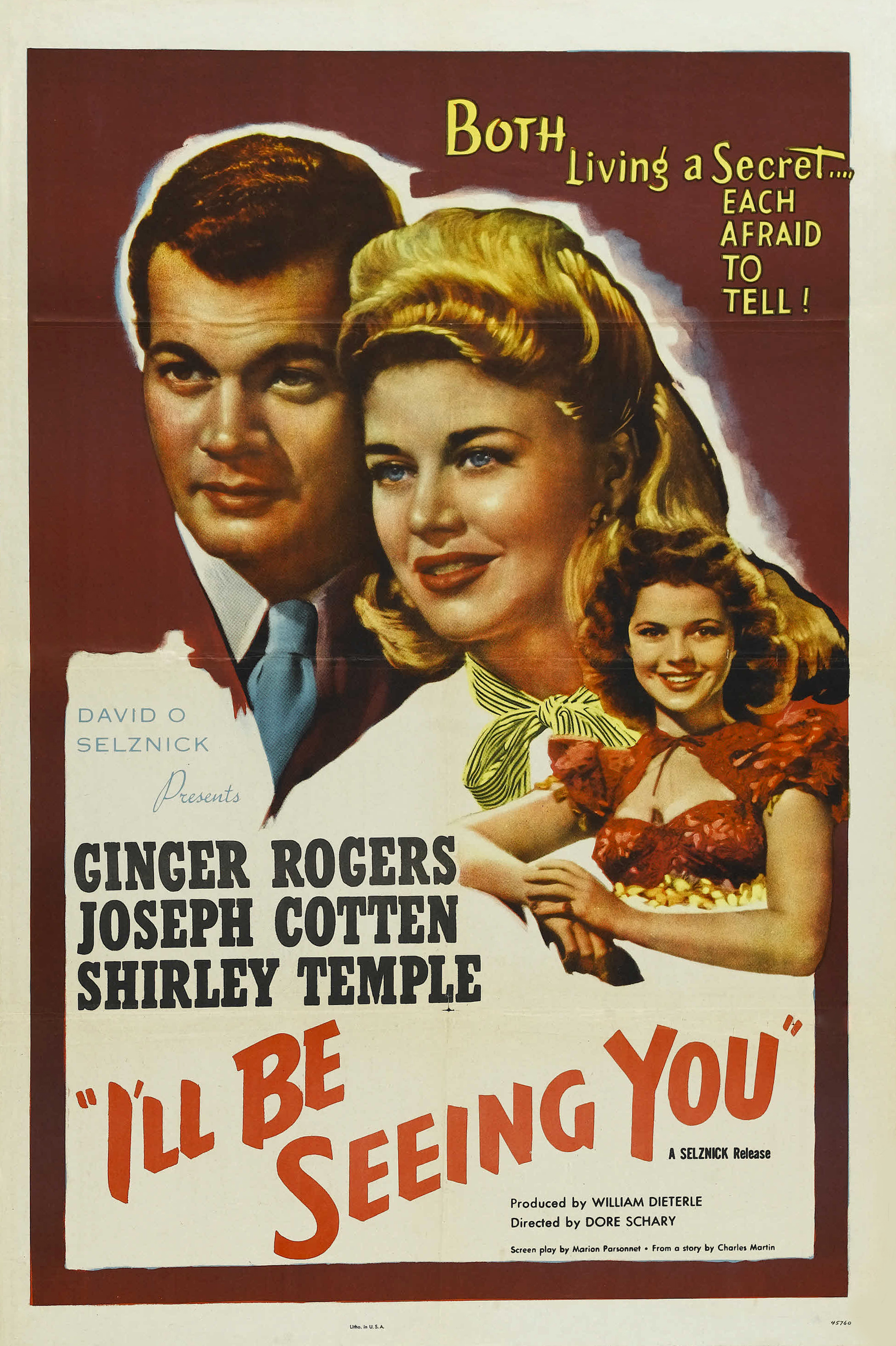
William Dieterle directed this film, which is a David O. Selznick production starring Joseph Cotten as a shellshocked Army officer on leave and Ginger Rogers as a prisoner on an eight-day furlough.

Based on a radio play called “Double Furlough,” I’ll Be Seeing You is bittersweet and beautifully acted. The nature of Rogers’s crime is not explained until well into the film, and Cotten’s mental condition is hinted at, but not made explicit until the viewer has gotten a chance to know the characters.

The film overall is great, but there’s one scene in particular that really stayed with me. Cotten and Rogers go to a flag-waving war movie and the camera stays on his face while the viewer hears the sounds of explosions, gunfire, and screaming. Cotten holds his hand to his chin, desperately trying to keep his composure during the date. It’s an upsetting scene, and it’s surprising to see such a realistic, sensitive portrayal of post-traumatic stress disorder in a film made while American involvement in World War II was at its peak.

I’ll Be Seeing You beautifully depicts a fragile, growing romance between two likable people who each have something they desperately try to hide from the other. Not only is this a beautifully told love story, it’s also a great story about how hard it is to trust someone else, even when your happiness and sanity both depend on it.