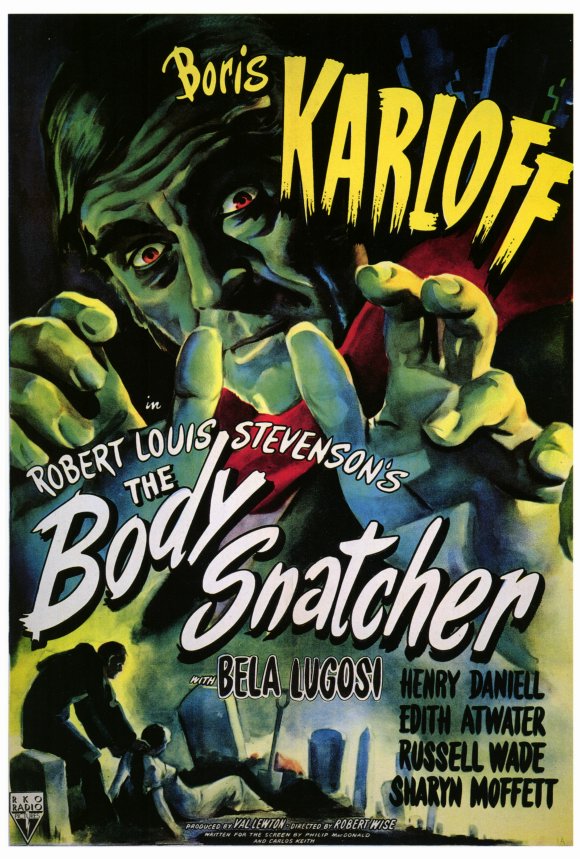
The Body Snatcher (1945)
Directed by Robert Wise
RKO Radio Pictures
The Body Snatcher is based on Scottish author Robert Louis Stevenson’s short story of the same name, which was first published in December 1884. Stevenson’s story was inspired by a crime well-known to Scots to this day; the Burke and Hare murders. Burke and Hare were two Irish immigrants who sold corpses to Dr. Robert Knox for use in his dissection experiments in 1827 and 1828, and were symptomatic of a time when scientific curiosity was outpacing social and religious squeamishness. Prior to the Anatomy Act 1832, the only bodies that doctors could legally dissect were those of executed criminals. There were simply not enough executed criminals to fill the needs of medical schools, however, especially with the decline in executions in the early 19th century, so doctors and anatomy students frequently turned to sellers of corpses on the black market. Most of these sellers simply dug up freshly buried bodies, but Burke and Hare went an extra step, saving time by smothering people to death and selling their bodies. In the film, set in Edinburgh in 1831, the “Dr. K.” of the story becomes Dr. Wolfe MacFarlane (played by Henry Daniell), a respected surgeon who relies on the ghoulish cabman John Gray (played by Boris Karloff) to provide him with the corpses he needs to experiment on before he can cure crippling ailments. In a typical move for a film of this time, there is also a blandly handsome young doctor (played by Russell Wade), who adds little to the proceedings, merely existing to show the idealistic, humane, and optimistic face of medicine. The meat of the film is the twisted and symbiotic relationship between Gray and Dr. MacFarlane, whom Gray constantly calls “Toddy,” an old nickname that the doctor hates.
The Body Snatcher was produced by Val Lewton, who is one of the few producers to have survived the advent of the Auteur theory and emerge better remembered than many of the men who directed his films. A novelist, screenwriter, and producer, Lewton was a talented purveyor of horror and dread. He methods were suggestion and atmosphere, and he avoided cheap shocks and grotesque makeup. His monsters didn’t look like monsters, and the terror his films conveyed was largely psychological. And when horrific events did occur in his films, they did so mostly off screen. They delivered chills through the power of suggestion, and occasionally a stream of blood flowing under a door.
Prior to making The Body Snatcher, which was directed by Robert Wise, Lewton had a string of low-budget horror hits for RKO, all of which are currently available on DVD and are considered minor classics; Cat People (1942, directed by Jacques Tourneur), I Walked With a Zombie (1943, dir. Jacques Tourneur), The Leopard Man (1943, dir. Jacques Tourneur), The Seventh Victim (1943, dir. Mark Robson), The Ghost Ship (1943, dir. Mark Robson), and The Curse of the Cat People (1944, dir. Gunther von Fritsch and Robert Wise), which was originally supposed to be called Amy and Her Friend, and has only a tangential connection to the original Cat People. He had also produced two non-horror films, Mademoiselle Fifi (1944, dir. Robert Wise) and Youth Runs Wild (1944, dir. Mark Robson).
Lewton was under a few strict edicts from RKO when making his famous horror films; each had to come in at under 80 minutes long, each had to cost no more than $150,000, and the title of each would be provided by Lewton’s supervisors, which could explain why an intelligent, understated, and artful film like I Walked With a Zombie has the lurid title that it does. After the success of Cat People, however, which was made for $134,000 and grossed nearly $4 million, the studio interfered little with Lewton’s scripts and productions, generally allowing him to make exactly the kind of picture he wanted, as long as he brought it in under budget. I’ve felt for a long time that Lewton, who was a mostly unsuccessful novelist and journalist before he got into the movie business, felt as if he was better than the cheapjack films he produced. He may have been a master of the power of suggestion, but sometimes his films just feel too removed from the world of horror that they depict. I’m not saying that Lewton’s pictures would be better if they were awash in blood and guts, but sometimes they feel clinical and distant.
Along with I Walked With a Zombie, The Body Snatcher is one of my favorite Lewton pictures, due in no small part to Karloff’s brilliant performance. While the film itself can be stagy, Karloff’s performance is not. Each line he speaks drips with malevolence, while still showing the twisted humanity hidden somewhere deep inside. Gray is a man past redemption. One of the first things he does in the film is use a shovel to kill a little dog who is guarding its young master’s grave. That Karloff can create a somewhat sympathetic character from what he’s given is nothing short of phenomenal. I can think of few actors who are able to do what Karloff does with monstrous characters. (Anthony Hopkins in The Silence of the Lambs is the only person who immediately springs to mind.) Part of the success of Karloff’s performance lies in its nuances. He interacts with nearly every character in the film–Dr. MacFarlane, his young assistant, a little crippled girl (played by Sharyn Moffett), a pathetic servant named Joseph (played by Bela Lugosi)–and is a subtly different person in each scene.
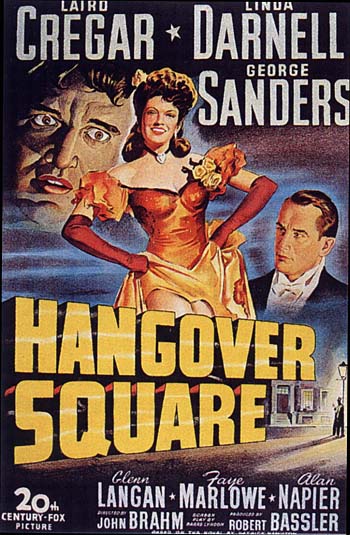
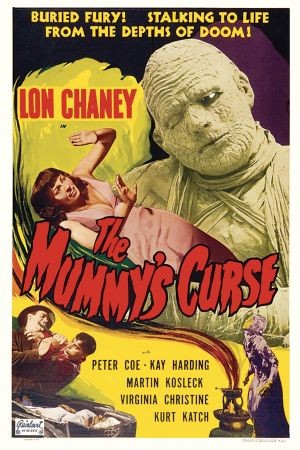
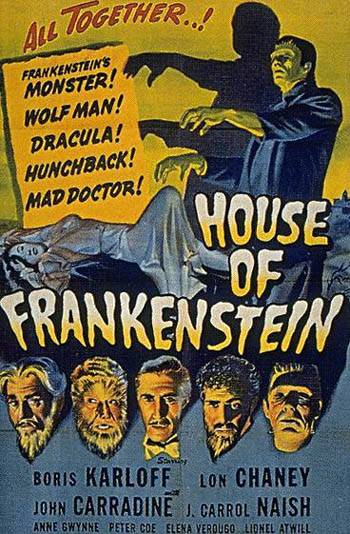 In an effort to more deeply penetrate the pop culture of the 1940s and 1950s, I’ve been listening to radio shows and watching old movies pretty much in the order they were released. I’ve been doing this for awhile, but since we have to start somewhere, we’re starting on December 1st, 1944. World War II was in full swing in both Europe and the Pacific, and a little film called House of Frankenstein was released in theaters in the United States.
 OCD Viewer