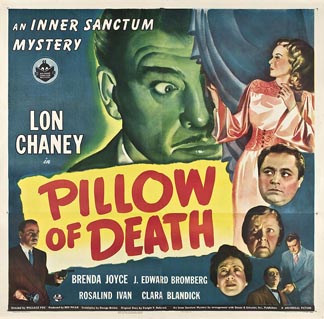
 Wallace Fox’s Pillow of Death, the sixth and final film in the Inner Sanctum Mysteries series, is a haunted house mystery, the kind that Charlie Chan and the Crime Doctor excelled at solving. It lacks the ghoulish fun of the Inner Sanctum radio show, and it’s the least memorable of the film series.
The film begins when attorney Wayne Fletcher (Lon Chaney, Jr.) drops his secretary Donna Kincaid (Brenda Joyce) off at her family home after another late night of preparing briefs at the office. The crotchety patriarch of the family, Sam Kincaid (George Cleveland) grumbles, “The Kincaid women never worked,” which is funny, considering the fact that his sister Belle (Clara Blandick) waits on him hand and foot, and he employs Amelia Kincaid (Rosalind Ivan), a poor relative from England, as his housekeeper.
When Fletcher returns home, the police are waiting for him in his living room. Capt. McCracken (Wilton Graff) and his men acted on a tip from a spiritualist named “Julian” (J. Edward Bromberg), who is sitting in Fletcher’s rocking chair like he owns the place. The police inform Fletcher that Julian had a psychic presentiment that one of his adherents, Mrs. Fletcher, had come to harm. When the police arrived at the Fletcher home, they found her murdered corpse. Fletcher is now the prime suspect.
After he’s questioned and released, Fletcher goes to the Kincaid home, as does Julian, and most of the rest of the film takes place there. Donna’s amorous teenaged neighbor Bruce (Bernard Thomas) keeps popping up, skulking around the grounds and saying little, as the bodies start piling up. The haunted house clichés come fast and furious, including a séance presided over by Julian, which gives the roly-poly character actor Bromberg free rein to tilt his head back, roll his eyes up in his head, and speak very, very slowly. It’s not quite entertaining enough to be called “campy,” but it comes close.
Unlike the previous films in the series, the supernatural element is poorly handled and its role in the story is never fully explained. In other Inner Sanctum films, and on the radio show, any supernatural hokum was usually debunked and explained away. Like pulling the mask off the monster at the end of Scooby-Doo, the explanations were sometimes preposterous, but they were usually clever, or at least fun. And since Pillow of Death a straightforward mystery, the lack of explanation seems more like a product of lazy writing than anything else.
Also, with a title like Pillow of Death I was expecting something more overtly supernatural, like a pillow cursed by Satan, or a talking pillow, or possibly even a pillow with a hole in it full of sharp teeth. Instead, an ordinary pillow is used at one point as a murder weapon, in an attempt to smother someone, but that’s it. Given the pillow’s limited role in the film, the title seems almost like a joke.
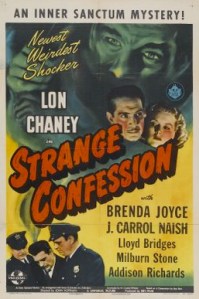 Apparently populist rage against pharmaceutical giants is nothing new. In Strange Confession, the fifth of six “Inner Sanctum Mysteries” produced by Universal Pictures and released from 1943 to 1945, Lon Chaney, Jr. plays a brilliant chemist named Jeff Carter whose life goes from bad to worse when he twice accepts employment from the unscrupulous owner of the largest medical distributing company in an unnamed American city.
 Media tie-ins are nothing new. Radio’s Boston Blackie, a long-running syndicated show about a (mostly) reformed jewel thief and amateur sleuth, got its start as a series of short stories, then silent films, then talkies, before being adapted for radio. And big-screen adaptations of radio series were commonplace. The Whistler, The Great Gildersleeve, Fibber McGee & Molly, The Green Hornet, The Lone Ranger, and I Love a Mystery all led to multiple film adaptations, not to mention the many radio series that were adapted from other media, like dime novels or the daily comic strips, that went on to be films.
 OCD Viewer