Tag Archives: Mystery

The Missing Corpse (June 1, 1945)

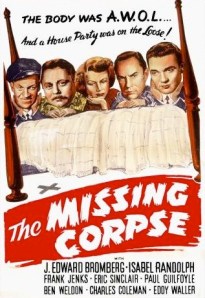
MissingCorpseThis movie is sort of like Weekend at Bernie’s, if the object in that film had been to keep Bernie’s body hidden and constantly on the move so no one could find it.

J. Edward Bromberg, a hard-working character actor, gets a rare chance to star in a film. He plays an upstanding newspaper publisher named Henry Kruger who threatens rival publisher Andy McDonald (played by Paul Guilfoyle) after McDonald splashes a tawdry story about Kruger’s daughter all over the front page of his daily paper. McDonald turns out to also be a blackmail magnate, and when one of his victims rubs him out, his body winds up in the trunk of Kruger’s car. Most of the film involves the increasingly perplexed Kruger’s attempts to deep-six the body so he won’t be accused of a crime he didn’t commit. The only problem is, the body won’t stay in one place for very long. Who’s moving it? And why?

The Missing Corpse is a fun mix of comedy and suspense. Like most of the output from P.R.C., it’s a quick, low-budget diversion, and little more, but it’s still a light-hearted and fun hour and one minute. As far as MacGuffins go, a dead body is a pretty good one, and P.R.C. certainly released worse films into theaters in the ’40s.

The Frozen Ghost (June 1, 1945)

FrozenGhostMedia tie-ins are nothing new. Radio’s Boston Blackie, a long-running syndicated show about a (mostly) reformed jewel thief and amateur sleuth, got its start as a series of short stories, then silent films, then talkies, before being adapted for radio. And big-screen adaptations of radio series were commonplace. The Whistler, The Great Gildersleeve, Fibber McGee & Molly, The Green Hornet, The Lone Ranger, and I Love a Mystery all led to multiple film adaptations, not to mention the many radio series that were adapted from other media, like dime novels or the daily comic strips, that went on to be films.

The radio drama Inner Sanctum Mysteries, which was produced by Himan Brown, premiered in 1941 and ran for more than 10 years. An anthology thriller program, its scripts weren’t quite as clever as The Whistler, and it didn’t regularly feature A-list Hollywood talent like Suspense, but it was an effective show. While rarely out-and-out supernatural, it tended more toward the macabre than other programs of its type. Its jealous husbands, scheming wives, and escaped lunatics were flesh and blood, but its settings — crumbling churchyards, decrepit mansions, and dark and stormy nights — could have done double duty in horror stories.

One of the things that made the show stand out was its host, Raymond Edward Johnson (who simply went by the name “Raymond” on the show), and the memorable sound effect of a creaking door that opened each program. Raymond prefigured TV horror hosts like Zacherley, Elvira, and Ghoulardi with his macabre, tongue-in-cheek humor. A typical program began like this:

“Good evening, friends. This is your host, Raymond. Welcome to the inner sanctum. Come in, won’t you? What are you staring at? The walls? Well, you know that old saying about walls having ears? Well, these walls have eyes, and a nice assortment of fingers and hands. One of them has a heart, but you can’t beat that. Don’t mind me, friends, in my old age I’m getting to be a bit of a gore.”

Raymond’s mocking delivery made it clear that none of it was meant to be taken seriously. Part of the pleasure of listening to the programs in 1945 and 1946, when Lipton Tea was the sponsor, was listening to the host’s exchanges with Mary, the Lipton Tea and Lipton Soup girl, whose sunny disposition he frequently ridiculed, and who in turn expressed shock and dismay at the gloomy goings-on the show dramatized. (When Raymond left the show in May 1945 to serve in the Army, he was replaced with Paul McGrath, who never stated his name. The format of the show and his relationship with Mary, however, were pretty much the same as Raymond’s.)

From 1943 to 1945, Universal Pictures released six “Inner Sanctum Mysteries.” They were all low-budget B pictures starring Lon Chaney, Jr., all clocking in at under 70 minutes, each designed to be the second half of a double bill. Calling Dr. Death (1943) was followed by Weird Woman (1944), Dead Man’s Eyes (1944), and The Frozen Ghost. All of these films are entertaining (especially Weird Woman), but compared with the radio show, they’re missing some of the ghoulish fun. They’re always introduced the same way … not by Raymond or someone like him, but by a head floating in a crystal ball that speaks as though its owner is on a heavy dose of Thorazine.

The Frozen Ghost features Chaney as a famous mentalist who watches a man die during his act. He believes he caused the man’s death with his hypnotic gaze, and goes into seclusion to a wax museum, of all places. When a woman dies after a hypnosis session there, he’s convinced he’s a psychic killer, but then her body disappears. What gives? Unlike the first three films in the Inner Sanctum series, The Frozen Ghost is a bit of a mess, but scream queen Evelyn Ankers is always a welcome sight, and at one hour and one minute, the picture doesn’t really overstay its welcome.

Chaney was born Creighton Chaney, but started being billed as “Lon Chaney, Jr.” in 1935. As an actor, he is the antithesis of his father, who was one of the most brilliant chameleons in film history, and one of the finest actors of the silent era. Chaney, Jr., on the other hand, acted exactly the same in every movie, like a hulking man-child who appeared to be staggeringly hungover in every scene. I enjoy plenty of films he appears in, but he’s not a great actor. To its credit, the Inner Sanctum series makes good use of him. In the four films I’ve seen so far, he always plays a character who is at the mercy of forces outside of his control, which requires him to appear bewildered, upset, and terrified, which he’s pretty good at doing.
The Lady Confesses (May 16, 1945)

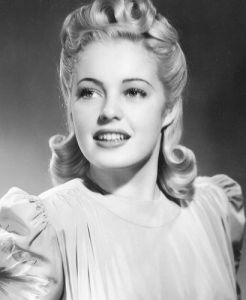
HughesMary Beth Hughes appeared in dozens of films from 1939 onward as a second- or third-billed actress (including films in the Charlie Chan, Cisco Kid, and Michael Shayne series), but in director Sam Newfield’s P.R.C. production The Lady Confesses she gets to strut her limited but charming stuff in a lead role. A natural redhead, Hughes usually appeared onscreen as a platinum blonde. Her round cheeks, big eyes, and moxie made up for what she lacked as a thespian.
When The Lady Confesses begins, Vicki McGuire (Hughes) receives a visit from a woman named Norma (Barbara Slater), who turns out to be the wife of Vicki’s fiancé, Larry Craig (Hugh Beaumont). Norma has been missing for seven years and was presumed dead. Nasty Norma tells little sweetheart Vicki that she won’t let anyone marry her Larry, even though she doesn’t care for him one bit. Vicki runs off to find Larry, who has been stumbling around a nightclub, three sheets to the wind, generally making an ass of himself. When she finds him and wakes him up, they go to Norma’s apartment to sort things out with her. When they arrive, however, the place is lousy with cops, and Norma lies dead, strangled with a piece of wire. To convince the police of his innocence, Larry takes them to the club where he had been dead drunk for the past several hours. Everyone there admits having seen him, except for the club owner, the shady Lucky Brandon (Edmund MacDonald), who denies having seen Larry, even though Larry had talked to him and asked him for permission to sleep it off in his office. Later, under police questioning, Brandon admits he knew the dead woman, and that she had lent him $10,000 to start up the club, and had recently returned to collect interest on the loan. Suspicious of Brandon, Vicki goes undercover in his club. She waits tables, sings a few songs, and even begins to feel herself falling under his dangerous sway.

The Lady Confesses is an average bottom-of-the-bill noir, but it moves at a nice clip and Hughes is cute. Also, you get to see Beaumont (who would go on to play everyone’s favorite sitcom dad, Ward Cleaver) act totally wasted for the first 10 minutes, which is fun.

A note on the title of the film; contextually it makes no sense. Both Ladies of the Night and Undercover Girl were considered. The first might have implied that the film was about prostitutes. The second actually would have been fitting. But I suppose the point is to get asses in the seats, not to give people an accurate idea of what they’re going to be seeing, especially when it’s a Poverty Row production.

Strange Illusion (March 31, 1945)

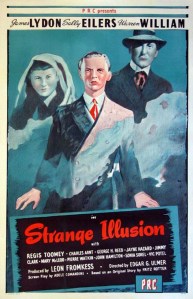
StrangeIllusionEdgar G. Ulmer was born in 1904 in Olmütz, Moravia, Austria-Hungary (now part of the Czech Republic). Like a number of talented German and Austrian directors, he moved to the United States in the ’20s and began working in Hollywood. Unlike better-known directors like Billy Wilder or Fritz Lang, however, Ulmer toiled in obscurity for most of his career, cranking out no-budget films. At least part of this was due to the fact that he was blackballed after he had an affair with Shirley Castle, who was the wife of B-picture producer Max Alexander, a nephew of powerful Universal president Carl Laemmle. Castle divorced Alexander and married Ulmer (becoming Shirley Ulmer), but the damage to Ulmer’s career was done. He spent most of the rest of his career churning out product for P.R.C. (Producers Releasing Corporation) Studios, one of the financially strapped Hollywood studios collectively referred to as “Poverty Row.”
Today, Ulmer is best known for two films, The Black Cat (1934) and Detour (1945). I’ve seen the former, but not the latter. The Black Cat stars Boris Karloff and Bela Lugosi, and is one of the more memorable and strange Universal horror pictures. It was a big box-office success, too. I haven’t seen Detour yet, but it has a reputation as one of the best low-budget noirs.

Strange Illusion, which Ulmer made for P.R.C. early in 1945, is a mixed bag. Ulmer’s ideas are clearly larger than the short shooting schedule, low budget, and B-grade actors can support. James “Jimmy” Lydon (on loan from Paramount) plays a young man named Paul Cartwright, whose late father was once the governor of California. The film opens with a stunning, Freudian dream sequence in which Paul walks with his young, attractive mother through clouds of smoke. A menacing, dark man whose face cannot be seen walks with them. He seems to have designs on Paul’s mother. Then the mysterious automobile accident in which Paul’s father died is replayed. It’s a fantastic sequence, and grabs the viewer right away. Much of what follows is prosaic, but not bad. There are a lot of great shots of Paul and other characters that incorporate an enormous portrait of the late Mr. Cartwright, towering over his survivors as though he is passing judgment on them from the afterlife. Warren William is very good as Paul’s mother’s fiancé, and he brings the right balance of charm and menace to his role. Lydon, on the other hand, really irritated me, and some of the youthful “jive” talk he has with his girlfriend is pretty stilted and painful. There’s also a little too much plot for the film’s brief running time. If by the end of this picture you haven’t figured out that this is Ulmer’s teen-oriented take on “Hamlet,” then, brother, you never took a comp lit class. Overall, Strange Illusion isn’t bad, but it’s recommended only if you really enjoy B movies from the ’40s.

Horror fans are encouraged to check out The Black Cat, as well as Bluebeard, a dreamy and beautiful horror movie Ulmer made for P.R.C. in 1944. It stars John Carradine as a homicidal puppeteer in 19th century Paris.

The House of Fear (March 16, 1945)

Even when it’s pretty easy to figure out the solution to the mystery, as is the case here, the Sherlock Holmes pictures starring Basil Rathbone and Nigel Bruce are well-oiled machines; exceedingly well-made, and a joy to watch. Directed by Roy William Neill, The House of Fear is loosely based on Sir Arthur Conan Doyle’s story “The Five Orange Pips,” and is the tenth film that Rathbone and Bruce made together in the Sherlock Holmes series. It tells the farfetched story of a group of curmudgeonly old friends who call themselves “The Good Comrades,” and spend most of their time together as a club in a remote area of Scotland (in a creepy old castle, natch). After one man receives a single orange seed in an envelope at dinner one night, he is murdered. And then it happens again to another member of the club. And again. Oh, and did I mention that each member of The Good Comrades has an insurance policy with all the other members listed as beneficiaries? Sounds like a job for Sherlock Holmes…

The Hound of the Baskervilles (1939) was the first film that featured Rathbone as Holmes and Bruce as his faithful sidekick Dr. Watson, and it set the tone for the series beautifully. If you’re a fan of English mysteries, I can’t recommend it highly enough (even though it’s an American production, it gets most of the details right). Their second film, The Adventures of Sherlock Holmes (1939) is also a doozy. It’s probably my favorite in the series, owing in no small part to George Zucco’s brilliant performance as the cunning Professor Moriarty. After the first two, I found the next few Rathbone/Bruce films, Sherlock Holmes and the Voice of Terror (1942), Sherlock Holmes and the Secret Weapon (1943), and Sherlock Holmes in Washington (1943), a bit of a letdown. The setting was changed to the present day, and the films contained a good amount of World War II-era propaganda. Worst of all, someone decided that Rathbone’s hair should be combed forward. This might seem like a minor detail, but Rathbone, with his aquiline nose and intense gaze, is the very embodiment of Holmes when his hair is slicked back. With his hair combed forward he looks as if he’s wearing a curly pageboy wig.

The series hit its stride again with Sherlock Holmes Faces Death (1943). Not only was Rathbone’s hair restored to its full Holmesian glory, the Conan Doyle story “The Adventure of the Musgrave Ritual” was adapted to a more temporally indeterminate setting. It may have been “the present day,” but the wartime propaganda was jettisoned, and aside from automobiles and telephones, it could have been the Victorian era. Holmes was Holmes again. This film and the three that followed in 1944, The Spider Woman, The Scarlet Claw, and The Pearl of Death, are all fantastic.

In total, Rathbone and Bruce made 14 full-length features together as Holmes and Watson, and they appeared together for years on the Sherlock Holmes radio show. For many people, Rathbone and Bruce simply are Holmes and Watson. Rathbone was often cast as the villain, a role he played well (e.g., in The Adventures of Robin Hood [1938] opposite Errol Flynn), but when I think of Rathbone, I think of a brave, brilliant, and heroic detective.

The Jade Mask (Jan. 26, 1945)

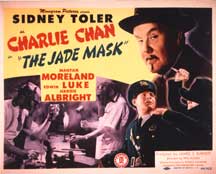
Phil Rosen directed this rather strange entry in the rather strange Charlie Chan series. The mystery writer Earl Derr Biggers created the Chan character as a Chinese-American, Honolulu-based police detective. The character was in some ways a corrective to “yellow peril” characters like Fu Manchu who represented only menace and danger.

Chan was a benevolent figure, but he was still a neutered, sycophantic “other,” the yellowface equivalent of the “good slave” archetype. The Swedish actor Warner Oland starred in a number of successful Chan films in the ’30s. I’ve only seen one of them, Charlie Chan in London, from 1934, and aside from the strange, stereotypical, “ah so” performance by Oland as a Chinese detective, the film is a typical drawing-room mystery with static camerawork and a predictable “whodunit” plot.

In 1938, Sidney Toler took over the role, and his portrayal of Chan (at least in the films I’ve seen) is more interesting than Oland’s Chan. He is less sycophantic to white authority and his humor has an edge. He’s still a white man in yellowface makeup, though, and the faux Confucian aphorisms are still stupid. Also, Mantan Moreland’s performance as Chan’s black driver, Birmingham Brown, is pretty stereotypical, and may offend modern viewers. Moreland is actually black and none of his scenes are meant to be mean-spirited, but a scene in which he outruns a moving car because he’s that afraid of ghosts is still kind of offensive.

Oh, and The Jade Mask is a seriously strange film aside from all the racist anachronisms. The plot concerns a scientist who has discovered a way to make wood as strong as steel. Naturally, the world’s superpowers want to get their hands on his secret, and his murder is what draws Chan in to the case.

This film has some great set pieces, such as corpses strung up and manipulated like mannequins, but there are a few things that are hard to figure out, such as the numerous billowing clouds of supposedly poisonous gas that the characters blithely stand around in while investigating the mystery. Oh, and Edwin Luke plays Chan’s “Number 4 Son,” and doesn’t make much of an impression.

Murder, My Sweet (Dec. 9, 1944)

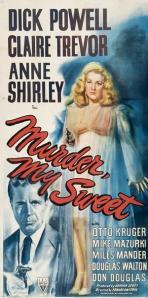
murdermysweetDick Powell was known as a song-and-dance man when he was cast as hard-boiled dick Philip Marlowe in this adaptation of Raymond Chandler’s novel Farewell, My Lovely.

He nailed the role by not overplaying it. It didn’t hurt that the script and direction were pretty good, too. Powell in Murder, My Sweet will never give Humphrey Bogart in The Big Sleep much competition, but he does a pretty good job.

This film marked a turning point in Powell’s career, too. At the age of 40, Powell was able to slough off the public’s perception of him and reinvent himself as a noir tough guy.

He would go on to star in film noirs like Cornered (1945), which, like this film, was directed by Edward Dmytryk, Johnny O’Clock (1947), To the Ends of the Earth (1948), and Pitfall (1948), among others, as well as two classic radio detective shows, Rogue’s Gallery, which premiered in 1945, and Richard Diamond, Private Detective, which premiered in 1949.