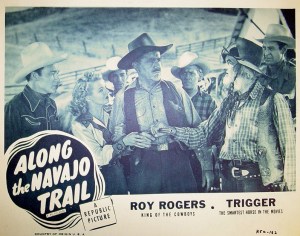
 There are no Navajos to be found in this run-of-the-mill Roy Rogers picture, or American Indians of any tribe, for that matter. The title comes from a popular song that was written by Dick Charles (a.k.a. Richard Charles Krieg), Larry Markes, and Edgar De Lange in 1945, and is sung by Rogers, Dale Evans, and the rest of the gang to close the picture. No, the only people of color in Along the Navajo Trail are Spanish-speaking Gypsies, who are portrayed in much the same way Mexicans were in Hollywood westerns except that they wear funny clothes, travel in wagons, and the men wear gold hoop earrings. They also provide George “Gabby” Hayes’s character with a series of comic interludes in which he attempts to cheat the Gypsies, and is in turn cheated himself. These horse trades don’t add much to the plot, but they do result in Hayes sputtering the memorable line, “I sure have gypped that gyppin’ Gypsy!”
In Along the Navajo Trail, Rogers plays a character named “Roy Rogers” who at first appears to be an itinerant cowpoke, but whom we later discover is a Deputy U.S. Marshal. Dale Evans plays a ranch owner named Lorry Alastair, and Hayes plays her foreman, Gabby Whittaker. Lorry is skittish about Rogers when he drifts onto her property, the Ladder A Ranch, and orders Gabby to run him off. She changes her tune, however, when she walks to his relocated campsite herself to kick him off her land, but he ends up singing to her under his tarp in the rain, making up a song as he goes, and asking her if she knows a girl’s name that rhymes with “Saskatoon.”
Lorry eventually finds the Deputy U.S. Marshal badge in his boot and realizes beyond a doubt that he’s one of the white hats. The black hats in Along the Navajo Trail are the representatives of the Santa Fe Drilling Company. There isn’t any oil on Lorry’s land, but the company needs to lay a pipeline through her property, and they’ll stop at nothing to do so.
Along the Navajo Trail is heavier on action than some of Rogers’s efforts, and it should please most fans of old B westerns. As usual, Rogers solves problems with haymakers and gunplay, but stops short of ever getting too bloodthirsty, since plot contrivances take care of the worst of the bad guys. The climax of the picture occurs when the final black hat loses control of his buckboard, and it flies over a cliff and he falls to his death (in the form of an especially noticeable dummy). Rogers rides to the edge of the cliff and surveys the destruction with the same look of mild disapproval one reserves for drunks puking in Dumpsters in the middle of the afternoon.
At the end of the picture, Rogers, Evans, and the rest of the cast gather to sing “Along the Navajo Trail,” and then they all live happily ever after. Or at least, their characters do. Rogers, Hayes, Evans, and Trigger would all be back exactly two Saturdays later, when Sunset in El Dorado was released into theaters.
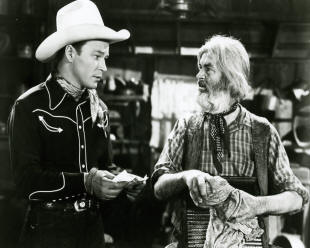 The western genre may be moribund, but it refuses to kick the bucket. Singing cowboys, on the other hand, are deader than vaudeville. There was a time, however, when Gene Autry and Roy Rogers were two of the biggest film stars in America.
 OCD Viewer