Tag Archives: Westerns

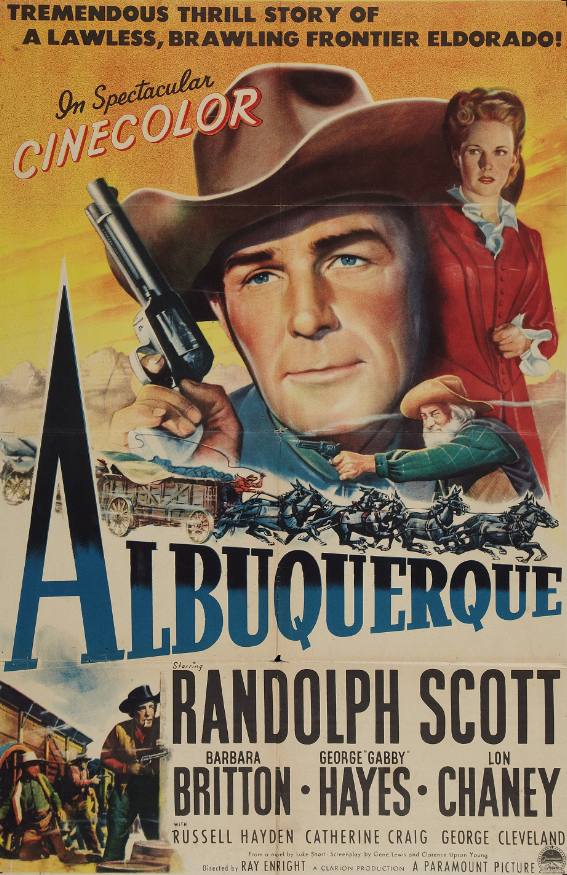
Albuquerque (Feb. 20, 1948)

Like Randolph Scott’s last western, Gunfighters (1947), director Ray Enright’s Albuquerque was filmed in Cinecolor, which was a two-color film process that was less expensive than Technicolor.

Unlike Gunfighters, it’s punchy and fast-moving, which could have something to do with the source material. Gunfighters was based on a novel by the long-winded Zane Grey, while Albuquerque is based on the 1939 novel Dead Freight for Piute, which was written by the terse, hard-boiled western author Luke Short.

Albuquerque isn’t quite on the level of André de Toth’s Ramrod (1947), which was the best adaptation of a Luke Short book I’ve seen to date, but it’s a well-made B western.

The lean, weather-beaten Randolph Scott plays Cole Armin, a man coming to Albuquerque to do a job. On the way there, he and his fellow stagecoach passengers are robbed by a group of masked bandits. Celia Wallace (Catherine Craig) loses $10,000 to them, and a young girl named Myrtle (Karolyn Grimes, best known for playing little Zuzu in It’s a Wonderful Life), is put in a perilous position when the stage goes out of control with spooked horses and no driver.

It quickly becomes clear that more pernicious forces are at work in Albuquerque than just a few stagecoach robbers preying on wayfarers. John Armin (George Cleveland), Cole’s uncle and the man he’s come to Albuquerque to work for, turns out to have a stranglehold on the territory, and he expects Cole to help him carry out all manner of dirty business.

So the honest Cole Armin goes into business with Celia and her brother Ted Wallace (Russell Hayden), forming Wallace & Armin Freighting. Their freighting company moves ore from the Half-High Mine down a steep, twisting, treacherous trail. (Even higher up the mountain is Angel’s Roost Mine, but it’s so high up that no one’s sure if it’s even possible to get the ore down from there.)

Naturally, none of this makes John Armin very happy, and he dispatches forces both foul and fair — a hulking henchman named Steve Murkill (Lon Chaney Jr.), who appears to have been hired not only for his great strength and mercilessness, but also his ability to get hit in the face without losing the cigarette clenched between his teeth; and a beautiful young woman named Letty Tyler (Barbara Britton), who ingratiates herself to our heroes with her feminine charms and a revolver that secretly contains blanks.

Albuquerque is a B western through and through (look no further than the presence of the rootin’, tootin’ Gabby Hayes as “Juke”), but its production values are solid and it’s pretty entertaining, especially for fans of Randolph Scott, who for my money is the most archetypal western star of all time.
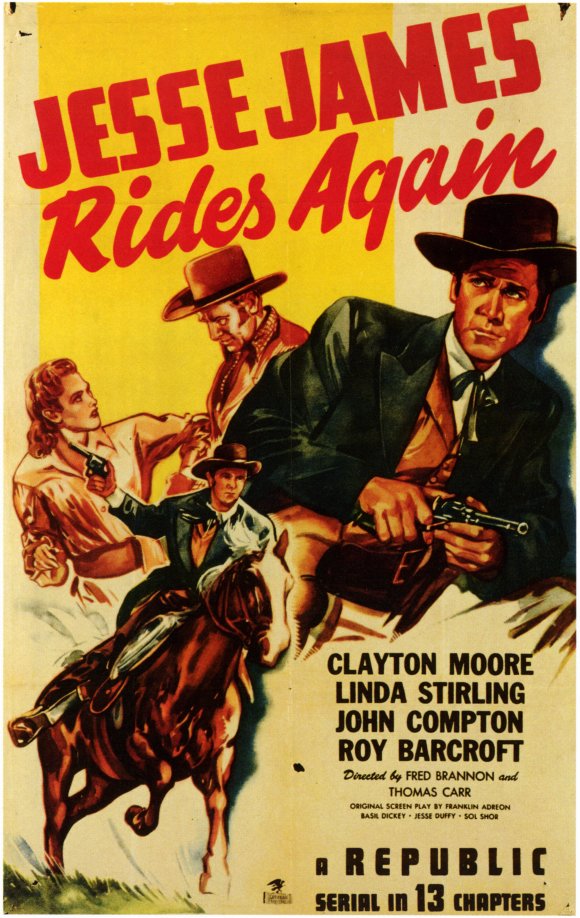
Jesse James Rides Again (13 chapters) (June 2-Aug. 25, 1947)

I’ve said it before and I’ll say it again. Republic Pictures made the best serials in the business. While you could sometimes find better acting in the Saturday-afternoon chapterplays from Universal and Columbia, neither could top Republic when it came to pure slam-bang entertainment. They employed the best stuntmen in Hollywood, and their serials were action packed.

Jesse James Rides Again, which was directed by Fred C. Brannon and Thomas Carr, could have gone the Poverty-Row route and used its western setting as an excuse to deliver a cheap finished product. They had the Iverson Ranch and plenty of reusable costumes, after all. Throw in some chases on horseback, some fistfights, some gunfights, and you’re golden.

Instead, Brannon and Carr delivered a fast-moving serial with lots of pyrotechnics. Some chapters are more exciting than others, obviously, but I still wasn’t expecting so many blown-up barns, flaming logs pushed down hills, exploding riverboats, and burning oil derricks.

Every chapter opens with a shot of men on horseback. They’re all wearing black robes and black hoods. The exciting theme music by Mort Glickman incorporates elements of Stephen Foster’s “Oh! Susanna.” The black-robed riders look exactly like members of the Ku Klux Klan in photo-negative, and they’re called — not terribly creatively — the Black Raiders.

The Black Raiders are secretly working for a man named James Clark, who’s played by Tristram Coffin, a dependable Republic villain playing the most dependable villainous archetype in westerns, the greedy land baron. Clark knows that the farmers who live in Peaceful Valley, Tennessee, are sitting on a rich vein of oil, and it’s only a matter of time before they find out about it.

Clark’s plan is to have the Black Raiders drive all the farmers out of Peaceful Valley by using violence and intimidation; good, salt-of-the-earth people like Ann Bolton (Linda Stirling) and her crippled father Sam Bolton (Tom London).

So in classic western fashion, into the Boltons’ lives rides Jesse James (Clayton Moore). The ex-Confederate outlaw is on the lam for a crime he didn’t commit (the robbery of a bank in Northfield, Minnesota) along with his buddy Steve Long (John Compton).

Jesse James is traveling under the name “J.C. Howard,” and he’s a modern-day paladin, ready to take up arms in defense of the helpless, like Mr. Bolton and his daughter.

If you know anything about the real-life Jesse James, you’ve probably already realized that Jesse James Rides Again plays fast and loose with the facts.

But who cares? It’s all just an excuse for action and feats of derring-do, and as such, it succeeds admirably. Most of the chapters follow a predictable arc — J.C. Howard ( Jesse James) gets out of whatever scrape the previous chapter left him in, then it’s off to the James Clark Land Office, where Clark and his beefy henchman Frank Lawton (Roy Barcroft) discuss their nefarious plans for the oil under Peaceful Valley, just in case any of the kids in the audience are seeing the serial for the first time. Then Jesse James, Steve Long, and Ann Bolton become embroiled in another of Clark and Lawton’s plans, and have to fight their way out. (Clark’s role as villain is unknown to the protagonists until the last chapter.) And finally, each chapter ends with a cliffhanger, like Ann Bolton unconscious inside a cotton compress, or Jesse James knocked out and left behind in the boiler room of a riverboat that’s about to explode.

As the weeks go by, Jesse James and the farmers eventually discover the oil they’re sitting on, and it becomes a race to register their land, sink wells, and get the oil out of the valley. All the while, Lawton and his boys commit one act of sabotage after another.

The most explosive and exciting chapter is the penultimate one, “Chapter Twelve: Black Gold,” in which Steve Long leads a wagon train carrying barrels of oil through a prairie set afire by Lawton and his boys. There are crackups and explosions galore. It’s not quite The Road Warrior, but it’s still an impressive set piece.

Clayton Moore, who plays Jesse James, is probably best known for playing the Lone Ranger on TV from 1949 to 1957. His role in Jesse James Rides Again sometimes seems like a dry run for playing the Lone Ranger.

Moore isn’t the greatest actor in the world, but he’s a solid choice to play a stalwart western hero. Also, I really like the outfit he wore in this serial. Unlike the leather vests and dungarees favored by plenty of B western heroes, Jesse James wears a black hat, a black top coat, a black long string tie, and a dark vest over a white shirt. It’s what every Southern gentleman with a price on his head should be wearing.

Republic would make two more serials featuring Jesse James as a character; The Adventures of Frank and Jesse James (1948), which again starred Moore as Jesse and co-starred Steve Darrell as his brother Frank, and The James Brothers of Missouri (1949), which starred Robert Bice as Frank James and Keith Richards as Jesse James. (No, not the Keith Richards you’re thinking of.)

Under the Tonto Rim (Aug. 1, 1947)

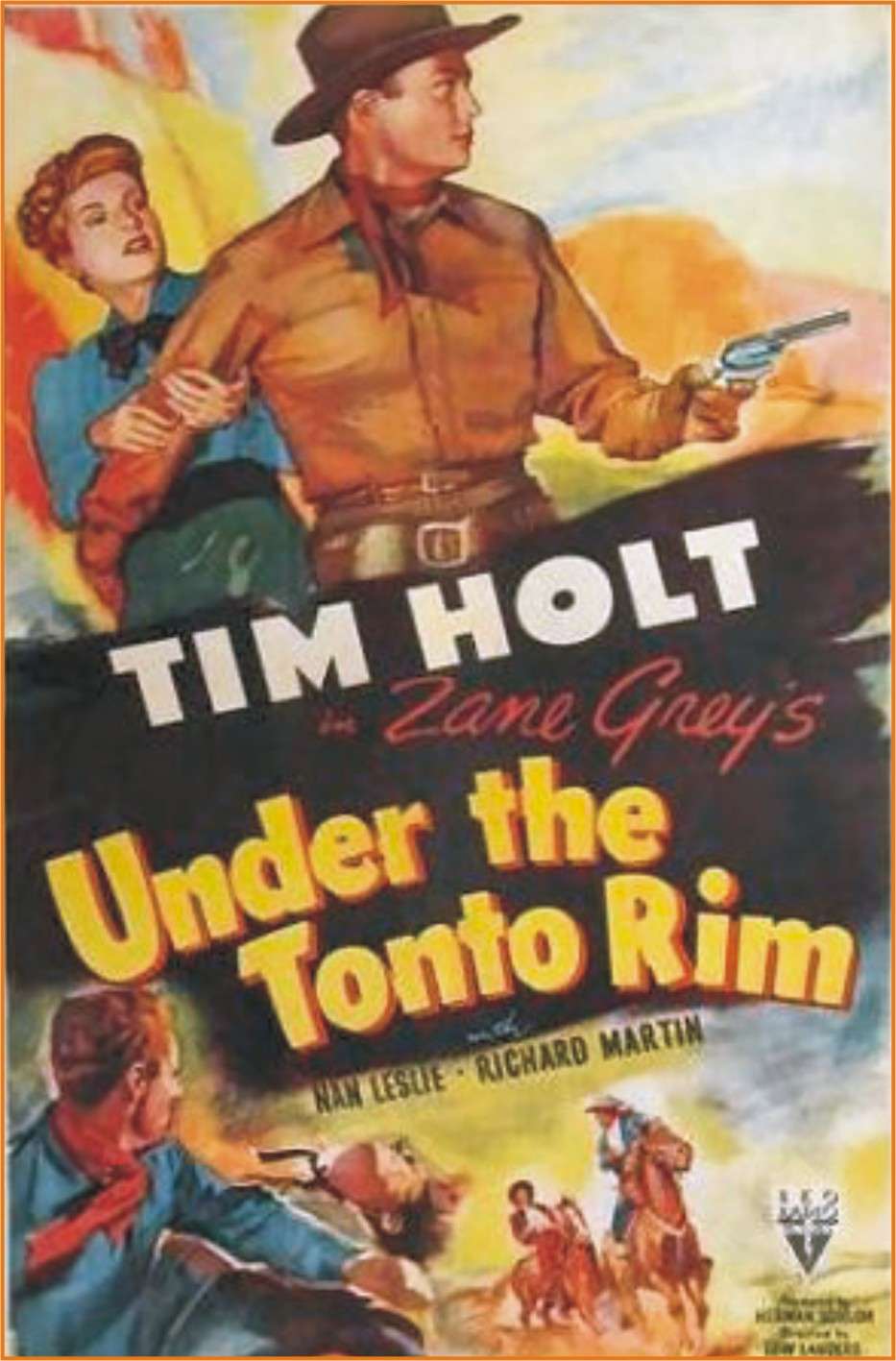
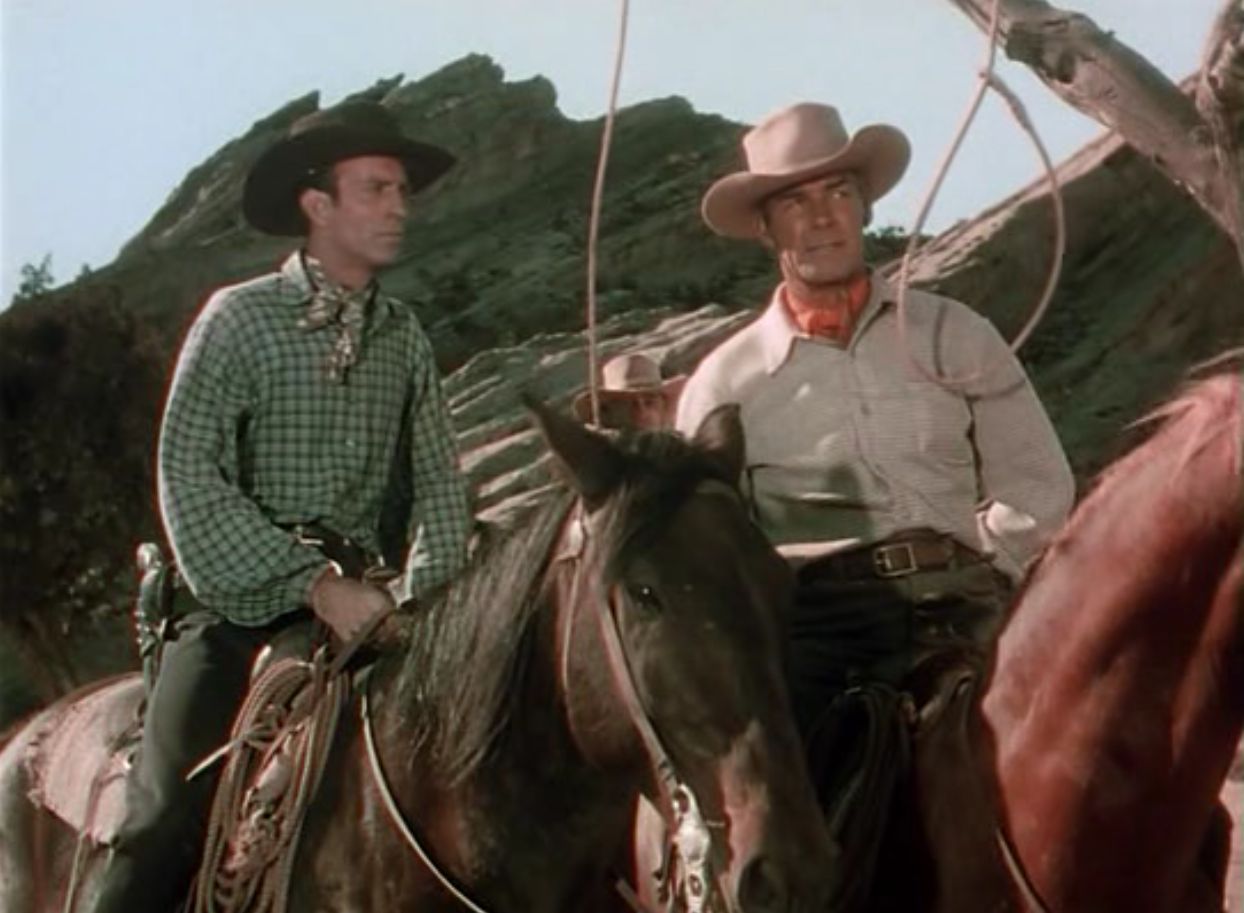
Tim Holt’s second postwar western, Under the Tonto Rim, is a lot like his first postwar western, Thunder Mountain (1947). Both are RKO films produced by Herman Schlom and directed by Lew Landers, with screenplays by Norman Houston that are based on Zane Grey novels.

And even though Tim Holt plays a different character in Under the Tonto Rim than he did in Thunder Mountain, Richard Martin is back as his Irish-Mexican sidekick, Chito Jose Gonzalez Bustamonte Rafferty, the same character he played in Thunder Mountain. Chito is tall and handsome, and has a way with the ladies, but he’s also a barrel of laughs, and has a way with malapropisms like “He swallowed it hook, line, and stinker.”

In Under the Tonto Rim, Tim Holt plays Brad Canfield, the new owner of the Rim Rock Stage Line. In the first reel of the film, one of his stagecoaches is held up by masked bandits who carry off the Wells Fargo box, kidnap Lucy Dennison (Nan Leslie) — a beautiful blonde with a mysterious past — and kill his friend Andy (Jay Norris), a young stage driver who was about to be married.

No one ever said running a stage line in a B western was easy.

Chito and Brad ride into Wicksburg and describe their attackers to Captain McLean of the Arizona Rangers. All the raiders wore black masks, except for the leader, who wore a gray, spotted bandanna

“A gray, spotted bandanna!” exclaims Capt. McLean (Jason Robards). “Sounds like the Tonto Rim Gang!”

Capt. McLean tells Brad and Chito that the Tonto Rim Gang’s hideout is somewhere under the Tonto Rim.

Before you jump to the conclusion that the Tonto Rim Gang are a bunch of clowns, naming themselves after their hideout isn’t quite like a group of criminals on the lam calling themselves “The 285 West Sycamore Street Safe House Gang,” since there are more than a hundred canyons under the Tonto Rim, and the gang could be in any one of them.

Brad and Chito decide to take matters into their own hands. Brad arranges to get himself thrown in jail in Tonto, where one of the captured raiders, Patton (Tony Barrett), is locked up and scheduled to hang. Brad thinks that if he can pass himself off as a criminal with $10,000 buried somewhere, he can escape with Patton, and Patton will lead him to the Tonto Rim Gang. But as they ride into Tonto, Chito expresses his doubts about the plan in his own inimitable way.

Chito: “You know what the word ‘Tonto’ means in Spanish?”
Brad: “No.”
Chito: “It means ‘fool.’ And I bet you that’s what we are.”
Brad: “Ah, keep your shirt on.”
Chito: “I always keep that on. Except on Saturday nights, when I take it back.”
Brad: “Well, this is only Thursday, and I don’t want to attract too much attention yet.”

When they arrive in Tonto, Chito passes himself off as “Ranger Rafferty” to Deputy Joe (Lex Barker), then bends the ear of the sheriff (Harry Harvey) with tales of Brad Canfield the outlaw, and tells him he needs to be taken alive.

Brad’s plan works out, and he and Patton escape together. But Brad’s quickly back in hot water when he finds that Lucy Dennison is part of the gang.

Or is she? And what part will the sultry Juanita (Carol Forman) play?

Under the Tonto Rim is good fun. Before this year, I’d only ever seen Tim Holt as a supporting player in A pictures like My Darling Clementine (1946) and The Treasure of the Sierra Madre (1948). He never made a huge impression on me, and after watching a couple of his starring roles in B westerns, I think I know why. He’s a soft-spoken, unassuming guy with average looks. But he projects a lot of steel when he’s the focus of the film, and gives the impression that he won’t stop fighting until the fight is through.

Wyoming (July 28, 1947)

The last time I saw cowboy star Bill Elliott was in the Red Ryder movie Conquest of Cheyenne (1946), in which he was credited as “Wild” Bill Elliott.

I missed the next picture he made, Plainsman and the Lady (1946), but in both that film and this one, he’s listed in the credits with the more mature moniker “William Elliott.”

Like Elliott’s name change, Wyoming reflects a B-grade product’s aspirations to A-level status.

It’s about halfway successful.

Director Joseph Kane knows how to shoot a western, and Wyoming looks great. It’s full of snowstorms, big cattle drives, and beautiful wide open spaces. Legendary stuntman Yakima Canutt is credited as the second unit director, and the fistfights, shootouts, and horse action are all well-done. (One fight in particular is more brutal than I ever expected from a Republic western.)

But the script by prolific screenwriters Lawrence Hazard and Gerald Geraghty never rises to A quality. It’s full of big ideas and grand themes, but the treatment of those themes is muddled, and the dialogue is hackneyed.

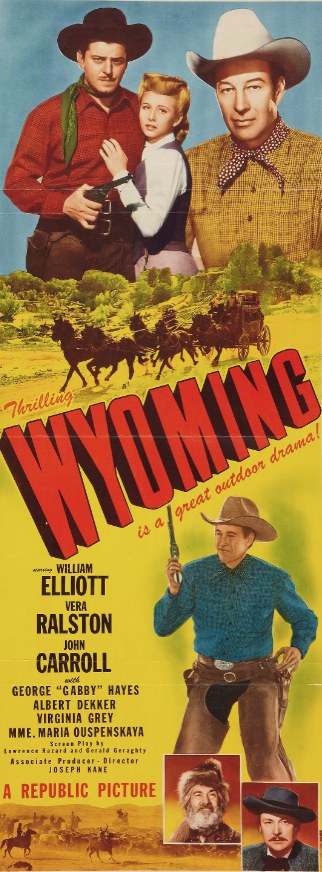
In Wyoming, Elliott plays Charles Alderson, an intrepid pioneer who settles in the territory of Wyoming with his pregnant wife. When she dies in childbirth, Alderson sends his daughter to Europe for an education. While she is away, he builds up an enormous cattle herd, and becomes rich. He does so with the help of his friend Thomas Jefferson “Windy” Gibson (George “Gabby” Hayes), a grizzled old mountain man who says that while he may not look it, he was originally a lawyer from Vermont. But he got too involved with another “bar.” Get it?

Alderson’s daughter Karen returns to Wyoming in 1890, soon after it has been admitted to the union. (Karen is played by Vera Ralston, who also played her own mother in the opening portion of the film.) Alderson is now a cattle baron, but all is not well. Much of his range is now open to homesteaders, who are led by John “Duke” Lassiter (Albert Dekker). Lassiter is a shady character who is involved in rustling cattle, and who is exploiting the homesteaders for his own purposes.

Alderson’s foreman, Glenn Forrester (John Carroll), cautions Alderson that resorting to violence will only make things worse, but Alderson is a prideful, tyrannical man who shoots first and thinks later.

If all of this sounds a lot like Howard Hawks’s Red River (which was filmed in 1946 but wasn’t released until 1948), that’s because it is. But Wyoming never achieves the same impact as Red River.

The biggest problem with Wyoming is Elliott himself. The character he plays, Charles Alderson, is a complicated man who is nearly undone by his own ambition and propensity for violence, but Elliott is not a nuanced actor. I loved him in the Red Ryder westerns because he was so wooden that it added to the comic-book stalwartness of the character, but in Wyoming he seems to be overreaching, and it’s a little like watching Leslie Nielsen play Othello.

Gunfighters (July 1, 1947)

Another day, another western based on a Zane Grey novel.

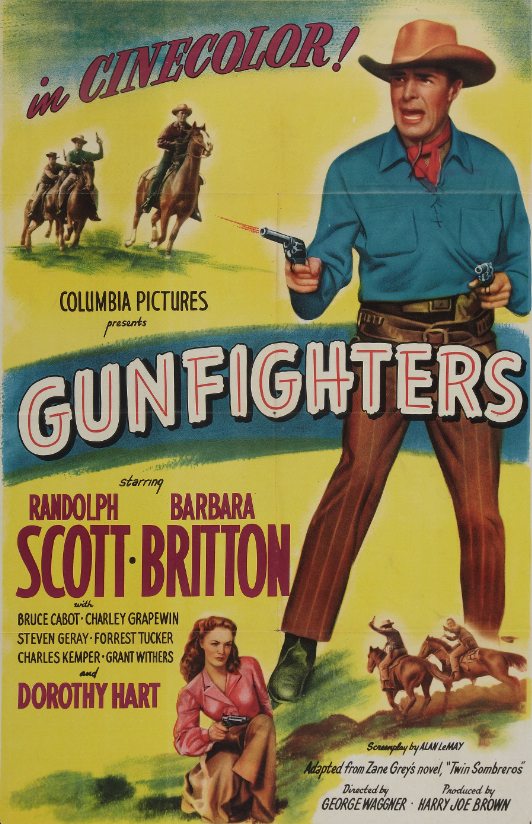
Unlike the last movie I watched that was based on a book by Zane Grey — Thunder Mountain, which was a fun little 60-minute black and white western from RKO Radio Pictures — George Waggner’s Gunfighters gets the prestige treatment from Columbia Pictures. It’s a feature-length film (almost 90 minutes long), and it’s shot in Cinecolor.

Cinecolor was a two-color film process that was cheaper than Technicolor, and could sometimes look washed-out or unnaturally reddish, but Gunfighters looks great. For what it is, the production values are high, and legendary cowboy star Randolph Scott is always fun to watch.

In Gunfighters, which is based on Zane Grey’s posthumously published novel Twin Sombreros, Scott plays a seasoned gunman with the unlikely name of Brazos Kane.

Brazos is the veteran of so many shootouts that as soon as the opening credits are done rolling, his best friend steps out of a cantina, calls him out, and Brazos is forced to kill him. As his friend lies dying, he offers no explanation for starting the duel. In the world of Gunfighters, gunmen are like mountain climbers — ask mountain climbers why they want to climb a mountain, and they’ll respond, “Because it’s there.” Likewise, Brazos’s friend just had to know who was the faster draw.

But Brazos doesn’t want to be a part of this topsy-turvy fast-draw world anymore. As he says in one of the film’s bits of sporadic voice-over, “When your best friend tries to beat you to the draw, it’s time to put up your guns.”

But it’s the same everywhere he goes — the Texas Panhandle, Wichita, Dodge — so Brazos heads for the Inskip Ranch, where he plans to ride the range with his old friend Bob Tyrell.

And that’s just what they do. After Brazos arrives at the Inskip Ranch, he and his old buddy Bob herd cattle, bust broncos, sleep under the stars, start their days with strong coffee and hot biscuits, pass a jug of whiskey around the campfire at night, tell tall tales, and live happily for all the days of their life, making Gunfighters unique among ’40s westerns, since it contains almost no gunplay or violence.

Ha ha! Just kidding. As soon as Brazos shows up at the Inskip Ranch, he finds Tyrell’s corpse facedown in a creek.

And even worse, he’s immediately blamed for the murder, and finds himself on the wrong end of a lynch mob.

Gunfighters has plenty to recommend it. It looks good and contains some of the most impressive chases on horseback I’ve seen in a western. But for every exciting five-minute stretch there’s a boring one, and the final showdown between Brazos and the bad guys seems to take forever to get to.

I enjoyed the performances of both Dorothy Hart and Barbara Britton, who play sisters Jane and Bess Banner. Most of the humor in the film comes from the fact that the two sisters look enough alike to be mistaken for twins, and there’s plenty of cases of mistaken identity, if that’s your thing.

Forrest Tucker, who is probably best remembered for playing Sergeant O’Rourke on the TV show F Troop, makes a great sneering bad guy, but the other major villain, Bruce Cabot (of King Kong fame), never makes much of an impression.

I didn’t love Gunfighters, but I didn’t hate it, either. And you can’t beat scenes like the one in which Brazos tells a crooked sheriff’s deputy played by Grant Withers, “Never mind my shots. Count my guns.”

Thunder Mountain (June 1947)

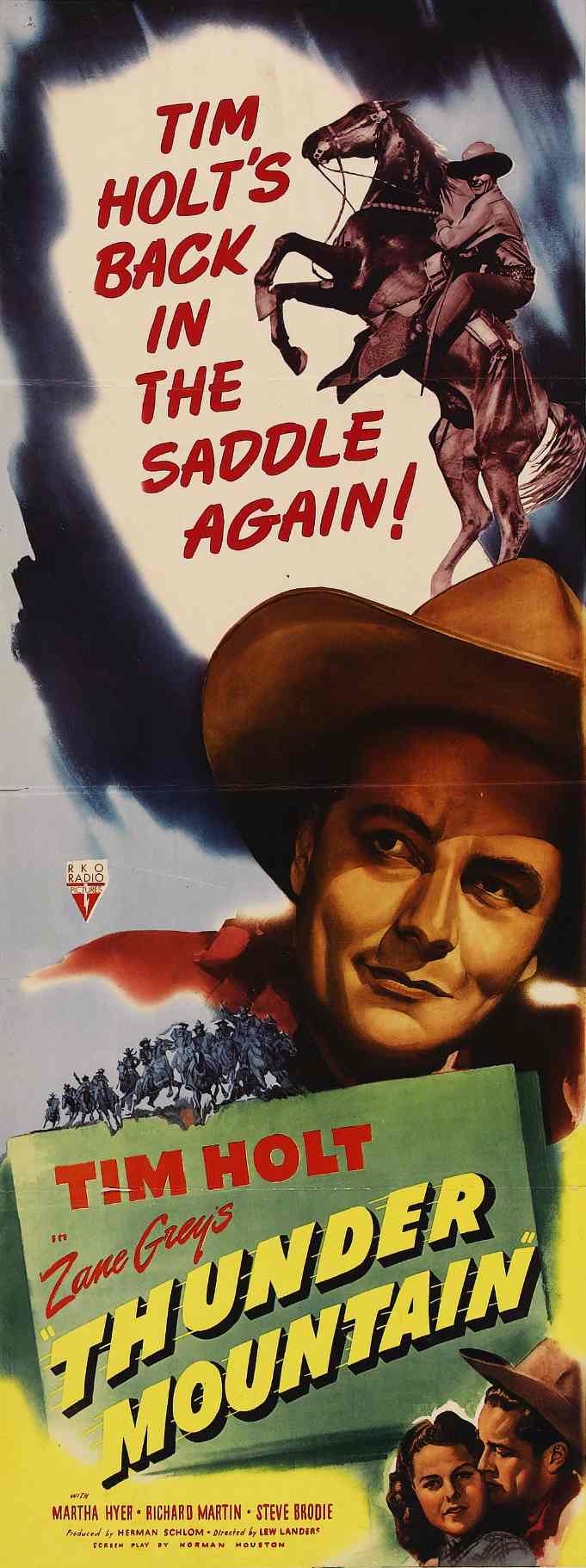
Thunder Mountain, which was directed by Lew Landers, is one of a long line of RKO westerns that were loosely based on Zane Grey novels, including Nevada (1944), Wanderer of the Wasteland (1945), West of the Pecos (1945), Sunset Pass (1946), and Code of the West (1947).

In some cases, a character’s name was all that remained from the source material, and the use of the name “Zane Grey” above the title was just a way to sell the film.

But even when the plots followed Grey’s novels, the RKO westerns based on his books bore little resemblance to Grey’s feverish prose, larger-than-life Romantic heroes, and old-fashioned dime-novel plots. They were straightforward B westerns with straight-shooting heroes, vicious bad guys, comical sidekicks, and beautiful women. They were rarely much longer than an hour, and they were fashioned solely to entertain.

Thunder Mountain, which stars quiet, understated cowboy star Tim Holt (the son of cowboy star Jack Holt and a veteran of World War II — he served in the Army Air Corps as a bombardier), is solidly in this tradition. Its story about greedy land-grabbers and old family feuds is the standard stuff of horse operas, but it’s still a well-made and enjoyable way to spend an hour.

Marvin Hayden (Holt) returns to Grass Valley, and lands smack-dab in the middle of a long-standing feud with the Jorth family. Hayden is the last surviving member of his family, and his romance with the pretty little Ellie Jorth (Martha Hyer) is cut short as soon as they discover each other’s parentage.

Ellie’s brothers, Chick Jorth (Steve Brodie) and Lee Jorth (Robert Clarke), are itching to put Hayden six feet under, but what none of them knows is that the real bad actors in Grass Valley are Trimble Carson (Harry Woods) and his right-hand man Johnny Blue (Tom Keene), who quickly realize how easy it will be to play Hayden against the Jorths.

But like any good western hero, Hayden has a solid group of compadres — the Mexican-Irish Chito Rafferty (Richard Martin), the feisty Irish bar girl Ginger Kelly (Virginia Owen), and the alcoholic and broken-down old lawyer Jim Gardner (Jason Robards Sr.) — not to mention Ellie and her conflicted feelings about Hayden. It’s a foregone conclusion that Hayden will come out on top, just like it’s a foregone conclusion that his vow to never wear a gun will be broken by the end of the picture, but the journey is a fun one, and well worth watching for fans of ’40s B westerns.

Cheyenne (June 6, 1947)

Cheyenne
Cheyenne (1947)
Directed by Raoul Walsh
Warner Bros.

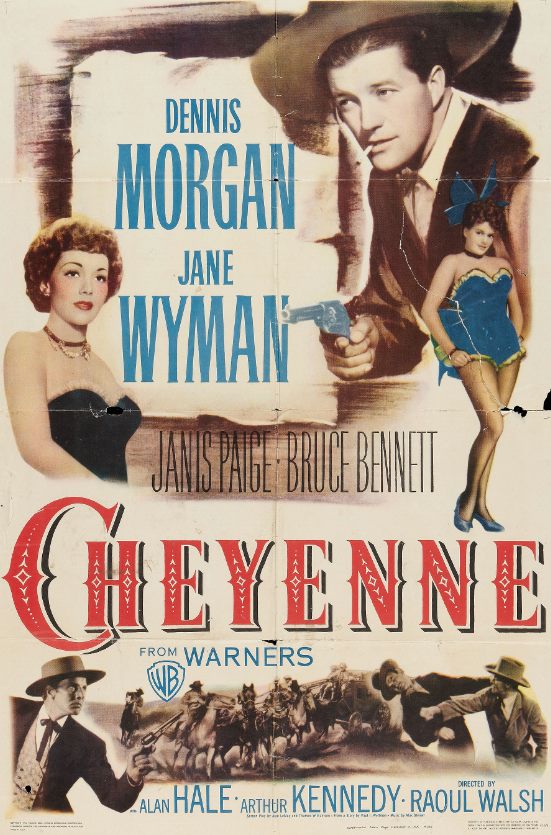
Most of the time, when people say “adult western,” they’re talking about the more psychologically realistic western dramas that stood apart from the fray of Saturday matinee singing cowboys. They’re talking about the films of John Ford and Anthony Mann, and TV series like Gunsmoke (1955-1975). Raoul Walsh’s Cheyenne is a different kind of adult western.

While tame by the standards of today’s R-rated movies and cable TV, Cheyenne is a feast of double entendres and sexually suggestive scenes and dialogue. The film stars Dennis Morgan — doing his best impression of George Sanders — as James Wylie, a gentleman gambler who’s impressed into the service of the law by private detective Webb Yancey (Barton MacLane).

Yancey offers to cut Wylie in on the $20,000 reward being offered for “The Poet,” who’s responsible for a series of stagecoach robberies along the Wells Fargo line. Wherever the Poet strikes, he leaves a piece of paper with a few lines of verse, such as “I’m happy the frontier is settling down / With a thriving bank in every town / Let the riders and nesters deposit their pay / So I and my gun can take it away.”

Cheyenne co-stars Jane Wyman (back when she was still Mrs. Ronald Reagan) as a woman named Ann Kincaid. Ann is married to a Wells Fargo banker named Ed Landers (Bruce Bennett), but their marriage is on the rocks, and she’s clearly attracted to the dashing and roguish Wylie. Of course, for the sake of propriety (and the Hays Code), she acts as though she can’t stand Wylie.

There’s plenty of lighthearted, sexy banter, and great lines like, “How did I know she was the sheriff’s daughter? I couldn’t find a badge.” Or my personal favorite, “You know how women are. Like bears. They never get enough honey.”

Ann and Wylie’s situation is complicated when they fall in with a gang led by the Sundance Kid (Arthur Kennedy). Kennedy plays his role with brio. Sundance is a snarling badass who shoots first and thinks later. When a young punk in his gang stands up to him, and says that the Sundance Kid may have all the other members of his gang buffaloed but he doesn’t fool him, Sundance kicks him to the ground and shoots him dead.

Wylie tells Sundance that he is in fact the Poet, and offers to cut him in on the take from his robberies. He also claims that Ann is his wife, which leads to some sexy playacting. Maybe too sexy. As one of Sundance’s gang says, “He kissed the gal like he liked it. That ain’t like no husband.”

When they go to bed in the same room because some of Sundance’s gang are outside watching, Wylie says, “I’ll sleep with one eye open.” Ann responds, “What do you think I’m gonna do?”

The sexual suggestions aren’t limited to the dialogue. The old spinster housekeeper’s look of regret when Ann says “You know how men are” is priceless. And even I couldn’t believe the scene in which Ann complains about back pain after the night she spends with Wylie.

Janis Paige

The sexiness doesn’t stop with Jane Wyman. Janis Paige gives a good performance as a voluptuous saloon singer named Emily Carson. The two songs she performs in a black bustier, dark stockings, and high heels — M.K. Jerome & Ted Koehler’s “I’m So in Love” and Max Steiner & Ted Koehler’s “Going Back to Old Cheyenne” — were a high point of the picture for me.

I enjoyed Cheyenne quite a bit, but it’s not as interesting as Raoul Walsh’s previous western, Pursued (1947), and it suffers from wild shifts in tone. Most of the film is sexy and playful, but the action scenes are surprisingly dark and violent.

Cheyenne is definitely worth seeing for fans of westerns and aficionados of its prolific and talented director. The actors are all fun to watch, especially Arthur Kennedy, and Max Steiner’s bombastic score does a nice job of propelling the action during the film’s shootouts and chase scenes.

Saddle Pals (June 6, 1947)

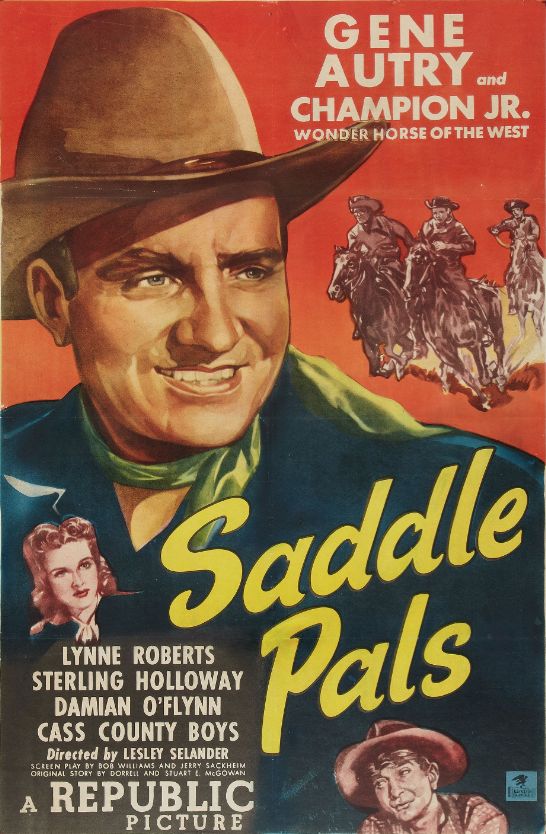
Of the movies Gene Autry made after serving in the Army Air Corps during World War II, Saddle Pals is my favorite so far.

That’s not to say that I loved the picture. I think Gene Autry is a great country singer, but as a leading man, I find him flat. But Saddle Pals is funnier and generally more entertaining than the last few Autry pictures I’ve seen, and it wasn’t a chore to sit through.

The picture begins when the beautiful, wealthy, and devil-may-care Shelly Brooks (Lynne Roberts) buzzes Gene, his boys, and their cows with her brand-new Lincoln. Of course, she blows a tire not long after, and Gene’s such a gentleman that he doesn’t hold her bad behavior against her, and changes the tire for her.

Shelly’s brother Waldo T. Brooks Jr. is raising rents on all the ranches in the valley so his wealthy family can be even wealthier. Not only is it unfair, it’s downright illegal, says attorney Thaddeus Bellweather (Irving Bacon), and he’ll handle the case for Gene just as soon as he gets back from trout season … which is going to last a long time.

So Gene and the Cass County boys (his backup band/ranch hands) head to the Brooks ranch to talk to Waldo, who turns out to be an effeminate, hysterical, rubber-faced hypochondriac played by Sterling Holloway. It turns out that Waldo is barely in control. It’s the Brooks Land Corporation that’s raising rents, under the direction of their evil leader Bradford Collins (Damian O’Flynn).

Waldo gives Gene control of his money. Gene tells Collins that he wants to buy into the corporation. Gene is then forced to come up with $50,000 in 30 days. He comes up with most of the money by selling off the Brooks’s show horses, and then decides to throw a rodeo to raise the rest of the money.

Shelly and Waldo have an adorable little sister, Robin (Jean Van), who wants desperately to be a cowgirl. She’s got the skills to pay the bills, so Gene puts her in the rodeo, but Collins uses the fact that she’s a minor to get Gene in trouble with the law.

Collins doesn’t stop there. If you’ve ever seen a B western from the ’30s or ’40s before, you know those greedy land-grabbing real estate barons never stop at legal malarkey, and sure enough, by the end of the picture there’s an out-of-control wagon on fire with Robin inside, and Gene and his horse Champion Jr. in hot pursuit.

The songs in Saddle Pals are generally good, even though there’s no single stand-out number. The songs include “You Stole My Heart,” “Which Way’d They Go,” “The Covered Wagon Rolled Right Along,” “Amapola,” and “I Wish I Never Had Met Sunshine.” Also, Sterling Holloway, who’s sort of like a less-funny, more-irritating version of Jim Carrey, is used judiciously in the picture, and most of his scenes are humorous, if not exactly hilarious.

Oregon Trail Scouts (May 5, 1947)

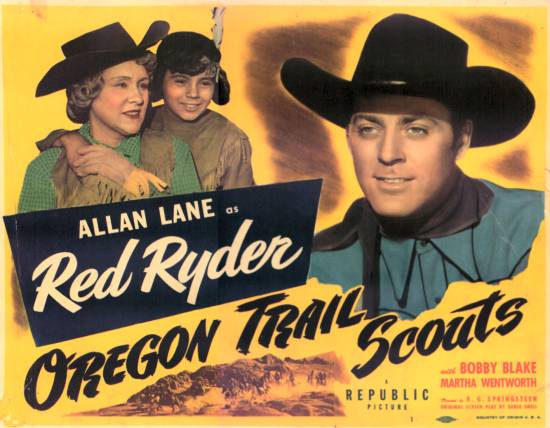
R.G. Springsteen’s Oregon Trail Scouts is an origin story, and tells how cowboy hero Red Ryder (Allan Lane) and his young Indian sidekick Little Beaver (Bobby Blake) first met.

If you’re expecting a grand comic book origin story like Batman Begins (2005), don’t bother. The Red Ryder film series is strictly kids’ stuff, and Oregon Trail Scouts is nearly indistinguishable from all the other entries in the series, but that’s not a bad thing. The journeymen at Republic Pictures — both in front of and behind the camera — knew how to craft solid entertainment for the Saturday-matinée crowd.

Oregon Trail Scouts takes place in the early 1890s, when the best spots for trapping along the Snake River were reserved for American Indians. (Because we all know that the Bureau of Indian Affairs and the federal government bent over backwards to give Indians the best stuff.) This leads to various groups of trappers attempting to curry favor with Chief Running Fox (Frank Lackteen), much to the consternation of Red Ryder’s pal Bear Trap (Emmett Lynn), who fondly recalls the good old days when all you needed to do was get an Indian drunk and keep him drunk to get what you wanted … not that he ever did it himself (wink wink). Bear Trap is a western sidekick in the rootin’ tootin’ mold of Fuzzy Q. Jones and Gabby Hayes.

Meanwhile, a group of black hats attempt to get permission to trap beaver on the Willamette River from Running Fox using methods more devious than firewater. Bill Hunter (Roy Barcroft) uses reverse psychology couched in the pidgin English necessary to communicate with American Indians in B westerns. “Me come to bury hatchet,” he says. And when Running Fox doesn’t agree to give Hunter trapping rights, Hunter says, “What’s the matter with you, Running Fox? You heap big chief? Or like old squaw? That Indian agent lead you around by nose.”

Oregon Trail Scouts is packed with action, even by the action-packed standards of Republic westerns. There are shootouts galore, most of them the function of a ridiculously convoluted plot that has Bill Hunter and his henchmen going after their old comrade, the Judge (Earle Hodgins), who now calls himself the Doctor. The Judge ran off years earlier with Hunter’s money and the Indian boy Hunter had kidnapped. Hunter believes that the Indian boy is actually Running Fox’s grandson, and that if he can get him back then Running Fox will give Hunter beaver trapping rights for sure.

Guess who that little Indian boy turns out to be? If you guessed “Little Beaver, the cutest little Indian boy in the west,” you’d be correct. As if he wasn’t adorable enough, he comes equipped with a little canine sidekick named Wolf Dog, who looks like a Scotty mix with nary a bit of wolf in him. As soon as Little Beaver meets Red Ryder, he falls in platonic love with him, and wants to stay with Ryder, Bear Trap, and Ryder’s aunt, the Duchess (Martha Wentworth), forever and ever. Ryder likes the idea, but is circumspect about the prospect of adopting the Indian boy, and tells him, “I like you, too, Little Beaver, but if I don’t take you back, the Great White Father in Washington may get heap mad.”

Don’t you fret, boys and girls. If you’ve seen just one other Red Ryder movie, you know that things will turn out just fine for Red Ryder and Little Beaver, and that Little Beaver will, in his own words, “Make heap good sidekick.”

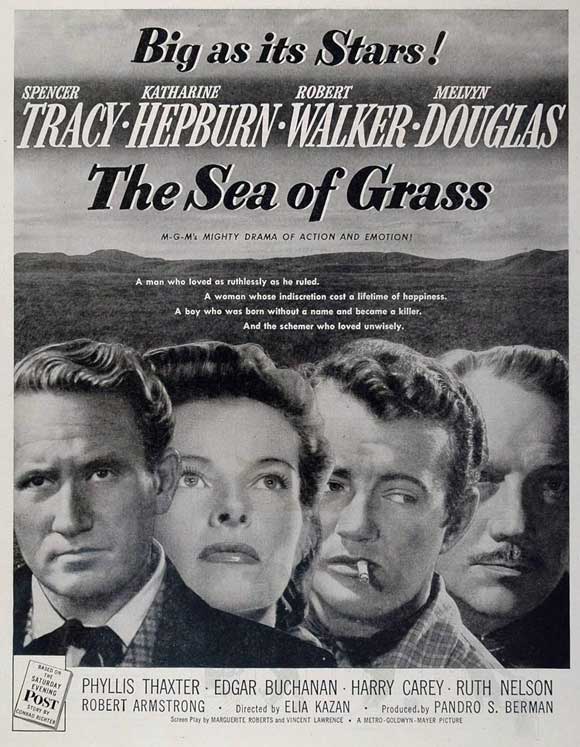
The Sea of Grass (April 25, 1947)

Elia Kazan’s The Sea of Grass premiered February 26, 1947, in Lincoln, Nebraska. It opened in New York City a day later, and went into wide release on April 25, 1947.

In his review of the film in The New York Times on Friday, February 28, Bosley “The Grouch” Crowther referred to the film as “Metro’s new cow-or-plow drama,” which is the best and most succinct description of the film imaginable.

This was Kazan’s second film — his first was A Tree Grows in Brooklyn (1945), and Boomerang (1947), which I reviewed earlier this year, was his third.

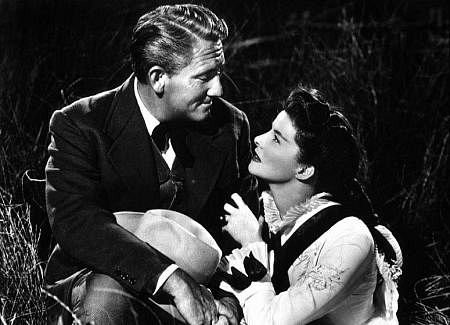
The Sea of Grass is the story of a high-born St. Louis woman, Lutie Cameron (Katharine Hepburn), who marries a cattle baron, Col. Jim Brewton (Spencer Tracy), and leaves the comfortable world of high society for a rough-and-tumble life in a place called Salt Fork, in the Territory of New Mexico. Brewton legally owns very little of the hundreds and hundreds of acres over which his cattle roam, but he fought and bled for the land, and he’ll be damned if any pussy-footing sodbusters are going to come in and reap the rewards he feels he earned for himself. Brewton’s connection to the land is full of mystical reverence, and he’s distant from people, including his wife. Lutie is driven into the arms of Brewton’s mortal enemy, Brice Chamberlain (Melvyn Douglas) — a lawyer who fights for the rights of homesteaders — just long enough to wind up carrying Chamberlain’s child. Lutie returns to Brewton and bears him a second child, a son named Brock (they already have a girl named Sara Beth).

When Brewton discovers that he has been cuckolded, he gives Lutie a choice. She can either leave and take Brock with her, exposing him as a bastard, or she can leave alone and he will raise Brock as his own son. Tearfully, Lutie takes the latter option, and lives in exile. Sara Beth grows into actress Phyllis Thaxter, and Brock grows up into snivelling punk Robert Walker. Brock’s true parentage seems to be an open secret in and around Salt Fork, and he responds by drinking, gambling, sneering, and throwing lead into anyone who disparages him. He’s an early-20th-century rebel without a cause, and tragedy always seems right around the corner whenever he’s onscreen.

The Sea of Grass is based on the 1936 novel by Conrad Richter. Kazan was so attracted to the material that he specifically asked MGM if he could direct it. (Kazan was under contract with Twentieth Century-Fox at the time, but it wasn’t an exclusive contract, and it allowed him to work with other studios.) His vision was of an on-location shoot that would last months, featuring unknown actors with leathery faces and a grand sense of scale that would express the drama and sadness of a way of life in America that is dead and gone.

There are hints of this in a few scenes. The few sweeping shots of the pre-Dust Bowl prairie land of the Great Plains, with the gently rolling oceans of grass that give the film its title, are unspeakably beautiful. But for the most part, The Sea of Grass is a melodrama that’s soapy enough to wash your car with.

Kazan was restricted by the studio to shooting on soundstages, and he found directing Spencer Tracy nearly impossible. Tracy was in a bad way during the making of the film, and he was drinking heavily. His performance isn’t bad, but it’s muted and deeply subdued, as though he’s only partly present most of the time. Katharine Hepburn, on the other hand, is histrionic, and very nearly a haughty parody of herself. There are moments of great visual excitement in the film, such as a violent confrontation between homesteader Sam Hall (James Bell) and Brewton’s men during a windstorm. At more than two hours long, however, The Sea of Grass offers very little in the way of the kind of action I look for in a western, and the soapy drama it’s packed with is pretty turgid.