Tag Archives: Westerns

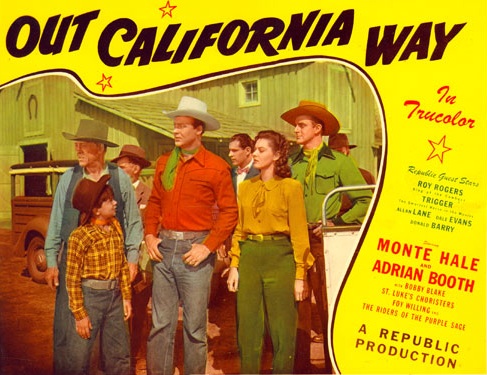
Out California Way (Dec. 5, 1946)

In the grand tradition of singing cowboys, Monte Hale plays a character in Out California Way named “Monte Hale.”

Out California Way is filmed in “Trucolor,” a two-color film process owned by Republic Pictures, and throws Hale into a metafictional world that pulls back the curtain and allows boys and girls at the Saturday matinée to see what might be going on behind the scenes at Republic with all of their favorite cowboy stars.

Hale doesn’t sit quite as tall in the saddle as Republic’s big boys, Gene Autry and Roy Rogers, but he’s self-effacing and charming enough to be believable when he says he’s “just a plain cowboy trying to break in” to the movies.

He’s assisted by little Danny McCoy (Bobby Blake, famous for playing Little Beaver in the Red Ryder series), who’s trying to get his horse Pardner into the movies.

Opposing them is the prima donna Rod Mason (John Dehner), who’s a big radio star as the “Robin Hood of the Range,” and has a career in pictures, too. Little Danny McCoy is president of the Rod Mason Fan Club, but that changes pretty fast after he actually meets the guy. Not only is Mason temperamental and nasty to his co-stars, but he hates children and animals. After threatening to whip Pardner if Danny doesn’t get him off the set, it’s clear that Danny has room in his heart for another cowboy actor. For that matter, so does his young, pretty mother, Gloria (played by Lorna Gray, who’s just 16 years older than Blake).

Hale’s an expert horse trainer, and together he and Pardner form a great team. Originally cast as stunt actors on one of Rod Mason’s pictures, they do such a good job that every rewrite comes back with a bigger role for Hale and a smaller part for Mason.

Mason and his sidekick, stunt rider Ace Hanlon (Fred Graham), are typical black hats, so they stop at nothing to foil Hale and Pardner’s success. While performing a stunt, Ace throws short-fuse dynamite at Hale that doesn’t kill him, but totally blows Pardner’s nerves.

Hale takes time off to retrain Pardner and help him over his trauma, but Mason and Ace immediately undo his hard work by sneaking into the corral at night and freaking out Pardner all over again by repeatedly firing a revolver near his head.

On his journey from “plain cowboy” to movie star, Hale is joined by special guest stars Allan Lane, Don “Red Barry,” Dale Evans, Roy Rogers, and horse Trigger, all members of Republic Pictures’ stable of western stars, and all playing themselves in the sequence in which Hale gives Gloria a tour of the studios. Roy and Dale perform a nice rendition of “Ridin’ Down the Sunset Trail” for them. Not bad for a first date.

John Dehner, who would later be a recurring actor on Gunsmoke (both the radio and TV versions), was a fine actor and makes for a great villain in this picture. While Out California Way isn’t substantively different from any of the hundreds of other oaters put out by Republic Pictures, it was fun to see a slightly different plot than the dependable old “evil land baron makes a grab for smaller ranchers’ land.”

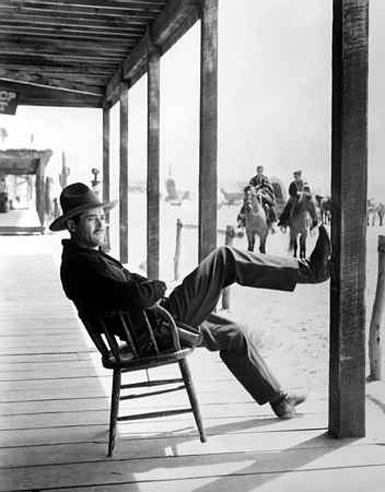
My Darling Clementine (Dec. 3, 1946)

My Darling Clementine
My Darling Clementine (1946)
Directed by John Ford
20th Century-Fox

“This is the west, sir. When the legend becomes fact, print the legend.” — The Man Who Shot Liberty Valance (1962)

John Ford’s My Darling Clementine is one of the most lauded westerns of all time.

Most criticism of the film is directed at its numerous historical inaccuracies, not its artistic merits. The ages of the Earp brothers are changed, for what seems no discernible reason. Characters die in the film who didn’t die until decades later. The chain of events that led up to the shootout near the O.K. Corral in Tombstone, Arizona, in 1881 is highly fictionalized. In reality, Doc Holliday was a dentist, not a medical doctor. The list goes on and on.

So to enjoy this film, it’s probably best not to watch it with a talkative history junkie.

And if you yourself are a history junkie, try to ignore all the little details and appreciate this film for what it is — one of the great westerns, full of iconic scenes, memorable performances, finely staged action, and little moments that would be copied over and over again in westerns in the decades that followed.

My Darling Clementine is a remake of Allan Dwan’s Frontier Marshal (1939), which starred Randolph Scott as Wyatt Earp. Both films are based on Stuart N. Lake’s book Wyatt Earp, Frontier Marshal, which was based on interviews with Earp, although most historians suspect that either Lake was embellishing or Earp was.

Again, it really doesn’t matter when it comes to this film. The plot is not the important thing, it’s Ford’s evocation of a frontier town. The rhythms of life, the strong feeling of nighttime, daytime, daybreak — all are perfectly realized. It doesn’t matter that the real Tombstone isn’t anywhere near Monument Valley. Ford shot there because he liked the way it looked.

Day for night shooting can look terribly fake, or just plain terrible, but in this film Ford makes it look beautiful. In one nighttime scene, Wyatt Earp appears on a rooftop, shot in low angle, firing his revolver at a man fleeing on horseback. Behind him is a dark sky full of silvery clouds. The scene clearly wasn’t filmed at night, but it’s still breathtaking.

Henry Fonda

Henry Fonda’s performance as Wyatt Earp is one of the finest I’ve ever seen in a western. Protagonists in westerns tend to be stalwart men of few words, and Earp is no exception, but the humanity Fonda is able to express merely through his eyes is remarkable.

Fonda generates absolute authority in every scene. Except, of course, when he’s with the pretty Clementine Carter (Cathy Downs). The scene in which he takes her to a Sunday dance at the site where the town’s church will be built is one of the highlights of the film. As Earp walks beside Clementine, the congregation sings “Shall We Gather at the River?” (later to be paid gruesome homage to by Sam Peckinpah when he made The Wild Bunch in 1969). The budding romance between the two is palpable, and is a fine example of Fonda’s wonderful silent acting.

Walter Brennan is also great as Old Man Clanton, the vicious patriarch of a nasty clan. Brennan played a lot of cuddly, blustery sidekicks, but here he’s completely convincing as a cold-eyed villain who tells his boys things like, “When you pull a gun, kill a man.”

I’m less bowled over by Victor Mature’s performance as Doc Holliday. The oily Mature seems to be in a different picture in most of his scenes, as he drinks to escape his past and romances the tragic prostitute Chihuahua (Linda Darnell).

As I said, the liberties Ford takes with history are legion. But as Lawrence Kasdan’s Wyatt Earp (1994) showed, an accurate recitation of the facts doesn’t necessarily make for compelling drama. And who cares about the actual details of the shootout near the O.K. Corral when we have things in this film like Earp standing perfectly still as a stagecoach pulls in, then running to his left as soon as it kicks up a trail of dust, nearly invisible even to the viewer as he fires several shots and hits his target?

Producer Daryl F. Zanuck notoriously tinkered with this film. He thought Ford’s original version was too long, so he had director Lloyd Bacon shoot some new footage, and then re-edited the film himself. While some of Ford’s lost footage has been unearthed, his original version is lost. Would it have been a better film? Possibly. Is the version we are left with still a great film, and one of the greatest American westerns? Absolutely.

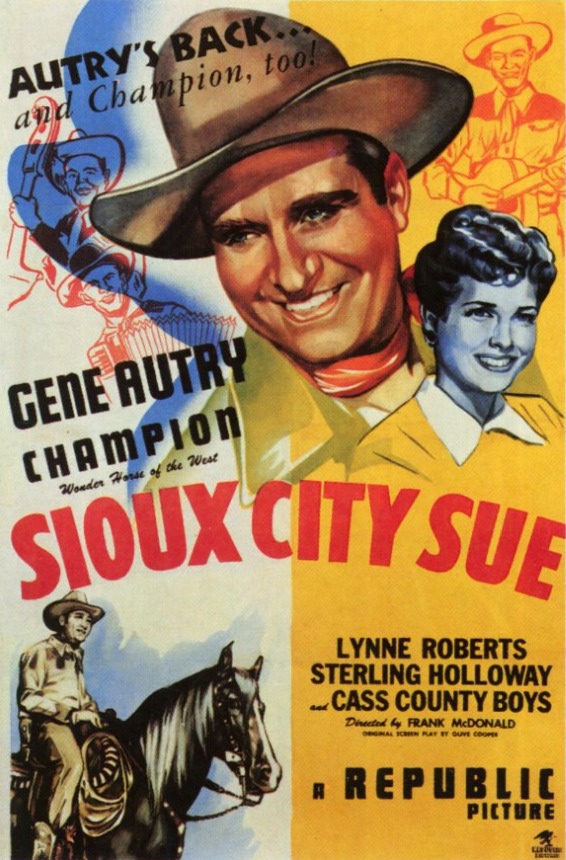
Sioux City Sue (Nov. 21, 1946)

Frank McDonald’s Sioux City Sue repurposes the script from the 1939 comedy She Married a Cop and takes its title from one of the most popular songs of 1946. It was Gene Autry’s first film after he completed his service in the Army Air Corps during World War II.

More comedy than western, Sioux City Sue is lightweight fluff, but if you like Autry’s music, there’s plenty of it. (Although, if you’re like me, you’ll be a little sick of the title song by the end of the picture.)

In a plot that makes no sense if you stop to think about it for longer than half a second, a pretty blond Hollywood talent scout named Sue Warner (Lynne Roberts) casts Autry in an upcoming movie without telling him that he’ll never actually appear onscreen and is in fact voicing a singing donkey in an animated feature.

Things have changed a lot. Now, Hollywood stars regularly lend their voices to animated features. It’s nice work if you can get it; no time in the makeup chair, no difficult location shooting, and you can take your toddlers to the premiere. But in 1946, no star would ever dream of being in a cartoon. It’s hard, though, not to be delighted and amused by the premiere of the cartoon feature in Sioux City Sue. The little donkey with Autry’s voice, singing to his sweetheart on horseback, both of them wearing western duds, is pretty gosh-darned cute.

But Autry’s been lied to, and that rightly doesn’t sit well with the man. Of course, during the making of the film, Sue fell in love with him, so the big question for the second half of the picture is whether or not she’ll be able to convince him she’s sorry. She does her darnedest, quitting her job and coming to work on his ranch as a cook and general menial laborer.

This being a Republic western programmer, there’s an action-packed climax, and it’s up to Autry and his wonder horse Champion to save the day. The last few minutes of the picture, which involve a dynamited dam, a flood, and a cattle stampede, are exciting. But for the most part, Sioux City Sue is a laid-back and easygoing good time.

Santa Fe Uprising (Nov. 15, 1946)

R.G. Springsteen’s Santa Fe Uprising was a bittersweet viewing experience for yours truly. On the one hand, I really enjoy this series, based on Fred Harman’s comic-strip cowboy. It’s solid, fun, Saturday matinée entertainment. On the other hand, a big part of my enjoyment came from the wooden, straight-shooting acting style of “Wild” Bill Elliott as Red. Elliott’s persona was so stolid that it seemed tongue-in-cheek, and he had great chemistry with the child star who played his Indian sidekick Little Beaver (Bobby Blake, who later in life would be known as “defendant Robert Blake [9/18/33], aka Michael Gubitosi”).

After starring in 16 Red Ryder pictures from 1944 to 1946, Elliott bowed out and was replaced by square-jawed matinée idol Allan Lane. In the title sequence of Santa Fe Uprising, in which Red Ryder and Little Beaver appear in motion on the cover of a storybook, Lane bears a striking resemblance to Elliott. Up close, however, he’s more traditionally handsome and less interesting a performer.

Still, director Springsteen is a professional, and he keeps things fast-moving and exciting despite a modest budget and familiar shooting locations.

The film takes place in Bitter Springs, New Mexico, in 1894. The action kicks off when the U.S. Marshal for the territory is murdered by stagecoach robbers. The editor of the Territorial Gazette, a man named Crawford (Barton MacLane), demands that his killers be found. There is a toll road that’s safer to travel on than the main road, but the man who owns the property through which the toll road runs demands $3 a head of cattle to use it, which few ranchers can afford. When old rancher Lafe Dibble (Tom London) is killed by bandits, his son, Sonny Dibble (Pat Michaels), vows revenge.

Red takes over as U.S. Marshal of the territory, but he finds himself in hot water when it turns out that Crawford’s motives might not be as pure as they seem. When a man is murdered, and it looks as if Sonny killed him, Crawford and his boys demand that Sonny be strung up despite the fact that he professes his innocence. Things go from bad to worse when Little Beaver is kidnapped, held as a possible exchange for Sonny, after Crawford’s crew fails to bust Sonny out of jail to lynch him.

During the last part of the picture, Red is sleep-deprived after searching for Little Beaver night and day, which leads to a lot of strange acting from Lane, who keeps opening his eyes wide and half-yawning.

But if you’ve ever seen a western programmer before, you know that neither rain, nor snow, nor sleet, nor sleep deprivation shall keep the heroes from their appointed shoot-outs, from which they will always emerge victorious.

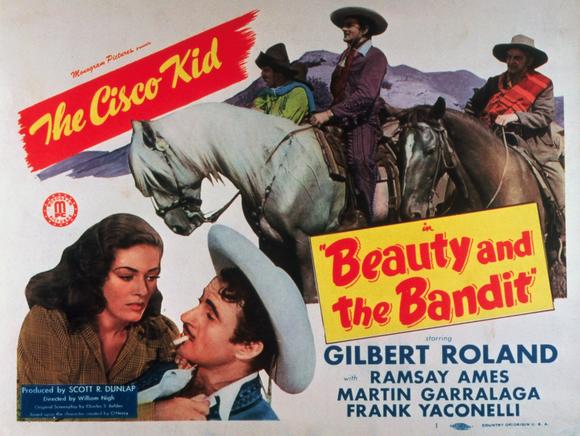
Beauty and the Bandit (Nov. 9, 1946)

Maybe I should stop watching these Cisco Kid pictures. They’re dead-on-arrival Saturday matinées from Monogram Pictures that have now thrice failed to entertain me. After sitting through The Gay Cavalier and South of Monterey, feeling like a drunk who’d fallen asleep in a grindhouse on a Friday night in 1946 and woken up the next morning surrounded by kids yelling at the screen and throwing popcorn at each other — too hungover to get up and leave — I figured I could call it quits with the series and not miss much.

But Gilbert Roland is a lot of fun to watch as Cisco. While these movies seemed pitched at a pretty young audience, his smooth line deliveries and double entendres are clearly aimed at adults. And the presence of Ramsay Ames as the heroine made it hard to say no to Beauty and the Bandit. I fell in love with Ames in the Universal horror picture The Mummy’s Ghost (1944), and will watch her in anything, although in both Cisco Kid pictures I’ve seen her in she’s skinnier, less voluptuous, and a little harder-looking than she was in her earlier horror-movie appearances in The Mummy’s Ghost and Calling Dr. Death (1943).

In the first scene of the film, Cisco (Roland) gets a tip from his old friend Sailor Bill (Glenn Strange) — who has given up a life of crime for a home, wife, and eight children — that a young Frenchman is traveling to San Marino with a chestful of silver. This young man is played by Ames, who is the least convincing young “man” I’ve seen since Barbara Hale put on drag in West of the Pecos (1945). Perhaps this is by design. If Ames was convincing as a fellow, the scene in which Roland leans forward and lights her cigarette would be the most homoerotic image of 1946, since they stare at each other with more heat and longing than you’d see during a day at the beach with Cary Grant and Randolph Scott.

Later he teaches Ames to drink tequila (with lemon and a little salt) and engages in all manner of sexual teasing, like trying to sleep in her bed and then kicking her out when she objects.

Once the idiotic cross-dressing subterfuge is done away with, Ames looks great in a pair of pants and boots. She has more swagger dressed in men’s clothes with her long hair free than she does in drag, but her accent is still all over the place, and the “n’est-ce pas” that often ends her lines sounds about as French as Steve Martin playing Inspector Clouseau. Her character, Jeanne Du Bois, is trying to buy land from the disgraced and drunken Dr. Juan Valegra (Martin Garralaga), land which was stolen, and which Cisco wishes to return to the peasants. His devotion to the Mexican people of Old California gets in the way of his romance with the headstrong Jeanne, but as usual, a good spanking fixes her right up.

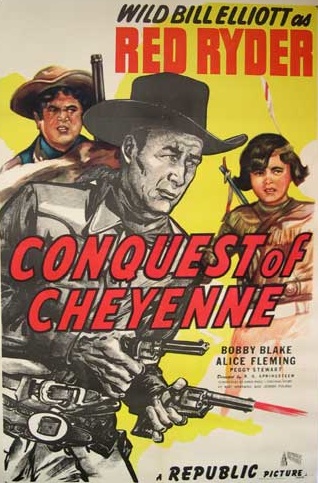
Conquest of Cheyenne (July 29, 1946)

R.G. Springsteen’s Conquest of Cheyenne was the last Red Ryder adventure to star “Wild” Bill Elliott. Bobby Blake, who plays “Little Beaver,” the adorable little Indian boy whose biggest challenge in life is the English language, would stay with the series for seven more films, but after Conquest of Cheyenne, Allan “Rocky” Lane took over as the stalwart comic-strip cowboy Red Ryder.

As last hurrahs go, it’s not much, which is too bad. I really like Elliott’s stolid presence in these western programmers, and looked forward to each new one that came out. Unfortunately, Red Ryder, Little Beaver, and Ryder’s aunt, “The Duchess” (Alice Fleming), are barely characters in this film. For the most part, it focuses on an ambitious young man named Tom Dean (Jay Kirby) and his dream of bringing a big oil-drilling operation to west Texas.

Speaking of locations, the Duchess’s ranch sure did move around a lot. Just look at the list of Red Ryder films with a place name in them: Tucson Raiders (1944), Marshal of Reno (1944), The San Antonio Kid (1944), Cheyenne Wildcat (1944), Vigilantes of Dodge City (1944), Sheriff of Las Vegas (1944), Lone Texas Ranger (1945), Marshal of Laredo (1945), Colorado Pioneers (1945), California Gold Rush (1946), Sheriff of Redwood Valley (1946), and Sun Valley Cyclone (1946). In a lot of cases, of course, the names of the films had nothing to do with where the action actually took place, and that’s the case here. Conquest of Cheyenne takes place in Texas, and Cheyenne refers not to the city in Wyoming, but to a young woman, Cheyenne Jackson (Peggy Stewart).

Is there a conquest of her in this movie? ‘Fraid not.

The movie starts out with plenty of action. With the classic “spinning newspapers flying at the screen” gag, we learn that masked bandits have struck in Lubbock, Amarillo, and Muleshoe, where most of the rest of the action will take place. (I guess Conquest of Muleshoe wasn’t a catchy enough title.)

Cheyenne (the Duchess’s second cousin on her mother’s side) goes missing, and is believed kidnapped by the bandits, but she soon arrives in Muleshoe driving an out-of-control automobile. It turns out she wasn’t kidnapped after all, and the whole bandit subplot is largely forgotten.

Soon, the comic relief character “Daffy” (Emmett Lynn) will be forgotten, too, but at least we are treated to a good old fashioned dousing in a water trough when he falls in while attempting to get out of the way of Cheyenne’s car. And of course he emerges spitting a stream of water out of his mouth like a fountain.

Immediately following this fracas, the sheriff tries to ban cars. Tom Dean angrily tells him that he can’t do that. “Deny their use to the harebrained women drivers, but not to the horseless carriages themselves,” he says. (The movie itself sort of makes a nod towards equality by showing that Tom has some trouble starting the car himself, and by showing that Cheyenne learns to drive just fine by the end.)

Tom believes oil is the future of west Texas. There are already oil wells in east Texas, and he believes the entire state is heading in this direction, but he’ll not only have to convince the townspeople of Muleshoe, he’ll have to contend with an evil banker named Tuttle (Milton Kibbee), who plans to foreclose on Cheyenne’s ranch and take all the oil for himself. He’s aided in his crooked scheme by dependable Republic heavy Kenne Duncan as a geologist named McBride.

As I said, Red Ryder and Little Beaver don’t have much to do in this picture. It’s mostly Tom and Cheyenne’s story. Elliott does get the last words of the picture, however, when he rides in and sees Tom and Cheyenne lying on the ground, both being sprayed with oil gushing from Tom’s well on Cheyenne’s property. “Looks like the preacher’s gonna have to take care of both of ’em!” Red says happily.

OK, maybe that counts as a conquest. For Tom, at least.

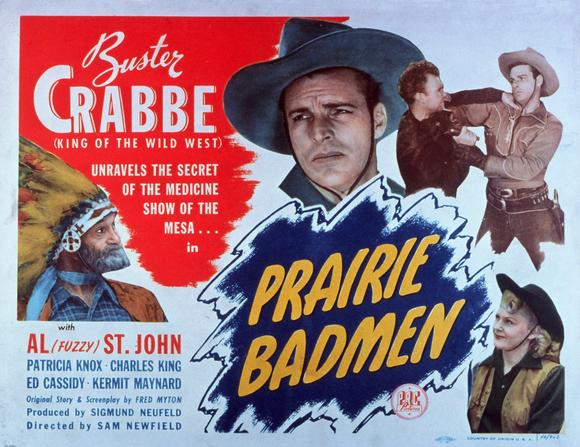
Prairie Badmen (July 17, 1946)

Is wildly prolific Poverty Row director Sam Newfield’s Prairie Badmen really that much better than the last two westerns of his I’ve seen? Or is he just wearing me down?

Probably a little of both. Prairie Badmen has all the hallmarks of a shoddy P.R.C. western — incompetent use of library music by musical director Lee Zahler, insouciant use of obvious stunt doubles, and static, unimaginative camerawork — but it moves at a nice clip, has a decent story, doesn’t overstay its welcome, and features plenty of goofy physical humor courtesy of Al “Fuzzy” St. John.

As the film opens, we see Fuzzy, wearing a feathered trailer warbonnet that flows down his back and reaches the ground. He’s standing on the back of a wagon, hawking patent medicine called “Kickapoo Elixir” (subtitled “A Blessing to Mankind”) to a bunch of cowpokes and yokels. Inside the wagon lies Doc Lattimer (Ed Cassidy), who is convalescing. Lattimer tells his daughter, Linda (Patricia Knox), “Fuzzy seems to be all right on the crescendo, but he doesn’t seem to have the proper persuasive note in his confidential appeal.”

Before you can say “Jack Robinson,” a trio of no-good characters, Cal (Charles King), Lon (Kermit Maynard), and Steve (John L. Cason), surreptitiously hitch their horses to the front of the wagon and take off with it, with Lattimer and his daughter inside. Fuzzy falls off, but he quickly gets to his feet and chases after them, his headdress flying behind him, nearly parallel to the ground. (It’s clearly held aloft by an off-screen wire, since its angle is different in each shot.)

Pretty soon, Billy Carson (Buster Crabbe) rides in and saves the motley crew of good-natured scam artists from the troublemakers. They claim they were just having some fun. Prairie badmen? More like prairie frat boys.

Or so it seems. Eventually we’ll learn that those badmen are after a map that a wounded and dying outlaw named Bill Thompson (Frank Ellis) may have left with Doc Lattimer five years earlier. The map supposedly shows the location of four bars of gold stolen from an express office.

The thickening of the plot, such as it is, comes from Doc Lattimer’s son, Don (John L. Buster), who’s sick of traveling with his father and sister, making chicken feed while standing on the back of the medicine wagon and singing songs like “Prairie Pete.” Billy offers him some avuncular advice, “You don’t prove you’re a man by carrying a chip around on your shoulder.” But Don doesn’t take it to heart, and soon falls in with the black hats, attempting to finagle a half share of the loot in exchange for revealing the location of the treasure.

The plot is nothing outstanding, but it’s engaging enough, and frequently punctuated by Fuzzy’s corn-pone antics, so it never gets boring. When Billy tells Fuzzy he should know what he’s selling for a dollar a bottle, Fuzzy accidentally grabs turpentine instead of patent medicine. He pours it on his head, down his back, and then drinks it. He proceeds to make facial expressions that would make Red Skelton ashamed, spits it out, yowls, and leaps up and down like a jumping jack.

Some of the comic relief goes on too long, such as the scene in which Fuzzy attempts to string up a hammock and then get into it, but it’s mostly entertaining. He wears his Indian warbonnet for most of the picture, and it’s practically another character in the movie, snaking and flying around, constantly manipulated by that off-screen wire.

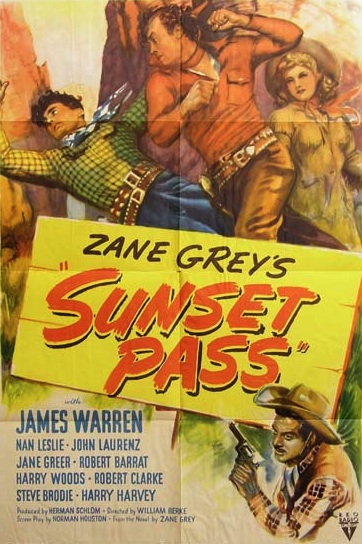
Sunset Pass (July 8, 1946)

Judging by the only Zane Grey novel I’ve read, Riders of the Purple Sage, which was published in 1912, Grey was the most influential and important writer to ever mythologize the American west.

He was also a hack, and his florid prose made me wish for the more psychologically realistic and straightforward portrayals of the west I grew up reading in westerns by Louis L’Amour. Part of this is due to the era in which he was writing. By the ’40s and ’50s, passages like the following would have seemed ridiculous:

Her head was bowing to the inevitable. She was grasping the truth, when suddenly there came, in inward constriction, a hardening of gentle forces within her breast. Like a steel bar it was stiffening all that had been soft and weak in her. She felt a birth in her of something new and unintelligible.

The word “overwrought” doesn’t begin to describe the world Grey creates. His hero, Lassiter, wears an outfit that would make Richard Boone as Paladin in the TV series Have Gun — Will Travel (1957-1963) look positively conservative. Not only is Lassiter dressed all in black leather, but his black sombrero boasts a band of silver dollars, and his long-barreled revolvers are sexualized to a ridiculous degree. And, of course, the action is fast, furious, implausible, and frequently accentuated by exclamation marks. I’d be tempted to call the novel Riders of the Purple Prose if it didn’t contain such raw power in its descriptions of landscapes.

Low swells of prairie-like ground sloped up to the west. Dark, lonely cedar-trees, few and far between, stood out strikingly, and at long distances ruins of red rocks. Farther on, up the gradual slope, rose a broken wall, a huge monument, looming dark purple and stretching its solitary, mystic way, a wavering line that faded in the north. Here to the westward was the light and color and beauty. Northward the slope descended to a dim line of canyons from which rose an up-Hinging of the earth, not mountainous, but a vast heave of purple uplands, with ribbed and fan-shaped walls, castle-crowned cliffs, and gray escarpments. Over it all crept the lengthening, waning afternoon shadows.

Grey had the soul of a Romantic. In his world, emotion trumps reason and the physical world mirrors the longings and passions of the people who exist in it. For better or for worse, it is this vision of the old west that captured the imagination of the reading public in the early 20th century, and informs the western genre to this very day.

I don’t really know why I’m going on and on about Riders of the Purple Sage, except that William Berke’s film Sunset Pass, which I’m reviewing today, is based on the 1931 novel of the same name by Zane Grey, and watching it made me think back to the only novel by Grey that I’ve read. (There’s an earlier filmed version of Sunset Pass that was directed by Henry Hathaway and starred Randolph Scott. It was released in 1933. I haven’t seen it.)

Sunset Pass, which was released by RKO Radio Pictures, hasn’t gone down in history as one of the great westerns, and it certainly can’t hold a candle to John Ford’s early westerns, but it’s a sight better than the stuff P.R.C. and Monogram were churning out week after week in the ’40s. The print I watched was clean and crisp. The black and white cinematography looked great. Neither Berke’s direction nor Norman Houston’s screenplay, however, capture Grey’s febrile world or antiquated dialogue. This is a by-the-numbers oater with plenty of shootouts, fistfights, chases on horseback, romance, and a few songs.

The film begins with an exciting but nonsensical scene. A cowboy named Rocky (James Warren) and his Mexican sidekick Chito (John Laurenz) tie up their horses in a stand of trees and watch a passenger train chugging toward them. They leave their horses and run alongside the train, which appears to be moving at top speed, and hop aboard. They take their seats, flirt with the ladies, and are in place to attempt to foil a train robbery. I say “attempt,” because a young woman named Jane Preston (Nan Leslie) knocks Rocky’s rifle barrel to the side when he attempts to shoot one of the robbers, allowing him to make his getaway. The men are all masked, but it’s clear that she recognizes him, and intervenes to save his life.

It turns out that Rocky and Chito are undercover agents employed by the railroad to stop robberies. If this is the case, what was the purpose of them not only leaving their horses in a remote area but also boarding the train in the middle of its journey? If anyone can explain it to me, please do. Were they hungover and missed the train? That’s the only explanation I can think of.

With the money stolen, Rocky and Chito are in hot water with the railroad company. Rocky rides off to track down the stolen loot while Chito grabs his guitar and makes love to showgirl Helen “Lolita” Baxter (played by Jane Greer, who exhibits none of the malevolence she would exude a little more than a year later in her most famous role as the femme fatale who ensnares Robert Mitchum in Out of the Past).

Eventually Rocky catches up with the robbers, but he’s shot and badly wounded. Luckily, he’s spirited away by a young man named Ash (Robert Clarke), who turns out to be Jane’s brother.

Clarke gives the best performance of the film as Ash Preston, and when his character faces ethical dilemmas, the movie really comes alive.

James Warren is a decent hero, but his performance is more one-note than Clarke’s. Tall, lean, and blond, with a perpetual scowl, Warren is sort of a Sterling Hayden Lite.

The villain of Sunset Pass, Cinnabar (Harry Woods), is good, too, but his name sounds like a candy bar or a coffee bar chain, and the other characters in the film refer to him a lot by name, which I found unintentionally funny.

Sunset Pass is standard western fare, but it was an enjoyable enough way to while away an hour and 5 minutes.

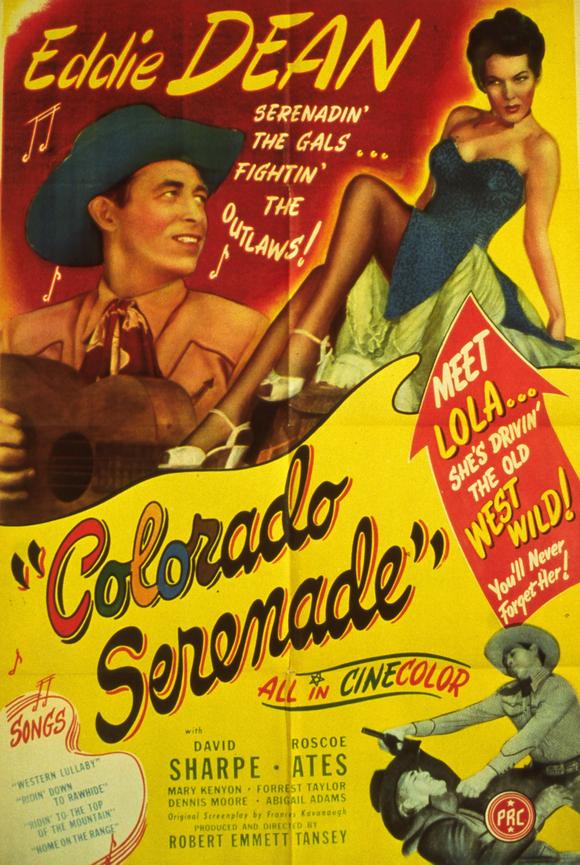
Colorado Serenade (June 30, 1946)

P.R.C. western Colorado Serenade, which stars lunkheaded cowboy actor Eddie Dean, is a good movie to fall asleep while watching. Dean has a terrible screen presence, zero acting ability, one dopey facial expression, and a great voice. So the best way to enjoy him is with your eyes closed, halfway between sleep and wakefulness.

That’s how I imagine at least a few moviegoers enjoyed this picture in the summer of 1946. As a one-hour Poverty Row oater, Colorado Serenade would have played as the bottom half of a double bill. After the newsreel, the cartoon, and the feature at the top of the bill, who wouldn’t be a little bit sleepy? And with Dean’s smooth, rich baritone belting out tunes like “Home on the Range,” “Ridin’ Down to Rawhide,” “Riding on Top of the Mountain,” and “Western Lullaby,” staying awake doubtless proved a challenge to anyone who hadn’t just drunk a cup of coffee.

Because, Lord knows, the plot of the film won’t keep you on the edge of your seat. Like many of Dean’s other P.R.C. westerns, Colorado Serenade is filmed in color — a rarity for the bargain basement studio — but everything else is typically cheap. Eddie and his comical sidekick, “Soapy” Jones (Roscoe Ates) team up with an undercover lawman named Nevada (David Sharpe) to take down a bunch of stagecoach robbers, but not before Eddie and Nevada, thinking each other on opposite sides of the law, slug it out in a good old-fashioned western saloon brawl.

The fight that closes the picture is actually pretty good, too, with a few stand-out stunts, such as Nevada leaping from the balcony and tackling a black hat in the bar below him, but it’s too little, too late after a turgid, talky flick that feels much longer than its 68-minute running time.

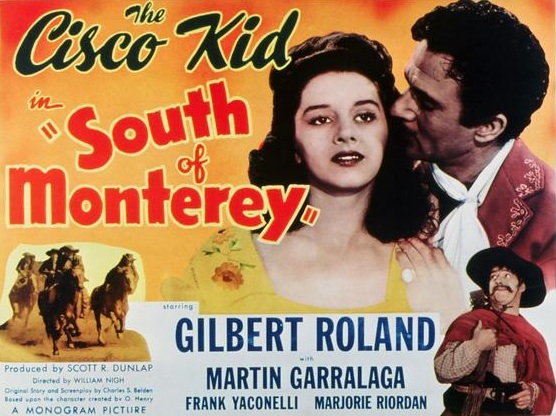
South of Monterey (June 15, 1946)

William Nigh’s South of Monterey is another dreary Cisco Kid programmer from Monogram Pictures. Gilbert Roland, in his second appearance as the character, cuts a dashing figure and is always fun to watch, but overall this one is a real snoozer.

I wasn’t exactly knocked out of my seat by Roland’s first turn as the character in The Gay Cavalier (1946), and his second outing is more of the same, with a by-the-numbers story and an anticlimactic finale. As before, Roland is fun to watch as a smooth Lothario and laid-back hero. It’s everything else about this picture that’s the problem.

This time around, Cisco, his sidekick Baby (Frank Yaconelli), and his merry band of Mexican outlaws have a rival, called “The Silver Bandit.” It should come as no surprise to veterans of Saturday afternoon matinees that Cisco and his crew will be blamed for the nefarious exploits of The Silver Bandit.

South of Monterey combines the two hoariest concepts in these types of films; the evil landowner bleeding the poor farmers dry and the young woman in danger of being forced to marry a man she doesn’t love.

The main villain of the piece is the local tax collector, Bennet (Harry Woods), who repossesses peasants’ land based on non-payment of sky-high taxes and then resells them for a profit. The young woman in danger of being forced into a loveless marriage is Carmelita (Iris Flores), the sister of local commandante of police Auturo (Martin Garralaga). Carmelita is engaged to a fiery young activist named Carlos Mandreno (George J. Lewis), but her brother is angling to have Carlos thrown in jail and his sister married off to his friend Bennet.

The film tries hard to achieve an exciting, south of the border flavor, and occasionally succeeds. Roland doesn’t play Cisco as a Boy Scout — he’s a tequila-drinking, womanizing, cigarette-smoking rapscallion. Also, there are four songs in the film sung in Spanish, one of which leads Cisco to pay Carmelita one of his typically over-the-top compliments, “Your voice has the sweetness of a meadowlark, and the softness of mission bells at twilight.”

South of Monterey isn’t a terrible programmer, it’s just a fairly typical Monogram cheapie. The main reason for me that it was a step down from The Gay Cavalier was the climactic fight, which was a fistfight. Yawn.

As he ably demonstrated in Captain Kidd (1945) and The Gay Cavalier, Roland was a hell of a sword fighter, so it’s a shame to see him swinging haymakers and smashing furniture when his blade was no doubt screaming out for blood. I know I was.