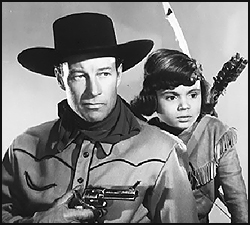
 Red Ryder was a comic-strip cowboy created by writer Stephen Slesinger and artist Fred Harman. Red Ryder premiered in the Sunday funnies on November 6, 1938, and soon grew into one of the largest franchises in entertainment history. In the 1940s, there was nary a kid-friendly product that didn’t have a Red Ryder tie-in; comic books, novels, Big Little Books, a radio show, and the infamous Red Ryder BB Gun, which is still in production today despite the fact that Red Ryder hasn’t appeared in newspapers since the 1960s. For thousands of baby boomers, the Red Ryder BB Gun wasn’t the only way to put an eye out, but it was the most universal.
The first appearance of Red Ryder on film was in 1940, in the Republic serial Adventures of Red Ryder, which starred Don “Red” Barry as Red Ryder and Tommy Cook as his young Indian sidekick, Little Beaver. Like all Republic chapterplays, it was quality entertainment, but Barry was a bit of a pipsqueak compared with the tall, square-jawed actor who stepped into the role next, “Wild” Bill Elliott. Starting with Tucson Raiders in 1944, Elliott was paired with future ladykiller Robert Blake (at that time credited as “Bobby Blake”) as Little Beaver in a total of 16 features over the course of two years. (Blake kept appearing as Little Beaver in the series after Elliott left. Starting with Santa Fe Uprising in 1946 he was paired with Allan “Rocky” Lane in seven more Red Ryder films.)
Colorado Pioneers begins in Chicago, where Red Ryder and Little Beaver run afoul of a couple of ragamuffins who today would be called “at-risk youth.” Red Ryder intercedes on their behalf in court, and frees them from a life of petty street crime by taking them back to the Colorado ranch run by his aunt, “The Duchess” (Alice Fleming), where he teaches them the value of hard work and fresh air. Originally planning to take just the two boys who stole his money (Billy Cummings and Freddie Chapman), Red Ryder is convinced by Little Beaver to take the whole gang, including a token black member named “Smokey,” who is played by Billie “Buckwheat” Thomas (yes, he’s the Buckwheat you’re thinking of). The situation may be hokey and formulaic, but Elliott is a strong enough presence to make you believe it when the kids start following his lead. The emotional core of the film is the most recalcitrant boy, who resists Red Ryder’s mentorship, but who can’t resist a frail colt, which he feeds and talks to in secret. The boy’s journey from a hardened little thug to a young man who is able to care for something weaker than himself and tell the truth even when it’s difficult makes for a surprisingly moving story.
Colorado Pioneers is an excellent little B western. While it’s aimed at kids, Elliott is believable and tough enough as Red Ryder for adults to enjoy the film, too. He’s not quite Henry Fonda or Randolph Scott, but he’s one of the better western stars you’ve probably never heard of.
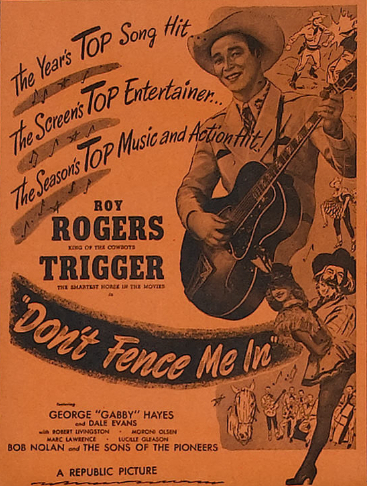
 A lot of men were drafted during World War II. Roy Rogers was one of them. With a 1-A classification, he expected to be shipped out in the spring of 1945. Consequently, screenwriter John K. Butler (working from a story by Leon Abrams) came up with a script to showcase Rogers’s leading lady, Dale Evans. When V-E Day rolled around, however, the draft board exempted men over the age of 30 who had children, so Rogers never had to serve. Director Frank McDonald’s Sunset in El Dorado ended up starring both “The King of the Cowboys” and “The Queen of the West,” but Evans is still the central figure, and it’s a great showcase for her sunny persona.
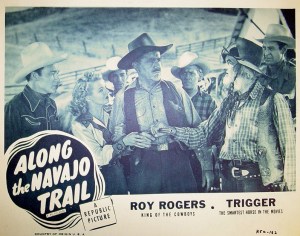 There are no Navajos to be found in this run-of-the-mill Roy Rogers picture, or American Indians of any tribe, for that matter. The title comes from a popular song that was written by Dick Charles (a.k.a. Richard Charles Krieg), Larry Markes, and Edgar De Lange in 1945, and is sung by Rogers, Dale Evans, and the rest of the gang to close the picture. No, the only people of color in Along the Navajo Trail are Spanish-speaking Gypsies, who are portrayed in much the same way Mexicans were in Hollywood westerns except that they wear funny clothes, travel in wagons, and the men wear gold hoop earrings. They also provide George “Gabby” Hayes’s character with a series of comic interludes in which he attempts to cheat the Gypsies, and is in turn cheated himself. These horse trades don’t add much to the plot, but they do result in Hayes sputtering the memorable line, “I sure have gypped that gyppin’ Gypsy!”
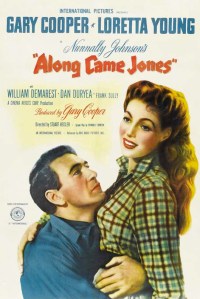 Along Came Jones is a silly little western that verges on being a spoof of the genre, but it’s worth seeing for a couple of reasons. Gary Cooper pokes fun at his stalwart image without devolving into parody, and the gender reversals in some of the action scenes are still surprising.
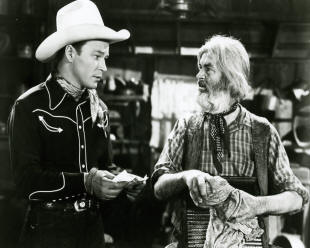 The western genre may be moribund, but it refuses to kick the bucket. Singing cowboys, on the other hand, are deader than vaudeville. There was a time, however, when Gene Autry and Roy Rogers were two of the biggest film stars in America.
 OCD Viewer