 James Cagney made a big splash in William A. Wellman’s The Public Enemy (1931). It was his first starring role. Some people claim that when Cagney first walked on screen in that picture, it was the beginning of “modern acting.” Whether or not you believe that claim, there’s no denying the impact Cagney had on Hollywood, especially gangster films. The scene in which he shoves a grapefruit half into Mae Clarke’s face is iconic. Late in his life, Cagney claimed that people still sent grapefruits to his table in restaurants, with a wink and a nod. The Public Enemy ushered in a new era of onscreen violence, and an icon was born.
Cagney would go on to play many criminals, gangsters, and con men, in films like Smart Money (1931), Blonde Crazy (1931), Hard to Handle (1933), Picture Snatcher (1933), The Mayor of Hell (1933), Lady Killer (1933), He Was Her Man (1934), Angels With Dirty Faces (1938), Each Dawn I Die (1939), and The Roaring Twenties (1939). He was so good in these roles that when a lot of people hear the name “Jimmy Cagney,” they can only think of a sneering mug with a gat clenched in his fist and a cigarette dangling from his lower lip. But Cagney was a versatile actor. He also played cops, G-men, servicemen, and comedic roles, as well as singing and dancing in musicals. In fact, the only Academy Award he ever won was for his role in Michael Curtiz’s Yankee Doodle Dandy (1942), a drama and musical that told the life of George M. Cohan.
I think Cagney is a great actor with a unique style and personality. Anything he appears in is worth watching. Blood on the Sun was directed by Frank Lloyd, a Hollywood veteran who’d been making pictures since the silent era. It’s a wartime potboiler with a dubious MacGuffin; the Tanaka Memorial, an alleged strategic document from 1927 in which Prime Minister Baron Tanaka Giichi created for Emperor Showa a strategy to take over the world. It is believed by many historians to have been a forgery. In the ’30s and ’40s, however, the document was widely accepted as true. It was mentioned in Frank Capra’s agitprop documentary series, Why We Fight, and translations were published in Chinese and American periodicals. Of course, one reason why it was widely regarded to be an actual document is because Japan’s actions so closely mirrored the strategy that the Tanaka Memorial outlined; the conquest of Manchuria and Mongolia, followed by the invasion of China, the establishment of bases in the Pacific, and the eventual conquest of the United States. So although General MacArthur’s armies were unable to uncover any original Japanese-language versions of the Tanaka plan after World War II, perhaps its authenticity is beside the point.
In Blood on the Sun, which takes place in Tokyo in the late ’20s, Cagney plays an American reporter named Nick Condon. Condon writes for the Tokyo Chronicler, which is essentially a mouthpiece for the Japanese government, and is aimed at the Western business community. When Condon writes and publishes an article about a secret plan that outlines Japan’s plans for world domination, his editor tells him to print a retraction. He refuses, and the Japanese secret police plant a false story in the newspaper designed to discredit Condon. When Condon still refuses to back down, the Japanese secret police raise the stakes by murdering two of Condon’s friends, whom they believe are smuggling a copy of the Tanaka plan out of the country. Eventually, the film becomes a cat-and-mouse espionage thriller, with Condon on the run with a “half-breed” named Iris Hilliard, played by Sylvia Sidney, who is originally sent by the secret police to ingratiate herself to Condon and find out if he has a copy of the Tanaka plan. (Since Sidney is a white actress in yellowface makeup, I wasn’t clear for awhile which two races she was supposed to be descended from. One is Chinese, but I could have sworn that at one point, another character described her as being half Japanese/half Chinese. Her surname, however, implies that her father was British or American. So I must have misheard the line of dialogue.) Besides the questionable historical accuracy of Blood on the Sun, the white actors playing Japanese roles will probably be the hardest thing for modern audiences to swallow. John Emery, who plays Tanaka, and Robert Armstrong, who plays Col. Hideki Tojo, are not the worst examples of yellowface I’ve ever seen, but with their indeterminate, lisping accents, they’re still pretty bad. Blood on the Sun isn’t a particularly racist film, however, especially when one considers the context in which it was made. All of its villains are representatives of the Japanese government, which committed horrifying atrocities during World War II, and with whom the United States was still at war when this film was made. Several of the actors in smaller roles are actually Asians (although it’s unlikely that too many, if any, are actually Japanese).
The main reasons to see this film today, aside from historical curiosity, are the performance of Cagney and the well-choreographed fight scenes. Blood on the Sun won a single Oscar at the 18th Academy Awards in 1946, for best art direction in a black and white film, but it should have won for “most awesome martial arts battle in an American film.” Sadly, such a category did not exist. How could it? Martial arts were new to Hollywood. Some people cite John Frankenheimer’s The Manchurian Candidate (1962) as having the first real martial arts fight scene in an American film, which is clearly not the case. Frank Sinatra and Henry Silva’s karate chops were fine, but they pale in comparison to the brutal judo smackdown that crowns Blood on the Sun. Cagney studied judo for this film, and liked it so much he kept it up for most of his life. How could he not? A born-and-bred brawler, Cagney clearly took to martial arts like a fish to water. The combination of judo throws and boxing as he fights the leader of the secret police, Capt. Oshima, played by Jack Sergel (who acted under the stage name “John Halloran”), is fairly basic by today’s standards, but it’s still impressive. Cagney and Sergel go to the ground several times, and the chokeholds and arm bars look as if they hurt. So do the throat punches. Sergel was actually my favorite actor in the film after Cagney. He’s tall, menacing, and has a shaved head and black mustache. He doesn’t look particularly Japanese, but he’s more convincing as an Asian than any of the other white actors in the film. Sergel was a former LAPD officer who had been investigated by the FBI because of his involvement with the sport of judo, including his participation in at least one judo tournament that was held in a Japanese internment camp. Even though he was a Los Angeles police sergeant and loyal American citizen, his admiration for Japanese culture and sport was seen as suspicious by federal and local authorities, and he ended up resigning from the LAPD in 1944. Cagney spends a lot of his time in this film punching, kicking, and throwing the bad guys who come after him, but his fight with Sergel is the high point. Cagney was a small man, and Sergel towers over him, but Cagney’s sheer physicality makes you believe they’re evenly matched.
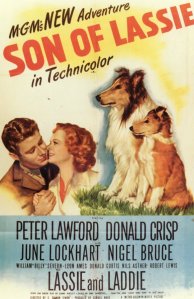 Son of Lassie could just as easily have been called Laddie Goes to War! In this follow-up to Lassie Come Home (1943), which starred Roddy McDowall and Elizabeth Taylor, Lassie has a son, named Laddie. Laddie grows ups, as does young Joe Carraclough, who was played by McDowall in the first film, but is here replaced by future Rat Pack member and Kennedy spouse Peter Lawford, whose slightly deformed arm kept him out of World War II. Joe joins the army, and Laddie tries to join up with him, but he cringes the first time blank cartridges are fired at his face, which disqualifies him as a canine soldier. When Joe is taken prisoner of war in Norway, however, Laddie … well, I don’t want to give anything away. (But if you’ve ever seen a “boy and his dog” movie before, you can probably predict what will happen.)
 OCD Viewer