Monthly Archives: May 2011

Monsieur Verdoux (April 11, 1947)

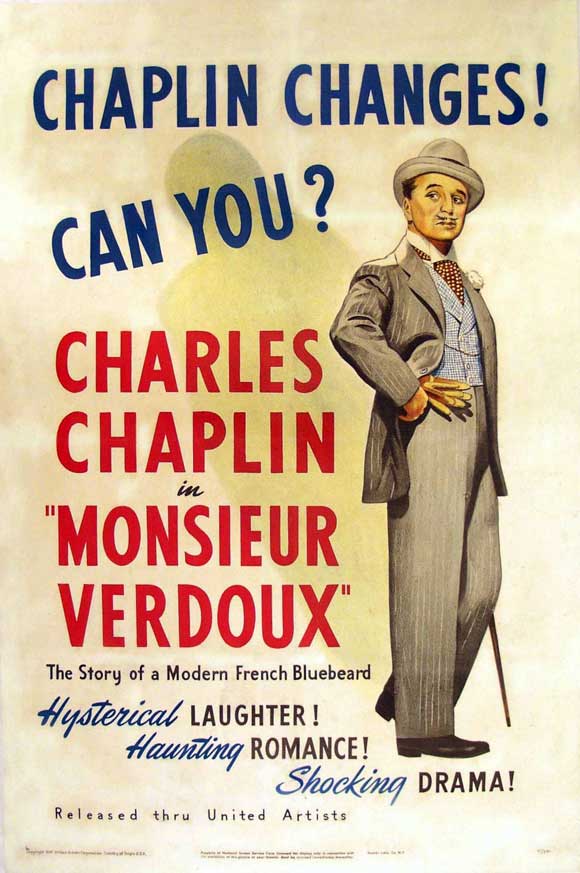
Monsieur Verdoux
Monsieur Verdoux (1947)
Directed by Charles Chaplin
United Artists

Monsieur Verdoux, “a comedy of murders,” is a product of Charles Chaplin’s Frantic One-Man Band. Besides starring in the film, Chaplin is credited with directing the picture, writing the screenplay, producing the film, and writing the music. Orson Welles wrote the original script and was slated to direct Chaplin in the picture, but at the last minute, Chaplin decided that he didn’t want to be directed by someone else — he’d always been his own director in the past — and bought the script from Welles, crediting him with the “idea” for the film.

The film is based on the career of real-life murderer Henri Désiré Landru, who between 1914 and 1918 seduced a number of women and murdered them after gaining access to their assets. He burned their dismembered bodies in his oven, disposing of them completely, which made prosecuting him a challenge after he was caught. A trail of paperwork and other evidence was enough to eventually convict him of 11 counts of murder (10 women and one of their teenaged sons), and he was executed on the guillotine in 1922.

In Monsieur Verdoux, Chaplin plays a man named Henri Verdoux, who describes himself as an “honest bank clerk.” Honest, that is, until the Depression of 1930, at which point he began his new career, “liquidating members of the opposite sex.” He claims that he began his career as a Bluebeard strictly as a business proposition. This is utter claptrap, as is nearly every other word out of M. Verdoux’s mouth that isn’t plot-advancing dialogue, but we’ll get to that later.

The film takes place in 1932. M. Verdoux had a 30-year career in banking before he began his new career as a murderer, and with his dainty, foppish clothes he looks like a relic of another time. When the film begins, he is living in a villa in the south of France. He’s a tidy little man who loves to garden, but whose incinerator has been going full-blast for the past three days. He’s kind to animals, moving a caterpillar out of his way in the garden path and feeding a cat on the street. M. Verdoux is even a vegetarian.

He is also a lothario with an insatiable appetite for well-heeled widows. But this, M. Verdoux assures us, is just his day job. His heart belongs to his wheelchair-bound wife Mona (Mady Correll) and adorable little boy Peter (Allison Roddan). At home, M. Verdoux lectures Peter when he catches him pulling the cat’s tail that “violence begets violence.” He also tells his son that he has a mean streak. “I don’t know where you get it!” he exclaims.

Aside from the saintly Mme. Verdoux, nearly everyone in the film is a grotesque and obnoxious caricature. In this way, Monsieur Verdoux is a distillation of Chaplin’s career-long vacillation between sentimentality and cruelty. A perfect example of this is the scene in which M. Verdoux brings a girl in off the street to poison her, but thinks better of it after she speaks of how wonderful life can be, and how she loved her husband, crippled in the war. (The girl is played by 20-year-old ingenue Marilyn Nash.)

The few bits of physical comedy in the film are funny, but they’re mostly either too brief or out of character with the rest of the scene in which they take place. Several comedic scenes — such as when M. Verdoux and another man start slapping each other with rapid-fire speed, or when M. Verdoux is romancing the older woman who was going to buy his villa in the beginning of the film, and he’s moving ever closer to her on the couch — fade to black in a quick, unsatisfying way.

When Monsieur Verdoux was released, Chaplin’s reputation was severely tarnished. He hadn’t made a film since The Great Dictator (1940), and he was under attack for both his Leftist political sympathies and his morals (he was the subject of a sensational paternity suit, and was a serial seducer of young women, many of them underage).

Chaplin and Nash

Monsieur Verdoux can be seen as a defiant stand against his critics. It’s the blackest of black comedies, and was a box office disaster in the United States when it was first released (it fared a bit better in Europe), but has built up quite a cult since it was re-released to receptive audiences in the ’60s and ’70s. At the time of its release, however, it polarized critics. James Agee crowned it a masterpiece, and the National Board of Review named it the best English-language film of 1947. Others were less enthusiastic.

I think that Monsieur Verdoux is a deeply flawed film. Chaplin was the preeminent clown of the silent era. He wasn’t quite the master technician of hijinks that Buster Keaton was, but he was able to convey a panoply of emotions through his face and body. His films are not only some of the funniest of the silent era, but are emotionally affecting, too. The ending of City Lights (1931) is still one of the most powerful I have seen in any film.

When he was able to speak onscreen, however, Chaplin was a tedious hack who only thought he was profound. Monsieur Verdoux isn’t as crushingly pretentious and boring as his later film Limelight (1952), but it has its moments.

The end of Monsieur Verdoux is especially problematic. Speaking on his own behalf in court, M. Verdoux says, “I was forced to go into business for myself. As for being a mass killer, does not the world encourage it? Is it not building weapons of destruction for the sole purpose of mass killing? Has it not blown unsuspecting women and little children to pieces? And done it very scientifically? As a mass killer, I am an amateur by comparison. However, I do not wish to lose my temper, because very shortly, I shall lose my head. Nevertheless, upon leaving this spark of earthly existence, I have this to say: I shall see you all… very soon… very soon.”

The problem with this is that the murders of dowdy and grotesque women that we’ve seen M. Verdoux carry out in the film are very different from the mass mechanized killing of the Great War or the genocidal horrors of World War II. They’re intimate crimes, carried out for personal gain, and occasionally hilarious, such as the sequence in which M. Verdoux is repeatedly foiled while attempting to drop a noose around one of his wives’ necks while they are out fishing. It would be one thing if Chaplin were presenting M. Verdoux’s crimes as symptoms of a sick society, but what he seems to be doing is using a sick society as a justification for M. Verdoux’s crimes.

Is M. Verdoux meant to be an unreliable narrator? Perhaps, but he never comes across that way. I think that Chaplin was simply too infatuated with himself to present M. Verdoux as anything but a lovable cad, which makes the entire film uncomfortable and off-putting in ways I’m not sure Chaplin ever intended.
Tarzan and the Huntress (April 5, 1947)

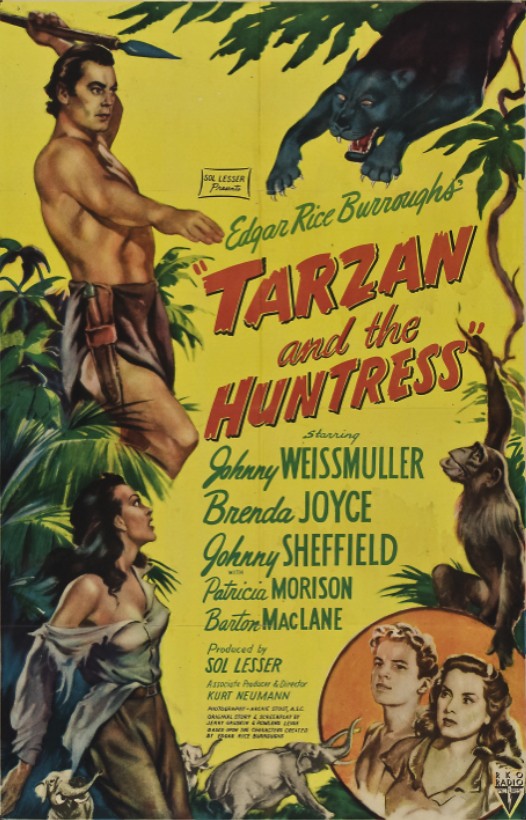
Kurt Neumann’s Tarzan and the Huntress should really be called Tarzan and the Poachers. The word “huntress” conveys more risqué sexiness than the film actually contains (the same can be said of the poster), and seems designed to draw in the same people who shivered at the sight of the muscular Johnny Weissmuller being clawed by the beautiful actress Acquanetta in his previous outing as the King of the Jungle, Tarzan and the Leopard Woman (1946).

When Tarzan and the Huntress begins, we learn that zoos around the world are facing a post-war shortage of animals. (Did lions and monkeys get drafted? I missed that.)

Enter Tanya Rawlins (Patricia Morison, stepping up from Queen of the Amazons to a higher-quality jungle movie). Tanya is an animal trainer leading a safari that also includes her villainous guide, big-game hunter Paul Weir (Barton MacLane), and the moneyman, Carl Marley (John Warburton).

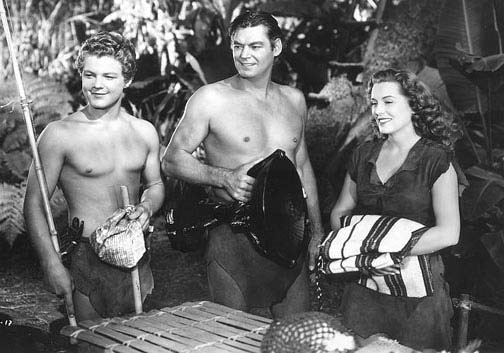
Meanwhile, a half-naked couple who live in a treehouse with their pet chimp and their boy, who calls his adoptive parents by their first names, are preparing to honor local monarch King Farrod (Charles Trowbridge) on the occasion of his birthday. No, they’re not hippies, they’re Tarzan and Jane, played by Weissmuller and Brenda Joyce. Their adopted son, “Boy,” is once again played by Johnny Sheffield, who looks as if he should probably change his name to “Man” sometime soon (or at least “The Artist Formerly Known As ‘Boy'”), since he’s nearly as big as Tarzan. (This was Sheffield’s last role in a Tarzan picture. In 1949 he struck out on his own in the Bomba, the Jungle Boy series.) When Tarzan inspects the fishing pole that Boy has fashioned for King Farrod, he smiles and says, “Everybody like fishing, even kings.” This might be a lesser entry in the Tarzan series, but the playfulness of Tarzan’s little family group and their idyllic life in the jungle is always fun to watch. If you’ve seen one Tarzan movie, however, you’ve seen them all, and you know that something will soon come to threaten their peaceful existence.

In this case, it’s a perfect storm of Tarzan-related problems — hunters and trappers arriving from the “civilized” world, treacherous locals, and Cheeta and Boy’s shared love of shiny objects.

When Weir tells Tanya that King Farrod won’t allow more than two specimens of each animal to be taken out of the jungle, Noah’s-Ark style, she sputters, “You can’t be serious!” So in a back-door deal, the king’s scheming nephew, Prince Ozira (Ted Hecht), offers Weir and Tanya a “no quota, no restrictions” offer on trapping animals, as long as they pay him a bounty per animal.

One of the members of Tanya’s safari offers to trade Boy a hand-crank flashlight for Cheeta. Boy refuses, since Cheeta’s like a member of the family, but he’s not above stealing a pair of lioness’s cubs in exchange for the nearly worthless bauble.

Tarzan returns the two cubs to their mother and draws a line in the sand. Hunters stay on their side of the river, Tarzan stay on his.

The hunting party doesn’t seem overly concerned, but then Tarzan calls all the animals to him with his powerful jungle cry, and they leave the hunters’ side and come to his.

It’s on.

Tarzan knows just how to handle the greedy poachers when they cross the river into his territory. “Hunters without guns like bees without stings. Hunters not so brave now,” he says, after he steals all of their weapons and hides them behind a waterfall.

That would be the end of the story if it weren’t for that darned Cheeta, who wants Tanya’s shiny compact so badly that she shows the hunters the way to the waterfall.

Cheeta gets her compact, the poachers get their guns, and it’s time for Tarzan and Boy to hand out the punishment, one hunter at a time.

Tarzan and the Huntress was Weissmuller’s penultimate turn as Tarzan. After appearing in Tarzan and the Mermaids (1948), he went on to star in the Jungle Jim series and Lex Barker took over starring in the franchise with Tarzan’s Magic Fountain (1949).

Weissmuller appears to have gained some weight since he made the previous picture in the series, Tarzan and the Leopard Woman, but he’s always fun to watch as the character. Brenda Joyce looks beautiful, as always, but I wasn’t sure what to make of her little slip-on pantyhose shoes.

If you’ve never seen a Tarzan picture before, Tarzan and the Huntress probably isn’t the place to start, but it’s solid entertainment for fans of the series, and offers especially good animal action and hijinks.

My Favorite Brunette (April 4, 1947)

Elliott Nugent’s My Favorite Brunette begins with baby photographer Ronnie Jackson (Bob Hope) in the death house at San Quentin. Jackson is set to be executed that night, and he’s hoping for a stay from the governor. When none arrives, Jackson quips, “No word? Well, I’ll know who to vote for next time.”

Jackson takes a look into the chamber where he’s set to die. “Gas,” he scoffs. “You haven’t even put in electricity.”

Like any good film noir protagonist, Jackson gets to tell his story before he takes that last, long, lonely walk. (Of course, Jackson isn’t really a noir protagonist, since My Favorite Brunette is a spoof of hard-boiled detective movies, but he doesn’t know that.)

When Jackson’s story begins, he’s desperately trying to get an adorable little Chinese-American boy to smile for the camera, but he’s hungry for bigger problems. Jackson may be San Francisco’s premier baby photographer, but he idolizes the man who has the office across from him, two-fisted he-man Sam McCloud (an uncredited Alan Ladd, who’s clearly able to laugh at himself). Jackson longs to be a detective, too. “It only took brains, courage, and a gun,” Jackson says. “And I had the gun.”

When McCloud has to run off to Chicago for a few days, Jackson just happens to be sitting in his office when the beautiful and exotic Carlotta Montay (Dorothy Lamour) walks in. When she thinks he’s McCloud, he can’t bear to tell her the truth, and is off on his first case, tracking down Carlotta’s missing husband, the Baron Montay. (Or is he her uncle? The story keeps changing.)

I won’t summarize the plot any further, mostly because it’s beside the point, but also because it’s nearly as convoluted as an actual hard-boiled P.I. story. Also, some of Jackson’s hard-boiled narration is so close to the real thing that it’s remarkable. After he’s knocked out in his office, he says in voiceover, “When I came to, I was playing ‘post office’ with the floor. I had a lump on my head the size of my head. Inside, Toscanini was conducting the Anvil Chorus with real blacksmiths. I looked at the bottle of Old Piledriver and decided to stick to double malts.”

Sure, it’s over-the-top, but so was most of the dialogue in hard-boiled detective films. Threats like, “I’ll fill you so full of holes you’ll look like a fat clarinet,” sound funny when they’re coming out of Bob Hope’s mouth, but they’re no more ridiculous than half of the things Humphrey Bogart and Dick Powell growled at tough guys.

Besides the genuinely funny script and manic direction by Nugent, the casting is key to the success of My Favorite Brunette. Dorothy Lamour is attractive and sleepy-eyed enough to be a real femme fatale, and the hulking Lon Chaney Jr. and the sinister Peter Lorre are both on hand to play bad guys. (All that’s missing is Boris Karloff with an eye patch and a hook for a hand.)

I’m not the biggest fan of Bob Hope, but he’s excellent in this movie, and frequently had me in stitches. The comedy mostly comes from the dialogue, but there are some classic bits of physical humor, too. The scene in which Lorre tries to force a false clue on Hope while hiding in various spots in a room, but Hope just keeps missing it, might be the funniest bit in the film.

My Favorite Brunette has fallen into the public domain, and is available to watch at archive.org. You’ll have to wait until the very end for Bing Crosby’s cameo, but it’s worth it.