Yearly Archives: 2011

The Secret Life of Walter Mitty (Aug. 14, 1947)

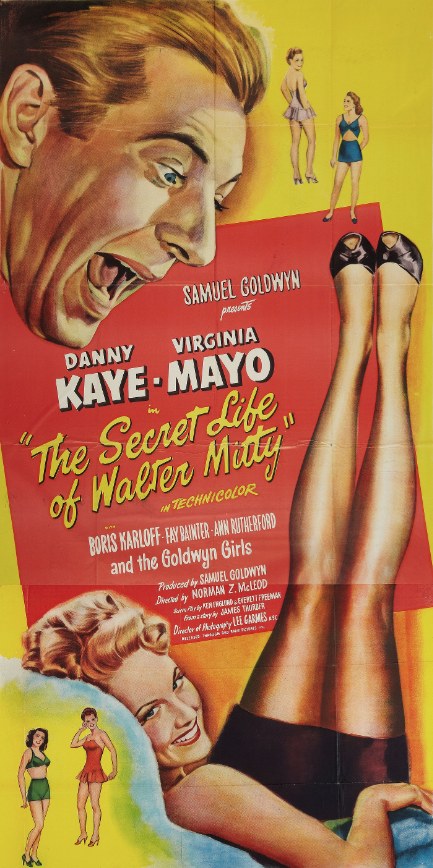
Norman Z. McLeod’s The Secret Life of Walter Mitty is a pretty funny film, and sometimes funny is all you need.

It wasn’t all James Thurber needed at the time the film was made, however. The movie was based on Thurber’s 1939 short story of the same name, and he was extremely unhappy with all the changes made to it. He also hated Danny Kaye’s performance as Mitty, since it was nothing like how he had originally conceived of the character.

I haven’t read Thurber’s short story. If I had, this movie and the liberties it took with the source material might have irritated me.

As it was, the only thing that irritated me was the length of some of the film’s musical interludes. Danny Kaye is an engaging and likable performer, but he milks his musical stand-up comedy bits for such a long time that I had more fun watching the amused extras than I had watching Kaye.

The Secret Life of Walter Mitty is a Technicolor extravaganza that follows the misadventures of a put-upon editor named Walter Mitty (Kaye). Mitty lives with his mother (played by Fay Bainter) and commutes into New York City every morning to his job at a company that publishes pulp magazines. He also has a rich fantasy life, and imagines himself as a sea captain, a brilliant surgeon, a gunslinger in the Old West, a … well, you get the idea.

He’s engaged to a girl who doesn’t really love him named Gertrude Griswold (Ann Rutherford), his mother piles errands on him until packages are literally falling out of his arms, his boss Mr. Pierce (Thurston Hall) steals his ideas, and Mitty takes it all in stride. One day, however, the girl who prominently features in all of his daydreams (Virginia Mayo) suddenly appears in the flesh, and Mitty is drawn into a real-life adventure involving stolen jewels and a spy ring. A grim-looking assassin who masquerades as a psychiatrist named Dr. Hugo Hollingshead (played by a perfectly cast Boris Karloff) dogs Mitty’s every move, first trying to kill him, then trying to convince him that the whole affair was just another one of his daydreams.

It may not be a deep film, but The Secret Life of Walter Mitty is a lot of fun. It’s a production of The Samuel Goldwyn Company, so of course the luscious Goldwyn Girls are on hand for all those department store dressing-room scenes and lingerie-modeling bits that are integral to the film’s story.

Singapore (Aug. 13, 1947)

Note to aspiring makers of B movies — if you’re going to blatantly rip off Casablanca (1942), take a page from director John Brahm’s book. Don’t just change the characters’ names and tack on a happy ending. Do it with real panache and also change the hero’s occupation to “pearl smuggler” and spice up the love triangle by giving the heroine a case of amnesia.

True to its title, Singapore is steeped in the exoticism and heat of the Pacific Rim, but like the film noir techniques Brahm uses to tell his story, it’s mostly just window dressing for a run-of-the-mill potboiler. But that’s not entirely a bad thing. Brahm keeps things moving along nicely, and Singapore is a lot of fun if you’re in the mood for a melodrama and you can overlook some contrivances.

When Matt Gordon (MacMurray) returns to Singapore after World War II, it’s clear as soon as he steps off the plane that he has a history there. Deputy Commissioner Hewitt (Richard Haydn) has Gordon brought to his office, and he reminds him that the penalty for removing illegally obtained pearls from a British colony is a minimum of 10 years in prison.

“Before the war it was only eight,” Gordon quips. “But I guess everything’s gone up, huh?”

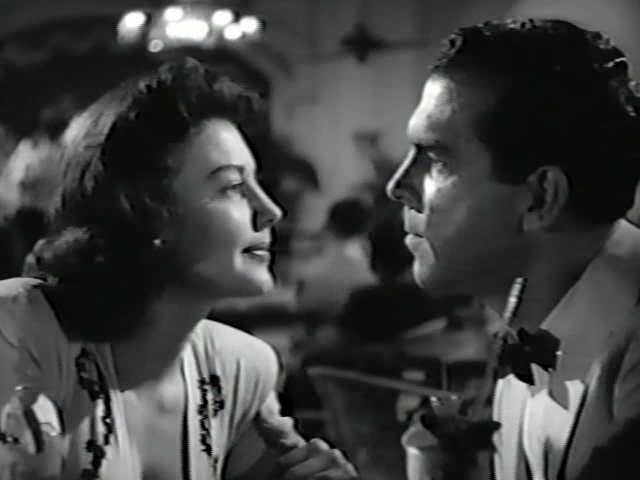
Gordon sits down in the hotel bar, orders two gin slings, and sits alone, reminiscing about life in Singapore before the war. He fell in love with a beautiful young woman named Linda Grahame (Ava Gardner), but their whirlwind romance was cut short by the beginning of hostilities with the Japanese.

They were engaged to be married, but before they could tie the knot she was killed in a bombing raid, and Allied forces had occupied his hotel room, where his $250,000 worth of pearls were secreted in the motor of the ceiling fan in his room.

He made it out of Singapore with his life, but that’s all, and now that the war is over he’s intent on retrieving his pearls. (It’s established that Gordon has a service record, and saw combat during the war, perhaps to engender audience sympathy.)

Of course, Linda didn’t really die in a bombing raid. She was injured and stricken with total amnesia. Unable to remember any details of her former life, she was interned in a Japanese concentration camp, where she met Michael Van Leyden (Roland Culver), a British plantation owner who saved her life many times during the war. Now they are married, and her name is Ann Van Leyden. No matter how many times Gordon calls her “Linda,” she just can’t remember their time together, or the love they shared.

So Gordon has two problems — winning back Linda/Ann, and somehow getting his pearls out of the ceiling fan of a hotel room that is now occupied by an obnoxious married couple. The problem of the pearls is compounded not only by the watchful eye of Deputy Commissioner Hewitt, but also by the corpulent gangster Mr. Mauribus (Thomas Gomez), who wants the pearls for himself.

There are a lot of ceiling fans in Singapore, and none of them move quickly. It’s all part of the languorous, overheated atmosphere of the film, but like I said above, it’s all just window dressing. The Asian extras in the background and the crowded streets of the port city add ambiance, but not much else. The action could be moved to any other “exotic” locale, and few details of the plot would have to be changed. (And that’s exactly what happened in 1957 when director Joseph Pevney remade Singapore as a vehicle for Errol Flynn called Istanbul.)

I liked Singapore despite its flaws, and it’s always enjoyable to watch the beautiful Ava Gardner do anything. I didn’t completely buy her relationship with the hulking, thuggish Fred MacMurray — I’ve always thought MacMurray was better in comedic roles than dramatic ones — but it works well enough to keep the film moving.

Under the Tonto Rim (Aug. 1, 1947)

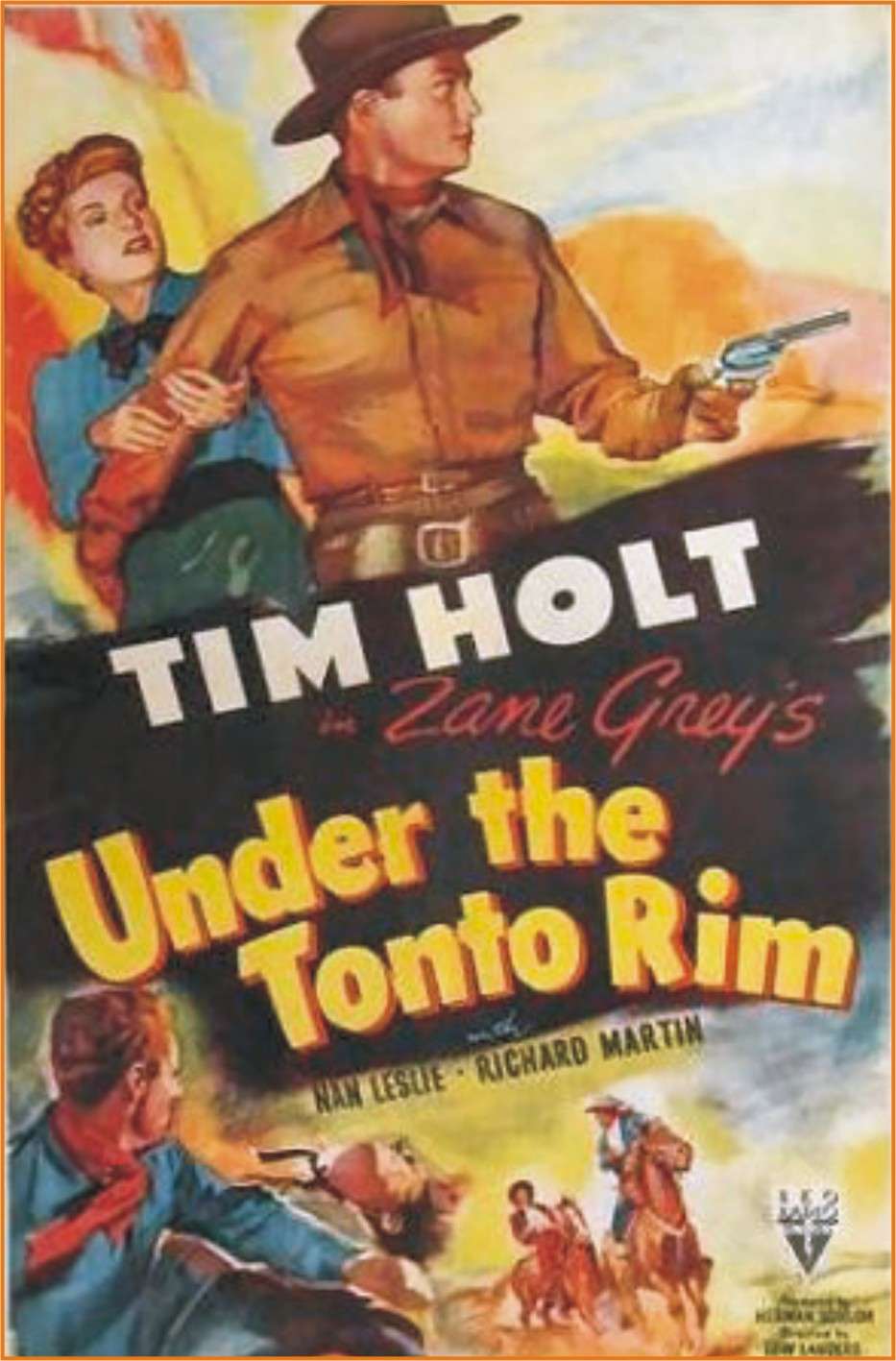
Tim Holt’s second postwar western, Under the Tonto Rim, is a lot like his first postwar western, Thunder Mountain (1947). Both are RKO films produced by Herman Schlom and directed by Lew Landers, with screenplays by Norman Houston that are based on Zane Grey novels.

And even though Tim Holt plays a different character in Under the Tonto Rim than he did in Thunder Mountain, Richard Martin is back as his Irish-Mexican sidekick, Chito Jose Gonzalez Bustamonte Rafferty, the same character he played in Thunder Mountain. Chito is tall and handsome, and has a way with the ladies, but he’s also a barrel of laughs, and has a way with malapropisms like “He swallowed it hook, line, and stinker.”

In Under the Tonto Rim, Tim Holt plays Brad Canfield, the new owner of the Rim Rock Stage Line. In the first reel of the film, one of his stagecoaches is held up by masked bandits who carry off the Wells Fargo box, kidnap Lucy Dennison (Nan Leslie) — a beautiful blonde with a mysterious past — and kill his friend Andy (Jay Norris), a young stage driver who was about to be married.

No one ever said running a stage line in a B western was easy.

Chito and Brad ride into Wicksburg and describe their attackers to Captain McLean of the Arizona Rangers. All the raiders wore black masks, except for the leader, who wore a gray, spotted bandanna

“A gray, spotted bandanna!” exclaims Capt. McLean (Jason Robards). “Sounds like the Tonto Rim Gang!”

Capt. McLean tells Brad and Chito that the Tonto Rim Gang’s hideout is somewhere under the Tonto Rim.

Before you jump to the conclusion that the Tonto Rim Gang are a bunch of clowns, naming themselves after their hideout isn’t quite like a group of criminals on the lam calling themselves “The 285 West Sycamore Street Safe House Gang,” since there are more than a hundred canyons under the Tonto Rim, and the gang could be in any one of them.

Brad and Chito decide to take matters into their own hands. Brad arranges to get himself thrown in jail in Tonto, where one of the captured raiders, Patton (Tony Barrett), is locked up and scheduled to hang. Brad thinks that if he can pass himself off as a criminal with $10,000 buried somewhere, he can escape with Patton, and Patton will lead him to the Tonto Rim Gang. But as they ride into Tonto, Chito expresses his doubts about the plan in his own inimitable way.

Chito: “You know what the word ‘Tonto’ means in Spanish?”
Brad: “No.”
Chito: “It means ‘fool.’ And I bet you that’s what we are.”
Brad: “Ah, keep your shirt on.”
Chito: “I always keep that on. Except on Saturday nights, when I take it back.”
Brad: “Well, this is only Thursday, and I don’t want to attract too much attention yet.”

When they arrive in Tonto, Chito passes himself off as “Ranger Rafferty” to Deputy Joe (Lex Barker), then bends the ear of the sheriff (Harry Harvey) with tales of Brad Canfield the outlaw, and tells him he needs to be taken alive.

Brad’s plan works out, and he and Patton escape together. But Brad’s quickly back in hot water when he finds that Lucy Dennison is part of the gang.

Or is she? And what part will the sultry Juanita (Carol Forman) play?

Under the Tonto Rim is good fun. Before this year, I’d only ever seen Tim Holt as a supporting player in A pictures like My Darling Clementine (1946) and The Treasure of the Sierra Madre (1948). He never made a huge impression on me, and after watching a couple of his starring roles in B westerns, I think I know why. He’s a soft-spoken, unassuming guy with average looks. But he projects a lot of steel when he’s the focus of the film, and gives the impression that he won’t stop fighting until the fight is through.

Deep Valley (July 30, 1947)

Every student of film noir knows that the genre owes its style to German Expressionism, and to the influx of European directors to the U.S. during World War II.

Jean Negulesco’s Deep Valley doesn’t really qualify as a film noir, although it has some hallmarks of the noir style. Instead, it seems as if Negulesco is drawing from an earlier German artistic movement — Sturm und Drang.

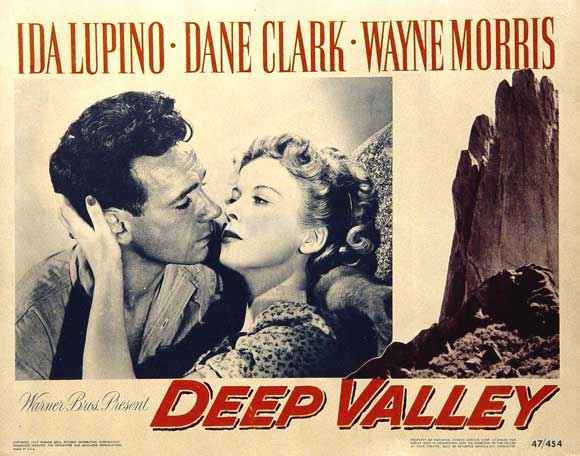
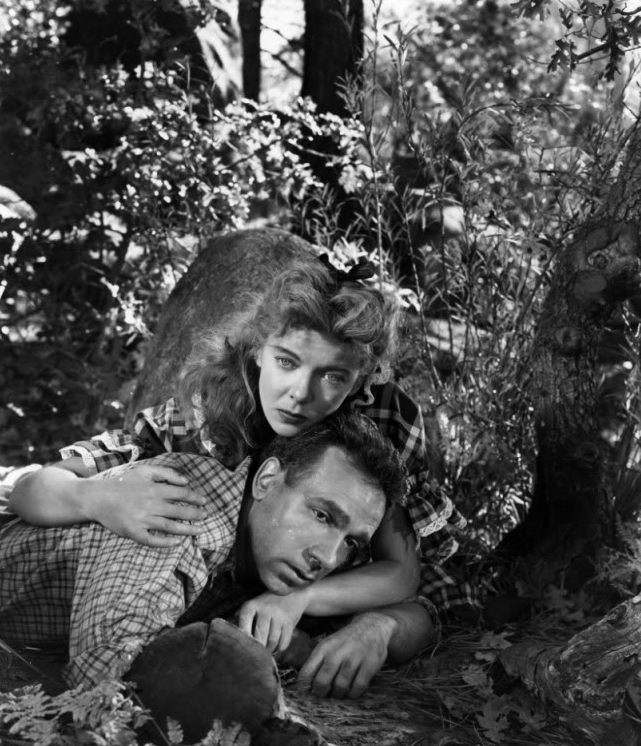
The high emotions of the film are expressed physically — often through the turbulence of the natural world. Ida Lupino plays a simple country girl named Libby Saul who lives in a broken-down old farmhouse deep in the California wilderness with her parents, Cliff Saul (Henry Hull) and Ellie Saul (Fay Bainter). One night, long ago, Libby’s father beat her mother, and her mother has never forgiven him or spoken to him again. Libby speaks with a stutter, and it is implied that it is directly related to the traumatic memory of seeing her father hit her mother.

The rift between Libby’s parents is absolute. Mrs. Saul never leaves her upstairs bedroom, and relies on Libby to wait on her. Mr. Saul never goes upstairs, and roams the ramshackle property in a perpetual foul mood.

Libby has no friends, and is isolated from the world. Her father is cruel to her and her mother, who is an invalid by choice, lives in a fantasy world and has never let go of the idea that she is an aristocratic lady. Libby’s only solace is her dog, Joe, and the woods that surround the Sauls’ property. Her only happy moments are when she is roaming the forest with Joe and communicating with nature and wild animals.

One day, she discovers a crew of prisoners working on a chain gang along the ocean, excavating and dynamiting the coastline in preparation for a highway. This destruction and remaking of the natural world will bring a steady flow of people past the Sauls’ farm, and radically change Libby’s life.

But her life is changed almost immediately when she spots a dark, handsome convict named Barry Burnette (Dane Clark) working on the line.

Naturally, fate contrives to bring them together.

During a dark and stormy night, a landslide destroys the toolshed in which Barry and a couple of other prisoners are locked up. Libby finds Barry in the woods and helps him stay hidden from the posses that are searching for him, as well as from the good-natured but black-hearted Sheriff Akers (Willard Robertson) and the blandly handsome engineer running the highway project, Jeff Barker (Wayne Morris), who has an eye for Libby.

Libby and Barry’s romance begins in an idyllic fashion, but the weight of doom slowly crushes it. It’s not just because he’s an escaped convict. He’s also a violent hothead — never towards Libby or someone who hasn’t provoked him, but when faced with a problem, his first instinct is to lash out and break through, with no thought of what he’ll do next.

But Barry is always a likable character. Dane Clark’s performance is soulful and tortured, and his big eyes and open countenance make him sympathetic, even when he’s crouching in the second floor of a barn with a scythe, ready to kill whoever comes up the ladder.

We root for Barry and Libby, even though we know their love is impossible. As the film progresses, the shots become increasingly full of shadows and menace, and Barry and Libby are forced into smaller and smaller spaces, symbolizing the world closing in on them.

Deep Valley is based on a novel by Dan Totheroh. The screenplay is by Salka Viertel and Stephen Morehouse Avery, with uncredited assistance from William Faulkner.

Wyoming (July 28, 1947)

The last time I saw cowboy star Bill Elliott was in the Red Ryder movie Conquest of Cheyenne (1946), in which he was credited as “Wild” Bill Elliott.

I missed the next picture he made, Plainsman and the Lady (1946), but in both that film and this one, he’s listed in the credits with the more mature moniker “William Elliott.”

Like Elliott’s name change, Wyoming reflects a B-grade product’s aspirations to A-level status.

It’s about halfway successful.

Director Joseph Kane knows how to shoot a western, and Wyoming looks great. It’s full of snowstorms, big cattle drives, and beautiful wide open spaces. Legendary stuntman Yakima Canutt is credited as the second unit director, and the fistfights, shootouts, and horse action are all well-done. (One fight in particular is more brutal than I ever expected from a Republic western.)

But the script by prolific screenwriters Lawrence Hazard and Gerald Geraghty never rises to A quality. It’s full of big ideas and grand themes, but the treatment of those themes is muddled, and the dialogue is hackneyed.

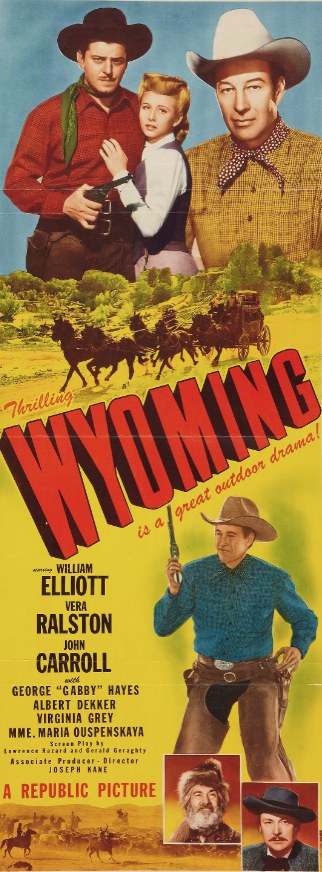
In Wyoming, Elliott plays Charles Alderson, an intrepid pioneer who settles in the territory of Wyoming with his pregnant wife. When she dies in childbirth, Alderson sends his daughter to Europe for an education. While she is away, he builds up an enormous cattle herd, and becomes rich. He does so with the help of his friend Thomas Jefferson “Windy” Gibson (George “Gabby” Hayes), a grizzled old mountain man who says that while he may not look it, he was originally a lawyer from Vermont. But he got too involved with another “bar.” Get it?

Alderson’s daughter Karen returns to Wyoming in 1890, soon after it has been admitted to the union. (Karen is played by Vera Ralston, who also played her own mother in the opening portion of the film.) Alderson is now a cattle baron, but all is not well. Much of his range is now open to homesteaders, who are led by John “Duke” Lassiter (Albert Dekker). Lassiter is a shady character who is involved in rustling cattle, and who is exploiting the homesteaders for his own purposes.

Alderson’s foreman, Glenn Forrester (John Carroll), cautions Alderson that resorting to violence will only make things worse, but Alderson is a prideful, tyrannical man who shoots first and thinks later.

If all of this sounds a lot like Howard Hawks’s Red River (which was filmed in 1946 but wasn’t released until 1948), that’s because it is. But Wyoming never achieves the same impact as Red River.

The biggest problem with Wyoming is Elliott himself. The character he plays, Charles Alderson, is a complicated man who is nearly undone by his own ambition and propensity for violence, but Elliott is not a nuanced actor. I loved him in the Red Ryder westerns because he was so wooden that it added to the comic-book stalwartness of the character, but in Wyoming he seems to be overreaching, and it’s a little like watching Leslie Nielsen play Othello.

Possessed (July 26, 1947)

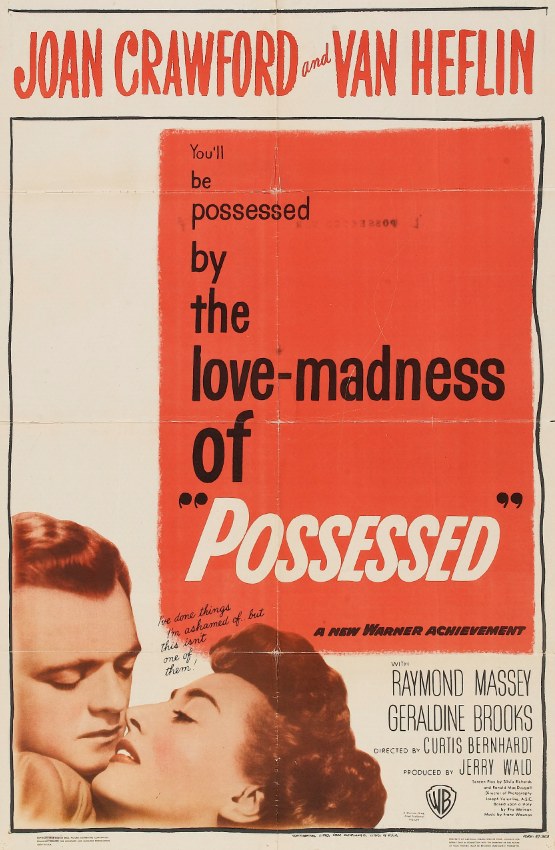
If you like to see Joan Crawford get her crazy on as much as I do, then you’ll love Possessed.

Curtis Bernhardt’s fevered noir melodrama begins with a surprisingly unglamorous-looking Crawford wandering the streets of Los Angeles in a daze, asking everyone she passes if they’ve seen “David.”

Crawford isn’t wearing any makeup, and her journey through the early dawn streets reminded me of a similar scene that appeared a decade later in Louis Malle’s Ascenseur pour l’échafaud (Elevator to the Gallows) (1958), in which Jeanne Moreau wanders the streets of Paris without makeup. (Was Malle influenced by Possessed? It’s certainly possible.)

The character Crawford plays, Louise Howell, is taken by ambulance to the psychopathic ward of the Los Angeles Municipal Hospital, where she is cared for by Dr. Willard (Stanley Ridges). He gives her narcosynthesis to lift her out of her catatonic stupor, and the tale of what brought Louise to this place is told through a haze of flashbacks and psychobabble.

Louise was a nurse in the employ of wealthy Dean Graham (Raymond Massey). Her job was to care for Graham’s infirm wife.

After a brief love affair with an average-looking but very charming architect named David Sutton (Van Heflin), Louise became hopelessly attached to him. When David told her that he wasn’t the marrying kind, and that he had to break things off with her, it began her spiral into madness. She was convinced that there was another woman, but he assured her there wasn’t.

“Louise, don’t hang onto me. You’ll get hurt,” he said in exasperation, and his words were prescient. The straitlaced, self-possessed Louise began to unravel.

Dr. Willard diagnoses her with a persecution complex. She thought that David breaking up with her was all part of a plan. Everyone was against her. Dr. Willard calls it “typical schizoid detachment … split personality.”

Despite its sometimes overheated story and dialogue, Possessed is a stylistic feast. Franz Waxman’s musical score perfectly underscores every one of Joan Crawford’s scenes, and Joseph A. Valentine’s cinematography visually expresses her madness.

There are recurring visual motifs, most notably water. For instance, when David gets into his boat and leaves Louise sobbing on the dock, the churning water symbolizes her inner turmoil. The doctors hovering over Louise’s bed discuss her case, then the scene cuts to a shot of the carafe of water by her hospital bed that dissolves into a shot of the water around Dean Graham’s home.

When Louise stops the little pendulum of her bedside clock from ticking because it’s “driving her crazy” the sound is replaced by the sound of dripping water outside her open window. She slams the window shut, trying to control her madness.

Possessed could never be called a realistic film. But that’s not its goal. It subjectively depicts an unraveling psyche, and isn’t afraid to veer into territory that sometimes seems as if it would be more at home in a horror movie than in a melodrama.

Crossfire (July 22, 1947)

Crossfire
Crossfire (1947)
Directed by Edward Dmytryk
RKO Radio Pictures

In 1947, social-issue pictures were starting to come out of Hollywood that tackled a formerly taboo subject — antisemitism.

This might not seem like such a big deal today, but it was a big deal at the time.

No matter how artful or moving some of its products are, the film industry is still a business, and any subject that challenges the status quo or that might hurt ticket sales is extremely difficult to make a film about. And despite the fact that in the ’40s the majority of studio heads were Jewish, they preferred to release films that depicted a homogenous, idealized vision of America.

Richard Brook’s 1945 novel The Brick Foxhole is about a homosexual who is beaten to death by his fellow Marines. Producer Adrian Scott convinced the studio bosses at RKO Radio Pictures that an adaptation of the book would pass muster with the production code if the gay character in the novel were changed to a Jewish character.

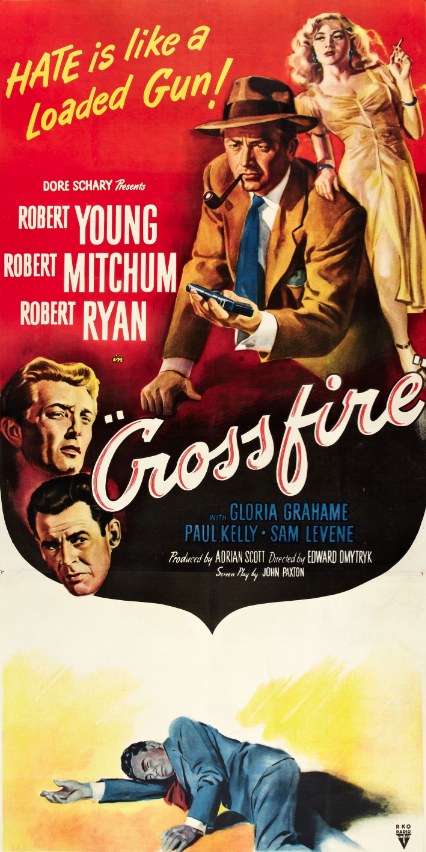
Crossfire is a social-issue picture wrapped in a murder mystery. It’s likely that many ticket buyers didn’t realize the film would contain a message about antisemitism, and were attracted by the “three Bobs” in the credits (Robert Ryan, Robert Young, and Robert Mitchum) or the lurid promise of violent death in the poster.

Whatever drew people into the theater when the film opened, however, nothing kept them away in the weeks that followed. Crossfire was a big hit, and was eventually nominated for five Academy Awards, although it lost out to Elia Kazan’s Gentleman’s Agreement, Twentieth Century-Fox’s more “prestigious” take on antisemitism. (In the case of best picture, best director, and best supporting actress, the awards went to Gentleman’s Agreement. In the case of best supporting actor and best adapted screenplay, the awards went to Miracle on 34th Street.)

Edward Dmytryk, the director of Crossfire, once said in an interview that he used “film noir” techniques primarily to save money, and because he wanted to spend more time working with the actors than doing setups. Dmytryk and his cinematographer, J. Roy Hunt, worked six and a half hours a day, and did about seven setups a day.

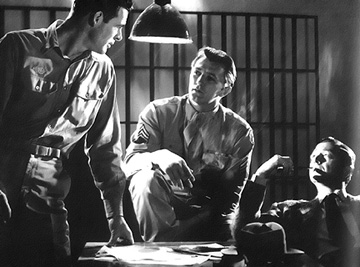
Ryan, Mitchum, and Young

Dmytryk was an excellent director, and Crossfire is an exceedingly well-made film.

He shot Crossfire in 20 days, less than the 22 days he was allowed with his $500,000 B-movie budget. Because of this, RKO was able to beat Twentieth Century-Fox’s Gentleman’s Agreement to the box office. (But not, ultimately, in the Oscar race.)

The darkness and shadows that creep into each shot disguise the simplicity of the sets, and the performances from all the actors are exceptional, especially Robert Ryan as the vicious, Jew-hating soldier named Montgomery, and Gloria Grahame as a lonely B-girl named Ginny.

The beating death of the Jewish man, Samuels (Sam Levene), that opens the film takes place in darkness, so the culprit is not seen. But the mystery doesn’t really persist. Montgomery is the likely suspect right from the beginning. His sneering dismissal of the “kind of guy” Samuels was makes his guilt seem pretty obvious during the scene in which he’s interrogated by the police detective, Finlay (Robert Montgomery).

The film quickly switches gears, however, and focuses on the search for a missing soldier named Mitchell (George Cooper), whom the police suspect of the murder. The jaded and world-weary Sgt. Keeley (Robert Mitchum) helps Detective Finlay, but ultimately shields Mitchell, helping him hide in a movie theater while Keeley and his buddies try to sort out what really happened.

Mitchell was pretty drunk, and can barely remember what happened at the party that evening. But the last words we hear Montgomery say in Mitchell’s flashback to the party — “What’s the matter, Jew boy? You afraid we’ll drink up all your stinking wonderful liquor?” — cement Montgomery’s guilt.

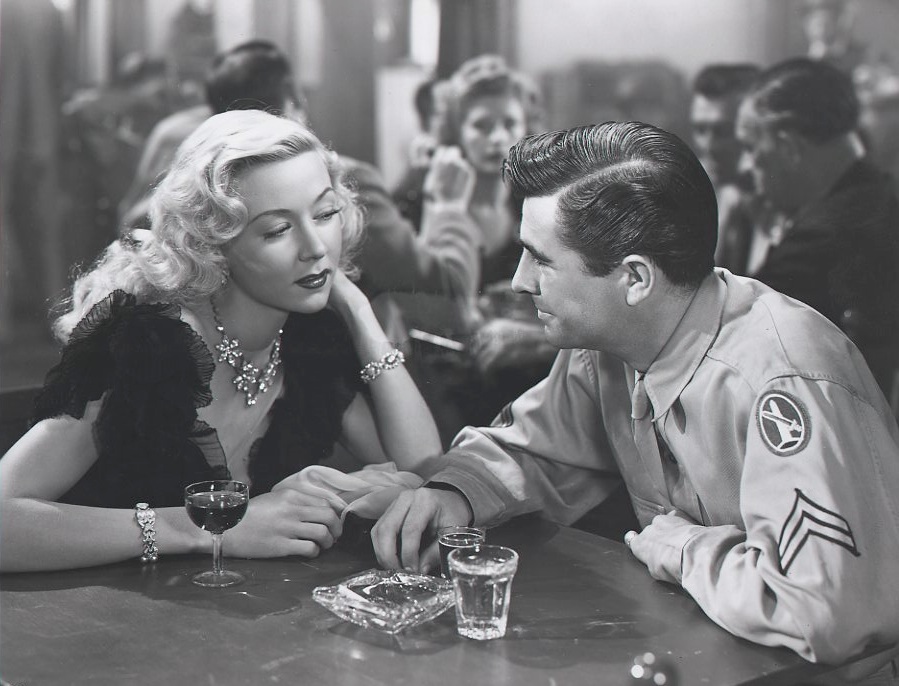
Grahame and Cooper

Mitchell’s sad and lonely journey through the night is classic noir stuff. His strange encounters — like the ones he has with B-girl Ginny and later with her “husband” (played by Paul Kelly), whose name we never learn — are haunting.

While Crossfire is occasionally preachy, this can be forgiven, especially considering the time when the film was released.

Unlike Brute Force (1947), which showed what American fascism could look like at the upper echelons of authority, Crossfire is a portrait of the rank and file of fascism — the dumb, mean, resentful men who “just carry out orders,” and do so happily. Ryan doesn’t overplay his role, and he’s all the more scary for it.

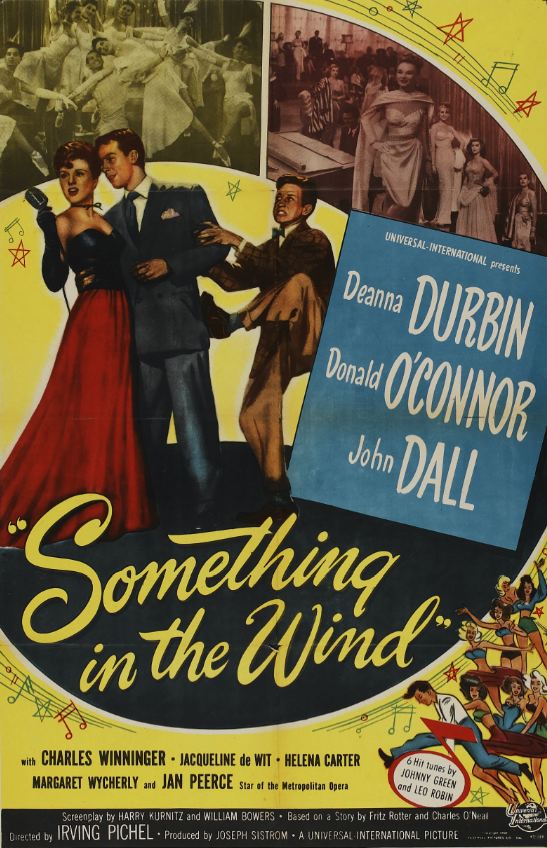
Something in the Wind (July 21, 1947)

I mentioned in my review of I’ll Be Yours, which was released earlier in 1947, that Deanna Durbin called the last four films she made “terrible,” and permanently retired from acting in 1948.

But just like I’ll Be Yours, I found Something in the Wind thoroughly enjoyable. The songs are great, the dancing is spectacular, and for the most part, it’s genuinely funny.

I think that Durbin’s retirement from acting had less to do with the quality of the films she was starring in and more to do with her desire for privacy and a normal life. (She apparently hated the public persona she’d been saddled with since she appeared in her first musical comedy, Three Smart Girls, in 1936 at the age of 14.)

Something in the Wind is by no means a great film, but Durbin’s impish sense of humor, beautiful singing voice, and perfect comic timing make up for a lot. It’s also a lot of fun to see tall drink of water John Dall in a light role. (Something in the Wind was made shortly before he would stake his place in cinematic history in 1948 as one of the thrill killers in Alfred Hitchcock’s Rope and again in 1950 as the firearms-fancying protagonist of the noir classic Gun Crazy.)

Dall plays Donald Read, the scion of the wealthy Read family. When he attempts to “make things right” with the woman to whom his recently deceased grandfather has been making regular payments, he confuses Mary Collins (Durbin) with her aunt (Jean Adair), who is also named Mary Collins. Mary Collins (the younger) is a struggling radio DJ with a beautiful voice, and she has no idea what Donald is talking about, but she’s offended by the very nature of his proposal. When she finds out that her aunt has been receiving payments from the Read family after a failed love affair with the late patriarch of the family, she’s doubly offended, and sets out to ruin the Reads.

The Reads are a pleasantly screwball family — the kind that regularly engages in hilarious kidnappings and fun-loving extortion.

Donald is the straight man of the bunch, his cousin Charlie (Donald O’Connor) is the wacky cut-up, and his uncle Chester (Charles Winninger) is the blackmailing con man who will screw over anyone for a buck.

All of this is just an excuse for laughs, music, and dance, of course, but who cares? Donald O’Connor’s wild, no-holds-barred performance of Johnny Green & Leo Robin’s “I Love a Mystery” is the stuff of legend, and must be seen to be believed. And Durbin is a one-of-a-kind star, and as far as I’m concerned, every film she appeared in is worth watching.

Cry Wolf (July 18, 1947)

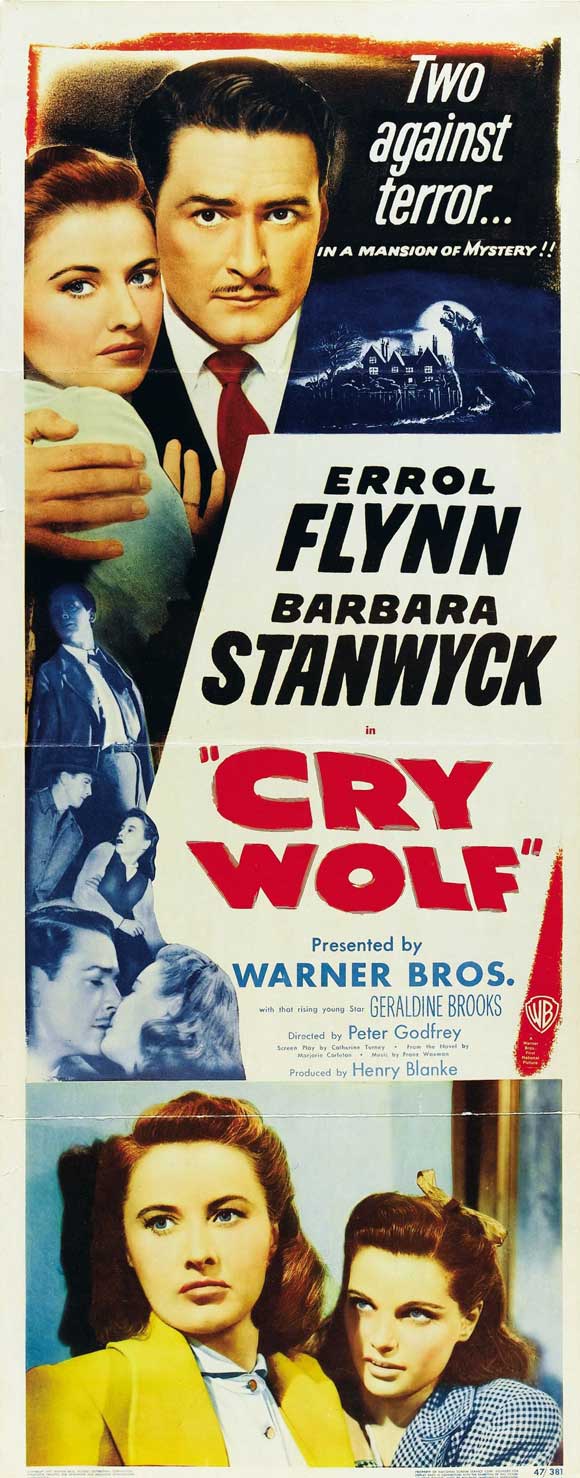
Peter Godfrey’s Cry Wolf is a good-looking thriller with two great stars and an intriguing setup, but it never quite fulfills its promise, and eventually peters out with an ending that you can see coming a mile away.

Barbara Stanwyck plays a young widow, Sandra Demarest née Marshall, who arrives at the creepy New England mansion of Mark Caldwell (Errol Flynn). Mark is a cold, imposing patriarch who lives with his brother, Senator Charles Caldwell (Jerome Cowan), and his teenage niece, Julie Demarest (Geraldine Brooks).

Sandra claims she was married to Mark’s deceased nephew, James Caldwell Demarest (Richard Basehart). She says she was working toward her doctor’s degree in geology. Jim came to her as a friend and she helped him. She needed money. He needed his inheritance. (Jim and his sister Julie have money that is kept in trust until they are 30. If, however, Jim were to marry, control of his inheritance would immediately pass from Mark to Jim’s wife.)

Sandra tells Mark she knows he would have preferred to choose a wife for Jim himself — someone placid — and she assures Mark that she is not a placid girl.

Jim gave Sandra $2,000 to complete her studies and she was to divorce him in six months. There were no other strings. They were married five months before his death. She has come to collect his inheritance. Two thousand dollars has become $2 million.

Doubt and mistrust informs Sandra’s relationship with Mark. Mark isn’t convinced that Sandra’s marriage certificate is genuine, and Sandra suspects Mark is up to no good in his mysterious laboratory. Nevertheless, there are clearly romantic sparks between the two. Also, Mark’s niece Julie instantly becomes attached to Sandra, and begs her to stay.

So it’s a perfect setup for a Gothic thriller. Mark struts and preens about the house, a pipe clenched between his teeth, spitting out nasty one-liners like, “Next time you hear some odd noise in the night, just follow the memorable custom of your sex and stick your head under the bedclothes.” And Sandra gets to play at being a grown-up Nancy Drew, pulling herself up to Mark’s lab in a dumbwaiter and then hiding behind a door when he unexpectedly arrives, and later climbing along the eaves of the mansion and dropping down a skylight to spy on him.

Cry Wolf reminded me a lot of Vincente Minnelli’s Undercurrent (1946), which is another Gothic thriller about a not-terribly-romantic love triangle in which one-third of the equation is absent for most of the picture.

Like Undercurrent, Cry Wolf is competently put together, and it’s worth seeing if you like the film’s stars, but it never really takes flight. Franz Waxman’s musical score and Carl E. Guthrie’s cinematography are both top-notch, and add a good deal of suspense to the shadowy proceedings, but there’s only so far that atmosphere can take a picture. Ultimately, Cry Wolf is a mystery that’s not terribly mysterious.

Gunfighters (July 1, 1947)

Another day, another western based on a Zane Grey novel.

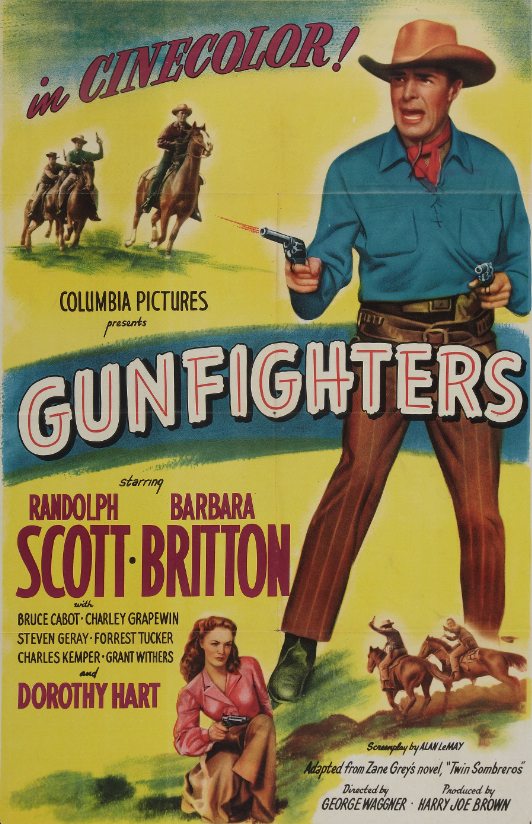
Unlike the last movie I watched that was based on a book by Zane Grey — Thunder Mountain, which was a fun little 60-minute black and white western from RKO Radio Pictures — George Waggner’s Gunfighters gets the prestige treatment from Columbia Pictures. It’s a feature-length film (almost 90 minutes long), and it’s shot in Cinecolor.

Cinecolor was a two-color film process that was cheaper than Technicolor, and could sometimes look washed-out or unnaturally reddish, but Gunfighters looks great. For what it is, the production values are high, and legendary cowboy star Randolph Scott is always fun to watch.

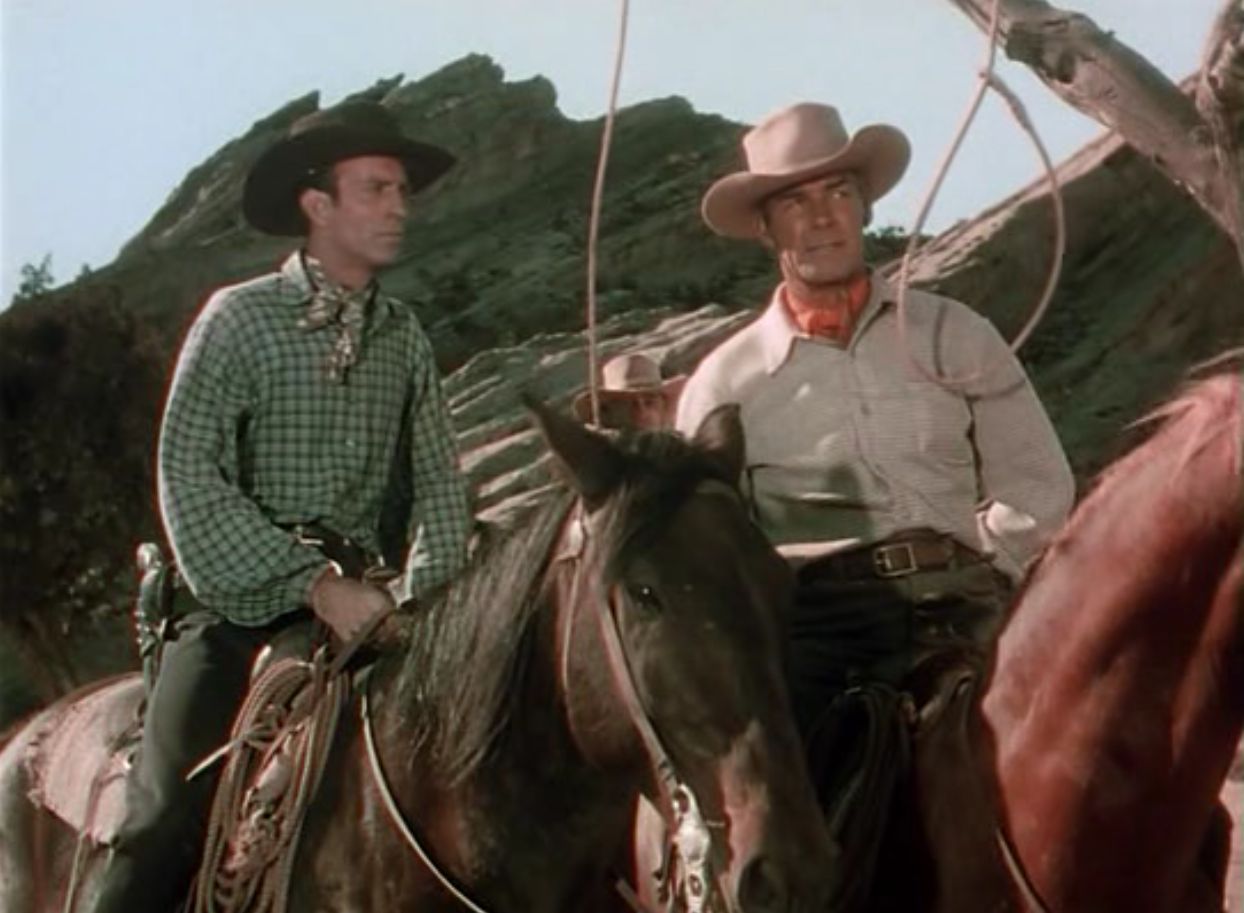
In Gunfighters, which is based on Zane Grey’s posthumously published novel Twin Sombreros, Scott plays a seasoned gunman with the unlikely name of Brazos Kane.

Brazos is the veteran of so many shootouts that as soon as the opening credits are done rolling, his best friend steps out of a cantina, calls him out, and Brazos is forced to kill him. As his friend lies dying, he offers no explanation for starting the duel. In the world of Gunfighters, gunmen are like mountain climbers — ask mountain climbers why they want to climb a mountain, and they’ll respond, “Because it’s there.” Likewise, Brazos’s friend just had to know who was the faster draw.

But Brazos doesn’t want to be a part of this topsy-turvy fast-draw world anymore. As he says in one of the film’s bits of sporadic voice-over, “When your best friend tries to beat you to the draw, it’s time to put up your guns.”

But it’s the same everywhere he goes — the Texas Panhandle, Wichita, Dodge — so Brazos heads for the Inskip Ranch, where he plans to ride the range with his old friend Bob Tyrell.

And that’s just what they do. After Brazos arrives at the Inskip Ranch, he and his old buddy Bob herd cattle, bust broncos, sleep under the stars, start their days with strong coffee and hot biscuits, pass a jug of whiskey around the campfire at night, tell tall tales, and live happily for all the days of their life, making Gunfighters unique among ’40s westerns, since it contains almost no gunplay or violence.

Ha ha! Just kidding. As soon as Brazos shows up at the Inskip Ranch, he finds Tyrell’s corpse facedown in a creek.

And even worse, he’s immediately blamed for the murder, and finds himself on the wrong end of a lynch mob.

Gunfighters has plenty to recommend it. It looks good and contains some of the most impressive chases on horseback I’ve seen in a western. But for every exciting five-minute stretch there’s a boring one, and the final showdown between Brazos and the bad guys seems to take forever to get to.

I enjoyed the performances of both Dorothy Hart and Barbara Britton, who play sisters Jane and Bess Banner. Most of the humor in the film comes from the fact that the two sisters look enough alike to be mistaken for twins, and there’s plenty of cases of mistaken identity, if that’s your thing.

Forrest Tucker, who is probably best remembered for playing Sergeant O’Rourke on the TV show F Troop, makes a great sneering bad guy, but the other major villain, Bruce Cabot (of King Kong fame), never makes much of an impression.

I didn’t love Gunfighters, but I didn’t hate it, either. And you can’t beat scenes like the one in which Brazos tells a crooked sheriff’s deputy played by Grant Withers, “Never mind my shots. Count my guns.”