Author Archives: Adam Lounsbery

Beauty and the Bandit (Nov. 9, 1946)

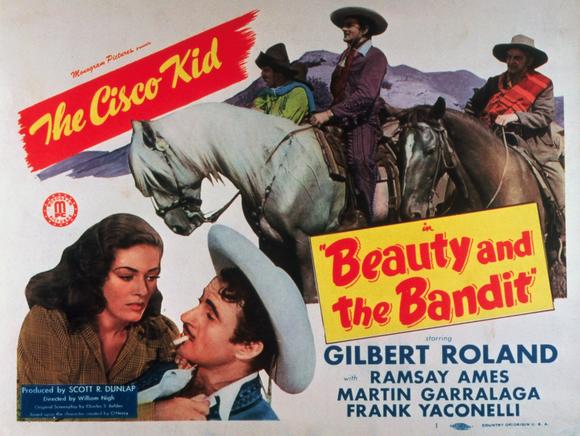
Maybe I should stop watching these Cisco Kid pictures. They’re dead-on-arrival Saturday matinées from Monogram Pictures that have now thrice failed to entertain me. After sitting through The Gay Cavalier and South of Monterey, feeling like a drunk who’d fallen asleep in a grindhouse on a Friday night in 1946 and woken up the next morning surrounded by kids yelling at the screen and throwing popcorn at each other — too hungover to get up and leave — I figured I could call it quits with the series and not miss much.

But Gilbert Roland is a lot of fun to watch as Cisco. While these movies seemed pitched at a pretty young audience, his smooth line deliveries and double entendres are clearly aimed at adults. And the presence of Ramsay Ames as the heroine made it hard to say no to Beauty and the Bandit. I fell in love with Ames in the Universal horror picture The Mummy’s Ghost (1944), and will watch her in anything, although in both Cisco Kid pictures I’ve seen her in she’s skinnier, less voluptuous, and a little harder-looking than she was in her earlier horror-movie appearances in The Mummy’s Ghost and Calling Dr. Death (1943).

In the first scene of the film, Cisco (Roland) gets a tip from his old friend Sailor Bill (Glenn Strange) — who has given up a life of crime for a home, wife, and eight children — that a young Frenchman is traveling to San Marino with a chestful of silver. This young man is played by Ames, who is the least convincing young “man” I’ve seen since Barbara Hale put on drag in West of the Pecos (1945). Perhaps this is by design. If Ames was convincing as a fellow, the scene in which Roland leans forward and lights her cigarette would be the most homoerotic image of 1946, since they stare at each other with more heat and longing than you’d see during a day at the beach with Cary Grant and Randolph Scott.

Later he teaches Ames to drink tequila (with lemon and a little salt) and engages in all manner of sexual teasing, like trying to sleep in her bed and then kicking her out when she objects.

Once the idiotic cross-dressing subterfuge is done away with, Ames looks great in a pair of pants and boots. She has more swagger dressed in men’s clothes with her long hair free than she does in drag, but her accent is still all over the place, and the “n’est-ce pas” that often ends her lines sounds about as French as Steve Martin playing Inspector Clouseau. Her character, Jeanne Du Bois, is trying to buy land from the disgraced and drunken Dr. Juan Valegra (Martin Garralaga), land which was stolen, and which Cisco wishes to return to the peasants. His devotion to the Mexican people of Old California gets in the way of his romance with the headstrong Jeanne, but as usual, a good spanking fixes her right up.

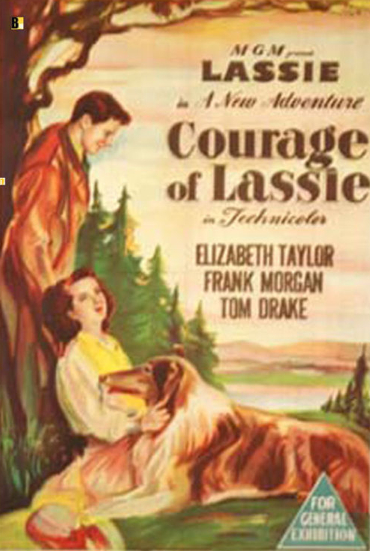
Courage of Lassie (Nov. 8, 1946)

Pal rides again! In Fred M. Wilcox’s Courage of Lassie, the irrepressible little scamp from whose seed all dogs who ever played Lassie are descended plays an orphaned collie. The little guy is left behind in an idyllic, Technicolor wilderness after the old fisherman who owns Lassie rows off with her and what he thinks are all of her puppies.

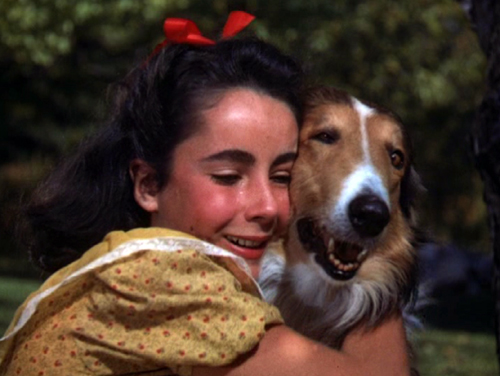
There follows a delightful montage of the little collie frolicking in the woods for days with birds, other four-legged beasties, and even a big black bear. This being a kid’s movie, however, you can be sure that gut-wrenching tragedy is right around the corner. Sure enough, the collie puppy and his little fox friend are caught in stormy rapids, and the fox is washed away, presumably to his death. The puppy, balanced on a tangle of branches, safely makes it to shore. Seemingly unfazed by his little buddy’s demise, the puppy’s next move is to happily run off with Elizabeth Taylor’s pants, and a lifelong bond is formed.

Taylor was 14 years old when she appeared in this film. Just like Pal, she’s playing a different role than she played in the film Lassie Come Home (1943). I think Taylor was a fantastic child actor. Just like in National Velvet (1944), she takes material that could be laughable or treacly and performs it with such conviction that you can’t help but be swept along. As Kathie Merrick, she believes in her dog, whom she names “Bill,” even though her family doesn’t think he has what it takes to be a sheep-herding dog.

By the end of the film Bill will prove that he not only has “the right stuff” in the pasture, but that he can be drafted and serve under heavy fire just like any other red-blooded American boy.

Bill goes through a lot in this film. He’s shot by a couple of dopey young hunters with quick trigger fingers, he’s run over by a truck while herding sheep across the road (and carried off by the well-meaning driver who doesn’t realize Bill belongs to someone), he’s renamed “Duke” at Dr. Colman’s Dog and Cat Hospital in the big city, and he’s trained for war and shipped off to the Aleutians to fight the Japanese.

“Duke” performs bravely despite a bloody neck wound, dragging himself through the mud to deliver a message, then leading the reinforcements back to the troops. He saves the day, but suffers from shell shock. He escapes the train that is taking him home and runs off into the area of the country where he remembers being with Kathie. Unfortunately, his PTSD has taken a toll, and he lives as a feral animal, raiding hen houses and killing local livestock. Kathie saves him from a farmer’s bullet, but he’s still put on trial as a mad dog.

Things look pretty grim for Bill until Harry MacBain (Frank Morgan, who played Prof. Marvel and the Wizard in The Wizard of Oz) makes an impassioned plea for understanding. This is the most interesting part of the film, since MacBain has looked up Bill’s war record, and his speech is a thinly veiled reference to human veterans who may be acting differently after their service overseas. Violent, antisocial behavior and drastic personality changes can be a byproduct of serving in combat, he says, and we on the homefront shouldn’t be so quick to judge our returning veterans. Even if they’re not lovable border collies.

Secret of the Whistler (Nov. 7, 1946)

Secret of the Whistler
Secret of the Whistler (1946)
Directed by George Sherman
Columbia Pictures

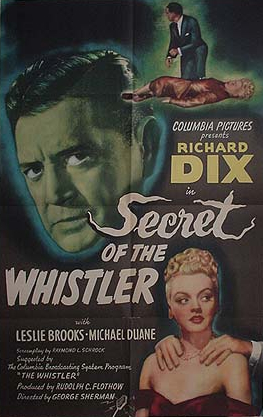
George Sherman’s Secret of the Whistler is a solid but unremarkable entry in Columbia Pictures’ series of bottom-of-the-bill programmers based on the radio show The Whistler. Each film in the series starred Richard Dix, a he-man of the silent era whose star was fading. Dix delivered sweaty, paranoid performances in a variety of roles in The Whistler series; businessman, drifter, private investigator, homicidal maniac. His health may have been failing, but he was still a solid performer.

In Secret of the Whistler he plays a painter named Ralph Harrison who is living the high life on his wealthy wife’s dime. He throws lavish parties in his studio/bachelor pad for people who aren’t really his friends, but who don’t mind eating his food and drinking his booze. Among the many attractive young women who pose for Harrison for big money is Kay Morrell (Leslie Brooks), a beautiful blonde with gams that won’t quit.

Meanwhile, Harrison’s wife, Edith Marie Harrison (Mary Currier), lies in bed at home, at death’s door. When the film begins, Harrison seems to genuinely care for his ailing wife, and she adores him. Slowly but surely, however, Harrison begins to fall for Kay. (And after the scene in which she poses for him wearing a small one-piece undergarment, I thought to myself, “Who wouldn’t?”) He buys her expensive presents and lavishes her with attention. His wife isn’t long for this world, so what’s the harm?

The only problem is that Mrs. Harrison comes under the care of a specialist, and makes a miraculous recovery. (Her cardiologist’s course of therapy seems to mostly involve getting out of bed and taking long walks, which is still good advice today.) When she drops by her husband’s studio unannounced, however, her excitement turns to horror when she overhears her husband pitching woo to Kay. She suffers a major setback and promises to write Ralph out of her will.

Fans of The Whistler radio show will have no trouble predicting what will happen next, or the panoply of complications that will arise. True to the radio show, the Whistler himself shows up several times in the film, always as a dark silhouette or a shadow thrown on a wall, speaking directly to Harrison and revealing his murderous thoughts.

The screenplay for Secret of the Whistler by Richard H. Landau and Raymond L. Schrock is the most thematically similar to the radio show of all the films in the series I’ve seen so far. If murdering your wife was your thing, The Whistler was the best show on the air. Nearly every week it seemed as if someone’s spouse was being bumped off for an inheritance and a chance at life with a younger boyfriend or girlfriend, although things never went according to plan.

With a little more than double the running time of a typical episode of the radio show, Secret of the Whistler has more time to develop its characters and its story. On the radio, there just wouldn’t be enough time to show Ralph’s tepid devotion slowly changing to disinterest. At the same time, though, the film feels a little longer than its 65-minute running time, and while its twist ending is good, it doesn’t have the devious ingenuity of the best twists of the radio show.

Still, this is a really good mystery series, with heavy doses of noir atmosphere and performances by Dix that are always interesting to watch. Secret of the Whistler is a lesser entry in the series, but it’s still a pretty good one.

Wanted for Murder (Nov. 2, 1946)

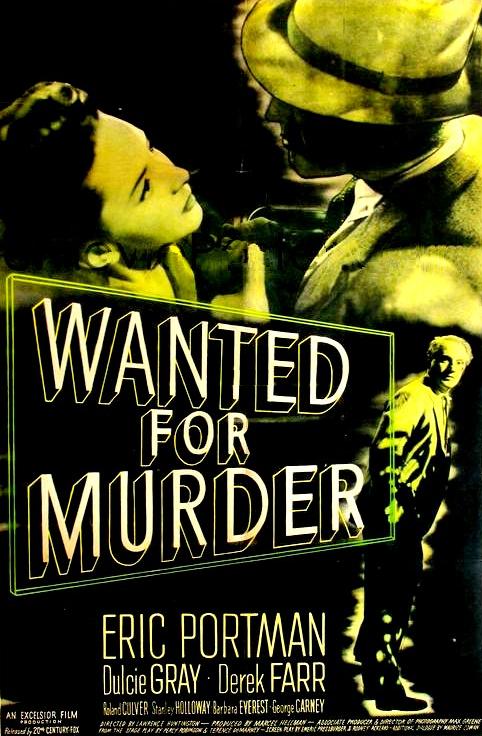
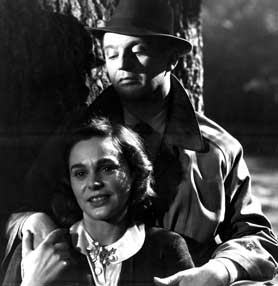
Lawrence Huntington’s Wanted for Murder, which was originally released on June 17, 1946, in the U.K., premiered in the United States on November 2, 1946. It’s an effective chiller with a dependable cast and an excellent screenplay by Rodney Ackland and Emeric Pressburger, based on the stage play by Percy Robinson and Terence de Marney.

The film boasts a terrific sense of place, with scenes filmed in Hampstead Fairground, Madame Tussaud’s wax museum, and the center of London (which, when necessary, appears as rear screen projection stock footage, a technique that can be distractingly fake-looking but here is done fairly skillfully). There are also several atmospheric nighttime murder sequences in Hampstead Heath, Regent’s Park, and Hyde Park.

Particularly effective is the music by Mischa Spoliansky, whose pop-orchestral tune “A Voice in the Night” is a motif that follows the murderer around like his shadow, and which you’ll be hard-pressed not to hum after seeing this picture.

Eric Portman plays middle-class mummy’s boy Victor James Colebrooke, a man who feels haunted by the specter of his late father, William Colebrooke, an executioner to Queen Victoria whose eerie likeness stands in Madame Tussaud’s.

Colebrooke is a handsome, superficially charming gentleman who drink Hendrick’s Gin, lives at home with his mother and a servant, and whose single-breasted suits often sport a white boutonniere and a pocket square. He’s the embodiment of the British fascination with “the murderer next door” — the outwardly ordinary man whose wife’s remains are bricked up in the basement or who strangles working girls on the weekend.

Wispy brunette Dulcie Gray plays Anne Fielding, a young woman who works in a gramophone shop and is dating Colebrooke. A starry-eyed young bus conductor named Jack Williams (Derek Farr) finds her waiting at the fairgrounds and mashes her as hard as he can. She’s attracted to him, but Colebrooke is manipulative and possessive.

Rounding out the fine cast are Roland Culver as Chief Insp. Conway and Stanley Holloway as Sgt. Sullivan, the two Scotland Yard detectives who are on the trail of the killer. Their scenes are some of the film’s most light-hearted, but they are never less than professional, and are dogged in their pursuit of the strangler.

When the first murder occurs, the audience doesn’t know who the killer is, but we strongly suspect Colebrooke. It’s not long before the film removes any doubt about his guilt, which allows for a more interesting and creepy character study than in a whodunnit, where the murderer’s identity is a secret up until the climax.

Most of the film is a game of cat and mouse, with the detectives fairly certain Colebrooke is guilty, but unable to gather anything but circumstantial evidence.

Meanwhile, Colebrooke goes about his dastardly business at night in the parks, telling young women he takes out on dates and strangles that his name is “Tom Mahon.”

Colebrooke blames his sickness on his father, whose killings were all committed in the course of his duty, but whose grim pride in his work earned him the nickname “The Happy Hangman.” The Freudian-minded viewer might blame his overbearing, possessive mother, but the film itself doesn’t draw any such trite conclusions. His father is just a picture on the wall or — in one scene — a disturbingly realistic wax figure, and his mother isn’t a bad person, even encouraging him to find a nice girl and marry her.

Wanted for Murder is a first-rate thriller. Although the adjective hadn’t been invented when it was made, I’d go so far as to call it “Hitchcockian.”

Nobody Lives Forever (Nov. 1, 1946)

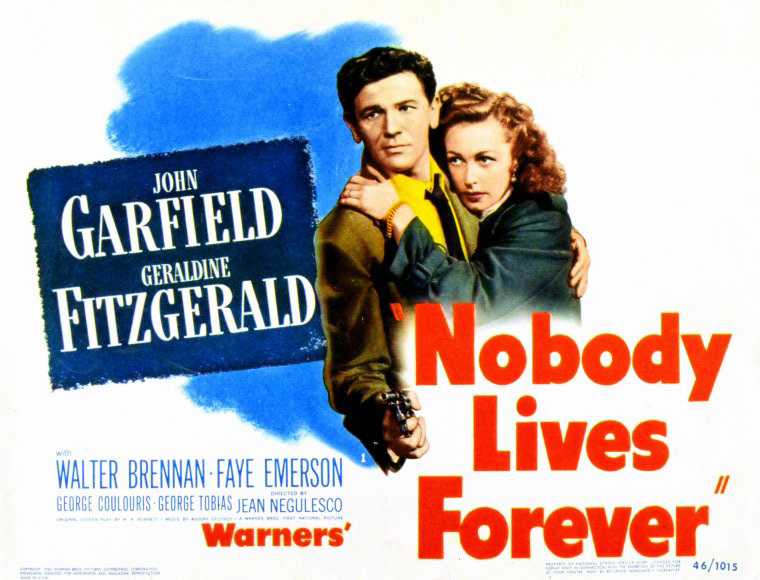
Jean Negulesco’s Nobody Lives Forever is far from a great film, but it’s crackerjack entertainment. Warner Bros. had been making crime pictures for 16 profitable years at this point. While the heyday of the Warner gangster film may have been in the ’30s, this is a fine example of the quality product the studio was still churning out in the post-war era.

The screenplay is by W.R. Burnett, whose 1929 novel Little Caesar was made into a film in 1931 starring Edward G. Robinson — the first of Warner’s great cycle of gangster movies. Nobody Lives Forever is based on Burnett’s novel I Wasn’t Born Yesterday, and while it may not be as significant as Little Caesar, it’s still a tight thriller with plenty of snappy tough-guy dialogue.

Besides the good script and excellent direction, the picture works as well as it does because of impeccable casting. When you’re looking for a hard-bitten but essentially decent con man, you can’t ask for a better protagonist than John Garfield. A kindly, doddering old mentor of cons named “Pop”? Who better than Walter Brennan? A sweaty, bug-eyed, paranoid louse named “Doc” who desperately needs one decent score to get back on top? Is George Coulouris available?

Garfield plays Nick Blake, a World War II veteran honorably discharged after being wounded in action. One of his hands doesn’t close quite right, but other than that he’s none the worse for wear. After his sidekick Al Doyle (George Tobias) picks him up from the hospital in Governor’s Island, they take the ferry back to Manhattan, where he reunites with his girl, Toni Blackburn (Faye Emerson). As she sings “You Again” in a swanky nightclub, Nick follows the mustachioed club owner Chet King (Robert Shayne) into his office to settle a beef over money. Rudi Fehr’s editing in this sequence is superb, cutting between Toni on stage, Al standing guard outside the office, and Nick bracing Chet inside.

After Toni finishes her number, Nick confronts her, then kisses her passionately, then smacks her in the face for double crossing him.

The action soon switches to California, where Al has gotten a line on a widow with a $2 million fortune, which — as Pop points out — is a lot of money, even after taxes. Nick, a handsome “diamond in the rough,” is the perfect candidate to pose as a shipping magnate and charm her out of her cash.

Unlike most long cons, Nick, Pop, Doc, Al, and the other members of their crew meet in smoky back rooms as if they’re planning a bank heist. The only problem with the job is that Nick actually starts to fall for the widow, Gladys Halvorsen (Geraldine Fitzgerald), who turns out to be younger than most widows, and a dish to boot.

When Doc pushes Nick to close the deal, he shoots back, “I’m not used to operating with a bunch of cheap, hungry chiselers who should be in the strong-arm racket. Big deals take time.”

Garfield has great chemistry with his co-stars, particularly the ladies, but the relationships take a back seat to the action, especially during the final climactic 20 minutes.

Sure, there are some holes in the plot, and there’s nothing deep about Nobody Lives Forever, but it’s a hell of a way to kill an hour and 40 minutes.

No Regrets for Our Youth (Oct. 29, 1946)

No Regrets for Our Youth
No Regrets for Our Youth (1946)
Directed by Akira Kurosawa
Toho Company

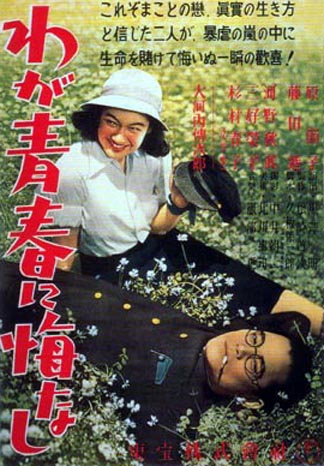
No Regrets for Our Youth was the second film Akira Kurosawa directed after the end of World War II. (The first was Those Who Make Tomorrow, which was released on May 2, 1946. He was forced to direct it by Toho studio bosses. He disliked making the film and never included it in his list of official credits.) No Regrets for Our Youth is an interesting counterpart to two other films I watched this year, Italy’s Roma, città aperta (Rome, Open City) and Germany’s Die Mörder sind unter uns (The Murderers Are Among Us). These three pictures are all early efforts by filmmakers in former Axis powers to come to terms with the enormity of World War II.

Roma, città aperta represents an almost total abnegation of responsibility, which is fair enough, considering the role most Italians played in the war compared with the litany of horrors perpetrated by Germany and Japan. No Regrets for Our Youth is more similar to Die Mörder sind unter uns. Both films are stridently anti-Fascist, but both sidestep the gruesome specifics of what actually went on during the war.

Setsuko Hara stars as Yukie, the daughter of a university professor with leftist leanings. (Hara would only work with Kurosawa once more, when she starred in his film The Idiot in 1951, but she was one of Yasujirô Ozu’s favorite actresses, and starred in six of his films from 1949 to 1961.) The film begins immediately after the 1933 University at Takikawa protests against the Japanese invasion of Manchuria. Yukie is courted by two young men, Ryukichi Noge (Susumu Fujita) and Itokawa (Akitake Kôno). Itokawa is sensible and boring, while Noge is a political firebrand and hot-headed. Yukie is naturally drawn to Noge, but he is arrested after a demonstration and spends four years in prison.

When he is released, he seems to be a changed man; broken in some essential way. Yukie packs up and moves to Tokyo, where she lives for three years, toiling away in a variety of menial jobs. Itokawa and Noge both re-enter her life, and she ends up marrying Noge, who is now involved in espionage. Eventually he is arrested by Imperial forces, and Itokawa, who is now a lawyer, steps in to defend him.

No Regrets for Our Youth is a film with two distinct halves. The second half, in which Yukie goes to visit Noge’s parents, is visually and dramatically stronger than the first. Noge’s parents are both simple farmers living in a remote village. They are terrorized by the other villagers because their son was a spy, and they never go out during the day, only planting at night. Yukie decides to stay with them and fight against adversity, finding value in tilling the land.

It would be decades, of course, before most filmgoers in the West would see this film. The first Kurosawa film to make any impact outside of Japan was Drunken Angel (1948), and Kurosawa didn’t have a true breakout success until Rashomon (1950), which won the Golden Lion at the Venice Film Festival in 1951.

No Regrets for Our Youth is a good film, but it’s not a great one. The performances from the lead actors are excellent, especially from Hara. She ages and grows over the course of the film in a realistic way, which is important when a film covers a period of many years. The story is involving, but not exactly what I would call “gripping.” The scenes in the rural village have a distinctly Soviet flavor to them, and I believe that Kurosawa made this film in an atmosphere of heavy censorship and control by occupying forces.

This is the earliest Kurosawa film I’ve seen, so I don’t know what his pre-war films are like, but it seems to me that he really came into his own as an artist starting in the late ’40s, when he reworked American and European stories and film techniques for pictures like Stray Dog (1949) and High and Low (1963), two of the best police procedurals ever made; Seven Samurai (1954) and Yojimbo (1961), two samurai films that drew heavily from American westerns and were in turn copied over and over by directors making actual westerns; and his reimaginings of Shakespearean dramas set in feudal Japan, Throne of Blood (1957) and Ran (1985).

La Belle et la Bête (Oct. 29, 1946)

La belle et la bête
La Belle et la Bête (Beauty and the Beast) (1946)
Directed by Jean Cocteau
DisCina

Jean Cocteau began filming La Belle et la Bête (Beauty and the Beast) almost immediately after the end of the Nazi occupation of France. It wasn’t a quick or an easy shoot. Cocteau had to contend with limited film stock of varying quality, cameras that jammed, aircraft flying overhead that ruined the sound, and the general disarray of post-war France.

The 56-year-old Cocteau was a well-known writer, poet, visual artist, and director of avant-garde films, but this was his first foray into mainstream filmmaking. It begins with an exhortation to audiences to remember what it is to be a child, and to experience magic without the jaundiced eyes of an adult.

This is probably a direct reaction to the critics (most notably Jean-Paul Sartre) who felt that Cocteau was not political enough. Cocteau’s only allegiance in life was to art, and it is appropriate that he made this film as a reaction to critics, since it’s one of the most beautiful and magical pieces of filmmaking I’ve ever seen. His plea to audiences that opens the film seems unnecessary. This is a film that speaks for itself.

In adapting the 18th-century fairy tale, Cocteau used a lot of the same techniques he used when he made his experimental 1930 film Le sang d’un poète (The Blood of a Poet); simple special effects, an obsession with mirrors, statues that come to life, and tricks of speed and perspective.

As in the original story (most famously written by Mme Jeanne-Marie Le Prince de Beaumont in 1756, although she didn’t create the tale), Belle (played by Josette Day) lives with her merchant father (Marcel André) and her two nasty, selfish sisters, here named Félicie (Mila Parély) and Adélaïde (Nane Germon). Cocteau added two male characters, Belle’s brother Ludovic (Michel Auclair) and her handsome but shallow suitor, Avenant (Jean Marais).

The domestic scenes in the film are designed and lighted to look like paintings by Vermeer and Rembrandt. The characters all wear 17th-century costumes, and the interiors are beautiful to look at, even though the human drama is stifling and petty. Félicie and Adélaïde bicker and ridicule Belle, and are indifferent to their father’s rising debts. Meanwhile, Ludovic and Avenant avoid all responsibility and are only interested in the pursuit of leisure.

When Belle’s father rides off into the woods, the mood of the film dramatically shifts. Using a combination of real parks and woodlands with studio sets, Cocteau creates a magical fairy-tale world directly based on 19th-century engravings by Gustave Doré.

La Belle

When Belle’s father first enters la Bête’s castle — revealed when a gate of tree branches magically parts — his shadow moves against the castle entrance even though he is standing still. Once inside, candelabras held by human arms mounted into the wall magically spring to light. It doesn’t matter that you can see wires holding the candelabras aloft; the simple but painstaking special effects are still breathtaking. When Belle’s father sits down in the banquet hall, sculptures of human faces on the mantel of the fireplace are actually the faces of human actors covered with soot, their bright eyes the only thing about them that looks alive as smoke pours out of their nostrils.

This delineation between fantasy and reality continues throughout the film. When Belle enters the castle to fulfill the punishment meted out to her father for picking one of la Bête’s white flowers, she floats through long corridors full of billowing white curtains in dreamy slow-motion. There are doors and mirrors that speak to her, and a bed with a white fur spread that slithers open. The special effects are simple, and a lot of them are done “in the can” by simply reversing the film.

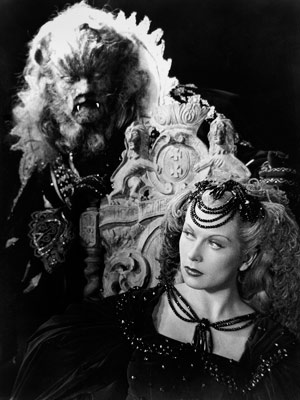
It’s been awhile since I’ve seen Disney’s 1991 version of this fairy tale, but that film bears an enormous debt to Cocteau’s version. Everything from the look of the beast to the costumes, set design, and subplot about Belle’s jealous suitor are lifted directly from this film. While the Disney version is perfectly competent, it doesn’t have the otherworldly power of Cocteau’s vision. La Bête, in particular, is less cuddly and more uncanny here. He’s played by Jean Marais, who also plays Belle’s suitor, Avenant, which would be distracting if he wasn’t completely unrecognizable under the heavy makeup and mountains of hair. Marais plays la Bête as a noble, leonine creature with a deep nasal monotone. Unlike the lovable furball of the Disney film, there are a few moments in which he is truly frightening; appearing as if by magic when Belle’s father picks a flower, drinking from a brook on all fours like an animal, or standing over the carcass of a deer that he has mutilated.

Given that Cocteau was gay and Marais was his longtime lover, it’s tempting to read a lot into this film. For Freudian readings of heterosexual power dynamics and the vagaries of lust, the Beauty and the Beast myth is second perhaps only to the story of Bluebeard. Are all men beasts who must stifle bloodthirsty and rapacious urges in order to be with women? Did Cocteau, who had begun to suffer from painful eczema, feel like a beast himself?

All theories are welcome, but I prefer to heed Cocteau’s advice in the preface and take this magical film at face value.

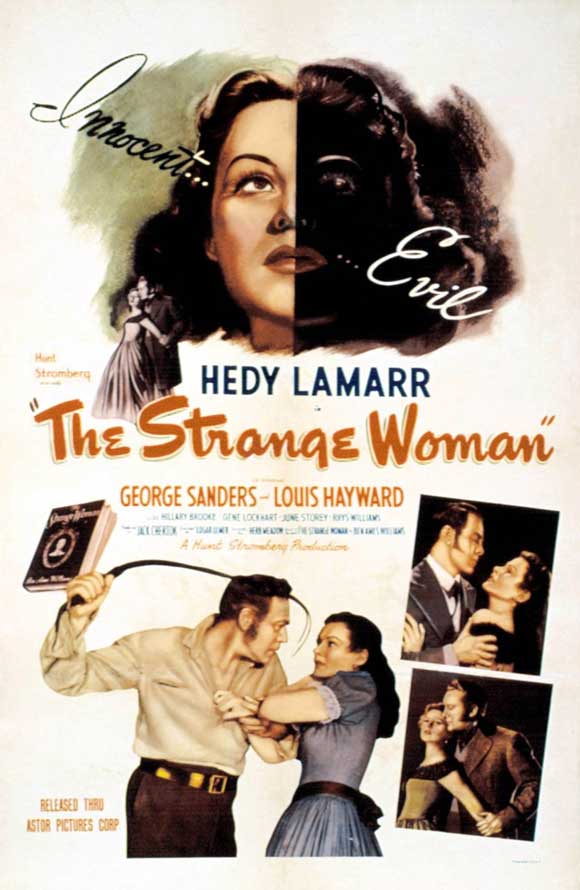
The Strange Woman (Oct. 25, 1946)

Edgar G. Ulmer’s The Strange Woman, directed with uncredited assistance from Douglas Sirk, is based on the 1945 novel of the same name by Ben Ames Williams.

Born in 1889, Williams was a prolific novelist who is probably best known today for the same reason he was famous in 1946; he wrote the novel Leave Her to Heaven in 1944, which was made into a hit film in 1945 starring Gene Tierney as Ellen Berent, a calculating sociopath with twisted ideas about love.

The Strange Woman was a natural choice to be made into a film following the success of Leave Her to Heaven. Both stories are psychosexual portraits of women with Electra complexes who use their allure to ensnare men and who don’t allow conventional morality to keep them from their goals; even taboos like murder mean nothing to them.

Unlike Leave Her to Heaven, The Strange Woman is a period piece. The film begins in Bangor, Maine, in 1824. Young Jenny Hager (Jo Ann Marlowe) is being raised by a single father (Dennis Hoey) whose only love in life seems to be drink. After Mr. Hager receives stern words from prosperous shop keeper and importer Isaiah Poster (Gene Lockhart) when he once again begs a jug of liquor off of him, the scene switches to a river bank, where young Jenny is tormenting Mr. Poster’s son Ephraim (Christopher Severn), a sickly boy who can’t swim. She pushes him into the river and holds his head under with her bare foot, but when Judge Henry Saladine (Alan Napier) arrives in a carriage, she says, “Poor, poor Ephraim,” and jumps in. She drags him to shore and blames his predicament on the boys she was with.

The judge is disgusted with Mr. Hager for stumbling through life drunk and failing to care for his daughter, but once Jenny and her father are alone, it’s clear that she loves him unconditionally. “Before long we’ll have everything,” she says. “Just as soon as I grow up we’ll have everything we want, because I’m going to be beautiful.” Mr. Hager tosses his empty jug into the river, and when the ripples clear, child actress Marlowe’s reflection has become that of the beautiful Hedy Lamarr.

Jenny may be all grown up, but clearly only a few years have passed. All the adults are played by the same actors, and things are much the same in Bangor. Her father is still a hopeless drunk and Mr. Poster is still the wealthiest, most powerful man in town. Bangor appears to be a little rowdier, however, with more commerce coming through the docks, and more drunken sailors stumbling around. Jenny and her friend Lena (June Storey) hang around the waterfront, attracting the attention of sailors. Lena tells Jenny that, with her looks, she could get the youngest and best-looking men around, but Jenny replies that she’s only interested in snagging the richest.

When her father confronts her, she flaunts her sexuality, bragging that she can make any man want her, and he beats her viciously. The whipping he gives her, while they stand face to face, is a little ambiguous, and more than a little sexual.

She runs away to Mr. Poster’s house, and shows him the stripes on her back, throwing her hair forward and dropping the back of her dress, as if she’s posing for a racy portrait, and his face registers both shock and lust.

It’s not long before Jenny marries Mr. Poster. It’s clear that he is a replacement for her father. Her physical longing, at least for the moment, is focused on her old friend — and new son-in-law — Ephraim, who has been sent away to school. She writes Ephraim a letter telling him how lucky he is to have a “nice young mother” and that she will “demand obedience and love.” She writes that if he refuses her, “I will punish you by not kissing you good night” and ends her letter with the line “…come home and see what a fine parent I can be. I do think families should be close, don’t you? Your loving mother, Jenny.”
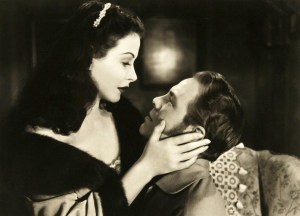
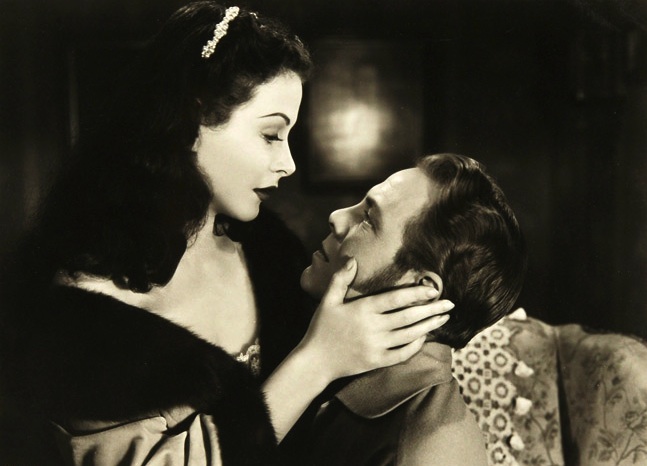
Ephraim (now played by Louis Hayward) returns home, and he and Jenny slowly but surely fall for each other.

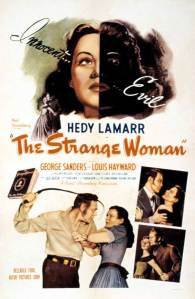
As the film poster above rather obviously shows, Jenny has two faces. For instance, when she and Ephraim sit on the banks of the river together, her recollection of pushing him into the river when he was a boy is flawed. She tells him that those rotten boys did it to him, and she tried to save him. Is she lying? Does she know she is lying? Does he know? Does he go along with it because he loves her, or does he truly believe her?

Jenny’s dual nature mirrors the nature of Bangor itself. On the one hand it is a prosperous New England town with an active churchgoing population of well-to-do people (like Mr. Poster and his young wife), but on the other hand it is a seedy little port city full of drunken sailors and “grog shops and low houses” (a.k.a. pubs and brothels). Jenny uses her husband’s money from his shipping and lumber businesses to improve the town, shaming him publicly into contributing large sums to the church. In private, however, she is carrying on with Ephraim, and even encourages him to arrange an “accident” for his father so they can be married.

Ephraim won’t be the last man in Jenny’s trail of conquest, either. As soon as she lays her eyes on John Evered (George Sanders), the tall, strapping foreman of Mr. Poster’s lumber business, it’s clear that the weak-willed Ephraim doesn’t stand a chance.

The Strange Woman is a well-made film with fine performances all around (with perhaps the exception of Gene Lockhart, who as Mr. Poster exhibits some of the most over-the-top reaction shots I’ve seen since watching Grayson Hall on Dark Shadows). Its narrative is sprawling, and clearly adapted from a novel, but the filmmakers keep everything moving along nicely.

Director Ulmer was a talented craftsman who toiled away in Poverty Row for most of his career, producing a few masterpieces, a few awful pictures, and plenty of films in between. The Strange Woman represents the rare film on his résumé with a decent budget and a reasonable shooting schedule. He was lent out by P.R.C. (Producer’s Releasing Corporation) at Lamarr’s insistence (apparently they were friends back in their native Austria-Hungary). He was paid $250 a week for the job. P.R.C. studio boss Leon Fromkess, on the other hand, received roughly $2,500 from United Artists. While he may have gotten the short end of the stick financially, the deal gave Ulmer a chance to work with a professional cinematographer (Lucien Andriot), a major star or two, a well-written script based on a hot property, and major studio distribution.
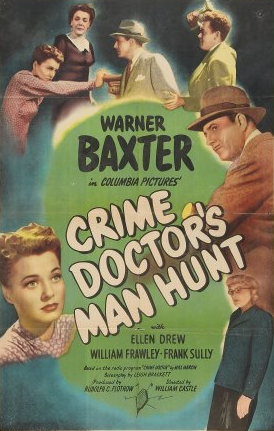
Crime Doctor’s Man Hunt (Oct. 24, 1946)

Crime Doctor's Man Hunt
Crime Doctor’s Man Hunt (1946)
Directed by William Castle
Columbia Pictures

William Castle’s mystery programmer Crime Doctor’s Man Hunt is yet another wacky outing with Warner Baxter as Robert Ordway, M.D., Ph.D. (a.k.a. the Crime Doctor).

The Crime Doctor was a character created by Max Marcin for a Sunday-night mystery radio show that ran from 1940 to 1947 on CBS stations. Like a lot of radio detectives (e.g., Boston Blackie, the Falcon), the Crime Doctor also got his own series of hour-long B movies.

In the first film in the series, Michael Gordon’s Crime Doctor (1943), a Depression-era crook and racketeer named Phil Morgan survives a murder attempt, but suffers from complete amnesia, reinvents himself as “Robert Ordway,” and puts himself through medical school. Once he gets his degree, he focuses on rehabilitating criminals. His past eventually catches up with him, but everything works out all right, and he is able to continue being Dr. Ordway, putting crooks behind bars and helping the helpless.

Crime Doctor is one of the best films in the series. The subsequent films are all a lot of fun, but Dr. Ordway’s checkered past is rarely referred to. Baxter’s performance in the lead role is always top-notch, however, and most of the Crime Doctor pictures are a cut above most other mystery programmers from the ’40s.

In Crime Doctor’s Man Hunt, John Foster (Myron Healey), a young, pencil-mustachioed man suffering from “bomb shock and combat fatigue,” comes to see Dr. Ordway. He’s suffering from fugue states in which he wanders in a daze, always drawn to the same intersection, but he doesn’t know why, and never remembers how he got there. He could get treatment from the Army, but he doesn’t want his fiancée to know about his condition.

His fiancée, Irene Cotter (Ellen Drew), comes to see Dr. Ordway right afterward. (Foster’s attempts to conceal his condition from her were clearly in vain.) Dr. Ordway deflects her questions and tells her that he can’t violate any patient’s confidentiality.

As with most of the Crime Doctor films, things get loonier as the film goes on. We learn that Foster had his fortune cast during a “slumming party” downtown, and was told by a fortuneteller named “Alfredi” (real name “Alfred Hemstead,” played by Ivan Triesault) that he would meet his violent death on the corner of Garth and Davis streets, which is why he is continually drawn there.

There’s also a case of split personality, which I won’t say too much about in order not to give anything away. However, even the dimmer bulbs in the audience will see the “twist” ending coming from a mile away. I’m not even sure it was meant to be a surprise.

Ordway comments at the end of the film that this has been a strange case, first the fugue, then the split personality. “Doctor, I’d like you to come see my wife,” says Police Inspector Harry B. Manning (William Frawley). “Split personality?” asks the doctor. “No personality,” quips the inspector.

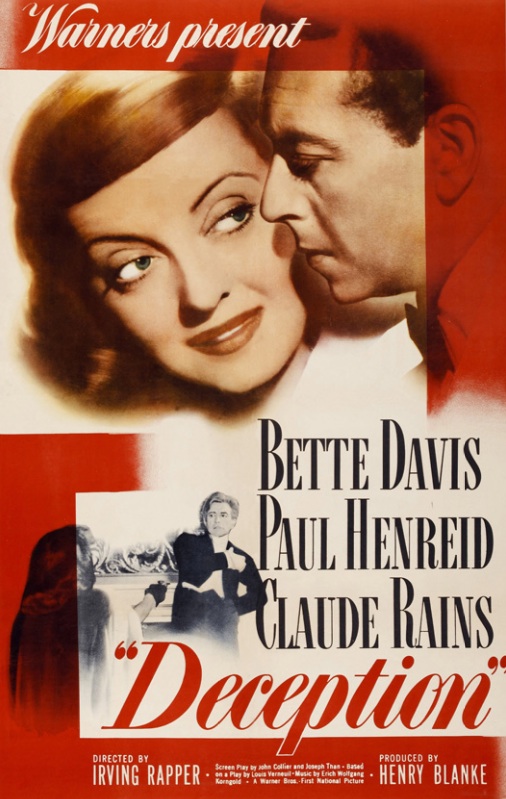
Deception (Oct. 18, 1946)

In my recent review of Decoy (1946), I mentioned that most of the movies that are now classified as film noirs were originally called “thrillers” or “melodramas.”

Irving Rapper’s Deception, about a love triangle in the world of classical music, sometimes gets thrown on the film noir pile, but it’s a melodrama through and through. The film reunited the director and all three stars of the popular, classy flick Now, Voyager (1942), which featured one of Bette Davis’s most iconic performances.

Lightning didn’t strike twice. While Deception, which reunited Davis with her fellow Now, Voyager alumni Paul Henreid and Claude Rains, received generally positive reviews, it was the first picture Bette Davis made for Warner Bros. that lost money. It’s a good film, but as melodramas go, it’s not terribly thrilling, and the criminal activity is kept to a minimum.

In the first scene of the film, piano teacher and musician Christine Radcliffe (Bette Davis) rushes through the driving rain to a concert in a small, second-floor performance area. She sees cellist Karel Novak (Paul Henreid), and she begins to cry. Quite by chance, she saw an announcement for the performance and couldn’t believe it, since she believed that Novak, her old flame, had died during World War II.

Their reunion is so emotional that it quickly leads to marriage. Even before the nuptials, however, Novak senses that Christine might be hiding something from him. She lives in an enormous apartment with a spectacular view of Manhattan, and her closets are full of fur coats, all improbabilities in the tight housing market of 1946, especially on a piano teacher’s salary.

Things quickly reach a head at their wedding celebration, with the appearance of Christine’s teacher, the famous composer Alexander Hollenius (Claude Rains). He has witticisms and icy remarks to spare, but he doesn’t really tip his hand until Christine sits down to play Beethoven’s Piano Sonata No. 23 in F minor, Op. 57, the “Appassionata.” Hollenius listens, enthralled, and crushes his champagne glass in his hand. When Christine rushes to tend to him, he says, “Like all women, white as a sheet at the sight of a couple of scratches. Calm and smiling like a hospital nurse in the presence of a mortal wound.”

That’s the first hint he drops about his feelings, but it won’t be the last. When Christine goes to visit him the next day, she walks into Hollenius’s conservatory and calls the piece he is playing “wonderful,” to which he responds, “Extraordinary, isn’t it, that music can exist in the same world as the basest treachery and ingratitude?”

From the beginning, Christine kept Novak in the dark about her relationship with Hollenius. Hollenius goes along with this deception, but never misses an opportunity to drop a hint or needle Novak about something. Compounding the mess is the fact that Hollenius is one of Novak’s favorite composers, and when he offers Novak the chance to be the soloist for the world premiere of his new cello concerto, Novak is ecstatic. Christine, on the other hand, senses that the mercurial Hollenius may be setting a trap for the emotionally fragile Novak.

And it certainly seems that way to the viewer, especially when Hollenius brings in Bertram Gribble (John Abbott), a journeyman cellist, to act as understudy in case Novak’s strained nerves get the better of him. Besides all the barbs and insinuations in social settings, Hollenius the conductor even seems hell-bent on tormenting Novak during the serious work of preparing for their concert, when he forces him to replay the same measure over and over during a dress rehearsal.

I’ve rarely seen a character in a film wield his art as a weapon quite so effectively as Hollenius does. It’s a perfect role for Rains, who as an actor projected a unique mix of effeteness and virility. By the time the climactic world premiere scene rolls around, the audience’s nerves are so thoroughly jangled that merely watching Henreid bow and pluck at his cello’s strings is as suspenseful as watching someone defuse a ticking time bomb. (It helps that Henreid’s pantomiming is nearly perfect. His cello parts were actually played by cellist Eleanor Aller, the wife of Felix Slatkin, when she was pregnant with their son, Frederic Zlotkin. Henreid was coached on how to properly mimic playing the instrument by Aller’s father, Gregory Aller.)

The score of Deception and all of Hollenius’s compositions were written by Erich Wolfgang Korngold (1897-1957), an Austro-Hungarian composer whose stirring, neo-Romantic scores for films like The Adventures of Robin Hood (1938) and The Sea Hawk (1940) presaged the work of John Williams. His style was too old-fashioned and his medium was too populist to attract anything but disdain and indifference from critics and scholars during his lifetime, but he was incredibly talented, even though his music was neither groundbreaking nor avant-garde. In Deception, he seems to be straining against the bonds imposed on him by the conventions of the cinema, and Novak’s cello part in the concerto is especially moving and powerful. At least I thought so.