Author Archives: Adam Lounsbery

Anna and the King of Siam (June 20, 1946)

John Cromwell’s Anna and the King of Siam isn’t nearly as well known as The King and I, the Technicolor extravaganza starring Yul Brynner and Deborah Kerr that was made a decade later. Both films tell the same story, but The King and I does it in the form of a Rodgers & Hammerstein musical. I saw The King and I when I was a kid, and have strong memories of certain scenes, but not of the film as a whole. So I came to Anna and the King of Siam relatively fresh, and was able to watch it without constantly thinking of Brynner’s iconic performance, at least most of the time. The one big difference — if memory serves correctly — is that the later, musical version of this tale was more of a love story. It’s not as if it ended with a marriage, or Kerr being added to the king’s harem or something, but there was a romance of some sort that grew over the course of the film. The closest Anna and the King of Siam gets is a couple of scenes between Anna and the king that end with the king leering, and seeming to contemplate her in a sexual fashion.

Anna and the King of Siam is the first filmed adaptation of Margaret Landon’s 1944 book of the same name. Producer Darryl F. Zanuck reportedly bought the rights to Landon’s book immediately after reading the galleys. As is often the case, the real-life Anna Owens was a considerably more interesting and complicated person than she was portrayed in the book or any of the films about her. This is largely due to her own self-invention. Anna Leonowens was born in poverty in India in 1831, the daughter of Sgt. Thomas Edwards, a soldier in the private army of the Dutch East India Company, and his wife Mary Anne Glasscott, an Anglo-Indian woman. Later in her life, Leonowens took pains to hide her origins, and claimed that her father’s rank was lieutenant (later she claimed he had been a captain), and that she had been born in Wales. It’s important to remember that these fabrications were not merely for the purpose of self-aggrandizement. As a widow and a single mother, Leonowens faced an uphill battle in life, and almost certainly would have faced discrimination if her mixed-race heritage had been known.

While Anna and the King of Siam doesn’t delve deeply into Anna’s background, there is never any intimation that she is anything but the most proper of British ladies. The Anna Owens of the film, played by Irene Dunne, embodies the best values of the “modern” British empire, while King Mongkut (Rex Harrison) represents an older form of governance; repressive, misogynistic, autocratic, and superstitious.

Reportedly, most Thai who saw the picture were shocked and angered by the portrayal of their revered nineteenth century king, and the film was banned in Thailand due to “historical inaccuracies.” It’s hard to argue with this assessment. Landon’s book and Leonowens’s own recollections were by all accounts at least partially fabricated, and overemphasized Leonowens’s role in the king’s life, as well as the harshness of his regime. And there’s the larger question of how well any white actor — even one as talented as Rex Harrison — can portray an Asian character.

Granted, the yellowface portrayals in the film look ridiculous, especially Lee J. Cobb as the “Kralahome,” or prime minister, who appears for much of the film stripped to the waist, covered with dark makeup, and sporting a pomaded pompadour. But, like Harrison, he delivers a nuanced performance, and in their scenes together they drop the stilted line deliveries that they have in their scenes with Anna or her son Louis (Richard Lyon). (They continue to speak English, of course, but the syntactical variance is still a nice touch.)

If one ignores questions of historical accuracy, Anna and the King of Siam is an excellent and involving story of cultural differences and the challenges and rewards of education in the face of adversity. The principal actors all give great performances, especially the beautiful Linda Darnell as the king’s newest and most alluring wife, Lady Tuptim. It’s a role that easily could have been one-note, but Darnell is able to create a sexy yet repulsive character who grows more complicated as the film goes on, and eventually becomes the central tragic figure of the picture. Also, Anna and the King of Siam looks fantastic. It won two Oscars, one for best black and white cinematography and the other for best art direction, and they were well-deserved.
Henry V (June 17, 1946)

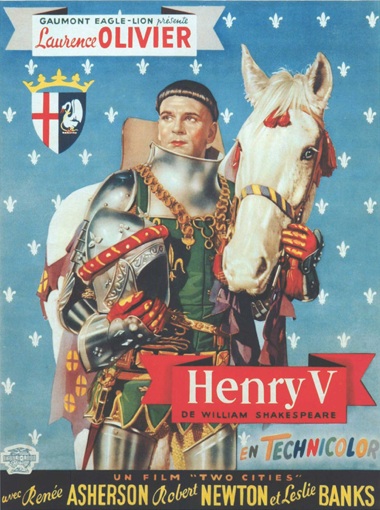
Laurence Olivier’s film adaptation of Shakespeare’s history play Henry V was originally released in the United Kingdom in November of 1944. (The date I’ve listed above is the release date of the film in the United States.) Following its release in the United States, Henry V was nominated for a 1946 Oscar for best picture, as well as Oscars for best actor, best score, and best art direction. It didn’t win in any of its nominated categories, but Olivier did receive an honorary Academy Award “for his outstanding achievement as actor, producer, and director in bringing Henry V to the screen.”

The recognition was well deserved (even though Olivier considered the award a “fob-off” from a jingoistic Academy). This film is a splendid achievement, and holds up remarkably well. Not only is it a fine cinematic adaptation of a great play, it’s a beautifully crafted film within a play within a film, in which Olivier the director has fun with convention while Olivier the actor delivers an assured and commanding performance as Henry, only recently a monarch after a misspent youth (chronicled by Shakespeare in Henry IV parts one and two).

The film’s full title is “The Chronicle History of King Henry the Fift With His Battell Fought at Agincourt in France,” and that’s how the title appears on the opening placard, which invites people to attend “Will” Shakespeare’s play, performed by the Lord Chamberlain’s Men at the Globe Playhouse this day, the first of May, 1600. There follows a panoramic vista in gorgeous, nearly surreal Technicolor of the London of Shakespeare’s day. It’s obviously a model, but it’s an effective one, with wisps of smoke rising from chimneys and tiny vessels dotting the Thames.

The beginning of the film attempts to faithfully recreate the theatrical experience one would have had at the Globe during Shakespeare’s time. There are no set dressings, and the Chorus (Leslie Banks), in each of his appearances, invites the viewer to suspend his or her disbelief, vividly describing the scene that is about to be played, and in so doing draws attention to the artifice of the play. As the film goes on, however, it moves out of the confines of the theater and becomes increasingly realistic, reaching its apex when Henry finally leads his troops in battle against the French at Agincourt.

Artifice and realism aren’t strictly delineated in Henry V, however. When the film first moves out of the theater to the court of France, the ocean is a static sea of waves that looks like the backdrop for a puppet show in Mister Rogers’ Neighborhood. And after the impressive battle, which was filmed in County Wicklow, Ireland (as a neutral country, it wasn’t ravaged by the war), artifice slowly returns in the form of phony-looking backdrops and a return to the stagey castle set of the French court.

When Olivier first appears on screen, it is as Oliver the actor, standing backstage in full costume, waiting for his entrance cue, and coughing into his hand in a decidedly unheroic fashion. As soon as he steps on stage, however, his voice commands attention. By the time he delivers his famous Saint Crispin’s Day speech, I was eating out of his hand. This is no mean feat, either, considering the historically accurate haircut Olivier saddled himself with, as well as his very noticeable eye makeup.

It’s common knowledge that Henry V was made with the cooperation of the British government and designed to be a nationalistic morale booster in the days following the Allied push into Normandy. Consequently, the scene in which Henry threatens to rape women and kill children was excised from the script, along with the hanging of Bardolph and Henry’s order to kill French prisoners. But it’s all in keeping with the tone of the film, which is more a celebration of theater and patriotism than it is a nuanced character study.

South of Monterey (June 15, 1946)

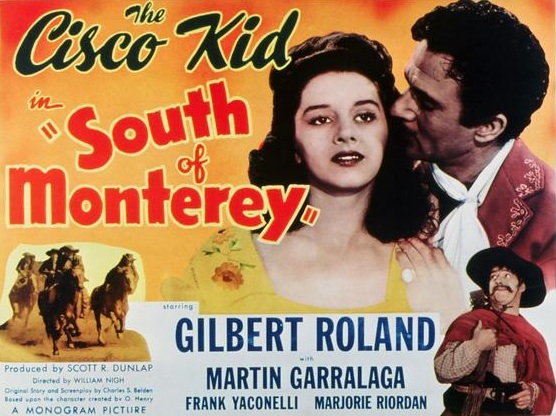
William Nigh’s South of Monterey is another dreary Cisco Kid programmer from Monogram Pictures. Gilbert Roland, in his second appearance as the character, cuts a dashing figure and is always fun to watch, but overall this one is a real snoozer.

I wasn’t exactly knocked out of my seat by Roland’s first turn as the character in The Gay Cavalier (1946), and his second outing is more of the same, with a by-the-numbers story and an anticlimactic finale. As before, Roland is fun to watch as a smooth Lothario and laid-back hero. It’s everything else about this picture that’s the problem.

This time around, Cisco, his sidekick Baby (Frank Yaconelli), and his merry band of Mexican outlaws have a rival, called “The Silver Bandit.” It should come as no surprise to veterans of Saturday afternoon matinees that Cisco and his crew will be blamed for the nefarious exploits of The Silver Bandit.

South of Monterey combines the two hoariest concepts in these types of films; the evil landowner bleeding the poor farmers dry and the young woman in danger of being forced to marry a man she doesn’t love.

The main villain of the piece is the local tax collector, Bennet (Harry Woods), who repossesses peasants’ land based on non-payment of sky-high taxes and then resells them for a profit. The young woman in danger of being forced into a loveless marriage is Carmelita (Iris Flores), the sister of local commandante of police Auturo (Martin Garralaga). Carmelita is engaged to a fiery young activist named Carlos Mandreno (George J. Lewis), but her brother is angling to have Carlos thrown in jail and his sister married off to his friend Bennet.

The film tries hard to achieve an exciting, south of the border flavor, and occasionally succeeds. Roland doesn’t play Cisco as a Boy Scout — he’s a tequila-drinking, womanizing, cigarette-smoking rapscallion. Also, there are four songs in the film sung in Spanish, one of which leads Cisco to pay Carmelita one of his typically over-the-top compliments, “Your voice has the sweetness of a meadowlark, and the softness of mission bells at twilight.”

South of Monterey isn’t a terrible programmer, it’s just a fairly typical Monogram cheapie. The main reason for me that it was a step down from The Gay Cavalier was the climactic fight, which was a fistfight. Yawn.

As he ably demonstrated in Captain Kidd (1945) and The Gay Cavalier, Roland was a hell of a sword fighter, so it’s a shame to see him swinging haymakers and smashing furniture when his blade was no doubt screaming out for blood. I know I was.

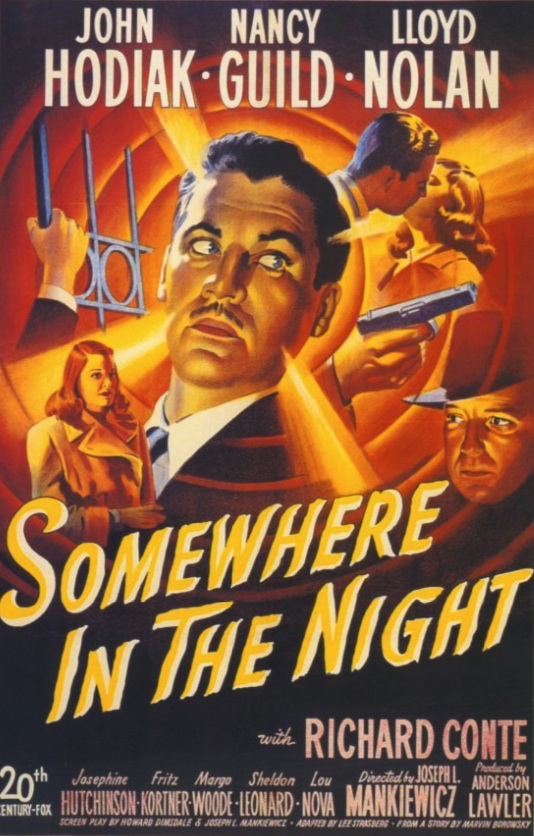
Somewhere in the Night (June 12, 1946)

Joseph L. Mankiewicz’s Somewhere in the Night looks like a noir, talks like a noir, and walks like a noir. But when the credits rolled I felt more like I’d watched a light-hearted mystery farce than a noir. This isn’t to say that Somewhere in the Night is a bad movie. It’s actually a really fun one. But the dark journey promised by the film’s opening never pans out, and the plot twists grow increasingly ludicrous as the picture goes on.

The first few minutes of the picture are mostly shot in first-person P.O.V., as a man (played by John Hodiak) wakes up in an Army field hospital. Through voiceover and the images in front of his face, we learn that he has no idea who he is, and doesn’t remember anything leading up to this point. This opening presages Robert Montgomery’s ill-advised first-person P.O.V. extravaganza Lady in the Lake (1947). Luckily, unlike that picture, the technique is used judiciously in Somewhere in the Night.

Hodiak’s character has Army identification in the name of “George Taylor,” a Dear John letter (it’s really more of an “I Hate You, John” letter), and a letter of credit from someone named “Larry Cravat.” What’s a noir protagonist to do? Clearly, the best course of action is to head for the mean streets of Los Angeles and attempt to track down Larry Cravat, even though “Taylor” has no idea what he’s doing or who all these people are who seem to want him dead. Why should that stop him? Taylor is a Purple Heart recipient and seems to be able to handle himself. It doesn’t hurt that the briefcase he picks up in a Los Angeles train station contains a gun and a letter from Larry Cravat telling Taylor that there is $5,000 deposited in his name in an L.A. bank.

For the first half hour or so, Somewhere in the Night has a few things to say about the plight of returning G.I.s, in particular the disappointments handed them by the women they came home to (or didn’t come home to, in Taylor’s case), and the resentment some servicemen must have felt upon their return.

“You know there’s been a terrible shortage of men,” a beautiful young woman named Phyllis (Margo Woode) tells Taylor.

“Yeah, so we heard in the Pacific,” he responds. “This war must have been murder on you poor women. We used to cry our eyes out about it.”

But, as I said, the longer Somewhere in the Night goes on, the more plot points stack up, and the less time the film has to do anything but crank through its story.

When Taylor goes to the bank to try and collect his $5,000 he arouses the suspicion of the cashier and he ends up fleeing empty-handed. He follows leads to a Turkish bath and then to a nightclub. Set up at the club by the bartender, he ends up hiding from a couple of mugs in the dressing room of a pretty singer named Christy Smith, who is played by the 20-year old Nancy Guild (rhymes with “wild”).

Guild is fresh-faced, has a beautiful voice, and plays her role well. She’s not outstanding, but she does a good job, especially considering this was her first role in a film; not just as leading lady, her first film role, period. Apparently she felt out of her depth, and the production was a struggle for her. In later interviews, she credited Mankiewicz’s generous nature and sensitive direction, and said he was a real father figure to her.

Hodiak also does a decent job, but it’s a one-note performance. He sweats profusely and looks haunted, and does a great job with lines like, “I’m tired of being pushed around. The war’s over for me. I don’t have to live afraid anymore.” He sounds genuinely angry, and he also sounds as if he doesn’t believe his own words one bit.

It wasn’t until after I finished watching Somewhere in the Night that I learned that while Hodiak was born in the United States, he grew up in an immigrant family, spoke Hungarian and Polish at home, and always had to work hard at his English diction. “No part has ever come easily to me,” Hodiak once said. “Every one has been a challenge. I’ve worked as hard as I could on them all.” I never would have guessed from this film that his first language wasn’t English, but there is something about his delivery that is strange and stilted.

Luckily, Guild and Hodiak have wonderful support from two great actors who straddled the line between character actor and leading man; Lloyd Nolan and Richard Conte.

Nolan plays a police detective, Lt. Donald Kendall, who doesn’t eat lunch because it puts him to sleep and doesn’t drink coffee because it keeps him awake. He also wonders aloud several times why detectives in the movies don’t ever take their hats off. (He figures it out by the end of the picture.) And he has plenty of great lines, which he delivers in his trademark wry fashion, like “Big post-war boom in homicide.”

Conte plays a nightclub owner named Mel Phillips, who’s smooth without seeming oily, and whose motives aren’t initially clear. (If you had $5 for every time Conte played a nightclub owner in a noir, you could probably take your whole family out to a nice dinner.)

Somewhere in the Night is a good picture; well-made and a lot of fun. It was all just a little silly for my taste, though.

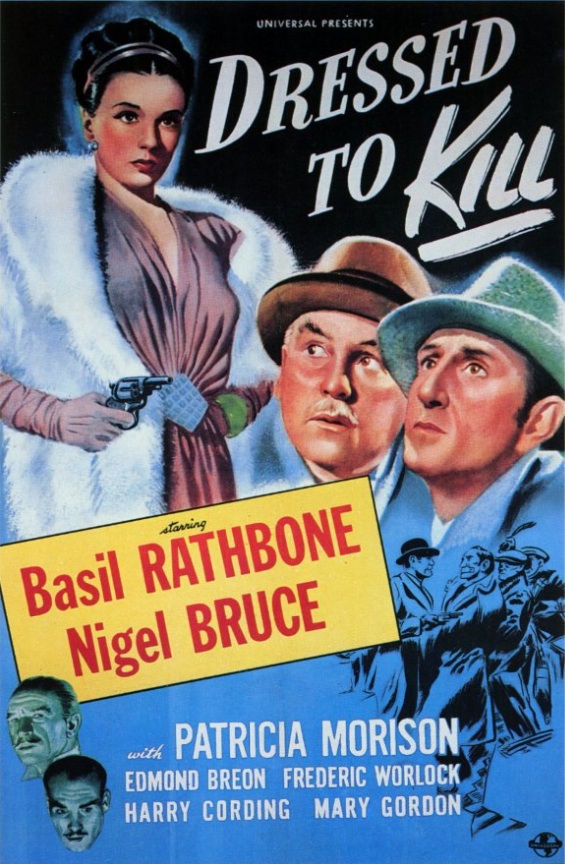
Dressed to Kill (June 7, 1946)

Dressed to Kill was director Roy William Neill’s eleventh Sherlock Holmes film, and the fourteenth and final film starring Basil Rathbone as Holmes and Nigel Bruce as his loyal sidekick Dr. John H. Watson.

This was the year that Rathbone said goodbye to the character. His last appearance on the Mutual Broadcasting System radio program The New Adventures of Sherlock Holmes was in “The Singular Affair of the Baconian Cipher,” broadcast on Monday, May 27, 1946. The next week’s time slot was filled with the summer replacement program The Casebook of Gregory Hood, which starred Gale Gordon as an antique dealer and gourmand living in San Francisco who solved mysteries in his spare time. Like the Sherlock Holmes program, the scripts were written by Holmes aficionados Anthony Boucher and Denis Green. The show was fun, but Gregory Hood was no Sherlock Holmes.

Holmes returned to the airwaves in October, on the American Broadcasting Company. Nigel Bruce reprised his role as Dr. Watson, but Tom Conway took over the role of Sherlock Holmes (although Bruce received top billing). Rathbone, who felt that his association with the character, whom he had played on a regular basis since 1939, was killing his career, so he returned to New York City and the theater. He won a Tony in 1947 for his role in the Broadway play The Heiress, but little significant stage work presented itself to him in the years to come. He had bad luck with films, as well. When The Heiress was made into a film in 1949, Rathbone hoped to appear again as Dr. Sloper, the role for which he had won a Tony, but the part ended up going to Ralph Richardson.

Whatever Rathbone’s feelings about his iconic performances as Holmes, there is no question that he left an indelible mark on the character. (He eventually returned to the role in 1953 when he appeared as Holmes in an episode of the Suspense TV show, as well as starring as Holmes in a play that was written by his wife, Ouida. The play received lukewarm reviews and closed after just three performances.)

In the first scene in Dressed to Kill in which Rathbone and Bruce appear, Rathbone waxes nostalgic about “the woman,” Irene Adler, a character in Sir Arthur Conan Doyle’s 1891 story “A Scandal in Bohemia,” while Watson sits reading The Strand, the magazine in which Conan Doyle’s Sherlock Holmes stories originally appeared. (Later in the film, a smoke bomb will prove the undoing of Watson, and Holmes will taunt him, since Watson described an identical ruse in the story he wrote called “A Scandal in Bohemia.” It’s an enjoyable bit of metafiction of the type Conan Doyle himself engaged in.)

The boys receive a visitor to 221b Baker Street, Julian “Stinky” Emery (Edmund Breon), an old friend of Watson’s. Emery is an avid collector of music boxes, and was robbed the night before. Curiously, the thief (or thieves) knocked him unconscious and then took just one music box, a trifling little thing that Emery had purchased earlier in the day at auction for just £2.

We, the viewers, know that Emery’s music box was one of three manufactured in Dartmoor Prison, so we know that the trio of miscreants tracking them down in London have an ulterior motive, in this case, finding where a pair of original Bank of England plates are hidden, which they will be able to use to produce £5 notes that are not “counterfeit” in the traditional sense. The three music boxes all seem to play the same tune, but with his fine ear for music, Holmes will note minor variations in the melodies, which is the key to the code.

Dressed to Kill features many plot elements that will be familiar to long-time viewers of the series. Mrs. Hilda Courtney (Patricia Morison) is a clever femme fatale in the mold of the eponymous antagonists of The Spider Woman (1944) and The Woman in Green (1945). And the plot device of a number of cheap trinkets holding a code was used before, and to better effect, in The Pearl of Death (1944).

Dressed to Kill is far from the best of Universal’s Sherlock Holmes series, but it’s far from the worst. The Rathbone Holmes pictures are remarkably consistent and terrifically entertaining, however, so the worst picture in the series is still better than most mysteries from the ’40s.

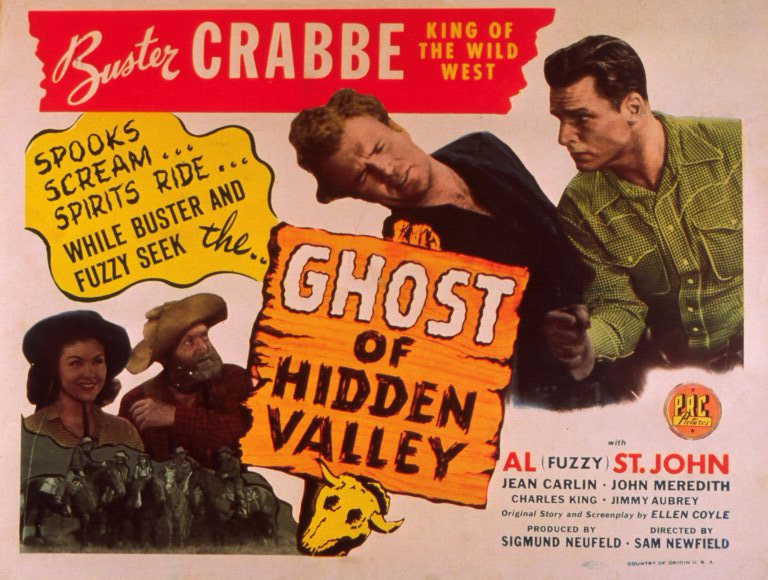
Ghost of Hidden Valley (June 5, 1946)

When it comes to Poverty Row westerns, there’s a fine line between watchable and unwatchable.

I didn’t dislike Ghost of Hidden Valley, and even enjoyed a lot of it. I can’t say whether that’s because it’s a slight cut above other Poverty Row westerns distributed by P.R.C. (Producers Releasing Corporation) that I’ve seen lately, or because my expectations were ground down to a nub by the three other movies directed by Sam Newfield that I’ve watched in the past year.

One of the most prolific directors of all time, Newfield directed more than 250 movies in a career that spanned almost 40 years. Martin Scorsese once said, “Newfield is hard, that’s a hard one, you can’t do too much of that.” This from a man well known for his insatiable appetite for films of all kinds.

Ghost of Hidden Valley begins with some stock footage of an enormous herd of cattle. In the next scene, Ed “Blackie” Dawson (Charles King), the leader of a group of cattle rustlers, shoots an interloper so he won’t tell any tales to the law. “Well, that takes care of that,” Dawson’s henchman says. “The ghost of hidden valley will get all the blame.”

I’m a fan of economical storytelling, even when it’s outlandish.

There is no ghost, of course, and we won’t see any more cattle, either. There will be some weak-sauce comedy in which the grizzled and toothless Fuzzy Q. Jones (Al “Fuzzy” St. John) will mistake the calls of a hoot owl for the spectral cries of a wandering spirit, but that’s it.

After Dawson and his rustlers commit murder, we see cowboy Billy Carson (Buster Crabbe) and his friend Fuzzy at the post office in Canyon City, Arizona. Fuzzy has received a letter from someone named Cecil Trenton. (It comes addressed to “Fuzzy Jones, Esq.”) Cecil’s late brother, Sir Dudley Trenton, spoke well of Fuzzy, as well as his sojourn in America generally. “It was his wish that his son Henry, a young gentleman just out of Oxford, should experience a bit of the rugged life and devote some attention to the property Sir Dudley purchased in your vicinity,” Cecil writes.

“What is this Oxford he just got out of, a penitentiary?” asks Fuzzy.

“No,” Billy responds. “Some sort of a school.”

Henry Trenton (John Meredith) is exactly what you might expect. A fey, snooty-accented tenderfoot wearing a checked shirt, vest, ten-gallon hat, and ridiculous sheepskin chaps. “I always make it a point to dress correctly,” he says. He even has an aristocratic butler in tow named Tweedle (Jimmy Aubrey).

Billy sees the potential of Hidden Valley Ranch, if only someone could knuckle down and work it properly. Will Henry Trenton be that man?

Ghost of Hidden Valley is a typical P.R.C. western, with plenty of shootouts, chases on horseback, and furniture-destroying fistfights to fill out its 56-minute running time, but at least it’s briskly paced. Also, the female lead (Jean Carlin) is pretty, unlike the last Crabbe P.R.C. western I saw, and the script by Ellen Coyle is breezy and relatively entertaining.

There’s still Newfield’s trademark sloppiness and inattention to detail for the viewer to contend with. For instance, there’s one scene in which Crabbe’s skinny stunt double, his loose shirt hanging out of his pants, takes a punch, there’s a cut, and the next shot is of the real Crabbe, his chunky torso unmistakable, and his shirt tightly tucked into his jeans.

Crabbe was my main problem with this film. No longer the dashing young actor he was when he played Flash Gordon in the ’30s, Crabbe phones in his performance, has trouble mounting his horse in at least one scene, and generally looks as if he’d rather be somewhere else.

The Stranger (May 25, 1946)

The Stranger isn’t most people’s favorite Orson Welles film, and a lot of people even consider it his worst. (Welles did.) It’s the third film he directed, and as far as Oscar bait goes, it certainly pales in comparison with Citizen Kane (1941) and The Magnificent Ambersons (1942), but I think a lot of the criticism heaped upon it is unfair. The Stranger is a crackerjack thriller with tension and suspense to spare. I was drawn in by the first scene, and was completely involved throughout the film’s 95-minute running time.

Despite its sometimes hackneyed script and implausible situations, The Stranger shows a master in complete control of his craft. The first 15 minutes of the film are some of the most perfect cinematic storytelling I’ve ever seen. Mr. Wilson (Edward G. Robinson), an investigator for the Allied Commission for the Punishment of War Criminals, sets free a Nazi war criminal named Konrad Meinike (Konstantin Shayne) and has him tailed, believing that he will lead them to the secret architect of the Holocaust, Franz Kindler (Welles). Kindler is living in the idyllic little town of Harper, Connecticut, under the name “Charles Rankin” and is a professor at a boy’s school.

Meinike’s journey to find Kindler is an object lesson in how to tell a story with a minimum of dialogue and a maximum of tension. The shots are visually arresting, the editing is rapid without ever being confusing, and the pacing is fast. As openings go, it’s not quite the bravura performance Welles would later put on with his single crane shot that opens Touch of Evil (1958), but it’s just as good in its own way. The disconnect only appears during the first lengthy stretch of dialogue. Once Meinike tracks down Prof. Rankin, the clumsy exposition that Welles grumbles through — which explains who his character is, whom he is marrying, and who his father-in-law will be — sticks out like a sore thumb.

Meinike will prove to be just the beginning of Rankin’s troubles. The noose tightens around his neck as soon as Wilson arrives in town, posing as a dealer in antiques. Robinson plays his role well, in an understated fashion that contrasts nicely with Welles’s bug-eyed histrionics. After a few extreme close-ups of Rankin’s sweaty face as he tells lies to convince his new wife, Mary Longstreet (Loretta Young), that he is an innocent hounded by nefarious forces, there is no doubt about the depths of his villainy.

Not that there every really was any doubt, since Rankin behaves in such a despicable fashion throughout the picture. It’s not just his dinnertime conversation — in which he explicates the warlike soul of the German people and denies that Karl Marx was a German because he was a Jew — it’s his willingness to engage in wet work, killing a troublesome character without a second thought and later beating his new wife’s dog when it attempts to dig up the corpse.

In his review of The Stranger in the July 11, 1946, edition of the NY Times, Bosley Crowther wrote that Welles’s performance “gave no illusion of the sort of depraved and heartless creatures that the Nazi mass-murderers were. He is just Mr. Welles, a young actor, doing a boyishly bad acting job in a role which is highly incredible — another weak feature of the film.” Again, I think this is unfair. Welles got his start in the theater, and as a thespian, he never really grew out of it. His acting was always highly theatrical. He was a man who played to the back row, with grand gestures and a booming voice, but he did so extremely effectively. Not every film performance has to be subtle and understated.

It’s his work behind the camera, however, that really shows Welles in top form. The fast cutting in a scene in a diner, for instance, creates a tense subtext beneath Loretta Young’s seemingly casual banter with Edward G. Robinson by showing each character’s motivations by the looks on their faces. Mary is hiding something, Rankin is coercing her into doing so, and Wilson knows exactly what is going on. Director Welles and editor Ernest J. Nims make it all look easy, but it’s not, or more films would be this well-made.

The film also brilliantly uses sound. For instance, the tolling of the clock in the village square (which the clock-obsessed Rankin has fixed) underscores the tension in the film’s final half hour. The bonging of the clock has a peculiar timbre, and sounds more like incidental music from a ’70s or ’80s suspense or horror flick than any soundtrack from the ’40s I’ve ever heard before. The score itself, by Bronislau Kaper, is quite good, too, and is reminiscent of the work of Bernard Herrmann.

The screenplay, by Anthony Veiller, from a story by Victor Trivas, was imposed on Welles by the studio. The studio and the producer, Sam Spiegel (listed in the credits as “S.P. Eagle”), made plenty of other decisions Welles didn’t like. For instance, Welles wanted Agnes Moorehead to play the part of Wilson, but they forced him to go with Robinson. As far as the studio was concerned, however, everything worked out for the best, since The Stranger was the only film Welles directed that ever made a profit during its initial theatrical run.

The Stranger is a potboiler, to be sure, but it’s such a brilliantly edited, directed, and acted potboiler that it’s remarkable. This is one of those rare movies that I looked forward to seeing again as soon as it was over.

She-Wolf of London (May 17, 1946)

Jean Yarbrough’s She-Wolf of London is a passable way to while away an hour after the A feature has run its course, but that’s about it. By the mid-’40s, Universal’s horror department was looking pretty moribund. The last truly outstanding horror film Universal Pictures released was probably The Wolf Man (1941). After that, there were several Mummy, Dracula, and Invisible Man sequels and spin-offs, as well as a couple of everything-but-the-kitchen-sink monster mashes, House of Frankenstein (1944) and House of Dracula (1945). Most of them were fine, campy entertainment, but none of them approached the truly outstanding horror pictures that Universal produced in the ’30s.

This picture is similar in many ways to Devil Bat’s Daughter (1946), which I watched a few weeks ago. (Incidentally, Jean Yarbrough, who directed She-Wolf of London, also directed the original The Devil Bat in 1940.) Like Devil Bat’s Daughter, She-Wolf of London is a horror film with every last drop of the supernatural squeezed out of it. Sure, there are a few teases here and there, and the foggy atmosphere is thick, but as soon as a young girl in a film who’s set to inherit a fortune starts to think she’s crazy, five’ll get you 10 she’s being manipulated by someone.

She-Wolf of London takes place in turn-of-the-century London. The Allenby Curse has almost been forgotten, but this is a Universal horror picture, so it’s all set to rear its ugly head again. (The curse has something to do with members of the Allenby family assuming the form of wolves, but the film is vague about the details.) Phyllis Allenby (played by June Lockhart, who is best known to legions of baby boomers as the mom on two classic TV series, Lassie and Lost in Space) is a young woman who just wants to marry her sweetheart, Barry Lanfield (Don Porter). When a series of brutal murders committed by a woman wearing a cloak and hood occur in a nearby park, Phyllis fears she is killing people at night and forgetting everything when she wakes up in the morning. All the evidence of cinematic lycanthropy is there — the muddy footprints leading back to the bed, the blood on the hands — but, as I said, she’s an heiress on the verge of inheriting a vast fortune, so you can bet she’s being gaslighted.

Even for what it is, She-Wolf of London is stunningly predictable, right down to its easy-to-spot red herrings. It’s notable only for taking a relatively serious approach to its material long after most of the studio’s horror films were pure camp. But that, in itself, is another problem. As an exploration of the psychosexual motivations that might drive a murderess, the picture falls completely flat. Cat People (1942) this film is not.

Without Reservations (May 13, 1946)

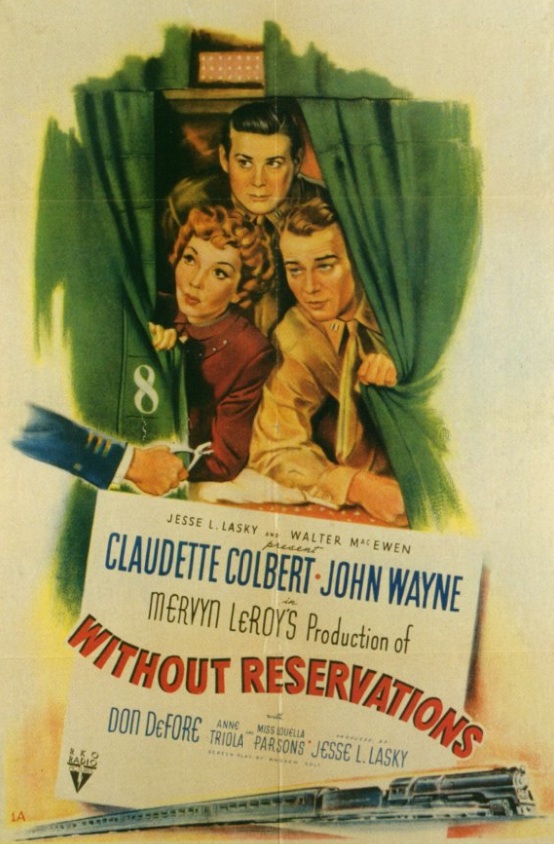
Mervyn LeRoy’s Without Reservations is the kind of old-fashioned romantic comedy that frequently has adjectives like “sparkling” and “breezy” attached to it. It’s also the last film in which John Wayne appeared as one of the leads but did not receive top billing. Claudette Colbert’s star power still shone pretty brightly in 1946.

I thought that LeRoy’s previous film, Thirty Seconds Over Tokyo (1944), was one of the best World War II films I’ve ever seen, so I was looking forward to seeing Without Reservations, but found it mediocre. I enjoyed it, but I didn’t love it.

In the film, Colbert plays Christopher “Kit” Madden, a sort of socially progressive version of Ayn Rand. Her novel Here Is Tomorrow is a runaway best-seller, and is the one book it seems that everyone in post-war America has read. When the film begins, Kit is arguing with film producer Henry Baldwin (Thurston Hall), who is unable to fulfill his promise to secure Cary Grant for the part of Mark Winston, the protagonist of Here Is Tomorrow. Kit won’t consider making the picture without Cary Grant, and begins drafting a letter while traveling by train that will stop production of the film. Anyone who’s been paying attention, however, will notice that the heroic painting of Mark Winston on the cover of her novel looks an awful lot like John Wayne, and will probably be able to predict what will happen next.

Sure enough, Kit meets two Marine pilots, Rusty Thomas (John Wayne) and Dink Watson (Don DeFore), on the train. As soon as she lays her eyes on Rusty, she realizes he’s perfect for the role of Mark Winston, and immediately begins to rewrite her letter. Since she introduces herself only as “Kit,” and the novel was published under her full name, Dink and Rusty don’t realize that she’s the most popular author in America. When she asks Rusty what he thinks of the novel Here Is Tomorrow he rips into it with abandon. His main complaint seems to be that the romance in the novel is unconvincing. Mark Winston, a progressive with grand plans to remake America, is chased around by a woman, but they can’t make things work because she’s a political reactionary.

In reality, of course, it’s Kit who’s the progressive (Mark Winston is merely her mouthpiece) and Rusty who’s the reactionary. Without Reservations is based on the novel Thanks, God! I’ll Take It From Here, by Jane Allen and Mae Livingston. I haven’t read the novel, but if the film is in any way faithful to its source material, the title comes from a speech Rusty makes about the first men in America. According to Rusty, no amount of political disagreement is enough to keep a man and a woman apart if they’re hot for each other. (Can you sense, yet, where the film might be heading?)

Angry about the grand plan laid out for society in Here Is Tomorrow, Rusty says to Kit, “Have you ever heard of some fellows who first came over to this country? You know what they found? They found a howling wilderness, where summer’s too hot and winter’s freezing. And they also found some unpleasant little characters who painted their faces. Do you think these pioneers filled out form number X6277 and sent in a report saying the Indians were a little unreasonable? Did they have insurance for their old age? For their crops? For their homes? They did not. They looked at the land and the forest and the rivers. They looked at their wives, their kids, and their houses. And then they looked up at the sky and they said, ‘Thanks, God. We’ll take it from here.'”

Watching the film in 2010, I found it hard to believe that no one from the Tea Party movement has latched onto this scene and played it on JumboTrons across the country, since its simplistic vision of America’s beginnings and total opposition to the federal government and even the most basic of social programs seem so close to that movement’s weltanshauung. Not to mention that the speech is delivered as only John Wayne can.

There’s a lot of great stuff going on here, and Wayne and Colbert have decent chemistry, even though he’s not that well suited to playing a romantic lead, especially in a comedy. If Without Reservations had kept up the momentum it establishes in its first couple of acts, I would have really liked it. Unfortunately, it goes off the rails and becomes a meandering road movie.

But not before Rusty, Kit, and Dink run afoul of one of the Pullman porters when they stack up the tables in the club car and have Kit “fly a plane” with a stand-up ashtray for a yoke. The drunken Kit eventually falls over, knocking everything to the ground. Like a bunch of goons, they run off, leaving the mess for one of the porters to clean up while they hide in one of the sleeping compartments (see the film’s poster above).

Once on the road, they buy a flashy sports car from its exasperated owner, and it constantly breaks down. They stay with a colorful Mexican family with a hot and spicy daughter named Dolores (Dona Drake) and a fiery patriarch, Señor Ortega (Frank Puglia), who teaches Kit a few things about love, namely how brutal, selfish, and turbulent it is, and should be. “Love and violence walk hand in hand, señorita!” he says.

The strangest thing about Without Reservations is that Colbert and Wayne do not appear in the same scene at any point during the last act of the film. Kit galivants around Hollywood with a series of leading men in an effort to make Rusty jealous, and the viewer is treated to cameos by Cary Grant (playing himself) and Raymond Burr (still young and trim enough to play an up-and-coming leading man named “Paul Gill”). In these sequences it makes sense for Colbert and Wayne to not appear together, since they’re in different physical locations, but when Rusty finally gives in and appears on Kit’s doorstep, we hear him ringing her doorbell and see her run out of her bedroom downstairs to let him in, but the camera pans right and stops and lingers on a shot of her bed as we hear her greet him off screen. Fade to black. It’s about as subtle as a train going into a tunnel.

I know there are legions of people who think Colbert was the epitome of class, beauty, and charm, but I found her unappealing in this film. With her little stick body, hunched shoulders, spastic movements, short hair in a tight perm, and heavy makeup, she looked to me like an eighty-year old woman with a forty-year old face.

Sun Valley Cyclone (May 10, 1946)

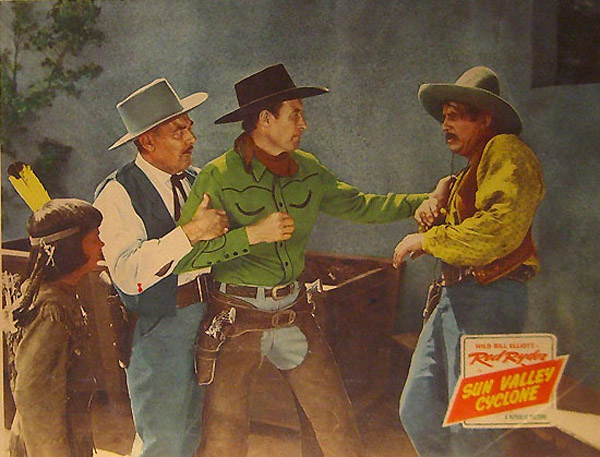
Sun Valley Cyclone, another entry in the Red Ryder film series directed by the dependable R.G. Springsteen, tells the story of how Ryder got his horse, Thunder. These kinds of stories are classic; how Sgt. Preston of the Yukon got his dog King, how the Lone Ranger got Silver, and so on. I don’t know if there was ever a film that told the story of how Roy Rogers got his horse Trigger, but if there wasn’t, then Republic Pictures really dropped the ball.

When Sun Valley Cyclone begins, Ryder (Bill Elliott) is tracking a man who last went by the name of “Blake” in Wyoming, but has probably changed his name several times to evade the law. Ryder is accompanied, as always, by his pint-sized Indian sidekick, Little Beaver (Robert “Bobby” Blake). While discussing the issue with the sheriff of a sleepy Arizona town, Blackie Blake (Roy Barcroft) draws a bead on Ryder from his hiding place. Just in the nick of time, however, the black stallion Thunder rushes to Ryder’s aid, trampling Blake. Blake is basically uninjured, but the townspeople see only a killer horse that must be put down. Ryder intervenes, and says that Thunder must first receive a fair trial.

In the best Saturday matinee tradition, this trial comes in the form of a flashback that takes up most of the running time of the picture, and which tells the story of how Ryder and Thunder came to be acquainted.

When Theodore Roosevelt (played by Ed Cassidy) was putting together his Rough Riders, Ryder headed straight for the recruitment office. In the corral, he saw a black stallion. The horse breaker told Ryder, “He’s got a mean streak in him so deep and wide that nobody’s ever going to be able to ride him. He’s black as a thunder cloud, and as violent as lightning.” Ryder responded, “Well I’ve seen a lot of horses, but not any one of them as ornery as you claim that stallion is. Fact is, horses are like most people. You get to understand them, and they understand you, you get along somehow.”

Colonel Roosevelt arrives just as Ryder is being flung back and forth atop Thunder, but managing to stay in the saddle. Roosevelt admires the man’s bronc-busting ability, and says he’s only known one man in all his years who could break a horse like that. It turns out that Ryder and Roosevelt are old friends (who knew?), and the colonel decides that Ryder’s talents would be better served fighting range outlaws in Wyoming than waging war with the Rough Riders.

I really enjoy the Red Ryder series. Bill Elliott’s moniker of “Wild Bill Elliott” might have helped establish his western bona fides on movie posters, but he’s about the least wild actor I’ve ever seen. In fact, he’s so stolid that after watching him in several films, I can’t help but feel there’s a joke, and that he’s in on it.

For instance, after a long sequence in which the bad guys try to break Thunder, whip him viciously, and then watch him escape with the fancy new saddle belonging to black hat Dow (Kenne Duncan), the scene cuts back to the present, and Elliott, his arms crossed, says, “Of course, some of the things I’m telling you I got second hand. And a considerable time later.” And then it’s back to the flashback. His delivery is perfect, and it’s a funny line. Was it meant to be? It’s hard to say, but I couldn’t help feeling that if Elliott hadn’t died in 1965, he might have found work in Airplane!-style comedies with other deadpan funnymen like Leslie Nielsen, Lloyd Bridges, and Robert Stack.

Sun Valley Cyclone is an enjoyable picture, and not just because of Elliott’s impossibly straight-shooting persona. There’s also a delightful equine love triangle between Thunder, a white mare, and a paint stallion. Their story is told through body language, which means there are plenty of lips curled back from teeth on the part of the guys, and some come-hither hoof pawing on the part of the lady.