Author Archives: Adam Lounsbery

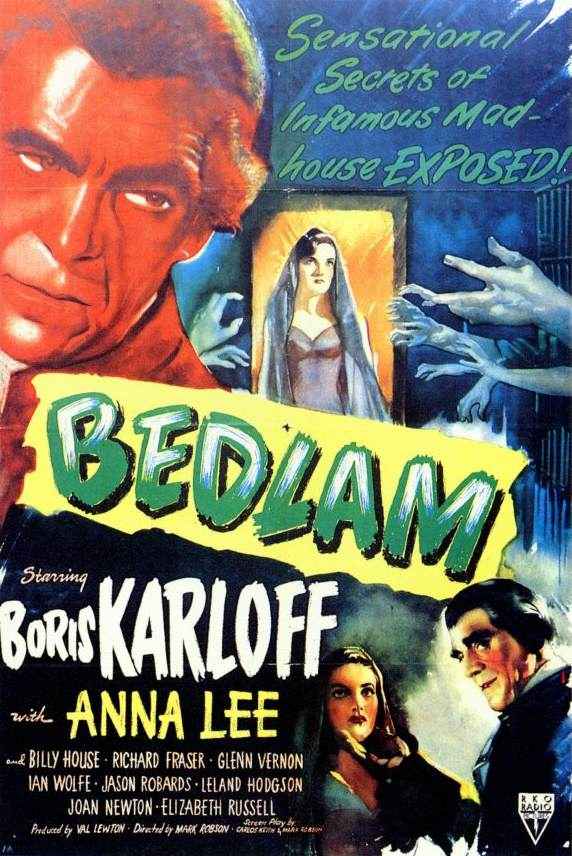
Bedlam (May 10, 1946)

Bedlam,jpg
Bedlam (1946)
Directed by Mark Robson
RKO Radio Pictures

Mark Robson’s Bedlam, produced by the legendary Val Lewton, takes place in London in 1761. It was Lewton’s ninth and final horror film.

A novelist, screenwriter, and producer, Lewton was a master of suggestion and eerie ambience. His films were the antithesis of Universal’s horror offerings, which offered iconic monsters and more overt shocks. Lewton had phenomenal success with his first horror picture for RKO, Cat People (1942, directed by Jacques Tourneur), and his reputation continued to grow with a string of classic and near-classic horror pictures; I Walked With a Zombie (1943, dir. Jacques Tourneur), The Leopard Man (1943, dir. Jacques Tourneur), The Seventh Victim (1943, dir. Mark Robson), The Ghost Ship (1943, dir. Mark Robson), The Curse of the Cat People (1944, dir. Gunther von Fritsch and Robert Wise), The Body Snatcher (1945, dir. Robert Wise), Isle of the Dead (1945, dir. Mark Robson), and Bedlam (1946, dir. Mark Robson).

The screenplay for Bedlam, which was written by Robson and Lewton (under the name “Carlos Keith”), was inspired by the William Hogarth engraving of Bethlehem Hospital (a.k.a. Bedlam); the final plate in his 1735 series “The Rake’s Progress,” which depicts in detail the journey of its hero, William Rakewell, from an inheritor of his father’s wealth and happy cad to a broken man locked up in an insane asylum.

Neither Rakewell nor anyone like him appears as a character in the film Bedlam. Rather, Lewton and Robson took the nightmarish images Hogarth created with such elaborate care in his depiction of Bedlam and shaped them into the window dressing of a film that, like The Ghost Ship and Isle of the Dead, is a meditation on the abuse of power. Hogarth’s vision was of a morally bankrupt society, from the monarchy and the church all the way down to the commoners on the street. Lewton and Robson took this idea and shaped it to their own ends. The inmates of Bedlam may be strange and threatening, but it is the men who control them who are the real monsters.

This idea is exemplified in the first scene of the picture. A lunatic is attempting to escape St. Mary’s of Bethlehem Asylum by scaling the wall. He is forced to jump to his death when a guard carrying a lantern grinds his boot down on the man’s hand.

The man who fell turns out to be an acquaintance of the grotesque Lord Mortimer (Billy House), who arrives at Bedlam that night for a spot of entertainment gawking at the loonies. “Everyone who goes to Bedlam expires from laughter,” he tells his companion, Nell Bowen (Anna Lee). When he discovers that his acquaintance has fallen to his death, however, Lord Mortimer is upset. He had paid the man for poetry to be delivered at a later date, and he feels he is now owed a night of entertainment. Enter George Sims (Boris Karloff), the apothecary general of Bedlam. Master Sims promises Lord Mortimer a play performed by his lunatics.

Sims is a combination of the worst qualities of the characters Karloff played in his previous two collaborations with Lewton; the pure malevolence of cabman John Gray in The Body Snatcher and the twisted abuser of power General Nikolas Pherides in Isle of the Dead.

Disturbed by what she sees at Bedlam, but not fully able to admit it, Lord Mortimer’s companion Nell returns to Bedlam alone and is taken on a tour by Sims. Leering, he tells her, “Ours is a human world, theirs is a bestial world, without reason, without soul. They’re animals. Some are dogs; these, I beat. Some are pigs; those, I let wallow in their own filth. Some are tigers; these, I cage. Some, like this one, are doves.” (Students of script machinations, however, will want to keep an eye on that “dove,” a woman in white who stands immobile, not speaking or blinking.) Also, it should go without saying that Sims’s ability to have anyone he wants committed to Bedlam, regardless of their sanity, will put Nell in grave danger when she breaks with Lord Mortimer and publicly ridicules him.

The rhythm of speech and the language of the script is excellent, and evokes 18th century Britain in a way few of the hackneyed period pieces of the ’40s did. Even if it’s not a perfect replication of the time, it does a pretty good job, and all of the little details are a joy to pick out, such as the words “I love sweet Betty Careless” scrawled on the wall in Bedlam, a detail inspired by the man in the Hogarth plate who has scrawled the initials of his beloved, “Charming Betty Careless” — a famous prostitute of the day — on a banister.

Viewers looking for a straight horror picture might be disappointed by Bedlam, although its scenes within the insane asylum walls deliver plenty of chills. Like many of Lewton’s later horror pictures, it’s an ambitious film that uses the trappings of horror to deliver a deeper message about a sick society.
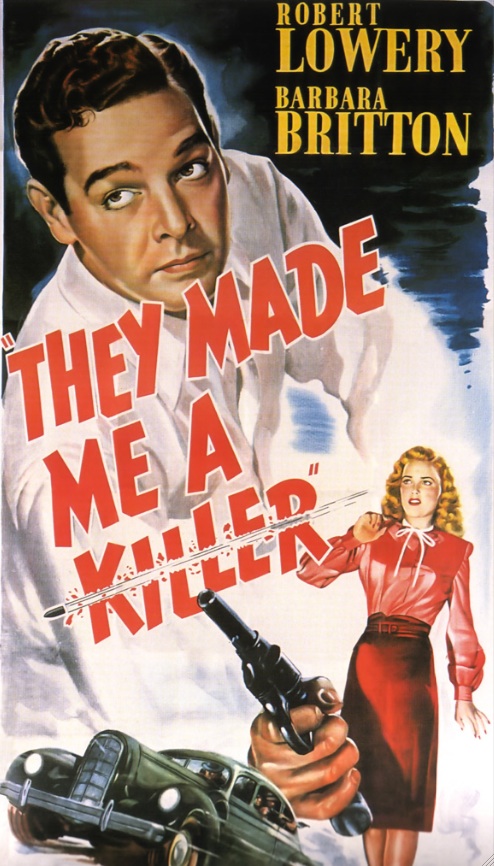
They Made Me a Killer (May 3, 1946)

Incompetent director William C. Thomas’s They Made Me a Killer is based on a screenplay by competent writer Daniel Mainwaring, who was working under the name “Geoffrey Homes.” Mainwaring was a prolific screenwriter whose most famous contribution to film noir is his script for Out of the Past (1947), which was based on his novel Build My Gallows High (both were written under his Homes pseudonym).

The script for They Made Me a Killer isn’t the problem. In the hands of a talented director and a better cast of actors, it could have been a crisp little thriller. There’s a decent amount of complexity in its familiar tale of an innocent man on the run, and the dialogue is snappy. Unfortunately it’s all handled so poorly that the protagonist’s flexible ethics end up seeming more like sloppy storytelling than anything else, and all the clever lines are delivered in too ham-handed a fashion to make much of an impact.

Produced by William H. Pine, They Made Me a Killer was released by Pine-Thomas Productions, the B unit of Paramount Pictures. It’s normal for low-budget productions to cut corners, but this picture has some of the most egregious examples of cost-cutting I’ve ever seen. Thomas employs rear projection frequently, and not just for scenes shot in cars, which is when the technique was most commonly used. There are numerous shots in They Made Me a Killer of people standing on a street corner in which everything behind them is clearly rear projected. In one scene, two actors stand in front of a rear-projected house, then one of them turns to walk toward it. The scene immediately cuts to a shot of her ringing the doorbell, standing in front of a door that doesn’t look as though it matches the house we saw in the establishing shot. There are certainly less noticeable and more artful ways to keep a picture under budget.

When They Made Me a Killer begins, Tom Durling (Robert Lowery) is leaving Chicago. His brother was killed there, and he has no desire to stay. He’s leaving his job as an auto mechanic, and heading for San Francisco. Once in California, he stops at an intersection. San Francisco is 248 miles away, and Santa Marta, “The Pearl of the Valley,” is just five miles away. He heads for Santa Marta, hoping to sell his souped-up jalopy, which he has modified to achieve speeds of up to 120 miles per hour.

He’s approached by a potential buyer named Betty Ford (Lola Lane), who tells Durling that she wants her boyfriend to buy the car for her for her birthday. Agreeing to meet her boyfriend the next day to close the deal, he ends up parked outside the Santa Marta Trust and Savings Bank the next morning with Betty exhorting him not to move, even to drive around the block to avoid a parking ticket, while Jack Conley (Edmund MacDonald) and Frank Conley (James Bush) are inside, making a very large withdrawal.

When he had initially shown her what his blocky hot rod could do, Durling had told Betty, “All I wanna do in this town is leave it.” He’ll get his wish, but he’ll get it the hard way.

He’s not the only one. Caught in the crossfire is a hapless little punk named Steve Reynolds (Byron Barr), a bank clerk at the Santa Marta Trust and Savings Bank who’s hanging around the getaway car because he has the hots for Betty.

Betty and the Conley brothers make off with $100,000, but Durling drives them into a ditch. He’s knocked unconscious, the robbers flee, and he’s left to take the rap.

He hangs his hopes for freedom on young Steve Reynolds, who lies in the hospital dying from a bullet wound. Steve’s sister June (Barbara Britton) comes to visit him in the hospital. She and Durling are immediately attracted to each other, and she reluctantly becomes his ally as they race to prove his innocence, and Steve’s.

All of this probably sounds better on paper than it plays out on screen. The acting is bargain basement and the direction is maladroit, turning what could have been an entertaining one-hour programmer into a forgettable snoozer.

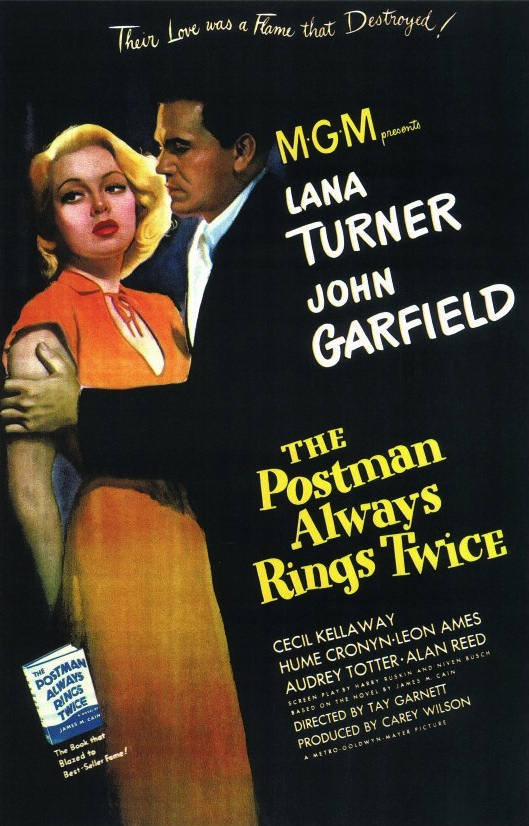
The Postman Always Rings Twice (May 2, 1946)

The Postman Always Rings Twice

The Postman Always Rings Twice (1946)
Directed by Tay Garnett
Metro-Goldwyn-Mayer

Tay Garnett’s The Postman Always Rings Twice, based on the 1934 novel by James M. Cain, opens on a lonely stretch of highway outside of Los Angeles, with a shot of a sign hanging outside a gas station that says “Man Wanted.” We’ll soon learn that the sign has a double meaning.

Itinerant drifter Frank Chambers (John Garfield) is hitchhiking from San Francisco, and has thumbed a ride with a nattily dressed man (Leon Ames) whom we’ll soon learn is the local district attorney. Nick Smith (Cecil Kellaway), the owner of the gas station/lunch counter, runs out and greets Frank, assuming he has come about the job.

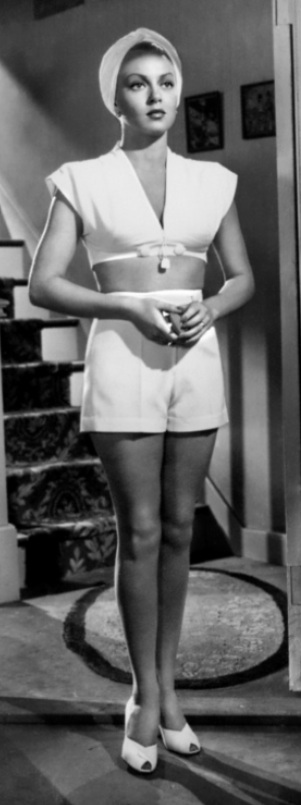
It isn’t long before Frank meets Nick’s wife, Cora, (Lana Turner), in one of the best introductions of a sexpot in ’40s cinema. As he’s eating at Nick’s lunch counter, a tube of lipstick rolls across the floor, the camera focuses on it, then pans back along the floor until it comes to rest on Turner’s legs. Cut to Garfield, his breath quickening, then to a full shot of Turner, in a skimpy white two-piece playsuit that would still turn heads today (although her turban might stand out as being a little odd).

As soon as Cora appears, we know Frank will take the job working for Nick just to be close to her. In the book, Nick is a Greek, and described in detail as a physically repulsive character. In the film, he’s just a harmless old fuddy-duddy. Things play out the same, however. Cora leaves a “Dear Nick” letter and she and Frank run off together, but life on the open road, hitchhiking with a delighted-looking Frank, who has two suitcases under his arm, doesn’t agree with Cora or her white blouse, or her white peekaboo toe pumps.

Lana Turner

So they return before Nick comes home and finds the note, and pick up again with their unhappy triangle. One murder attempt designed to look like an accident goes wrong, and after Nick announces that he is selling the business and taking Cora with him, Frank and Cora devise a simpler plan to just get Nick drunk and push him off a cliff in his car.

Technically The Postman Always Rings Twice is a film noir, but it occasionally borders on farce, especially after the murder, and is filmed in a professional and well-lighted but ultimately flat style. Too much of the film’s running time is taken up by courtroom machinations and the gamesmanship between Arthur Keats (Hume Cronyn), Frank and Cora’s lawyer, and district attorney Kyle Sackett (Ames). It’s all well-done and entertaining, but in a light and breezy way. There’s the threat of execution in the gas chamber for our two protagonists, but there’s no sense of impending doom during the courtroom proceedings, and with the focus on Ames and Cronyn, it borders on comedy. Things pick up in the noir department towards the end of the picture, but it takes too long to get there, and is undercut by a ridiculous, moralizing denouement. In some editions, Cain’s novel is barely more than 100 pages long, but this film is bloated and overlong at 113 minutes. More minutes in the film than there are pages in the original novel? There oughta be a law.

MGM wasn’t known for this kind of picture. In general, they didn’t even do crime pictures or thrillers. After the runaway success of Billy Wilder’s Double Indemnity in 1944, however, every big studio released at least one similar picture in an attempt to cash in on the craze, with all the attendant love triangles, murders, and doomed protagonists. What better choice for MGM than another novel by Cain? Especially the one most similar in its basic plot? Cain’s 1941 novel Mildred Pierce had already been done, and with a murder plot that was never in the novel, which was more of a straight kitchen sink drama. His 1937 novel Serenade was too weird. It featured a love triangle, but between a spicy Mexican prostitute, her opera-singing boyfriend who loses his voice when he’s tempted by homosexual desires, and the orchestra conductor whose magnetism threatens to draw him into a gay tryst. (Eventually Serenade was made into a film in 1956 starring tenor Mario Lanza and directed by Anthony Mann, but the gay theme was jettisoned.) And his 1942 novel Love’s Lovely Counterfeit, about a town full of gangsters and crooked politicians, seems as though it would have been a more appropriate vehicle for James Cagney or George Raft 10 or 15 years earlier.

So The Postman Always Rings Twice was a natural choice for MGM, a powerhouse of a studio that churned out high-quality product week in, week out. The film works as well as it does because of the presence of Lana Turner, who in 1946 may have been the sexiest woman in Hollywood. John Garfield turns in a credible performance, but he and Turner never quite click. So much of the film is spent setting up and knocking down plot points that their relationship seems almost like an afterthought.

A better adaptation of Cain’s novel is an unauthorized one, Luchino Visconti’s Ossessione (1943). (Cain’s publishers sued for copyright infringement, and kept the film off American movie screens until 1976.) Both the grimy working class milieu and desperate, sweaty love affair are better handled in Visconti’s film. The American version is just too sterile.

Devil Bat’s Daughter (April 15, 1946)

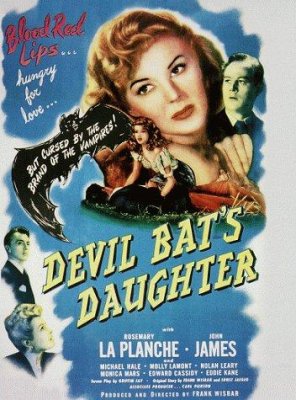
Frank Wisbar’s Devil Bat’s Daughter is a film that follows the template created by Dracula’s Daughter (1936), but doesn’t quite get it right.

Like Dracula’s Daughter, Devil Bat’s Daughter is a sequel to a Bela Lugosi horror film — in this case, The Devil Bat (1940) — that does not feature Lugosi. Instead, the protagonist is … you guessed it, his character’s daughter. But while Dracula’s Daughter was a slick, good-looking Universal horror picture that featured a haunting lead performance by Gloria Holden, Devil Bat’s Daughter is a run-of-the-mill Poverty Row mystery thriller whose connection to its predecessor feels forced.

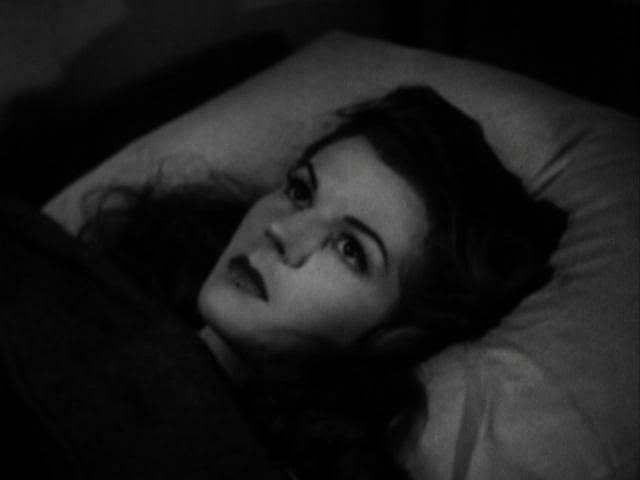
I haven’t seen The Devil Bat, but based on plot synopses, there seem to be several inconsistencies with how its treated in its sequel. Nina MacCarron (Rosemary La Planche), is the daughter of Dr. Paul Carruthers (Lugosi), of The Devil Bat, but she uses her mother’s maiden name. Returning in a stupor to her father’s home in Wardsley, New York (Heathville, Illinois, in the original), she collapses while searching the basement where he conducted his experiments (the basement was also apparently not present in the first film). She is taken in by the physician Dr. Elliot (Nolan Leary), who cares for her while she lies in a catatonic state. After she escapes from the hospital, Dr. Elliot has her transferred to the care of a psychiatrist, Dr. Clifton Morris (Michael Hale), who treats her while she lives in his home with him and his wife, Ellen Masters Morris (Molly Lamont). With Dr. Morris’s treatments, she slowly returns to normal, but she is plagued by terrifying visions (rippled footage from The Devil Bat).

Intrigue abounds. We learn early on that Dr. Morris has a mistress, Myra Arnold (Monica Mars), who is pressuring him to divorce his wife, whom he only married for her money. When Ted Masters (John James), Mrs. Morris’s son from her first marriage, returns home, he and Nina start to fall for each other, but a series of murders throws Nina’s sanity into question. The film seems confused about what type of picture it wants to be. There’s plenty of talk of vampires (Lugosi was inextricable from his most famous role), but it doesn’t come to anything, and this isn’t really a horror picture.

Devil Bat’s Daughter is modestly entertaining, but I was hoping for more. Director Wisbar was a German émigré, and his previous film, Strangler of the Swamp, was a great-looking, creepy little horror picture. Like Devil Bat’s Daughter, it also starred Rosemary La Planche, Miss America 1941. It’s too bad for genre film fans that La Planche wasn’t in more movies, especially horror movies. She could have been one of the great scream queens. She’s uniquely pretty, with thick eyebrows, big eyes, bow lips, a very straight nose, and mountains of wavy hair. Her face retains its attractiveness even when she’s screaming, and she sure can take a fall while running.

Thunder Town (April 12, 1946)

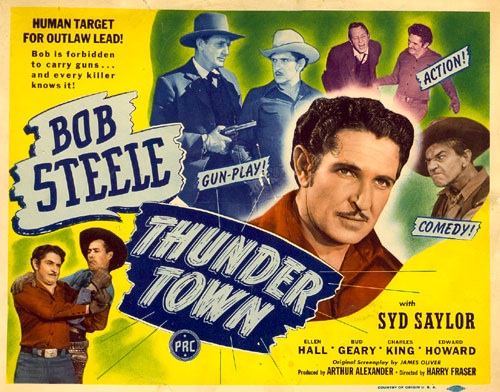
Diminutive cowboy actor Bob Steele rides again! In Harry L. Fraser’s Thunder Town, Steele plays Jim Brandon, a man recently paroled after serving time for a crime he claims he didn’t commit. Things aren’t easy for a parolee out there. As soon as Brandon gets off the stagecoach, he warmly greets the fellow loading it, but the man refuses to shake his hand. Then, while getting some drinking water, the sinister Dunc Rankin (Edward Howard) warns Brandon to stay away from him and his brother.

Brandon has a few friends on the outside, however. Matt Warner (Steve Clark), the local sheriff, recommended his parole, even though he doesn’t believe Brandon’s claim that he and his late partner Jim Donovan were framed. Brandon also claims Donovan’s suicide was really murder, and with the help of small-town ballistics expert Peter Collins (Jimmy Aubrey), he intends to prove it.

He also has a steadfast pal in Utah McGirk (Syd Saylor), who took care of Brandon’s ranch while he was behind bars. McGirk is hanging on to the ranch by his eyeteeth, and even had to take a job as a cook to make ends meet and keep paying taxes on the ranch.

The sheriff firmly reminds Brandon that, as a parolee, he won’t be allowed to carry a firearm. Brandon’s inability to carry a gun means that fisticuffs rule the day. This could have been interesting, but unfortunately he’s too obviously doubled by a stunt homunculus in some of his fight scenes. Also, he doesn’t do anything clever or flashy against his armed opponents, like throwing a knife into their hands or lassoing their guns. Mostly he just flees from them on horseback.

The main heavy in the picture is the aforementioned brother of Dunc Rankin, Bill Rankin (Charles King). Unsurprisingly for a P.R.C. western from the ’40s, the bad guy wants everyone else’s land, and will stop at nothing to get it. He even kidnaps Brandon and threatens to kill him in a bid to force a young woman named Betty Morgan (Ellen Hall) to marry Dunc so they can gain possession of the Morgan ranch. On the plus side, Hall is really easy on the eyes (too often, P.R.C. pictures featured some real dogs as the female leads), but if there was a scene that established her relationship with Brandon, I missed it. Also, the 23-year-old actress looks too young for Steele, who looks older than his 39 years. Strangest of all, the only love scene they share occurs in the last 30 seconds of the picture, and ends with a whispered proposal of marriage.

While Steele continued to appear in films and on television into the early ’70s, in parts both large and small, Thunder Town was his last leading role. He had a good run, though. He was a star of the silent era, and appeared in more than a hundred westerns.

For my money, Thunder Town is the type of western that should have died years earlier. The editing is jumpy, the framing is static, and every scene is lit like a bar after last call, when they turn all the lights on, temporarily blinding the patrons. The actors all deliver their lines in a stilted, cautious fashion, as though their pay will be docked if they flub a line. Steve Clark, who plays the sheriff, is the only supporting player who imbues his lines with any kind of human feeling, and his few scenes with Steele are the only ones that seem as if they belong in a decent movie. Overall, though, the acting is better than the last Steele P.R.C. western I saw, Ambush Trail. Blessedly, Syd Saylor acts like a normal person in this one, instead of the goggle-eyed, rubber-faced mugging machine he was in Ambush Trail. Except, that is, when he’s punched in the face. Then all bets are off. He’s still in this film to provide comic relief, after all.

There are also a few musical numbers shoehorned into the picture that aren’t bad, if you like old-school country music that occasionally involves yodeling.

Mysterious Intruder (April 11, 1946)

Mysterious Intruder
Mysterious Intruder (1946)
Directed by William Castle
Columbia Pictures

“I may not be the greatest detective in the world … but I am the most unusual.”

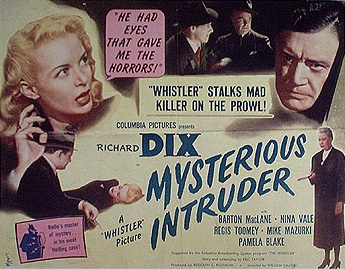
So says Don Gale, the shady private investigator played by Richard Dix in William Castle’s Mysterious Intruder, the fifth entry in Columbia’s mystery series The Whistler. Based on the CBS radio show of the same name, each film in the series featured Dix in the lead role, but unlike other B mystery series of the ’30s and ’40s, like Charlie Chan, The Falcon, Boston Blackie, Michael Shayne, and the Crime Doctor, Dix played a different character in each. The Whistler, who narrated the radio show but never participated directly in the events of the story, made similar appearances in the film series, walking in the shadows, whistling the haunting 13-note theme music by Wilbur Hatch, and occasionally offering a pithy analysis of the trouble the characters were in. The anthology format and Dix’s strange, arresting performances made The Whistler one of the more interesting series of its time.

In Mysterious Intruder, Gale is an oily operator who employs a “photographic model” named Freda Hanson (Helen Mowery) for dirty work. He also has a secretary named Joan (Nina Vale) who hates him. Clearly motivated by money, Gale walks the narrow line between self-interest and outright villainy. He’s an interesting character to watch, since his intentions remain shadowy right up to the end of the picture. This being a B-level programmer, we’re not treated to a deep character study, but Dix is a good enough performer to make Mysterious Intruder worth watching.

When the film begins, Gale is in his office, which has a spectacular view of the city and looks as if it should be home to the most expensive lawyer in town, not a small-time bedroom snooper. He’s visited by Edward Stillwell (Paul Burns), a kindly old music store owner who wishes to track down a young woman whom he hasn’t seen since she was 14, seven years ago. Her name is Elora Lund, and he has something he wants to give her. One hundred dollars is all Stillwell can afford to pay, which isn’t enough to pique Gale’s interest, but he changes his mind when Stillwell tells him that Elora Lund will pay any amount for bringing them together.

Three days pass, and Stillwell receives a visitor in his shop. She’s a tall, attractive blonde, and she convinces Stillwell that she is Elora Lund. (She’s actually Freda Hanson, Gale’s blackmail tool.) Stillwell tells “Elora” that among the countless odds and ends that her late mother brought in for him to sell was one item that will bring a fortune if sold. Unbeknownst to Freda, however, she was tailed to the store by a hulking thug named Pontos, played by dependable character actor Mike Mazurki. (Mazurki is always a welcome sight, but he doesn’t have a lot to do in this picture. It’s not too different from the role he played in Dick Tracy; a vicious killer with few to no lines.) Pontos murders Stillwell, and Freda screams and flees the scene.

Meanwhile, we learn that the real Elora Lund (Pamela Blake) is in a sanitarium, recovering from the effects of an auto accident. She’s appears to be uninjured physically, and why she wasn’t recuperating at home is never explained. Ah, the good old days of “rest cures.”

Before he became the premier schlockmeister of the ’50s and the most famous “gimmick” director in Hollywood, William Castle was a dependable director of one-hour programmers, including several Whistler and Crime Doctor pictures. Mysterious Intruder is a tight, entertaining ride that features plenty of twists and turns, as well as one of my favorite plot conceits, the private dick who constantly contaminates crime scenes and tampers with evidence for his own purposes, all while staying one step ahead of the police.

Dragonwyck (April 10, 1946)

Director Joseph L. Mankiewicz’s Dragonwyck was adapted from Anya Seton’s best-selling 1944 historical novel of the same name. I haven’t read Seton’s novel, but I loved this film, and would like to dig into the book some day. Based on the description on the back cover, the introduction, and the first several pages that I leafed through, the film is a relatively faithful adaptation, as far as these things go. Neither Edgar Allan Poe nor Herman Melville make an appearance in the film, however, and the Astor Place massacre and steamboat racing both, sadly, fell outside the scope of the film.

But that’s par for the course in any 100-minute long adaptation of a 350-page novel. Taken purely as a cinematic experience, Dragonwyck is an engrossing Gothic melodrama that treads lightly the tricky boundary between romance and horror. As a Vincent Price fan, I especially loved his performance in this film. In my review of Shock, which was released earlier the same year, I mentioned that it was the first role I’d seen Vincent Price play in which there was a glimmering of the horror icon he would become. Well, he continued to blossom in this role. While never descending into outright horror territory, Dragonwyck gave Price an opportunity to exhibit more range than any role I’d seen him play previously, and the way his character changes drives the film; from coldly aristocratic to warmly romantic, and from a wielder of petty power to a broken drug addict.

The film begins in 1844. Miranda Wells (Gene Tierney) is a bright, beautiful young woman who longs to see the world. She lives on a small New England farm with her younger siblings, her mother Abigail (Anne Revere), and her deeply religious and strait-laced father Ephraim (Walter Huston). The Wellses receive a letter from their distant cousin, Nicholas Van Ryn (Price), who wishes to take Miranda away from her simple surroundings and employ her as a governess and companion to his young daughter at his home, Dragonwyck Manor, on the Hudson River. After much deliberation, Ephraim assents, even though Van Ryn’s wealth and atheism distress him. Like everything else in the film, Huston’s portrayal is fully realized. The character could have been portrayed as a two-dimensional Bible-thumper, but Huston crafts a believable and sympathetic character.

Once Miranda arrives at Dragonwyck, the obvious touchstone is Jane Eyre, but instead of a madwoman locked in the attic, there is merely Van Ryn’s fussy, compulsively overeating wife Johanna (Vivienne Osborne). Theirs is clearly a loveless marriage, and as soon as we learn that Van Ryn is not really Miranda’s cousin by blood, we can read the handwriting on the wall.

The story takes a lot of interesting turns, however, and I wasn’t ever quite sure what was going to happen next. While Van Ryn is portrayed sympathetically, he is also deeply flawed. A “patroon,” he forces his tenant farmers to pay tribute to him while he sits on a throne. It’s an anachronistic display of power, even for the mid-nineteenth century, and shows early in the film that all may not be well in Dragonwyck.

Dragonwyck also has an excellent sense of place. As Seton said in her introduction to the novel, “There was, on the Hudson, a way of life such as this, and there was a house not unlike Dragonwyck. All Gothic magnificence and eerie manifestations were not at that time inevitably confined to English castles or Southern plantations!”

The Dark Corner (April 9, 1946)

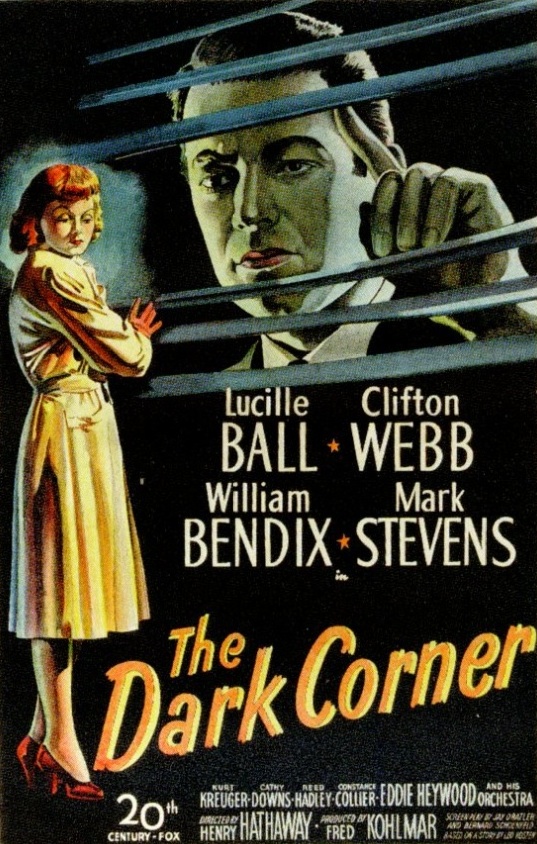
If someone were to say to me, “What exactly is a film noir? I don’t think I’ve ever seen one,” I might direct them to Henry Hathaway’s The Dark Corner. Not because it’s the greatest noir I’ve ever seen, but because it contains so many “noir” elements; a tough-talking P.I. and his sexy secretary, blackmail, frame-ups, violence, creative use of shadows and low-angle shots, and a plethora of quotable tough-guy dialogue like “I can be framed easier than Whistler’s mother.” It’s also not a picture that’s attained the status of a true “classic” like Double Indemnity (1944) or The Big Sleep (1946), so no one’s going to be distracted by great acting, iconic characterizations, or a brilliant storyline. This is pulp. Pure and unvarnished.

I love pulpy noir, so I really enjoyed The Dark Corner. On the other hand, I first saw this movie less than a decade ago, and only remembered one scene, in which one character pushes another out of a skyscraper window and then calmly walks to his dentist appointment. I have pretty good recall, especially when it comes to films, but I didn’t remember anything about this movie, not even after watching it again. Nothing came back. And I have a feeling that I won’t remember much about it 10 years from now, either.

But that doesn’t change the fact that I enjoyed the heck out of it while I was watching it. Mark Stevens isn’t an actor who ever made a big impression on me, but he’s a passable lead. As private investigator Bradford Galt, he delivers his lines with the speed and regularity of a gal in the steno pool pounding the keys of a Smith Corona typewriter. Galt is the kind of guy who makes himself a cocktail by grabbing two bottles with one hand and pouring them into a highball glass together. He’s also the kind of guy who probably wouldn’t do well in today’s litigious corporate environment. When he tells his newly hired secretary Kathleen Stewart (Lucille Ball) that he’s taking her out on a date, she asks, “Is this part of the job?” He responds, “It is tonight.”

It turns out that he’s (mostly) telling the truth, and the reason he’s taking her out on the town is to draw out a tail he’s spotted; a big mug in a hard-to-miss white suit played by William Bendix. Their date was one of my favorite sequences in the movie. There’s a lot of great location footage of New York in The Dark Corner, but the scenes in the Tudor Penny Arcade take the cake. I don’t know if any of the scenes in the arcade were shot in back lots, but the batting cages, the Skeebowl, and the coin-operated Mutoscopes with titles like “Tahitian Nights” and “The Virgin of Bagdad” all looked pretty authentic.

Once Galt gets his hands on the guy tailing him and roughs him up for information, the plot kicks into gear. Bendix’s character, “Fred Foss,” is a heavy who claims to have been hired by a man named Jardine. Galt starts to panic as soon as he hears the name. Jardine was Galt’s partner when he was a P.I. in San Francisco. Jardine had Galt framed, which led to Galt doing two years in the pokey. Jardine (played by the blond, German-accented Kurt Kreuger) is now in New York, but still up to his old tricks, seducing married women and running blackmail schemes. The current object of his affection, Mari Cathcart (Cathy Downs), is married to the effete art dealer Hardy Cathcart, who is played by Clifton Webb. In The Dark Corner, Webb essentially reprises his role from Otto Preminger’s Laura (1944); another film noir in which a painting of a beautiful brunette played a major role.

I won’t summarize the Byzantine plot any further, but it should go without saying that all the pieces tie together. As I said, The Dark Corner isn’t the greatest noir I’ve ever seen, but it’s pretty enjoyable to watch, and it looks fantastic. The dialogue is especially cracking, and consistently verges on the ridiculous. For instance, when Cathcart tells Foss (who is on the phone with Galt) to tell Galt that he wants $200 to leave town, Foss repeats the information to Galt by saying, “I need two yards. Powder money.”

Ziegfeld Follies (April 8, 1946)

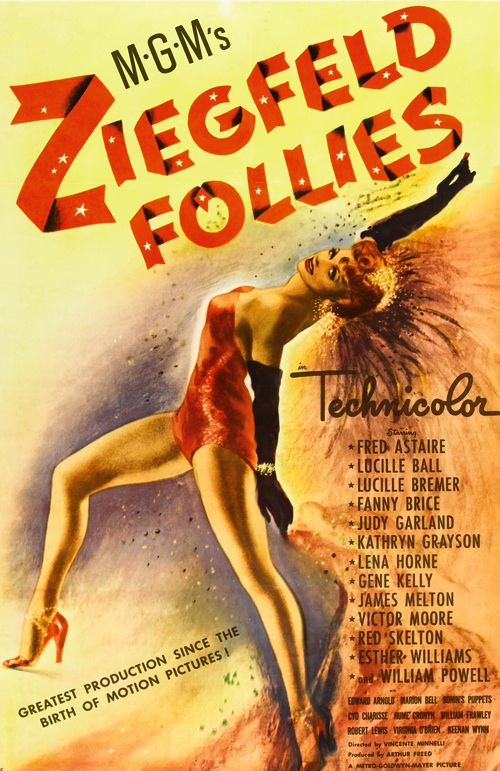
Ziegfeld Follies premiered in Boston on August 13, 1945. It was first shown in New York on March 22, 1946, and went into wide release on Monday, April 8, 1946. On some theatrical release posters, the film’s title was Ziegfeld Follies of 1946. The film is a lavish, old-fashioned musical pieced together from a big bag of spare parts. It was a pet project of producer Arthur Freed, and was originally intended to mark Metro-Goldwyn-Mayer’s 20th anniversary in 1944, but it went through so many edits and revisions that it missed the mark by more than a year.

Despite the studio’s boast on the theatrical release poster that Ziegfeld Follies is the “greatest production since the birth of motion pictures,” I really didn’t enjoy it that much. The musical numbers are hit and miss, and the comedy bits all hit the ground like lead zeppelins. There are a lot of impressive set pieces, and the colors are really bright, but as far as plotless extravaganzas go, it just doesn’t have the latter-day stoner appeal of Fantasia (1940).

The film begins with little models of Shakespeare’s Globe Theatre, then P.T. Barnum’s big top, then Florenz Ziegfeld, Jr.’s theater. That’s it, folks. The only three shows in the history of the world that matter. Clearly humility is not on the program for the evening.

William Powell, who played “Flo” Ziegfeld in The Great Ziegfeld (1936), reprises his role for the first segment of the picture. He’s on a set that looks like the kind of pad Liberace and Louis XVI might have picked out for themselves if they were roommates, talking a lot of nonsense about magic and the theater (it took me a little while to catch on to the fact that he’s supposed to be in heaven). We’re then treated to an elaborate stop-motion recreation of Ziegfeld’s 1907 opening by the Bunin puppets. All of his great stars are recreated as puppets; Marilyn Miller, Fanny Brice, Will Rogers, and even Eddie Cantor in blackface.

Each segment that follows is introduced by a storybook page. Fred Astaire appears in the first, “Here’s to the Girls.” He acknowledges that “Ziggy,” as he calls him, never had much use for villains or plots, then sings an ode to the American girls who were Ziegfeld’s main attractions. Cyd Charisse dances a little solo and then Lucille Ball cracks a whip over eight chorus girls dressed as panthers. Finally, Virginia O’Brien hollers for some fellers, and then sings, “Bring on Those Wonderful Men.” It’s a punishing spectacle that sets the tone for what is to come.

In the next segment, Esther Williams appears in … surprise, surprise … a water ballet. It’s fine, and she spends a lot of time underwater, which is neat, but what is the sequence even doing in this picture?

Next, Keenan Wynn appears in the comedy short “Number, Please.” I found it completely unfunny, but maybe that’s because I can’t stand “frustrating” humor. Basically, all he wants to do is make a phone call, but he’s thwarted at every turn, until his face is red and steam is coming out of his ears. For me it dragged the movie to a halt like a sweaty punchline comic working the in-betweens at a burlesque strip show.

Next, James Melton and Marion Bell sing “La Traviata.” Yawn.

Ooh, goody, more comedy! Victor Moore and Edward Arnold appear in “Pay the Two Dollars,” in which a man spits on the subway and is trapped in a legal nightmare because his attorney won’t let him just pay the $2 fine. Again, what’s up with the horribly frustrating situational humor? Not only did this segment not make me laugh, it made me feel as if I was watching a stage adaptation of a Kafka story.

Next, Fred Astaire and Lucille Bremer appear in a “dance story” called “This Heart of Mine,” with music by Harry Warren and words by Arthur Freed. It’s pretty good. It took me back to the days when lighting a girl’s cigarette and then dancing while smoking was still classy. On the other hand, no one glides across a ballroom like old Fred, so the rotating circular centerpiece seemed wholly unnecessary. Who did the director think he was dealing with, Clark Gable?

The next comedy segment is called “A Sweepstakes Ticket,” and for some reason it’s filmed on a regular set, not the impressionistic “stage” sets used in all the previous comedy bits. Hume Cronyn gives away a winning Irish sweepstakes ticket to make up the few bucks he was short on the rent, and he and his wife Fanny Brice try to get it back from their landlord. Again, it’s not at all funny, just frustrating.

The next segment, “Love,” with Lena Horne (R.I.P.), was a nice opportunity to see black people in Technicolor, and in a steamy tropical setting no less. It should have been longer.

Next, Red Skelton shows us all what will happen “When Television Comes.” He does a promo for “Guzzler’s Gin.” He drinks a whole bunch each take and acts more and more stinko. If you’re amused by cross-eyed drunkenness and double-takes, this will still do the trick. Although it’s possible audiences in 1946 were amused by this segment, I can’t imagine they were left with a very clear idea of what the advent of television would mean for the country.

Up next is “Limehouse Blues,” in which Fred Astaire and Lucille Bremer return, only this time in yellowface. The Chinatown tropes are offensive, but the colors and imagery are quite beautiful and impressive, in a non-P.C. sort of way. Once we get to the actual dance number, however, the piece is hamstrung by its own ridiculous conceit. It doesn’t help that in all the medium shots, Astaire’s makeup makes him look a lot like Boris Karloff in The Mask of Fu Manchu (1932).

In “A Great Lady Has an Interview,” Judy Garland seems to be lampooning Katharine Hepburn or possibly Greer Garson. I got the feeling that there were a lot of industry in-jokes that I wasn’t getting. For me, Garland is always a treat, however, so I didn’t mind it that much.

And then, like a terrible party that suddenly becomes fun 20 minutes before the police arrive to break it up, Fred Astaire and Gene Kelly appear in “The Babbitt and the Bromide,” by George and Ira Gershwin. Their dialogue is funnier than any of the “comedy” bits in the movie, and their side-by-side dance number is transcendent. Ziegfeld Follies is worth seeing for this sequence alone.

Finally, Kathryn Grayson sings “Beauty,” by Warren and Freed. It’s standard stuff, but there are enormous piles of bubbles that I thought were pretty cool.

In other news, the last living Ziegfeld Follies “girl,” Doris Eaton Travis, died yesterday at the age of 106. I hope it doesn’t seem as if I’m beating up on the Follies themselves. I’d love to go back in time and see a Ziegfeld revue on Broadway. This film just doesn’t really capture the magic.

The Gay Cavalier (March 30, 1946)

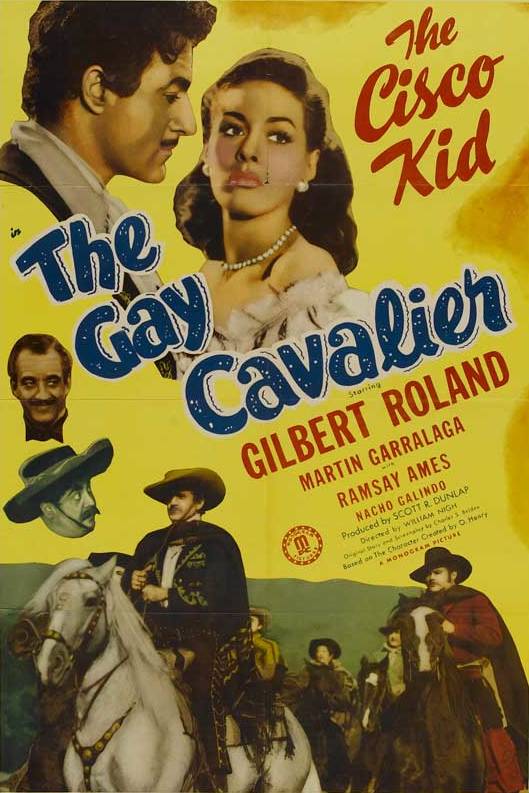
With this film, handsome 40-year-old actor Gilbert Roland stepped into the role of the Cisco Kid, a Mexican bandit created by O. Henry in his 1907 short story “The Caballero’s Way.” Roland was the fifth man to play the role, after Warner Baxter (in four films, 1928-1939), Cesar Romero (in five films, 1939-1941), Duncan Renaldo (in three films made in 1945), and William R. Dunn, who was the first man to play the Cisco Kid, in the silent short The Caballero’s Way (1914). Roland would go on to play the Cisco Kid in a total of six films released by Monogram Pictures in 1946 and 1947.

In O. Henry’s short story, the Cisco Kid was a vicious and slippery bandit, but by the time Warner Baxter was playing the role, the character had metamorphosed into a noble caballero; a sort of Mexican Robin Hood.

Baby boomers will remember that on TV, the Cisco Kid had a sidekick named Pancho. The first iteration of this character appeared in the 1939 film Return of the Cisco Kid, and he was named “Gordito” (Spanish for “Fatty”). In The Gay Cavalier he’s called “Baby,” and is played by the Mexican actor Nacho Galindo.

Baby gets the first lines of the picture. While Cisco kneels beside a grave, Baby explains to one of his fellow outlaws (presumably one who has just joined the gang and, like the audience, has no idea what’s going on) that Cisco’s father was a notorious bandit. To make up for his father’s exploits, Cisco now robs from the rich and gives to the poor. It’s a clumsy bit of exposition, but no clumsier than most of the rest of the dialogue in the picture. When Baby decides that they’ve spent enough time at the gravesite and he wants to get going, Cisco tells him, “Time is a wonderful thing. It ages wine and mellows women.” Roland is the main reason to see the picture, especially for women who get all hot and bothered for the Latin Lover type. He can really sell lines like this, and not sound too ridiculous.

What Roland is mostly selling, of course, is S-E-X. But not so much that it might offend audiences, or disrupt traditional morality too much. In one scene, Cisco climbs up onto a lovely young señora’s balcony while Baby plays a little music down below. Eventually she reveals that she has a husband who is away on a fishing trip. Cisco responds, “Sometime, when I see your husband, I will tell him the fishing is much better here on land. Adios, beautiful.” He kisses her hand, leaps from the balcony onto his horse, and rides off with his crew and Baby, whose serenade is no longer required.

The Gay Cavalier takes place in California in 1850. The nice thing about old Hollywood westerns that take place in California is that the scenery is authentic, if nothing else. Martin Garralaga, the actor who played “Pancho” in the three 1945 Cisco Kid films with Duncan Renaldo, here plays Don Felipe Geralda, a man who has fallen on hard times. His youngest daughter, Angela (Helen Gerald), is engaged to marry a wealthy American named Lawton (Tristram Coffin), whose money will allow the Geralda hacienda to stay in the family.

Unbeknownst to the Geraldas, Lawton and his partner Lewis (John Merton) are up to no good. In the beginning of the picture, they ambush a wagon carrying a shipment of silver collected from poor people to build a mission in Monterey. They leave one man wounded but alive, and say loudly within earshot of the man, “All right, Cisco, we got what we want. Now we go.”

All of this plays out about as predictably as you’d expect. The enjoyment comes from the particulars. The sultry and beautiful actress Ramsay Ames plays Don Geralda’s eldest daughter, Pepita, and she sings a few numbers that Ames herself is credited with writing. Also, the action is well staged, especially the final showdown between Cisco and Lawton. As he demonstrated in a film I watched last year, Captain Kidd (1945), Roland is a hell of a sword fighter. He and Coffin go at it with no stunt doubles in evidence, although the film is sped up very slightly.

Also, unlike most of the actors who played the Cisco Kidd, Roland was actually Mexican. He was born “Luis Antonio Dámaso de Alonso” in Juarez, Chihuahua, Mexico, in 1905. He took his stage name from his two favorite actors, John Gilbert and Ruth Roland. He’s a very credible swashbuckler, and a lot of fun to watch, even though The Gay Cavalier is strictly a programmer.

One odd note, the DVD from VCI Entertainment I watched uses a print with a strange ADR issue. It didn’t take long before I noticed that every time someone said “Cisco Kid” it was looped in, and not well. I did some research, but couldn’t find exactly why this was the case. This was originally released as a Cisco Kid feature, and there would have been no restriction on using the name, so the prevailing theory seems to be that the film was dubbed for television release in the ’50s, and the character’s name was changed so as not to cause confusion with the Cisco Kid TV show, and one of those prints was the only one they could find, so they dubbed the original character’s name back in. Whatever the reason, it was weird and distracting.