Category Archives: 1946

Prairie Badmen (July 17, 1946)

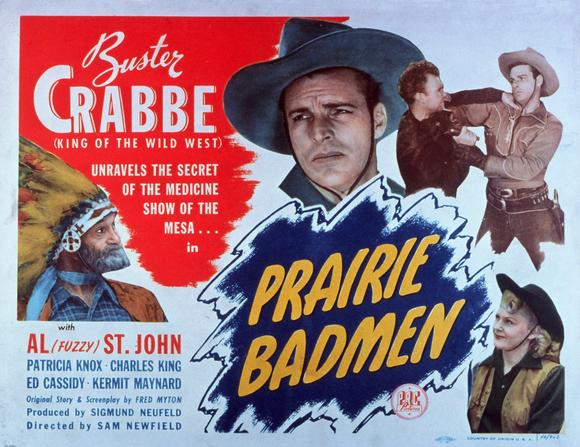
Is wildly prolific Poverty Row director Sam Newfield’s Prairie Badmen really that much better than the last two westerns of his I’ve seen? Or is he just wearing me down?

Probably a little of both. Prairie Badmen has all the hallmarks of a shoddy P.R.C. western — incompetent use of library music by musical director Lee Zahler, insouciant use of obvious stunt doubles, and static, unimaginative camerawork — but it moves at a nice clip, has a decent story, doesn’t overstay its welcome, and features plenty of goofy physical humor courtesy of Al “Fuzzy” St. John.

As the film opens, we see Fuzzy, wearing a feathered trailer warbonnet that flows down his back and reaches the ground. He’s standing on the back of a wagon, hawking patent medicine called “Kickapoo Elixir” (subtitled “A Blessing to Mankind”) to a bunch of cowpokes and yokels. Inside the wagon lies Doc Lattimer (Ed Cassidy), who is convalescing. Lattimer tells his daughter, Linda (Patricia Knox), “Fuzzy seems to be all right on the crescendo, but he doesn’t seem to have the proper persuasive note in his confidential appeal.”

Before you can say “Jack Robinson,” a trio of no-good characters, Cal (Charles King), Lon (Kermit Maynard), and Steve (John L. Cason), surreptitiously hitch their horses to the front of the wagon and take off with it, with Lattimer and his daughter inside. Fuzzy falls off, but he quickly gets to his feet and chases after them, his headdress flying behind him, nearly parallel to the ground. (It’s clearly held aloft by an off-screen wire, since its angle is different in each shot.)

Pretty soon, Billy Carson (Buster Crabbe) rides in and saves the motley crew of good-natured scam artists from the troublemakers. They claim they were just having some fun. Prairie badmen? More like prairie frat boys.

Or so it seems. Eventually we’ll learn that those badmen are after a map that a wounded and dying outlaw named Bill Thompson (Frank Ellis) may have left with Doc Lattimer five years earlier. The map supposedly shows the location of four bars of gold stolen from an express office.

The thickening of the plot, such as it is, comes from Doc Lattimer’s son, Don (John L. Buster), who’s sick of traveling with his father and sister, making chicken feed while standing on the back of the medicine wagon and singing songs like “Prairie Pete.” Billy offers him some avuncular advice, “You don’t prove you’re a man by carrying a chip around on your shoulder.” But Don doesn’t take it to heart, and soon falls in with the black hats, attempting to finagle a half share of the loot in exchange for revealing the location of the treasure.

The plot is nothing outstanding, but it’s engaging enough, and frequently punctuated by Fuzzy’s corn-pone antics, so it never gets boring. When Billy tells Fuzzy he should know what he’s selling for a dollar a bottle, Fuzzy accidentally grabs turpentine instead of patent medicine. He pours it on his head, down his back, and then drinks it. He proceeds to make facial expressions that would make Red Skelton ashamed, spits it out, yowls, and leaps up and down like a jumping jack.

Some of the comic relief goes on too long, such as the scene in which Fuzzy attempts to string up a hammock and then get into it, but it’s mostly entertaining. He wears his Indian warbonnet for most of the picture, and it’s practically another character in the movie, snaking and flying around, constantly manipulated by that off-screen wire.
The Bamboo Blonde (July 15, 1946)

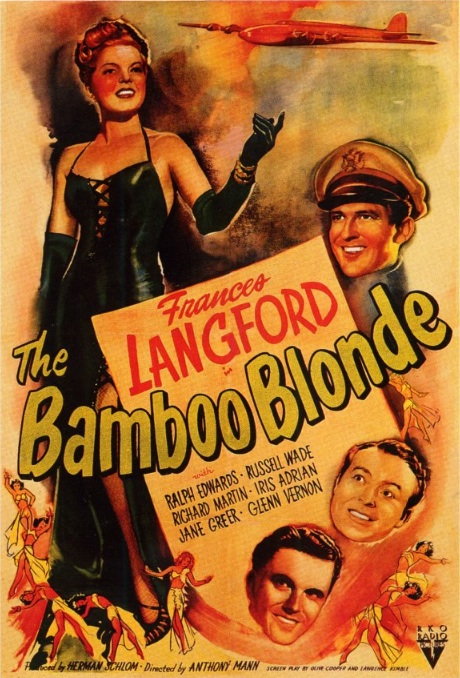
Anthony Mann’s The Bamboo Blonde is a cute little World War II-era programmer based on Wayne Whittaker’s story “Chicago Lulu.” It’s a romantic comedy, but there are nearly enough songs to qualify it as a musical. There are also nearly enough bombing raids over Japan to qualify it as a war movie, but the tone is so light that all the death and destruction on the ground is just there to provide a context for the saucy pinup girl painted on the nose of the bomber. It’s a fun romp — hell and gone from the westerns and noirs on which Mann’s reputation currently rests, but a thoroughly enjoyable way to kill 67 minutes during the dog days of summer.

The film begins with a magazine reporter named Montgomery (Walter Reed) interviewing Eddie Clark (“Truth or Consequences” host/creator Ralph Edwards), the mile-a-minute talker who runs Bamboo Blonde enterprises, an enormous conglomerate that operates a recording studio, furniture manufacturer, hosiery company, cosmetics line, and more. The reporter wants to know how the company got started, and when Eddie finally tires of trying to push Bamboo Blonde brand candy bars on the poor guy, he settles in to tell the story. It all started, Eddie explains, “Around the time Japan was finding out the B-29 wasn’t another American vitamin.”

The picture then begins in earnest, and we see the Ransoms, a wealthy family from Bucks County, Pennsylvania, tearfully send their son, Patrick Ransom, Jr. (Russell Wade), off to war. I say “tearfully,” but I can’t remember if there were any actual tears. The send-off was so wrought with emotion, however, that the presence of waterworks is beside the point. The Ransoms are the type of blue bloods who think nothing of Junior kissing mom on the mouth to say goodbye.

After cutting — or at least loosening — the umbilical cord, young Ransom wanders into Eddie’s Club 50, heedless of the sign outside barring all servicemen from entering. A couple of MPs walk out of the back office, and a perky little blonde named Louise Anderson (Frances Langford) acts quickly, hiding Ransom behind some curtains and then walking onstage to perform the song “I’m Good for Nothing But Love.”

Ransom is the new skipper of a bomber crew, and as the new guy, his boys had sent him to the club as a practical joke, or, as Ransom explains it to Louise over dinner, “Sending me here was a tactical maneuver to ditch me.” The two hit it off right away, and go on the kind of date that was really “on the beam” for the greatest generation, and is still pretty fun today. It starts with dinner at a restaurant with red and white checked tableclothes and candles stuck in bottles that’s run by a woman named “Mom” (Dorothy Vaughan) and it ends in a photo booth. The only thing that seems weird by today’s standards is that Louise sits in the photo booth alone, and Ransom ends up with a little framed photo of her.

That little framed photo will lead to big things. After a disastrous series of runs in the Pacific, Ransom’s B-29 has the worst record in the Air Force, without a single Zero downed. To turn their luck around, one of the guys borrows Ransom’s photo of Louise and paints an Alberto Vargas-style pinup of her with a stacked body “painted from memory.” After a long argument about what exact color hair their sexy new mascot has, they settle on “bamboo blonde,” and they’re well on their way to becoming “that nightmare to the Nips,” as Eddie Clark will later describe them.

The only problem is that Ransom’s crew thinks that Louise is his girlfriend, and he hasn’t disabused them of the notion, even though he has a dark-haired fiancée back home named Eileen Sawyer (Jane Greer, who shows a little bit more of that Out of the Past malevolence than she did in Sunset Pass, which was released a week before this picture). Eileen is a real harpy, and her interest in Ransom is only rekindled because of his growing fame. Meanwhile, Louise first learns that she’s been painted on the side of a bomber while reading a copy of Look magazine that has a picture of Ingrid Bergman on the cover wearing a nun’s habit (presumably from the 1945 film The Bells of St. Mary’s). You don’t have to be a genius to foresee the romantic complications that will arise once Ransom and his boys are called back home for a USO tour with Louise to help sell war bonds.

This is all frothy nonsense, of course, but Mann keeps things moving at a nice clip. Even when working with material that was clearly beneath him, such as this picture and Strange Impersonation (1946), he was able to craft something that was darned watchable. Langford was a classically trained singer, and has a really beautiful voice, which helps. (She was a radio star, and spent a lot of time as a USO performer.) For the most part, the musical numbers are staged in a straightforward fashion, but Mann takes a left turn into the realms of the surreal when Louise sings “Right Along About Evening.” Not only is everything in the idyllic farmland backdrop labeled (e.g., “mailbox,” “dog”), but it end with her rolling up a suddenly two-dimensional Ransom and stuffing him under her pillow before she goes to sleep. Truly odd.

Sunset Pass (July 8, 1946)

Judging by the only Zane Grey novel I’ve read, Riders of the Purple Sage, which was published in 1912, Grey was the most influential and important writer to ever mythologize the American west.

He was also a hack, and his florid prose made me wish for the more psychologically realistic and straightforward portrayals of the west I grew up reading in westerns by Louis L’Amour. Part of this is due to the era in which he was writing. By the ’40s and ’50s, passages like the following would have seemed ridiculous:

Her head was bowing to the inevitable. She was grasping the truth, when suddenly there came, in inward constriction, a hardening of gentle forces within her breast. Like a steel bar it was stiffening all that had been soft and weak in her. She felt a birth in her of something new and unintelligible.

The word “overwrought” doesn’t begin to describe the world Grey creates. His hero, Lassiter, wears an outfit that would make Richard Boone as Paladin in the TV series Have Gun — Will Travel (1957-1963) look positively conservative. Not only is Lassiter dressed all in black leather, but his black sombrero boasts a band of silver dollars, and his long-barreled revolvers are sexualized to a ridiculous degree. And, of course, the action is fast, furious, implausible, and frequently accentuated by exclamation marks. I’d be tempted to call the novel Riders of the Purple Prose if it didn’t contain such raw power in its descriptions of landscapes.

Low swells of prairie-like ground sloped up to the west. Dark, lonely cedar-trees, few and far between, stood out strikingly, and at long distances ruins of red rocks. Farther on, up the gradual slope, rose a broken wall, a huge monument, looming dark purple and stretching its solitary, mystic way, a wavering line that faded in the north. Here to the westward was the light and color and beauty. Northward the slope descended to a dim line of canyons from which rose an up-Hinging of the earth, not mountainous, but a vast heave of purple uplands, with ribbed and fan-shaped walls, castle-crowned cliffs, and gray escarpments. Over it all crept the lengthening, waning afternoon shadows.

Grey had the soul of a Romantic. In his world, emotion trumps reason and the physical world mirrors the longings and passions of the people who exist in it. For better or for worse, it is this vision of the old west that captured the imagination of the reading public in the early 20th century, and informs the western genre to this very day.

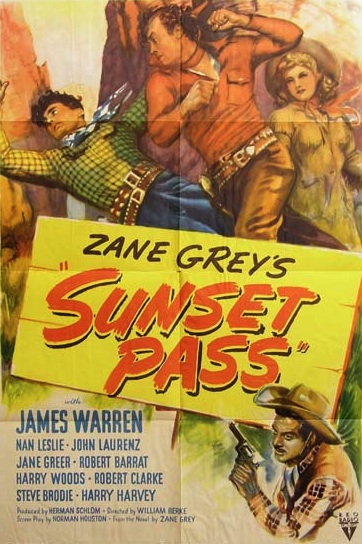
I don’t really know why I’m going on and on about Riders of the Purple Sage, except that William Berke’s film Sunset Pass, which I’m reviewing today, is based on the 1931 novel of the same name by Zane Grey, and watching it made me think back to the only novel by Grey that I’ve read. (There’s an earlier filmed version of Sunset Pass that was directed by Henry Hathaway and starred Randolph Scott. It was released in 1933. I haven’t seen it.)

Sunset Pass, which was released by RKO Radio Pictures, hasn’t gone down in history as one of the great westerns, and it certainly can’t hold a candle to John Ford’s early westerns, but it’s a sight better than the stuff P.R.C. and Monogram were churning out week after week in the ’40s. The print I watched was clean and crisp. The black and white cinematography looked great. Neither Berke’s direction nor Norman Houston’s screenplay, however, capture Grey’s febrile world or antiquated dialogue. This is a by-the-numbers oater with plenty of shootouts, fistfights, chases on horseback, romance, and a few songs.

The film begins with an exciting but nonsensical scene. A cowboy named Rocky (James Warren) and his Mexican sidekick Chito (John Laurenz) tie up their horses in a stand of trees and watch a passenger train chugging toward them. They leave their horses and run alongside the train, which appears to be moving at top speed, and hop aboard. They take their seats, flirt with the ladies, and are in place to attempt to foil a train robbery. I say “attempt,” because a young woman named Jane Preston (Nan Leslie) knocks Rocky’s rifle barrel to the side when he attempts to shoot one of the robbers, allowing him to make his getaway. The men are all masked, but it’s clear that she recognizes him, and intervenes to save his life.

It turns out that Rocky and Chito are undercover agents employed by the railroad to stop robberies. If this is the case, what was the purpose of them not only leaving their horses in a remote area but also boarding the train in the middle of its journey? If anyone can explain it to me, please do. Were they hungover and missed the train? That’s the only explanation I can think of.

With the money stolen, Rocky and Chito are in hot water with the railroad company. Rocky rides off to track down the stolen loot while Chito grabs his guitar and makes love to showgirl Helen “Lolita” Baxter (played by Jane Greer, who exhibits none of the malevolence she would exude a little more than a year later in her most famous role as the femme fatale who ensnares Robert Mitchum in Out of the Past).

Eventually Rocky catches up with the robbers, but he’s shot and badly wounded. Luckily, he’s spirited away by a young man named Ash (Robert Clarke), who turns out to be Jane’s brother.

Clarke gives the best performance of the film as Ash Preston, and when his character faces ethical dilemmas, the movie really comes alive.

James Warren is a decent hero, but his performance is more one-note than Clarke’s. Tall, lean, and blond, with a perpetual scowl, Warren is sort of a Sterling Hayden Lite.

The villain of Sunset Pass, Cinnabar (Harry Woods), is good, too, but his name sounds like a candy bar or a coffee bar chain, and the other characters in the film refer to him a lot by name, which I found unintentionally funny.

Sunset Pass is standard western fare, but it was an enjoyable enough way to while away an hour and 5 minutes.

I See a Dark Stranger (July 4, 1946)

Frank Launder’s I See a Dark Stranger, which premiered in the United Kingdom on July 4, 1946, is half a loaf of noir slathered with generous helpings of romance and comedy. It’s a very enjoyable picture that’s notable as a star vehicle for the lovely Deborah Kerr before she was well-known in Hollywood.

The opening of the film is pure noir. Shadows fall heavily on the quiet nighttime streets of a little town with signs all about in French. A panicked man rushes through the town, searching for something. Suddenly there’s a shot of something that doesn’t quite fit, and the narrator’s voice appears on the soundtrack. “An Isle of Man signpost outside a French town,” he says. “That’s odd. But we’ve started this tale at the wrong moment.”

He goes on to tell us that this is really the story of Bridie Quilty (Kerr), and we see the young woman in the pub where she works as she eavesdrops on her father’s boozy tales of the Irish Revolution, rapt, even mouthing the words of his story at one point. Bridie hates the English and the memory of Oliver Cromwell as much as the most hardened member of the I.R.A. does, and wants nothing more than to join the group when she reaches the age of majority, just like her father did. The film treats her fervor lightly, however, and right off the bat the viewer knows that this coming-of-age story will contain a fair measure of disillusionment for its protagonist. But not, of course, before she gets in over her head.

As soon as Bridie turns 21, she heads for Dublin to make contact with a former compatriot of her father, a man named Michael O’Callaghan (Brefni O’Rorke). Far from the fearsome soldier she expected, O’Callaghan is a mild-mannered curator of a museum who doesn’t seem to mind seeing a large painting of Cromwell every day and feels that the terms of the Government of Ireland Act 1920 that partitioned the country were fair enough, which boggles Bridie’s mind. More significantly, he seems to have never heard of her father, which should raise a red flag, but doesn’t, since Bridie is as bull-headed as she is patriotic.

Undeterred by her experience in the museum, Bridie looks for resistance where she can find it, and falls in with a man named Miller (Raymond Huntley). He appears at first glance to be a rumpled Englishman, but Bridie learns that he’s a spy working against the English, so she goes to work for him without a second thought.

Bridie is blithely unaware of politics outside of Ireland and the U.K., and the film is clever enough to share her point of view for some time. Astute viewers, of course, will immediately be able to suss out exactly which nation Miller is spying for, but it’s not directly stated for awhile. As far as Bridie’s concerned, the enemy of her enemy is her friend. After hearing how much Bridie hates every last Englishman, Miller says to her, “For a subject of a neutral country, aren’t you being a little belligerent?” Bridie responds, “There’s nothing belligerent about it. It’s entirely a question of which side I’m neutral on.”

As I said, I See a Dark Stranger is a mixture of noir and comedy. It’s heavier on the comedy than it is on the thrills, especially toward the end, but for the first half, there are some sequences that wouldn’t be out of place in any other espionage potboiler, such as the scene in which Bridie has to dispose of a corpse, and comes up with the ingenious notion of putting the body in a wheelchair and pushing it through town as though she’s just taking an old man for a walk (she’s really heading for the cliffs overlooking the ocean). It’s never very serious, though, and the film is generally more interested in humorous situations and amusing characterizations than it is in plot points.

Kerr is fantastic, and carries the picture with ease. Trevor Howard is great, too. He plays Lt. David Baynes, a Brit who becomes infatuated with Bridie and realizes too late the amount of trouble she’s in. There are also two very funny caricatures of stiff upper-lipped British policemen, Capt. Goodhusband (Garry Marsh) and Lt. Spanswick (Tom Macaulay) who may very well have served as the inspiration for Hergé’s comic characters Dupont et Dupond (Thomson and Thompson in English translation), two detectives who are indistinguishable from each other. Spanswick and Goodhusband are both bald, have neat little black mustaches, and say things like “Cheerio, old boy.” By the end of the picture, however, they’re allowed to grow out of their stereotyped roles, are fairly easy to tell apart, and even get a few intentionally funny lines, such as when Spanswick says to a hotel manager who is afraid that German prisoners of war may have escaped from the nearby internment camp to hide out in her hotel, “If the food I’ve had here is anything to go by, they’re more likely to escape from the hotel and beat it for the internment camp.”

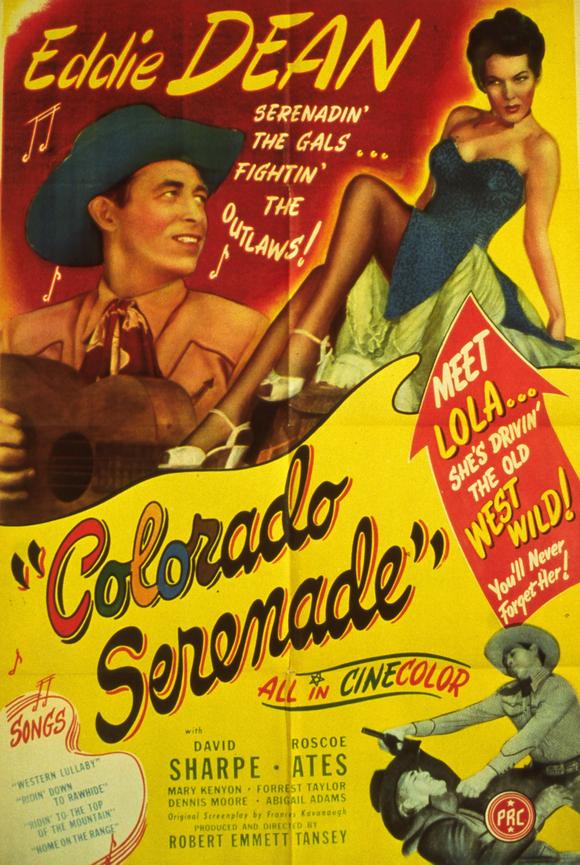
Colorado Serenade (June 30, 1946)

P.R.C. western Colorado Serenade, which stars lunkheaded cowboy actor Eddie Dean, is a good movie to fall asleep while watching. Dean has a terrible screen presence, zero acting ability, one dopey facial expression, and a great voice. So the best way to enjoy him is with your eyes closed, halfway between sleep and wakefulness.

That’s how I imagine at least a few moviegoers enjoyed this picture in the summer of 1946. As a one-hour Poverty Row oater, Colorado Serenade would have played as the bottom half of a double bill. After the newsreel, the cartoon, and the feature at the top of the bill, who wouldn’t be a little bit sleepy? And with Dean’s smooth, rich baritone belting out tunes like “Home on the Range,” “Ridin’ Down to Rawhide,” “Riding on Top of the Mountain,” and “Western Lullaby,” staying awake doubtless proved a challenge to anyone who hadn’t just drunk a cup of coffee.

Because, Lord knows, the plot of the film won’t keep you on the edge of your seat. Like many of Dean’s other P.R.C. westerns, Colorado Serenade is filmed in color — a rarity for the bargain basement studio — but everything else is typically cheap. Eddie and his comical sidekick, “Soapy” Jones (Roscoe Ates) team up with an undercover lawman named Nevada (David Sharpe) to take down a bunch of stagecoach robbers, but not before Eddie and Nevada, thinking each other on opposite sides of the law, slug it out in a good old-fashioned western saloon brawl.

The fight that closes the picture is actually pretty good, too, with a few stand-out stunts, such as Nevada leaping from the balcony and tackling a black hat in the bar below him, but it’s too little, too late after a turgid, talky flick that feels much longer than its 68-minute running time.

Anna and the King of Siam (June 20, 1946)

John Cromwell’s Anna and the King of Siam isn’t nearly as well known as The King and I, the Technicolor extravaganza starring Yul Brynner and Deborah Kerr that was made a decade later. Both films tell the same story, but The King and I does it in the form of a Rodgers & Hammerstein musical. I saw The King and I when I was a kid, and have strong memories of certain scenes, but not of the film as a whole. So I came to Anna and the King of Siam relatively fresh, and was able to watch it without constantly thinking of Brynner’s iconic performance, at least most of the time. The one big difference — if memory serves correctly — is that the later, musical version of this tale was more of a love story. It’s not as if it ended with a marriage, or Kerr being added to the king’s harem or something, but there was a romance of some sort that grew over the course of the film. The closest Anna and the King of Siam gets is a couple of scenes between Anna and the king that end with the king leering, and seeming to contemplate her in a sexual fashion.

Anna and the King of Siam is the first filmed adaptation of Margaret Landon’s 1944 book of the same name. Producer Darryl F. Zanuck reportedly bought the rights to Landon’s book immediately after reading the galleys. As is often the case, the real-life Anna Owens was a considerably more interesting and complicated person than she was portrayed in the book or any of the films about her. This is largely due to her own self-invention. Anna Leonowens was born in poverty in India in 1831, the daughter of Sgt. Thomas Edwards, a soldier in the private army of the Dutch East India Company, and his wife Mary Anne Glasscott, an Anglo-Indian woman. Later in her life, Leonowens took pains to hide her origins, and claimed that her father’s rank was lieutenant (later she claimed he had been a captain), and that she had been born in Wales. It’s important to remember that these fabrications were not merely for the purpose of self-aggrandizement. As a widow and a single mother, Leonowens faced an uphill battle in life, and almost certainly would have faced discrimination if her mixed-race heritage had been known.

While Anna and the King of Siam doesn’t delve deeply into Anna’s background, there is never any intimation that she is anything but the most proper of British ladies. The Anna Owens of the film, played by Irene Dunne, embodies the best values of the “modern” British empire, while King Mongkut (Rex Harrison) represents an older form of governance; repressive, misogynistic, autocratic, and superstitious.

Reportedly, most Thai who saw the picture were shocked and angered by the portrayal of their revered nineteenth century king, and the film was banned in Thailand due to “historical inaccuracies.” It’s hard to argue with this assessment. Landon’s book and Leonowens’s own recollections were by all accounts at least partially fabricated, and overemphasized Leonowens’s role in the king’s life, as well as the harshness of his regime. And there’s the larger question of how well any white actor — even one as talented as Rex Harrison — can portray an Asian character.

Granted, the yellowface portrayals in the film look ridiculous, especially Lee J. Cobb as the “Kralahome,” or prime minister, who appears for much of the film stripped to the waist, covered with dark makeup, and sporting a pomaded pompadour. But, like Harrison, he delivers a nuanced performance, and in their scenes together they drop the stilted line deliveries that they have in their scenes with Anna or her son Louis (Richard Lyon). (They continue to speak English, of course, but the syntactical variance is still a nice touch.)

If one ignores questions of historical accuracy, Anna and the King of Siam is an excellent and involving story of cultural differences and the challenges and rewards of education in the face of adversity. The principal actors all give great performances, especially the beautiful Linda Darnell as the king’s newest and most alluring wife, Lady Tuptim. It’s a role that easily could have been one-note, but Darnell is able to create a sexy yet repulsive character who grows more complicated as the film goes on, and eventually becomes the central tragic figure of the picture. Also, Anna and the King of Siam looks fantastic. It won two Oscars, one for best black and white cinematography and the other for best art direction, and they were well-deserved.

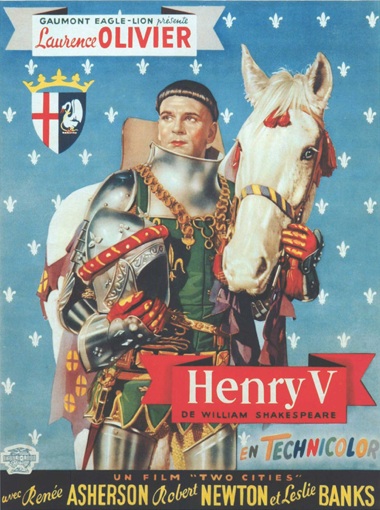
Henry V (June 17, 1946)

Laurence Olivier’s film adaptation of Shakespeare’s history play Henry V was originally released in the United Kingdom in November of 1944. (The date I’ve listed above is the release date of the film in the United States.) Following its release in the United States, Henry V was nominated for a 1946 Oscar for best picture, as well as Oscars for best actor, best score, and best art direction. It didn’t win in any of its nominated categories, but Olivier did receive an honorary Academy Award “for his outstanding achievement as actor, producer, and director in bringing Henry V to the screen.”

The recognition was well deserved (even though Olivier considered the award a “fob-off” from a jingoistic Academy). This film is a splendid achievement, and holds up remarkably well. Not only is it a fine cinematic adaptation of a great play, it’s a beautifully crafted film within a play within a film, in which Olivier the director has fun with convention while Olivier the actor delivers an assured and commanding performance as Henry, only recently a monarch after a misspent youth (chronicled by Shakespeare in Henry IV parts one and two).

The film’s full title is “The Chronicle History of King Henry the Fift With His Battell Fought at Agincourt in France,” and that’s how the title appears on the opening placard, which invites people to attend “Will” Shakespeare’s play, performed by the Lord Chamberlain’s Men at the Globe Playhouse this day, the first of May, 1600. There follows a panoramic vista in gorgeous, nearly surreal Technicolor of the London of Shakespeare’s day. It’s obviously a model, but it’s an effective one, with wisps of smoke rising from chimneys and tiny vessels dotting the Thames.

The beginning of the film attempts to faithfully recreate the theatrical experience one would have had at the Globe during Shakespeare’s time. There are no set dressings, and the Chorus (Leslie Banks), in each of his appearances, invites the viewer to suspend his or her disbelief, vividly describing the scene that is about to be played, and in so doing draws attention to the artifice of the play. As the film goes on, however, it moves out of the confines of the theater and becomes increasingly realistic, reaching its apex when Henry finally leads his troops in battle against the French at Agincourt.

Artifice and realism aren’t strictly delineated in Henry V, however. When the film first moves out of the theater to the court of France, the ocean is a static sea of waves that looks like the backdrop for a puppet show in Mister Rogers’ Neighborhood. And after the impressive battle, which was filmed in County Wicklow, Ireland (as a neutral country, it wasn’t ravaged by the war), artifice slowly returns in the form of phony-looking backdrops and a return to the stagey castle set of the French court.

When Olivier first appears on screen, it is as Oliver the actor, standing backstage in full costume, waiting for his entrance cue, and coughing into his hand in a decidedly unheroic fashion. As soon as he steps on stage, however, his voice commands attention. By the time he delivers his famous Saint Crispin’s Day speech, I was eating out of his hand. This is no mean feat, either, considering the historically accurate haircut Olivier saddled himself with, as well as his very noticeable eye makeup.

It’s common knowledge that Henry V was made with the cooperation of the British government and designed to be a nationalistic morale booster in the days following the Allied push into Normandy. Consequently, the scene in which Henry threatens to rape women and kill children was excised from the script, along with the hanging of Bardolph and Henry’s order to kill French prisoners. But it’s all in keeping with the tone of the film, which is more a celebration of theater and patriotism than it is a nuanced character study.

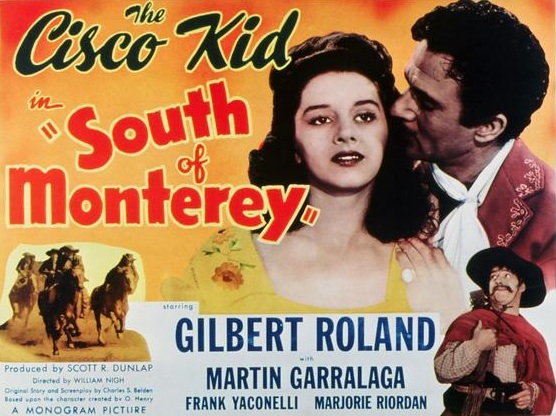
South of Monterey (June 15, 1946)

William Nigh’s South of Monterey is another dreary Cisco Kid programmer from Monogram Pictures. Gilbert Roland, in his second appearance as the character, cuts a dashing figure and is always fun to watch, but overall this one is a real snoozer.

I wasn’t exactly knocked out of my seat by Roland’s first turn as the character in The Gay Cavalier (1946), and his second outing is more of the same, with a by-the-numbers story and an anticlimactic finale. As before, Roland is fun to watch as a smooth Lothario and laid-back hero. It’s everything else about this picture that’s the problem.

This time around, Cisco, his sidekick Baby (Frank Yaconelli), and his merry band of Mexican outlaws have a rival, called “The Silver Bandit.” It should come as no surprise to veterans of Saturday afternoon matinees that Cisco and his crew will be blamed for the nefarious exploits of The Silver Bandit.

South of Monterey combines the two hoariest concepts in these types of films; the evil landowner bleeding the poor farmers dry and the young woman in danger of being forced to marry a man she doesn’t love.

The main villain of the piece is the local tax collector, Bennet (Harry Woods), who repossesses peasants’ land based on non-payment of sky-high taxes and then resells them for a profit. The young woman in danger of being forced into a loveless marriage is Carmelita (Iris Flores), the sister of local commandante of police Auturo (Martin Garralaga). Carmelita is engaged to a fiery young activist named Carlos Mandreno (George J. Lewis), but her brother is angling to have Carlos thrown in jail and his sister married off to his friend Bennet.

The film tries hard to achieve an exciting, south of the border flavor, and occasionally succeeds. Roland doesn’t play Cisco as a Boy Scout — he’s a tequila-drinking, womanizing, cigarette-smoking rapscallion. Also, there are four songs in the film sung in Spanish, one of which leads Cisco to pay Carmelita one of his typically over-the-top compliments, “Your voice has the sweetness of a meadowlark, and the softness of mission bells at twilight.”

South of Monterey isn’t a terrible programmer, it’s just a fairly typical Monogram cheapie. The main reason for me that it was a step down from The Gay Cavalier was the climactic fight, which was a fistfight. Yawn.

As he ably demonstrated in Captain Kidd (1945) and The Gay Cavalier, Roland was a hell of a sword fighter, so it’s a shame to see him swinging haymakers and smashing furniture when his blade was no doubt screaming out for blood. I know I was.

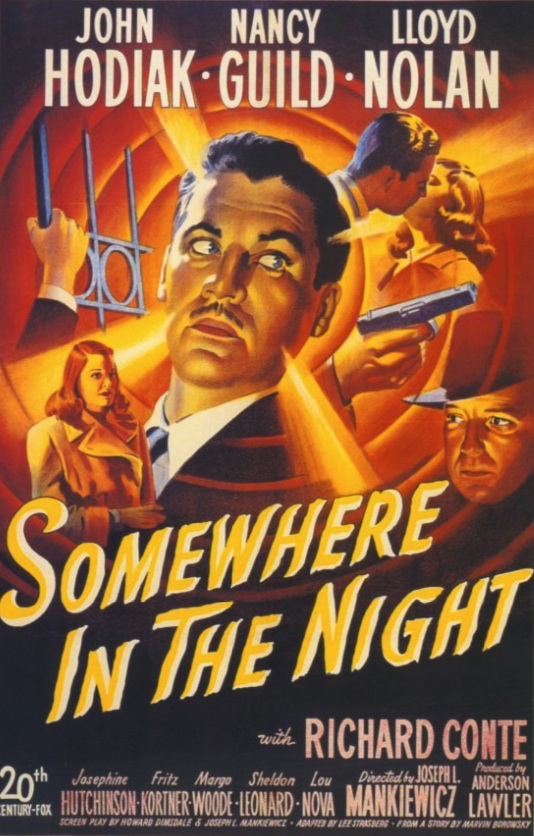
Somewhere in the Night (June 12, 1946)

Joseph L. Mankiewicz’s Somewhere in the Night looks like a noir, talks like a noir, and walks like a noir. But when the credits rolled I felt more like I’d watched a light-hearted mystery farce than a noir. This isn’t to say that Somewhere in the Night is a bad movie. It’s actually a really fun one. But the dark journey promised by the film’s opening never pans out, and the plot twists grow increasingly ludicrous as the picture goes on.

The first few minutes of the picture are mostly shot in first-person P.O.V., as a man (played by John Hodiak) wakes up in an Army field hospital. Through voiceover and the images in front of his face, we learn that he has no idea who he is, and doesn’t remember anything leading up to this point. This opening presages Robert Montgomery’s ill-advised first-person P.O.V. extravaganza Lady in the Lake (1947). Luckily, unlike that picture, the technique is used judiciously in Somewhere in the Night.

Hodiak’s character has Army identification in the name of “George Taylor,” a Dear John letter (it’s really more of an “I Hate You, John” letter), and a letter of credit from someone named “Larry Cravat.” What’s a noir protagonist to do? Clearly, the best course of action is to head for the mean streets of Los Angeles and attempt to track down Larry Cravat, even though “Taylor” has no idea what he’s doing or who all these people are who seem to want him dead. Why should that stop him? Taylor is a Purple Heart recipient and seems to be able to handle himself. It doesn’t hurt that the briefcase he picks up in a Los Angeles train station contains a gun and a letter from Larry Cravat telling Taylor that there is $5,000 deposited in his name in an L.A. bank.

For the first half hour or so, Somewhere in the Night has a few things to say about the plight of returning G.I.s, in particular the disappointments handed them by the women they came home to (or didn’t come home to, in Taylor’s case), and the resentment some servicemen must have felt upon their return.

“You know there’s been a terrible shortage of men,” a beautiful young woman named Phyllis (Margo Woode) tells Taylor.

“Yeah, so we heard in the Pacific,” he responds. “This war must have been murder on you poor women. We used to cry our eyes out about it.”

But, as I said, the longer Somewhere in the Night goes on, the more plot points stack up, and the less time the film has to do anything but crank through its story.

When Taylor goes to the bank to try and collect his $5,000 he arouses the suspicion of the cashier and he ends up fleeing empty-handed. He follows leads to a Turkish bath and then to a nightclub. Set up at the club by the bartender, he ends up hiding from a couple of mugs in the dressing room of a pretty singer named Christy Smith, who is played by the 20-year old Nancy Guild (rhymes with “wild”).

Guild is fresh-faced, has a beautiful voice, and plays her role well. She’s not outstanding, but she does a good job, especially considering this was her first role in a film; not just as leading lady, her first film role, period. Apparently she felt out of her depth, and the production was a struggle for her. In later interviews, she credited Mankiewicz’s generous nature and sensitive direction, and said he was a real father figure to her.

Hodiak also does a decent job, but it’s a one-note performance. He sweats profusely and looks haunted, and does a great job with lines like, “I’m tired of being pushed around. The war’s over for me. I don’t have to live afraid anymore.” He sounds genuinely angry, and he also sounds as if he doesn’t believe his own words one bit.

It wasn’t until after I finished watching Somewhere in the Night that I learned that while Hodiak was born in the United States, he grew up in an immigrant family, spoke Hungarian and Polish at home, and always had to work hard at his English diction. “No part has ever come easily to me,” Hodiak once said. “Every one has been a challenge. I’ve worked as hard as I could on them all.” I never would have guessed from this film that his first language wasn’t English, but there is something about his delivery that is strange and stilted.

Luckily, Guild and Hodiak have wonderful support from two great actors who straddled the line between character actor and leading man; Lloyd Nolan and Richard Conte.

Nolan plays a police detective, Lt. Donald Kendall, who doesn’t eat lunch because it puts him to sleep and doesn’t drink coffee because it keeps him awake. He also wonders aloud several times why detectives in the movies don’t ever take their hats off. (He figures it out by the end of the picture.) And he has plenty of great lines, which he delivers in his trademark wry fashion, like “Big post-war boom in homicide.”

Conte plays a nightclub owner named Mel Phillips, who’s smooth without seeming oily, and whose motives aren’t initially clear. (If you had $5 for every time Conte played a nightclub owner in a noir, you could probably take your whole family out to a nice dinner.)

Somewhere in the Night is a good picture; well-made and a lot of fun. It was all just a little silly for my taste, though.

Dressed to Kill (June 7, 1946)

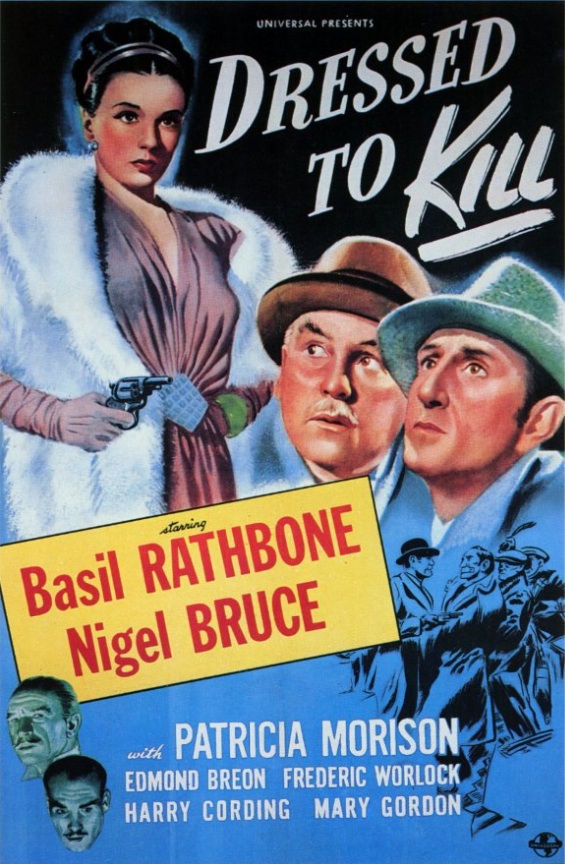
Dressed to Kill was director Roy William Neill’s eleventh Sherlock Holmes film, and the fourteenth and final film starring Basil Rathbone as Holmes and Nigel Bruce as his loyal sidekick Dr. John H. Watson.

This was the year that Rathbone said goodbye to the character. His last appearance on the Mutual Broadcasting System radio program The New Adventures of Sherlock Holmes was in “The Singular Affair of the Baconian Cipher,” broadcast on Monday, May 27, 1946. The next week’s time slot was filled with the summer replacement program The Casebook of Gregory Hood, which starred Gale Gordon as an antique dealer and gourmand living in San Francisco who solved mysteries in his spare time. Like the Sherlock Holmes program, the scripts were written by Holmes aficionados Anthony Boucher and Denis Green. The show was fun, but Gregory Hood was no Sherlock Holmes.

Holmes returned to the airwaves in October, on the American Broadcasting Company. Nigel Bruce reprised his role as Dr. Watson, but Tom Conway took over the role of Sherlock Holmes (although Bruce received top billing). Rathbone, who felt that his association with the character, whom he had played on a regular basis since 1939, was killing his career, so he returned to New York City and the theater. He won a Tony in 1947 for his role in the Broadway play The Heiress, but little significant stage work presented itself to him in the years to come. He had bad luck with films, as well. When The Heiress was made into a film in 1949, Rathbone hoped to appear again as Dr. Sloper, the role for which he had won a Tony, but the part ended up going to Ralph Richardson.

Whatever Rathbone’s feelings about his iconic performances as Holmes, there is no question that he left an indelible mark on the character. (He eventually returned to the role in 1953 when he appeared as Holmes in an episode of the Suspense TV show, as well as starring as Holmes in a play that was written by his wife, Ouida. The play received lukewarm reviews and closed after just three performances.)

In the first scene in Dressed to Kill in which Rathbone and Bruce appear, Rathbone waxes nostalgic about “the woman,” Irene Adler, a character in Sir Arthur Conan Doyle’s 1891 story “A Scandal in Bohemia,” while Watson sits reading The Strand, the magazine in which Conan Doyle’s Sherlock Holmes stories originally appeared. (Later in the film, a smoke bomb will prove the undoing of Watson, and Holmes will taunt him, since Watson described an identical ruse in the story he wrote called “A Scandal in Bohemia.” It’s an enjoyable bit of metafiction of the type Conan Doyle himself engaged in.)

The boys receive a visitor to 221b Baker Street, Julian “Stinky” Emery (Edmund Breon), an old friend of Watson’s. Emery is an avid collector of music boxes, and was robbed the night before. Curiously, the thief (or thieves) knocked him unconscious and then took just one music box, a trifling little thing that Emery had purchased earlier in the day at auction for just £2.

We, the viewers, know that Emery’s music box was one of three manufactured in Dartmoor Prison, so we know that the trio of miscreants tracking them down in London have an ulterior motive, in this case, finding where a pair of original Bank of England plates are hidden, which they will be able to use to produce £5 notes that are not “counterfeit” in the traditional sense. The three music boxes all seem to play the same tune, but with his fine ear for music, Holmes will note minor variations in the melodies, which is the key to the code.

Dressed to Kill features many plot elements that will be familiar to long-time viewers of the series. Mrs. Hilda Courtney (Patricia Morison) is a clever femme fatale in the mold of the eponymous antagonists of The Spider Woman (1944) and The Woman in Green (1945). And the plot device of a number of cheap trinkets holding a code was used before, and to better effect, in The Pearl of Death (1944).

Dressed to Kill is far from the best of Universal’s Sherlock Holmes series, but it’s far from the worst. The Rathbone Holmes pictures are remarkably consistent and terrifically entertaining, however, so the worst picture in the series is still better than most mysteries from the ’40s.