Category Archives: 1947

Lady in the Lake (Jan. 23, 1947)

Lady in the Lake
Lady in the Lake (1947)
Directed by Robert Montgomery
Metro-Goldwyn-Mayer

Robert Montgomery’s Lady in the Lake is a one-of-a-kind experience. Like a lot of one-of-a-kind experiences, it’s one that some people will never want to experience ever again after it’s over.

It’s not like any other movie you’ll ever see, but the fact that its central gimmick was never used again should tell you something.

The gimmick is that nearly the entire film is shot in a first-person point of view (POV). The film is a series of long tracking shots, but there are a few jump cuts and wipes when necessary. The trailer for Lady in the Lake told audiences that the film stars Robert Montgomery … “and you!” But this isn’t entirely true, for reasons that we’ll get into later.

Lady in the Lake is an adaptation of Raymond Chandler’s 1944 novel The Lady in the Lake, and stars Montgomery as private investigator Philip Marlowe (whose first name in this movie is spelled “Phillip”). Montgomery also directed the film — his first time as director, although he provided uncredited directorial assistance to John Ford when he starred in Ford’s World War II PT boat saga They Were Expendable (1945).

The only parts of the film that aren’t filmed from Marlowe’s POV — every actor interacting directly with the camera, Montgomery’s face only visible if he happens to look in a mirror — are stiff monologues by Montgomery as Marlowe, seated at his desk in his office, speaking directly to the viewer. These monologues are used to introduce the picture and to cover some gaps in the narrative.

Montgomery begins the films by telling viewers that they will be solving the mystery alongside him. He recites a street address and says, “make a note of it.” The problem with this is immediately clear. The film will continue to spool forward for you the same way it does for everyone else in the audience, whether you remember the address or not.

A first-person POV version of a Chandler novel must have made sense on paper. Chandler was a master of first-person narration, and his brilliant prose made first-person narration inextricable from the P.I. genre.

But first-person POV in film is very different from first-person narration in a novel. Despite what many critics of slasher films in the ’80s would have had you believe, first-person POV in a film does not create identification with the killer, it makes the viewer feels trapped and terrified.

While you’re unlikely to feel terrified while watching Lady in the Lake, it does inspire a sense of claustrophobia and surreality that is at odds with its goal of putting the viewer in the center of the action like no film had before.

Lady in the Lake begins in an odd fashion, as Marlowe tries to sell his semi-autobiographical story “If I Should Die Before I Wake” to magazine editor Adrienne Fromsett (Audrey Totter). When Fromsett’s stacked and gorgeous blond secretary (Lila Leeds) enters the office, she makes eyes at Marlowe, and the camera tracks her as she sashays out of the office. The eye contact she maintains with the camera is unbearably erotic. It’s ridiculous in terms of an actual narrative, but it works in the heat of the moment, like a tomahawk flying out of the screen in a 3D western. (Proponents of the “male gaze” theory can have a field day with this film.)

Audrey Totter

The problem with Lady in the Lake isn’t just its technique, it’s the fact that most of the actors interact with the camera in an unnatural fashion. Most of them never look away or even blink. Totter is the worst offender. She’s pretty, but her habit of arching one eyebrow while speaking to the camera is bizarre.

When Marlowe asks Fromsett a question — “What would happen if I kissed you?” — there’s no heat or interplay. It’s a purely technical question. If Marlowe kisses her, where will the camera go? Will it smoosh up against her face?

The only actor who interacts well with the camera is Lloyd Nolan, who plays the nasty and volatile police detective Lt. DeGarmot. Unlike the other actors — who seem afraid to break eye contact with the camera — he looks down, and around, occasionally turns his back on Marlowe, and steps forward to be threatening. In a memorable scene, he even slaps the camera in the “face” several times while sneering.

Lady in the Lake takes place during the Christmas holiday, and there’s very little incidental music, except for an eerie holiday vocal choir that shows up every now and then on the soundtrack.

While the first-person POV of Lady in the Lake doesn’t always work, there are a number of interesting “verité” moments, such as the scene in which Marlowe and the viewer sit around while observing Capt. Kane (Tom Tully) on the phone with his daughter on Christmas Eve. He’s embarrassed to be on a personal call while at work, but he chats with her anyway. There’s also an amazing quiet moment when Marlowe wakes up in Fromsett’s house on Christmas day, and the camera observes her lounging on the opposite couch in the living room, smoke curling out from behind the camera (Marlowe’s having a cigarette), as she and Marlowe listen to an adaptation of “A Christmas Carol” on the radio.

Because of the nature of the film, I still don’t feel as if I’ve ever seen Robert Montgomery play Philip Marlowe. He seems like a good choice for the character, since he bears a resemblance to Marlowe’s creator, Raymond Chandler, but his disembodied voice was too monotone to make up for the fact that he’s off-screen for most of the movie.

First-person POV would be used again in 1947 for the first section of Delmer Daves’s Dark Passage, and for memorable moments in other films, like the opening murder sequence in John Carpenter’s Halloween (1978) and a fistfight in Gordon Parks’s Shaft (1971), but this was the only time it would be used for an entire motion picture.

I actually really enjoyed Lady in the Lake, even though I think it’s a failed experiment. It’s worth seeing at least once by anyone who’s interested in film, and there are enough powerful, uncanny, and interesting moments to make up for the long stretches of flaccidity.
Sinbad the Sailor (Jan. 17, 1947)

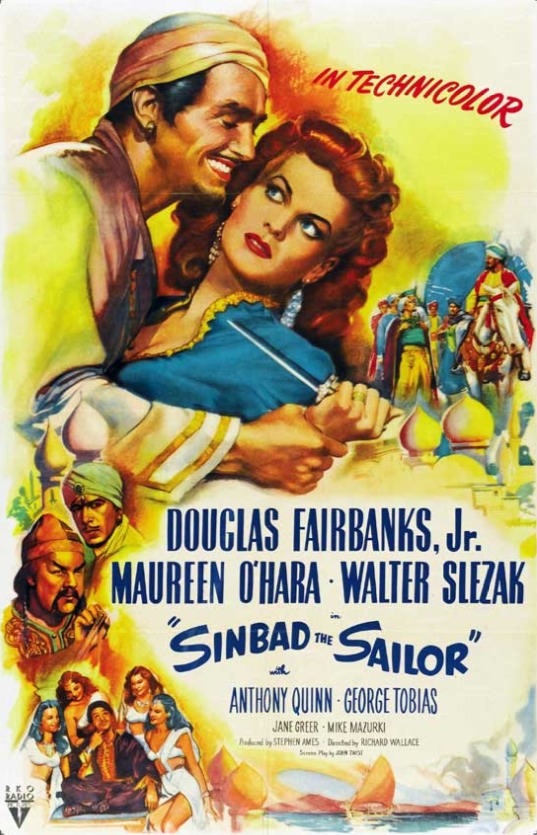
Sinbad the Sailor was the first film Douglas Fairbanks Jr. made after a decorated career serving in the Navy during World War II. The son of one of the most famous swashbucklers in Hollywood history, Fairbanks cuts a dashing figure in Richard Wallace’s overlong Orientalist fantasy, but there’s too much talk and too little excitement to recommend it to casual viewers.

I have fond memories of Nathan Juran’s The 7th Voyage of Sinbad (1958), which I saw on the big screen as a kid in the early ’80s. I don’t remember a lot about the lead performance by Kerwin Mathews, or how good the story was, but Ray Harryhausen’s stop-motion special effects blew me away. Sinbad the Sailor, on the other hand, has no wild monstrosities like the cyclops or the cobra woman. (A mynah bird on a string is the most memorable special effect, and it’s a bad one.) Instead it has fairly grown-up dialogue and a feisty romance between Sinbad (Fairbanks) and Shireen (a Kurdish woman improbably played by Maureen O’Hara).

Fairbanks plays Sinbad in a grand, theatrical style, with lots of balletic movements and arm sweeps. The Sinbad of Sinbad the Sailor is a braggart and raconteur who begins the film by promising to tell his rapt crew of his legendary “eighth voyage” — the one that never made it into the history books. It involves his quest for the lost treasure of Alexander the Great, hidden on the mysterious isle of Daryabar. He’s accompanied by his faithful (and comical) sidekick Abbu (George Tobias), a fat, effeminate cook named Melik (Walter Slezak), and a crew of roughneck sailors led by a brute named Yusuf (played by Mike Mazurki, of all people). Opposing him is the evil Emir (Anthony Quinn), who wants the treasure and the beautiful Shireen for himself.

RKO intended Sinbad the Sailor to be their big film of the 1946 Christmas season, but a strike at the Technicolor processing plant delayed its release. (A problem that plagued David O. Selznick’s Duel in the Sun, as well.) Instead, they dumped a little black and white movie called It’s a Wonderful Life into theaters. Oh well.

This was the first Douglas Fairbanks Jr. film I’ve seen, and while it wasn’t bad, it didn’t blow me away. (I’ve only seen one of Douglas Fairbanks Sr.’s films — the 1926 two-strip Technicolor adventure film The Black Pirate — and that one did blow me away.) Fairbanks channels his dad in a couple of action scenes in which he leaps from rooftop to rooftop, swings from balconies, somersaults through descending gates, and trips up legions of the Emir’s palace guards. The action sequences are good, but there are too few of them for a film that’s almost two hours long.

The lead actors are all good (I especially liked Anthony Quinn as Sinbad’s handsome antagonist), but the Arabian Nights-inspired sets are chintzy and the script is talky and repetitive. I didn’t hate Sinbad the Sailor, but I was looking at my watch a lot during the final 45 minutes.

Queen of the Amazons (Jan. 15, 1947)

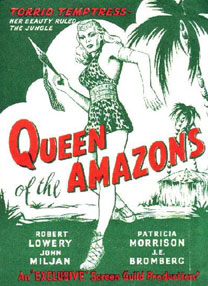
Edward Finney’s Queen of the Amazons is tailor-made for the bottom half of a double bill in the cheapest theater in town. It’s pretty terrible, but worth watching if you’re a fan of cheesy movies with lots of stock footage.

This is the kind of programmer in which a character will exclaim — “Uh oh! Locusts!” — and the scene will cut to some grainy footage of locusts (or something) teeming and swarming in the air. Cut back to our intrepid explorers. “We’d better camp here tonight until the locusts have passed,” the safari leader says. “This bad place for camp, bwana. It’s lion country,” responds the chief bearer.

Will there immediately follow some stock footage of lions? Will there also be a dramatic lion hunt lasting a couple of minutes that is composed entirely of stock footage? I don’t want to give anything away, but … yes, there will be.

Liberal use of stock footage is nothing new, especially in jungle movies (if you’ve ever watched several of Johnny Weissmuller’s Tarzan movies in a row, you’ll know exactly what I’m talking about), but Queen of the Amazons takes it to extremes I’d never thought possible. Certain reels of Queen of the Amazons contain more stock footage than original material, and the plot of the film (Roger Merton is credited with writing both the story and the screenplay) seems built around stock footage, rather than the other way around.

Take, for instance, the fact that while most of the film takes place in Africa, the first reel takes place in India. This seems due less to story concerns and more to the fact that the filmmakers had some cool footage of tigers, restive Punjabis, and an elephant tug-of-war available to them.

The plot of Queen of the Amazons, what there is of it, concerns a young woman named Jean Preston (Patricia Morison), whose fiancé, Greg Jones (Bruce Edwards), disappeared on safari in Africa. She globetrots from the subcontinent to the dark continent in search of him, finding a crew of misfits along the way; a chubby cook named Gabby (J. Edward Bromberg), an absent-minded entomologist called simply “the Professor” (Wilson Benge), a strait-laced military man named Colonel Jones (John Miljan), and a great white hunter named Gary Lambert (Robert Lowery) who hates women and thinks they’re a nuisance.

In the not-quite-there feminism typical of ’40s programmers, Jean proves Gary’s assumptions wrong after handily beating him in a shooting contest, but later in the picture the latter-day Annie Oakley is completely useless when a lion attacks Gary, and she stands there with a semiautomatic clutched loosely in her dainty hand, screaming her head off.

There’s also the matter of a contraband ivory trade, a murderer who may be a member of the safari, and the Queen of the Amazons herself, “Zita” (Amira Moustafa), leader of a “savage white tribe” of women shipwrecked as children. I’m a big fan of dishy gals from the ’40s and ’50s dressed in skimpy jungle gear, so — despite her total lack of thespian ability — I enjoyed Moustafa’s role in the film, although her handmaiden looked about as exotic as a Peoria hausfrau spinning Les Baxter records at a tiki party.

13 Rue Madeleine (Jan. 15, 1947)

Henry Hathaway’s 13 Rue Madeleine is a spiritual sequel to his espionage docudrama thriller The House on 92nd Street (1945). The address this time around refers not to the headquarters of a Nazi spy ring in New York City, but to Gestapo headquarters in Le Havre, France, during World War II.

Like The House on 92nd Street, 13 Rue Madeleine owes a debt to the style and presentation of Louis de Rochemont’s “March of Time” newsreels. (De Rochemont served as producer of both films.) I enjoyed The House on 92nd Street, but judged purely as a cinematic experience, 13 Rue Madeleine is the superior film.

A lot of that is due to the film’s star. James Cagney is dynamic and arresting in every role I’ve ever seen him play, and I would pay to watch a film in which all he did was order and consume room service by himself.

In this film, Cagney plays Robert Emmett “Bob” Sharkey, an instructor of potential agents in a U.S. agency called “O77.” (The organization is clearly based on the O.S.S., but the name was changed because of certain plot elements that we’ll get to in a moment.)

Early in the film, Sharkey’s boss, Charles Gibson (Walter Abel), informs him that one of his students is a German mole named Wilhelm Kuncel. The mole turns out to be one of his most promising pupils, William H. “Bill” O’Connell (Richard Conte). O’Connell looks and acts as American as apple pie, and during training grew especially close to blond, fresh-faced Jeff Lassiter (Frank Latimore), who never suspected a thing.

Gibson orders Sharkey to pass O’Connell and to not let on what he knows, in order to feed false information to the Germans through O’Connell. Alas, O’Connell proves to be even cannier than Sharkey’s bosses could have predicted, and this decision leads to a series of tragedies.

Conte isn’t an actor I could have picked out of a lineup a year ago, but after seeing him now in several roles, I think he’s a tremendous performer, and I look forward to a lifetime of watching his films. It doesn’t matter for his role as a double agent in 13 Rue Madeleine that he doesn’t look the slightest bit “German.” In a wordless scene in a transport plane over Europe, as O’Connell and Lassiter are preparing to jump, O’Connell suddenly sees what the straight-arrow Lassiter can’t hide, and the look on his face is chilling.

The Man I Love (Jan. 11, 1947)

The Man I Love
The Man I Love (1947)
Directed by Raoul Walsh
Warner Bros.

Loving the popular music of the ’30s and ’40s isn’t a prerequisite for enjoying Raoul Walsh’s The Man I Love, but it sure helps.

If you don’t like old pop standards (I do, and found myself humming “The Man I Love” constantly for about a day after I watched this movie), then you’d better like “women’s pictures,” because that’s what this is. (I’ve seen The Man I Love called a film noir, but it’s not. Half the movie takes place in nightclubs, and there’s a hint of criminal malice every now and then, but that alone does not a noir make.)

The most prominent tune is the one that gives the film its title, George and Ira Gershwin’s sublime “The Man I Love” — both as a smoky nightclub number and as a constant refrain in Max Steiner’s lissome score — but there are plenty of other great songs, like Jerome Kern and Oscar Hammerstein’s “Why Was I Born?” and James P. Johnson and Henry Creamer’s “If I Could Be With You.” There are also tunes just tinkled out on the piano, like George Gershwin’s “Liza (All the Clouds’ll Roll Away)” and Johnny Green’s “Body and Soul,” suffusing the film with a nostalgic languor that’s a nice counterpoint to all the melodrama.

When New York nightclub singer Petey Brown (Ida Lupino) packs her bags for Los Angeles to visit her siblings, she’ll find love, lose love, flirt with danger, and leave things a little better off than she found them. The poster for The Man I Love features the following tagline: “There should be a law against knowing the things I found out about men!” This is a bit of an overstatement, since most of what Petey finds out about men in this picture is what most clear-eyed women already know; most of them are rotten, some are crazy, some are sweet but naive and dim-witted, and the few you fall for are probably in love with another dame who they’ll never get over.

Petey’s sister Sally Otis (Andrea King) has a young son and a husband, Roy Otis (John Ridgely), who’s languishing in a ward for shell-shocked soldiers. Sally lives with the youngest Brown sister, Ginny (Martha Vickers), who’s 18 and should be enjoying life, but instead spends most of her time caring for the infant twins of their across-the-hall neighbors, Johnny and Gloria O’Connor (Don McGuire and Dolores Moran). Joe Brown (Warren Douglas) — the girls’ brother — is hip-deep in trouble. He’s working for a slimy nightclub owner named Nicky Toresca (Robert Alda) and seems destined for a one-way trip to the big house.

There are a few potentially interesting stories that never really go anywhere, such as Ginny’s attraction to Johnny, whose wife is two-timing him, and Sally’s relationship with her mentally ill husband. For better and for worse, Lupino is the star of The Man I Love, and her dangerous dealings with Nicky Toresca and her doomed romance with a pianist named San Thomas (Bruce Bennett) who’s given up on life dominate the running time of the picture.

The actors are all fine, and the stories are involving, but it’s the music that elevates this picture. Ida Lupino expertly lip synchs her numbers, which were sung by Peg La Centra (who can be seen in the flesh in the 1946 film Humoresque, singing and playing the piano in two scenes in a dive bar).

There’s also at least one allusion to a popular song in the dialogue. When Petey sees the twins and asks “Who hit the daily double?” Gloria responds gloomily, “Everything happens to me,” which is the title of a Matt Dennis and Tom Adair song first made popular by Frank Sinatra when he was singing for Tommy Dorsey’s band. There are probably other little in-jokes like that sprinkled throughout, but that was the only one I caught.

Half-Wits Holiday (Jan. 9, 1947)

I normally don’t review shorts, but Half-Wits Holiday (a reworking of the 1935 Three Stooges short Hoi Polloi) marked a milestone for the Stooges, since it was Curly’s last film.

Curly Howard (born Jerome Lester Horwitz in 1903) had suffered a series of minor strokes in 1945, but during the filming of Half-Wits Holiday in 1946, he suffered a severe stroke, which ended his career. (Curly’s older brother Shemp, an original member of the trio, stepped in, and appeared in dozens of shorts with Moe Howard and Larry Fine until his death in 1955.) Curly lived until 1952, but he was unable to perform during the last years of his life.

In this burlesque version of the Pygmalion myth, a couple of egghead “scientists” — Prof. Sedletz (Theodore Lorch) and Prof. Quackenbush (Vernon Dent) — argue over environment vs. heredity and make a $1,000 bet. Quackenbush believes in environment, and claims he can take a man from the lowest strata of life and turn him into a gentleman after just one month in the right situation and with the proper instruction. Enter the Three Stooges. Guess who’s going to win the bet?

When Quackenbush asks Larry, Moe, and Curly if they’d like to make $1,000, Moe asks, “Who do we have to murder?” (And because it’s Moe, he sounds serious.) Quackenbush’s lovely daughter Lulu (Barbara Slater) is home from college, and offers to help tutor the Stooges (see poster above). A month passes, and the Stooges make their grand entrance in society. Moe and Larry acquit themselves well for a few minutes, but the kleptomaniac Curly bites the diamond ring off of a grand dame’s finger when he kisses her hand, pockets champagne (a word he can’t even pronounce), and steals a load of silverware. And before you can say “Sword of Damocles,” a pie stuck to the ceiling falls on a woman’s face, and the party devolves into a pie-in-the-face-athon.

When I was in high school, I bought a $2 VHS tape featuring two Three Stooges shorts, Disorder in the Court (1936) and Sing a Song of Six Pants (1947). I watched it frequently, which led my mother to declare the Three Stooges entartete Kunst.* She even compared them with New Kids on the Block, as a high-water mark of how pop-culturally unenjoyable I should find them. But you know what? I refused to apologize for loving the Three Stooges when I was 15, and I refuse to apologize today.

Unlike every single other genre, I judge comedy by only one criterion — does it make me laugh? The Three Stooges may be aggressively lowbrow, but they crack me up every time. I love them. There, I said it. I’ll say it again. I love the Three Stooges. I would marry them if I wasn’t already married and they weren’t all dead.

*It’s just an expression. My mom’s not a Nazi.

Hungry Hill (Jan. 7, 1947)

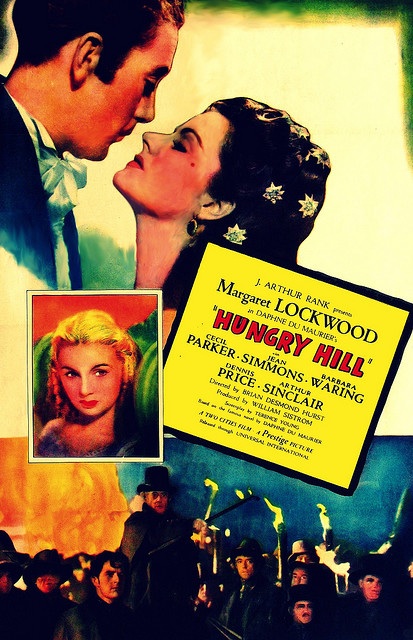
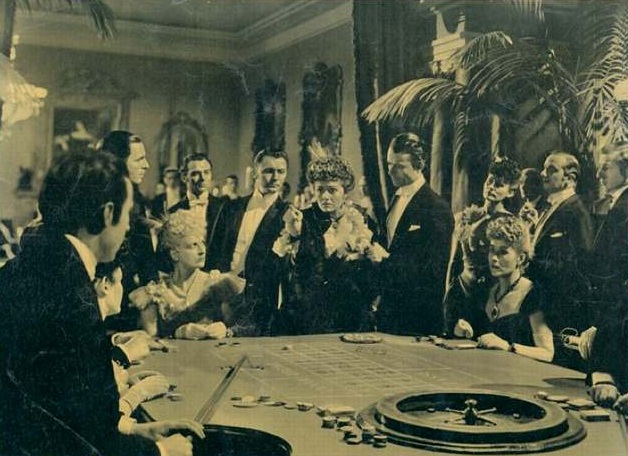
Daphne Du Maurier’s 1943 historical novel Hungry Hill covers a period of 100 years (1820 to 1920) in the lives of five generations of two feuding Irish families. Brian Desmond Hurst’s 1947 film adaptation narrows the scope of the story to three generations and a roughly 50-year timespan, but it’s still a lot to take in over the course of just 100 minutes. If you’re a fan of romantic yet gloomy historical melodramas, Hungry Hill is a filling dish. And if you’re not, Hungry Hill might leave you feeling stuffed and queasy.

Margaret Lockwood gets top billing (and the most time onscreen) as Fanny Rosa, a beautiful and headstrong young woman who marries into the wealthy Brodrick family, who live in a castle called “Clonmere” in County Cork. The patriarch of the clan, John Brodrick (Cecil Parker), has several children, John (Dennis Price), Henry (Michael Denison), and Jane (Jean Simmons). (Honestly, there are a lot of characters in Hungry Hill, and he might have had more children than those three, but they’re the only ones I was able to get a handle on.)

The patriarch of the Donovan clan, old Morty Donovan (Arthur Sinclair), violently objects to John Brodrick’s plans to mine for copper in Hungry Hill, and curses Brodrick and his entire family. (Hungry Hill is located in the beautiful Caha Mountains, which I’ve hiked, so I was disappointed that there wasn’t more location footage — most of the film takes place in drafty old rooms and the bowels of the Brodrick copper mine.)

While the copper mine ends up providing plenty of employment for the Donovan clan and other roustabouts, tensions are always simmering. A labor riot leads to the death of one young man, and a visit of reconciliation leads to a deadly typhoid infection.

Hungry Hill follows a familiar three-generation rise-and-fall story arc. By the time Margaret Lockwood’s hair is brushed through with gray and her face is lined with age makeup, it should come as no surprise to anyone that her handsome son, Johnnie Brodrick (Dermot Walsh), is drinking a bottle of whiskey a day, loving and leaving the ladies, and frittering away his family’s fortune. The scenes between Johnnie and his mother are well-played and affecting, but by that point in the movie I was starting to lose interest in the dismal goings-on.

One thing I can recommend unequivocally is the casting, which is excellent. Not only does Hungry Hill feature the cream of the crop of up-and-coming British actors, but the Brodrick men really do all look like members of the same family, and the Donovans resemble one another, too. Of course, this is a double-edged sword, since it’s sometimes difficult to keep them all straight.

Hurst himself clearly didn’t hold this film in the highest regard. In a letter to John Ford dated April 9, 1951, in which he sang the praises of Siobhan McKenna, who played Kate Donovan in Hungry Hill (Ford was interested in casting her in his film The Quiet Man), Hurst wrote, “There must be a copy of a rather indifferent film I made of Daphne du Maurier’s even more indifferent story ‘Hungry Hill.’ You could get hold of this through Eagle-Lion, but don’t inflict the whole of the picture on yourself. Just see about the last four reels, because she doesn’t come in till then.”

Dead Reckoning (Jan. 2, 1947)

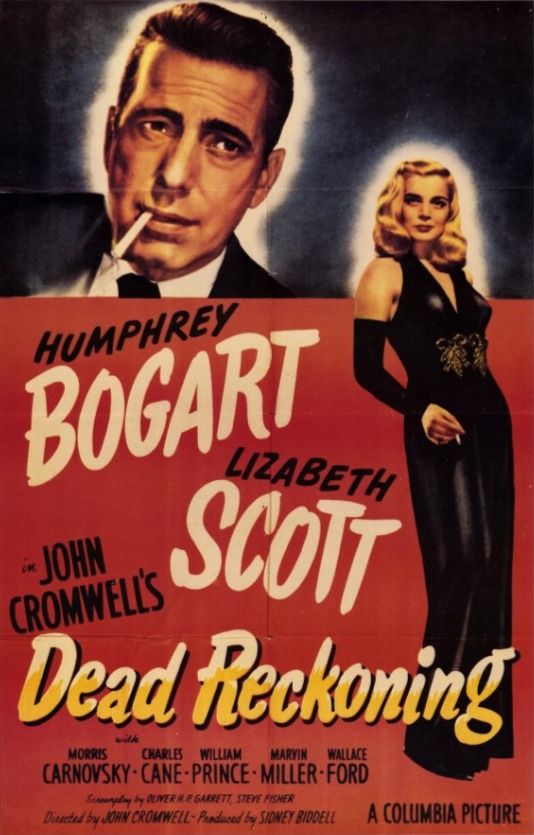
Lizabeth Scott looks a lot like Lauren Bacall. It’s hard not to compare her to Bacall even when she’s not acting opposite Humphrey Bogart.

There’s a lot of that going around in John Cromwell’s Dead Reckoning, a film that isn’t as well known as some of Bogie’s other noirs, like The Maltese Falcon (1941) or The Big Sleep (1946), and which suffers in direct comparison with them. But taken purely on its own merits, it’s a tense, well-made picture, full of post-war desperation, but with little of the silliness of a lot of returning-vet noirs, like Somewhere in the Night (1946).

Bogart plays a paratrooper, Capt. “Rip” Murdock, who was ordered to Washington, D.C., to receive the Distinguished Service Cross along with his buddy, Sgt. Johnny Drake, who was to receive the Congressional Medal of Honor. Before they could get there, Johnny hopped off the train and went on the lam before any newspaper reporters could snap his picture.

Rip finds a Yale pin from the class of ’40 that reveals that Johnny’s real name was John Joseph Preston. Rip follows the clues to Johnny’s hometown of Gulf City. (It’s unclear where Gulf City is supposed to be, but it has to be somewhere along the Gulf Coast. There are palm trees, and Bogie refers at one point to “Southern hospitality.” There is a real Gulf City in Florida, but it’s an unincorporated little town that had a population of zero by the 1920s.)

Rip rolls through the microfiche in the Gulf City public library until he finds a newspaper article dated September 3, 1943, with the headline “Rich realtor slain.” The motive was jealousy — both men loved a woman named Coral Chandler — and Johnny confessed to the murder, but disappeared before he could be sentenced, and enlisted in the army under a false name.

Rip finds a scrap of paper in his hotel room with a single word, “Geronimo,” scrawled on it. It’s from Johnny (it was what they always yelled before jumping out of planes), but the next time Rip sees Johnny, he’s a burnt-up corpse in a twisted car wreck.

Rip tracks down the woman in the case, the beautiful and statuesque Coral “Dusty” Chandler (Lizabeth Scott), a singer in a Gulf City nightclub. The scene in which she sings “Either It’s Love or It Isn’t” under a spotlight to Rip at his table is memorable, though Scott’s lip synching is pretty awful. Rip calls her “Cinderella with a husky voice,” and they embark on a whirlwind love-hate romance.

Most of the film is told in flashback. Rip sits in a pew in a church, his face hidden in the shadows, confessing his sins to Father Logan (James Bell), whom he sought out because he’s a former paratrooper. Logan was known as “the jumping padre, always the first one out of the plane.”

If you’re starting to think that Dead Reckoning might have an overabundance of references to parachuting, you’d be right, and we haven’t even scratched the surface. (The title of the film refers to flying a plane without the aid of electronic instruments — which is a metaphor for Rip’s dangerous, seat-of-the-pants investigation — and the final image of the film is a woman’s face metamorphosing into a billowing white parachute floating to earth along with the whispered word “Geronimo.”)

In many ways, Dead Reckoning feels like a pastiche of earlier Bogart film noirs. The loyalty to a dead man is straight out of The Maltese Falcon (“When a guy’s pal is killed he oughtta do something about it,” Rip says). A villain who rushes to open a door at the climax, only to be shot down, is straight out of The Big Sleep. And the film’s chief antagonists, the effete, cultured Martinelli (Morris Carnovsky) and his brutish, mildly brain-damaged henchman, Krause (Marvin Miller), are straight out of too many noirs to count.

Dead Reckoning carves out its own misanthropic place in the noir pantheon with its doses of brutal violence, fiery finale, and Rip’s distrust of dames, which is nothing new for a noir, but which Dead Reckoning takes to new heights. Rip says things like “I don’t trust anybody, especially women” and “Didn’t I tell you all females are the same with their faces washed?” And his diatribe about how women should all be shrunk down to pocket size has to be heard to be believed.

Dead Reckoning is full of memorable hard-boiled dialogue. Unfortunately, Scott can’t always pull it off the way Bogart can. The dialogue in film noir is often artificial, but it’s artificial in the same way as Shakespearean drama — it can express something more real than “naturalistic” dialogue can, but it takes a very talented actor to make it work.

Bogart had his limitations as an actor, but he perfectly delivered every single line of dialogue in every single film noir in which he appeared. Dead Reckoning is no exception, and while it’s not the greatest film I’ve ever seen, it’s damned good, and I look forward to seeing it again some day.