Category Archives: 1948

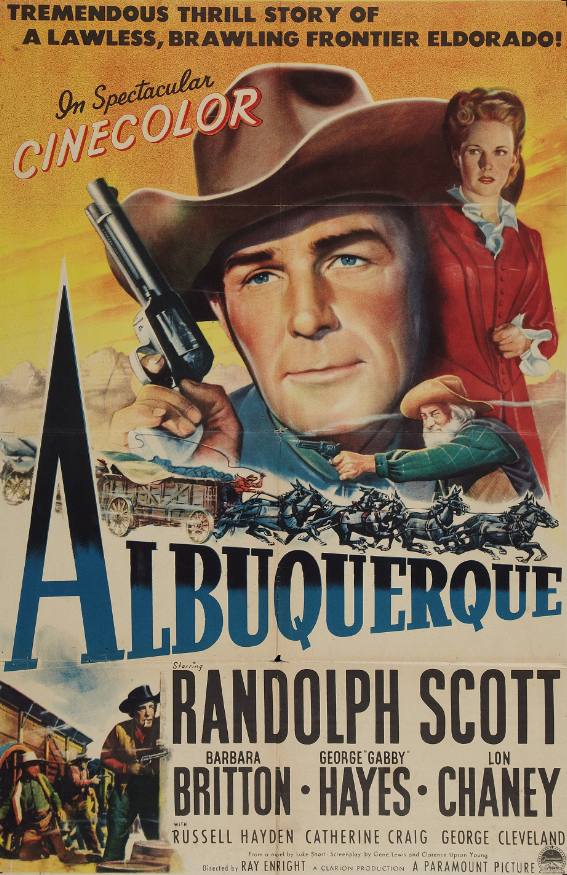
Albuquerque (Feb. 20, 1948)

Like Randolph Scott’s last western, Gunfighters (1947), director Ray Enright’s Albuquerque was filmed in Cinecolor, which was a two-color film process that was less expensive than Technicolor.

Unlike Gunfighters, it’s punchy and fast-moving, which could have something to do with the source material. Gunfighters was based on a novel by the long-winded Zane Grey, while Albuquerque is based on the 1939 novel Dead Freight for Piute, which was written by the terse, hard-boiled western author Luke Short.

Albuquerque isn’t quite on the level of André de Toth’s Ramrod (1947), which was the best adaptation of a Luke Short book I’ve seen to date, but it’s a well-made B western.

The lean, weather-beaten Randolph Scott plays Cole Armin, a man coming to Albuquerque to do a job. On the way there, he and his fellow stagecoach passengers are robbed by a group of masked bandits. Celia Wallace (Catherine Craig) loses $10,000 to them, and a young girl named Myrtle (Karolyn Grimes, best known for playing little Zuzu in It’s a Wonderful Life), is put in a perilous position when the stage goes out of control with spooked horses and no driver.

It quickly becomes clear that more pernicious forces are at work in Albuquerque than just a few stagecoach robbers preying on wayfarers. John Armin (George Cleveland), Cole’s uncle and the man he’s come to Albuquerque to work for, turns out to have a stranglehold on the territory, and he expects Cole to help him carry out all manner of dirty business.

So the honest Cole Armin goes into business with Celia and her brother Ted Wallace (Russell Hayden), forming Wallace & Armin Freighting. Their freighting company moves ore from the Half-High Mine down a steep, twisting, treacherous trail. (Even higher up the mountain is Angel’s Roost Mine, but it’s so high up that no one’s sure if it’s even possible to get the ore down from there.)

Naturally, none of this makes John Armin very happy, and he dispatches forces both foul and fair — a hulking henchman named Steve Murkill (Lon Chaney Jr.), who appears to have been hired not only for his great strength and mercilessness, but also his ability to get hit in the face without losing the cigarette clenched between his teeth; and a beautiful young woman named Letty Tyler (Barbara Britton), who ingratiates herself to our heroes with her feminine charms and a revolver that secretly contains blanks.

Albuquerque is a B western through and through (look no further than the presence of the rootin’, tootin’ Gabby Hayes as “Juke”), but its production values are solid and it’s pretty entertaining, especially for fans of Randolph Scott, who for my money is the most archetypal western star of all time.

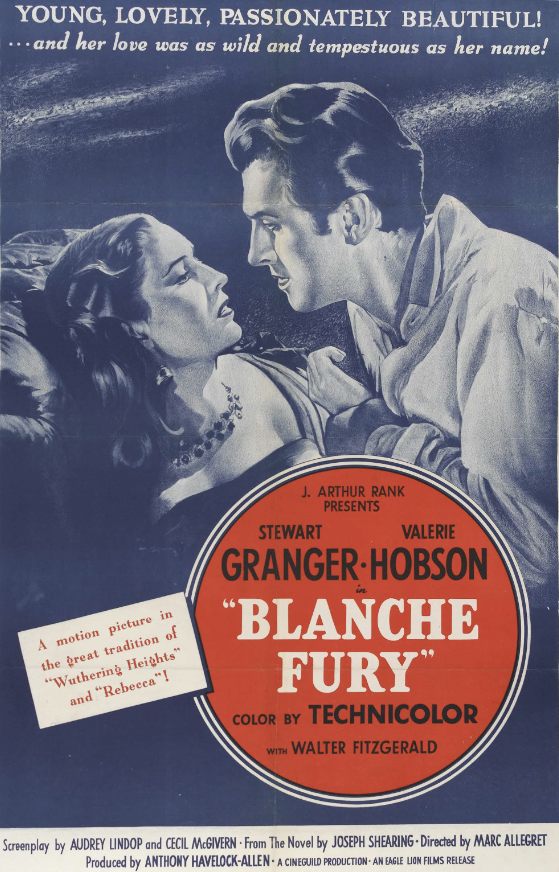
Blanche Fury (Feb. 19, 1948)

Marc Allégret’s Blanche Fury is a brilliantly made bodice-ripper. It’s based on the 1939 historical romance by Marjorie Bowen (published under Bowen’s pseudonym “Joseph Shearing”), and it strikes the perfect balance between high-minded Victorian drama and tawdry escapism.

The attractive and imperious English actress Valerie Hobson is perfectly cast as Blanche, a proud young woman forced to labor as a servant after the deaths of her parents.

When the film begins, it is 1853, and Blanche Fuller is continually being sacked from her domestic positions for her acid tongue and independent manner. She is 25 years old, ambitious, and has no desire to live the rest of her life as a paid companion to bedridden old ladies.

So when she accepts a position at Clare Hall from her uncle, Simon Fury (Walter Fitzgerald), she has her sights set on bigger things than room, board, and a small salary.

Her uncle Simon’s son, Laurence Fury (Michael Gough), is a widower with a young daughter, Lavinia (Susanne Gibbs), who has had neither suitable companionship nor adequate tuition since her mother’s death.

Blanche and the young girl have an easy rapport and grow to love each other. The same cannot be said of Blanche and Laurence, even though Blanche marries him to secure her position as an aristocratic lady.

The viewer gets the sense that there wouldn’t be much of an erotic spark between them even without the presence of Philip Thorn (Stewart Granger), the illegitimate offspring of the late Adam Thorn and an Italian woman.

Thorn is the squire of Clare Hall, and a servant, but he is as desperate to take his “rightful place” as Blanche is to take hers.

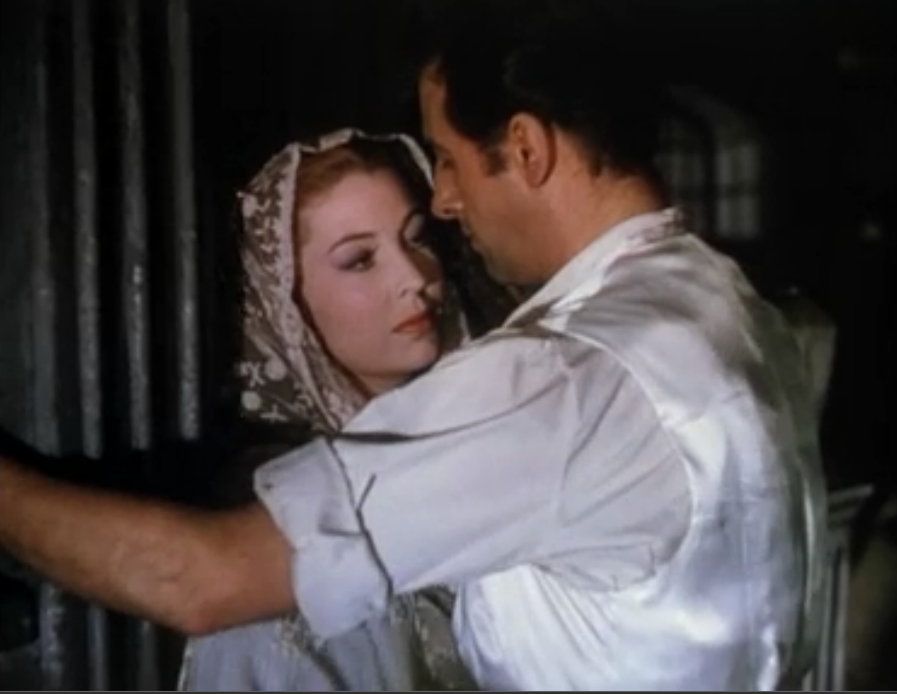
Still photographs don’t fully convey Stewart Granger’s erotic power in this film. His performance as Thorn is as pitch-perfect as Hobson’s performance as Blanche. He perfectly captures Thorn’s ambition and seductive power, as well as the violence and malevolence that swirls below his icy surface.

Blanche Fury has a faster pace than a lot of historical melodramas. There are fires, murders, dastardly schemes, and even dangerous bands of Gypsies. Clifton Parker’s music is full of drama and passion. The Technicolor cinematography is gorgeous. Victorian romances aren’t always to my liking, but it didn’t take long for Blanche Fury to completely engross me.

It’s currently streaming on Netflix. The color looks a little washed out and the print is a little softer than I’d like, but it’s a decent copy. There’s also — at least for the time being — a full version of the film on YouTube, which you can watch below:

http://www.youtube.com/watch?v=OWIVmm96R2o

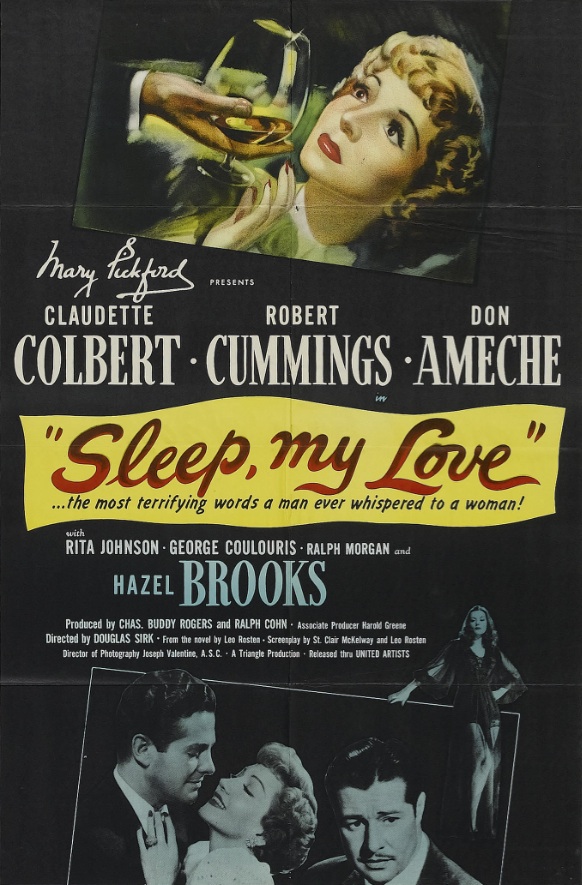
Sleep, My Love (Feb. 18, 1948)

Sleep, My Love is a slick, classy thriller from the slickest, classiest director of all time, Douglas Sirk.

Granted, his greatest work was a few years ahead of him, but even when he was making run-of-the-mill potboilers like Sleep, My Love and Lured (1947), Sirk applied not only his considerable skill as a filmmaker to the material, but also his fetishistic attention to details, and his love of the sumptuous and the glamorous.

The film starts with a bang. Alison Courtland (Claudette Colbert) wakes up from a nightmare on a train, screaming. She doesn’t have any memory of how she got there. The last thing she remembers is going to sleep next to her husband in their palatial home on Sutton Place and East 57th Street.

Oh, and there’s a small pistol in her bag that she doesn’t remember having, either.

Sirk introduces all the players in his mystery early in the film — Alison’s husband, Richard Courtland (Don Ameche), her friend Barby (Rita Johnson), Barby’s brother Bruce (Robert Cummings), Detective Sgt. Strake (Raymond Burr), a mysterious man with horn-rimmed glasses named Charles Vernay (George Coulouris), and the leggy, beautiful Daphne (Hazel Brooks) — but it’s not immediately clear how they all relate to one another.

Much of the pleasure in watching Sleep, My Love comes from seeing how Sirk moves all of his chess pieces around the board. It’s clear from the outset that someone is gaslighting Alison, but who is doing it? And why are they doing it?

This isn’t the kind of mystery in which the solution comes as a complete surprise and is explained by a brilliant detective who gathers all the suspects together in a drawing room; rather, it evolves and reveals itself naturally over the course of the film. It won’t take an astute viewer long to figure out what’s going on, but Sirk isn’t trying to pull the wool over anyone’s eyes. He’s simply making a thrilling film that’s beautiful to look at, and succeeding with aplomb.

Arch of Triumph (Feb. 17, 1948)

Lewis Milestone’s Arch of Triumph has all the elements of a great film, but they never quite coalesce. It’s based on a novel by Erich Maria Remarque, the writer of All Quiet on the Western Front (which was director Milestone’s greatest film success). It stars the patrician Charles Boyer, the beautiful Ingrid Bergman, and the grotesque Charles Laughton, all of whom are well cast. And its setting — Paris in 1939 — is atmospheric. The city was still a refuge for people fleeing the Nazis, but dark clouds were gathering over France, and everyone knew it.

The review of the film in the May 10, 1948, issue of Time called it an “outstanding misfire,” and that’s as good a description as any. Why? At a little more than two hours, is the movie too long? Is it too short? (The rough cut ran about four hours.)

I could go on and on with this kind of equivocation. Is the film too melodramatic? Not melodramatic enough? And so on. Suffice it to say that the film had a budget of $5 million, but doesn’t look nearly that expensive, and that it began filming in 1946 but didn’t make it to movie theaters until 1948.

Boyer plays a Central European medical doctor named Ravic who doesn’t exist on paper. He is in Paris without a passport, and if he’s caught he’ll be deported … or worse. (It is ironic but not disconcertingly dissonant to watch Boyer, the archetypal Frenchman, play a refugee in Paris.)

One night Ravic meets a despondent young woman named Joan Madou (Bergman), standing on a bridge, possibly contemplating suicide. They embark on a love affair that is as doomed as it is long-winded; they leave Paris on holiday, they return, Ravic is caught by the police, Joan attaches herself to another man, Ravic returns to Paris, etc.

For the most part, Arch of Triumph is an overlong, soapy melodrama. Every time Charles Laughton is on screen, however, it feels like a thriller. Laughton plays Ivon Haake, the Nazi officer who tortured and interrogated Ravic and murdered Ravic’s former lover. Ravic has vowed to avenge her death, and the scenes in which he stalks Haake through the nighttime streets of Paris generate the most excitement in the film, and lead to an exciting and violent conclusion (although the violence as originally written in the script had to be toned down for the Breen Office).

After Ravic’s arrest at about the midpoint of the film, his fellow refugee, the White Russian “Col.” Boris Morosov (Louis Calhern), tells Joan, “History has no special accommodations for lovers.”

It’s this sense of the great weight of history bearing down on people’s lives that is my most lasting impression of the film. Arch of Triumph is a much less hopeful film than the similarly themed Casablanca, but its dour tone suits the proceedings well. I certainly didn’t hate Arch of Triumph, and for the most part I liked it. There’s just the sense that something’s missing from the overall experience when the credits roll.

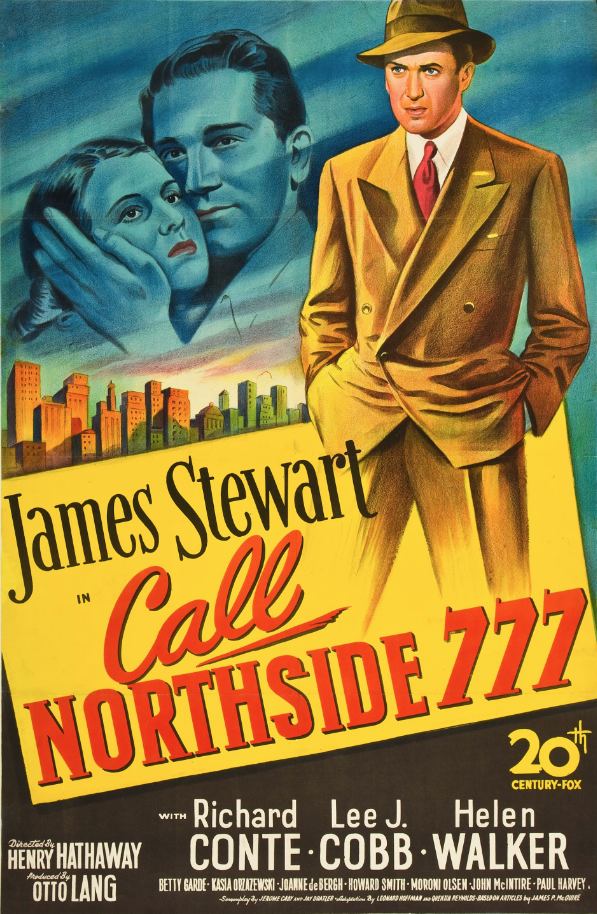
Call Northside 777 (Feb. 1, 1948)

Call Northside 777 is the latest in director Henry Hathaway’s series of fact-based dramas.

Together with producer Louis de Rochemont, the creator of the March of Time series of newsreels, Hathaway made The House on 92nd Street (1945) and 13 Rue Madeleine (1947), which were both based on the wartime exploits of the OSS.

Unlike Hathaway’s previous film, Kiss of Death (1947), which was fiction, but made in a verité style and filmed on location, Call Northside 777 is more in line with Louis de Rochemont’s Boomerang (1947), which was directed by Elia Kazan.

Like Boomerang, Call Northside 777 is about a miscarriage of justice.

In 1933, Joseph Majczek and another man, Theodore Marcinkiewicz, were convicted of killing a Chicago police officer the previous year. In 1944, their convictions were overturned when a crusading reporter named James McGuire helped prove that the eyewitness who gave the testimony that sent the two men to prison had perjured herself under pressure from the police.

Majczek is renamed “Frank Wiecek,” and he’s played by Richard Conte. The crusading Chicago Times reporter is renamed “Jim McNeal” and he’s played by James Stewart.

McNeal’s editor, Brian Kelly (Lee J. Cobb), spots a notice in the classified section of the Times — “$5000 reward for killers of Officer Bundy on Dec. 9, 1932. Call Northside 777. Ask for Tillie Wiecek 12-7 p.m.” — and sends McNeal to investigate.

Tillie Wiecek (Kasia Orzazewski) is the convicted man’s mother. She earned the $5,000 by scrubbing floors.

After McNeal interviews Mrs. Wiecek, his wife Laura (Helen Walker) says to him, “I wasn’t thinking about the boy, I was thinking about his mother. You know what it is? It catches your imagination. Nobody knows whether she’s right or not. She’s worked so hard, she’s had such faith that, well, I want her to be right.”

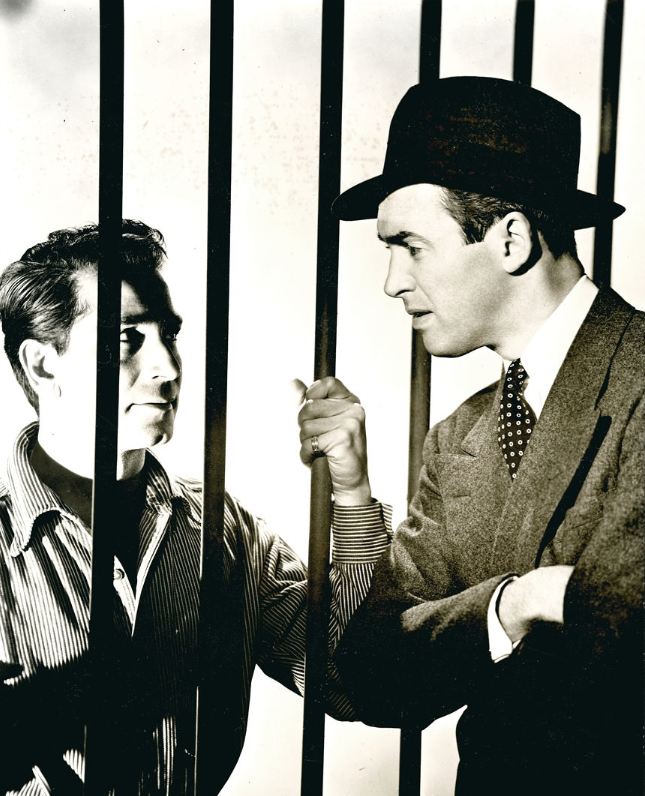
McNeal, on the other hand, is hard-nosed and unsentimental about the case. As he tells Wiecek when he goes to prison to interview him, “She believes you. I need proof. This thing’s gotta have sock — mass appeal. It’s the only way we’ll be able to help you.”

Eventually, though, the evidence begins to pile up, and even the cynical McNeal is convinced of Wiecek’s innocence.

Call Northside 777 was released on DVD in 2004 as part of the Fox Film Noir collection, but there’s very little thematically that marks it as “noir.” The closest the film gets stylistically to being a film noir is toward the end of the picture, when McNeal scours the Polish neighborhoods of Chicago in search of the eyewitness in the Wiecek case, Wanda Skutnik (Betty Garde). These scenes are bathed in shadows and shot through with suspense.

For the most part, though, Call Northside 777 is lit and shot in a neutral, docudrama fashion, which is a shame, since it was the first big Hollywood production filmed in Chicago. There are a few shots of the Merchandise Mart, the Loop, and Holy Trinity Polish Mission, but most of the film takes place indoors.

It’s a good film, but since it’s mostly a hidebound retelling of established facts, it’s never as thrilling or suspensful as a piece of pure fiction like Kiss of Death. It’s interesting, for instance, that Leonarde Keeler, the co-inventor of the polygraph, plays himself in the scene in which Wiecek is given a lie detector test, but it’s not really the stuff of great drama.

The best thing about the film is Jimmy Stewart’s performance. He handles his character’s progression from a cynical reporter who’s “just doing his job” to a man who’s finally found a cause worth fighting for wholly believable and thoroughly involving.

http://www.youtube.com/watch?v=7K5G-9CIUBc

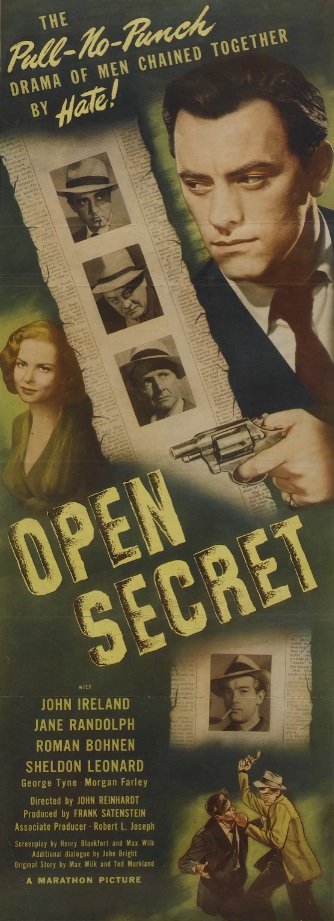
Open Secret (Jan. 31, 1948)

Open Secret
Open Secret (1948)
Directed by John Reinhardt
Marathon Pictures

The years following World War II gave us a number of films that explored anti-Semitism in America. On the top of the heap were Elia Kazan’s Gentleman’s Agreement (1947), a thoughtful, Oscar-winning drama, and Edward Dmytryk’s Crossfire (1947), a taut, Oscar-nominated thriller.

On the bottom of the bill, so to speak, were movies like the Monogram cheapie Violence (1947), which was about a cabal of American fascists who were dedicated to preserving “America for Americans,” although the film never really got into specifics about who they intended to preserve it from.

John Reinhardt’s Open Secret, on the other hand, is just as cheap as Violence (possibly even cheaper), but it’s very specific about who its anti-Semitic antagonists hate.

Open Secret grabs viewers right from the beginning with a pre-credits sequence. (A rare occurrence in movies made in the ’40s.) A man walks into the back room of a bar, where a group of men sit around a poker table, and stands in the shadows, his face hidden. The camera pans across the men’s faces until one of the men finally speaks. “He’s guilty,” he says. “Well, get going,” says the man in the shadows. The men get going, and walk by Marathon Pictures Presents painted on the side of a fence like “Kilroy Was Here.”

The following 66 minutes of Open Secret don’t always live up to to the exciting promise of the first 2, but it’s briskly paced and features a good lead performance by the always-dependable John Ireland. He’s reunited with Jane Randolph, his co-star from Railroaded (1947). They play a newlywed couple, Paul and Nancy Lester, who are the polar opposites of the boozy thugs they played in Railroaded.

Faced with a hotel shortage on their honeymoon, Paul and Nancy stay with Paul’s old friend Ed Stevens (Charles Waldron Jr.), and are shocked when they find pamphlets in his apartment with titles like “The White Knight” and “Were the Nuremberg Trials Fair?”

“Somebody probably stuffed them in his mailbox. Must be. Ed isn’t like that,” Paul says to his wife.

Open Secret has all the hallmarks of a B picture. Like similar offerings from Monogram Pictures and P.R.C., the sets look like they’d fall over if one of the actors sneezed, the music is obtrusive, and the supporting players’ acting is more wooden than a Louisville Slugger. But on the plus side it has an interesting premise, a decent script, and the “star” players are all convincing. I always enjoy seeing Sheldon Leonard (he plays a detective in Open Secret), and George Tyne, who plays Harry Strauss, the proprietor of a camera shop, is also good.

Strauss is targeted by his prejudiced neighbors, not only because he’s Jewish, but because he’s in possession of some damning photographic evidence.

Open Secret is also interesting because it’s the earliest film I’ve seen in which a television is present. There’s a scene in Strauss’s shop that shows him and another man watching a baseball game on the television behind his counter. Full-scale commercial television broadcasting began in 1947, and televisions started showing up in large numbers in bars, hotels, and private homes, but Open Secret is the first film in which I’ve seen characters watching television.

Excluding science-fiction films, does anyone know of an earlier film that showed people watching television? If you do, please comment.

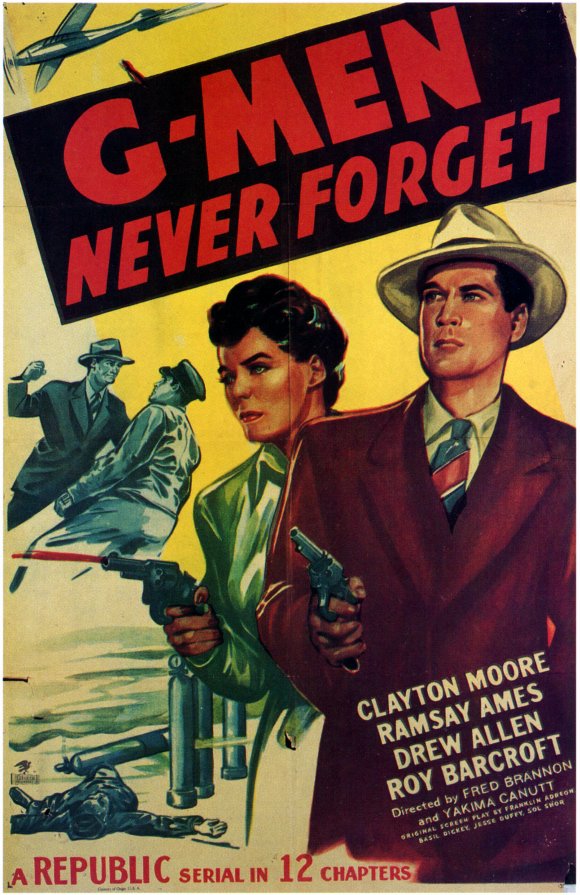
G-Men Never Forget (12 chapters) (Nov. 13, 1947-Jan. 29, 1948)

Republic serials were always solidly entertaining Saturday-afternoon time wasters for the kiddies, and G-Men Never Forget is no exception. It never soars to the heights reached by The Adventures of Captain Marvel (1941) or thrills with the same combination of intrigue and action as Spy Smasher (1942), but then again, neither has any other serial I’ve seen that was made after World War II.

G-Men Never Forget was co-directed by dependable chapterplay workhorse Fred C. Brannon and legendary stuntman and stunt coordinator Yakima Canutt. It stars Clayton Moore (who would go on to play the Lone Ranger on TV starting in 1949) as FBI agent Ted O’Hara. (It’s never explicitly stated, but I’m pretty sure O’Hara has an excellent memory.)

O’Hara is paired with the beautiful Ramsay Ames, who plays police officer Detective Sergeant Frances Blake. O’Hara and Blake start out pretending to be husband and wife criminals so O’Hara can infiltrate a gang run by the beefy criminal mastermind Vic Murkland (Roy Barcroft).

Murkland himself goes undercover in the FBI after getting plastic surgery to look like FBI Commissioner Angus Cameron, and operates from that position for most of the serial. O’Hara, on the other hand, is found out in the first chapter of G-Men Never Forget, slugs it out with one of the baddies, and is back to committing feats of derring-do as an FBI agent in no time.

I couldn’t help thinking this serial would have been more interesting if Murkland had been undercover with the FBI while O’Hara was undercover with the crooks, but we’d have to wait until Infernal Affairs and The Departed for that kind of action.

I’ve had a crush on Ramsay Ames since seeing her in The Mummy’s Ghost. I liked her in G-Men Never Forget, but she’d lost a bit of weight by this point, which made her more “glamorous” and “angular,” but less appealing, at least in my opinion.

I wouldn’t recommend G-Men Never Forget to someone unfamiliar with serials, but if you’re a fan of serials and have already seen all of the best ones, it’s a strong second-tier offering. It features car chases, shootouts, explosive cliffhangers, and furniture-destroying fist fights. I was hoping for something a little more over-the-top considering Yakima Canutt was one of the directors, but I was never less than entertained by the proceedings.

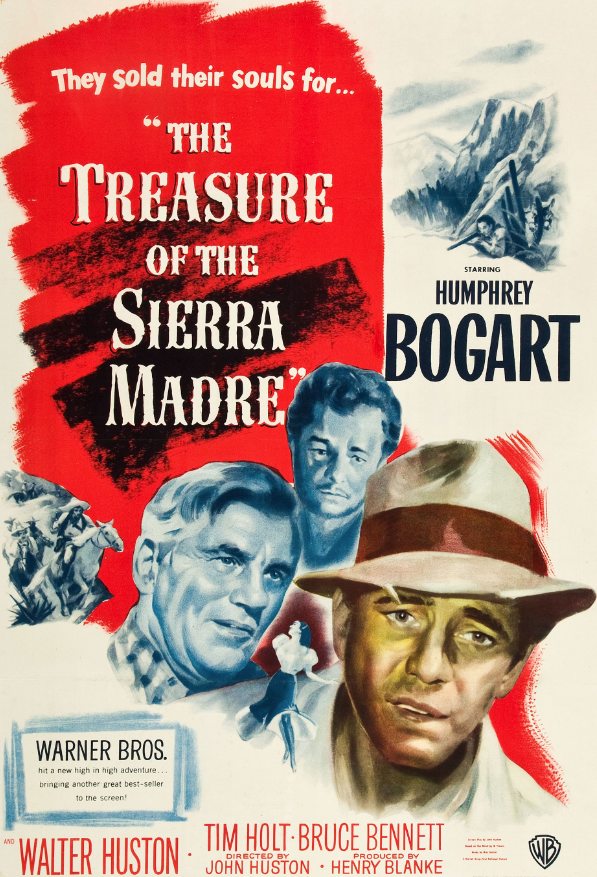
The Treasure of the Sierra Madre (Jan. 24, 1948)

The Treasure of the Sierra Madre
The Treasure of the Sierra Madre (1948)
Directed by John Huston
Warner Bros.

In his review of Elmore Leonard’s 1995 novel Riding the Rap, Martin Amis wrote that “Mr. Leonard has only one plot. All his thrillers are Pardoner’s Tales, in which Death roams the land — usually Miami or Detroit — disguised as money.”

The same could be said of John Huston’s The Treasure of the Sierra Madre, but instead of the duffel bags full of cash found in Leonard’s hard-boiled crime novels, money in this film takes the form of gold.

The gold in The Treasure of the Sierra Madre isn’t just a disguise for death, either; it’s the impetus for all manner of human striving and weakness, and brings out the best and the worst in the men who seek it.

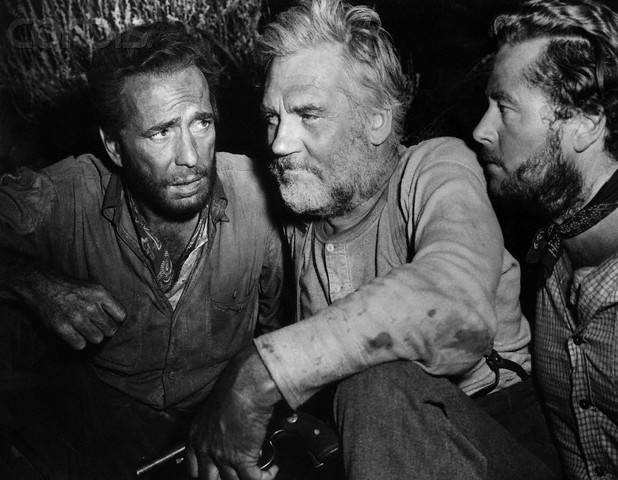
As for the film itself, it mostly brings out the best in all of its actors. Neither Humphrey Bogart nor Tim Holt are completely able to shed their well-worn personas, but the same cannot be said of Walter Huston, the director’s father, who is pitch-perfect in his role. (Also, it’s likely that many people who watch The Treasure of the Sierra Madre today will have never seen Tim Holt in any of his countless B westerns and therefore have little trouble accepting him in his role.)

Bogart plays Fred C. Dobbs, a man who finds himself penniless in Tampico, Mexico. He meets fellow American drifter Bob Curtin (Holt) and together they get jobs working in the oilfields, but their unscrupulous employer runs off without paying them, leaving them back where they started. However, luck smiles on them, and after winning a little money they hook up with an old prospector named Howard (Walter Huston) and head for the Sierra Madre mountains to mine their fortune. Howard warns Dobbs and Curtin of the dangers of “gold fever,” but they both claim they’ll deal with their windfalls sensibly if they strike it rich.

No points will be awarded first-time viewers who correctly predict that the protagonists will both strike it rich and succumb to greed and paranoia.

The Treasure of the Sierra Madre is based on the 1927 novel by the mysterious author “B. Traven.” Little is known about the possibly German-born novelist who probably lived most of his life in Mexico, which is where most of his fiction is set. According to the February 2, 1948, issue of Time, Traven was paid $5,000 for the screen rights to his novel. Traven was such a mysterious figure that although director Huston frequently corresponded with him, when it came time to meet Traven, a nervous translator named “Hal Croves” showed up in his place, claiming to be a close friend of Traven’s. Huston hired Croves as a technical adviser on the film, paying him $150 a week. Huston strongly suspected (but could never conclusively determine) that “Croves” was really Traven.

The Treasure of the Sierra Madre was nominated for four Oscars — best picture, best director, best supporting actor for Walter Huston, and best screenplay. It won every Academy Award for which it was nominated except for best picture.

The Treasure of the Sierra Madre is a great film. It’s also one of those rare movies — like Casablanca — that even people who “don’t like old movies” will usually enjoy. It has excellent pacing, an involving story, and believable characters, but most importantly, it has authenticity. It was filmed mostly on location in Mexico, and the Mexican characters actually speak Spanish. It’s ironic that this is the movie that gave us the most enduringly stereotypical “Mexican” line — “I don’t have to show you any steenking batches!” — because it’s one of the few films from the ’40s in which Mexican characters actually speak Spanish, and without even subtitles to make things easier on a gringo audience.

Musik i mörker (Jan. 17, 1948)

After Ingmar Bergman’s last movie, Skepp till India land (A Ship to India) (1947), I was expecting more of the dismal same from this one.

Skepp till India land is a bleak, claustrophobic tale of a miserable family, so when I sat down to watch Musik i mörker (Music in Darkness), which is about a blind musician, I was prepared for something even glummer.

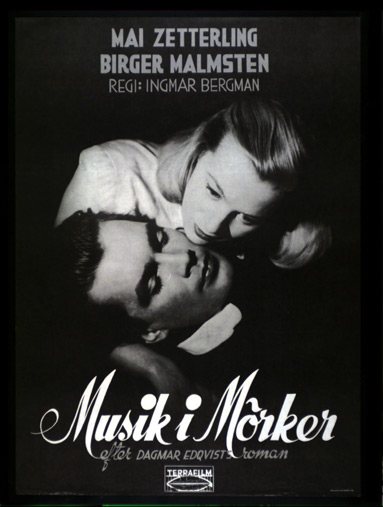
Surprisingly, Musik i mörker is a romantic and even sometimes whimsical film. Birger Malmsten, who played the bitter, hunchbacked son in Skepp till India land, here plays a sweeter, more likable character.

Musik i mörker is based on the novel by Dagmar Edqvist, and she and Bergman collaborated on the screenplay. Malmsten plays Bengt Vyldeke, a young musician who is blinded during his military training (when he attempts to save a little dog that runs out onto a firing range, of all things).

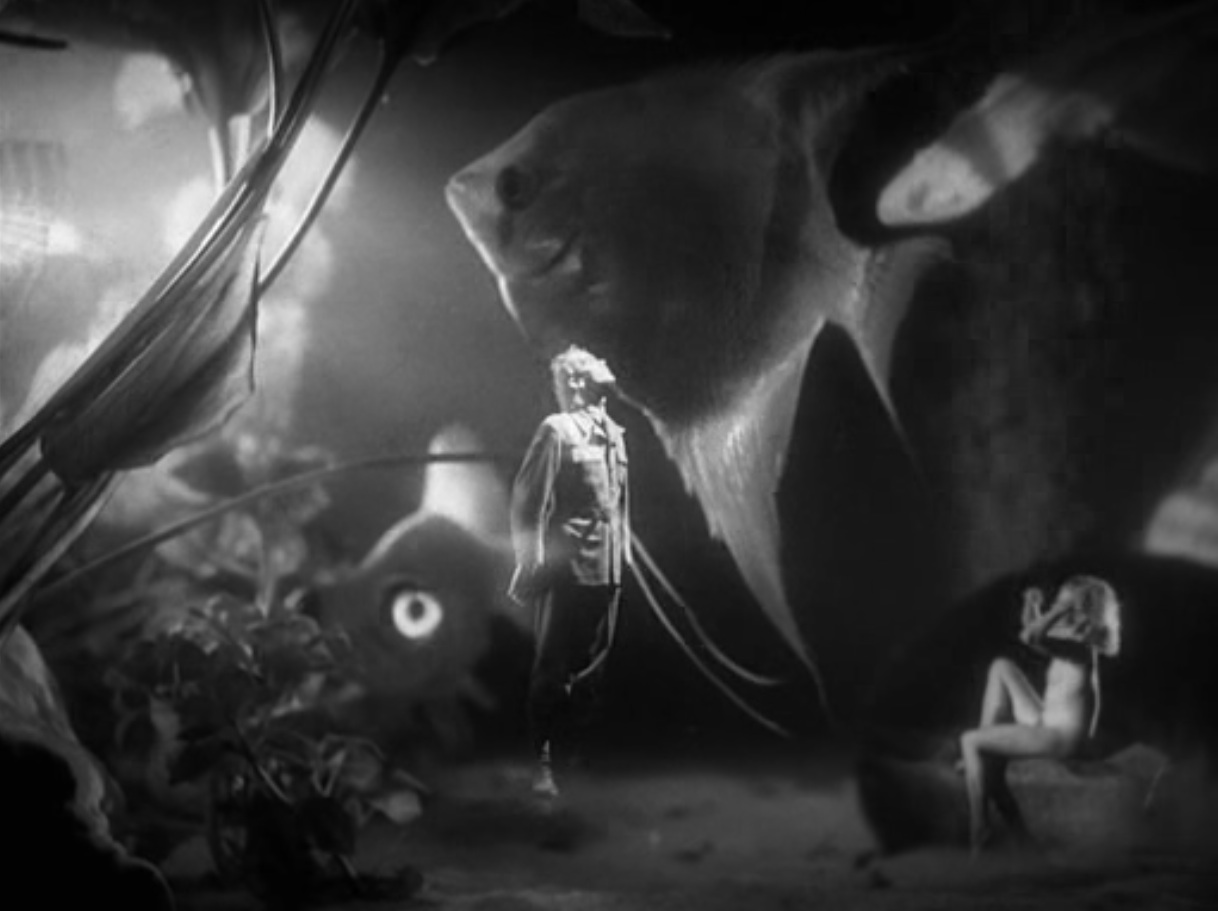
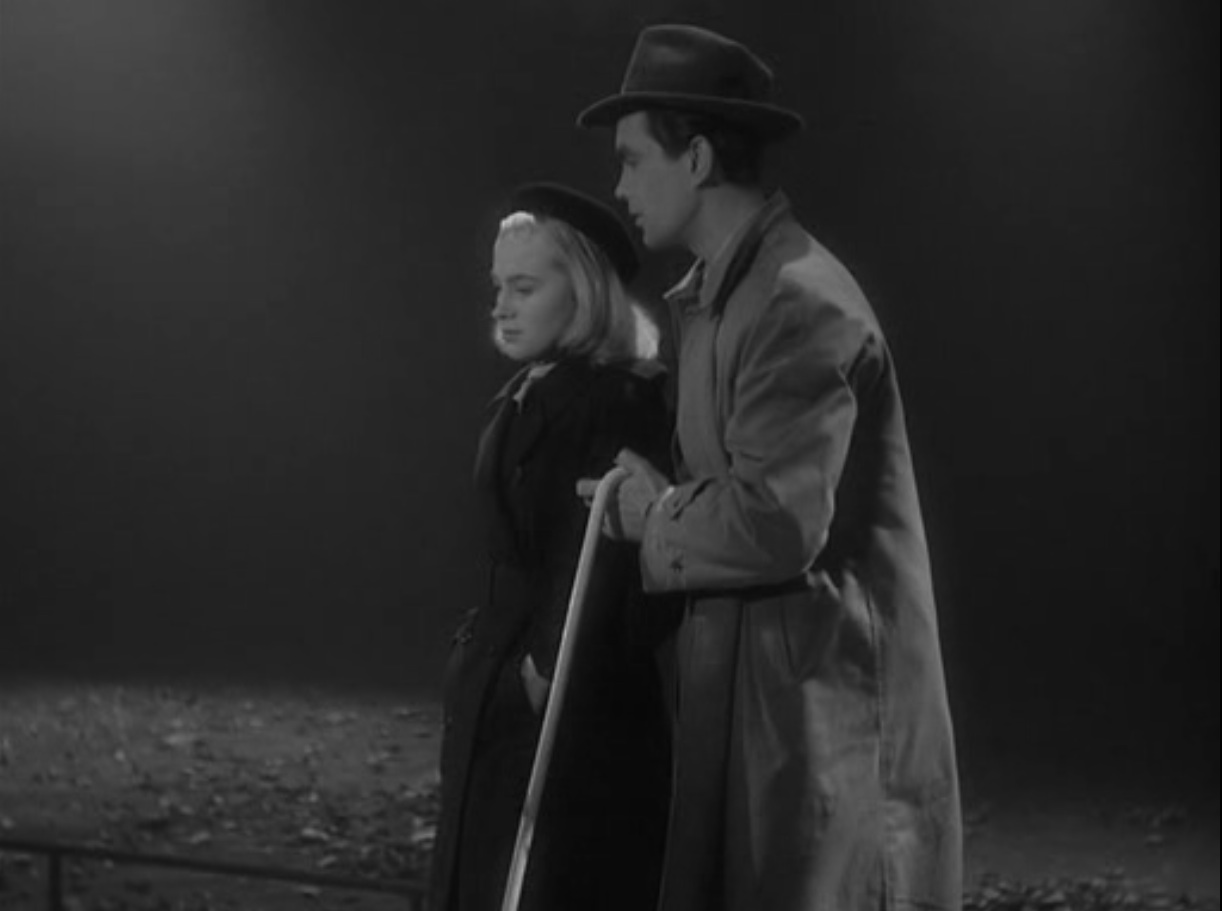
Bergman visually represents Bengt’s initial shock and the blindness that results from his accident in a bizarre dream sequence, shown in the still below:

That’s about as extravagant as Bergman gets in Musik i mörker, but the entire film is pleasingly shot. The lighting is especially good, and beautifully complements the fresh-faced beauty of Mai Zetterling.

Zetterling plays Ingrid, a lower-class servant girl who works for Bengt’s family. She cares for him after he loses his sight, but he is caught in a spiral of self-pity, and eventually he offends her deeply enough to drive her away.

In his second autobiography, Images: My Life in Film (1990), Bergman wrote of making Musik i mörker, “My only memory of the filming is that I kept thinking: Make sure there are no tedious parts. Keep it entertaining. That was my only ambition.”

I think he succeeded. The events of the film are small and intimate, but they move along at a nice clip. Bengt takes a job playing piano in a saloon, he’s cheated by someone he trusts, and he tries to make Ingrid a part of his life again. Meanwhile, Ingrid develops a relationship with a young intellectual named Ebbe (Bengt Eklund) and resists Bengt’s advances when he reenters her life.

Musik i mörker still shows Bergman developing as a director. It’s not a towering cinematic achievement like some of his later films, but it’s a satisfying picture full of gentle romance and bittersweet moments.

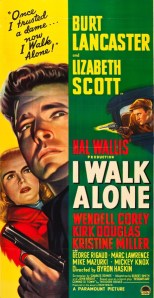
I Walk Alone (Jan. 16, 1948)

It’s the battle of the strutting, preening alpha males!

Fighting out of the blue corner, with the prison pallor, the brand new cheap suit, and the “not good, not bad” room at the Avon, it’s Frankie Madison (Burt Lancaster), former world heavyweight champion of bootlegging.

Fighting out of the red corner, with the jutting cleft chin, the expensive wardrobe, and the controlling interest in the swank night spot the Regent Club, it’s Noll “Dink” Turner (Kirk Douglas), the current world heavyweight champion of upscale criminality.

Let’s get ready to ruuuuuuuuuuuuuuumble!

When the film begins, Frankie, a former hard man in the bootlegging rackets who came up in a tough neighborhood and knew how to handle himself, has just gotten out of prison after a 14-year stretch for murder.

He’s picked up at Grand Central Station by his old friend Dave (Wendell Corey), who’s now the bookkeeper for Dink Turner.

The killing that sent Frankie to prison occurred when he and Dink were running rye whiskey from Canada through upstate New York and they blew through a roadblock set up by hijackers, which led to a chase and a gun battle that left one of the hijackers dead. Afterward, Dink and Frankie split up and agreed to go 50-50 for each other, no matter what happened or which one of them got nabbed.
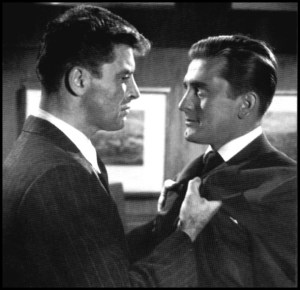
All of Turner’s men call him “Noll” now, but Frankie mostly still refers to him as “Dink.” When Dave takes Frankie to the Regent Club, Frankie recognizes his old friend Dan (Mike Mazurki), a hulking mug who used to be behind the door of Dink and Frankie’s speakeasy the Four Kings, staring through a little peephole. Now he’s out front, in a snappy uniform.

A lot has changed in 14 years, but Frankie’s still the same guy he was when he went to prison.

Dink tells him, “The world’s spun right past you, Frankie. In the ’20s you were great. In the ’30s you might’ve made the switch, but today you’re finished. As dead as the headlines the day you went into prison.” (On New Year’s Day, 1930, Burt Lancaster was 16 years old and Kirk Douglas had just turned 13, so I think both men might be a little young for the roles they’re playing.)

The Regent Club was built on the force of Dink’s personality. It was his personality that controlled Frankie back in their bootlegging days. He expects the force of his personality to still be able to get Frankie to do what he wants, but all of his smooth talk and finesse only carries him so far.

Frankie is bitter than Dink never came to personally visit him in prison, and instead sent Dave, even though the prison was only an hour’s drive on the new parkway. All Dink did was send Frankie a carton of cigarettes a month.

Dink tells Frankie he feels terrible about never coming to see him, but that he just couldn’t be associated with a convicted murderer when he was building up a high-class joint like the Regent Club. Back in the days of the Four Kings they ruled things by force, but now Dink deals with banks and lawyers, and his nightclub has a Dun & Bradstreet rating.

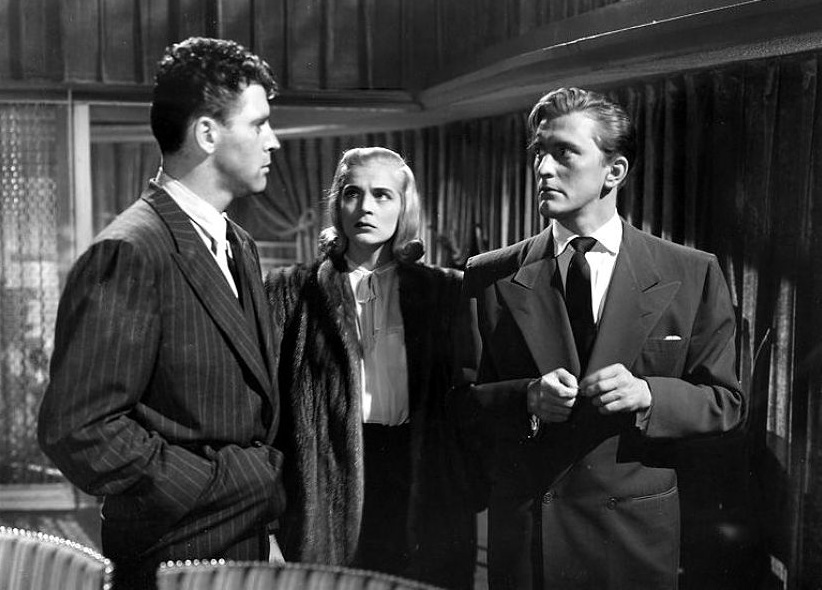
Dink manages to deflect Frankie for a little while by setting him up with his paramour Kay Lawrence, who’s played by the angular, dead-eyed beauty Lizabeth Scott. Dink tells Kay he wants her to find out what Frankie really wants, so he can help him, but she can’t help falling for Frankie a little, especially after Dink shows his true colors by planning to marry the wealthy Mrs. Alexis Richardson (Kristine Miller) while telling Kay that it’s just to increase his wealth and prestige, and his upcoming nuptials don’t have to change anything between him and Kay.

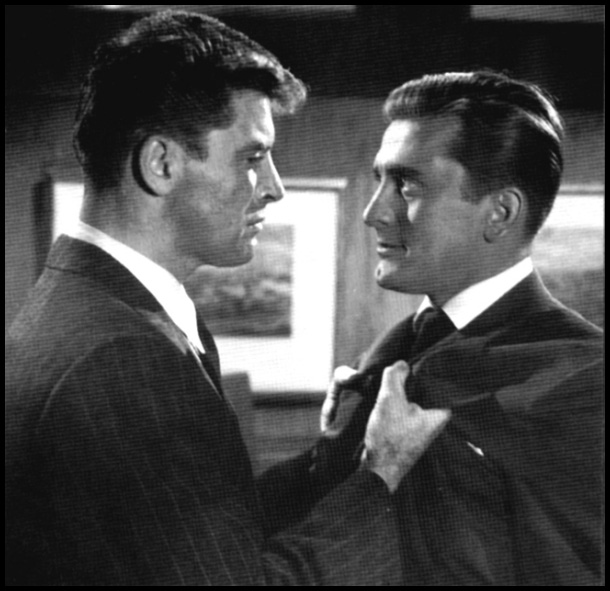
Frankie is volatile and brutish. He wants what’s his. But he’s like a bulldozer and Dink is like a silk curtain. No matter how hard he comes at him, Dink just seems to slide harmlessly to one side.
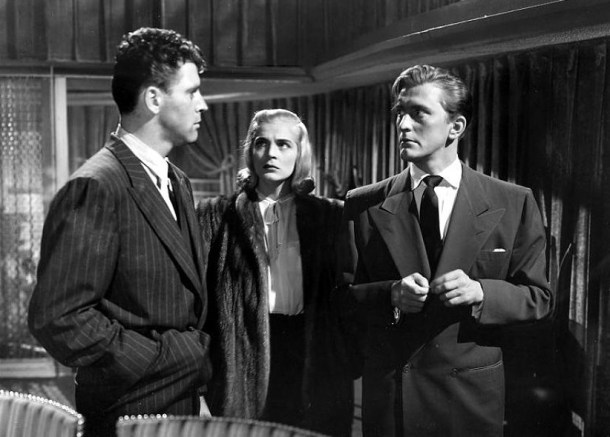
Dink tells Frankie that their 50-50 agreement was based on their partnership in the Four Kings, not on anything future. Dave brought Frankie a lot of things to sign in prison that he didn’t read very carefully, and one of them was a dissolution of his partnership in the Four Kings. After closing costs, plus 6% interest compounded over 14 years, there’s $2,912 Frankie has coming to him. Dink makes it an even $3,000 and wishes him well. Frankie wants half of everything Dink has, but Dink doesn’t think Frankie’s entitled to anything Dink earned on his own after the Four Kings closed down. “How can you collect on a race when you don’t hold a ticket?” Dink asks Frankie rhetorically.

This confrontation occurs about two-thirds of the way through the film, and it’s a great sequence. Burt Lancaster was a former acrobat and circus performer, and he was always wonderful at using his body. When he finally realizes how little he can do to get what he wants from Dink, he stands alone in the middle of Dink’s conference room, his fists balled, bent over in anguish.

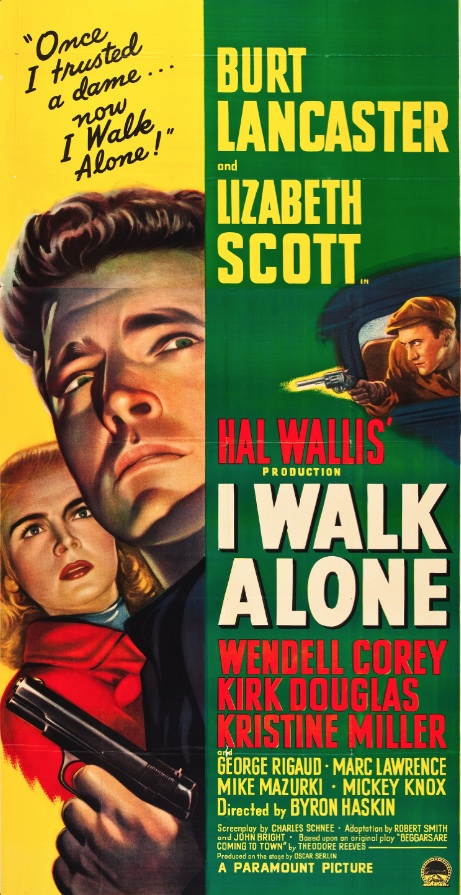
I Walk Alone was directed by Byron Haskin and produced by Hal B. Wallis. The screenplay is by Charles Schnee, and it’s based on the play Beggars Are Coming to Town by Theodore Reeves.

It’s not a bad film, but it’s not good enough to be called a classic. Part of the problem is that it too often strays from its most compelling feature, the snarling macho men at its center who oppose each other. I was really caught up in the story when Dink denies Frankie his half and Frankie vows to kill him, but then the story veers into less interesting territory. Where does Dave’s loyalty lie? What does Dink have over Dave? Will Dave be able to break free? Does Kay really love Frankie? And so on.

Lancaster and Douglas are both outsized personalities who dominate the screen. By the time things come to a head two-thirds of the way through the film, the picture might have been more compelling if it focused solely on them and their head-to-head conflict, instead of spinning off a variety of plot threads.

The film ends with a shootout in a darkened room that we’ve seen a hundred times before and will probably see a thousand times again. Like everything else in the film, it’s not terrible, but it’s too run-of-the-mill to be truly outstanding.

I Walk Alone is definitely worth seeing if you’re a die-hard fan of either of the two lead actors, and worth a look for film noir fans who’ve never seen it. If, however, you’re looking for something truly great, I Walk Alone never quite rises above the level of entertaining mediocrity.