The Iron Curtain (May 12, 1948)

The Iron Curtain
The Iron Curtain (1948)
Directed by William A. Wellman
20th Century-Fox

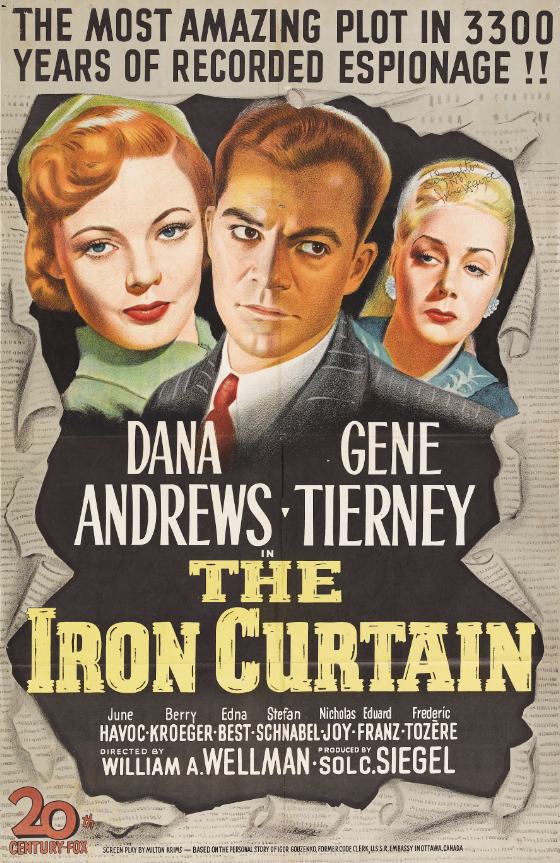
William A. Wellman’s The Iron Curtain was the first appearance of Dana Andrews and Gene Tierney together in a film since Otto Preminger’s Laura (1944). This really has no bearing on The Iron Curtain, but I love the movie Laura and Andrews and Tierney are one of my favorite screen couples, so it was fun to see them play completely different roles.

The Iron Curtain is the fictionalized tale of Igor Gouzenko, a Soviet code clerk who was stationed at the U.S.S.R. Embassy in Ottawa and discovered that American military secrets and other products of Soviet espionage were being transmitted through his office.

There is the obligatory text preceding the film that tells the viewer that all the documents presented appear exactly as they did in actual court records, as authenticated by the R.C.M.P.

This is a standard opening for a docudrama, which in the late ’40s was sort of a subgenre of film noir, with dramatic lighting, expressionistic camera angles, and subjective storytelling applied to true stories of espionage or miscarried justice, like The House on 92nd Street (1945), 13 Rue Madeleine (1947), Boomerang (1947), and Call Northside 777 (1948). These films used actual locations, documents, and occasionally even the actual participants in historical events to add sizzle to their “ripped from the headlines” plots.

When Gouzenko first arrives in Canada he’s the perfect apparatchik, devoted to Marxism and to the Communist Party. When one of his fellow Soviet embassy workers, Nina Karanova (June Havoc), shows him her spacious, well-decorated apartment, he berates her for her laxity and for being seduced by the trappings of Western decadence. But a chain of events conspires to force Gouzenko to experience some character development. His wife, Anna Gouzenko (Gene Tierney), joins him in Ottawa, and together they experience the friendliness and good hearts of their North American neighbors, and realize that they might have more in common with their “enemies” than they thought. At work, Gouzenko is haunted by the drunken recollections of Maj. Semyon Kulin (Eduard Franz), who murdered some of his own men to force others to “volunteer” for a mission during the war.

When Gouzenko discovers that he is passing classified information from the embassy back to Moscow — American nuclear secrets, the details of a supposedly secret meeting in Canada between FDR and Churchill, details of sleeper agents — he experiences a crisis of conscience, and has to decide if he should turn documents over to the Canadian Minister of Justice and put his life and the lives of his wife and child in danger.

The Iron Curtain is a slick, well-made thriller that doesn’t generate suspense through over-the-top elements like chases or shootouts, but rather through grounded, real-life elements like the threat of the NKVD, the Soviet Secret Police.

When the story of Igor Gouzenko was originally covered by the media in February 1946, it was the beginning of public awareness of the Cold War. The revelation that our former allies were running a spy ring in North America had a profound impact that would last for decades. The Iron Curtain is the earliest film I’ve seen to tackle the looming Soviet menace, and it’s more tasteful and factually accurate than some of the outré Red Scare flicks the ’50s would give us.

Hamlet (May 4, 1948)

Hamlet
Hamlet (1948)
Directed by Laurence Olivier
Two Cities Films / Universal Pictures

Laurence Olivier’s Hamlet dominated the 21st Academy Awards with seven nominations and four wins. (Jean Negulesco’s Johnny Belinda was nominated in 12 categories — more than any other picture — but only won a single Oscar.)

It was the first time a non-Hollywood production won an Oscar for best picture, and it was the first time an Oscar for best actor was given to an actor who had directed himself. (Besides best picture and best actor, Hamlet also won Oscars for best costume design in a black and white picture and best art direction in a black and white picture.)

These accolades represented something of a vindication for Olivier, whose previous film, Henry V (1944), was nominated for best picture and best actor Oscars (among others), but only received a special Academy Award “for his outstanding achievement as actor, producer, and director in bringing Henry V to the screen,” which Olivier considered “a fob-off.”

Well, sometimes great works require big egos, and Hamlet is proof. It’s a dark, expressionistic psychodrama and a deeply satisfying cinematic achievement, which is no small feat for a film based on a play by William Shakespeare. While Shakespeare is an unassailable and towering figure in English literature, I don’t find most films based on his plays very satisfying. They either treat his texts with stodgy reverence or go off the deep end with ridiculous costumes and set pieces that seem designed to draw in viewers who find Shakespeare “boring.”

Olivier’s Technicolor production of Henry V played around with artifice, beginning by showing the inner workings of a stage play complete with shots of the actors backstage waiting for their cues and slowly became more realistic, culminating in the battle of Agincourt, which was filmed outdoors.

Hamlet, on the other hand, establishes its moody, black and white world with the opening shots and stays the course. Olivier’s camera moves in a lissome fashion around his fog-shrouded castle set, which is a hulking, brooding character unto itself, towering over a dark, roiling sea. The dialogue and the movement of the actors are treated as realistically as possible. Monologues are not delivered in a theatrical fashion toward the audience, but in voiceover as the actor silently broods.

Hamlet was mostly a success with the critics, but Shakespeare purists took umbrage at Olivier’s tinkering with the text, since he cut out roughly half the play, losing whole characters in the process.

There were numerous minor cuts, too, as the very first moments of the film demonstrate. Olivier’s Hamlet begins with the lines from Act 1, Scene 4, that precede the appearance of the ghost. They appear onscreen and are spoken by the narrator. Olivier excised certain lines, which I’ve shown below as crossed-out text:

So oft it chances in particular men
That for some vicious mole of nature in them—
As in their birth (wherein they are not guilty,
Since nature cannot choose his origin),

By the o’ergrowth of some complexion,
Oft breaking down the pales and forts of reason,
Or by some habit that [grown] too much o’erleavens
The form of plausive manners—
that these men,
Carrying, I say, the stamp of one defect,
Being nature’s livery or fortune’s star,
Their virtues else (be they as pure as grace,
As infinite as man may undergo)
Shall in the general censure take corruption
From that particular fault.

The demands of cinema are different from the demands of the stage, and I find these edits sensible and pleasing. However … and this is a big “however” … Oliver ends his prologue with the following line of spoken dialogue, which does not appear in text on screen, but is spoken by the same narrator, and could easily be mistaken for more of Shakespeare’s writing by the unschooled: “This is the tragedy of a man who could not make up his mind.”

To me this seems like pandering, but I suppose it helps to have a “mission statement” for the more thick-headed among us in the audience.

And this is indeed the story of a young man crippled by indecision. By removing all of the political aspects of Hamlet (the character Fortinbras, for instance, is excised completely and is never mentioned), it becomes a character study. For 20th century audiences I think this was the enduring view of Hamlet, and the aspect people found most interesting. Modern audiences probably miss most of the political undertones of the play, which was written at the tail end of the 16th century, when the age of chivalry was dying and the age of global empire was beginning with the creation of the East India Company. Surely Shakespeare’s contemporaries saw aspects of their own time in the tale of a slain king, a usurper on the throne, and a young prince dealing poorly with political realities.

Even in its edited form, Olivier’s Hamlet runs for a little more than two and a half hours. There simply would have been no way to film the entire play and end up with a commercially successful film. (When Kenneth Branagh filmed a complete version of Hamlet in 1996 it clocked in at 242 minutes and was not widely released theatrically. The cut version was 150 minutes.)

If you can stomach an edited Bard, Olivier’s Hamlet stands as one of the best cinematic adaptations of Shakespeare. The cast are all good, including Jean Simmons as Ophelia, Basil Sydney as Claudia, Eileen Herlie as Gertrude, Norman Wooland as Horatio, Felix Aylmer as Polonius, and Terence Morgan as Laertes. But the real star is Olivier, both in front of and behind the camera.

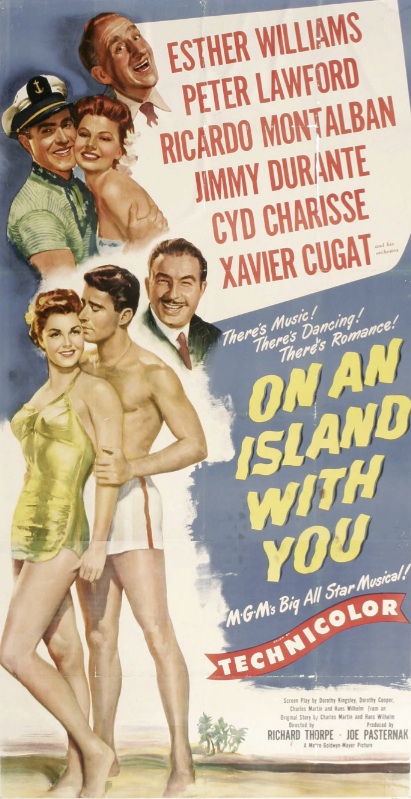
On an Island With You (May 3, 1948)

On an Island With You was director Richard Thorpe’s fourth film to star the shimmering sea creature Esther Williams.

I didn’t get a chance to see the last film they made together, This Time for Keeps (1947), but I enjoyed On an Island With You a lot more than their second collaboration, the disappointing bullfighting drama Fiesta (1947), mostly because On an Island With You allows Williams to do what she did best — look stunning in and out of the water, and perform some spectacular water ballet numbers. (I’ve also never seen Thorpe’s first film starring Williams, Thrill of a Romance (1945) … what kind of an Esther Williams fan am I?!?)

In On an Island With You, she’s again paired with Mexican heartthrob Ricardo Montalban — her co-star in Fiesta (1947) — and also with Peter Lawford, who comes off as a real drip compared to the dashing Montalban.

This is too bad, since the audience is supposed to be rooting for Lt. Lawrence Y. Kingslee (Lawford), who fell in love with movie star Rosalind Rennolds (Williams) when he was serving in the South Pacific in World War II. Rosalind was doing a USO tour to raise the boys’ morale, and doesn’t even remember meeting Lt. Kingslee. She had too many brief romantic dalliances during the war to remember one more than any of the others, but for him it was the single most important event of his life.

As is all too common in movies from the ’40s, his romantic brio is so excessive it borders on stalking. During a break in the filming of Rosalind’s latest picture, Lt. Kingslee flies her away to the island where they met against her will. The rub is that real islands aren’t like islands in the movies. There are leeches and sinkholes, and when they’re away from the plane the natives steal the wheels. On the plus side, he remembers where he buried all the cans of Spam around the old Quonset hut where he used to bunk.

There’s a metafictional element to On an Island With You, since the film Rosalind is making with her fiancé, Ricardo Montez (played by Ricardo Montalban), is also called “On an Island With You,” and in all the spectacular dance numbers there are at least a few shots of the cameramen filming the action to remind you that they’re making a movie.

While I thought Lawford was miscast, there’s plenty of entertainment to be had in On an Island With You. Besides Williams’s luminescent screen presence and big water ballet numbers, Ricardo Montalban has some wonderful dances with Cyd Charisse — all high points of the film — and Xavier Cugat and his Orchestra are on hand for some good musical numbers. I especially liked Cugat’s tiny chihuahua.

Jimmy Durante has a big role in On an Island With You, too. He might even have more screen time than Lawford. I like Durante, but he’s not exactly the first person I want to see when I sit down to watch a Technicolor musical that takes place in the South Pacific.

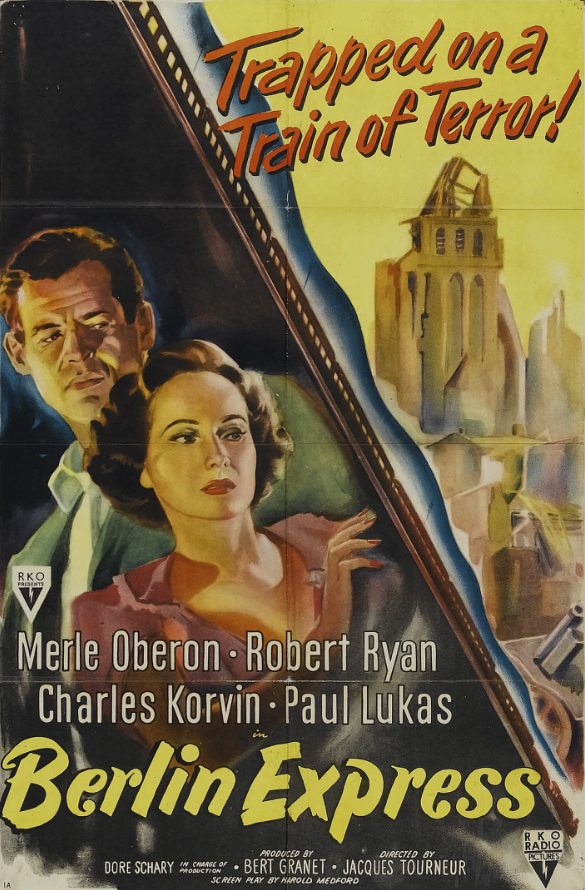
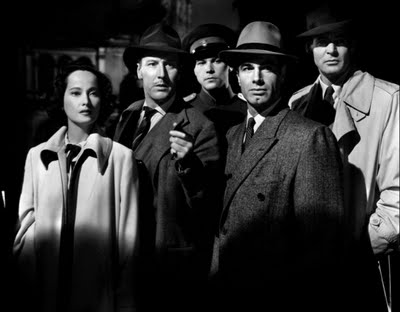
Berlin Express (May 1, 1948)

Jacques Tourneur’s crisp thriller Berlin Express presents occupied Germany in miniature. Every nation associated with Allied-occupied Germany is represented by the film’s characters — the United States, France, Germany, England, and Russia.

It’s filmed in the semi-documentary style that was popular in the late ’40s. Europeans speak to each other in their own languages, with no subtitles (there is a voiceover narrator to explain to the viewer what’s transpiring), and much of Berlin Express was filmed on location in Paris, Frankfurt, and Berlin. (According to IMDb.com, it was the first Hollywood production in Europe after World War II.)

Berlin Express has stylistic elements of the German “Trümmerfilm” (“rubble film”), like Die Mörder sind unter uns (The Murderers Are Among Us) (1946). The German rubble films used the war-ravaged backdrops that were plentiful in German cities heavily bombed during the war. Berlin Express doesn’t have the same gravitas or overwhelming sense of tragedy as the rubble films, but the location footage gives it a sense of authenticity not found in most run-of-the-mill thrillers.

Compared with Jacques Tourneur’s previous film, the film noir masterpiece Out of the Past (1947), Berlin Express is a lesser effort, but Tourneur is a pro, and every one of his films that I’ve seen has been a work of solid craftsmanship.

The MacGuffin in Berlin Express is a note that falls into the hands of the Deuxième Bureau that reads: “21:45 / D / 9850 / Sulzbach.” The first part seems to refer to a time of day (9:45 PM), but there are Sulzbachs in every occupied zone of Germany. What’s happening? And where will it happen?

Enter a multinational motley crew of characters traveling aboard the Berlin Express. In compartment A is Robert J. Lindley (Robert Ryan), a United States Government Agricultural Expert. In compartment B is Lucienne Mirbeau (Merle Oberon), a secretary from France. In compartment C is Herr Otto Franzen (Fritz Kortner), once a German industrialist, now a dealer in scrap iron. Compartment D is unoccupied, but is being held for a “person of importance.” Compartment E is shared by two men, a former British soldier named James Sterling (Robert Coote), and a military aide for the Russian Occupation Authority, Lt. Maxim Kiroshilov (Roman Toporow). In compartment F is Henri Perrot (Charles Korvin), once a member of the French Underground, now a man of commerce. And finally, in compartment G, is Hans Schmidt (Peter von Zerneck), whose occupation is a mystery to the viewer (the whistle of the train covers what the narrator is saying, which is a cute touch).

Of course, this is an espionage thriller, so it should go without saying that not everyone is what they appear to be, and there will be at least one big reveal or switcheroo before the credits roll.

Berlin Express was made during that curious little space in time when World War II was over but the Cold War had not yet kicked into high gear. Its villains may not seem very plausible or consequential to modern viewers, but for my money, a good thriller is a good thriller. The voiceover narration is a little heavy-handed, but for the most part Berlin Express keeps things tight, fast-paced, and properly thrilling.

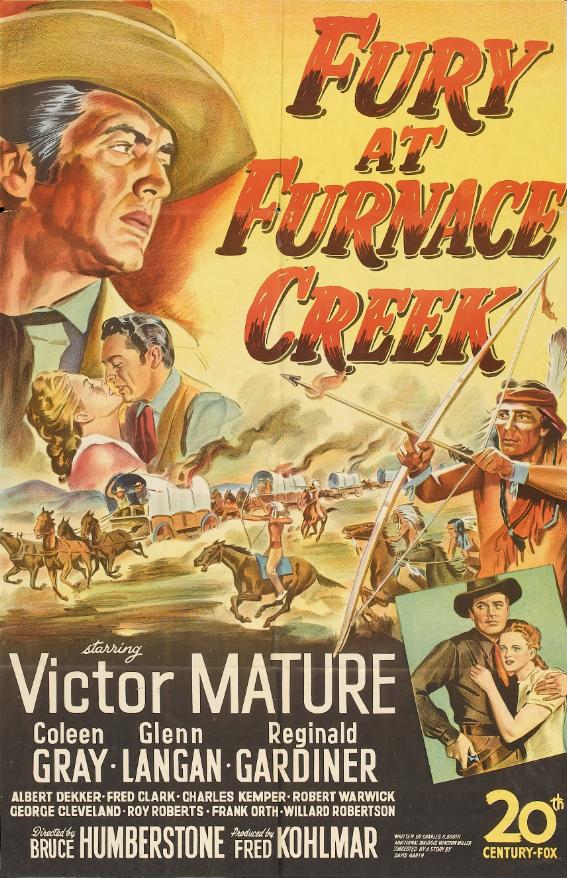
Fury at Furnace Creek (April 30, 1948)

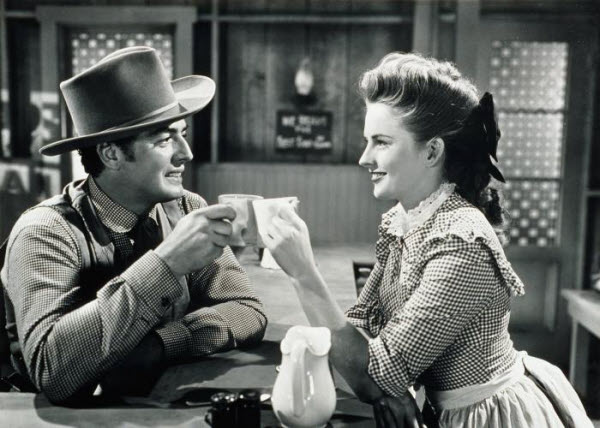
Fury at Furnace Creek might not be a towering classic of western cinema, but I think I flat-out enjoyed it more than any other western I’ve seen recently.

I’ve never been a big fan of Victor Mature, but when he had good material to work with — My Darling Clementine (1946) and Kiss of Death (1947), for instance — he could be an engaging performer. I thought it made a lot of sense for him to play Doc Holliday in My Darling Clementine as a drunk and a gambler, since Mature always looked more at home in a saloon than he did riding the range.

Fury at Furnace Creek allows Mature to stick with this formula, more or less. He plays Cash Blackwell, a fast-on-the-draw gambler who goes undercover to clear his father’s name.

His father, General Fletcher Blackwell (Robert Warwick), died of a stroke during court martial proceedings against him, and not because things we’re going well at his trial. In 1880, the Furnace Hills were still Apache territory, but rumors that the Apaches were using silver in their bullets led to a clamor for the region to be opened to mining. Gen. Blackwell stood accused of issuing an order that left a wagon train unprotected, and the prosecutor implied that this was done purposefully to draw the Apaches into an attack, which directly led to the opening of the area to white settlement.

The evidence is there, too. There is an order, signed by Gen. Blackwell, that supports the prosecution’s case. But even faced with this evidence, Gen. Blackwell still denied ever issuing the order, and he died with the shame of guilt hanging over him.

Enter Cash Blackwell, estranged from his family, but not estranged enough that he doesn’t care about his father’s good name. He goes undercover in Furnace Creek, now a boom town of 10,000 settlers, miners, and merchants. Calling himself “Tex Cameron,” Cash ingratiates himself to the local syndicate by saving the life of Capt. Grover A. Walsh (Reginald Gardiner) at the gambling tables. A gunman named Bird (Fred Clark) planted a card on Capt. Walsh so he could accuse him of cheating and shoot him dead, but Cash sees through the ploy, and puts a bullet in Bird’s gun hand.

“When a man can knock the knuckles off a moving hand at ten paces, I want him on Mr. Leverett’s side,” says Al Shanks (Roy Roberts).

Edward Leverett (Al Dekker) is the head of the Furnace Creek Mining and Development Syndicate, and it’s clear that he’s up to no good, but it’s not clear what his connection to Gen. Blackwell was.

In addition to his detective work, Cash finds time to romance the pretty Molly Baxter (Coleen Gray, who also starred with Mature in Kiss of Death). Molly’s father Bruce died in the massacre at Fort Furnace Creek, and she hates Gen. Blackwell with a passion, potentially complicating things.

And before long, Cash’s brother Capt. Rufe Blackwell (Glenn Langan) also shows up in Furnace Creek with his own plan to clear his father’s name.

Fury at Furnace Creek has a lot of moving parts, but the plot never feels crowded or confusing. Full of coincidences, sure, but not confusing. It’s genuinely suspenseful, and I wasn’t sure how things were going to resolve themselves. It’s a film that occupies the same basic physical space as John Ford’s Fort Apache (1948), but it takes a completely different approach to the western genre. There’s no self-conscious myth-making or grand statements in Fury at Furnace Creek, it’s just a solid, grown-up western with good production values. The music nicely sets the scene, with strains of the cowboy ballad “Bury Me Not on the Lone Prairie” popping up frequently in the score.

The director of Fury at Furnace Creek, Bruce Humberstone (sometimes credited as “H. Bruce Humberstone”), began his career in the silent era and ended up working in just about every genre Hollywood deigned to dip its toe in; musicals, film noir, westerns, war pictures, Charlie Chan mysteries, Tarzan adventures, sports comedies … the list goes on and on. Fury at Furnace Creek is not a great work of art, but it’s made with real flair and craftsmanship. It’s exciting, action-packed, and suspenseful. I enjoyed it a hell of a lot and recommend it to anyone who likes westerns from the Golden Era of Hollywood.

Smart Woman (April 30, 1948)

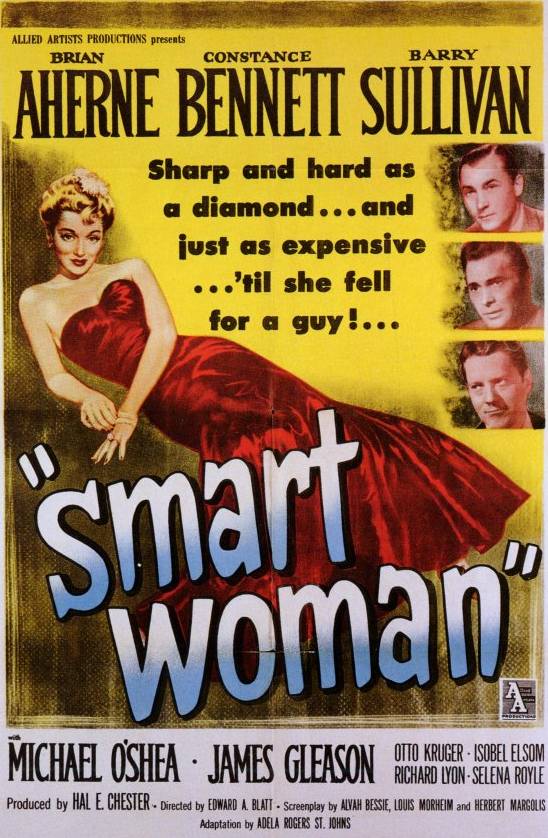
Edward A. Blatt’s Smart Woman is a film of “lasts.” It was the last screenplay for which Alvah Bessie received a credit. (Louis Morheim and Herbert Margolies are also credited for the screenplay, from a story by Leon Gutterman and Edwin V. Westrate.) Bessie was one of the infamous “Hollywood Ten,” a group of people who refused to cooperate with HUAC and who were blacklisted from the movie industry in 1948.

It was also the last film to feature Constance Bennett in a starring role. Bennett was a glamorous actress who appeared in dozens of films in the ’20s and ’30s, but whose star began to fade in the ’40s. (Her younger sister, Barbara Bennett, also appeared in films, and her youngest sister was film noir icon Joan Bennett.)

Smart Woman was the second and final film released by Bennett’s own production company, Constance Bennett Productions (the first was Paris Underground in 1945). It was distributed by Allied Artists. Smart Woman is by no means a bad film, but it’s not difficult to see why it didn’t reignite Bennett’s career and launch her back into starring roles.

Bennett plays defense attorney Paula Rogers, a woman who’s “smart” not just in the cerebral sense, but also in the sense that she is fashionable and sophisticated. She’s a single woman with a young son named Rusty (Richard Lyon), and her love for her son will force her to make difficult decisions as the plot of the film unfolds.

As in most “women’s pictures,” there is a suave, sophisticated, and handsome gentleman to set Paula’s heart (and the hearts of distaff audience members) aflutter with desire. He’s a special prosecutor named Robert Larrimore (Brian Aherne) who’s appointed to investigate cases the crooked district attorney, Bradley Wayne (Otto Kruger), may have improperly handled.

There’s also a slippery gangster named Frank McCoy (Barry Sullivan), whom Paula defends in a murder case. The prosecuting attorney? You guessed it … it’s Larrimore.

Smart Woman is well-made entertainment, but it’s lacking that essential spark that would move it up into the “must-see” category. Thematically, the film has elements of a film noir or gangster picture, but its cinematic style is straightforward and without any baroque flourishes. The script is well-written, but it contains a lot of parallelisms, which always seem more clever to someone hunched over a typewriter than they play out in an actual film. The film’s leads are good, but they had more active careers in the ’30s than they did in the ’40s, and Smart Woman occasionally feels a little old-fashioned because of it.

Under California Stars (April 30, 1948)

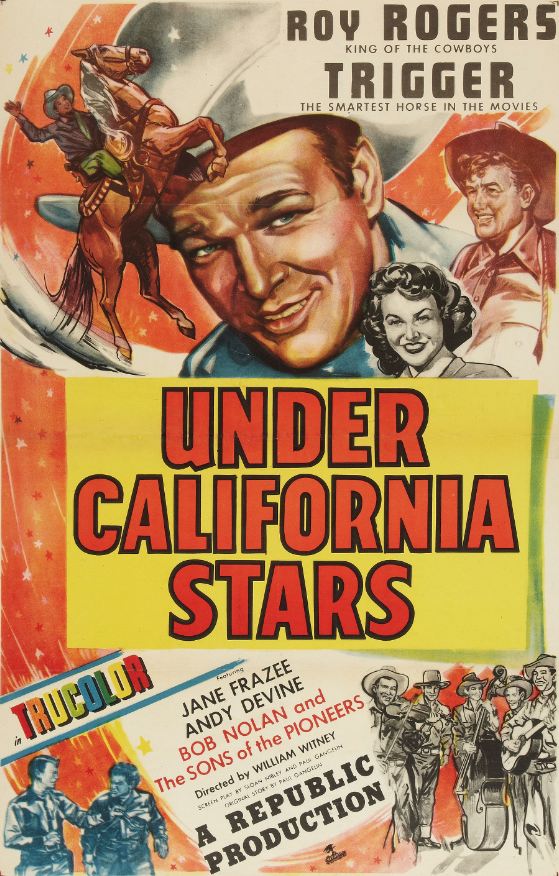
Under California Stars is one of those “Trigger in peril” pictures in which Roy Rogers’s faithful palomino Trigger, “the smartest horse in movies,” faces terrible danger, and only his best friend Roy Rogers can make things right … with plenty of help from Trigger himself, of course. (Another “Trigger in peril” film, The Golden Stallion, was the subject of a NY Times piece in which Quentin Tarantino waxed rhapsodic about the film’s director. It’s a great article, and you can read it by clicking on this sentence.)

Like most Roy Rogers movies made in the post-war ’40s, Under California Stars was directed by William Witney, a veteran B-movie director born in 1915 who had nearly 40 westerns and serials under his belt by 1948.

Witney was a brilliant director of action. He was reportedly inspired by watching Busby Berkeley direct big musical numbers in which different takes were designed to be cut together for a coherent whole.

Before Witney’s innovative work on action serials, most directors would just train the camera on the stuntmen and let them do their thing, but Witney took a more active role, arranging action set pieces that incorporated elegant camera movements and effective cutting between actors and their stuntmen doubles.

The serials he directed for Republic Pictures were done on a tight budget and an even tighter timeline, so Witney often directed the action segments while his frequent collaborator John English handled the dialogue scenes. (Witney and English directed Adventures of Captain Marvel [1941], which I consider the greatest serial ever made.) Witney’s film work is a far cry from today’s hyperactive, chopped-to-hell action movies, but in many ways he is the father of the modern action movie.

Under California Stars isn’t wall-to-wall action, but the fight scenes are well-done, and like most Witney joints, it’s a classic example of good B filmmaking.

Like most Roy Rogers movies from the ’40s, Under California Stars blurs the line between Roy’s on-screen persona and his real life. He plays a character named “Roy Rogers,” who, when the film begins, is being told by his director, “Roy, you can be mighty proud of your ten years in pictures.” (Roy’s first starring role was in the film Under Western Stars, which was released on April 20, 1938.)

The action quickly shifts from Hollywood to the Double R Ranch, where Trigger and Roy are met by foreman Cookie Bullfincher (Andy Devine), as well as Bob Nolan and the Sons of the Pioneers, who sing a hymn to Roy’s good-natured greatness. Roy is also presented with a 10-year anniversary cake and does a radio broadcast from the Double R in which he sings “Dust,” one of the songs that made him famous.

But not everyone is thrilled to pieces about Roy Rogers and his marvelous horse. Lige McFarland (Wade Crosby) and his henchman Ed (House Peters Jr.) resent the handsome do-gooder and hatch a scheme to kidnap Trigger and ransom him for $100,000 … or else.

Under California Stars is a brisk, well-made Saturday matinee western with good songs and hard-hitting action. The whole film is currently uploaded to YouTube, and you can watch it by clicking on the link below. It’s also currently available to download from archive.org.

State of the Union (April 30, 1948)

Sixty-four years ago there was a Democrat in the White House facing reelection in the fall, and there was no single heavily favored Republican candidate as the days marched on toward the Republican National Convention.

That Democrat was, of course, Harry S. Truman, and he had faced a bitter rebuke two years earlier when the Democratic Party lost 11 seats in the Senate and 54 seats in the House of Representatives in the 1946 midterm elections (a landslide for Republicans similar to the 2010 midterm elections). I’m tempted to keep drawing parallels to the present day, but I’m afraid that if I do it’ll devolve into me spewing a bunch of meaningless facts, like how the 1948 Summer Olympics were held in London, just like the 2012 Summer Olympics.

Suffice it to say that this was a good time for me to watch Frank Capra’s State of the Union for the first time. And if you’ve never seen it before, then it’s a good time for you to watch it, too.

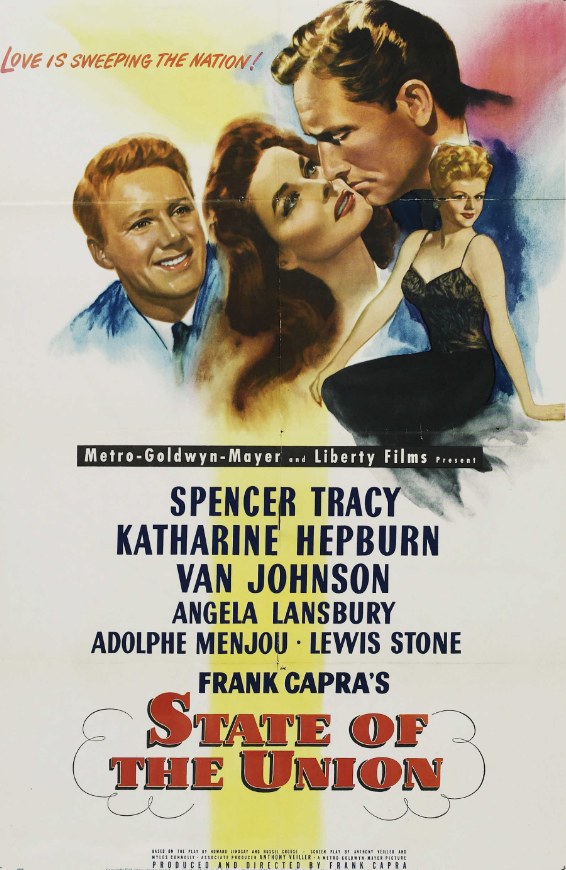
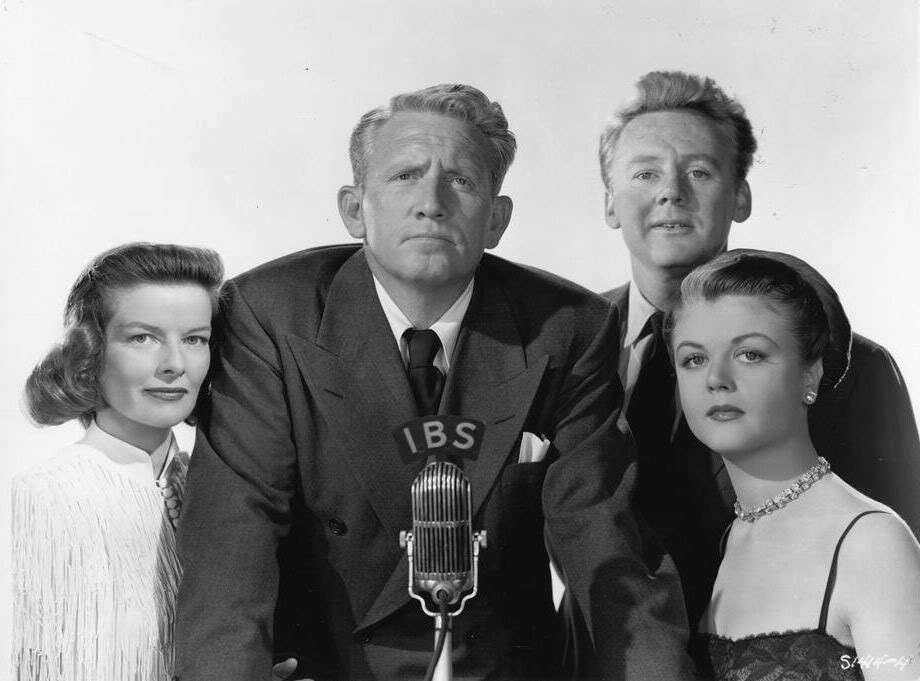
Adolphe Menjou plays a brilliant Republican party strategist named Jim Conover, who works with the young but equally brilliant Kay Thorndyke (Angela Lansbury) to split the Republican primaries in order to get their own dark-horse candidate the nomination for the presidency. Kay is the ruthless publisher who owns the Thorndyke Press, which was bequeathed her by her equally ruthless father.

Van Johnson plays campaign manager “Spike” McManus, a devil-may-care sort who’s happy to tell anyone who will listen that they have no hope of unseating Truman. Instead of coasting on his million-dollar boyish charm, Johnson engages in some “acting” in State of the Union, which didn’t always work for me, but it didn’t ruin the picture either. (And we have to cut Van Johnson a little slack, since in State of the Union he’s acting opposite four absolutely brilliant film actors who are all at the top of their game.)

In response to the assertion that there’s no real difference between the Republicans and the Democrats, Conover exclaims, “There’s all the difference in the world. They’re in and we’re out!”

With this “win or die” attitude, Conover, Thorndyke, and McManus approach the plain-speaking Grant Matthews (Spencer Tracy) to be their candidate. Matthews is a wealthy and successful airplane designer who has a “hang the politicians” attitude and thumbs his nose at political divisiveness with statements like, “Either we all pull together or we’ll be pulled apart.”

On the other hand, he’s in the midst of a long-standing extramarital affair with Kay Thorndyke, and when he launches his campaign for the presidency, it’s the first time he’s seen his wife Mary (Katharine Hepburn) in four months.

I’m not sure why this film isn’t talked about as much as Capra’s earlier films, like It Happened One Night (1934), Mr. Smith Goes to Washington (1939), and It’s a Wonderful Life (1946). Despite its cynical view of our two-party system, I think State of the Union is every bit as hopeful about humanity as Capra’s earlier films.

It’s also a very funny film, which I wasn’t expecting. Even when movies about politics are labeled “comedies” I usually find them more depressing than funny, but State of the Union features a cast of characters who are genuinely interesting and likable (and when they’re unlikable, it’s done in a natural and believable way). Capra’s direction is smooth and assured, with shot constructions that are occasionally brilliant, but there are a lot of jump cuts, too, as though Capra cared more about getting the right flow and combination of dialogue takes then setting up his shots seamlessly.

State of the Union is based on the Pulitzer Prize-winning play by Howard Lindsay and Russel Crouse that ran on Broadway from 1945 to 1947. The dialogue in the play was changed slightly from week to week to reflect the current political reality, which is obviously not something that can be done once a film is completed and released into theaters.

It could be this “trapped in amber” quality that has led to State of the Union being relegated to second-tier status among Capra’s films. If that’s the case, I think that’s sad and short-sighted. Despite the fact that State of the Union is entirely about the 1948 election for president, its depiction of our two-party system, the personal and moral compromises a presidential candidate must make, and the corrupting influence of big money in politics is just as relevant today as it was 64 years ago.

Homecoming (April 29, 1948)

Homecoming
Homecoming (1948)
Directed by Mervyn LeRoy
Metro-Goldwyn-Mayer

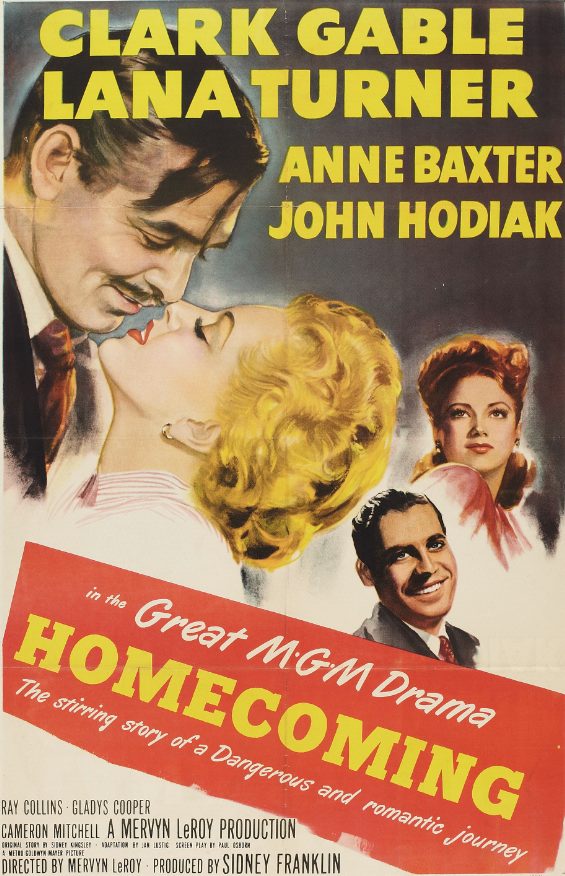
If Mervyn LeRoy’s slick M-G-M romance Homecoming is to be believed, the entire European theater of operations in World War II was an elaborate backdrop for a passionate and illicit romance between Clark Gable and Lana Turner.

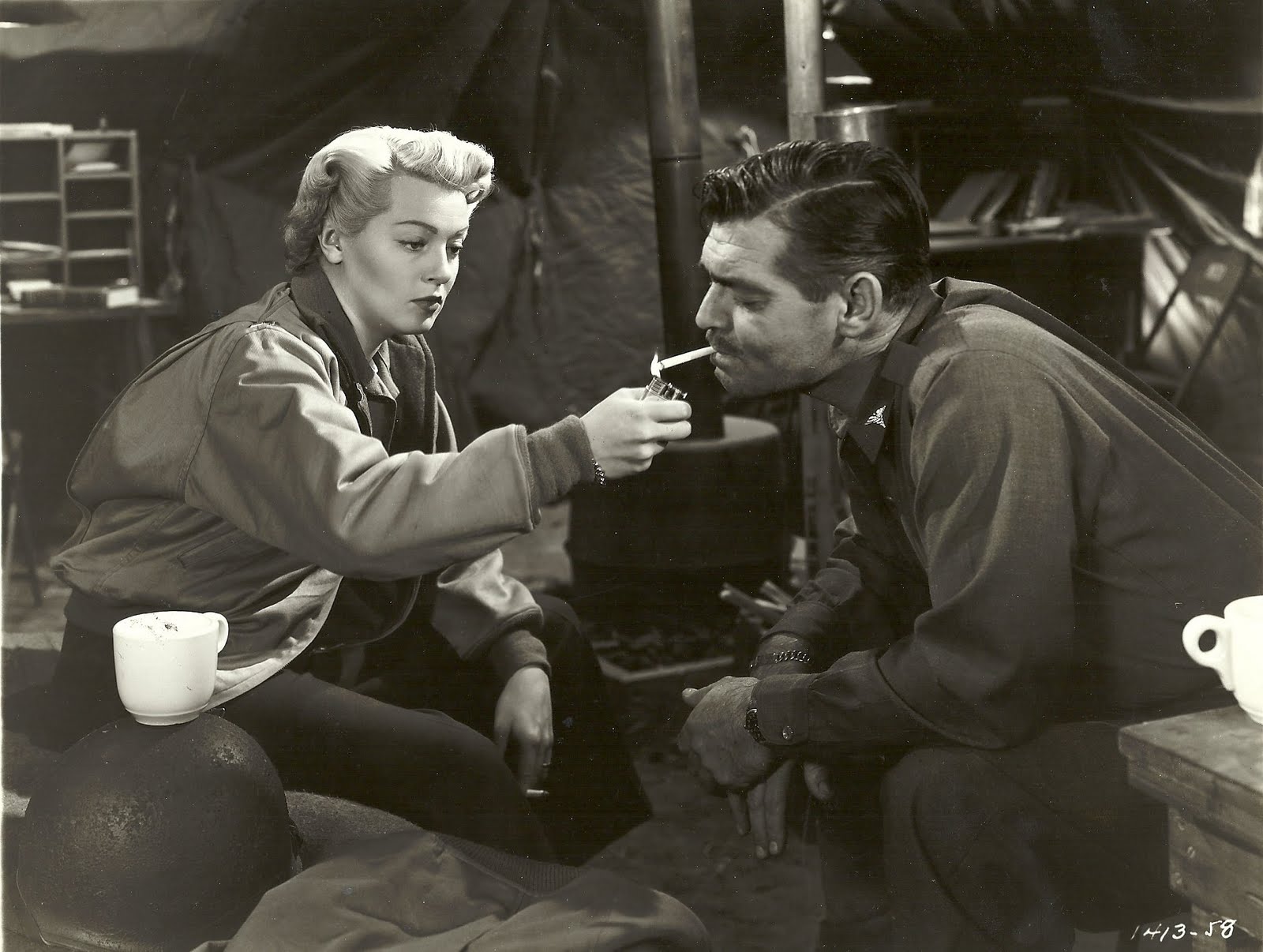
Gable plays a doctor named Ulysses Johnson. His friends call him “Lee,” but the beautiful nurse he befriends during the war calls him “Useless.” (That beautiful nurse is Lieutenant Jane McCall, nicknamed “Snapshot.” She’s played by Lana Turner, who was really good at playing beautiful women.)

Dr. Johnson is a noninterventionist who enlists to fight mostly because it’s “the thing to do.” Six year earlier this wasn’t our war, he says, and he doesn’t see how it’s any more our war now.

Lt. McCall tries to convince Dr. Johnson otherwise, which leads him to quip, “When women talk world politics it makes me laugh.”

McCall responds tartly, “Do the women of the bombed cities of Europe make you laugh, Major?”

Turner and Gable

Unsurprisingly, this sharp verbal exchange leads to more sharp verbal exchanges, most of them with a strong undercurrent of flirtatiousness.

Dr. Johnson has a wife back home, Penny (Anne Baxter), and McCall has a son to think about, but the more they try to keep things professional, the more the tension builds.

It should come as no surprise that Homecoming is more concerned with Dr. Johnson’s budding affair with Snapshot than it is with his moral and patriotic development. For instance, during the battle of Bastogne, the biggest trouble they face is having to abandon their jeep after it’s stuck in the mud. They have no difficulty locating an abandoned farmhouse in which to sexily and achingly hole up for the night. Try watching this movie immediately after watching the harrowing Band of Brothers episode “Bastogne” (Oct. 7, 2001). It will be really difficult to take Homecoming seriously.

Actually, Homecoming may be really difficult to take seriously even if you’ve never seen Band of Brothers and are totally unfamiliar with the history of World War II. But if all you’re looking for is a wartime romance starring a couple of members of Hollywood royalty, it fits the bill.

Letter From an Unknown Woman (April 28, 1948)

The key to Max Ophüls’s Letter From an Unknown Woman lies, simply enough, in its title. No matter how rapturous or romantic the proceedings get, the title of the film will nag at viewers’ minds. We know what is coming, even if we’re not fully conscious that we know.

Letter From an Unknown Woman takes place mostly in Vienna around the turn of the 20th century. It tells the story of a love affair between a young woman, Lisa Berndle (Joan Fontaine), and a concert pianist, Stefan Brand (Louis Jourdan).

When the film begins, Stefan is coming home in a carriage. He appears dissolute and wasted. He is to fight a duel in the morning, and he’s more upset that he’ll have to get up early than he is about possibly being killed.

In his apartment, a letter awaits him from Lisa, his old love. In the letter she recalls the stages of her life with him, beginning with girlish obsession, moving on to a more mature love affair, and finally … the end of it all.

Through it all we see Stefan, a brilliant and temperamental musician, experience his own journey of love with Lisa, albeit a more selfish one.

Like his fellow German expatriate director Douglas Sirk, Ophüls has a love of beautiful costumes, sumptuous set design, and moments of beautiful whimsy. One scene in Letter From an Unknown Woman begins with Lisa and Stefan sitting in a train compartment, having a conversation. The moving background outside the train’s window looks almost ridiculously fake until the full scene is revealed to the viewer. They are at a carnival, and an old man on a bicycle is making the painted backgrounds scroll past their window. He even has a wooden train whistle he blows as they stop at each new “station.”

Letter From an Unknown Woman is based on a story by Stefan Zweig, with a screenplay by Howard Koch. It’s a meditation on love, memory, and loss that I really liked, but didn’t completely love, although I suspect that repeating viewings might reveal added layers.