Mr. Soft Touch (July 28, 1949)

Mr Soft Touch
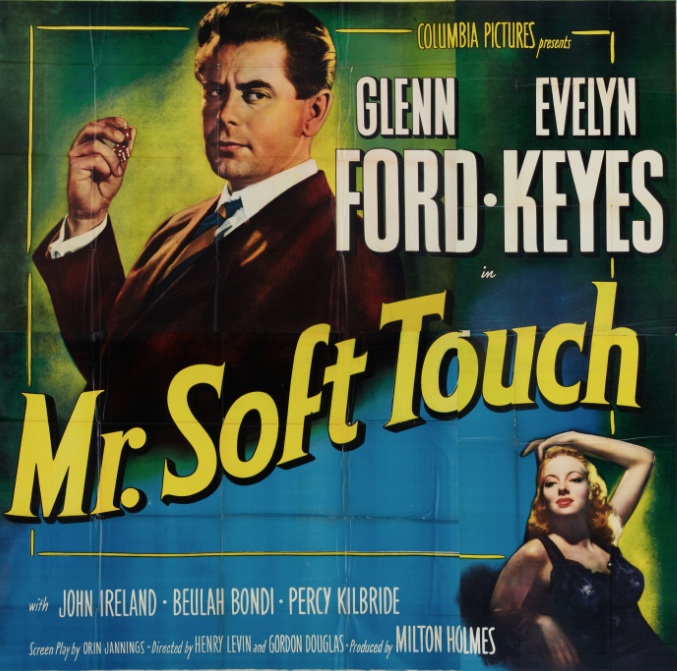
Mr. Soft Touch (1949)
Directed by Gordon Douglas and Henry Levin
Columbia Pictures

I saw Mr. Soft Touch two weeks ago at the Music Box Theatre, and I loved everything about it.

I couldn’t find many reviews of Mr. Soft Touch online, but most of the reviews I found were lukewarm, and criticized its dichotomous nature. “It can’t make up its mind if it wants to be a film noir or a comedy” seems to be the consensus. Another refrain I saw was “Could have been a holiday classic but misses the mark.”

Most of those reviews blame the fact that the film has two directors.

Well, for once in my life I don’t care what went on behind the scenes, or which director contributed to what parts of the film, because I loved Mr. Soft Touch and I’ll sing its praises from the rooftops.

It probably helped that I saw it on the big screen in a real theater on a gloomy winter afternoon. If it wasn’t a pristine and fully restored 35mm print then it was a damned good facsimile of one. I watch most of the movies I review on DVD (occasionally Blu-ray) or on a streaming service, but that’s out of necessity. If you love classic films there is simply no substitute for the theatrical experience.
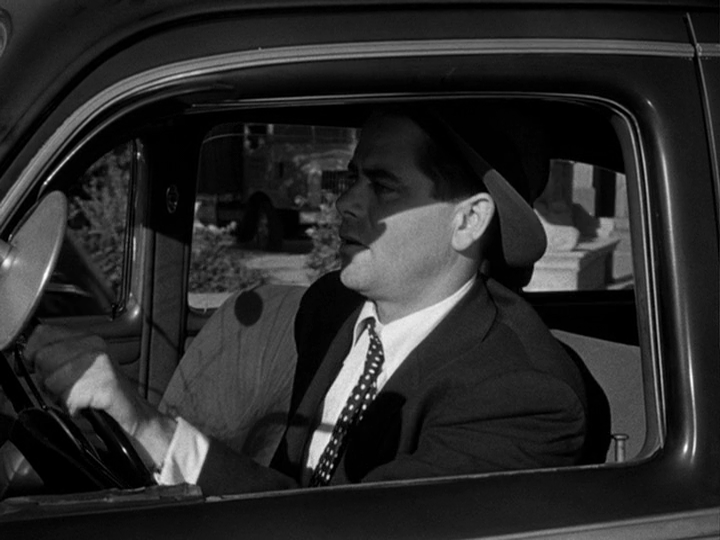
Glenn Ford

Mr. Soft Touch stars Glenn Ford as Joe Miracle, a shady character who’s running from the law with a bag full of cash when the movie begins. The opening sequence is suspenseful and features some great San Francisco location shooting. Joe Miracle uses his wits to get through a series of close shaves and eventually winds up hiding out for several days in a settlement house run by a woman named Jenny Jones (Evelyn Keyes).

The settlement house is staffed by Jenny and a group of older women, including actresses Beulah Bondi and Clara Blandick. They tend to the needs of homeless men, juvenile delinquents, and poor immigrants.

For the first reel or two of Mr. Soft Touch I kept waiting for a flashback sequence that would show how Joe Miracle wound up with a bag full of cash, fleeing for his life, and biding his time until he can hop on a steamer bound for Japan. A flashback like that would have been a classic film noir device, but the story unfolds in a linear fashion, and everything is explained along the way.

A bunch of gangland toughs are on Joe’s tail, and they’re led by the always entertaining mug Ted de Corsia. There’s also a muckraking radio reporter, Henry “Early” Byrd (played by a bespectacled John Ireland), who sends warnings to Joe over the airwaves but who might not have Joe’s best interests at heart.

Significantly, Mr. Soft Touch takes place at Christmastime, and adds the layer of “holiday film” to the already rare blending of hard-boiled noir, romantic comedy, and “social issues” picture.
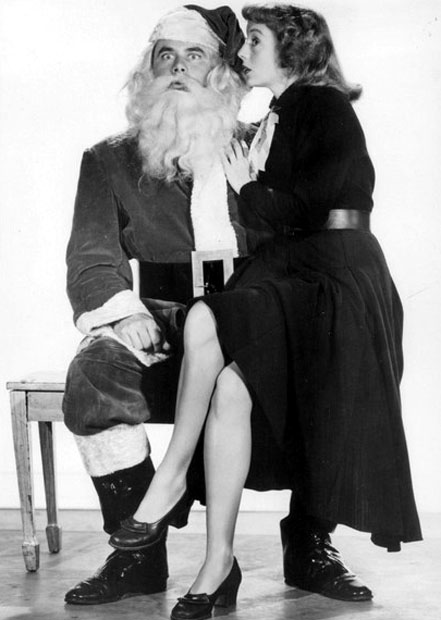
Santa Ford

I got very involved with the story and characters in Mr. Soft Touch. I tend to dislike movies that have an inconsistent tone. Despite the blending of genres, I never felt like the tone of Mr. Soft Touch shifted uncomfortably from one genre to another. It was unpredictable, but it all worked.

I don’t know which director did what, but I never had the sense that there were two different films fighting each other for supremacy. Mr. Soft Touch is all about dualities, though, so perhaps having two directors works in the film’s favor. Joe Miracle’s last name is an Americanization of a much longer Polish surname that starts with the letter M. But it also symbolizes the unexpected gifts of the holiday season, and the element of the unexpected that he brings to Jenny’s settlement house. The title of the film has a double meaning, too. Joe Miracle has hands that can make the dice in a craps game come up the way he wants them, but the title of the film also refers to the goodness lurking behind his tough exterior that Jenny helps expose.

It’s a somewhat odd film, but a thoroughly enjoyable one.

Mighty Joe Young (July 27, 1949)

Mighty Joe Young

Mighty Joe Young (1949)
Directed by Ernest B. Schoedsack
Argosy Pictures / RKO Radio Pictures

This review originally appeared last year on The Mortuary as part of The Ludovico Film Institute’s program on Ray Harryhausen.

Mighty Joe Young is a wonderful fantasy movie, but I doubt it would have much staying power without the special effects work of Willis O’Brien and Ray Harryhausen.

At a young age, Harryhausen was influenced by the groundbreaking stop-motion effects O’Brien created for the dinosaur epic The Lost World (1925). At a slightly less young age, Harryhausen was even more bowled over by O’Brien’s work on King Kong (1933), and a lifelong obsession was born.

Harryhausen’s first professional work was a series of Puppetoons shorts for George Pal at Paramount Pictures. During World War II he worked on various short films. He also worked on commercials and an anthology short called Mother Goose Stories. But Mighty Joe Young was his first big feature film. He was working under the direction of his idol, Willis O’Brien. (In supplementary features on the DVD of Mighty Joe Young that I watched, Harryhausen affectionately refers to him as “Obi.”) O’Brien did all of the continuity sketches, but the majority of the painstaking stop-motion animation was carried out by Harryhausen.

Mighty Joe Young armature

In reality, Mighty Joe Young was a metal armature with hinges and ball-and-socket joints covered with rubber and fur. But on screen, he is a living, breathing creature with emotions that are as easy for the audience to understand as the most overwrought histrionics of a silent-movie actor.

For instance, watch the clip below, which shows Mighty Joe Young’s first appearance at the Golden Safari Club (which was reportedly inspired by the Cocoanut Grove nightclub in Los Angeles). Look at the mix of emotions on Joe’s face. Confusion. Concern for the girl he’s holding up, who is his only friend. And curiosity about all the people thronged to see him. Mixed with the music of “Beautiful Dreamer” (Joe’s favorite song), it’s a powerful moment, and it was created one frame at a time by Ray Harryhausen with metal, rubber, fur, and bits of clay for Joe’s lips and brow.

If Mighty Joe Young had been played by Ray “Crash” Corrigan in a gorilla suit, it just wouldn’t have had the same effect.

Mighty Joe Young is a series of grand stop-motion set pieces. Each is more spectacular than the one before it, and each tells us more about Joe’s character. When we first see him, he’s a ferocious beast, smashing open a lion’s cage. His ferocity remains formidable, but we grow more sympathetic to him as we begin to see his noble heart. Not to mention the fact that he’s mistreated by humans in infuriating ways.

The human protagonists of the film aren’t nearly as interesting as Joe, but they all give good performances.

Robert Armstrong plays Max O’Hara, the blustery Hollywood producer who brings Mighty Joe Young to America. It’s a very similar role to that of Carl Denham, who Armstrong portrayed in both King Kong (1933) and Son of Kong (1933), both of which — like Mighty Joe Young — were directed by Ernest B. Schoedsack.

According to Harryhausen, writer Ruth Rose patterned the character of Max O’Hara on producer Merian C. Cooper, who always wanted things “bigger!”

Moore and Joe on stage

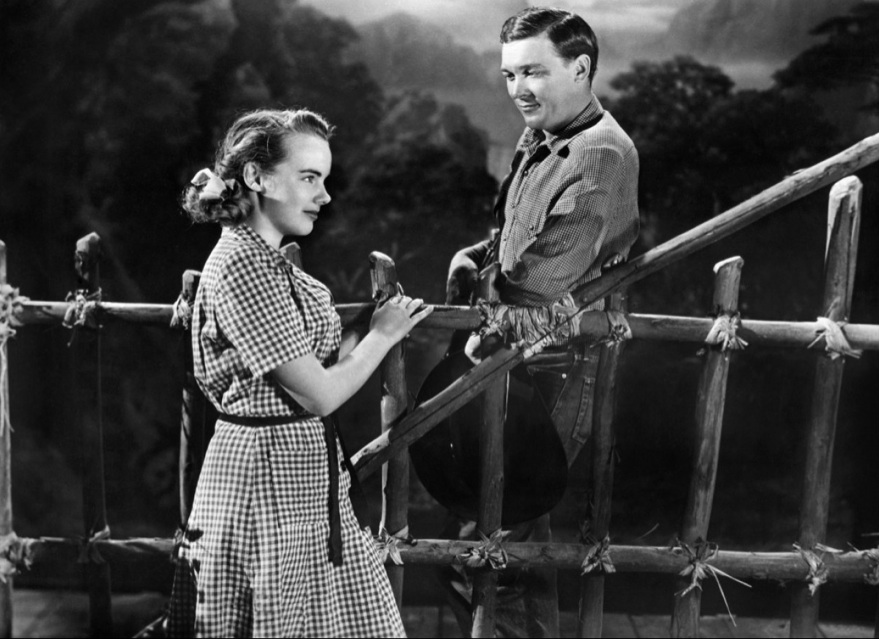
Terry Moore plays Joe’s oldest human friend, Jill Young, a white girl who grew up in Africa on her father’s farm. She purchased Joe from two natives when he was still an infant. (She was lonely and had no one to play with.) In many ways, Jill is as much of an outsider in America as Joe is.

Film fans today probably know Ben Johnson best from his work with Sam Peckinpah — he appeared in Major Dundee (1965), The Wild Bunch (1969), Junior Bonner (1972), and The Getaway (1972). Or possibly they know him as “Sam the Lion” in Peter Bogdanovich’s The Last Picture Show (1971) or as G-man Melvin Purvis in John Milius’s Dillinger (1973). If you’re a horror fan, you might know him from Charles B. Pierce’s The Town That Dreaded Sundown (1976) or Roger Spottiswoode’s Terror Train (1980).

In Mighty Joe Young, Johnson plays Gregg, an Oklahoma ranch hand and rodeo rider, which is exactly what Johnson was in real life. He’s a little wooden, but his authenticity makes up for it. Johnson had bit parts in a bunch of films before Mighty Joe Young, but this was his first leading role, and the first time he had his name in the credits.

Moore and Johnson

Mighty Joe Young won one Oscar at the 22nd Academy Awards, for best visual effects.

Despite Harryhausen’s spectacular special effects, Mighty Joe Young was a box-office disappointment at the time of its release, and plans for a possible sequel, in which Joe would team up with RKO’s other hot jungle property — Tarzan (at this point played by Lex Barker), were scrapped.

But it was just the beginning for Harryhausen.

Mighty Joe Young will be shown on TCM on February 24, 2014.

Too Late for Tears (July 17, 1949)

Too Late for Tears
Too Late for Tears (1949)
Directed by Byron Haskin
United Artists

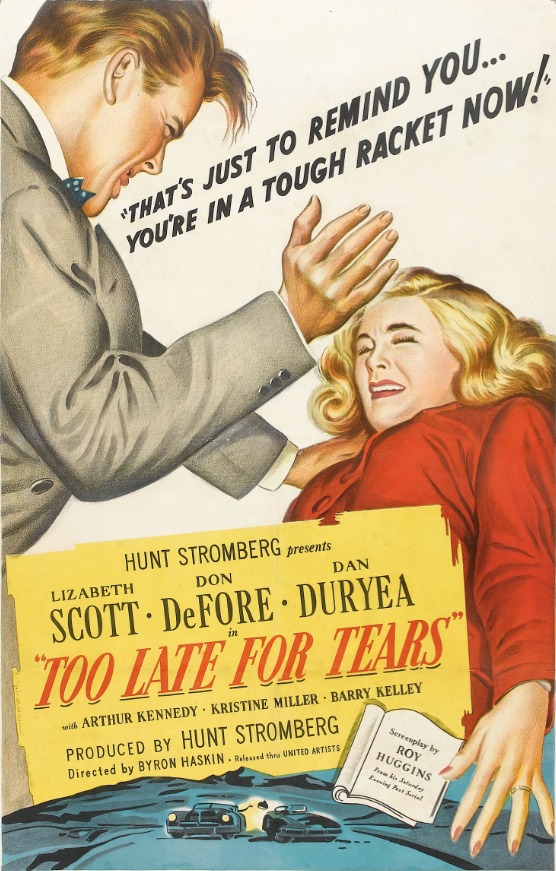
With Too Late for Tears, director Byron Haskin continued his postwar run of unremarkable but solidly entertaining B movies.

After I Walk Alone (1948) and Man-Eater of Kumaon (1948), I wasn’t expecting anything special from Too Late for Tears. But I was expecting a well-paced, twisty little thriller, and that’s exactly what I got.

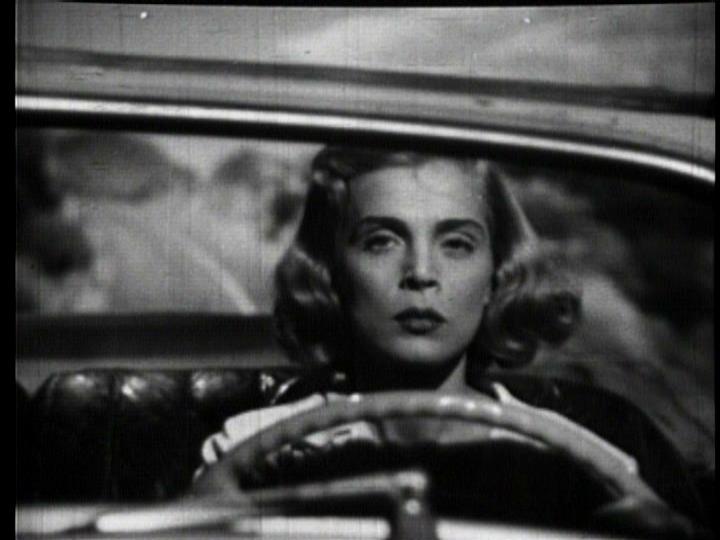
Dependable everyman Arthur Kennedy and icy femme fatale Lizabeth Scott play a married couple, Alan and Jane Palmer. One night on a lonely stretch of road in the Hollywood Hills, a huge sum of money literally falls into their laps. They are both tempted by the possibilities that so much cash offers, but they have different ideas about how to proceed. Alan sees nothing but trouble ahead and thinks they should turn the money over to the police. Jane thinks they’d be fools to give it up so easily.

Jane is a striver who’s not above chipping her manicured fingernails to claw her way to the top. She tells Alan that she was never poor, but something much worse — her family was “white-collar poor, middle-class poor,” and they could never quite keep up with the Joneses. Alan tells her there will always be Joneses with more money and shinier toys. Money isn’t the key to happiness.

Lizabeth Scott

Jane disagrees, and the plot of the film is driven by her limitless avarice. Dependable beanpole villain Dan Duryea shows up in the early going as a man named Danny Fuller who’s after the money for his own reasons. He throws his weight around, and attempts to intimidate Jane with harsh words and several slaps to the face.

When she says to him, “What do I call you besides Stupid?” he responds, “Stupid’ll do if you don’t bruise easily. Otherwise you might try Danny.”

But in the great tradition of tough-talking bad guys in film noirs, Danny badly underestimates the craftiness and ruthlessness of the femme fatale in the picture.

Lizabeth Scott appeared in a lot of noirs. She chronically underacted, but it works for movies like Too Late for Tears, which are light on characterization but heavy on plot. In addition to the Palmers and the vicious Danny, there is also Alan’s suspicious sister, Kathy Palmer (Kristine Miller), and the mysterious stranger Don Blake (Don DeFore), who may not be who he claims to be.

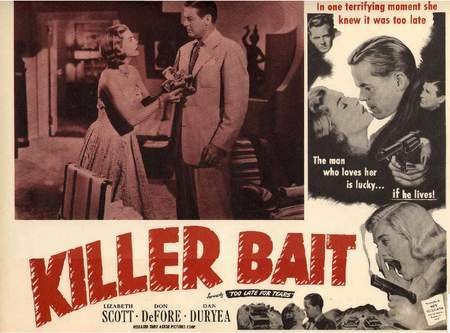
Too Late for Tears is not a classic film noir, but it’s a good afternoon time-waster. It premiered in Los Angeles on July 17, 1949, and went into wide release in August. It was re-released in September 1955 under the title Killer Bait. It’s in the public domain, so you can download it from archive.org here: http://archive.org/details/TooLateForTears. You can also watch the film in its entirety on YouTube (link below).

Killer Bait

The Great Gatsby (July 13, 1949)

The Great Gatsby
The Great Gatsby (1949)
Directed by Elliott Nugent
Paramount Pictures

Long before Robert Redford and Leonardo DiCaprio played F. Scott Fitzgerald’s great American striver Jay Gatsby, another iconic blond pretty boy tackled the role.

I first saw Elliott Nugent’s version of The Great Gatsby in 2012 as part of Noir City 4 at The Music Box Theatre. Although in the lobby after the screening I overheard one audience member very angrily denounce the film as “not noir in any way,” and I couldn’t disagree, it’s not a bad film and I’m glad I saw it.

At one point, both Gene Tierney and Tyrone Power were attached to the project. According to several websites, Tierney was deemed “too beautiful” to play Daisy Buchanan by both Nugent, the director, and Richard Maibaum, the producer, but none of those websites have a source for that claim. Personally, it seems an insane reason not to cast an actress as Daisy Buchanan. She’s the unattainable object of Gatsby’s romantic longing. Whether or not she’s really the most beautiful woman in West Egg, Long Island, is immaterial. Film is a visual medium and a beautiful actress playing Daisy just makes sense.

Betty Field, who plays Daisy in this film, is attractive, but she possesses none of the ethereal beauty of an actress like Tierney. Also, I can think of no better actress than Tierney to project outward beauty coupled with inward emptiness and callousness.

Alan Ladd, however, makes a better Jay Gatsby than I imagine Tyrone Power would have. Ladd was a handsome actor whose understated persona was always somewhat unknowable. Viewers could project whatever they wanted onto him.

Because of this, Ladd is perfect as Gatsby, the bootlegger who single-mindedly built a fortune and passed himself off as a man who came from money. Gatsby’s outward appearance was perfect, but like the beautiful books in his study, which all have uncut pages, there is nothing behind the façade.

Alan Ladd

The early parts of the film play up Gatsby’s early days in organized crime, exploiting Ladd’s facility with gangster movies and film noirs. Eventually, though, the film settles into a talky version of the novel that is largely drawn from Owen Davis’s stage adaptation that opened in 1926 and ran for 112 performances.

As I said, it’s not a bad film, but it’s not a particularly compelling one. Ladd is a good Gatsby, and the other performers are generally fine. I liked Barry Sullivan as Daisy’s husband Tom and loved Shelley Winters as Tom’s mistress Myrtle.

The film is at its best when it most resembles a hard-boiled noir, but those moments are few and far between.

The biggest flaw, of course, is that it’s a straightforward and very literal adaptation of a great American novel, and possesses none of Fitzgerald’s elegant prose. It’s worth seeing, but far from a masterpiece. It’s a great example of why the phrase “the book was better” became a cliché.

The Big Steal (July 9, 1949)

The Big Steal

The Big Steal (1949)
Directed by Don Siegel
RKO Radio Pictures

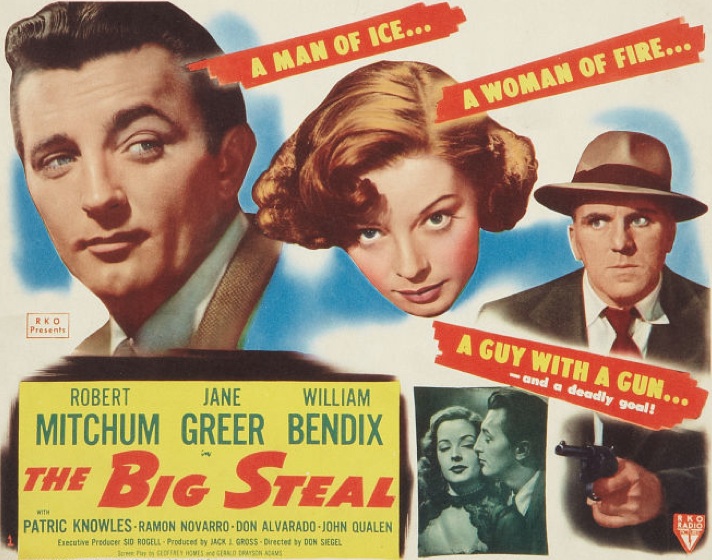
Robert Mitchum and Jane Greer starred in my favorite film noir of all time, Out of the Past (1947). It’s not everyone’s favorite film noir, but I think most noir aficionados would at least put it in their top 10.

The Big Steal probably isn’t in too many noir fans’ top 10 lists, but it’s a damned good picture. I actually don’t think it’s a noir at all, even though it’s often classified as one. (It’s available on DVD as part of the Film Noir Classic Collection, Vol. 4 box set.)

Except for the noir-heavy power of the two leads and the presence of lovable film noir lummox William Bendix as a heavy (as well as the fact that the MacGuffin of the film is a large sum of money), there’s really nothing “noir” about The Big Steal.

The Big Steal is a fast-paced chase movie set in the sun-drenched countryside of Mexico. Robert Mitchum plays a US Army lieutenant named Duke Halliday who’s been accused of stealing a military payroll. On his trail is Capt. Vincent Blake (William Bendix). The film opens with Capt. Blake catching up to Duke on a ship docked in Veracruz, but Duke quickly gets the upper hand and goes on the lam with Blake’s identification papers.

Duke has a “meet cute” scene with American tourist Joan Graham (Jane Greer). She thinks he’s a boor; he thinks she’s a scold. She speaks Spanish; what he speaks barely qualifies as “Spanglish.”

They go their separate ways. She goes to the hotel room of her ne’er-do-well fiancé Jim Fiske (Patric Knowles) and demands he return the $2,000 he “borrowed” from her. Fiske slips away while she’s in the shower and Duke shows up, looking for Fiske, since Fiske has a lot more money than Joan realizes.

At just 71 minutes long, this is a movie that doesn’t waste any time. Duke and Joan are chasing Fiske, and Capt. Blake is chasing Duke and Joan. Mexican police officials Inspector General Ortega (Ramon Novarro) and Lt. Ruiz (Don Alvarado) are chasing all four of them, with no particular urgency.

There’s plenty of action. Siegel keeps the tone light, but when there’s gunplay or a fistfight, it’s swift and tough, which is as it should be.

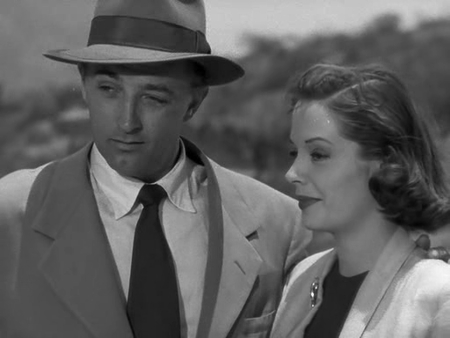
Mitchum and Greer

While I love Jane Greer in Out of the Past, her character in that film is a classic femme fatale — icy and unknowable. Her role in The Big Steal is more similar to the screwball comediennes of the 1930s. Greer and Mitchum have an easy chemistry, trading barbs and falling for each other along the way. He cracks wise about women drivers, and later she gets to show him exactly what a woman driver can do in a high-speed chase on a twisty mountain road.

Oh, and there’s one more connection with Out of the Past. The Big Steal is based on Richard Wormser’s story “The Road to Carmichael’s,” but the screenplay is by Gerald Drayson Adams and Daniel Mainwaring. Daniel Mainwaring also wrote the screenplay for Out of the Past, which was based on his novel Build My Gallows High.

Don Siegel was a craftsman who had a long career in Hollywood. He directed some of my favorite films of all time, like Invasion of the Body Snatchers (1956) and Dirty Harry (1971), but there are a ton of his films I haven’t seen. I’ve seen his first film, a short called Star in the Night (1945), which is a sweet little Christmas parable starring J. Carrol Naish. I haven’t seen his next few films, the documentary short Hitler Lives (1945), the mystery feature The Verdict (1946), or the romantic melodrama Night Unto Night (1949), which starred Ronald Reagan and Viveca Lindfors (who was married to Siegel from August 10, 1949, to May 26, 1954).

Watching The Big Steal reminded me just how much I love Siegel’s films, and made me happy that I still have so many left to see.

Kind Hearts and Coronets (June 21, 1949)

Kind Hearts and Coronets
Kind Hearts and Coronets (1949)
Directed by Robert Hamer
Ealing Studios

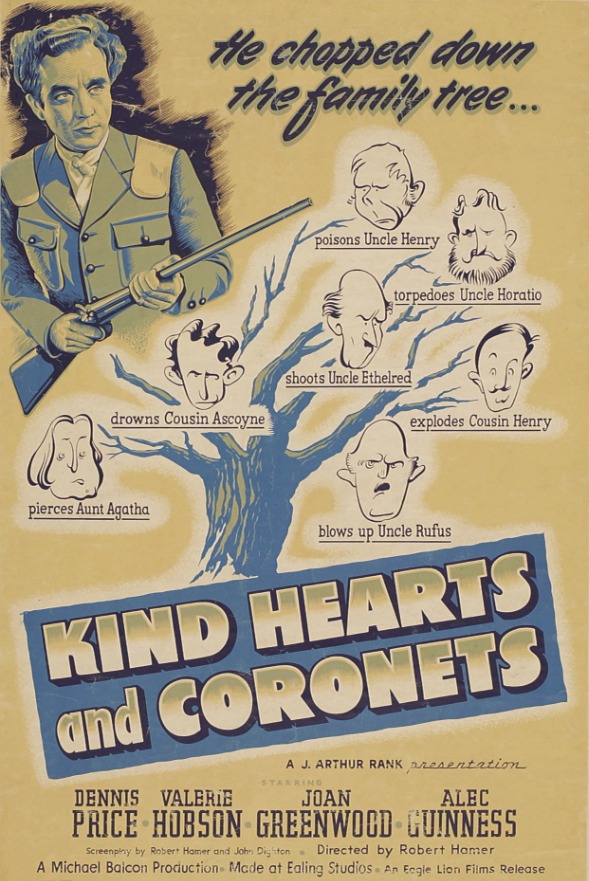
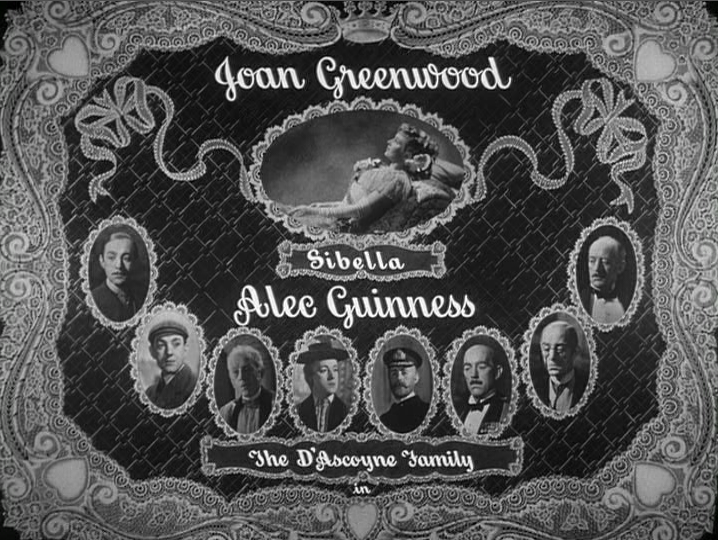
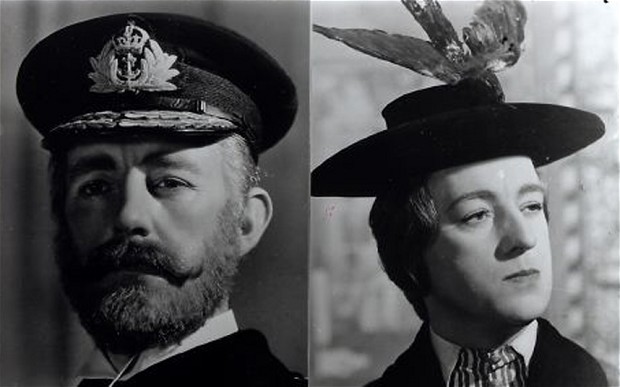
Alec Guinness isn’t the star of Kind Hearts and Coronets. Not exactly. Dennis Price plays the protagonist, a ruthless social climber who attempts to murder his way to a dukedom, but Guinness dominates the film by playing eight different characters of vastly different ages (including one who is a woman).

If the opening credits of the film didn’t clearly show that Guinness plays multiple characters, I’m sure a few viewers would miss that fact, since he disappears into each role.

Greenwood and Guinness

The film tells the story of Louis Mazzini (Dennis Price), whose mother was disowned by her aristocratic family, the D’Ascoynes, when she married an Italian organ grinder. (Guinness isn’t the only actor in the film who plays multiple parts. Price plays his own father in a short flashback, sporting a thick black mustache.) Mazzini’s father died when he was a baby, leaving his mother penniless.

Mazzini vows revenge on the D’Ascoynes. He keeps careful track of all the noblemen and noblewomen who stand in the way of his Dukedom. Sometimes the death notices bring good news. Sometimes the birth column brings bad news.

After a chance encounter with his playboy cousin, Ascoyne D’Ascoyne, leads to Mazzini losing his job, he decides that waiting for everyone who stands in his way to die of natural causes will take too long, and he coolly takes to plotting murder.

Alec Guinness

Kind Hearts and Coronets is based on Roy Horniman’s 1907 novel Israel Rank: The Autobiography of a Criminal. I haven’t read the novel, but by all accounts the film improves on it. The dry, acerbic voiceover by Price apparently owes a lot to its literary source, but the comedic tone of the murders is amped up for the film. In the book, Israel Rank mostly disposes of his victims with poison, but in the film they meet their ends in wildly varied ways; drowning, explosion, falling from the sky, and a well-placed shotgun blast. And yes, a little poison.

Another difference between the film and the book is that the novel’s protagonist has a Jewish father. I think the name “Israel Rank” is a trifle too obvious for a half-Jewish man who attempts to improve his station through murder. And in any case, “Rank” was out of the question as the surname in the film since Ealing Studios’ films were distributed by J. Arthur Rank and most of Kind Hearts and Coronets was shot at Rank’s studios at Pinewood. The scale of the film was simply too large for the Ealing studio.

Price and Greenwood

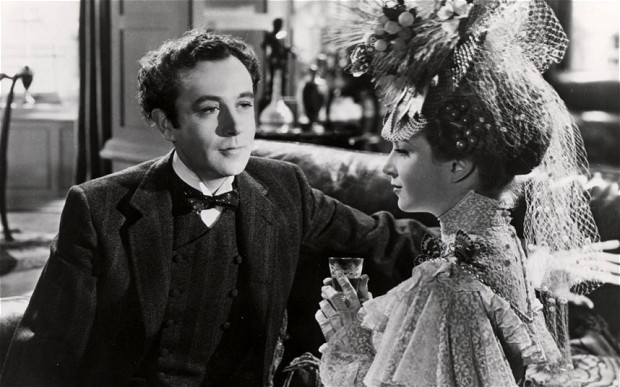
Guinness is a comedic juggernaut in Kind Hearts and Coronets and Price ranks with Hannibal Lecter as one of the most charming serial murderers in cinematic history, but the film also features two great performances by women: Valerie Hobson as Edith, the noblewoman whom Mazzini schemes to marry, and Joan Greenwood as Sibella, the seductive coquette who rejected him in favor of a boring, wealthy man, but with whom he carries on an extramarital affair for most of the film.

Kind Hearts and Coronets is one of the most pitch-black comedies I’ve ever seen, but it never devolves into mere gruesomeness. The witty and irony-laden script is one reason, but the fact that Guinness plays all of the murder victims is another. It adds a layer of theatricality to the proceedings that makes it difficult to take any of the homicides too seriously.

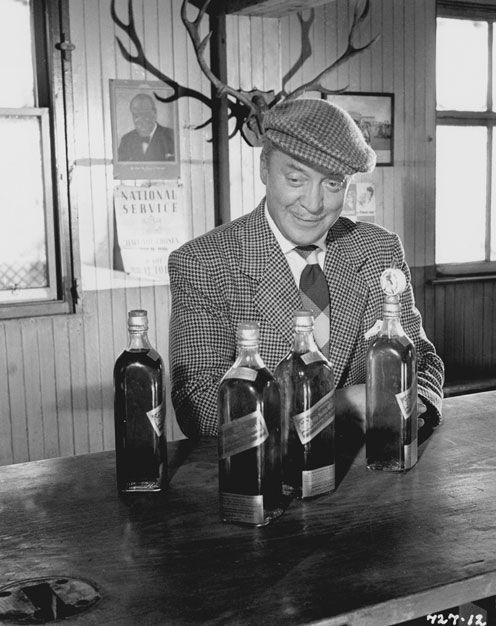
Ealing scored a real one-two punch in 1949 with Whisky Galore and Kind Hearts and Coronets. One is warmly human and the other is cold and biting, but they both rank among the best comedies ever made.

Incidentally, the title of the film is taken from one of Alfred Lord Tennyson’s poems, “Kind hearts are more than coronets / And simple faith than Norman blood.”

Kind Hearts and Coronets will be shown on TCM on April 2, 2014.

Whisky Galore! (June 16, 1949)

Whisky Galore
Whisky Galore! (1949)
Directed by Alexander Mackendrick
Ealing Studios

I first saw Whisky Galore back in college. It wasn’t part of a class, it was just a Saturday-night feature shown in the film department.

I went to Bard College, which is in a beautiful, rural part of New York State. Procuring booze wasn’t exactly difficult, but it could be a challenge, especially if you didn’t have a car. So this rollicking tale of whisky drinkers on an isolated island suddenly facing the prospect of living without “the water of life” resonated with more than a few audience members. Hell, some of us were probably only there because we couldn’t find any booze.

I enjoyed Whisky Galore the first time I saw it, but I didn’t find it uproariously funny. This time around was different. I now think it’s one of the best comedies ever made.

Except for a few sight gags here and there — like a straight line of footsteps leading into a cave where whisky is hidden and a weaving, curving line of footsteps leading out — most of the humor is subtle and tongue-in-cheek. I realized that I’d completely missed some of the funniest bits of the movie on my first viewing. (If you have even the slightest difficulty understanding English or Scottish accents — or if you’re at all hard of hearing — you’re going to want to watch this film with subtitles. The DVD currently available to rent from Netflix has no closed captioning, and there are several reviews written solely to complain about that fact.)

Whisky Galore is based on the novel by Compton MacKenzie, which was inspired by the sinking of the S.S. Politician in 1941. The screenplay is by MacKenzie and Angus MacPhail.

The film takes place in 1943 in the Outer Hebrides, on the fictional island of Todday. The Second World War is raging, but far from Todday. The Home Guard goes on maneuvers and set up roadblocks that would be ridiculous even without the benefit of hindsight. The Home Guard in Todday is commanded by the puffed-up Captain Paul Waggett (Basil Radford), who is English, and frequently mystified by the peculiarities of the Scottish natives of this far-flung island.

One day, disaster strikes. Not famine or pestilence, but something far, far worse. No whisky.

But then, one foggy night, the S.S. Cabinet Minister, a freighter carrying 50,000 cases of whisky, runs aground on the shoals.

When Waggett gets wind of the locals’ plan to “liberate” as much whisky as they can from the ship before it sinks, he jumps into action. Waggett feels strongly that order must be maintained. Allow a little looting, and anarchy will follow.

Basil Radford

Whisky Galore wrings humor out of more than just forced sobriety and drunken revelry. It’s an extremely well-crafted film about small-town life.

Todday seems to contain just two small villages, Snorvaig and Garryboo. The insularity of Todday is personified by the young schoolteacher George Campbell (Gordon Jackson), who assigns his students a composition assignment, “Why I like living in Garryboo.”

One of his pupils reads his essay aloud: “There are more people in Snorvaig. But they are not so nice as the people in Garryboo.”

Even though Campbell is an adult with a real job, he lives with his mother (played by Jean Cadell), who still treats him like a child. She doesn’t let him use the telephone on the Sabbath, and when he protests, she scolds and punishes him. “Go to your room, George Campbell! There’ll be no church for you in Snorvaig today!” And he sheepishly complies.

All the actors in this film are wonderful, and perfectly cast. Besides the pitch-perfect performances by Radford and Cadell (who have the funniest exchange of the picture when he tries to convince her to let her son out of his room because he needs his Home Guard second-in-command), I especially liked the lovely Joan Greenwood and the stalwart Bruce Seton as the man who loves her.

But, as I said, all the actors are wonderful. And this is a wonderful film. Even the ending, which seems to have been forced on the filmmakers by the censors, is hilarious.

Colorado Territory (June 11, 1949)

Colorado Territory
Colorado Territory (1949)
Directed by Raoul Walsh
Warner Bros.

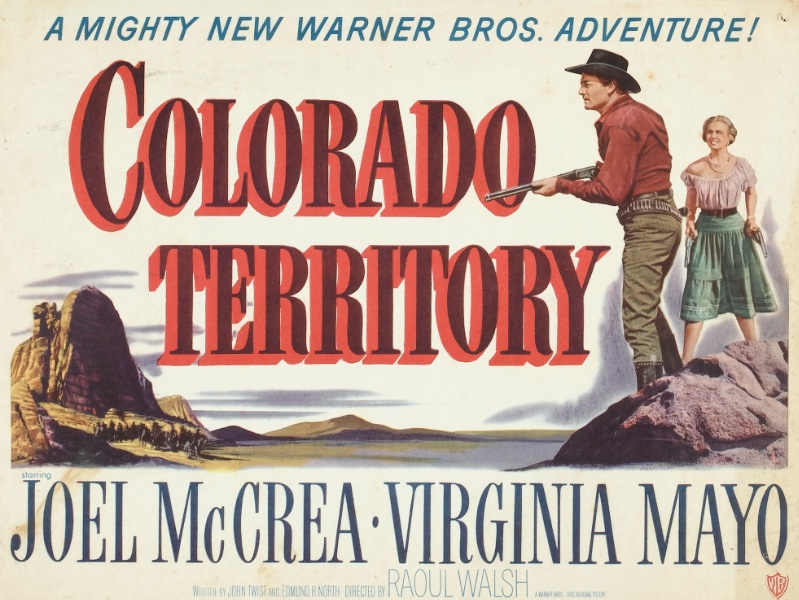
Most plot summaries of Raoul Walsh’s western Colorado Territory mention that it’s a remake of the great Warner Bros. gangster movie High Sierra (1941), but that fact is curiously absent from the opening credits.

The screenplay is credited to John Twist and Edmund H. North, but there’s no mention of W.R. Burnett, who wrote the novel High Sierra, and there’s no mention of the earlier film.

This is strange, since the change of setting from the modern day to the Old West could almost qualify this as a “variation on a theme” rather than a straight remake, but there are so many scenes and characters that are nearly identical to scenes and characters in High Sierra.

I recently wrote a piece on producer Mark Hellinger for the annual “giant” issue of The Dark Pages, which was devoted this year to The Killers (1946). (You can order copies of The Dark Pages and subscribe here: http://www.allthatnoir.com/newsletter.htm).

Hellinger frequently worked with director Raoul Walsh at Warner Bros., so I went back and watched a bunch of their collaborations — The Roaring Twenties (1939), They Drive by Night (1940), and High Sierra (1941). (I still haven’t seen The Horn Blows at Midnight, though. Jack Benny made a running joke of it on his radio show, but it can’t be that bad, can it?)

Walsh was a great director who made unabashedly commercial films with a great sense of scope and memorable characters.

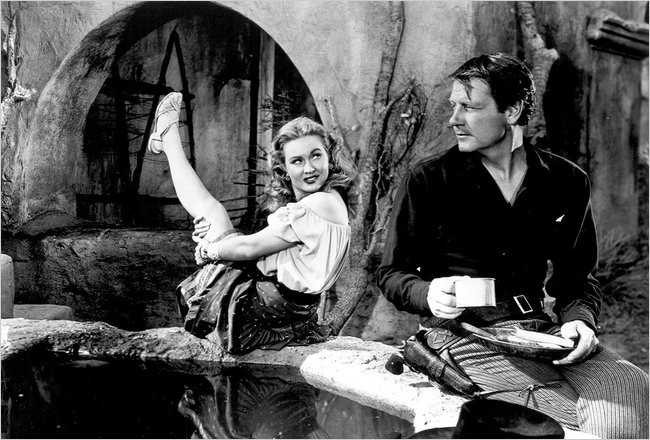
Mayo and McCrea

Colorado Territory isn’t ever listed among Walsh’s greatest achievements, but it’s a damned fine western that I think would be better regarded if it didn’t have such a generic title. If one were to scan through a list of westerns from 1949, Colorado Territory screams “B picture.” With a title like that, it easily could have been an RKO Radio Pictures western starring Tim Holt or a Republic Pictures western starring Roy Rogers (not that there’s anything wrong with that).

Joel McCrea plays Wes McQueen, an outlaw who escapes from jail and is on the run for most of the movie. (This is essentially the same as Roy Earle, the role Humphrey Bogart played in High Sierra, except that Earle was released from prison.) He hooks up with a couple of vicious characters who aren’t as smart as they think they are — Reno Blake (John Archer) and Duke Harris (James Mitchell) — and together they plan a daring train heist. (These two criminals were played in High Sierra by Arthur Kennedy and Alan Curtis.)

There’s also a beautiful woman to makes things complicated. Her name is Colorado Carson (Virginia Mayo), and she wears lots of flowing low-cut tops and Southwestern-style jewelry because she’s supposed to be part Pueblo. (This is essentially the character Ida Lupino played in High Sierra, although her fashion sense in that film was a lot more conservative.)

And of course, just like High Sierra, there’s a criminal mastermind behind the scenes of the heist and a sweet, innocent-seeming girl whom our criminal protagonist idolizes for a little while before coming to his senses and realizing that he belongs with a straight-up ride or die chick.

There is, however, no cute little stray dog or “comical Negro” character. (You take the bad with the good.)

In Walsh’s filmography, High Sierra will forever be regarded as the superior film. And in 1949, Walsh also directed his masterpiece White Heat, so Colorado Territory suffers by comparison in that department too. (Virginia Mayo is also in White Heat, and her role in that film is a lot meaner and juicier.)

One of the problems with remakes is that no matter how good they are, it’s nearly impossible to lose yourself in them if you’ve seen the original film, since they constantly evoke it. I like Joel McCrea and think he’s a great actor, especially in westerns. But he lacks the nastiness and cynicism Bogart had in High Sierra, which made his more human side stand out in such sharp relief.

On the other hand, when a remake differs from its source material, it can make certain scenes even more shocking and emotionally affecting than they would be on their own, since you’re really not expecting things to go down that way. Colorado Territory has a few bits like that, and it’s exciting and well-made enough to stand on its own.

The Red Menace (June 9, 1949)

The Red Menace
The Red Menace (1949)
Directed by R.G. Springsteen
Republic Pictures

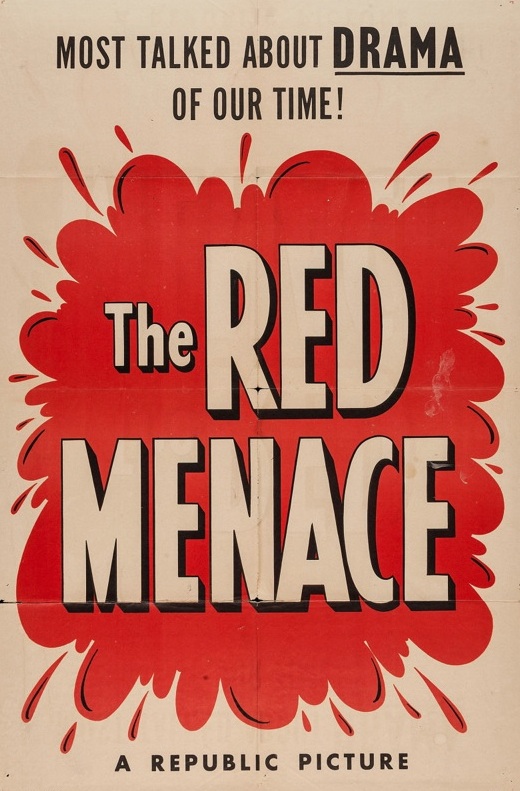
The Red Menace was one of the first American postwar scaremongering films to explicitly name Communism as a threat. The structure and plotting of the film are similar to both Violence (1947) and Open Secret (1948), but those films dealt with cells of American fascists who used postwar housing and employment crises for their own anti-Semitic and xenophobic ends.

The Red Menace makes no bones about naming the most pervasive threat to America — it’s Communism, brother, and it’s everywhere.

When The Red Menace premiered, Herbert J. Yates, the president of Republic Pictures, released a brochure that explained his motivation for producing the film, and ended with the following cri de guerre:

Even though the picture was made behind closed doors, and there has been no public showing to date, Republic Studios and the Writer Have Already Been Attacked by the Daily People’s World, a Communist Paper Published in San Francisco, and the Daily Worker, A Communist Paper Published in New York.

The attack is more than an open threat. It is an effort to intimidate Republic Pictures and to stifle its right of freedom of speech. We accept the challenge of The Communist Party and its Fellow Travelers, and we declare that the Republic organization will do everything in its power, regardless of expense or tribulations, to make certain that “The Red Menace” Is Shown in Every City, Town and Village in The United States of America and Other Countries Not Under Communist Control.

I assume Yates liberally used initial caps for Extra Emphasis.

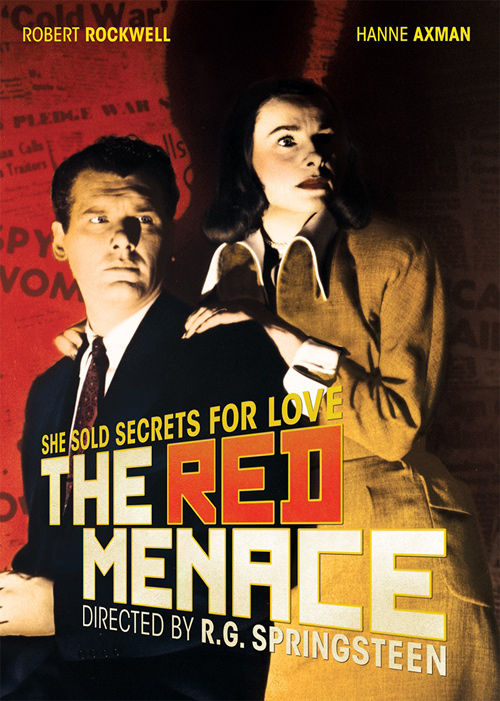
RedMenaceBluray

The Red Menace was directed by Republic Pictures mainstay R.G. Springsteen, who had mostly directed westerns for Republic, including several Red Ryder films. (Don’t let his name fool you, kids. Red Ryder was no Commie.)

I really enjoyed some of Springsteen’s westerns, so I was hoping for more from The Red Menace. The main problem with the film is that it’s not ludicrous enough to be truly entertaining, but it’s not realistic or incisive enough to be a great movie.

The opening is shadowy and atmospheric. A young couple are fleeing a pervasive and terrifying menace. They’re driving at night from Los Angeles through Arizona. Could the gas station attendant be part of the conspiracy? They can’t trust anyone.

Most of the rest of the film is told in flashback. Returning serviceman Bill Jones (Robert Rockwell, who would go on to play Mr. Boynton when Our Miss Brooks moved from radio to television) is fleeced of his savings by an unscrupulous real estate developer, and he’s not the only G.I. facing a housing crisis. His disillusionment is seized on by the local chapter of the Communist party, who play on his anger toward the system. He’s further lured in by the beautiful Nina Petrovka (played by German actress Hannelore Axman, who’s credited as “Hanne Axman”) and good-time girl Mollie O’Flaherty (Barbra Fuller). In The Red Menace, sex is the gateway drug to the philosophy of Marx and Engels.

The script is talky, and to its credit much of the back-and-forth debates are interesting. It’s also nice that the film acknowledges American discrimination against Jewish people and African-Americans, and there are two black men in the film who are not stereotypes (Duke Williams and Napoleon Simpson).

The film also correctly points out that Soviet bloc countries were far from paradises for writers, poets, and artists, who were forced to toe the party line or suffer the consequences. The film’s most tragic character is Henry Solomon (Shepard Menken), a Jewish poet who resigns from the Communist party when the party newspaper he works for tries to force him to retract true statements he has made about the evolution of Communist philosophy.

Not every character is three-dimensional, however. The Red Menace features accomplished radio actress Betty Lou Gerson (who would go on to voice Cruella De Vil in the Disney movie 101 Dalmations) as a Communist party leader whose final histrionics are so over-the-top that they are positively hilarious.

Axman

I think it’s easy to look back on the excesses of McCarthyism during 1950s America and see only madness. But let’s keep in mind that Soviet Russia was a totalitarian state in which dissent was met with imprisonment or execution. Millions died under Stalin’s reign of terror. Whatever Communism promised in theory, it miserably failed to deliver in practice.

But the United States was hardly a paradise for dissenters itself. The Red Menace ends with a kindly cowboy sheriff assuring our fleeing protagonists that the difference between the United States and the Soviet Union is that while in Russia there are no second chances, here in the U.S. we give people just as many second chances as they’re entitled to. But this isn’t even what the film itself has depicted, as the poet Henry Solomon was fired from one job after another and driven to suicide after his former Communist affiliations were revealed.

There is a world of difference between Socialism and Communism, but most Americans (including elected officials) could never see that. People who embraced Socialism in the 1930s because they perceived unfairness in the relationship between labor and management were driven out of their jobs and blacklisted in the 1950s because they refused to “name names.”

Despite some nuances here and there, films like this toed their own party lines. While it’s tempting to see a film like The Red Menace as a historical curiosity, fear and hatred are still the driving force behind much of our politics, and we forget that at our own peril.

Neptune’s Daughter (May 22, 1949)

Neptune's Daughter
Neptune’s Daughter (1949)
Directed by Edward Buzzell
Metro-Goldwyn-Mayer

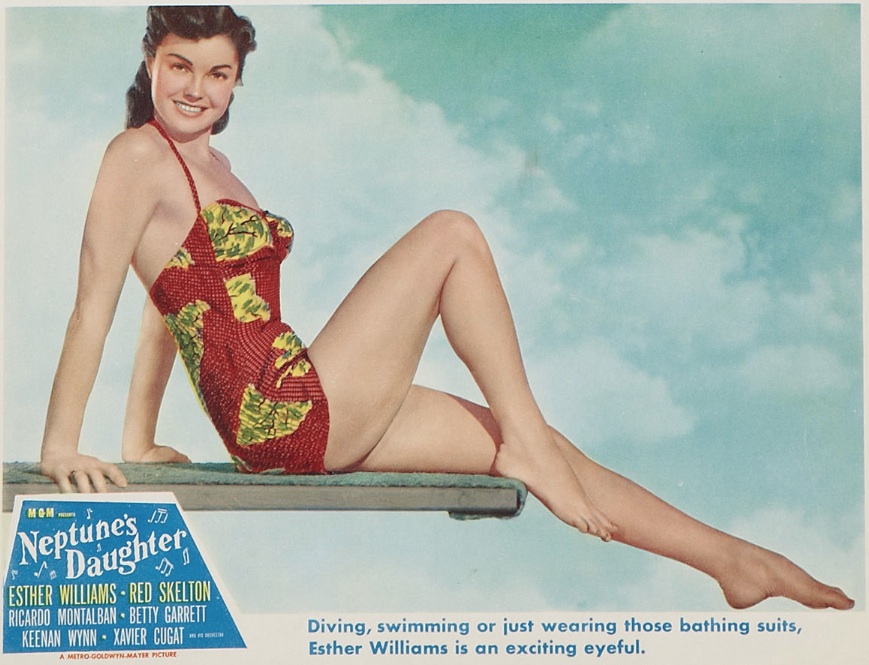
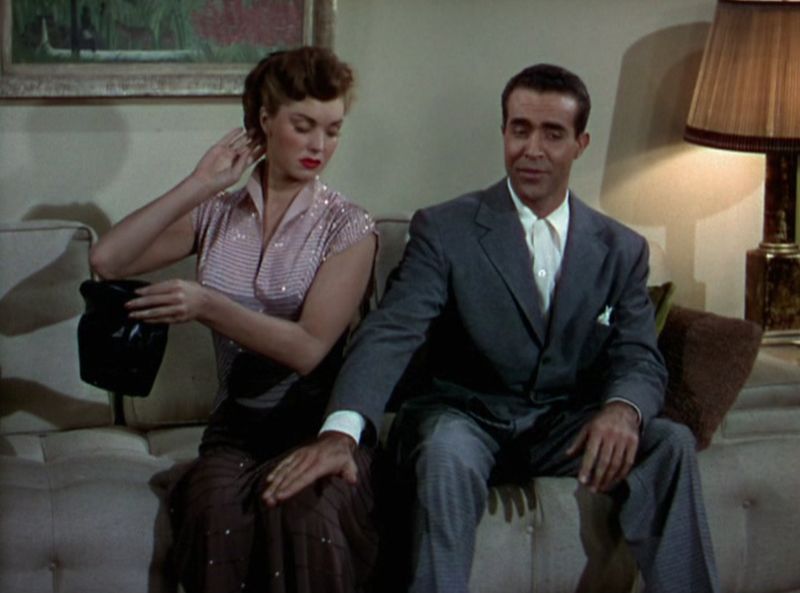
Neptune’s Daughter was the third and final pairing of Esther Williams and Ricardo Montalban. The two previously starred together in Fiesta (1947) and On an Island With You (1948).

In Neptune’s Daughter, Williams plays Eve Barrett, a swimsuit designer, and Montalban plays a dashing South American polo player named José O’Rourke.

The film also stars MGM’s big comedic draw, Red Skelton, as masseur Jack Spratt, and the manic, wild-eyed Betty Garrett as Eve’s sister, creatively named “Betty Barrett.”

Neptune’s Daughter was the second time Skelton and Williams appeared together. The first was Bathing Beauty (1944). (They both appeared in the revue film Ziegfeld Follies, but in separate segments.)

I love Esther Williams. She’s beautiful, athletic, and charming. And the fact that she was a swimming star made her unique. I also like Betty Garrett, who plays essentially the same man-crazy role in Neptune’s Daughter that she played in Take Me Out to the Ball Game (1949). And Ricardo Montalban is Ricardo Montalban. He’s the smoothest Latin lover in Hollywood history.

Williams and Montalban

But I’m not totally sold on Red Skelton. I just don’t find him that funny. Plenty of his bits in Neptune’s Daughter are amusing, but I didn’t find them particularly uproarious, and I really don’t enjoy all his mugging for the camera.

The musical high point of Neptune’s Daughter is the song “Baby, It’s Cold Outside,” by Frank Loesser. It was nominated for an Academy Award for best original song, but there was some controversy over whether it should be eligible for the 1949 Oscars, since Loesser wrote it in 1944 and had performed it at parties with his wife, Lynn Garland. Since it had never been performed “professionally” until its appearance in Neptune’s Daughter, it was deemed eligible and went on to win the Oscar. Loesser’s wife, however, was furious that her husband had sold it to MGM, since she considered it “their song.”

“Baby, It’s Cold Outside” is first performed by Montalban and Williams; he sings the “wolf” part and Williams sings the “mouse” part. It’s performed later by Betty Garrett and Red Skelton with the roles reversed; she is the aggressor and he is the shy one.

“Baby, It’s Cold Outside” was used in the film because MGM’s censors decided that the lyrics of Loesser’s song “I’d Love to Get You (On a Slow Boat to China)” were too suggestive. (Which explains its presence in a film that takes place in sweltering heat.)

This is ironic, since “Baby, It’s Cold Outside” has lyrics that are more more suggestive than the lyrics of “I’d Love to Get You (On a Slow Boat to China).” Parts of the song even border on suggesting date rape, an aspect of the song that was recently satirized by Key & Peele.

I think some of the lyrics to “Baby, It’s Cold Outside” sound worse now than they were intended to. For example, the line “Hey, what’s in this drink?” suggests roofies nowadays, but at the time Loesser wrote the song it was probably meant to imply the sentiment, “Oh my goodness this is a strong drink.”

I think it’s a playful and seductive song, and the fact that Skelton and Barrett reverse the roles when they perform the song adds to the acceptability.

What I found totally unacceptable in Neptune’s Daughter, from a gender standpoint, is the unquestioned assumption that Esther Williams’s character will have to give up her swimwear design business — which she built herself — if she gets married. The idea that she could remain head of a successful company and also be a married woman is unthinkable.

But for the most part, Neptune’s Daughter is a fun, vibrant Technicolor extravaganza. For my money, anything with Esther Williams is worth watching.

Neptune’s Daughter will be shown on TCM on April 6, 2014.