Tag Archives: 20th Century-Fox

The Invisible Wall (Oct. 15, 1947)

Never gamble with the boss’s money.

I don’t know about you, but that seems to me like a pretty simple rule to follow.

Then again, more film noirs than I can count are based on doomed protagonists breaking simple life rules because of their uncontrollable urges.

In the case of Eugene Forde’s The Invisible Wall, the protagonist’s uncontrollable urge is the urge to gamble.

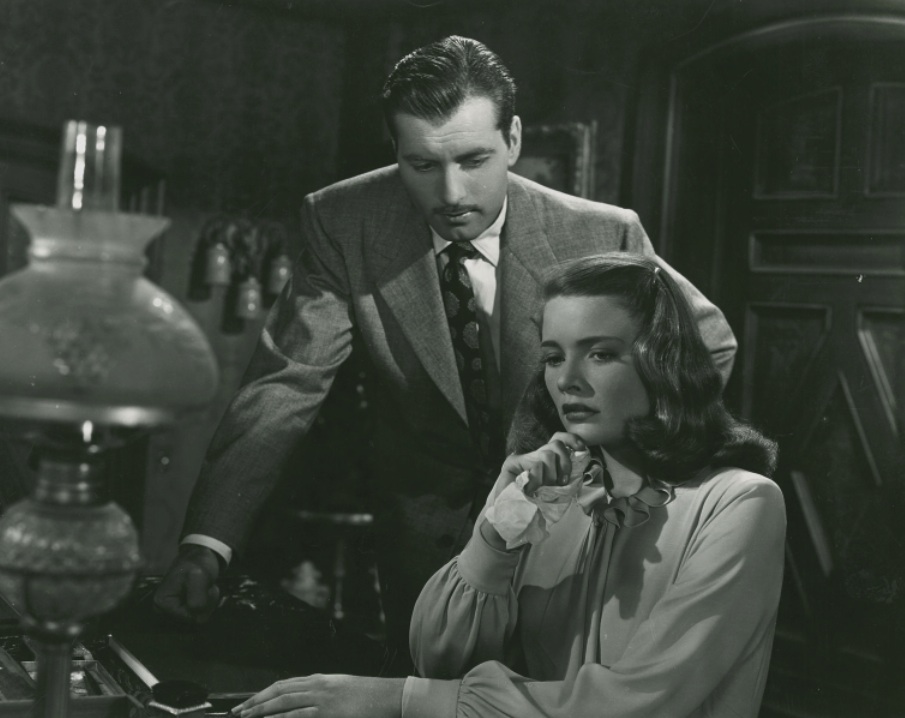
When World War II veteran Harry Lane (Don Castle) is sent to the Hotel Flamingo in Las Vegas by his once and future boss, big-time L.A. bookie and racketeer Marty Floyd (Edward Keane), he has $1,000 of his own money, and he plans to blow his roll fast. He’s holding $20,000 of Marty Floyd’s money that he needs to make a payoff with, though, so when he meets a man who claims to have a system for beating roulette, his goose is cooked.

The man who draws Lane into his gambling scheme in Las Vegas, Richard Elsworth (Richard Gaines), is accidentally killed, so Lane heads to Denver, where he impersonates Elsworth. The only snag is Elsworth’s wife, Mildred (Virginia Christine), who shows up and throws a monkey wrench into Lane’s plans.

The Invisible Wall follows a familiar film noir structure. It begins in St. Louis, where Harry Lane works at the Crown Jewelry Company under another name. He’s arrested for murder and gives a full confession, telling the story in flashback.

The Invisible Wall isn’t a great film by any stretch of the imagination, but it’s solid entertainment from Sol M. Wurtzel Productions, theatrically distributed by Twentieth Century-Fox. The actors are all stiff, but not laughably so, and as far as B noirs go, you could do a lot worse.

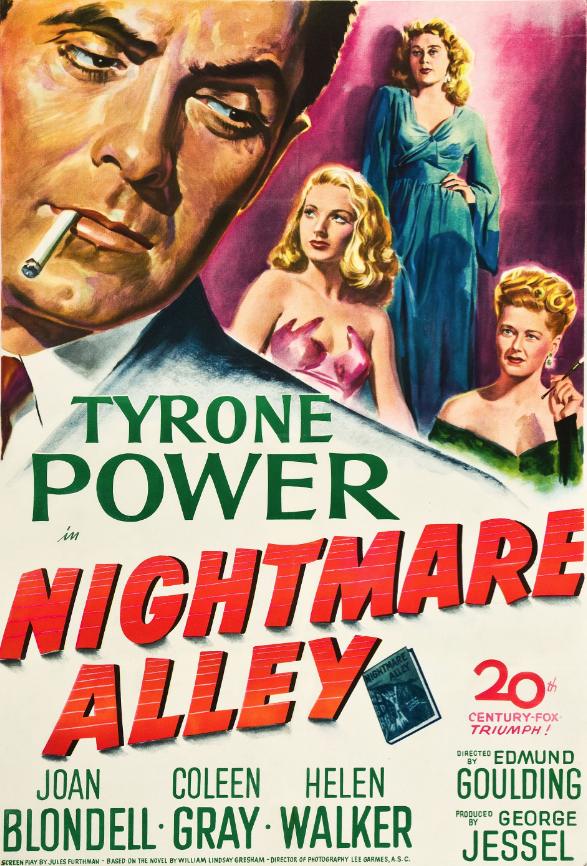
Nightmare Alley (Oct. 9, 1947)

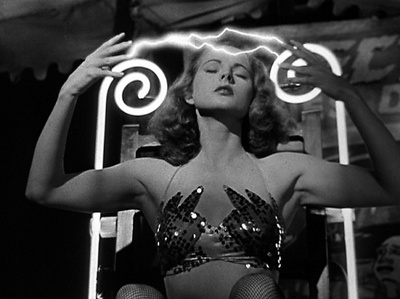
Nightmare Alley is a harrowing tale of manipulation and degradation. It’s a journey through a night-lit carnival world in which everyone is out for themselves and no one cares who they chew up and spit out if it means climbing one more rung on the ladder.

It was Tyrone Power’s second film directed by Edmund Goulding, and it’s miles ahead of their first collaboration, The Razor’s Edge (1946).

While The Razor’s Edge was more acclaimed at the time of its release — four Oscar nominations and one win — it’s aged poorly, and the Eastern mysticism at its center is supposed to be profound but is really just high-minded hokum.

Power made The Razor’s Edge with Goulding as a deliberate attempt to break out of the mold he’d been cast in as a handsome swashbuckler with a limited range. His performance wasn’t bad, but at times it seemed forced.

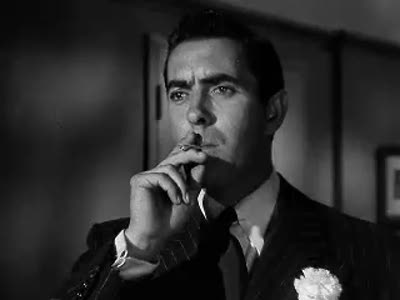
In Nightmare Alley, however, he completely loses himself in his character. His performance as Stanton “Stan” Carlisle — a grasping, duplicitous carny who graduates to tony nightclub performances and fleecing the wealthy — is so natural that I think someone who’d never heard of Tyrone Power before seeing Nightmare Alley would never guess that he wasn’t always seen as a serious actor.

Stan is one of the most memorable film characters I’ve seen in a long time. He’s a drifter who joins a carnival and attaches himself to an aging mentalist named Zeena (Joan Blondell) and her husband, broken-down alcoholic Pete (Ian Keith), then throws both of them aside when he’s learned all he can from them.

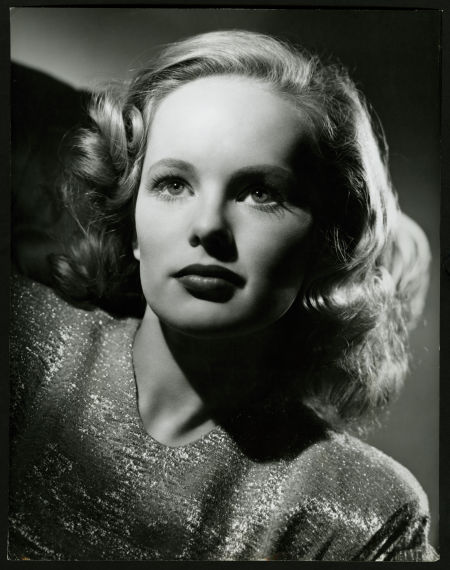
He takes up with Molly (played by the stunningly beautiful Coleen Gray), much to the dismay of her boyfriend, the brutish, simple-minded carnival strongman Bruno (Mike Mazurki). Using the techniques he learned from Pete and Zeena for cold reading a subject and conveying information through a spoken code, he and Molly take their mind-reading act to posh nightclubs, where they’re a sensation. Stan is more than just a quick study. He has an innate ability to see through people and glean their pasts, their innermost desires, and their secrets. The fact that he uses his talents to take people’s money doesn’t bother him, but it bothers Molly, who’s the only character in the film who’s essentially good and decent.

I love the scene in which Stan breaks down and finally uses the oldest trick in the book on Molly. He admits he’s a bad person and a hustler, but that he’s never lied to her. He may have used everyone else in his life, but he’s never used her.

This is, of course, also a lie, which becomes clear when he tosses Molly aside for Lilith Ritter (Helen Walker), consulting psychologist to Chicago’s upper crust, and uses Lilith’s knowledge of the intimate details of the lives of the wealthy to take them for all they’re worth.

While The Razor’s Edge was about Power’s character’s spiritual awakening, Nightmare Alley is about his character’s use of spiritual tropes to lie, cheat, and steal. Maybe it’s just the cynical age in which we live, but I thought that The Razor’s Edge came off as disingenuous, while Nightmare Alley was utterly convincing.

Nightmare Alley is based on the best-selling novel by William Lindsay Gresham. Certain aspects of the novel had to be sanitized for the film version, but it’s still a kick to the stomach. Its story of degradation is so powerfully told that there are many people who saw the film a long time ago and claim that there was a horrifying scene that was deleted for the DVD release. The scene they remember never existed (even in the novel), but it’s easy to see why they think they saw it. Like Psycho (1960) and Rosemary’s Baby (1968), Nightmare Alley uses the power of suggestion to make you remember horrifying things that you never actually see. It’s a great film, and one that will stay with you a long time after the credits have rolled.

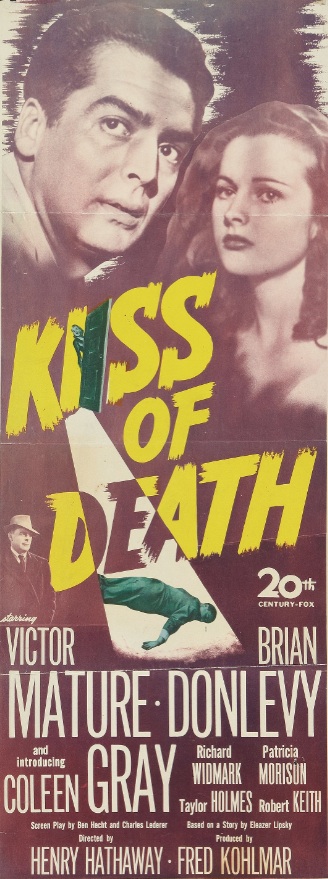
Kiss of Death (Aug. 27, 1947)

Kiss of Death is director Henry Hathaway’s greatest film noir. It’s a mix of the semi-documentary style of his earlier films The House on 92nd Street (1945) and 13 Rue Madeleine (1947) with the hard-boiled conventions of his private eye flick The Dark Corner (1946).

The film begins with the following words: “All scenes in this motion picture, both exterior and interior, were photographed in the State of New York on the actual locale associated with the story.”

Unlike The House on 92nd Street and 13 Rue Madeleine, however, this commitment to veracity isn’t in service of a true-ish retelling of World War II-era espionage, but of a hard-boiled crime drama about a three-time loser facing 15 years in stir after being nabbed for a jewel robbery.

His name is Nick Bianco (Victor Mature), and if he wants to watch his two little girls grow up, he’s going to have to stool for the district attorney’s office.

Bianco has been in this position before, and he took the full four-year rap instead of squealing.

“I’m the same guy now I was then. Nothin’ has changed. Nothin’,” he tells Assistant District Attorney Louis D’Angelo (Brian Donlevy).

On his way up the river to Sing Sing, Nick meets a cackling, sociopathic hood named Tommy Udo (Richard Widmark). Udo won’t show up again for awhile, but he’ll play a major role in Nick’s life when he does.

For awhile, Nick stays clammed up, but then his wife Maria commits suicide and he starts to rethink matters. When a pretty girl from his old neighborhood, Nettie (Coleen Gray), comes to visit him in Sing Sing and tells him that the driver on the jewelry job, a guy named Pete Rizzo, was responsible for Mrs. Bianco putting her head in the oven, Nick decides he wants to talk to the D.A. and secure his release in exchange for information. (In the original story, it was implied that Rizzo raped Nick’s wife, but that’s sidestepped in the final version, making it seem more as if she was having an affair with Rizzo.)

Nick trusts Assistant D.A. D’Angelo enough to tumble to a job in his past that he got away with — the Thompson Fur Company heist — to provide a cover for his trips to the D.A.’s office. D’Angelo promises that he’ll drop the charges later for insufficient evidence.

Things are looking up for Nick. He’s able to care for his daughters, and he’s eventually paroled, leaving him free to marry Nettie.

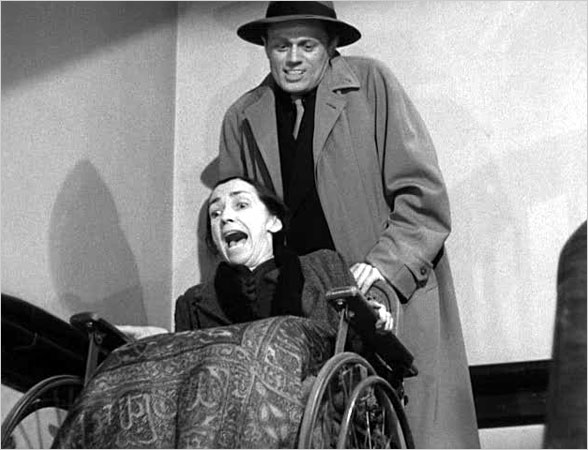
But as soon as Tommy Udo — Nick’s old pal from the trip up to Sing Sing — re-enters his life, things go very bad very quickly. Udo is the kind of guy who thinks nothing of wrapping up an older wheelchair-bound woman (played by Mildred Dunnock) in electrical cord and pushing her down a long flight of stairs, in one of the most enduring scenes of cinematic sociopathy.

Kiss of Death was Richard Widmark’s film debut, and his balls-out crazy performance is something to behold. The filmmakers thought that Widmark’s high forehead made him look too intelligent, so they outfitted him with a low-browed hairpiece. Like Heath Ledger’s performance as the Joker in The Dark Knight (2008), Widmark’s performance as Tommy Udo straddles the line between gangster movie and monster movie. Director Hathaway had toyed with the idea of casting the manic Harry “The Hipster” Gibson, who sang the 1944 druggie classic “Who Put the Benzedrine in Mrs. Murphy’s Ovaltine?” as Udo, but it’s impossible now to imagine anyone but Widmark in the role.

The screenplay for Kiss of Death was adapted by Ben Hecht and Charles Lederer from a story by Eleazar Lipsky originally called “Stoolpigeon.” Lipsky was a novelist who worked as a Manhattan assistant district attorney. He was also legal counsel for the Mystery Writers of America. Perhaps because of Lipsky’s day job, the realism of the setting of Kiss of Death is matched by the actions of its characters. Brian Donlevy, in the role of Assistant D.A. D’Angelo, is neither a hero nor a villain. When he tells Nick that he’s going to have to testify in court after all, and later that it was all for nothing, and that Tommy Udo was acquitted and is probably coming after Nick, the viewer gets the sense that D’Angelo genuinely cares for Nick, but that at the same time, putting Nick’s life in danger is just part of the job. D’Angelo might not like it, but he accepts it as a necessary evil.

Interestingly, the fictional Kiss of Death comes off as a more realistic film than either The House on 92nd Street (1945) or 13 Rue Madeleine (1947), both of which touted the “true” stories that were their inspirations. Although not every scene in Kiss of Death was shot on the actual locale associated with the story, as the title card promises (some of the interiors were clearly shot in a studio), the use of real New York City and Upstate New York locations coupled with realistic dialogue, understated performances from all the cast besides Widmark, and extremely sparse use of background music makes for a powerful, engrossing drama. There are standout set pieces, like the jewel heist in the Chrysler Building that opens the film, and spectacular shots of the Manhattan Criminal Courts Building, the Tombs, and the Triborough Bridge from the Queens side of the East River, but there are also lots of little touches that give the film its sense of realism. When Nick watches his daughters during their music lesson at the Academy of the Holy Angels in Fort Lee, New Jersey, the piano is slightly out of tune. When Nick sits in his cell at Sing Sing, the toilet in the cell is clearly visible, which is something you’d never see in a prison cell built on a Hollywood soundstage in the ’40s. (Incidentally, prior to shooting the scenes in Sing Sing, Hathaway had both Victor Mature and Richard Widmark processed through the system to give them a better sense of the characters they were playing.)

Kiss of Death isn’t a perfect movie, but it stands up to repeated viewings, and its use of music and location are both revolutionary. If you don’t believe me, take it from Walter Winchell…

The Ghost and Mrs. Muir (June 26, 1947)

The Ghost and Mrs. Muir
The Ghost and Mrs. Muir (1947)
Directed by Joseph L. Mankiewicz
20th Century-Fox

Gene Tierney is one of my favorite actresses from the ’40s. (What can I say? I’m a sucker for a cute overbite.) She’s often criticized for being more of a pretty face than a talented performer, but I think that’s unfair. Maybe some of these criticisms spring from her most famous role — Laura (1944) — in which she literally played a painting. I don’t know. What I do know is that when she was given good material and paired with a good director and co-stars, she really shone.

The Ghost and Mrs. Muir was directed by Joseph L. Mankiewicz, who made another wonderful film starring Tierney, Dragonwyck (1946). Mankiewicz clearly cared about helping Tierney craft a fully realized character. And it doesn’t hurt that in this film, she is paired with the great Rex Harrison, who plays the ghost of the title.

Harrison’s scenes with Tierney are the highlights of the film, and the two actors play off each other beautifully. Their relationship runs the gamut of human emotion, from fear to amusement, anger to warmth, reproach to acceptance, and eventually even into the uncharted territory of human-spectral love.

The Ghost and Mrs. Muir takes place in England at the turn of the century. Tierney plays a widow named Lucy Muir who moves with her young daughter Anna (Natalie Wood) and her maid Martha Huggins (Edna Best) to Gull Cottage at Whitecliff-by-the-Sea. Unlike her real estate agent, Mr. Coombe (Robert Coote), who flees from ghostly laughter when showing Lucy the house, Mrs. Muir is sanguine about the prospect of moving in with a ghost. “Haunted,” she says. “How perfectly fascinating.”

Gene Tierney and Rex Harrison

Of course, she’s also a skeptic who doesn’t believe that medieval nonsense like ghosts and hauntings could ever exist in the 20th century. The painting of the fearsome-looking former owner of the house — Capt. Daniel Gregg — is certainly lifelike, but it takes the appearance of the salty old seaman “in the flesh” to convince Lucy that she’s not imagining things.

Philip Dunne’s screenplay for The Ghost and Mrs. Muir is based on a novel by Josephine Leslie, who published it under the masculine-sounding pseudonym “R.A. Dick.” (I’m not sure if that pen name is supposed to be as funny as I find it.) In the novel, Capt. Gregg was just a voice inside Mrs. Muir’s head. He manifests more literally in the film, but in many ways he still symbolizes Lucy’s personal journey from a black crepe-wearing widow bound by convention to a liberated woman who writes and publishes a very unladylike book entitled Blood and Swash (with Capt. Gregg’s help, of course).

Ironically, the ghost of the Captain has no use for superstition or fear, and his plain, unvarnished speech, peppered with curses, speaks the truths that everyone in Lucy’s life has been too straitlaced to ever acknowledge. Also, because he has no corporeal form, the film is able to get away with things that otherwise wouldn’t have been acceptable under the Hay’s Code, such as a widow and a virile man sharing a room and intimate talk. He insists she call him by his Christian name, “Daniel,” and he decides her name should be something more exotic than Lucy, so he calls her “Lucia.”

“Keep on believing in me, and I’ll always be real,” Capt. Gregg tells Lucy, but eventually a real man enters her life — a slippery lothario named Miles Fairley (George Sanders) who writes children’s books under the name “Uncle Neddy” — and the jealous ghost must fade away.

The scene in which he says goodbye to her might be the most weirdly erotic and deeply romantic scenes of all time. She lies down in bed, her eyes close, and he sits down next to her, his face very close to hers as he says, “It’s been a dream, Lucia. And in the morning, and the years after, you’ll only remember it as a dream, and it’ll die, as all dreams must die at waking.”

Mankiewicz’s able direction is aided by the brilliant cinematography of Charles Lang and the luscious musical score of the great Bernard Herrmann. Together, they craft a film that nimbly moves from horror film to comedy, and then from romance to drama. I can’t recommend The Ghost and Mrs. Muir highly enough for lovers of classic cinema.

Moss Rose (May 30, 1947)

Gregory Ratoff’s Moss Rose is a murder mystery set in Victorian London. It stars Peggy Cummins — a beautiful blond actress who looks like a doll come to life — as Rose Lynton, a Cockney chorus girl. Rose works under the stage name “Belle Adair.” She may have grown up in Shoreditch, but she aspires to be a fine lady.

Margo Woode plays Rose’s friend Daisy Arrow, a fellow actress who has a mysterious boyfriend. He’s a handsome, well-dressed gentleman who Rose only catches glimpses of as he moves in and out of the shadows. Daisy only appears in a handful of scenes before Rose discovers her corpse in bed in the room they share, an open Bible lying on the bed next to her with a dried and pressed moss rose laid across its pages. Was it her suitor who killed her? Or someone else?

Vincent Price — always a welcome sight — plays Inspector Clinner, the Scotland Yard detective who investigates the case along with his lumpy little partner, Deputy Inspector Evans (Rhys Williams). Soon, the identity of Daisy’s suitor becomes clear. He’s a wealthy gentleman named Michael Drego, and he’s played by the always oily Victor Mature, whose lack of a British accent is explained away by the fact that his Canadian father took him away from England when he was very young.

Rose plays girl detective, and it’s not long before she seems to be two steps ahead of the police in identifying Michael as Daisy’s murderer. At first it’s unclear what she wants from him, or why she fails to identify him to the police. She initially blackmails him, but then gives the money back and tells him that all she wants is for him to take her with him to his home, Charmley Manor, for just two weeks. Michael denies that he is guilty of Daisy’s murder, but he tells Rose he’ll go along with her scheme because he’s desperate to keep his family’s name out of the spotlight.

Most of the film takes place at Charmley Manor, which is presided over by Michael’s mother, Lady Margaret (played by the grandest Hollywood dame of them all, Ethel Barrymore).

Lady Margaret keeps her son’s childhood room exactly as it was, because when he was taken away by his father, she knew it was the last time she’d ever see that little boy again. She doesn’t allow anyone in the room, not even the servants, but after her first flash of rage at Rose when she discovers her snooping around the room, she softens, and tells Rose that there’s nothing like a secret to bring two people together.

Complicating matters for Rose at Charmley Manor is the presence of Michael’s fiancée, the beautiful Audrey Ashton (Patricia Medina). Lady Margaret grows to accept Rose, even going so far as to tell people that she is her “companion,” but Audrey sees Rose as a threat to her impending nuptials, and rightly so.

Moss Rose is based on The Crime of Laura Saurelle, one of author Joseph Shearing’s many Gothic thrillers, which were quite popular at the time of the film’s release. (Shearing was one of several pseudonyms used by writer Marjorie Bowen.) It’s a decent whodunnit that will keep you guessing. Michael Drego is the prime suspect, but Inspector Clinner loves flowers — moss rose in particular — and he’s played by Vincent Price, so he always seems suspicious, especially when he’s cutting himself a piece of moss rose in Lady Margaret’s greenhouse and he has a maniacal gleam in his eye. There is also Lady Margaret’s intense-looking butler, Craxton (George Zucco), and as we all know, butlers are always under suspicion. The ladies aren’t exempt from suspicion, either. We learn that Audrey made a mysterious bulk purchase of three Bibles just like the one found next to Daisy Arrow’s corpse, and she’s obviously jealous of any woman in whom Michael shows an interest. And Lady Margaret is hard-headed and clear-eyed, but she seems like a different person whenever she speaks of her son.

Despite the wealth of suspects, Moss Rose turned out exactly how I thought it would, but it wasn’t a bad way to kill some time.

Miracle on 34th Street (May 2, 1947)

When I was a kid, I briefly corresponded with Santa Claus. I’m not talking about the annual “letter to Santa” every kid writes, with a list of everything they want in their stocking that year. I dropped Santa a line in the off-season — June or July — and asked him how summers were at the North Pole, how Mrs. Claus and the elves were doing, and what his reindeer liked to eat.

I was eight or nine years old. I didn’t exactly believe in Santa Claus, but I liked the idea of him. Writing a letter to him felt good. And doing it in the summer made me feel unselfish.

I can’t remember if I was surprised or not when I received a response from Santa Claus.

It was a typewritten letter, and it was postmarked the North Pole. Santa thanked me for my letter, let me know what was going on at the North Pole, told me what his reindeer liked to eat, and told me that he liked my drawing of a train and said he assumed I must live near a railroad and that he sincerely hoped I stayed away from the railroad tracks. I didn’t quite understand that last part. There was a freight train that ran through town, but it wasn’t that close to my house, and I never hung out down there, and why wouldn’t Santa know that? Doesn’t he know everything? Surely “plays risky games on the train tracks” would’ve put me in the “naughty” column, wouldn’t it?

He ended the letter by saying that he thought the stamp I’d pasted to the front of the letter was awfully attractive, and asked if I’d ever considered stamp collecting as a hobby. He may have thrown in some stamps to get me started. I can’t remember.

I figured I should probably take Santa’s advice, so I got into stamp collecting and kept up the hobby for several years. It did occur to me that it was a little strange that the last place I saw my letter to Santa was sliding down the mail slot at the post office and that I got a response from some dude calling himself Santa who seemed to be really into philately. (That’s “stamp collecting” for all you non-philatelists out there.)

Around this time, one of my teenaged foster sister’s friends asked me if I believed in Santa Claus, and I responded, “I believe in the spirit of Christmas.”

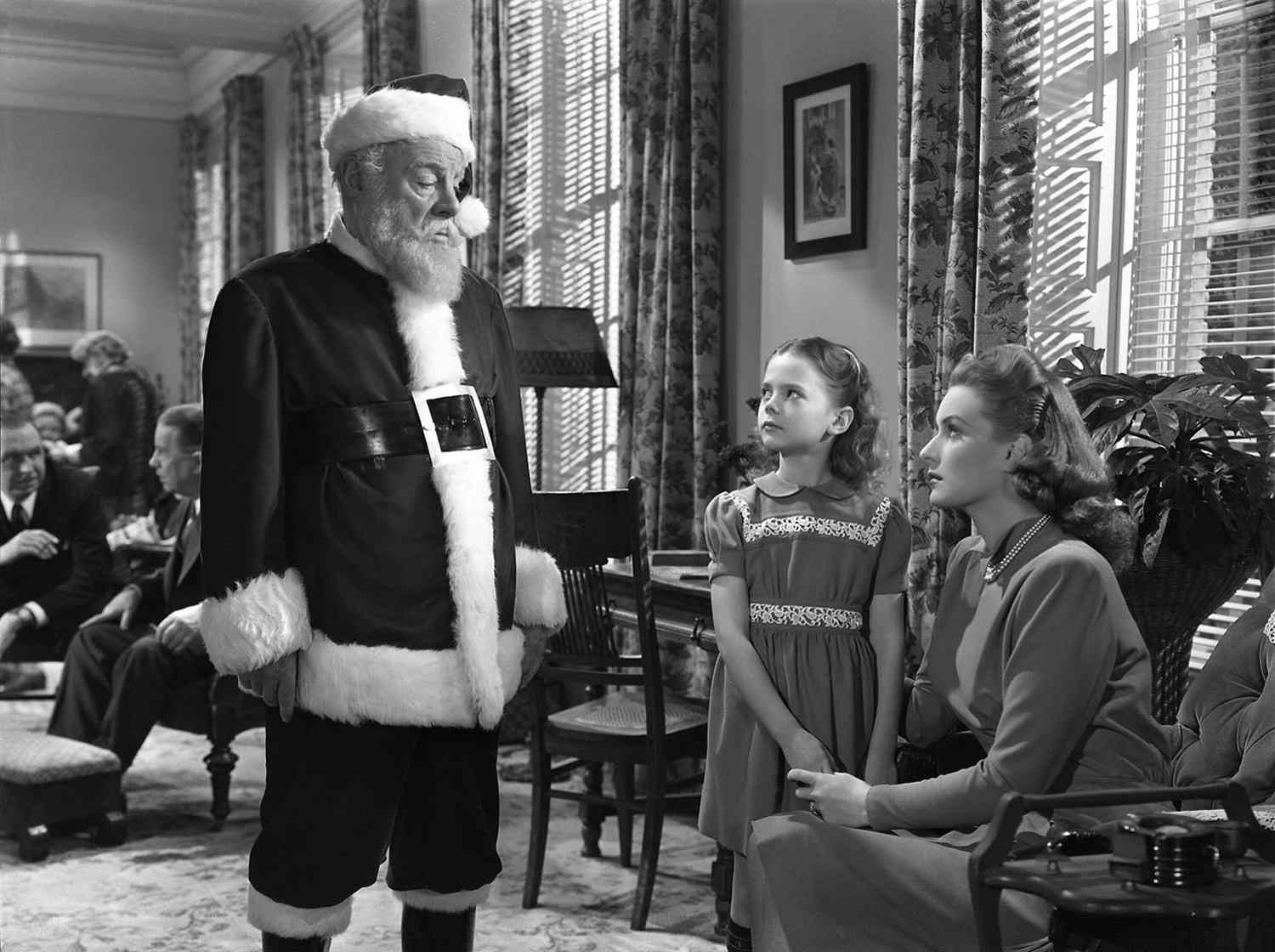
Which brings me around (finally) to George Seaton’s Miracle on 34th Street, which I hadn’t seen since I was a kid. It was just as funny and enjoyable as I remember it being. I found the scene in which Kris Kringle (Edmund Gwenn) tells a shop owner that his store display features his reindeer in the wrong order more whimsical than factual this time around, and the scene in which we see a man in a chintzy Santa suit, drunk as a lord, really disturbed me when I was a kid. This time around, it was merely mildly amusing. (As a jaded adult, Santa Claus-related hijinks have to be a little more disturbing than public intoxication to get a rise out of me.)

Kris Kringle replaces the intoxicated Santa in the Macy’s Thanksgiving Day Parade, and does such a good job that he’s hired as a store Santa. Unlike most department store Santas, he doesn’t shill for his employer. In his first day on the job at Macy’s, he sends a harried mother (Thelma Ritter) to Schoenfeld’s Department Store, which he says is the only place in town that has the toy her son wants. Kringle keeps a very close watch on the toy market, after all. She’s flabbergasted that a department store Santa would send her to a competitor, but she’s delighted, too, and Kringle’s helpfulness creates an enormous wave of good publicity for Macy’s.

The only problem is that Kris believes he really is Santa Claus, and tells everyone so. When the event director who hired him, single mother Doris Walker (Maureen O’Hara), finds out that he’s been filling the head of her six-year-old daughter, Susan (Natalie Wood), full of such nonsense, she’s upset, and pulls his employment card. It lists his address as Brooks’ Memorial Home for the Aged, 126 Maplewood Drive, Great Neck, Long Island, but his date of birth says “As old as my tongue and a little bit older than my teeth,” under “place” he has written “North Pole,” and his eight tiny reindeer are listed as his next of kin.
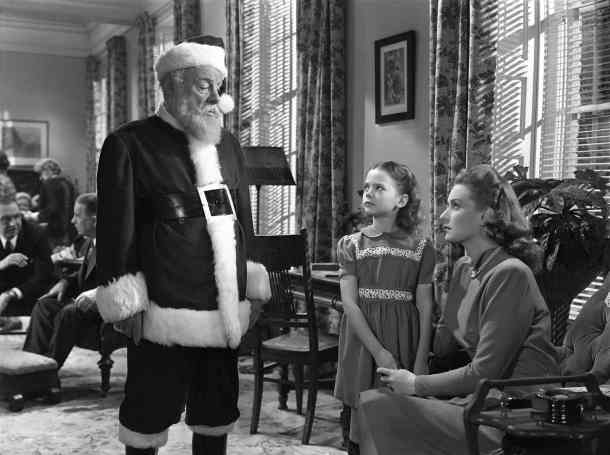
Dr. Pierce (James Seay), the doctor at Kris’s nursing home, assures Doris that Kris’s delusion is harmless, but a meddling little twit named Granville Sawyer (Porter Hall) who gives psychological evaluations to Macy’s employees conspires to have Kris committed.

In order to prove Kris’s sanity, his lawyer, Fred Gailey (John Payne), announces that he will in fact prove that Kringle is Santa Claus, and therefore not insane. It’s the trial of the century. A series of newspapers blare increasingly wild headlines, culminating in the ridiculous “Kris Kringle Krazy? Kourt Kase Koming ‘Kalamity!’ Kry Kiddies.” (A lot of people will tell you that puns are the lowest form of humor, but they’re not. Alliteration is.)

Miracle on 34th Street is a wonderful film. It walks the tricky line between faith and skepticism without ever going too far in either direction. Every character who has faith is rewarded, but there’s nothing in the film that’s overtly unreal. Doris and Fred find love with each other, and Susan’s only Christmas wish is fulfilled, but in a clever, roundabout way. (There’s no final shot of Kris Kringle shooting out of a chimney or anything.)

It was a little weird to watch this movie in springtime. It created the same type of cognitive dissonance as smelling turkey roasting in August, or attending a Fourth of July barbecue in November. I blame Daryl F. Zanuck, who insisted that the film be released in May, since he said that more people went to the movies in the summer than during the holidays. The studio kept the film’s Christmas theme a secret in its trailer. Also, you’ll note that the theatrical release poster above prominently features Payne and O’Hara, and Gwenn is not dressed up like Santa.

Miracle on 34th Street was nominated for four Academy Awards — Best Picture, Best Supporting Actor (Gwenn), Best Adapted Screenplay (George Seaton), and Best Story (Valentine Davies). It won all of the Oscars it was nominated for except Best Picture, which went to Elia Kazan’s Gentleman’s Agreement.

Boomerang (March 5, 1947)

Boomerang is another fact-based drama produced by Louis de Rochemont, the maker of the “March of Time” series of newsreels. Like de Rochemont’s other films, The House on 92nd Street (1945) and 13 Rue Madeleine (1947), it features stentorian, “newsreel”-style narration by Reed Hadley, a number of the actual participants in the case playing themselves in minor roles, and a commitment to verisimilitude that is less cut-and-dried than the filmmakers would have the audience believe.

For my money, Boomerang (or Boomerang!, as it appears on the cover of a notebook in the opening credits) is far and away the best of the first three films de Rochemont produced. A great deal of that is due to the direction by Elia Kazan.

Kazan was coming off the success of A Tree Grows in Brooklyn (1945), but he was still better known for his work in the theater than in Hollywood. I think that Kazan’s enormous talent as a film director and his strong visual sense are often underestimated, but there’s no denying that he was an actor’s director. The actors in Boomerang all turn in powerful, fully realized performances, and I think a lot of that is due to Kazan’s experience directing for the stage.

Boomerang is based on a real case that took place in 1924 in Bridgeport, Connecticut. (To sidestep raw feelings, the production was filmed in Stamford.)

A beloved priest named Father Lambert (Wyrley Birch) is killed by a single .32 caliber bullet fired point blank into the back of his head on Main Street one evening. When a prime suspect does not immediately materialize, the reform party newly in power is lambasted in the press, which leads to overzealous police tactics, which means plenty of round-ups and arrests, but not much else. Finally, a drifter named John Waldron (Arthur Kennedy) is picked up by police in Ohio. Waldron has a .32 revolver in his pocket, was passing through Connecticut at the time of the murder, and is identified by numerous eyewitnesses as the shooter.

Waldron also makes a signed confession, but only after he’s subjected to days of intense grilling by police chief Harold F. “Robbie” Robinson (Lee J. Cobb) and Detective Lt. White (Karl Malden), as well as a parade of other police officers and a psychiatrist, Dr. William Rainsford (Dudley Sadler).

It seems like an open-and-shut case, and a slam-dunk for State’s Attorney Henry L. Harvey (Dana Andrews), but after talking to Waldron, Harvey has doubts about his guilt, which he shares with his wife, Madge Harvey (Jane Wyatt), before doing some investigating of his own.

When called upon to make his case in court, Harvey says, “I thought I had the case going perfectly straight and then all of a sudden it comes back and hits me right between the eyes.”

Boomerang brilliantly depicts a number of concepts that were fairly new to the public at the time of its release — the unreliability of eyewitness testimony, especially a large group of eyewitnesses, and the idea that a man who was not guilty of a crime might still make a full confession to police under duress.

Kazan also shows exactly what abuse of power looks like. It’s not committed by scheming men of pure evil, it’s committed by police officers like the one played by Lee J. Cobb — decent men with a strong moral code who are desperate to make a conviction, and are absolutely sure that they have the right man. Kazan also does a good job of weaving a story of petty, venal, small-town politics into the larger crime story and courtroom drama.

The character Dana Andrews plays is based on Homer Cummings, who would go on to be the U.S. Attorney General under Franklin D. Roosevelt, but it’s not a biopic. It’s also not a wholly nonfictional telling of the real case, since there’s a character created from whole cloth named Jim Crossman (Philip Coolidge), who may or may not have murdered the priest, and who seems to have been created purely to satisfy audience members who need to see some sort of justice done.

Luckily, false notes like the Crossman character are few and far between in Boomerang.

The Brasher Doubloon (Feb. 6, 1947)

Ladies, I don’t know if you know this, but the cure for frigidity is George Montgomery.

Let’s pretend that you are a young woman who is terrified of a man’s touch, due to some unstated trauma in your past. You work for a tyrannical old dowager who has an unnatural attachment to her spoiled, weak-willed son. You tremble at the sound of the old woman’s voice, and you live in her Southern California mansion as a virtual slave.

Then, one day, a man appears at the front door. He’s tall, he’s trim, he’s 30 years old, and he has high cheekbones and a nice mustache. In short, he’s the complete package. He’s come at the behest of your mistress, Mrs. Murdock, who wants him to track down a coin that has been stolen from her. The coin is the Brasher Doubloon of the title, and it’s a coin with “a romantic and violent history.”

If this man approached you privately after meeting with the old woman and you told him you don’t like to have men touch you, and he responded — “Well, in that case you better do something about your appearance. And that perfume you use … Night of Bliss. You just can’t seem to make up your mind, can you, Miss Davis?” — would you accept his offer to “take it very slowly” and cure you of your phobia?

Of course you would.

In John Brahm’s The Brasher Doubloon, private investigator Philip Marlowe (Montgomery) accepts both cases — tracking down the missing coin owned by Mrs. Murdock (Florence Bates) and curing her secretary, Merle Davis, of her frigidity.

Merle is played by Nancy Guild (rhymes with “wild”), who looks a little like a softer-featured Margot Kidder. She and Montgomery are an attractive pair, but their limits as thespians keep The Brasher Doubloon from being a top-flight picture.

Montgomery delivers every line in an emphatic huff. If it’s supposed to be hard-boiled it doesn’t come across that way. When a slimy coin dealer named Elisha Morningstar (Houseley Stevenson) asks Marlowe if he’s threatening him, Marlowe responds, “Yes…,” as though he’s not sure. When Marlowe tell Mrs. Murdock, “I do things my own way,” he sounds like a petulant child.

Throughout the film, Guild looks as though she’s been thrown into the deep end of the pool and doesn’t know how to swim. (This was only her second film — the first was Joseph L. Mankiewicz’s 1946 noir Somewhere in the Night.) Luckily, wide-eyed panic is what her character calls for. Unfortunately, her performance remains pitched at exactly the same level throughout the film.

Dorothy Bennett’s screenplay, which is adapted from Chandler’s 1942 novel The High Window, is pretty good. John Brahm’s direction is excellent. Unlike The Big Sleep (1946), this isn’t a picture that’s overly difficult to follow, and the settings — from baronial mansions to smoky underworld dives and rented rooms — are well-done.

The Brasher Doubloon is one of the least well-known films adapted from a Raymond Chandler novel. After two B movies adapted from Chandler novels that did not retain the Philip Marlowe character were released — The Falcon Takes Over (1942) and Time to Kill (1942), based on Farewell, My Lovely and The High Window, respectively — the two most famous Philip Marlowe movies were made: Murder, My Sweet (1944), which starred Dick Powell as Marlowe, and The Big Sleep (1946), which starred Humphrey Bogart as Marlowe. Robert Montgomery’s Lady in the Lake (1947) rounds out the “big three” Philip Marlowe films of the ’40s, and while it’s not as well-regarded as the other two, it’s available on DVD, and is an interesting picture.

The Brasher Doubloon is currently unavailable on DVD, which is a shame. While the acting by the two leads is pretty bad, and there’s a really cheesy scene at the end in which Marlowe assembles all of the suspects and explains to them who committed the murders, overall this is a pretty tight noir mystery.

13 Rue Madeleine (Jan. 15, 1947)

Henry Hathaway’s 13 Rue Madeleine is a spiritual sequel to his espionage docudrama thriller The House on 92nd Street (1945). The address this time around refers not to the headquarters of a Nazi spy ring in New York City, but to Gestapo headquarters in Le Havre, France, during World War II.

Like The House on 92nd Street, 13 Rue Madeleine owes a debt to the style and presentation of Louis de Rochemont’s “March of Time” newsreels. (De Rochemont served as producer of both films.) I enjoyed The House on 92nd Street, but judged purely as a cinematic experience, 13 Rue Madeleine is the superior film.

A lot of that is due to the film’s star. James Cagney is dynamic and arresting in every role I’ve ever seen him play, and I would pay to watch a film in which all he did was order and consume room service by himself.

In this film, Cagney plays Robert Emmett “Bob” Sharkey, an instructor of potential agents in a U.S. agency called “O77.” (The organization is clearly based on the O.S.S., but the name was changed because of certain plot elements that we’ll get to in a moment.)

Early in the film, Sharkey’s boss, Charles Gibson (Walter Abel), informs him that one of his students is a German mole named Wilhelm Kuncel. The mole turns out to be one of his most promising pupils, William H. “Bill” O’Connell (Richard Conte). O’Connell looks and acts as American as apple pie, and during training grew especially close to blond, fresh-faced Jeff Lassiter (Frank Latimore), who never suspected a thing.

Gibson orders Sharkey to pass O’Connell and to not let on what he knows, in order to feed false information to the Germans through O’Connell. Alas, O’Connell proves to be even cannier than Sharkey’s bosses could have predicted, and this decision leads to a series of tragedies.

Conte isn’t an actor I could have picked out of a lineup a year ago, but after seeing him now in several roles, I think he’s a tremendous performer, and I look forward to a lifetime of watching his films. It doesn’t matter for his role as a double agent in 13 Rue Madeleine that he doesn’t look the slightest bit “German.” In a wordless scene in a transport plane over Europe, as O’Connell and Lassiter are preparing to jump, O’Connell suddenly sees what the straight-arrow Lassiter can’t hide, and the look on his face is chilling.

My Darling Clementine (Dec. 3, 1946)

My Darling Clementine
My Darling Clementine (1946)
Directed by John Ford
20th Century-Fox

“This is the west, sir. When the legend becomes fact, print the legend.” — The Man Who Shot Liberty Valance (1962)

John Ford’s My Darling Clementine is one of the most lauded westerns of all time.

Most criticism of the film is directed at its numerous historical inaccuracies, not its artistic merits. The ages of the Earp brothers are changed, for what seems no discernible reason. Characters die in the film who didn’t die until decades later. The chain of events that led up to the shootout near the O.K. Corral in Tombstone, Arizona, in 1881 is highly fictionalized. In reality, Doc Holliday was a dentist, not a medical doctor. The list goes on and on.

So to enjoy this film, it’s probably best not to watch it with a talkative history junkie.

And if you yourself are a history junkie, try to ignore all the little details and appreciate this film for what it is — one of the great westerns, full of iconic scenes, memorable performances, finely staged action, and little moments that would be copied over and over again in westerns in the decades that followed.

My Darling Clementine is a remake of Allan Dwan’s Frontier Marshal (1939), which starred Randolph Scott as Wyatt Earp. Both films are based on Stuart N. Lake’s book Wyatt Earp, Frontier Marshal, which was based on interviews with Earp, although most historians suspect that either Lake was embellishing or Earp was.

Again, it really doesn’t matter when it comes to this film. The plot is not the important thing, it’s Ford’s evocation of a frontier town. The rhythms of life, the strong feeling of nighttime, daytime, daybreak — all are perfectly realized. It doesn’t matter that the real Tombstone isn’t anywhere near Monument Valley. Ford shot there because he liked the way it looked.

Day for night shooting can look terribly fake, or just plain terrible, but in this film Ford makes it look beautiful. In one nighttime scene, Wyatt Earp appears on a rooftop, shot in low angle, firing his revolver at a man fleeing on horseback. Behind him is a dark sky full of silvery clouds. The scene clearly wasn’t filmed at night, but it’s still breathtaking.

Henry Fonda

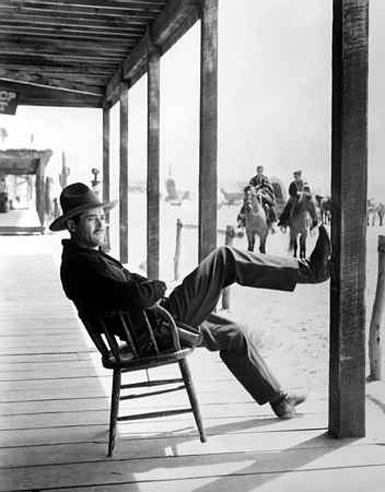
Henry Fonda’s performance as Wyatt Earp is one of the finest I’ve ever seen in a western. Protagonists in westerns tend to be stalwart men of few words, and Earp is no exception, but the humanity Fonda is able to express merely through his eyes is remarkable.

Fonda generates absolute authority in every scene. Except, of course, when he’s with the pretty Clementine Carter (Cathy Downs). The scene in which he takes her to a Sunday dance at the site where the town’s church will be built is one of the highlights of the film. As Earp walks beside Clementine, the congregation sings “Shall We Gather at the River?” (later to be paid gruesome homage to by Sam Peckinpah when he made The Wild Bunch in 1969). The budding romance between the two is palpable, and is a fine example of Fonda’s wonderful silent acting.

Walter Brennan is also great as Old Man Clanton, the vicious patriarch of a nasty clan. Brennan played a lot of cuddly, blustery sidekicks, but here he’s completely convincing as a cold-eyed villain who tells his boys things like, “When you pull a gun, kill a man.”

I’m less bowled over by Victor Mature’s performance as Doc Holliday. The oily Mature seems to be in a different picture in most of his scenes, as he drinks to escape his past and romances the tragic prostitute Chihuahua (Linda Darnell).

As I said, the liberties Ford takes with history are legion. But as Lawrence Kasdan’s Wyatt Earp (1994) showed, an accurate recitation of the facts doesn’t necessarily make for compelling drama. And who cares about the actual details of the shootout near the O.K. Corral when we have things in this film like Earp standing perfectly still as a stagecoach pulls in, then running to his left as soon as it kicks up a trail of dust, nearly invisible even to the viewer as he fires several shots and hits his target?

Producer Daryl F. Zanuck notoriously tinkered with this film. He thought Ford’s original version was too long, so he had director Lloyd Bacon shoot some new footage, and then re-edited the film himself. While some of Ford’s lost footage has been unearthed, his original version is lost. Would it have been a better film? Possibly. Is the version we are left with still a great film, and one of the greatest American westerns? Absolutely.