Tag Archives: 20th Century-Fox

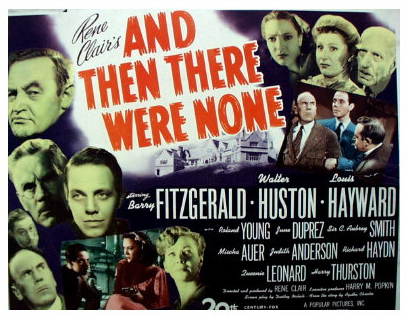
And Then There Were None (Oct. 31, 1945)

Agatha Christie’s novel And Then There Were None, originally published in England in 1939 under the unfortunate title Ten Little Niggers, is tied with J.R.R. Tolkien’s The Lord of the Rings as the second best-selling novel of all time (only J.K. Rowling’s Harry Potter and the Philosopher’s Stone has sold more copies). This makes it the most widely read mystery novel of all time, so hopefully nothing I say here will be giving much away. (But don’t worry … I’m not going to reveal “whodunnit.”)

In And Then There Were None, eight people are invited to an island off the coast of Devon by a Mr. and Mrs. “U.N. Owen.” (Get it?) When the guests arrive, they are informed that Mr. Owen is away, and that the guests will be attended to by servants Thomas and Ethel Rogers, bringing the cast of characters up to ten.

Even 70 years ago, the N-word was a more sensitive topic in America than it was in England. Presumably because of this, the novel was published in the U.S. as And Then There Were None in 1940, the name of the island was changed from “Nigger Island” to “Indian Island,” and the song that provides the structure of the story was changed from the original, which had been a standard of blackface minstrel shows since 1869, to “Ten Little Indians”:

Ten little Indian boys went out to dine; One choked his little self and then there were nine.
Nine little Indian boys sat up very late; One overslept himself and then there were eight.
Eight little Indian boys travelling in Devon; One said he’d stay there and then there were seven.
Seven little Indian boys chopping up sticks; One chopped himself in half and then there were six.
Six little Indian boys playing with a hive; A bumblebee stung one and then there were five.
Five little Indian boys going in for law; One got in Chancery and then there were four.
Four little Indian boys going out to sea; A red herring swallowed one and then there were three.
Three little Indian boys walking in the zoo; A big bear hugged one and then there were two.
Two Little Indian boys sitting in the sun; One got frizzled up and then there was one.
One little Indian boy left all alone; He went out and hanged himself and then there were none.

Each guest finds a framed copy of this gruesome little poem in his or her room, and is informed over dinner, via a phonograph record, that everyone on the island has gotten away with murder in one way or other, and that all are going to pay. Then the fun begins, as the characters are dispatched in the manner of the rhyme. The first guest drinks cyanide at dinner (choking), the second has an overdose of sleeping pills (oversleeping), the third declares that no one will leave the island and soon after is bludgeoned (one said he’d stay there), and so on.

The novel is a case of truth in advertising. At the end, all the characters are dead. The film is somewhat lighter, and allows a couple of them to escape unharmed. It follows Christie’s own 1943 stage adaptation of her novel, which softened the grim denouement. Given what’s come before, however, the happy ending feels like a bit of a cheat, and modern viewers might find themselves rolling their eyes at the finale.

And Then There Were None is still a great little mystery picture, though, and its cast of veteran character actors play their parts to the hilt. The film occasionally borders on farce, but never in a bad way. I especially enjoyed Walter Huston’s performance as the quietly maniacal Dr. Armstrong, but Louis Hayward as the cat-like Lombard and Barry Fitzgerald as the phlegmatic Judge Quinncannon are both memorable, as well.
The House on 92nd Street (Sept. 10, 1945)

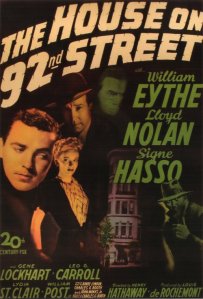
House92ndStWhen The House on 92nd Street was released on DVD in 2005, it was as part of the “Fox Film Noir” collection. This is misleading, since it’s more of a docudrama than it is a noir. It’s a historically important film, however, since it was one of the first to feature location shooting for nearly all the exteriors, and one of the first to skillfully blend fact with fiction while presenting itself as essentially factual. (Charles G. Booth won an Academy Award for best original story for his work on this film.)
The House on 92nd Street stars William Eythe as Bill Dietrich, a second-generation German-American who becomes a double agent for the F.B.I., Lloyd Nolan as his contact in the Bureau, Agent George A. Briggs, and Signe Hasso as the leader of the spy ring, Elsa Gebhardt. The film is a fictionalized account of the F.B.I.’s 1941 operation against the Nazi spy ring led by Fritz Joubert Duquesne. It was one of the largest counterspy operations in U.S. history, and led to the conviction of 33 people. In reality, however, none of them were involved in anything quite as grand as the secrets of the atomic bomb, which is the MacGuffin in The House on 92nd Street. And the real Dietrich was not the all-American boy portrayed by Eythe. He actually was a German-born man named William G. Sebold who served in the German army during World War I but became a naturalized American citizen in 1936. Presumably the war was still too fresh in the minds of the American viewing public for them to accept a German as the hero of a picture.

This film also shows the beginnings of J. Edgar Hoover’s massive publicity campaign for the F.B.I., which he disguised as a simple display of information. In reality, of course, Hoover carefully controlled the information that the public saw about the F.B.I., twisting and distorting as necessary. A good example of this information control is a scene early in the film, in which we see an indoor enclosure the size of an airplane hangar, filled with filing cabinets. The booming voice of the narrator (Reed Hadley) explains that this is the F.B.I.’s collection of 100 million sets of fingerprints, a number that seems unlikely, given that the population of the United States was fewer than 140 million people in 1945. Were they counting each finger? The message, of course, is that there is no hiding from the F.B.I. If you commit a federal crime or spy for another nation, they will find you. (This was also the message of the radio show This Is Your F.B.I., which began broadcasting dramatizations of real federal cases on American Broadcasting Company stations in the spring of 1945, all with the cooperation of Hoover, who called it “the finest dramatic program on the air,” and “our show.”)

The House on 92nd Street was directed by Henry Hathaway, but much of its style can be attributed to producer Louis de Rochemont, who created the “March of Time” newsreel series. When he lacked the footage he wanted, de Rochemont would stage clever recreations, but his newsreels were presented as wholly factual. It’s important to keep in mind that American audiences were less savvy about media trickery in 1945. After all, it had only been six years since people tuned into Orson Welles’s War of the Worlds broadcast midway through the program and thought Martians were vaporizing people in New Jersey.

The House on 92nd Street begins with a compilation of actual footage of people entering and exiting the German embassy, which is interesting. Of course, the characters in this film watch a great deal of surveillance footage. Some of it is real, some is not. It’s not that audiences in 1945 didn’t realize that the film was a blending of reenactments and actual footage, it’s the overall message they were taking away from the film that was perhaps not completely accurate. For instance, in Thomas M. Pryor’s September 27, 1945 review of the film in the New York Times, he wrote the following:

Since the picture, produced by Twentieth Century-Fox with full cooperation from the F.B.I., was completed some months ago, the secret of the atomic bomb has been revealed. Now the picture carries a simple and restrained foreword explaining that the “Process 97” which the Nazi agents are attempting to steal was in reality a part of the atomic bomb formula. It is to the producers’ everlasting credit that this information is not sensationalized in the film.

In reality, however, there is no evidence that there was a single “missing piece” of the atomic bomb process that spies were in danger of transmitting back to Nazi Germany. And of course, film by its very nature presents a sensationalized picture of reality.

Also, a big deal is made at the beginning of the picture that every person playing an F.B.I. agent, aside from the principals, is an actual F.B.I. agent. This, however, does not make what is depicted any more or less truthful than if they were played by actors, but it seems to.

The House on 92nd Street is not a bad picture by any stretch. Taken at face value, it’s tense and exciting. And director Hathaway, when not constrained by the documentary-style approach of de Rochemont, creates some great sequences, such as when Dietrich gets himself arrested just to get in touch with Briggs at the F.B.I., or the meeting between Dietrich and his co-conspirators at a waterfront dive. And the final shootout, which involves tear gas grenades and a surprising disguise, is fantastic. If you’re looking for a film that uses the framework of a docudrama to present a tense film noir, however, you’d be better off watching Anthony Mann’s excellent T-Men (1947).

State Fair (Aug. 30, 1945)

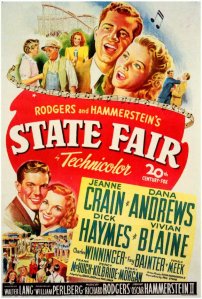
StateFairState Fair was the first musical made specifically for film by Rodgers and Hammerstein. Their two previous musical collaborations, Oklahoma! and Carousel, were both stage productions. (Although both would eventually be made into films in the ’50s.) State Fair was based on a novel by Philip Stong that had previously been made into a non-musical film in 1933 with Will Rogers.
Margy Frake (Jeanne Crain) and her brother, Wayne (Dick Haymes), go to the Iowa State Fair with their parents (played by Fay Bainter and Charles Winninger) and their prize hog, Blue Boy. Margy and Wayne are both somewhat dissatisfied with their current significant others, and each find someone a whole lot more exciting at the fair; she a cavalier reporter played by Dana Andrews and he a flame-haired singer played by Vivian Blaine. Things go well for both, but can their love affairs outlast the fair?

Musically primitive and relentlessly cheery, State Fair injects life into its clichéd proceedings with charm, humor, and some cartoonishly outsized, Technicolor images of middle-American excess. And Andrews (who played the detective in the 1944 noir classic Laura) is rakishly charming, almost but not quite a thug, and always fun to watch.

Hangover Square (Feb. 7, 1945)

Hangover_square
Hangover Square (1945)
Directed by John Brahm
20th Century-Fox

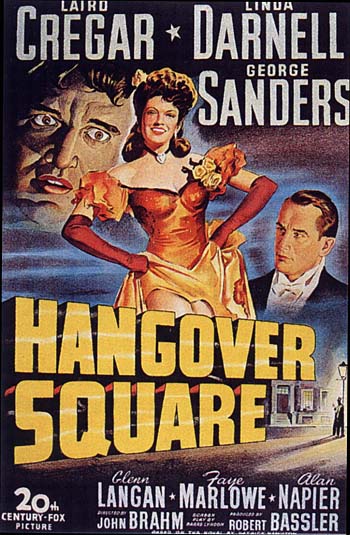
Laird Cregar’s is a sad story. A brilliant character actor, Cregar died in December of 1944 as a result of a crash diet that most likely included amphetamines. Cregar shed approximately 100 pounds in a short space of time in an attempt to reinvent himself. Reinvention is a hard business, and no more so than in the studio-controlled Hollywood of the ’40s. Firmly established as a towering, 300-pound, sympathetic (and often childlike) heavy, Cregar’s notion that he could shed his tonnage, get plastic surgery, and reinvent himself as a romantic leading man was delusional.

Hangover Square is a follow-up of sorts to The Lodger (1944), in which Cregar played a highly fictionalized version of Jack the Ripper. Both films were directed by John Brahm, and both feature sympathetic depictions of mentally ill characters who are compelled to kill. In Hangover Square, Cregar plays a composer named George Harvey Bone, a man who is struggling to complete his masterpiece (an effective if not totally convincing concerto composed by Bernard Herrmann, who also composed the film’s incidental music). However, Bone suffers from a bizarre condition that causes him to black out when he hears loud, discordant noises. In these fugue states he may or may not be committing murders. His energy and creativity are reinvigorated, however, when he meets a beautiful singer, played by Linda Darnell. Unsurprisingly, she leads him on and then does him wrong, which frays his last shred of sanity to the breaking point.

Hangover Square was based on a novel by Patrick Hamilton. The novel was published in 1941 and took place in the late ’30s. I’ve never read it, but apparently it’s a black comedy, and there’s a lot of thematic material about the rise of fascism in Europe. Not much of that stuff made it into the film. Originally the film was supposed to be set in the present day, but it was changed to the late Victorian era, presumably to capitalize on the success Brahm and Cregar had had with The Lodger. Both films are very good, and worth seeing, but Hangover Square is more of a mess than its predecessor. Herrmann’s score, as well as the music he writes that’s meant to be composed by Bone, makes the film feel very contemporary, and the Victorian setting isn’t handled very well. What Hangover Square does have going for it, besides Cregar’s performance, are a couple of incredibly striking scenes, both involving fire, that will stick with a lot of viewers.

It’s a shame that Cregar died when he did. He hadn’t even hit 30 when he passed away (although he could play much older). Even in minor roles he always made an impression. Had he lived, would he have been the gay (or at least gayish) Orson Welles? We’ll never know. In his last role, he’s not what anyone would call “svelte,” but the weight he had lost is noticeable. He appears diminished, haunted, and on the verge of being destroyed. It’s a masterful performance in a pretty good film, and one worth seeing.