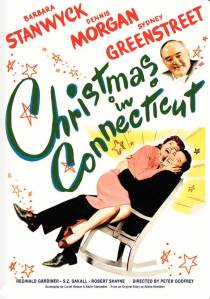
 Barbara Stanwyck was a superstar of screwball comedies, and she created one of the all-time great femmes fatales in Billy Wilder’s Double Indemnity (1944). Christmas in Connecticut is one of her minor efforts, but it’s amusing enough, and if you’re specifically looking for a holiday film, you could do a lot worse.
Stanwyck plays a renowned magazine food writer named Elizabeth Lane, a woman whose public persona might remind modern viewers of Martha Stewart. She writes about her perfect life in Connecticut, describing her beautiful snow-blanketed farm, her husband, her child, and the lavish meals she prepares. She has a loyal readership of both men and women. Women aspire to be like her and men dream of having a wife like her. In reality, however, Lane lives in a cramped studio apartment in Manhattan, types her columns next to a hissing radiator, and can’t boil an egg. She’s a talented writer, but that’s it. Her recipes all come from her restaurateur friend Felix (S.Z. Sakall). Her editor, Dudley (Robert Shayne), knows her secret, but her publisher, Alexander Yardley (Sydney Greenstreet), does not, and that’s where the trouble starts. Mr. Yardley thinks it would be terrific publicity to reward a handsome but malnourished young sailor named Jefferson Jones (Dennis Morgan), who survived a German U-Boat attack on his ship, with a Christmas dinner hosted by Lane and her husband. Who does not exist. At a country home that does not exist.
In classic screwball comedy fashion, confessing right away and letting the chips fall where they may does not even qualify as Plan C, so Lane enlists the help of an accomplice, her friend John Sloan (Reginald Gardiner), a pompous ass who keeps proposing to her even though she has no interest in marrying him. She agrees to finally get hitched if only he’ll go along with her deception. The fact that he owns a farm in Connecticut is key, as well. He doesn’t have a baby, but they can always borrow one from a neighbor, right?
It should go without saying that Jones and Lane are attracted to each other, but their incipient romance is complicated by the fact that Lane is pretending to be married with a child. When the film first came out, the NY Times review said that “Peter Godfrey, the director, has a good deal to learn about the art of telling a boudoir joke in the parlor and getting away with it.” Modern viewers, however, will probably find most of the jokes fairly tame. Jones’s seeming willingness to cuckold Lane’s “husband” does reach a fever pitch toward the end, but nothing very lascivious comes of it.
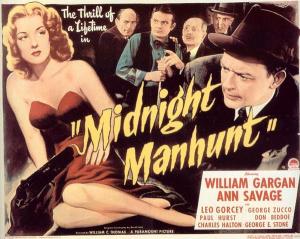 Ann Savage and William Gargan play competing newspaper reporters in this mercifully brief bottom-of-the-bill B mystery from Pine-Thomas Productions. Distributed by Paramount Pictures, Midnight Manhunt has the look and feel of a P.R.C. cheapie, right down to its minimal sets and poorly handled mixture of comedy and suspense.
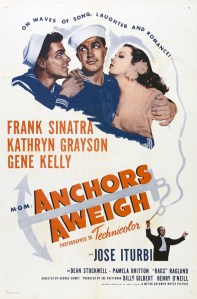 I don’t generally like musicals, but I loved Anchors Aweigh. It probably doesn’t hurt that I really like both Frank Sinatra and Gene Kelly, and this movie uses both of them to wonderful effect. Kelly’s dance sequences are all high points, and even Sinatra comports himself well in the one dance in which he has to match Kelly step-for-step. Although I can only imagine how many takes it took to get it right. Unlike today’s hyperkinetic editing styles, most of the dance sequences in Anchors Aweigh are done in what appear to be one take, or just a few at most.
 OCD Viewer