Tag Archives: Foreign Films

Quai des Orfèvres (Oct. 3, 1947)

Nothing spices up a love triangle like murder.

And nothing elevates a routine police procedural like the sure hand of director Henri-Georges Clouzot, who is ultimately less interested in the mechanics of unraveling a murder mystery than he is in showing human life in all of its sordid glory.

Quai des Orfèvres is based on Stanislas-André Steeman’s 1942 novel Légitime défense, which Clouzot adapted from memory when he was unable to locate a copy.

The plot isn’t hard to summarize. What is hard to convey is the richness of its characters and its evocation of the messiness of real life.

Quai des Orfèvres is a film in which a woman complains about a nail in her shoe poking her foot, in which a tense police interview takes place next to a pair of cops inspecting and discussing a fishing pole, in which a police inspector who comes round asking questions ends up shuffling around on carpet slippers because the floors have just been waxed, and in which a man opens his veins in a jail cell on Christmas Eve while the prostitute in the cell next to him natters on about inconsequential matters, not realizing what’s going on right next to her.

The film demonstrates a sense of the movement of time that few films do. It begins in early December and marches on inexorably toward Christmas. At first, Paris looks cold and damp, but toward the end of the picture we see fat flakes of snow beginning to fall slowly outside the windows of the police station.

The aforementioned plot involves a bald, chubby pianist-accompanist named Maurice Martineau (Bernard Blier) and his coquettish wife, a music-hall singer whose stage name is Jenny Lamour (Suzy Delair). The two couldn’t be less alike, and Maurice is constantly jealous of his wife. The two share a friendship with their neighbor, Dora Monier (Simone Renant), a photographer who is as perceptive and close-lipped as Maurice and Jenny are hot-tempered and argumentative.

Things come to a head when Jenny begins meeting with a dirty-old-man producer named Georges Brignon (Charles Dullin, a legend of the French stage, in his last film role). She wants a part in a movie. Maurice wants Brignon to stay far, far away from his wife.

On the night when Jenny is set to go to Brignon’s house for a romantic dinner, Maurice cooks up a half-baked scheme. He’ll go to the theater for a show and be seen by his friends in the business before and after the show, but during the show, he’ll quietly slip out with his revolver in his pocket and drive to Brignon’s house.

It’s never made clear whether he plans to kill both Brignon and his wife or just Brignon, and we never find out, because when he arrives at Brignon’s house, Brignon has already been killed.

And worse, when he flees the scene, he finds his car has been stolen, which means he barely gets back to the theater in time to shuffle out with the stragglers, which pokes a few holes in his alibi.

Meanwhile, Jenny admits to her friend Dora that she hit Brignon over the head with a bottle when he became too amorous, and Dora goes to Brignon’s house to clean up the scene.
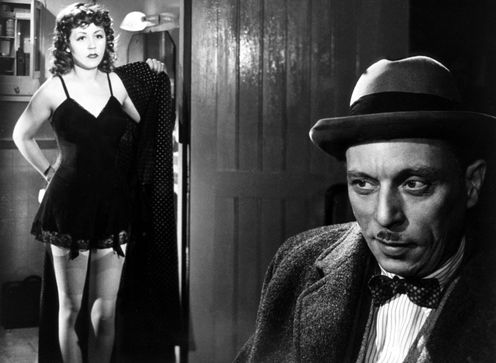
Enter Inspector Antoine of the Paris police (Louis Jouvet).

Inspector Antoine is no Sherlock Holmes. He’s a detective for a homicide department that currently has a 48% clearance rate. But he is a dogged investigator, and as any Columbo fan knows, beware a hangdog police detective with a runny nose who never, ever gives up.

The character of Antoine — perfectly played by Jouvet — is a great example of how Clouzot injects little unexpected moments to make characters three-dimensional. For instance, Antoine is a single father raising a mixed-race son. When he learns that his son has failed one of his final exams — that pesky geometry — Antoine is upset, and mutters that he’ll just have to give his son the Meccano set he already bought him as a Christmas present instead.

Oh, and remember that love triangle I referred to in the lede? At first it seems that Dora has feelings for Maurice, but it very quickly becomes clear that her feelings are for Jenny. The fact that she is a lesbian is handled delicately, but is confirmed late in the film when Antoine tells her, “When it comes to women, we’ll never have a chance.”

Quai des Orfèvres is a remarkable film. It doesn’t have the heart-stopping suspense of some of Clouzot’s more famous later pictures, like Le salaire de la peur (The Wages of Fear) (1953) and Diabolique (1955), but it’s an extraordinarily well-made, well-acted, richly textured, and involving movie that I couldn’t wait to see again as soon as it was over.
Skepp till India land (Sept. 22, 1947)

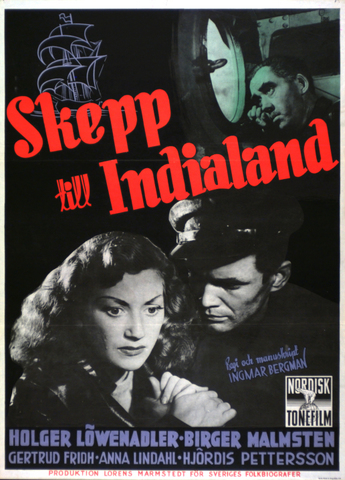
Ingmar Bergman’s third time in the director’s chair, Skepp till India land (A Ship to India), was released in Sweden in September 1947 and was shown at the 2nd Cannes Film Festival around the same time.

It was the first Bergman film to be shown in the United States, where it was released in 1949 as Frustration.

Frustration isn’t a bad title. It is a film about angry, trapped, and frustrated people, after all. But A Ship to India is such a beautifully understated title, and it has a touch of irony. It evokes exoticism and adventure, but for most of the film, the characters are stifled and miserable, and trapped in one dreary place.

The film, which is based on a play by Martin Söderhjelm, begins with a handsome young sea captain named Johannes Blom (Birger Malmsten) returning to Sweden after being away for eight years. He learns from an old friend, Sally (Gertrud Fridh), that his father died of pneumonia while he was away, but he seems strangely unmoved by the news. Sally has fallen on hard times, and seeing her upsets Johannes.

He walks down to the beach and falls asleep on the rocks, remembering his earlier life.

He was born with a hump on his back and his father beat him mercilessly when he was a child. His father, Alexander Blom (Holger Löwenadler), was the captain of a salvage vessel, and lived on it with his crew, as well as his son Johannes and his wife Alice (Anna Lindahl). Capt. Blom was an alcoholic who would disappear for days at a time, which threatened his salvage operation. With his crew doing nothing while he was away, the wreck they were working on was in danger of sinking forever.

The tensions simmering below the surface bubbled over when Capt. Blom brought his mistress, Sally, to live with him on the salvage ship.

Capt. Blom is one of the nastiest, most despicable film characters I’ve seen in a long time. The worst thing about him is that he never comes off as a monster. His cruelty to his wife and son is believable, and we see just enough of his internal life to understand him without ever sympathizing him. It helps that Löwenadler is a really fantastic actor.

Like Bergman’s first film, Kris (Crisis) (1946), Skepp till India land shows flashes of brilliance, but it’s not as masterful as a lot of his later work. Birger Malmsten, who plays Johannes, is easy to feel sorry for, but not always easy to understand.

But Bergman has a keen sense of why people do the things that they do, and the human drama in Skepp till India land is keenly observed, if rarely uplifting.

Gran Casino (June 12, 1947)

Gran Casino
Gran Casino (1947)
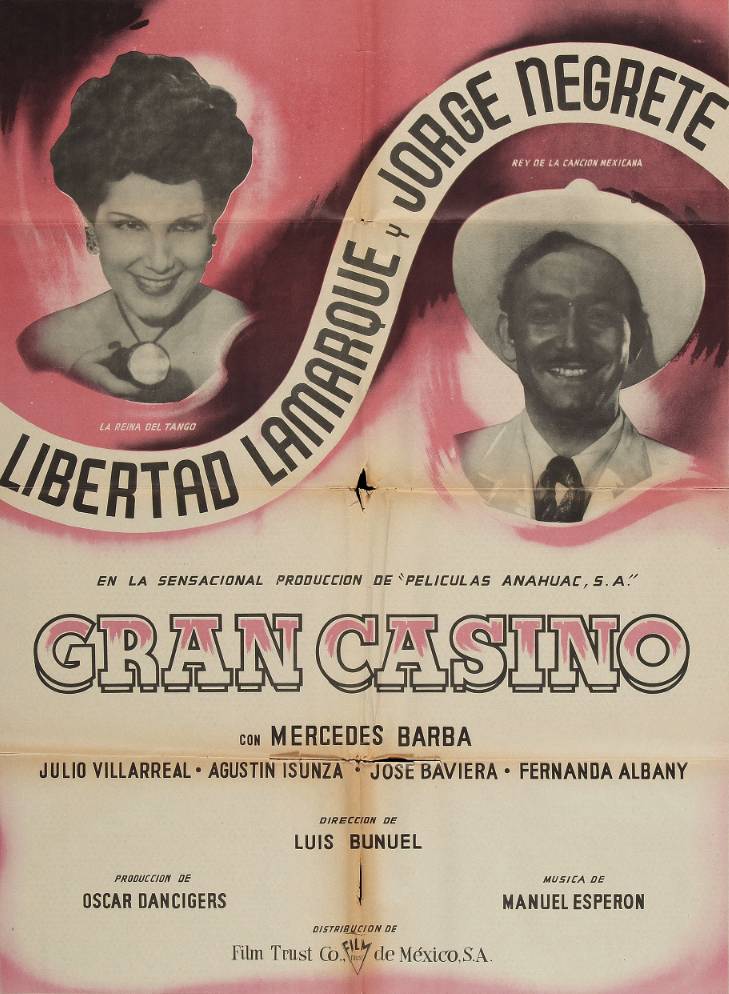
Directed by Luis Buñuel
Películas Anahuac S.A.

When the Spanish surrealist filmmaker Luis Buñuel made Gran Casino, his career was in a downswing. His 16-minute silent short Un chien andalou (1929), which he made with Salvador Dalí, had an impact on film and on the French surrealists that can’t be overstated.

His first feature, L’âge d’or (1930), was even more scandalous, and was widely seen as an attack on Catholicism.

He returned to his native Spain and made a semi-documentary, Las Hurdes: Tierra Sin Pan (1933), that depicted abysmal poverty in the mountainous region of Las Hurdes. The film was immediately banned in Spain.

In 1939, with the defeat of the Republican government and the end of the Spanish Civil War imminent, Buñuel moved to Hollywood with his family, hoping to make propaganda films about the war. This came to nothing, however. According to Buñuel, an order came from Washington D.C. forbidding Hollywood to make any films about the Spanish Civil War, no matter which side the film supported.

He worked for MoMA in New York, and was under contract with Warner Bros. from 1942 to 1946. What Buñuel wanted more than anything was to make his own films, but he was continually thwarted. It didn’t help that in 1942, Salvador Dalí had published his autobiography, The Secret Life of Salvador Dalí, in which he accused Buñuel of Marxism and anti-Catholicism.

When Buñuel’s contract with Warner Bros. was up in 1946, he moved to Mexico. He had no interest in Latin America, and didn’t like living in Mexico, but he wanted to make films. Better to make them in Mexico than not to make them at all. (And it’s likely that Buñuel saw the handwriting on the wall in Hollywood, and realized that hard times were coming for leftists in the American film industry.)

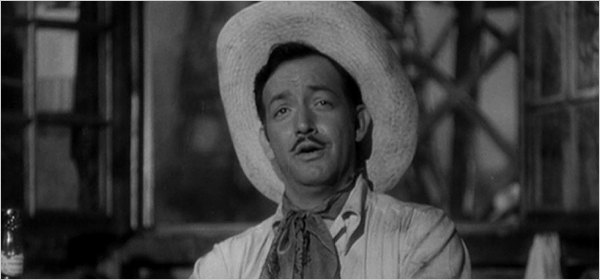
Producer Óscar Dancigers, an old Communist colleague of Buñuel’s from Paris who had used his labor connections to enter the Mexican movie industry, helped Buñuel get the job of directing Gran Casino. It was the first feature Buñuel made in Mexico. Despite his reputation as a brilliant artist, Buñuel had never really made a linear film with a story, so despite its shortcomings, Gran Casino is an important film in Buñuel’s career.

According to film historian Philip Kemp, when Buñuel recalled being offered the chance to direct a star vehicle for Jorge Negrete, he said that he thought to himself, “This is a little adventure-romance. Is there anything in it that betrays my conscience? No? Well then, let’s get going.”

Is Gran Casino a must-see for aficionados of Buñuel? No. The only way it could ever be mistaken for a surreal film is if you smoked a fat joint beforehand and were wholly unfamiliar with the conventions of movie musicals. But just because it’s not a must-see doesn’t mean it’s not worth seeing.

Jorge Negrete, the star of the film, started out as an opera singer, and his good looks and rich voice made him one of Mexico’s most popular leading men. (The only other actor who gave him a run for his money was Pedro Infante). Negrete starred in his first movie in 1937. He most often played a “charro,” or horseman, and just like the singing horsemen of Hollywood matinees, Negrete’s character usually rode into town, set things right, rode away with the girl, and sang a bunch of songs along the way.

Gran Casino follows this formula. Negrete plays a freewheeling charro named Gerardo Ramírez who escapes from jail and goes to work for José Enrique Irigoyen (Francisco Jambrina), the Argentinian owner of three oil wells in Tampico, on the Gulf of Mexico.

Señor Fabio (José Baviera), the owner of the casino of the film’s title, wants the oil wells for himself, and will stop at nothing to get them.

After José Enrique disappears, an apparent victim of foul play, his sister Mercedes arrives to take his place as patrona of the little oil field, but there’s a case of mistaken identity, and she’s able to go undercover in the casino as a singer named “Raquela Ortiz.” Mercedes is played by Libertad Lamarque, who was the “Queen of Tango” in her native Argentina, and her acting might be wooden, but her vocal performances are great.

Unfortunately, she and Negrete have no onscreen chemistry, and they don’t even sing any duets together.

If you’re a fan of Buñuel and you’re paying attention, there are a few surreal bits in Gran Casino, like the blurred reflection of the old Frenchwoman Nanette (Fernande Albany) in a champagne bucket that Negrete turns slowly in a way that seems to demonstrate his boredom at her long-winded story as the scene fades to black.

The best surreal bit comes toward the end, when Negrete approaches a bad guy hiding behind a curtain and smashes his head in with a statuette. There’s a brief, inexplicable shot of a mirror being smashed by the statuette in slow motion. Blink and you’ll miss it, but if you’re paying attention, it’s a jarring and memorably weird moment.

Gran Casino was a flop despite its popular stars, and it would be two years before Buñuel made another film. But as I said, it was an important film in his career. It allowed him to establish a foothold in the Mexican film industry, which led to him making the brilliant Los Olvidados (1950), which is one of the best and most powerful films I have ever seen. If you haven’t seen it, I can’t recommend it highly enough.

Paisà (Dec. 10, 1946)

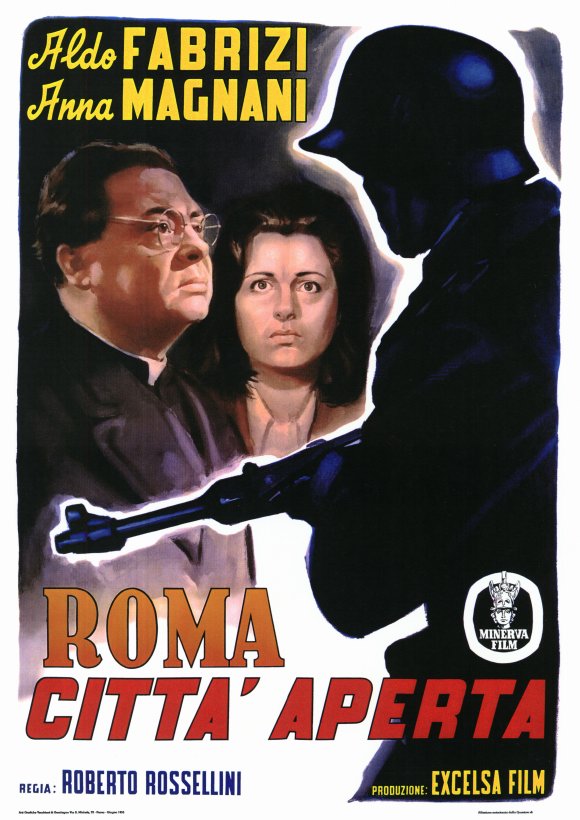
Roberto Rossellini’s Paisà (Paisan) is the follow-up to his wildly successful 1945 film Roma, Città Aperta (Rome, Open City).

Roma, Città Aperta is one of the most famous examples of Italian neorealist cinema, and is better known than Paisà, but I think that Paisà stands head and shoulders above Roma, Città Aperta as an artistic achievement. It’s a sprawling, chaotic picture of life in Italy during the last days of World War II. The title of the film comes from the word that American soldiers called Italians — “paisan,” or “buddy” — and over the course of six vignettes the film explores a variety of Italian characters’ attempts to communicate with and understand their occupiers.

Rod Geiger, the American G.I. who carried Roma, Città Aperta back to the United States, worked closely with Rossellini on Paisà, and is listed in the credits as a producer. Most of the Americans in the film were played by off-Broadway actors cast by Geiger’s father, who ran a theater in New York. Depictions of foreigners and foreign cultures in movies are tricky to get right. Usually there are at least a few things that just don’t ring true, but there were times while I was watching Paisà that I forgot that I was watching a “foreign” film featuring American characters. The American actors play their parts in a naturalistic, unaffected fashion, and their dialogue often seem ad-libbed. There are even aspects of the film that ring more true than anything coming out of Hollywood at the time, like an extremely drunk African-American soldier (played by Dots Johnson) who is full of anger and resentment.

Many writers contributed to the film, including Klaus Mann (the son of Thomas Mann), who wrote a treatment. A few of the six episodes that comprise the film function as parables, and have endings that border on being trite, but the overall effect of Paisà is an overwhelming panorama of violence, yearning, friendship, misunderstanding, and horror.

The film is a journey from the south of Italy to the north, and the segments take place in Sicily, Naples, Rome, Florence, a monastery in the Apennine mountains, and in a partison hideout in Porto Tolle. Unlike the American characters, the Italians mostly play themselves. The Sicilians are all played by Sicilian non-actors. The partisans in Porto Tolle are played by real partisans. A street urchin in Naples named Pasquale is played by a real street urchin named Alfonsino Pasca. The monks in the Apennines were really monks, but they were dubbed by different actors, since their accents would have made it clear that they were from the south of Naples, not to the north.

Most of the segments of Paisà end tragically, with characters the audience has grown to care about killed in combat. The deaths are senseless and sudden, and the feeling that no one is safe makes Paisà one of the most affecting and least cliched war films I’ve ever seen.

No Regrets for Our Youth (Oct. 29, 1946)

No Regrets for Our Youth
No Regrets for Our Youth (1946)
Directed by Akira Kurosawa
Toho Company

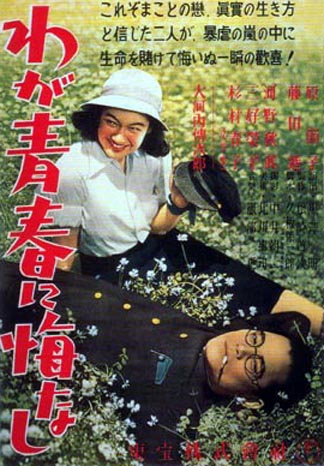
No Regrets for Our Youth was the second film Akira Kurosawa directed after the end of World War II. (The first was Those Who Make Tomorrow, which was released on May 2, 1946. He was forced to direct it by Toho studio bosses. He disliked making the film and never included it in his list of official credits.) No Regrets for Our Youth is an interesting counterpart to two other films I watched this year, Italy’s Roma, città aperta (Rome, Open City) and Germany’s Die Mörder sind unter uns (The Murderers Are Among Us). These three pictures are all early efforts by filmmakers in former Axis powers to come to terms with the enormity of World War II.

Roma, città aperta represents an almost total abnegation of responsibility, which is fair enough, considering the role most Italians played in the war compared with the litany of horrors perpetrated by Germany and Japan. No Regrets for Our Youth is more similar to Die Mörder sind unter uns. Both films are stridently anti-Fascist, but both sidestep the gruesome specifics of what actually went on during the war.

Setsuko Hara stars as Yukie, the daughter of a university professor with leftist leanings. (Hara would only work with Kurosawa once more, when she starred in his film The Idiot in 1951, but she was one of Yasujirô Ozu’s favorite actresses, and starred in six of his films from 1949 to 1961.) The film begins immediately after the 1933 University at Takikawa protests against the Japanese invasion of Manchuria. Yukie is courted by two young men, Ryukichi Noge (Susumu Fujita) and Itokawa (Akitake Kôno). Itokawa is sensible and boring, while Noge is a political firebrand and hot-headed. Yukie is naturally drawn to Noge, but he is arrested after a demonstration and spends four years in prison.

When he is released, he seems to be a changed man; broken in some essential way. Yukie packs up and moves to Tokyo, where she lives for three years, toiling away in a variety of menial jobs. Itokawa and Noge both re-enter her life, and she ends up marrying Noge, who is now involved in espionage. Eventually he is arrested by Imperial forces, and Itokawa, who is now a lawyer, steps in to defend him.

No Regrets for Our Youth is a film with two distinct halves. The second half, in which Yukie goes to visit Noge’s parents, is visually and dramatically stronger than the first. Noge’s parents are both simple farmers living in a remote village. They are terrorized by the other villagers because their son was a spy, and they never go out during the day, only planting at night. Yukie decides to stay with them and fight against adversity, finding value in tilling the land.

It would be decades, of course, before most filmgoers in the West would see this film. The first Kurosawa film to make any impact outside of Japan was Drunken Angel (1948), and Kurosawa didn’t have a true breakout success until Rashomon (1950), which won the Golden Lion at the Venice Film Festival in 1951.

No Regrets for Our Youth is a good film, but it’s not a great one. The performances from the lead actors are excellent, especially from Hara. She ages and grows over the course of the film in a realistic way, which is important when a film covers a period of many years. The story is involving, but not exactly what I would call “gripping.” The scenes in the rural village have a distinctly Soviet flavor to them, and I believe that Kurosawa made this film in an atmosphere of heavy censorship and control by occupying forces.

This is the earliest Kurosawa film I’ve seen, so I don’t know what his pre-war films are like, but it seems to me that he really came into his own as an artist starting in the late ’40s, when he reworked American and European stories and film techniques for pictures like Stray Dog (1949) and High and Low (1963), two of the best police procedurals ever made; Seven Samurai (1954) and Yojimbo (1961), two samurai films that drew heavily from American westerns and were in turn copied over and over by directors making actual westerns; and his reimaginings of Shakespearean dramas set in feudal Japan, Throne of Blood (1957) and Ran (1985).

La Belle et la Bête (Oct. 29, 1946)

La belle et la bête
La Belle et la Bête (Beauty and the Beast) (1946)
Directed by Jean Cocteau
DisCina

Jean Cocteau began filming La Belle et la Bête (Beauty and the Beast) almost immediately after the end of the Nazi occupation of France. It wasn’t a quick or an easy shoot. Cocteau had to contend with limited film stock of varying quality, cameras that jammed, aircraft flying overhead that ruined the sound, and the general disarray of post-war France.

The 56-year-old Cocteau was a well-known writer, poet, visual artist, and director of avant-garde films, but this was his first foray into mainstream filmmaking. It begins with an exhortation to audiences to remember what it is to be a child, and to experience magic without the jaundiced eyes of an adult.

This is probably a direct reaction to the critics (most notably Jean-Paul Sartre) who felt that Cocteau was not political enough. Cocteau’s only allegiance in life was to art, and it is appropriate that he made this film as a reaction to critics, since it’s one of the most beautiful and magical pieces of filmmaking I’ve ever seen. His plea to audiences that opens the film seems unnecessary. This is a film that speaks for itself.

In adapting the 18th-century fairy tale, Cocteau used a lot of the same techniques he used when he made his experimental 1930 film Le sang d’un poète (The Blood of a Poet); simple special effects, an obsession with mirrors, statues that come to life, and tricks of speed and perspective.

As in the original story (most famously written by Mme Jeanne-Marie Le Prince de Beaumont in 1756, although she didn’t create the tale), Belle (played by Josette Day) lives with her merchant father (Marcel André) and her two nasty, selfish sisters, here named Félicie (Mila Parély) and Adélaïde (Nane Germon). Cocteau added two male characters, Belle’s brother Ludovic (Michel Auclair) and her handsome but shallow suitor, Avenant (Jean Marais).

The domestic scenes in the film are designed and lighted to look like paintings by Vermeer and Rembrandt. The characters all wear 17th-century costumes, and the interiors are beautiful to look at, even though the human drama is stifling and petty. Félicie and Adélaïde bicker and ridicule Belle, and are indifferent to their father’s rising debts. Meanwhile, Ludovic and Avenant avoid all responsibility and are only interested in the pursuit of leisure.

When Belle’s father rides off into the woods, the mood of the film dramatically shifts. Using a combination of real parks and woodlands with studio sets, Cocteau creates a magical fairy-tale world directly based on 19th-century engravings by Gustave Doré.

La Belle

When Belle’s father first enters la Bête’s castle — revealed when a gate of tree branches magically parts — his shadow moves against the castle entrance even though he is standing still. Once inside, candelabras held by human arms mounted into the wall magically spring to light. It doesn’t matter that you can see wires holding the candelabras aloft; the simple but painstaking special effects are still breathtaking. When Belle’s father sits down in the banquet hall, sculptures of human faces on the mantel of the fireplace are actually the faces of human actors covered with soot, their bright eyes the only thing about them that looks alive as smoke pours out of their nostrils.

This delineation between fantasy and reality continues throughout the film. When Belle enters the castle to fulfill the punishment meted out to her father for picking one of la Bête’s white flowers, she floats through long corridors full of billowing white curtains in dreamy slow-motion. There are doors and mirrors that speak to her, and a bed with a white fur spread that slithers open. The special effects are simple, and a lot of them are done “in the can” by simply reversing the film.

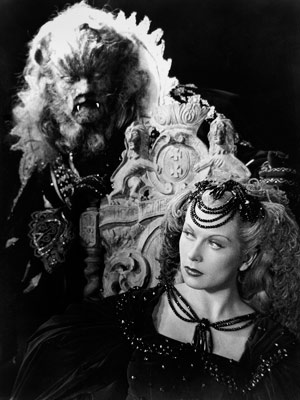
It’s been awhile since I’ve seen Disney’s 1991 version of this fairy tale, but that film bears an enormous debt to Cocteau’s version. Everything from the look of the beast to the costumes, set design, and subplot about Belle’s jealous suitor are lifted directly from this film. While the Disney version is perfectly competent, it doesn’t have the otherworldly power of Cocteau’s vision. La Bête, in particular, is less cuddly and more uncanny here. He’s played by Jean Marais, who also plays Belle’s suitor, Avenant, which would be distracting if he wasn’t completely unrecognizable under the heavy makeup and mountains of hair. Marais plays la Bête as a noble, leonine creature with a deep nasal monotone. Unlike the lovable furball of the Disney film, there are a few moments in which he is truly frightening; appearing as if by magic when Belle’s father picks a flower, drinking from a brook on all fours like an animal, or standing over the carcass of a deer that he has mutilated.

Given that Cocteau was gay and Marais was his longtime lover, it’s tempting to read a lot into this film. For Freudian readings of heterosexual power dynamics and the vagaries of lust, the Beauty and the Beast myth is second perhaps only to the story of Bluebeard. Are all men beasts who must stifle bloodthirsty and rapacious urges in order to be with women? Did Cocteau, who had begun to suffer from painful eczema, feel like a beast himself?

All theories are welcome, but I prefer to heed Cocteau’s advice in the preface and take this magical film at face value.

The Murderers Are Among Us (Oct. 15, 1946)

Wolfgang Staudte’s Die Mörder sind unter uns (The Murderers Are Among Us) premiered on October 15, 1946, in the Soviet sector of Berlin (later to be known as East Berlin). It’s an important film, and not just because it was the first film released in Germany after World War II.

It was the first attempt by German filmmakers to come to terms with the enormity of the war crimes committed during the Third Reich. It’s occasionally heavy-handed, and it doesn’t really address the specifics of who died in the Holocaust or why, but these things can be forgiven. It’s a powerful, well-made film with uniformly fine performances from its lead actors.

Die Mörder sind unter uns was the first “Trümmerfilm” (“rubble film”), which were films that used war-ravaged Berlin as a setting. Other Trümmerfilme that followed include Gerhard Lamprecht’s Irgendwo in Berlin (Somewhere in Berlin) (1946), Helmut Käutner’s In jenen Tagen (In Those Days) (1947), Josef von Báky’s … und über uns der Himmel (…And the Sky Above Us) (1947), and Harald Braun’s Zwischen gestern und morgen (Between Yesterday and Tomorrow) (1947).

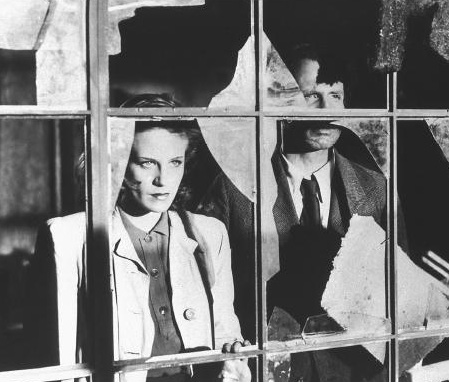
Die Mörder sind unter uns begins with a montage of miserable-looking people slowly making their way through the rubble by train and on foot. Among them is Susanne Wallner (Hildegard Knef), who has just been released from a concentration camp and is going back to the apartment she left in Berlin.

A poster featuring a picturesque castle that says “Das schöne Deutschland” (“beautiful Germany”) hangs askew in a bombed-out train station filled with shabby and emaciated people, including one man, hobbling on crutches, with “PW” stenciled in white on the back of his threadbare topcoat.

Knef is fresh-faced and beautiful, and an unlikely looking camp survivor. (Looks can be deceiving. In reality, the actress fled Berlin toward the end of the war dressed as a boy to avoid being raped by Soviet soldiers. Her ruse worked, and she was sent to a camp for prisoners of war. Eventually, however, her fellow prisoners helped her escape.) Before the end of the war, Knef had acted in a few minor roles in Nazi productions — most of which were released after the war — but as an actress in the post-war years, Knef didn’t try to hide her past. In fact, the crew of Die Mörder sind unter uns was dominated by veterans of the Nazi film industry. The director, Staudte, was involved with making the infamous antisemitic Nazi propaganda film Jud Süß (1940). To make this film, Staudte worked under the auspices of Deutsche Film (DEFA), which was the only production company licensed to operate in the Soviet Zone, and was formed from the ruins of Universum Film AG (Ufa), which was a powerhouse studio in Germany from the silent era through the downfall of the Third Reich.

Early in the film, a kindly old glasses maker named Mondschein (Robert Forsch) tells Susanne, “No, it is easy to forget what happened.” He tells her that she merely needs a goal, and to work.

On the one hand, it’s an ironic statement, since the whole movie is about coming to terms with the past, but it’s a statement that holds true for at least one of the main characters, Ferdinand Brückner (Arno Paulsen), a factory owner who recalls “golden days in gray uniforms,” but who now looks to the future. He wants to rebuild his industry and make a lot of money doing it.

In one memorable scene, Brückner sits at his breakfast table with a newspaper in front of him with a headline that screams, “2 Millionen Menschen vergast!” (“Two million people gassed”), in reference to Auschwitz. The camera tilts up to Brückner taking a sip of coffee or tea, then putting a piece of toast in his mouth and chewing it like a ruminating cow, his face placid and unconcerned.

On the other side of the coin is Dr. Hans Mertens (Ernst Wilhelm Borchert), a man so haunted by the war that he seeks refuge in the bottle but still can’t escape the horrors he carries with him.

Susanne meets the doctor when she comes home to her old apartment, and finds him living in it. She takes pity on him, and allows him to stay until he can find a new situation. Initially it seems that Dr. Mertens must be guilty of greater wartime crimes than anyone else in the film, if his palpable guilt is anything to go by. In a drunken stupor, lolling around backstage with a bunch of showgirls, he blows smoke over a chessboard. “Doesn’t it look like a battlefield?” he says. He smashes the board, and one of the girls says, “It’s just a harmless game of chess.”

Dr. Mertens responds, “A harmless game with tin soldiers leads down a short, perilous track to the harmless air rifle, to the harmless rifle range, and then to a mass grave.”

The film isn’t just about politics. A romance slowly grows between Susanne and Dr. Mertens, budding as he comes to terms with the things he witnessed during the war, culminating in a powerful finale that takes place on Christmas Eve, 1945. He stands outside of the skeletal remains of a cathedral, listening to the congregation singing “Stille Nacht, heilige Nacht” (“Silent Night, Holy Night”) as snow flurries whirl around him. He has a pistol in his pocket, and is determined to make his old captain pay for what he did during the war.

Dr. Mertens recalls Christmas Eve, 1942, in Poland, when he watched as 36 men, 54 women, and 31 children were gunned down as a reprisal for a single shot fired at the German soldiers by partisans. It isn’t the enormity of this crime that makes the biggest impact on the viewer, it’s the banality of the order given by the captain, and his total disregard for human life as he stands inside, untroubled by the mass execution that is occurring outside as he leads his officers in a Christmas carol.

The film was originally to be called Der Mann den ich töten werde (The Man I Will Kill), and to end with Dr. Mertens exacting justice, but instead the ending was softened, and Susanne convinces him to let the courts dispense justice. Apparently the Soviet authorities who granted the film license were worried that Germans would take the original title and ending as a call for vigilante justice and hunt down the former Nazi war criminals who lived in their midst.

La Bataille du Rail (Feb. 27, 1946)

About five years ago I saw a fantastic World War II movie from 1964 called The Train. Directed by John Frankenheimer, The Train stars Burt Lancaster as a French resistance member who has to stop a train bound for Germany that is carrying priceless art treasures. Filmed in grimy black and white, the film eschews any silliness like having Lancaster put on a fake French accent, and scores high marks as both a drama and an action film.

The reason I bring up The Train is because I couldn’t get it out of my mind while watching René Clément’s film La Bataille du Rail (The Battle of the Rails). If Frankenheimer and his crew didn’t study La Bataille du Rail when they were making The Train, I would be surprised, since Clément’s film is a landmark of vérité war action, and some of its action sequences are very similar to ones found in The Train. The gritty look of the picture also seems to have influenced Frankenheimer. Unfortunately, La Bataille du Rail doesn’t score as highly as a dramatic film, which would be fine if it were a documentary, but it’s not. It only looks like one.

The film opens with the following preamble: “This picture, which recalls actual scenes of the Resistance, was produced in cooperation with the Military Commission of the Resistance National Council.” How accurately any of the action reflects what actually went on during the war, however, I don’t know, but they unquestionably derailed an actual train during the climax, which was impressive.

There are many characters La Bataille du Rail, but they are played by unprofessional actors (who are listed in the opening credits only by surname), and they are never really allowed to develop personalities. The structure of the film is episodic, and depicts an escalating war of attrition. The resistance sabotages trains necessary to the German war effort, and the Germans respond by executing members of the resistance and increasing their military presence on the tracks.

At points, the film reminded me of Sergei Eisenstein’s 1925 film Stachka (Strike) in the way that it placed its numerous human characters against an enormous backdrop of industry. The smoke and grime from the trains covers everything, and the machinery dwarfs the people fighting and dying all around it. There’s an impressive nighttime battle sequence that ends with a resistance member being run over by the treads of a tank. It viscerally drove home the message that while the spirit of a collective can accomplish remarkable things, the integument of a single human body can be crushed by the machinery of war as easily as a person can step on a grape.

Most of the visuals in La Bataille du Rail are impressive because of their scale, but there’s one memorable scene that achieves its impact more subtly. A group of resistance members are lined up against a wall by the Germans and shot one by one. The camera lingers on a single man’s face. He grimaces as each shot is fired. The shot then cuts to what he is seeing; a spider spinning its web along the wall. It’s the last thing he will ever see. It’s a remarkable sequence, and one that makes its point without any dialogue.

I watched La Bataille du Rail immediately after watching Roberto Rossellini’s Roma, città aperta (Rome, Open City), another film about resistance under the Nazis that is shot in a semi-documentary style. In my review of Roma, città aperta I complained about some of the characters and the melodramatic storyline, which I felt undercut the impact of the more vérité material. La Bataille du Rail went completely in the other direction, and never developed its human characters at all. It’s effective in the context of the film, but keeps the viewer at a distance. It’s an impressive film, and I’m glad I saw it, but I’d sooner watch The Train again than La Bataille du Rail. It probably didn’t help that the DVD I watched, from Facets, looked like crap. The film could do with a restoration. The print was fuzzy, and the nighttime scenes looked muddy and were occasionally confusing because of it.

Roma, Città Aperta (Feb. 25, 1946)

Roberto Rossellini’s Roma, Città Aperta (Rome, Open City) premiered in Italy on September 27, 1945, and premiered in New York City on February 25, 1946, at the World Theatre on 49th Street, a 300-seat theater where it would continue to play for nearly two years. It was shown at Cannes in September 1946 and won the festival’s grand prize. It also received the New York Film Critics Circle award for best foreign film of 1946. It’s cited as one of the earliest masterpieces of the Italian neorealism movement, and has been generally accepted as a great film since its release. The problem with instant masterpieces is that sometimes they coast for decades on reputations that might not be fully deserved.

Does Roma, Città Aperta fall into this category? Yes and no. The cartoonish villains and black and white morality sometimes skirt the edge of the ridiculous, and the Italian population is painted as victims of the Nazis to such a large degree that a person who saw this film in a vacuum would be forgiven for thinking that Italy was an occupied Allied power. Also, the exteriors are shot in a verité style that sometimes clashes with the more traditional interior shots. For example, a sun-drenched, slightly overexposed street scene with genuinely angry-looking extras might be followed by a carefully lighted interior scene featuring a stereotypically mincing Nazi officer and his right-hand dyke. For the most part, however, Roma, Città Aperta holds up as a suspenseful, well-crafted wartime espionage yarn that inspires and uplifts, even though … spoiler alert … all the good guys die.

Roma, Città Aperta arrived at just the right time for a positive reception. While Mussolini’s Italy was an Axis power, the country had been completely dependent on Germany since the end of 1941. Rome was occupied by the German army, with help from the Mussolini’s fascist blackshirts, but Italy has never been the most organized or politically unified country, and plenty of Rome’s citizens were understandably restive during this time. Roma, Città Aperta is a story of resistance that takes toward the end of the German occupation of Rome. Rossellini began working on the script with Federico Fellini and Sergio Amidei in August 1944, two months after the Allies had forced the Germans out of Rome, and he began shooting the picture about five months later. The picture’s politics (staunch Communist and anti-Fascist) were also perfectly suited to receive a warm reception from audiences immediately following World War II. If it had been shown in America and Britain just a few years later, the picture’s cheerleading for Communist principles would doubtlessly have gone over less well.

The new DVD from the Criterion Collection I watched looks great. It’s the full version, too, with the blowtorch torture sequence in its entirety, and while the subtitles are merely adequate, they do appear for each line of dialogue (a complaint about one available DVD version I’ve seen is that whole sections of conversation weren’t translated). Even the snatches of conversation in German are subtitled, which seemed unnecessary, since the main baddie, Maj. Bergmann, speaks Italian most of the time. (He’s played by the Austrian actor Harry Feist, who lived in Italy most of his adult life.) Visually, the film captured my interest immediately. The sequence in which resistance member Giorgio Manfredi (Marcello Pagliero) eludes the Gestapo by fleeing along the rooftops is thrilling. The human drama took a little longer to jell for me, partly because there are a lot of characters, and since this is a neorealist picture, they don’t appear at the beginning with title cards explaining their relationships. Aldo Fabrizi gets top billing. He plays the priest, Don Pietro Pellegrini, who ties all the characters together. He transmits messages, cash, and weapons for the resistance. Giorgio’s friend Francesco (Francesco Grandjacquet) is a fellow member of the resistance, but seems less dedicated to the cause than Giorgio. Giorgio’s girlfriend, Marina (Maria Michi), works at a nightclub and doesn’t seem to understand the gravity of Giorgio’s situation. Francesco’s fiancée Pina (Anna Magnani) shelters Giorgio and cares for her young son Marcello (Vito Annicchiarico), who gets involved with his own resistance against the Nazis, a sort of children’s crusade that involves blowing shit up really good.

As I said, it’s the cartoonish villains that seem most silly six decades later. Maj. Bergmann is as prissy and effeminate as he is cruel, which would be easier to ignore if he weren’t paired with an evil lesbian named Ingrid (Giovanna Galletti). The scenes in which Ingrid cajoles the easily manipulated Marina are like something out of a ’60s James Bond film.

There’s an oft-repeated story that Roma, Città Aperta was an ad hoc production, and that it was shot on scraps of discarded film, which gave it its distinctive choppy look. According to David Forgacs’s recent book on the film for the British Film Institute, however, when the Cineteca Nazionale restored the film in 1995, they found that the original negative consisted of just three types of film; one for the exteriors and two different, more sensitive, types of film for the interiors. The inconsistencies and changes in brightness are now blamed on poor processing. It’s an alluring legend, though; Rossellini and his crew shooting in a beautiful, ancient city still damaged by war, picking film up out of the gutters, but it’s just that … a legend. There’s another great story about the film, also of questionable veracity. According to Fellini’s essay “Sweet Beginnings,” the American producer of the film, Rod Geiger, was a half-drunk American private stationed in Rome who bungled his way on to the set and misrepresented himself as a producer with connections. With a copy of the film in his barracks bag, Geiger somehow managed a theatrical distribution deal when he got back to the states, even though, according to Fellini, Geiger was “a nobody and didn’t have a dime.” Geiger disputed Fellini’s account, however, and the essay was the subject of a defamation lawsuit that led to the film being banned due to legal reasons in some countries.

Roma, Città Aperta is a very good film, but I think its reputation as a masterpiece is partly due to when and how it was released. In my opinion, Luchino Visconti’s 1943 film Ossessione is just as good, if not better, but it wasn’t shown in the United States until the ’70s, partly because it was produced during the war, but mostly because it was an unauthorized adaptation of James M. Cain’s 1934 novel The Postman Always Rings Twice and legal trouble affected its distribution. It’s a must-see for students of cinema, especially ones interested in both film noir and neorealism.

Kris (Feb. 25, 1946)

The Swedish film Kris (Crisis) was acclaimed director Ingmar Bergman’s first film. His only previous credited film work was the 1944 film Hets (Frenzy), which he wrote. Based on a play by Leck Fischer, Kris opens with shots of an idyllic little town, accompanied by a voice-over narrator. A strange, worldly woman steps off the bus one morning (the town is too small to have a railway station). The narrator tells us that it is Mrs. Jenny (Marianne Löfgren), who, after 18 years, has come to see her daughter, Nelly (Inga Landgré), who has been raised by Miss Ingeborg Johnson (Dagny Lind), a piano teacher. The narrator ends his opening monologue with the ironic words, “Let the play begin. I wouldn’t call this a great or harrowing tale. It really is just an everyday drama. Almost a comedy. Let’s raise the curtain.”

Despite the source material, and the narrator’s references to theatrical convention, I thought Kris avoided staginess for the most part. A lot of this is due to the direction. If Bergman had never made another film after this one, he almost certainly would not be remembered as a great director, but Kris still shows a lot of greatness. Also, Landgré, the 18 year-old actress who plays Nelly, is incredibly pretty and naturalistic, and the film wouldn’t work nearly as well as it does without her assured performance at its center.

Nelly calls Ingeborg “Mutti” and calls her birth mother “Aunt Jenny.” Before Jenny shows up, Nelly and her mutti seem quite happy, although Nelly is beginning to champ at the bit, and longs for more excitement than her little town can offer her. Ingeborg also has a roomer, Ulf, played by the 38 year-old actor Allan Bohlin, who is in love with Nelly. She likes him, spends a lot of time with him, and affectionately calls him “Uffe,” but he’s too old to arouse her romantic interest. Ingeborg is destitute and in poor health. She borrows money from her elderly aunt and her cleaning lady. Nelly seems unaware of their financial difficulties, but when Jenny buys her a beautiful party dress for the ball she can’t wait to attend, it contrasts sharply with the simple dress Ingeborg purchased for her.

Jenny, who is approximately 40 years old, also brings with her the reedy little 25 year-old dandy Jack (Stig Olin). Jenny refers to him as her “half-brother’s son,” but he’s clearly a gigolo who services her. Things come to a head at the ball, when Jack gets Nelly liquored up and starts an impromptu swing band session that scandalizes the older townspeople. He catches up with Nelly outside, and they enjoy a tryst by the lake until Ulf shows up, chastises Nelly, and beats up Jack.

Back at home, Nelly hugs her mutti Ingeborg good night and tearfully says that she never wants to leave her. In the cold light of morning, however, with the gossipy townsfolk spreading word of the scandals the night before, Nelly runs off to the city with Jack and Jenny, and takes a job at Jenny’s beauty salon, called “Maison Jeannie,” and the love triangle between Nelly, her birth mother, and Jack plays itself out while Ingeborg suffers through loneliness and a single, painful trip to see Nelly in the city.

The dramatic arc of Kris is nothing we haven’t seen before, but the acting and the direction elevate it. The textures in the film’s outdoor scenes are especially beautiful, and hint at some of what was to come in Bergman’s career. As someone who hates day-for-night photography, however, I felt that Bergman was a little too in love with the sun-dappled lake next to which Nelly and Jack have their rendezvous. For a scene that takes place at night, it couldn’t look any more like the middle of the afternoon.

For the most part, however, I thought Kris was a very good film. Its attitude toward sexuality was a little more frank than American films of the time, and the human relationships in the film were nuanced and believable. I could have lived without having to look at Olin’s mustache the whole time, however. While its disturbing qualities were appropriate for his ne’er-do-well character, it was really hard to deal with. The poster above doesn’t really do its sleaziness justice. You have to see it for yourself.