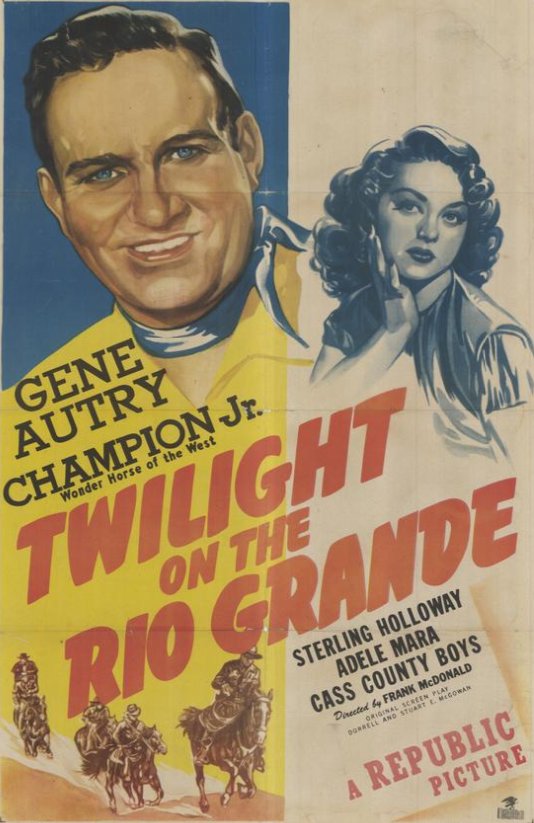
 Frank McDonald’s Twilight on the Rio Grande features Gene Autry and his co-stars being put through their B-movie paces south of the border.
Crime melodramas (we call them film noirs nowadays) were very popular Hollywood products in 1947, and Twilight on the Rio Grande incorporates several elements from them, such as the hero investigating the murder of his partner, lots of nighttime photography, a plot about jewel smuggling, and a beautiful knife-throwing señorita. (They showed up in noirs every now and then, didn’t they?)
Gene Autry (played by Gene Autry) and his ranch hands, Dusty Morgan (Bob Steele), Pokie (Sterling Holloway), and the singing trio The Cass County Boys, are all down in Mexico, singing in Spanglish and ogling the ladies. (If there was a deeper purpose to their visit, I missed it.)
The diminutive Bob Steele was a western actor whose star had faded by the mid-’40s, and he picks up a pretty easy paycheck in Twilight on the Rio Grande, since his character is murdered in the first reel, which I thought was a shame. I like Steele, and would have enjoyed seeing him and Autry solve the murder of Sterling Holloway’s character, Pokie, since the loose-limbed, rubber-faced Holloway is more annoying than a barrel of Jim Carreys.
The femme fatale of the film is the beautiful and hot-blooded Elena Del Rio (Adele Mara), who throws knives at Gene while he’s singing “I Tipped My Hat and Slowly Rode Away.” She throws one after the other into the wall behind him, in order to show him how angry she is. She has a steady hand, so she doesn’t hurt him. But then Gene shows her his steady hand when he finishes his song, throws her over his knee, and spanks the bejeezus out of her with the flat of a big knife blade.
Dusty is murdered with a knife in the back, and a smuggler Gene and his boys rope out on the prairie winds up with a knife in his back that could only have been thrown, not thrust at close range, so suspicions fall on Elena.
The title song is a good one, and was never released as a record by Autry, so if you’re a fan of his music, it’s a reason to see this picture. He sings two versions, a slow, mournful version at Dusty’s funeral, and a more upbeat version to close the picture.
If you’re not a fan of Autry’s music, there is really no reason to see this picture. It’s not terrible, but there are plenty of better B westerns out there.
 A lot of men were drafted during World War II. Roy Rogers was one of them. With a 1-A classification, he expected to be shipped out in the spring of 1945. Consequently, screenwriter John K. Butler (working from a story by Leon Abrams) came up with a script to showcase Rogers’s leading lady, Dale Evans. When V-E Day rolled around, however, the draft board exempted men over the age of 30 who had children, so Rogers never had to serve. Director Frank McDonald’s Sunset in El Dorado ended up starring both “The King of the Cowboys” and “The Queen of the West,” but Evans is still the central figure, and it’s a great showcase for her sunny persona.
 There are no Navajos to be found in this run-of-the-mill Roy Rogers picture, or American Indians of any tribe, for that matter. The title comes from a popular song that was written by Dick Charles (a.k.a. Richard Charles Krieg), Larry Markes, and Edgar De Lange in 1945, and is sung by Rogers, Dale Evans, and the rest of the gang to close the picture. No, the only people of color in Along the Navajo Trail are Spanish-speaking Gypsies, who are portrayed in much the same way Mexicans were in Hollywood westerns except that they wear funny clothes, travel in wagons, and the men wear gold hoop earrings. They also provide George “Gabby” Hayes’s character with a series of comic interludes in which he attempts to cheat the Gypsies, and is in turn cheated himself. These horse trades don’t add much to the plot, but they do result in Hayes sputtering the memorable line, “I sure have gypped that gyppin’ Gypsy!”
 OCD Viewer