 Actor Rondo Hatton, whose face was so unique that it has been immortalized in bust form as a series of horror awards, was reportedly voted the best-looking boy in his class at Hillsborough High School in Tampa, Florida.
Whether or not this story is apocryphal, we do know that Hatton didn’t always look the way he did when he starred as the hideous “Creeper” in a series of low-budget horror films in the 1940s.
Born on April 22, 1894, Hatton worked as a sportswriter and served in World War I, after which acromegaly began to change his facial features. Acromegaly is a syndrome often associated with gigantism. It usually manifests in adulthood or middle age, and its progression is slow. It involves swelling of the soft tissues — particularly the hands, feet, nose, lips, and ears — general thickening of the skin, the swelling of internal organs, and the pronounced protrusion of the brow and lower jaw.
While working as a reporter for the Tampa Tribune, he was spotted by director Henry King, who was in Florida to make Hell Harbor (1930). King hired Hatton for a bit part, and Hatton eventually moved to Hollywood, where he appeared in a series of small roles, most notably as a contestant in an “ugly man competition” in The Hunchback of Notre Dame (1939) and as a member of the lynch mob in The Ox-Bow Incident (1943). He first appeared as a character called “The Creeper” in the Sherlock Holmes thriller The Pearl of Death (1944), and then twice more in two horror films that were unrelated to the Sherlock Holmes series, House of Horrors and The Brute Man, both of which were directed by Jean Yarbrough.
In House of Horrors, which was released on March 29, 1946, an unsuccessful sculptor saves the Creeper from drowning, and gets him to murder all the critics who have written unfavorably about his cubist “tripe.”
 In The Brute Man, a once-handsome B.M.O.C. (big man on campus) who was disfigured in a lab accident prowls the city, killing for revenge. Spinning newspapers with headlines like “Back Breaker Claims Second Victim” fill in the missing details, as the viewer wonders why police can’t find the most unique and strange-looking person in the city, who is spotted in public plenty of times.
After one of his murders, the Creeper takes refuge in the home of a blind piano teacher named Helen Paige (Jane Adams, who unfortunately never appears in that pink satin and white ermine number we see her wearing on the lobby card above). For no reason I could discern, she lies to the police about someone being in her apartment, and the Creeper climbs out her window and makes his escape.
We eventually learn that the Creeper used to be a boy named Hal Moffet, a football star at Hampton University, who was popular and handsome, although his temper made him some enemies. He and his friend Clifford Scott (Tom Neal) were in love with the same girl, Virginia (Jan Wiley). The night before an oral exam in chemistry, Cliff fed the academically impatient Hal the wrong answers so he’d be kept after class and not be able to score with Virginia. Naturally, the professor did what any professor would do with a student who bungled a quiz; he kept him after class working on a complicated and dangerous experiment. After seeing Cliff and Virginia through the window, Hal realized he’d been deliberately crossed up, and smashed a flask of chemicals on the floor. Unfortunately, the cloud of caustic smoke damaged his face, and he’s now hell-bent on getting revenge on everyone he thinks wronged him. Last on his list are Cliff and Virginia, who are now married.
This story is, of course, a burlesque version of reality. Acromegaly, not a lab accident, was responsible for Hatton’s appearance, but he was a football player and handsome young man whose appearance gradually became monstrous. (The publicity department of Universal Studios actually claimed that Hatton’s facial deformities were the result of a mustard gas attack in World War I.)
Hatton died on February 1, 1946, before either House of Horrors or The Brute Man were released. He was 51 years old, and his death was caused by a heart attack that was directly related to his disorder. He wasn’t much of an actor, but his appearance alone telegraphed pathos, and the renewed interest in Universal’s horror films in the ’60s and ’70s eventually turned him into a horror icon.
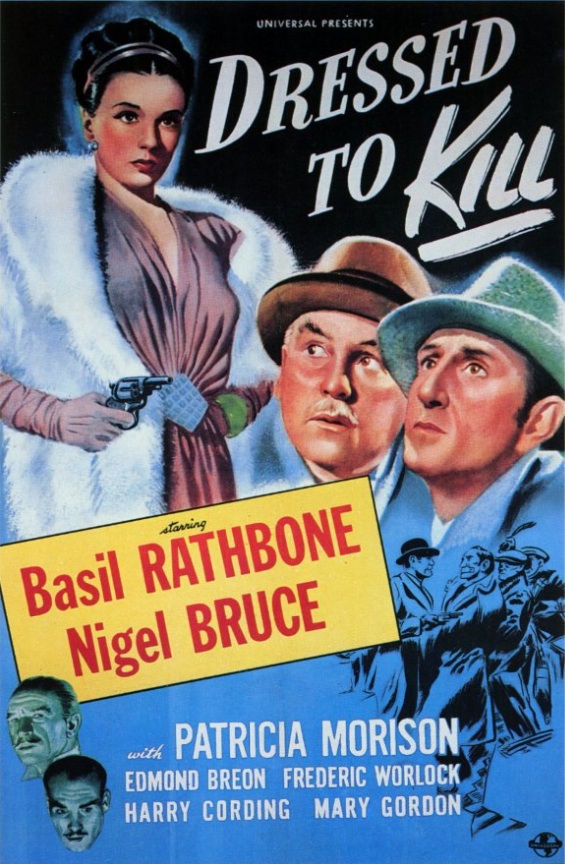


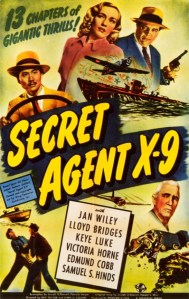 Republic Pictures is the unassailable king of the cliffhangers after the silent era. Most of the best chapterplays of the ’30s and ’40s were Republic productions. Dick Tracy (1937), The Lone Ranger (1938), Zorro’s Fighting Legion (1939), Adventures of Red Ryder (1940), Mysterious Doctor Satan (1940), Adventures of Captain Marvel (1941), Jungle Girl (1941), Spy Smasher (1942), Perils of Nyoka (1942), The Masked Marvel (1943), and Captain America (1944) are just a few of the more than sixty serials produced by Republic Pictures, most of which are still incredibly entertaining. The best Republic serials combined wild action and elaborate stunts with nicely paced stories that could be strung out over 12 to 15 weekly installments with a few subplots here and there, but nothing too complicated or that viewers couldn’t pick up with in the middle. Each chapter ended with a cliffhanger (like Captain Marvel flying toward a woman falling off a dam, or a wall of fire rushing down a tunnel toward Spy Smasher). The next week’s chapter would begin with a minute or two of the previous week’s climax and the resolution, and the cycle would repeat until the final chapter.
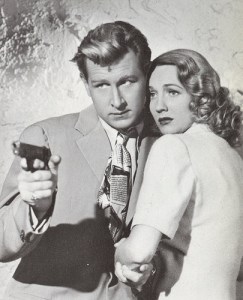 The first film serial featuring Secret Agent X-9 was made by Universal in 1937, and starred Scott Kolk as Agent X-9, a.k.a. “Dexter,” who sought to recover the crown jewels of Belgravia from a master thief called “Blackstone.” The second featured a boyish-looking 32-year-old Lloyd Bridges as Agent X-9, a.k.a. “Phil Corrigan.” Made toward the end of World War II, the 1945 iteration of the character focused on wartime intrigue and Corrigan’s cat-and-mouse games with Axis spies. Taking a cue from Casablanca (1942), the serial was set in a neutral country called “Shadow Island,” in which Americans, Japanese, Chinese, French, Germans, Australians, and the seafaring riffraff of the world freely intermingle. A fictional island nation off the coast of China, “Shadow Island” has a de facto leader named “Lucky Kamber” (Cy Kendall) who owns a bar called “House of Shadows” and has a finger in every pie, including gambling and espionage. Various German and Japanese military officers, secret agents, and thugs run amuck in this serial, but the one who most stands out is the unfortunately made-up and attired Victoria Horne as “Nabura.” In her role as a Japanese spymaster, Horne is outfitted with eyepieces that cover her upper eyelids, appearing to drag them down from sheer weight. She doesn’t look Asian, she just looks as if her eyes are closed.
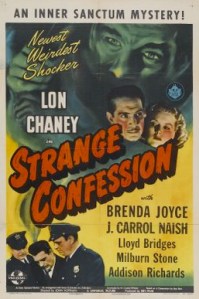 Apparently populist rage against pharmaceutical giants is nothing new. In Strange Confession, the fifth of six “Inner Sanctum Mysteries” produced by Universal Pictures and released from 1943 to 1945, Lon Chaney, Jr. plays a brilliant chemist named Jeff Carter whose life goes from bad to worse when he twice accepts employment from the unscrupulous owner of the largest medical distributing company in an unnamed American city.
 OCD Viewer