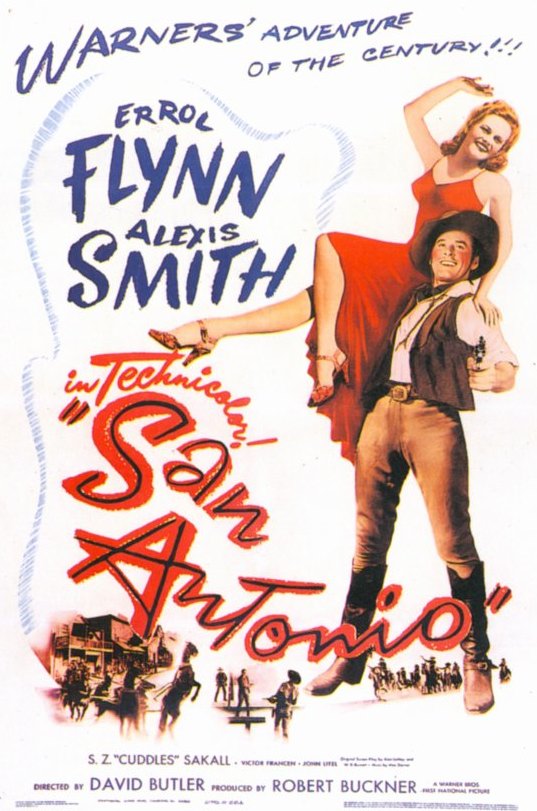
 San Antonio, directed by David Butler (with uncredited assistance from Robert Florey and Raoul Walsh), is a journeyman effort from start to finish. A lavish, Technicolor production, the film looks great, and its stuntwork and cinematography are top-notch. The final showdown, a three-way shootout staged at nighttime in the ruins of the Alamo, is especially well-done. But San Antonio never aspires to be anything more than middlebrow entertainment. It’s a star vehicle for Errol Flynn, a showcase for a couple of musical numbers by Alexis Smith, and not much more.
Flynn plays a rancher named Clay Hardin, one of the survivors of a vicious war that has raged for years between ranch owners and the rustlers who decimate their herds by running nightly raids and then rebranding and reselling the cattle at various points along the more than 1,000 miles of border that Texas shares with Mexico. Hardin was falsely branded a criminal, and when the film begins, we find him living in Mexico in exile. He finally has in his possession evidence that could clear his name, a tally book containing records of all the illegal cattle sales made by Roy Stuart (Paul Kelly), the cattle baron of San Antonio. With the tally book and his good friend Charlie Bell (John Litel), Hardin returns to San Antonio prepared to mete out justice. Along the way, he crosses paths with a singer named Jeanne Starr (Smith), as well as her attendant Henrietta (Florence Bates) and her roly-poly manager Sacha Bozic (S.Z. Sakall, who is curiously listed in the credits as “S.Z. ‘Cuddles’ Sakall”). Bozic and Henrietta provide comic relief in helpings that are a little too large, and Jeanne provides romantic interest and a couple of songs.
This wasn’t the first time Smith appeared opposite Flynn. The two starred together in Dive Bomber (1941) and Gentleman Jim (1942). I found their chemistry in San Antonio lukewarm. For a man who was reportedly a stone-cold freak in private, Flynn is remarkably wooden in many of his roles. In San Antonio he’s still working the “dashing” angle he perfected in Captain Blood (1935) and The Adventures of Robin Hood (1938), but he looks closer to the “world weary” angle that he would later play to perfection in the excellent black and white western Rocky Mountain (1950).
San Antonio doesn’t drag, and it’s solid western entertainment. The production values are high, the action is well-staged, and Victor Francen delivers a juicy turn as a villain named Legare, but overall it’s just O.K., with a run-of-the-mill story and passable performances by the leads. If you love the music of the period, Smith’s performance of “Some Sunday Morning” will be a highlight, but if you’re a fan of more historically accurate westerns, the songs in the film date it about as badly as Flynn’s perfect coiffure and jaunty red neckerchief.
 If you’ve only seen the film adaptation of James M. Cain’s 1941 novel Mildred Pierce, you’re forgiven for never wondering whether the striking murder set piece that opens the film and informs the entire picture was an invention of the producer and the screenwriters that never occurred in the novel.
 OCD Viewer