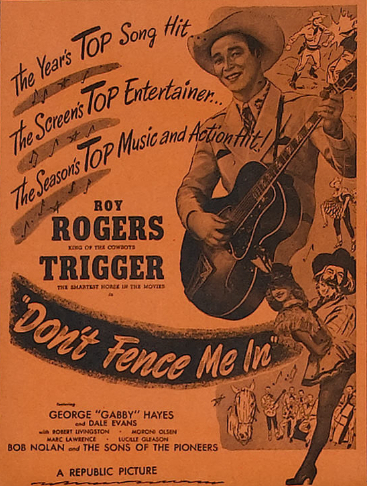
 Don’t Fence Me In is a particularly good Roy Rogers picture. Directed by John English (who with William Witney directed some of the best Republic serials of the late ’30s and early ’40s), it’s a well-paced, exciting, and thoroughly enjoyable B western.
The film opens with a western montage, accompanied by the Cole Porter song from which the film gets its title. After the credits roll, we’re treated to a cheap-looking Boot Hill set with a matte painting background that looks as if it’s about two feet away. A narrator tells us that “Once upon a time, as a matter of fact nearly forty years ago, there was a notorious western outlaw named Wildcat Kelly. He didn’t want to be fenced in either. But they stuffed him into a pine box and buried him six feet under the sod, on Boot Hill.” A masked man rises from behind Kelly’s tombstone, carrying a gun and a Wells Fargo case. The narrator, sounding surprised, says, “Wait a minute, that looks like Wildcat Kelly. It is Wildcat Kelly. There’s something mighty strange about this. I think we’d better investigate the story of Mr. Wildcat Kelly.”
And investigate we shall, but the job will fall on the pretty shoulders of a girl reporter named Toni Ames (Dale Evans). Toni has enough moxie to make an 800-pound gorilla stop dead in his tracks. When we first meet her, she’s performing the song “A Kiss Goodnight” while dancing on the table at a hot party in a big city, displaying her shapely gams to maximum effect. She’s doing it all for a story, though. A reporter for a tabloid called Spread magazine, Toni is undercover, secretly snapping shots of the party’s guest of honor, a dirty old cad named Cartwright (Andrew Tombes) who’s running for mayor as an incumbent.
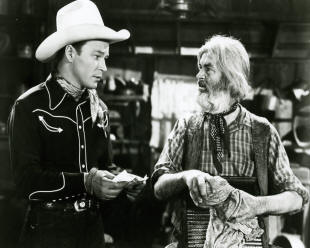
The plot eventually takes Toni out west to the R Barr Dude Ranch to investigate the legend of Wildcat Kelly, who it turns out faked his own death nearly 40 years ago and has been living as a regular western Joe named “Gabby Whittaker.” He’s played by George “Gabby” Hayes, and it’s a good part for him. In a lot of these pictures, Hayes was able to just coast on his ornery persona, but Don’t Fence Me In actually gives him something to do.
Rogers plays that charming and laconic singing cowpoke character called “Roy Rogers” that he played in dozens of movies. Roy is Gabby’s friend, and the only person who knows his secret. He tries to convince Toni not to publish what she knows about Wildcat Kelly, but she goes ahead with her story, and that’s when things get interesting.
There are a group of gangsters whose motives are shadowy, but who clearly want Kelly dead once it’s revealed he is still alive. One of them is played by the great character actor Marc Lawrence, who had a very long career as a sinister-looking hood.
This is a fine showcase for all of the regulars from the ’40s Roy Rogers pictures. Bob Nolan and the Sons of the Pioneers back Rogers up both musically and when it’s time for fisticuffs. And the wonder horse Trigger does a high-stepping dance, with Rogers astride him, to an instrumental version of “Don’t Fence Me In,” and even takes a bow when he’s finished.
Roy and Dale’s relationship is more antagonistic than in many of their other pictures, but it’s still fun to watch. When she first shows up and tries to stow away in the boot of a coach, Roy tosses a hunk of stinky Limburger cheese in the back with her and takes her on a bumpy ride. She later pays him back by pushing him into a swimming pool.
Don’t Fence Me In ends with a delightful rendition of the title song performed by Roy, Dale, and the Sons of the Pioneers, with a few lines added at the beginning about Wildcat Kelly to tie the whole thing together.
 A lot of men were drafted during World War II. Roy Rogers was one of them. With a 1-A classification, he expected to be shipped out in the spring of 1945. Consequently, screenwriter John K. Butler (working from a story by Leon Abrams) came up with a script to showcase Rogers’s leading lady, Dale Evans. When V-E Day rolled around, however, the draft board exempted men over the age of 30 who had children, so Rogers never had to serve. Director Frank McDonald’s Sunset in El Dorado ended up starring both “The King of the Cowboys” and “The Queen of the West,” but Evans is still the central figure, and it’s a great showcase for her sunny persona.
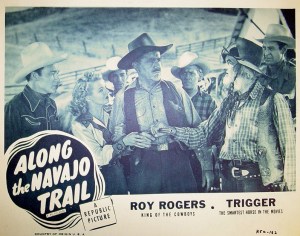 There are no Navajos to be found in this run-of-the-mill Roy Rogers picture, or American Indians of any tribe, for that matter. The title comes from a popular song that was written by Dick Charles (a.k.a. Richard Charles Krieg), Larry Markes, and Edgar De Lange in 1945, and is sung by Rogers, Dale Evans, and the rest of the gang to close the picture. No, the only people of color in Along the Navajo Trail are Spanish-speaking Gypsies, who are portrayed in much the same way Mexicans were in Hollywood westerns except that they wear funny clothes, travel in wagons, and the men wear gold hoop earrings. They also provide George “Gabby” Hayes’s character with a series of comic interludes in which he attempts to cheat the Gypsies, and is in turn cheated himself. These horse trades don’t add much to the plot, but they do result in Hayes sputtering the memorable line, “I sure have gypped that gyppin’ Gypsy!”
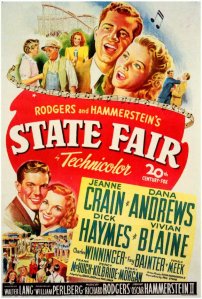 State Fair was the first musical made specifically for film by Rodgers and Hammerstein. Their two previous musical collaborations, Oklahoma! and Carousel, were both stage productions. (Although both would eventually be made into films in the ’50s.) State Fair was based on a novel by Philip Stong that had previously been made into a non-musical film in 1933 with Will Rogers.
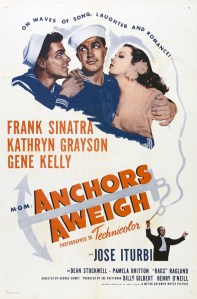 I don’t generally like musicals, but I loved Anchors Aweigh. It probably doesn’t hurt that I really like both Frank Sinatra and Gene Kelly, and this movie uses both of them to wonderful effect. Kelly’s dance sequences are all high points, and even Sinatra comports himself well in the one dance in which he has to match Kelly step-for-step. Although I can only imagine how many takes it took to get it right. Unlike today’s hyperkinetic editing styles, most of the dance sequences in Anchors Aweigh are done in what appear to be one take, or just a few at most.
 The western genre may be moribund, but it refuses to kick the bucket. Singing cowboys, on the other hand, are deader than vaudeville. There was a time, however, when Gene Autry and Roy Rogers were two of the biggest film stars in America.
 OCD Viewer