Tag Archives: Mystery

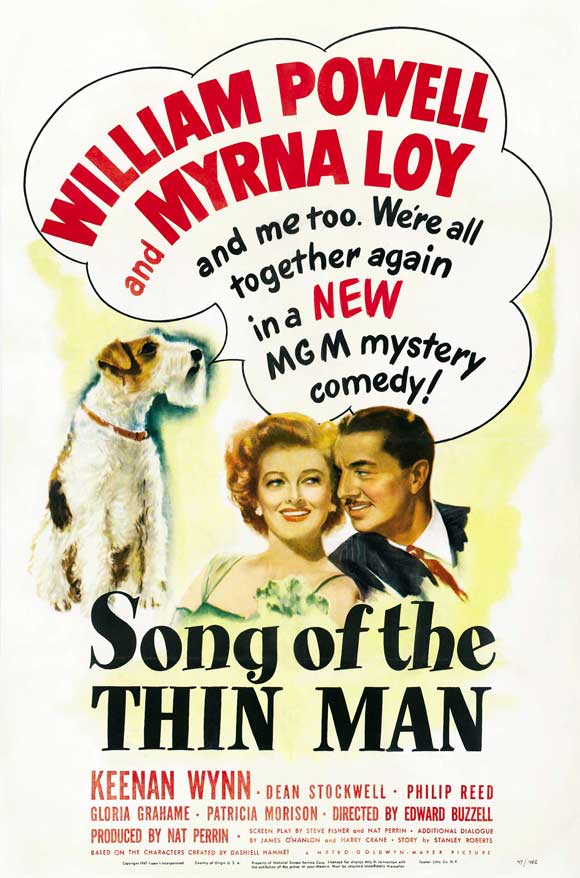
Song of the Thin Man (Aug. 28, 1947)

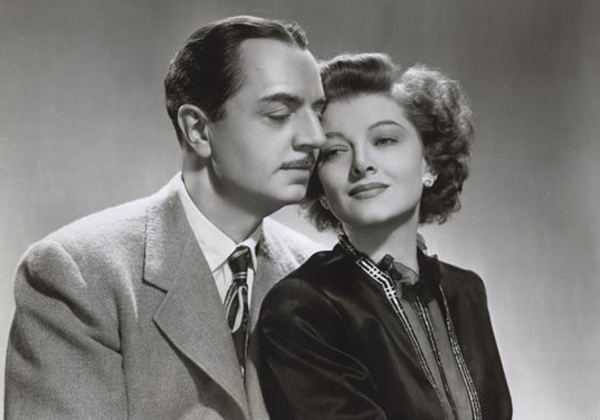
Edward Buzzell’s Song of the Thin Man was a bittersweet viewing experience for me. I’ve been a huge fan of the Thin Man series since the first film, The Thin Man (1934), so it was a little sad to know that Song of the Thin Man would be the last new film I’d see with William Powell and Myrna Loy as everyone’s favorite dipsomaniacal mystery-solving married couple, Nick and Nora Charles.

While some films in the Thin Man series are better than others, all of them are funny, well-made mysteries featuring two of the most appealing actors from Hollywood’s Golden Age.

As always, their little dog Asta is around for yuks, along with a brand new adorable little son, played by Dean Stockwell. (Yes, kids, Dean Stockwell was adorable once.)

But not to worry. Having a young son doesn’t stop Nick and Nora from continuing to booze it up and skulk around at night with flashlights, looking for clues.

The mystery they’re trying to solve this time around is the murder of a jazz band leader named Tommy Drake (Phillip Reed), who is shot aboard the S.S. Fortune, a gambling ship run by a man named Phil Brant (Bruce Cowling).

True to its title, Song of the Thin Man is all about music. Specifically jazz music, and the wacky nightclub performers who jam till dawn, like Drake’s former bandleader Buddy Hollis (Don Taylor) and his famous clarinet. Hollis is a talented musician, but he’s all whacked out from carrying a torch for the hot little cookie Fran Ledue Page (Gloria Grahame), a singer.

Keenan Wynn is also on hand as musician Clarence “Clinker” Krause, and he proves that his incredibly annoying character in The Hucksters (1947) wasn’t a case of lightning striking once.

The mystery in Song of the Thin Man isn’t that clever or involving. But as always with the Thin Man movies, the mystery and its solution is less important than all the fun Nick and Nora have carousing their way through it.

Powell and Loy were 41 years old and 28 years old, respectively, when the series began, so by the time they made Song of the Thin Man together they were starting to get on in years, but Loy looks just as beautiful as she did in 1934, and I don’t think anyone ever went to see the Thin Man movies for Powell’s looks.

All good things must come to an end, but I wish there could have been just a few more Thin Man movies with Powell and Loy.
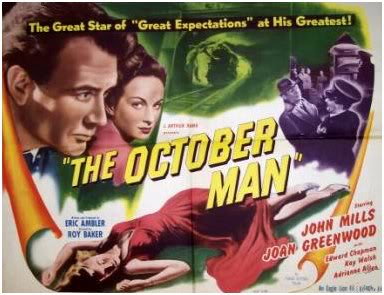
The October Man (Aug. 28, 1947)

The only problem with a really crackerjack opening is that sometimes it can make the rest of a film seem staid.

Roy Ward Baker’s The October Man, which was written and produced by spy novelist Eric Ambler, features a stunning, completely wordless opening sequence in which a bus full of passengers navigates twisting English country roads at night in the rain.

Jim Ackland (John Mills) sits next to a little girl. The two are friendly with each other, and he ties his handkerchief into a rabbit shape to amuse her. The film cuts from them to an axle under the bus with a loose screw, to the sleepy driver, and back to them. When disaster comes, it is swift.

Before the accident, Ackland had a good job as an industrial chemist and was quite sane. During the accident, however, he suffered a depressed fracture of the skull and multiple brain injuries.

The little girl on the bus next to him was the daughter of some of his friends, and he blames himself for her death, twice attempting suicide during his convalescence.

Eventually, though, Ackland starts to get his life back on track. He moves into a boarding house full of fusspots and weirdos and gets another job as a chemist. He meets a nice girl named Jenny Carden (Joan Greenwood) and starts seeing her regularly.

But when one of the other residents of Ackland’s boarding house — a woman named Molly Newman (Kay Walsh) — is murdered, suspicion falls on Ackland. The only person who should know beyond a shadow of a doubt whether he’s guilty or not — Ackland himself — isn’t even sure, since he’s a paranoiac who suffers from blackouts.

The October Man is a good film. It’s well acted and well shot, and the central mystery is intriguing, if not particularly difficult to unravel. My main problem with it is that nothing in the film is equal to the suspense and power of the first minute.

This was the first feature film that Roy Ward Baker directed. (He’s listed in the credits as “Roy Baker.”)

Baker was a prolific director of British film and television who worked into the 1990s, and who died last year at the age of 93. During World War II, Baker worked under Eric Ambler in the Army Kinematograph Unit, which eventually led to him directing The October Man. If you’re a fan of Hammer Studios’ horror films, you’ve doubtless seen films directed by Baker, but he worked in all manner of genres. His most enduring film is probably A Night to Remember (1958), about the sinking of the Titanic.

Cry Wolf (July 18, 1947)

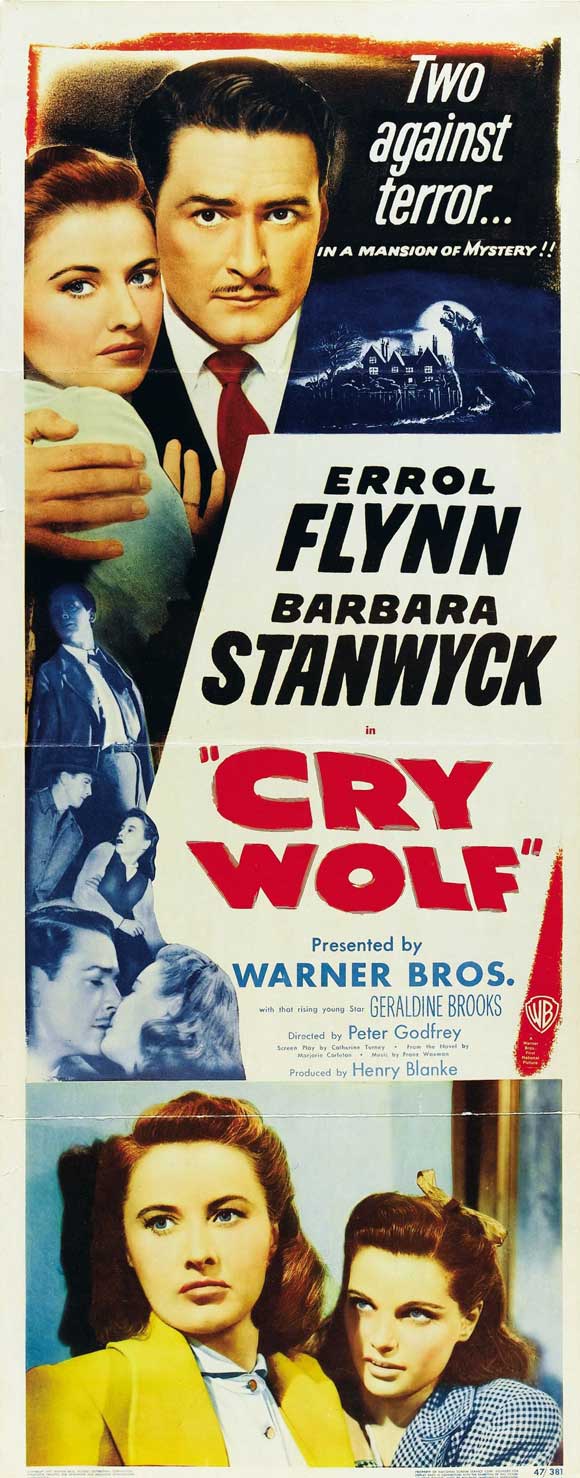
Peter Godfrey’s Cry Wolf is a good-looking thriller with two great stars and an intriguing setup, but it never quite fulfills its promise, and eventually peters out with an ending that you can see coming a mile away.

Barbara Stanwyck plays a young widow, Sandra Demarest née Marshall, who arrives at the creepy New England mansion of Mark Caldwell (Errol Flynn). Mark is a cold, imposing patriarch who lives with his brother, Senator Charles Caldwell (Jerome Cowan), and his teenage niece, Julie Demarest (Geraldine Brooks).

Sandra claims she was married to Mark’s deceased nephew, James Caldwell Demarest (Richard Basehart). She says she was working toward her doctor’s degree in geology. Jim came to her as a friend and she helped him. She needed money. He needed his inheritance. (Jim and his sister Julie have money that is kept in trust until they are 30. If, however, Jim were to marry, control of his inheritance would immediately pass from Mark to Jim’s wife.)

Sandra tells Mark she knows he would have preferred to choose a wife for Jim himself — someone placid — and she assures Mark that she is not a placid girl.

Jim gave Sandra $2,000 to complete her studies and she was to divorce him in six months. There were no other strings. They were married five months before his death. She has come to collect his inheritance. Two thousand dollars has become $2 million.

Doubt and mistrust informs Sandra’s relationship with Mark. Mark isn’t convinced that Sandra’s marriage certificate is genuine, and Sandra suspects Mark is up to no good in his mysterious laboratory. Nevertheless, there are clearly romantic sparks between the two. Also, Mark’s niece Julie instantly becomes attached to Sandra, and begs her to stay.

So it’s a perfect setup for a Gothic thriller. Mark struts and preens about the house, a pipe clenched between his teeth, spitting out nasty one-liners like, “Next time you hear some odd noise in the night, just follow the memorable custom of your sex and stick your head under the bedclothes.” And Sandra gets to play at being a grown-up Nancy Drew, pulling herself up to Mark’s lab in a dumbwaiter and then hiding behind a door when he unexpectedly arrives, and later climbing along the eaves of the mansion and dropping down a skylight to spy on him.

Cry Wolf reminded me a lot of Vincente Minnelli’s Undercurrent (1946), which is another Gothic thriller about a not-terribly-romantic love triangle in which one-third of the equation is absent for most of the picture.

Like Undercurrent, Cry Wolf is competently put together, and it’s worth seeing if you like the film’s stars, but it never really takes flight. Franz Waxman’s musical score and Carl E. Guthrie’s cinematography are both top-notch, and add a good deal of suspense to the shadowy proceedings, but there’s only so far that atmosphere can take a picture. Ultimately, Cry Wolf is a mystery that’s not terribly mysterious.

Riffraff (June 28, 1947)

Ted Tetzlaff’s Riffraff, which premiered in New York City on June 28, 1947, was Tetzlaff’s first feature film as sole director. (In 1941, he co-directed the John Barrymore comedy World Premiere with the uncredited Otis Garrett and he was the uncredited co-director on Ralph Murphy’s Jackie Cooper comedy Glamour Boy.)

Before he made the leap to directing, Tetzlaff worked as a cinematographer on more than a hundred films. He started working in the silent era, and his last credited film as cinematographer was Alfred Hitchcock’s Notorious (1946). Anyone who’s seen Notorious can attest to how beautifully it’s lighted and shot, and Tetzlaff brings his considerable skill to bear on Riffraff, elevating it from the very run-of-the mill detective story it could have been.

The opening sequence in Riffraff is the most talked-about part of the film. It’s five full minutes of dialogue-free bliss. After the credits roll, the film cuts to an unnerving shot of an iguana placidly lying on a log in the pouring rain. The iguana’s cold, reptilian gaze is a harbinger of things soon to come.

It’s 2:25 in the morning at El Caribe airlines in Peru. A meek, bespectacled man (Fred Essler) boards a cargo plane, the rain sheeting down on him. He sits nervously in the cargo hold, dripping wet and hanging onto his briefcase tightly. He’s sharing the space with a bunch of squawking chickens and an oily, mustachioed fat man with an unnerving smile. (He’s played by Marc Krah, and we’ll find out later in the film that his character’s name is Charles Hasso). The man with glasses watches Hasso fearfully as Hasso stares back at him. Then Hasso stands up and plucks an errant chick from the floor and replaces it gently in its box.

There’s an exterior shot of the cargo plane flying through the rain in the night, then an interior shot of the pilots lighting up a couple of smokes. A warning tone sounds in the cockpit. The co-pilot rushes back into the hold, where the door is wide open and rain is pouring into the plane. “I couldn’t stop him! He jumped!” exclaims Hasso.

Sure he did.

The cargo plane lands in Panama, where Hasso is questioned by the head of the secret police, Major Rues (played by an oddly accent-free George Givot). Hasso is evasive when he’s questioned about his fellow passenger’s death and suggests that the man might have killed himself for love.

Sure he did.

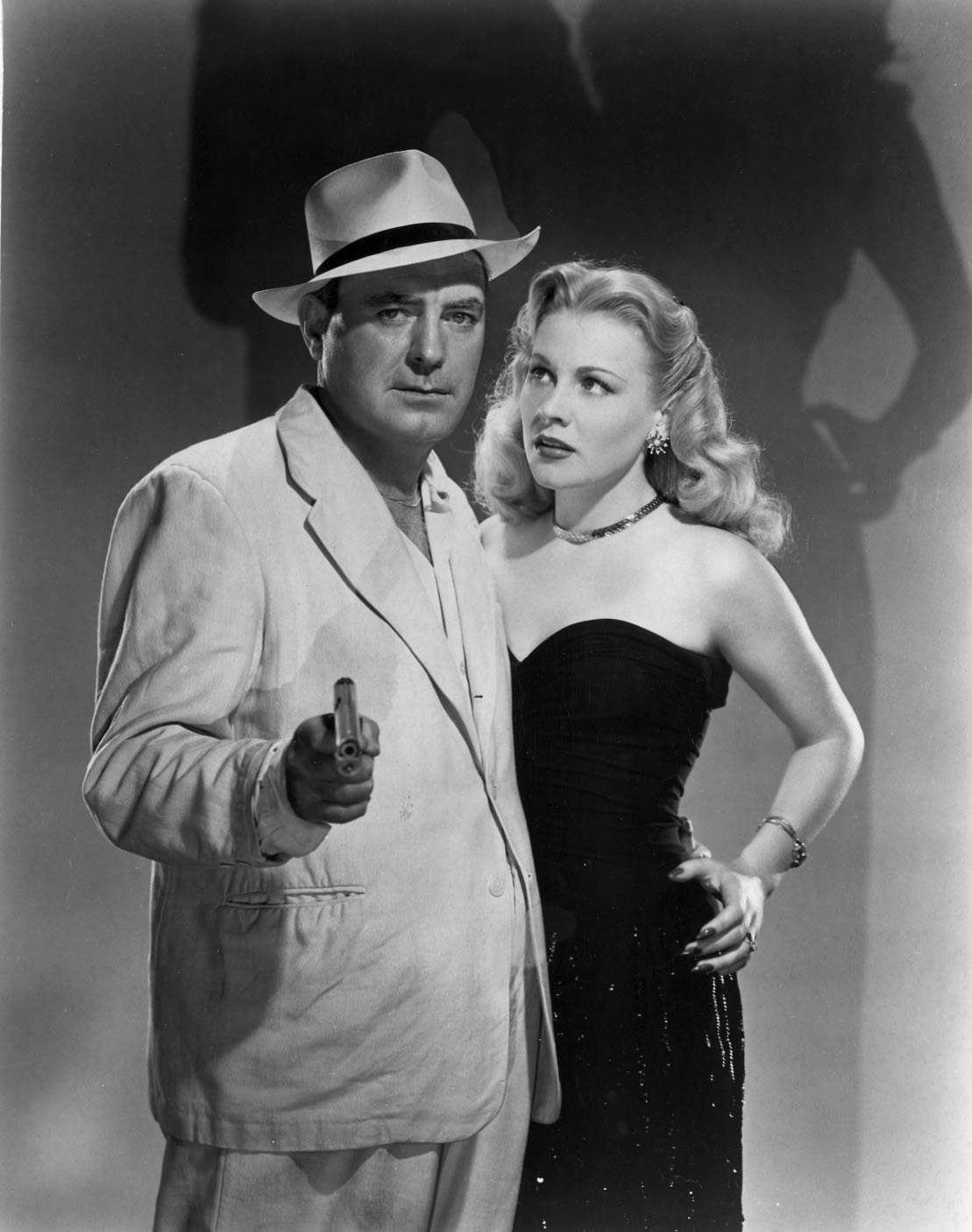
Major Rues’s suspicions (as well as the audience’s suspicions, if they’re awake) are confirmed when Hasso goes to see Dan Hammer (Pat O’Brien), president and sole operative of Zenith Services, a detective agency. Hasso hires Hammer as a bodyguard for his two-day sojourn in Panama City, and while Hammer’s back is turned, he takes the map he stole from the man on the plane and tacks it to Hammer’s cluttered bulletin board, where it will remain for most of the film’s running time (there’s no better place to hide something than in plain sight.)

Eventually we find out that the map shows the locations of a number of unregistered oil wells. Hammer is approached by a shady businessman named Walter Gredson (Jerome Cowan), who wants Hammer to find Hasso for him. Hammer talks Gredson and his assistant up to $5,000 to do the job, and of course never tells them that he already knows exactly who Hasso is and where he is staying.

Hammer is a mixture of hero and con man. In fact, nearly everyone in the film is an operator who is looking out for number one. The beautiful girl in the story is named Maxine Manning (Anne Jeffreys) and even her motives are unclear for awhile. (After a scuffle in a bar, she deliberately pours a drink on her dress just so she can get close to Hammer.)

Pat O’Brien is an interesting choice for the protagonist, since he’s a middle-aged character actor with a pear-shaped body. (Although, based on the presence of Marc Krah and Walter Slezak, who plays a vicious killer named Molinar, I suspect Tetzlaff had a fetish for fat guys.)

There’s plenty of violence in Riffraff, and more hard-boiled P.I. clichés than you can shake a stick at, but it’s ultimately not a very dark movie. Aside from all the corpses that pile up, it’s breezy, fast-paced fun in an exotic tropical setting.

Besides the performances, which are all excellent, the film is elevated by Tetzlaff’s direction and the terrific cinematography by George E. Diskant.

It’s too bad there weren’t more Dan Hammer films starring O’Brien. He’s hardly anyone’s picture of a tough-as-nails P.I., but he crafts a great character who I wouldn’t have minded seeing in more pictures. Hammer is the kind of guy who never wears a necktie because someone could choke him out with it, and who says he’s not going to give up on the case not because of any noble conviction, but rather, as he he says, because “I’ve got a lot of time invested in this thing. Plus a good shellacking!”

In case you’re wondering, I looked into it and couldn’t figure out who came first, Dan Hammer or Mike Hammer. (Mickey Spillane’s first novel, I, the Jury, was also published in 1947.) While it’s possible that Spillane took his character’s name from Martin Rackin’s script for Riffraff, or that Rackin cribbed the name from Spillane, it’s equally possible that a P.I. with the last name of “Hammer” was just a good idea whose time had come.

Moss Rose (May 30, 1947)

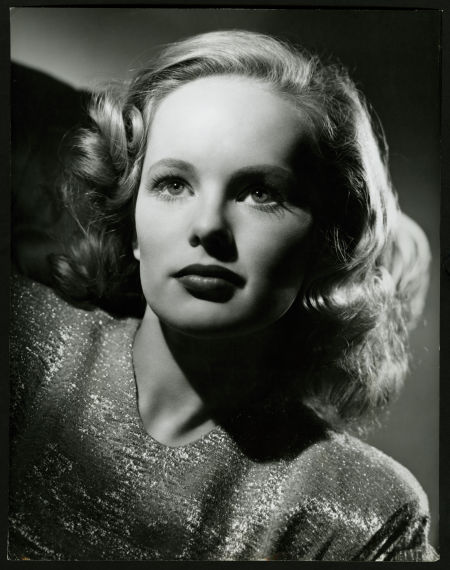
Gregory Ratoff’s Moss Rose is a murder mystery set in Victorian London. It stars Peggy Cummins — a beautiful blond actress who looks like a doll come to life — as Rose Lynton, a Cockney chorus girl. Rose works under the stage name “Belle Adair.” She may have grown up in Shoreditch, but she aspires to be a fine lady.

Margo Woode plays Rose’s friend Daisy Arrow, a fellow actress who has a mysterious boyfriend. He’s a handsome, well-dressed gentleman who Rose only catches glimpses of as he moves in and out of the shadows. Daisy only appears in a handful of scenes before Rose discovers her corpse in bed in the room they share, an open Bible lying on the bed next to her with a dried and pressed moss rose laid across its pages. Was it her suitor who killed her? Or someone else?

Vincent Price — always a welcome sight — plays Inspector Clinner, the Scotland Yard detective who investigates the case along with his lumpy little partner, Deputy Inspector Evans (Rhys Williams). Soon, the identity of Daisy’s suitor becomes clear. He’s a wealthy gentleman named Michael Drego, and he’s played by the always oily Victor Mature, whose lack of a British accent is explained away by the fact that his Canadian father took him away from England when he was very young.

Rose plays girl detective, and it’s not long before she seems to be two steps ahead of the police in identifying Michael as Daisy’s murderer. At first it’s unclear what she wants from him, or why she fails to identify him to the police. She initially blackmails him, but then gives the money back and tells him that all she wants is for him to take her with him to his home, Charmley Manor, for just two weeks. Michael denies that he is guilty of Daisy’s murder, but he tells Rose he’ll go along with her scheme because he’s desperate to keep his family’s name out of the spotlight.

Most of the film takes place at Charmley Manor, which is presided over by Michael’s mother, Lady Margaret (played by the grandest Hollywood dame of them all, Ethel Barrymore).

Lady Margaret keeps her son’s childhood room exactly as it was, because when he was taken away by his father, she knew it was the last time she’d ever see that little boy again. She doesn’t allow anyone in the room, not even the servants, but after her first flash of rage at Rose when she discovers her snooping around the room, she softens, and tells Rose that there’s nothing like a secret to bring two people together.

Complicating matters for Rose at Charmley Manor is the presence of Michael’s fiancée, the beautiful Audrey Ashton (Patricia Medina). Lady Margaret grows to accept Rose, even going so far as to tell people that she is her “companion,” but Audrey sees Rose as a threat to her impending nuptials, and rightly so.

Moss Rose is based on The Crime of Laura Saurelle, one of author Joseph Shearing’s many Gothic thrillers, which were quite popular at the time of the film’s release. (Shearing was one of several pseudonyms used by writer Marjorie Bowen.) It’s a decent whodunnit that will keep you guessing. Michael Drego is the prime suspect, but Inspector Clinner loves flowers — moss rose in particular — and he’s played by Vincent Price, so he always seems suspicious, especially when he’s cutting himself a piece of moss rose in Lady Margaret’s greenhouse and he has a maniacal gleam in his eye. There is also Lady Margaret’s intense-looking butler, Craxton (George Zucco), and as we all know, butlers are always under suspicion. The ladies aren’t exempt from suspicion, either. We learn that Audrey made a mysterious bulk purchase of three Bibles just like the one found next to Daisy Arrow’s corpse, and she’s obviously jealous of any woman in whom Michael shows an interest. And Lady Margaret is hard-headed and clear-eyed, but she seems like a different person whenever she speaks of her son.

Despite the wealth of suspects, Moss Rose turned out exactly how I thought it would, but it wasn’t a bad way to kill some time.

Dear Murderer (May 29, 1947)

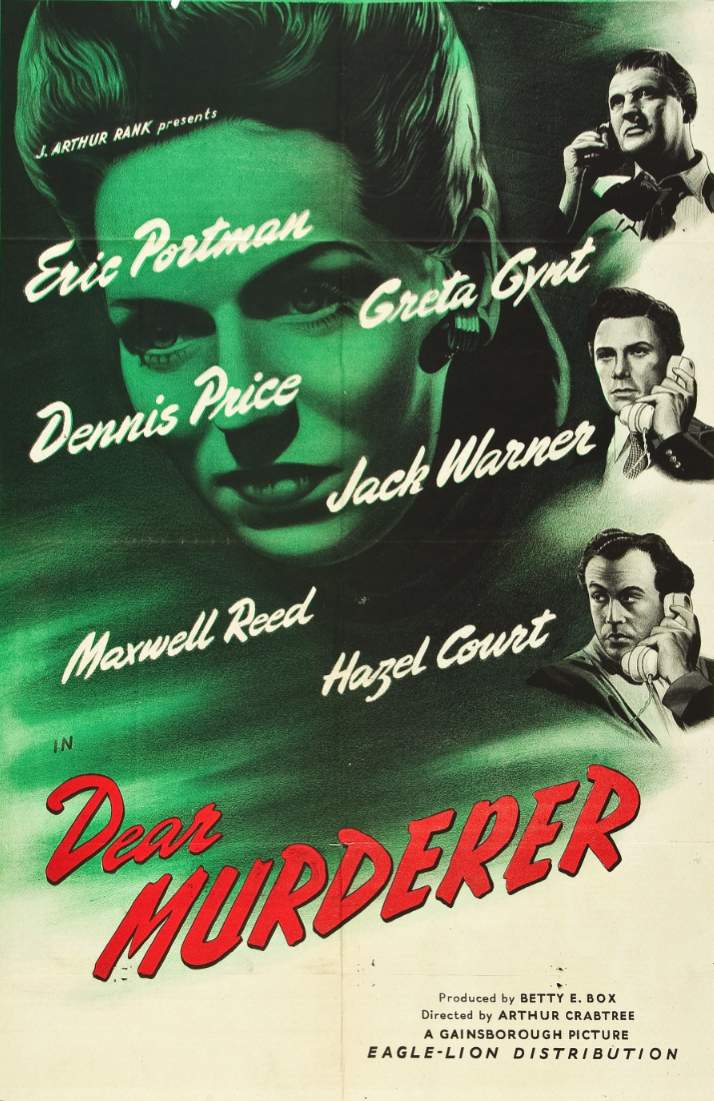
Arthur Crabtree’s Dear Murderer is a well-acted, competently directed British murder story that ultimately collapses under the weight of its own moving parts.

Successful businessman Lee Warren (Eric Portman) has just returned to England after a five-month assignment in New York, and he has murder on his mind. And not just any murder … the perfect murder.

But as any fan of murder mysteries knows, truly perfect murder schemes are rarely the subject of books and films, since the killer invariably does something to trip himself up.

Lee Warren alludes to this when he tells his victim, “The perfect murder is the one that nobody every hears about, because nobody thinks it is murder.”

Warren’s victim is a handsome young lawyer named Richard Fenton (Dennis Price), and Warren wants to kill him because he found out he was making love to his wife, Vivien, while Warren was living in New York.

After convincing Fenton to write a letter breaking it off with Vivien, a letter which Warren partially dictates, Warren “accidentally” spills a drink on the letter. Then, after Fenton begins to rewrite the letter on a dry piece of paper, Warren stops him midway through by pulling a gun on him and tying his wrists behind his back with the silk cord of his dressing gown. Without the second half of the letter, it reads exactly like a suicide note.

Warren informs Fenton that he intends to commit “the perfect murder,” and he’ll be convinced not to go through with it only if Fenton can find a flaw in his plan.

He tells Fenton that he’s going to give him a little rap on the head, just enough to knock him out, then gas him with a pillowcase and tube contraption he’s come up with that will go over Fenton’s head.

He’ll attach the tube to the gas jet in the living room, then move Fenton’s unconscious body into the kitchen and stick his head in the oven, where he will lie until he dies. Since no man can be forced to stick his head in an oven until he dies of gas inhalation without marks of violence, it’ll look like suicide, and the note will clinch it with the authorities.

Fenton tells Warren that Vivien isn’t just interested in him, she’s interested in many men, and Warren can’t kill them all. Warren hits him in the face and then draws back, telling Fenton he’s just being clever and trying to get him to lose his temper. What about an alibi? Warren says he doesn’t need one. He arrived home by plane that night, ate dinner, and went home alone. What about motive? As far as the rest of the world knows, Warren doesn’t even know Fenton exists. Is that all? Fenton sputters, but can’t think of anything else.

“You’re a bit of a failure as a lawyer. I’m glad my life didn’t depend on your arguments,” Warren says, then proceeds to do his cruel work.

By the 30-minute mark, I realized the film must have been based on a play. My moment of realization came when the handsome Jimmy Martin (Maxwell Reed) and Warren’s wife Vivien (Greta Gynt) show up in Fenton’s flat thinking they are alone, and discuss their affair. Jimmy tells Vivien that he wishes she would divorce her husband and marry him. Warren hides around the corner, listening in horror as he realizes that he should have taken Fenton’s admonishment about Vivien’s other lovers more seriously.

These bizarre clown-car meetings of several characters in one place continue for the remainder of the film. I’m sure they made perfect sense in the original stage play by St. John Legh Clowes, but plays have different rules than films do, and the screenplay of Dear Murderer, by Muriel & Sydney Box with Peter Rogers, does nothing to alleviate the staginess of the proceedings.

The first half hour is the best part of the film. It’s clever, sardonic, and involving. By the end of the film, however, the contrivances have stacked up higher than a 4,000-deck house of cards. I didn’t hate Dear Murderer, and could imagine it working very well as a campy stage production full of clever twists and funny dialogue, but as a film, it was too hidebound and stodgy to keep me involved throughout the running time. (It also doesn’t help that Portman and Jack Warner, who plays Inspector Penbury, the police detective investigating the case, look so much alike that I was frequently confused when a new scene opened.)

Dear Murderer compares unfavorably with another British film I saw that starred Eric Portman, Lawrence Huntington’s Wanted for Murder (1946), in which Portman plays a more sinister and psychopathic murderer than the one he plays in Dear Murderer. Wanted for Murder was also based on a play, but I never suspected it while watching it. The direction was creative and the settings in the film were dark, creepy, and often out of doors.

The Millerson Case (May 29, 1947)

The Millerson Case
The Millerson Casee (1947)
Directed by George Archainbaud
Columbia Pictures

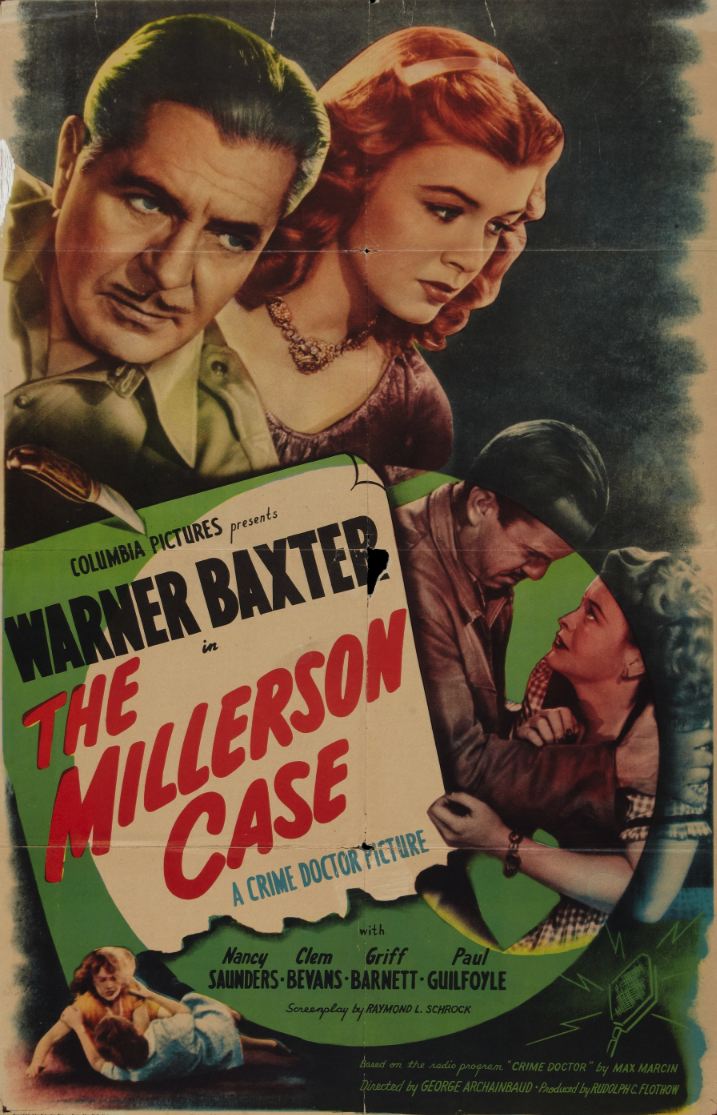
George Archainbaud’s The Millerson Case is the eighth film in the Crime Doctor series from Columbia Pictures and for my money, it’s easily the worst.

Produced by Rudolph C. Flothow, the picture finds Dr. Robert Ordway (Warner Baxter) leaving his Manhattan medical office in the incapable hands of his partner, Dr. Shaw (Walden Boyle), and taking a well-earned vacation in the country for some hunting and fishing.

I’m not sure exactly which remote rural area the film is supposed to depict. Dr. Ordway drives to it from New York City, but it looks suspiciously like California. All I can tell you for certain is that it’s a part of the country where people are always asking, “What fer?”

After a young man named Eben Tuttle (Elvin Field) is shot while carrying a deer on his back, Dr. Ordway comes face to face with the superstitious and uneducated ways of local physician Sam Millerson (Griff Barnett). When an epidemic of typhoid fever breaks out, Doc Millerson dismisses it as “summer complaint” and treats it with “complaint bitters.” He says that he’s been doctorin’ man and beast for 30 years in these parts and he’ll be damned before anyone else tells him what to do.

Three people in the rural community die during the outbreak of typhoid, but one of them, Ward Beechy (Trevor Bardette), has peculiar symptoms. One of the more sensible medical men in the area, Dr. Prescott (Robert Kellard), who’s sent in after the government quarantines the area, isn’t surprised to find evidence of perforated peritonitis in Beechy’s intestinal tract, but he’s never seen a typhoid case with perforations throughout the entire alimentary canal, such as might have been caused by a corrosive poison. Dr. Ordway is unsurprised, since he found no evidence of typhoid bacilli in Beechy’s blood sample and knew something was fishy.

We get a sense of Ward Beechy’s character as he lies dying on his sickbed and he amorously tells his wife’s sister, Belle Englehart (Nancy Saunders), “Sometimes I wish you wasn’t my sister-in-law, Belle.”

This turns out not to be just a typical piece of throwaway hillbilly humor (of which there’s plenty to go around in The Millerson Case). After his death, we learn that Beechy was the local Casanova and had made plenty of enemies — mostly cuckolded husbands and boyfriends who had access to poison. He’s also described as the handsomest man around, which, if you know what Trevor Bardette looks like, should give you some idea of how good-looking the average man in town is.

Doc Millerson, who claims he knows who the guilty party is, receives a note in a woman’s handwriting requesting a meeting at the river bank. He goes there and is killed in an ambush by a rifle shot. With only the note as a clue, Dr. Ordway sets out to find the murderer (or murderers) of Beechy and Millerson and set things right.

I generally like the Crime Doctor series, and while I didn’t hate The Millerson Case, it was the weakest entry yet. There was too much broad humor for my taste, and the mystery just wasn’t very compelling.

Dick Tracy’s Dilemma (May 20, 1947)

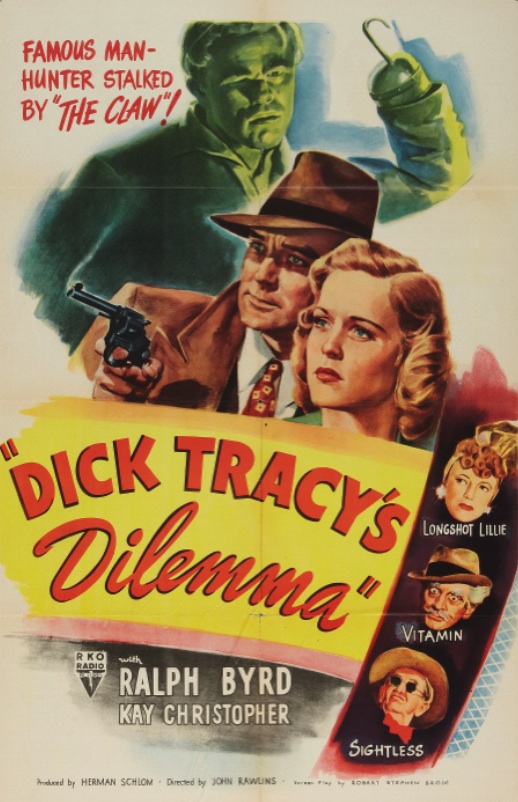
Dick Tracy’s Dilemma, directed by John Rawlins, marked Ralph Byrd’s triumphant return to playing Chester Gould’s famous police detective. Byrd played the hawk-nosed, square-jawed hero in four serials, Dick Tracy (1937), Dick Tracy Returns (1938), Dick Tracy’s G-Men (1939), and Dick Tracy vs. Crime Inc. (1941).

In William Berke’s excellent programmer Dick Tracy (1945), Morgan Conway stepped into the role. I really liked Conway as Tracy. His facial features were as big and ugly as Byrd’s were small and perfect, but he imbued the character with a humanity lacking in Byrd’s one-note performance, and I would have liked to see him in more Dick Tracy movies than just Dick Tracy and Dick Tracy vs. Cueball (1946).

On the other hand, I’m sure a lot of people who grew up watching Byrd in the Dick Tracy cliffhangers on Saturday afternoons were thrilled to see him return to the role. And besides, everything that made Dick Tracy and Dick Tracy vs. Cueball standout pieces of bottom-of-the-bill entertainment from RKO Radio Pictures is still present in Dick Tracy’s Dilemma — tight pacing, good writing, solid direction, dramatic lighting, and nicely staged action — so I enjoyed it in spite of Byrd’s somewhat wooden performance.

The plot of Dick Tracy’s Dilemma is pretty similar to the plot of Dick Tracy vs. Cueball. Instead of a chrome-domed thug with a leather garrote, the villain of the piece is a hulking Neanderthal with a club foot and a hook for a hand. He’s a 39-year-old career criminal named Steve Michel, but he’s better known in the underworld as “The Claw.” Michel was a bootlegger and hijacker during Prohibition. He lost his right hand and crippled his right leg when he was rammed by a Coast Guard cutter, and he’s looking to score some dough now that he’s back on the street. (The Claw is played by character actor Jack Lambert, who’s outfitted with bushy fake eyebrows and a glower that just won’t quit.)

The Claw is part of a crew that takes down a big score at the Flawless Fur warehouse. After the night watchman (Jason Robards Sr.) wakes up from the knockout blow The Claw gave him, he comes after the crew with a gun, and The Claw rips him up with his “hangnail” (as another member of his crew calls his hook). The murder brings in homicide detectives Dick Tracy and his partner, Pat Patton (Lyle Latell).

The Claw waits nervously with his partners for the big payoff. Tracy intercepts Longshot Lillie (Bernadene Hayes), a fence for stolen goods, with $20,000 in her purse. The crew also floats a proposal to Peter Premium (William B. Davidson), the vice president of Honesty Insurance, offering to sell him the furs for half their value before his company has to pay out on the policy.

While this is a solid police procedural with lots of violence, it’s also a Dick Tracy film, so there are plenty of comedic touches. Besides the ridiculous names of some of the characters (see above), there’s a bar called “The Blinking Skull” (not to be confused with “The Dripping Dagger,” which featured in Dick Tracy vs. Cueball), and a beggar named “Sightless” (Jimmy Conlin), who’s only pretending to be blind. Vitamin Flintheart (Ian Keith) is back, too, and provide plenty of laughs — if you’re amused by pretentiousness and narcissism, that is.

John Rawlins directs the one-hour programmer with brisk efficiency. His style is straightforward, but he and his cinematographer Frank Redman throw in plenty of nice touches, such as a man who knocks a plug out of its socket as he is being murdered by The Claw. The next shot is of The Claw rising to stand. The unplugged desk fan is in the foreground, and its blades slowly stop rotating as The Claw leaves the room. It’s a great visual metaphor for a life ending. The film also features a fine score by noir favorite Paul Sawtell.

Fear in the Night (April 18, 1947)

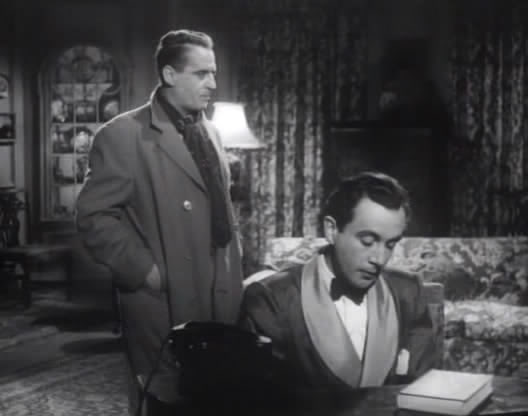
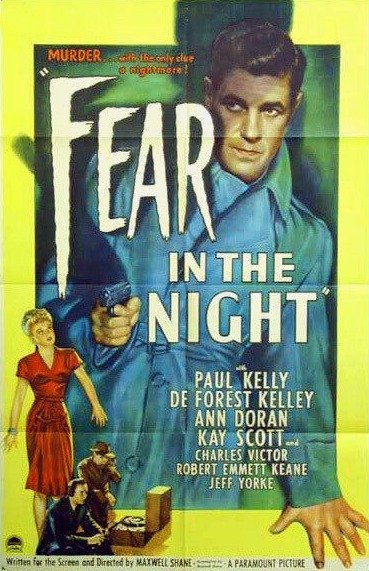
Fear in the Night begins with a little floating dot of light dancing around the screen. It’s a will o’ the wisp that flits here and there before it morphs into the title and an odd, pulsating background pattern that is abstract, but vaguely obscene. The background music by Rudy Schrager is high-pitched and eerie.

After the credits roll, the visual abstractions clear away and are replaced by a black screen and the disembodied head of a beautiful woman with upswept hair (Janet Warren) floating toward the viewer. We hear Vince Grayson (DeForest Kelley) narrate his strange vision:

At first, all I could see was this face coming toward me, then I saw the room. A queer, mirrored room. And somehow, I was inside it. There was danger there. I knew that. I wanted to turn and run, but I couldn’t. It seemed as if my brain was handcuffed, and I had to do what I’d come to do.

Vince dreams that he stabs a man (Michael Harvey) in the heart with a steel bore. The man resists, and chokes Vince. One of the buttons on the man’s jacket pops off. The beautiful woman with upswept hair watches and silently screams, then Vince hides the body in one of the closets in the strange octagonal room full of mirrors. He locks the closet and puts the little key in his pocket. He wakes up from his vivid dream. He is relieved, but then he sees in his bathroom mirror that he has thumbprints in his neck. He looks down and sees a spot of blood on his wrist. He reaches in his pocket and pulls out a key and a button.

Distraught, Vince calls in sick to work. He’s a bank teller, and his pretty co-worker Betty Winters (Kay Scott) is happy to take over his window for the day, but she clearly has feelings for Vince, and is worried when she calls his room and no one answers.

Vince walks the streets alone, eager to be in the sunshine, afraid of the shadows and the coming night. He goes to see his brother-in-law, Cliff Herlihy (Paul Kelly), who just happens to be a police detective. Cliff tells Vince that his mind is playing tricks on him — selling him a phony bill of goods — and not to say anything about this to his sister, Lil (Ann Doran), since she’s expecting a baby and high-strung enough already, but Vince insists on following the leads from his dream. He takes out a newspaper ad that says “WANTED—I am interested in buying or leasing a house with an octagonal mirrored-paneled room or alcove. Location, size secondary, provided has this one essential, desired for reason of sentiment. Phone Grayson, FE-7648.”

Nothing pans out until Vince and Betty go on a picnic with Lil and Cliff. Caught in the rain, they take refuge in a large, unoccupied house. Guess what Vince finds upstairs when he starts poking around? You guessed it … an octagonal mirrored room, the same one he dreamed about.

In a nice bit of realism, as soon as it becomes clear that a murder actually was committed, Cliff jumps to the conclusion that Vince has been stringing him along the whole time with a crazy story so he’ll be able to plead insanity when the case goes to trial.

Fear in the Night was the first film that screenwriter Maxwell Shane directed. He also wrote the screenplay, which was based on the story “Nightmare” by Cornell Woolrich (originally published under his “William Irish” pen name). If you’ve seen Roy William Neill’s Black Angel (1946), which was based on a novel by William Irish/Cornell Woolrich, you’ll noticed a few similarities to Fear in the Night. Blackouts and murders possibly committed in hypnagogic states were frequent occurrences in Woolrich’s fiction, which is unsurprising once you know that Woolrich was an alcoholic shut-in.

Fear in the Night was DeForest Kelley’s first role in a feature film. If you’ve ever seen an episode of Star Trek, it will be impossible to look at him in this film and not constantly see Dr. “Bones” McCoy and all of his trademark twitches and catchphrases. Even though Kelley was only 26 or 27 when he made Fear in the Night, he doesn’t look that different than he would in the ’60s.

If you can get over that, though, Fear in the Night is a twisty and involving noir with some remarkable subjective camerawork. The bits of straight drama are filmed in a flat, conventional style, but all of the dream stuff (of which there’s plenty) is really effective. I’ve seen numerous other films that the cinematographer, Jack Greenhalgh, worked on, and up until now they’ve all been flat, uninteresting P.R.C. westerns, horror films, and mysteries. Fear in the Night really lets him shine, and there are all kinds of wonderful cinematographic flourishes, such as images that shatter into pieces and then are reassembled, scenes that flutter in and out of focus, and even a freeze frame of Kelley’s face while a murder plays out across his empty eyeballs.

The plot is a little wacky, and the solution to the mystery involves some willing suspension of disbelief on the part of the viewer, but no noir fan will be able to resist the central conceit of the film, which is summed up nicely by Vince when he says, “I’ve got an honest man’s conscience in a murderer’s body.”

The Red House (March 16, 1947)

The Red House

The Red House (1947)
Directed by Delmer Daves
Sol Lesser Productions / United Artists

Is there really a red house in Delmer Daves’s The Red House? The movie is filmed in black and white, so I can’t tell you.

I’m not being cheeky, I’m making a point. The “red house” in The Red House is a haunting presence, unseen for most of the film. And when it is finally shown, it’s an eerie sight. It’s a structure in disrepair, covered in lichen, standing close to another abandoned house, both on the banks of a stream deep in the woods.

If The Red House had been filmed in color, this uncanny effect would have been destroyed. As it is, the red house — while shown — still stands more strongly as a disturbing manifestation of all the creepy goings-on in the film than as an actual thing.

The setting of the film is indeterminate. It’s a region called Piny Ridge, where, the narrator informs us, “modern highways have penetrated the darkness.” The darkness remains in an area farther south called Oxhead Woods, where “obsolete trails wander vaguely,” but “only one leads to the Morgan Farm.”

The narrator goes on to tell us that “Pete Morgan’s farm has the allure of a walled castle that everybody knows about, but that few have entered.” This all sounds a bit like a fairy tale, which I think is deliberate.

Pete Morgan (Edward G. Robinson) is a mercurial farmer who lives a lonely life with his sister, Ellen Morgan (Judith Anderson), and their adopted daughter, a pretty, demure 17-year-old named Meg (Allene Roberts). Fifteen years earlier, Meg’s parents both died in mysterious circumstances, and Pete and Ellen have raised her ever since.

Pete has a wooden leg, which makes farm work difficult, so he agrees to hire one of Meg’s high school classmates, Nath Storm (Lon McCallister), to help him out. Pete offers to pay Nath 35 cents an hour for his help after school, but Nath talks him up to four bits.

Pete seems reluctant to hire Nath, and is only convinced to do so by his sister and adopted daughter. It’s clear from the outset why this is. He has an unnatural interest in Meg, and wants to keep her all to himself.

After his first day helping out Pete, Nath plans to take a shortcut home through Oxhead Woods, but Pete tries to convince him to take the long way around. When Nath refuses to heed his warnings, Pete resorts to scare tactics. “You won’t save yourself from the screams in the night that’ll lodge in your bones all your life!” Pete tells him.

Nath asks, “Screams from what?”

Pete responds, “From the red house!!!”

Nath tries, but he can’t do it. The power of suggestion in the dark, terrifying woods amidst the howling winds proves too much for him, and he runs back to the Morgan farm and sleeps in the barn. Were they real screams? Or was it just the wind?

Meg and Nath are attracted to each other, but he has a girlfriend named Tibby, who’s played by the 20-year-old singer and actress Julie London. London is quite possibly the sultriest high school student I’ve ever seen in a film from the ’40s.

Tibby’s not very loyal to Nath, and throws herself at the strapping young woodsman named Teller (Rory Calhoun) who patrols Pete Morgan’s woods with a rifle. Teller never got past the ninth grade, but he’s as big and as handsome as Li’l Abner.

Teller is also the instrument of Pete Morgan’s twisted will, and goes even so far as attempting to commit murder when Pete Morgan asks him to.

The Red House, which is based on the 1943 novel by George Agnew Chamberlain, is sometimes classified as a film noir, but it’s not a noir. It’s a mystery wrapped up inside of a dreamy, avant-garde horror film. It’s halfway between Jean Renoir’s ode to rural American life The Southerner (1945) and Frank Wisbar’s backwoods ghost story Strangler of the Swamp (1946).

Daves’s naturalistic take on the uncanny tale, coupled with a lush score by Miklós Rózsa that alternates between being wildly dramatic and quietly eerie, elevates the pedestrian script and easy-to-figure-out mystery. The Red House could have easily been a forgettable B movie, but it’s a memorable little chiller with heavy doses of perverse sexuality running beneath the surface. With a few changes in costuming and dialogue, it could just as easily have taken place 300 years earlier, which is part of its power and its appeal.

https://www.youtube.com/watch?v=XzS-Vj6XsHM