Tag Archives: P.R.C.

The Flying Serpent (Feb. 1, 1946)

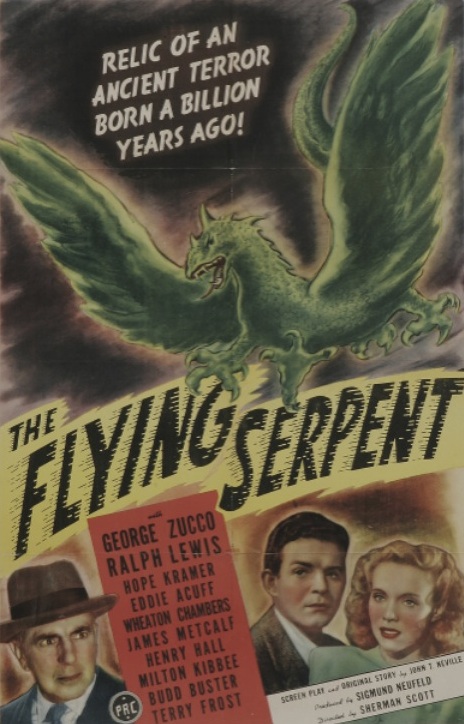
George Zucco was born in 1886 in Manchester, England. He appeared in nearly 100 movies during his 20-year career. He was a fine actor, but he appeared in a lot of bad movies. Case in point: The Flying Serpent, which was directed by prolific schlockmeister Sam Newfield under the pseudonym “Sherman Scott.”

Like White Pongo (1945) — the last steaming pile of celluloid by Newfield that I saw — The Flying Serpent begins with an onscreen prologue that raises more questions than it answers. The viewer is told that the “wiley [sic] Emperor Montezuma,” in order to outsmart Cortez, hid his treasure somewhere far to the north of San Juan, New Mexico, where the Aztec ruins are located, and implored his guards to protect it.

I’m pretty sure none of that is true. And I’m pretty sure the filmmakers are confusing San Juan County in New Mexico, where the Aztec Ruins National Monument is located, with the town of San Juan, which is in a neighboring county. I’m also pretty sure they either didn’t know or didn’t care that the name of this national monument is a misnomer, since the ruins are actually ancestral Pueblo structures, and have nothing to do with the Aztecs. But I digress.

Before you can ask how anyone sent by Montezuma to protect treasure 500 years ago could still be around to fulfill his duty, enter Quetzalcoatl, the feathered serpent. First seen in the shadows (or possibly just the murk of the lousy print used for the public domain DVD I watched), Quetzalcoatl is a puppet of indeterminate size locked safely behind iron bars in a secret mountain lair attended to by the archaeologist Dr. Andrew Forbes (Zucco). When Dr. Forbes pulls a lever, the stone roof of the cage opens, and the flying serpent takes wing. In flight, with nothing to give the puppet a sense of scale, it looks a little like the giant flying monster in the Japanese film Rodan (1956).

The only other appearance of Quetzalcoatl on film I can think of right now is Larry Cohen’s B movie classic Q (1982), in which the enormous Mesoamerican deity terrorizes Manhattan. Unlike Rodan or Q, however, the monster in The Flying Serpent turns out to be ridiculously small once it appears in the same frame as a human. When it lands on its first victim, Dr. John Lambert (James Metcalf), it looks as if he’s being attacked by a feathered Labrador Retriever with wings.

The Flying Serpent isn’t nearly as bad a film as White Pongo, but it never quite reaches the level of craziness I demand from an entertaining bad B movie. Zucco is always entertaining to watch, though, no matter how far down in the gutter he’s slumming.

Strangler of the Swamp (Jan. 2, 1946)

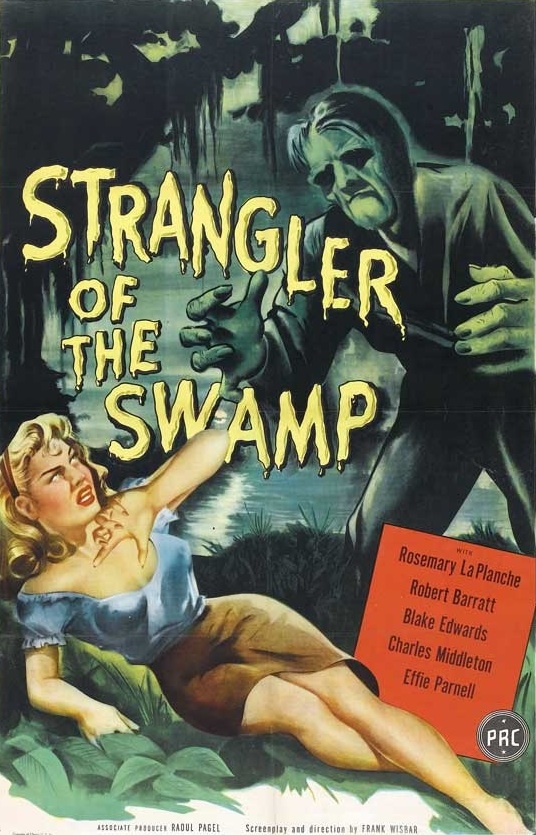
Frank Wisbar’s Strangler of the Swamp is a surprisingly good little ghost story. I don’t use the term “little” pejoratively, but as a term of affection, and in recognition of the film’s modest budget and one-hour running time. What Strangler of the Swamp lacks in lavish sets and big stars it makes up for with atmosphere, story, and pacing. Plenty of movies distributed by the Poverty Row studio P.R.C. (Producers Releasing Corporation) ranged from forgettable to completely stinko, but some were genuinely well-made films, and this is one of them.

Director Wisbar was born in 1899 in Tilsit, East Prussia, Germany (now part of Russia). After making nine films in Germany between 1932 to 1938, Wisbar emigrated to England, where he directed a television adaptation of Edgar Allan Poe’s story “The Telltale Heart” for the BBC in 1939, when TV was still in its infancy. In 1945, he directed his first American feature, the P.R.C. potboiler Secrets of a Sorority Girl. Strangler of the Swamp was his second film for P.R.C., and was a remake of one of his earlier films, Fährmann Maria (Ferryman Maria), from 1936.

Strangler of the Swamp takes place in a bayou, presumably somewhere in the American South, but, like a lot of horror movies from the ’40s, regional accents are nowhere in evidence, and geographical authenticity is an afterthought.

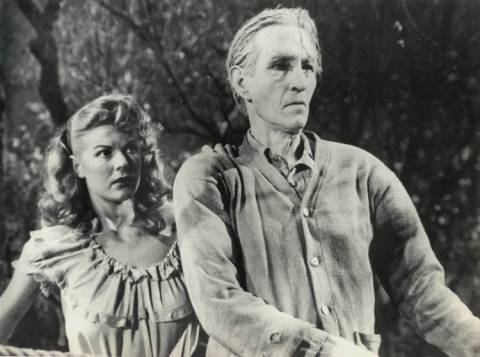
Old ferryman Joseph Hart (Frank Conlan) lives in a rude shack by a crossing, and ferries the townsfolk back and forth across a narrow strip of water by hauling his little craft hand over hand along a rope stretched between two trees. His passengers speak in hushed tones of the men they know who have recently died by strangulation. The denizens of the swamp believe that the previous ferryman, Douglas, was hanged for a crime he didn’t commit. They believe that his ghost haunts the swamp, strangling all the male descendants of the men responsible for putting him to death.

Ferryman Joseph does finds an actual noose hanging from a branch as a spectral warning, but most of the strangling in the film occurs in that neat ghost-story fashion in which it could just be a series of freak accidents. The spirit of ferryman Douglas (Charles Middleton) appears to ferryman Joseph with his head wreathed in clouds of dry ice, but Joseph meets his end when he panics and gets tangled up in some branches. The title of this film is the most gruesome thing about it.

After the death of ferryman Joseph, his granddaughter, Maria Hart (Rosemary La Planche), arrives in the swamp to claim her birthright. Fed up with urban isolation and happy to have a place to call her own, she takes up residence in Joseph’s shack and takes over his job shuttling people back and forth. Even though all the billowing clouds of dry ice cover up the set’s limitations, after the fifth or sixth ferry ride, even the least astute viewers will probably notice that there’s no water under the barge.

Blond, fresh-faced, and lithe, La Planche makes an appealing heroine. Her love interest, Chris Sanders, is played by the handsome but wooden actor Blake Edwards, who would end up being much more famous for his work as a director, writer, and producer (of, among other things, The Days of Wine and Roses, Breakfast at Tiffany’s, numerous Pink Panther films, and the Peter Gunn TV series).

Prior to appearing in this film, California native La Planche had lots of bit parts and uncredited roles. She was six years old when she made her first appearance on film (in the Louise Fazenda comedy short The Bearded Lady in 1930), but she never became a child star. Once in her teens, she appeared in a flurry of tiny roles and as a dance extra in many films, and was even crowned Miss America in 1941. (She was Miss California in both 1940 and 1941. The pageant rules later changed to only allow contestants to compete at the national level once.) As Miss America, she traveled extensively with the USO, and once helped sell $50,000 in war bonds in a single day. When Wisbar cast her in Strangler of the Swamp, it was her first starring role.

Wisbar brings a dreamy, European sensibility to the proceedings that sets Strangler of the Swamp apart from most of its B-movie brethren. The conclusion, in particular, didn’t fall into the ’40s cliché that anything supernatural had to eventually be explained away.

Detour (Nov. 30, 1945)

Detour
Detour (1945)
Directed by Edgar G. Ulmer
P.R.C.

There should be a picture of Tom Neal from the first few minutes of Detour next to the word “dejected” in the dictionary.

Unshaven, tie loosened, hat and suit rumpled, he walks along a California highway with his hands in his pockets, looking as though he just watched the world burn down to a cinder and he doesn’t know why he’s still standing.

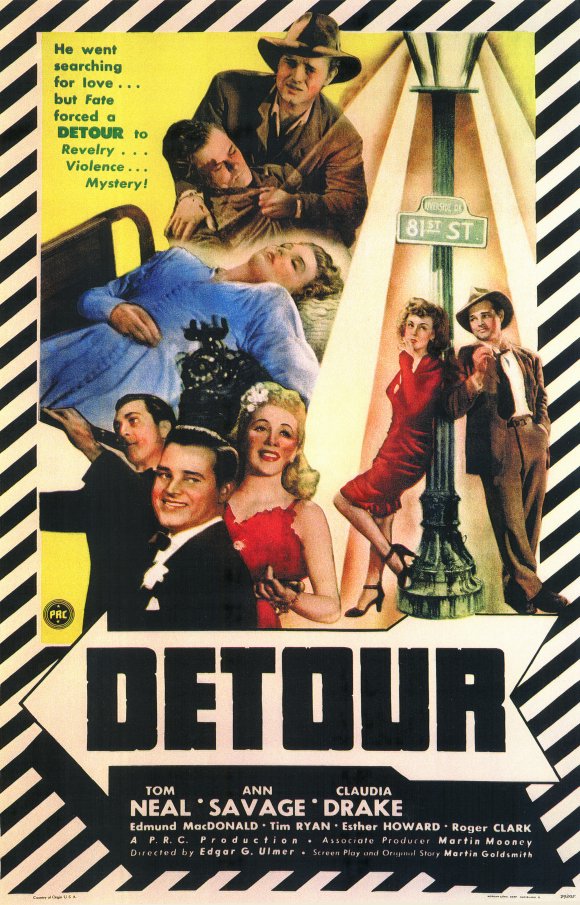
Like a lot of film noirs, Edgar G. Ulmer’s Detour is told through flashback and voiceover narration. Sitting at a counter, a cup of coffee in front of him, Al Roberts (Neal) recalls his nothing-special but decent job playing piano in a Manhattan nightclub called the Break o’ Dawn, back when he had a clean jaw, a sharp tuxedo, and brilliantined hair.

“All in all I was a pretty lucky guy,” he says, recalling his romance with Sue Harvey (Claudia Drake), the singer in the club. Al has dreams of Carnegie Hall that he downplays with cynicism, while Sue dreams of making it in Hollywood. When she leaves New York to fulfill her dream, Al is still stuck in the club, performing virtuoso pieces for the occasional sawbuck tip from a drunk.

When Al decides he’s going to travel to Los Angeles to marry Sue, he has so little money that the only way he can do it is by thumbing rides. Hitchhiking in Detour isn’t the transcendent experience Jack Kerouac described in On the Road, it’s a grim necessity. “Ever done any hitchhiking? It’s not much fun, believe me,” Al says. “Oh, yeah, I know all about how it’s an education and how you get to meet a lot of people and all that, but me? From now on I’ll take my education in college, or in P.S. Sixty-Two, or I’ll send a dollar ninety-eight in stamps for ten easy lessons. Thumbing rides may save you bus fare, but it’s dangerous. You never know what’s in store for you when you hear the squeal of brakes. If only I’d known what I was getting into that day in Arizona.”

What’s in store for Al is one of the most brilliant film noirs ever made. The plot of Detour is not that different from any number of 30-minute radio plays produced for Suspense or The Whistler, and any devotee of the pulp novels of Cornell Woolrich or Jim Thompson will feel right at home while watching this film. So what is it that makes Detour so unique?

First, it’s phenomenal that such a finely crafted film was produced in just six days, and mostly in two locations; a hotel room and a car in front of a rear projection screen. Furthermore, it’s stunning how easy it is to suspend one’s disbelief during all of the driving scenes. Usually rear projection is a technique that draws attention to itself, and looks incredibly fake, but in Detour it’s just part of the background. It helps that the performances in the film are hypnotic. When Al is picked up by a man named Haskell (Edmund MacDonald), Haskell pops pills from his glove compartment and tells Al the story of how he got the deep scratches on his hand. “You know, there oughtta be a law against dames with claws,” he says. “I tossed her out of the car on her ear. Was I wrong? Give a lift to a tomato, you expect her to be nice, don’t you? After all, what kind of dames thumb rides? Sunday school teachers? The little witch. She must have thought she was riding with some fall guy.” As Haskell speaks, Al responds with noncommital little “Yep”s in a way that will be familiar to anyone who’s hitchhiked, or who’s had to sit next to a talkative creep on a Greyhound bus.

When Haskell drops dead under mysterious circumstances, Al is convinced he’ll be blamed for the murder if he reports it to the police, so he hides the corpse, switches clothes with Haskell, and takes his identification and money. His luck goes from bad to worse when he picks up a slovenly hitchhiker the next day named Vera (Ann Savage), who looks as if she’s “just been thrown off the crummiest freight train in the world.” Despite her plain looks, Al is immediately attracted to her. Unfortunately for him, Vera turns out to be the woman Haskell threw out of his car. She doesn’t recognize the car at first, and takes a nap after exchanging a few sullen words with Al. But after a minute or two, she bolts awake and says, “Where did you leave his body? Where did you leave the owner of this car? You’re not fooling anyone. This buggy belongs to a guy named Haskell. That’s not you, mister.”

The heartless Vera blackmails Al, forcing him to give her all of Haskell’s money and promise to get his hands on more, or she’ll turn him in to the cops. The two of them hole up in a lousy hotel room with a bedroom and a living room with a Murphy bed. Vera plays Al like a fiddle while getting drunk off cheap liquor and flinging abuse at him. Even so, the sexual tension between them is unbearable, which is even more remarkable considering that Savage is no great beauty, and plays the scene in which she attempts to seduce Al while wearing a bathrobe and a headscarf.

Like everything else in Detour, Neal and Savage’s performances are not Oscar-caliber, but they have an eerie power that can’t be fully explained. Neal, who was born into a wealthy family in Evanston, Illinois, was a former boxer with a Harvard law degree who played mostly tough guys in the movies. A troubled man, he was blackballed in Hollywood in 1951 after beating Franchot Tone to a pulp and giving him a concussion in a quarrel over the affections of Barbara Payton. And in 1965, Neal was tried in the shooting death of his wife Gale, and did time in prison for manslaughter.

Neal’s performance in this film is haunting, and invites a subjective judgment from the viewer. Are the things Al tells us about the deaths in the film accurate? Were they, as he claims, purely accidental? Or is he like every other murderer who pleads for clemency because it “wasn’t really my fault”? How real are the things we’re shown? Is Al really the unappreciated piano virtuoso he seems to be, or is this just another part of an elaborate fantasy world in which life refuses to hand him any breaks? This sense of nightmarish uncertainty and the pervading sense of doom make Detour one of the all-time great noirs. Edgar G. Ulmer was probably the best director who made films for the Poverty Row studio P.R.C., but Detour is head and shoulders above anything else I’ve ever seen of his.
White Pongo (Oct. 10, 1945)

WhitePongo

White Pongo (1945)
Directed by Sam Newfield
Sigmund Neufeld Productions / Producers Releasing Corporation (P.R.C.)

If you needed a giant primate in Hollywood in the ’40s, Ray “Crash” Corrigan was your go-to guy. Corrigan would put on any ape costume for a paycheck. And if you didn’t have a particular vision of what your giant primate should look like, Corrigan was happy to wear his own fitted ape suit that was covered with “fur” made of human hair. He even did children’s parties and reportedly terrified some kids.

Nicknamed “Crash” for the way he tackled other football players and for his fighting skills, Corrigan got his start in Hollywood as a physical trainer to the stars, as well as performing stuntwork and acting in bit parts, such as his appearances in an ape costume in Tarzan and His Mate (1934) and as an “Orangopoid” in the Flash Gordon serial (1936). He got his big break playing a human when he was picked to star in the Republic serial Undersea Kingdom in 1936, after which he was signed as a term player for Republic Pictures. He eventually left over a pay dispute and went to Monogram Pictures.

He appeared in more than 50 movies in the late ’30s and early ’40s (including 24 outings as “Tucson Smith” in Republic’s “Three Mesquiteers” series and 20 appearances as “Crash Corrigan” in Monogram’s “Range Busters” series), but even during this fertile period of his career playing humans, he frequently found himself in monkey suits. And no, that’s not a euphemism for tuxedos.

He appeared as a gorilla or ape in Round-Up Time in Texas (1937), the Three Stooges short “Three Missing Links” (1938), the Boris Karloff horror film The Ape (1940), Law of the Jungle (1942), The Strange Case of Doctor Rx (1942), Dr. Renault’s Secret (1942), Captive Wild Woman (1943), She’s for Me (1943), Nabonga (1944), The Monster Maker (1944), and The Monster and the Ape (1945). He even did double duty in some films. In the Three Mesquiteers film Three Texas Steers (1939), he appeared not only as his recurring character Tucson Smith, but also as “Willie the Gorilla.” And in The White Gorilla (1945), he played not only the hero, but also “Konga,” the white gorilla whom the hero fights.

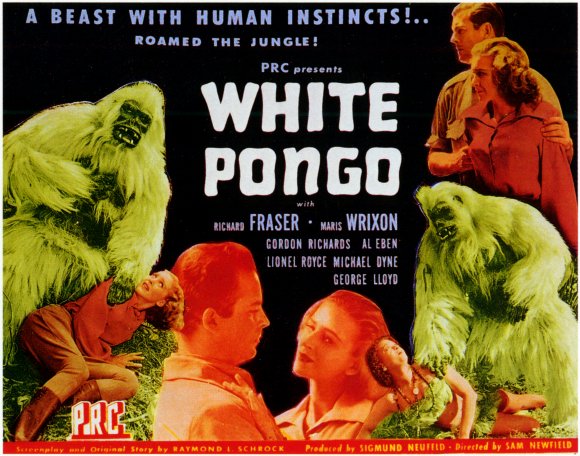
He also appeared as the eponymous White Pongo in this P.R.C. cheapie directed by Sam Newfield. It premiered in Los Angeles on Wednesday, October 10, 1945, and was released nationwide a month later, on Friday, November 2nd. The film is one of the poorer examples of a jungle adventure I’ve seen. After the credits finish rolling over an image of Africa, a pointer stick appears, insouciantly circling an enormous section of the southwestern coast of the continent as the narrator says, “Stretching north and south of the equator in west Africa are vast areas of dense forests and swamplands as yet unexplored by white men. A virgin territory penetrated only by the great Congo river and its tributaries. Here in this wild, steaming portion of the Dark Continent is the home of the ‘ponga,’ native name for the gorilla. It was here on the fringe of gorilla territory, in a nameless native village inhabited by a tribe of fierce Negritos, an incident occurred which was destined to startle the civilized world.”

There’s so much to work with already I don’t know where to start. The combination of the verb “penetrate” with the noun “virgin territory,” the fact that “Negritos” are ethnic groups in Southeast Asia, the idea that any village inhabited by humans would be “nameless.” The only thing the film sort of gets right is the general location where gorillas live. Once the wielder of the pointer calms down and focuses on the area where the Atlantic Ocean feeds into the Congo, that is.

The plot of the film, such as it is, involves a crew of scientists and hunters who are hot to find the white ponga because if he turns out not to be a hoax, he could be the “missing link that will prove Darwin’s theory.” Why they believe this despite having no direct contact with the creature is not explained. Because he has white fur? The mind reels. The leader of the expedition, Sir Harry Bragdon (Gordon Richards), of course brings along his beautiful blond daughter, Pamela (Maris Wrixon). The most watchable scenes in White Pongo are the ones she shares with the great white hunter of the expedition, Geoffrey Bishop (Richard Fraser), who’s believable in his role as a tall, lean, Rhodesian rifleman (even though he’s a Scot with an accent that sounds British). Unfortunately, there’s also an unnecessary triangle involving a twit named Clive Carswell (Michael Dyne) who fancies himself in love with Pamela, even though she has no interest in him.

At just under 72 minutes, the film still drags. There seems to be more stock footage, travelling scenes, and establishing shots than there are scenes that advance the story. Things don’t really pick up until the last 15 minutes, which are fairly brisk, though still not what I would call “action-packed.” For a guy who made wearing an ape costume a vocation, Corrigan doesn’t really move or act like a primate, making his large role in the climax more laughable than anything else. And the frequently interspersed stock footage of actual monkeys doesn’t help. Unless you have a fetish for humans in gorilla suits, you can pass this one up with a clear conscience.

http://www.youtube.com/watch?v=mkQODrJ8wSY

The Missing Corpse (June 1, 1945)

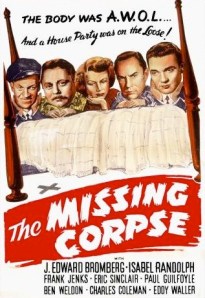
MissingCorpseThis movie is sort of like Weekend at Bernie’s, if the object in that film had been to keep Bernie’s body hidden and constantly on the move so no one could find it.
J. Edward Bromberg, a hard-working character actor, gets a rare chance to star in a film. He plays an upstanding newspaper publisher named Henry Kruger who threatens rival publisher Andy McDonald (played by Paul Guilfoyle) after McDonald splashes a tawdry story about Kruger’s daughter all over the front page of his daily paper. McDonald turns out to also be a blackmail magnate, and when one of his victims rubs him out, his body winds up in the trunk of Kruger’s car. Most of the film involves the increasingly perplexed Kruger’s attempts to deep-six the body so he won’t be accused of a crime he didn’t commit. The only problem is, the body won’t stay in one place for very long. Who’s moving it? And why?

The Missing Corpse is a fun mix of comedy and suspense. Like most of the output from P.R.C., it’s a quick, low-budget diversion, and little more, but it’s still a light-hearted and fun hour and one minute. As far as MacGuffins go, a dead body is a pretty good one, and P.R.C. certainly released worse films into theaters in the ’40s.

The Lady Confesses (May 16, 1945)

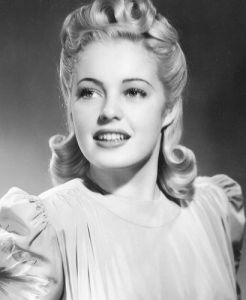
HughesMary Beth Hughes appeared in dozens of films from 1939 onward as a second- or third-billed actress (including films in the Charlie Chan, Cisco Kid, and Michael Shayne series), but in director Sam Newfield’s P.R.C. production The Lady Confesses she gets to strut her limited but charming stuff in a lead role. A natural redhead, Hughes usually appeared onscreen as a platinum blonde. Her round cheeks, big eyes, and moxie made up for what she lacked as a thespian.
When The Lady Confesses begins, Vicki McGuire (Hughes) receives a visit from a woman named Norma (Barbara Slater), who turns out to be the wife of Vicki’s fiancé, Larry Craig (Hugh Beaumont). Norma has been missing for seven years and was presumed dead. Nasty Norma tells little sweetheart Vicki that she won’t let anyone marry her Larry, even though she doesn’t care for him one bit. Vicki runs off to find Larry, who has been stumbling around a nightclub, three sheets to the wind, generally making an ass of himself. When she finds him and wakes him up, they go to Norma’s apartment to sort things out with her. When they arrive, however, the place is lousy with cops, and Norma lies dead, strangled with a piece of wire. To convince the police of his innocence, Larry takes them to the club where he had been dead drunk for the past several hours. Everyone there admits having seen him, except for the club owner, the shady Lucky Brandon (Edmund MacDonald), who denies having seen Larry, even though Larry had talked to him and asked him for permission to sleep it off in his office. Later, under police questioning, Brandon admits he knew the dead woman, and that she had lent him $10,000 to start up the club, and had recently returned to collect interest on the loan. Suspicious of Brandon, Vicki goes undercover in his club. She waits tables, sings a few songs, and even begins to feel herself falling under his dangerous sway.

The Lady Confesses is an average bottom-of-the-bill noir, but it moves at a nice clip and Hughes is cute. Also, you get to see Beaumont (who would go on to play everyone’s favorite sitcom dad, Ward Cleaver) act totally wasted for the first 10 minutes, which is fun.

A note on the title of the film; contextually it makes no sense. Both Ladies of the Night and Undercover Girl were considered. The first might have implied that the film was about prostitutes. The second actually would have been fitting. But I suppose the point is to get asses in the seats, not to give people an accurate idea of what they’re going to be seeing, especially when it’s a Poverty Row production.

Strange Illusion (March 31, 1945)

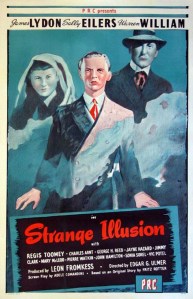
StrangeIllusionEdgar G. Ulmer was born in 1904 in Olmütz, Moravia, Austria-Hungary (now part of the Czech Republic). Like a number of talented German and Austrian directors, he moved to the United States in the ’20s and began working in Hollywood. Unlike better-known directors like Billy Wilder or Fritz Lang, however, Ulmer toiled in obscurity for most of his career, cranking out no-budget films. At least part of this was due to the fact that he was blackballed after he had an affair with Shirley Castle, who was the wife of B-picture producer Max Alexander, a nephew of powerful Universal president Carl Laemmle. Castle divorced Alexander and married Ulmer (becoming Shirley Ulmer), but the damage to Ulmer’s career was done. He spent most of the rest of his career churning out product for P.R.C. (Producers Releasing Corporation) Studios, one of the financially strapped Hollywood studios collectively referred to as “Poverty Row.”

Today, Ulmer is best known for two films, The Black Cat (1934) and Detour (1945). I’ve seen the former, but not the latter. The Black Cat stars Boris Karloff and Bela Lugosi, and is one of the more memorable and strange Universal horror pictures. It was a big box-office success, too. I haven’t seen Detour yet, but it has a reputation as one of the best low-budget noirs.

Strange Illusion, which Ulmer made for P.R.C. early in 1945, is a mixed bag. Ulmer’s ideas are clearly larger than the short shooting schedule, low budget, and B-grade actors can support. James “Jimmy” Lydon (on loan from Paramount) plays a young man named Paul Cartwright, whose late father was once the governor of California. The film opens with a stunning, Freudian dream sequence in which Paul walks with his young, attractive mother through clouds of smoke. A menacing, dark man whose face cannot be seen walks with them. He seems to have designs on Paul’s mother. Then the mysterious automobile accident in which Paul’s father died is replayed. It’s a fantastic sequence, and grabs the viewer right away. Much of what follows is prosaic, but not bad. There are a lot of great shots of Paul and other characters that incorporate an enormous portrait of the late Mr. Cartwright, towering over his survivors as though he is passing judgment on them from the afterlife. Warren William is very good as Paul’s mother’s fiancé, and he brings the right balance of charm and menace to his role. Lydon, on the other hand, really irritated me, and some of the youthful “jive” talk he has with his girlfriend is pretty stilted and painful. There’s also a little too much plot for the film’s brief running time. If by the end of this picture you haven’t figured out that this is Ulmer’s teen-oriented take on “Hamlet,” then, brother, you never took a comp lit class. Overall, Strange Illusion isn’t bad, but it’s recommended only if you really enjoy B movies from the ’40s.

Horror fans are encouraged to check out The Black Cat, as well as Bluebeard, a dreamy and beautiful horror movie Ulmer made for P.R.C. in 1944. It stars John Carradine as a homicidal puppeteer in 19th century Paris.