Tag Archives: Republic Pictures

Out California Way (Dec. 5, 1946)

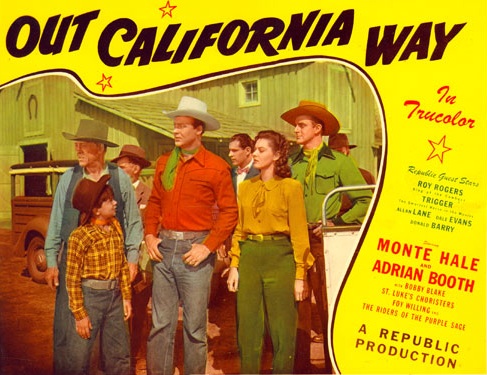
In the grand tradition of singing cowboys, Monte Hale plays a character in Out California Way named “Monte Hale.”

Out California Way is filmed in “Trucolor,” a two-color film process owned by Republic Pictures, and throws Hale into a metafictional world that pulls back the curtain and allows boys and girls at the Saturday matinée to see what might be going on behind the scenes at Republic with all of their favorite cowboy stars.

Hale doesn’t sit quite as tall in the saddle as Republic’s big boys, Gene Autry and Roy Rogers, but he’s self-effacing and charming enough to be believable when he says he’s “just a plain cowboy trying to break in” to the movies.

He’s assisted by little Danny McCoy (Bobby Blake, famous for playing Little Beaver in the Red Ryder series), who’s trying to get his horse Pardner into the movies.

Opposing them is the prima donna Rod Mason (John Dehner), who’s a big radio star as the “Robin Hood of the Range,” and has a career in pictures, too. Little Danny McCoy is president of the Rod Mason Fan Club, but that changes pretty fast after he actually meets the guy. Not only is Mason temperamental and nasty to his co-stars, but he hates children and animals. After threatening to whip Pardner if Danny doesn’t get him off the set, it’s clear that Danny has room in his heart for another cowboy actor. For that matter, so does his young, pretty mother, Gloria (played by Lorna Gray, who’s just 16 years older than Blake).

Hale’s an expert horse trainer, and together he and Pardner form a great team. Originally cast as stunt actors on one of Rod Mason’s pictures, they do such a good job that every rewrite comes back with a bigger role for Hale and a smaller part for Mason.

Mason and his sidekick, stunt rider Ace Hanlon (Fred Graham), are typical black hats, so they stop at nothing to foil Hale and Pardner’s success. While performing a stunt, Ace throws short-fuse dynamite at Hale that doesn’t kill him, but totally blows Pardner’s nerves.

Hale takes time off to retrain Pardner and help him over his trauma, but Mason and Ace immediately undo his hard work by sneaking into the corral at night and freaking out Pardner all over again by repeatedly firing a revolver near his head.

On his journey from “plain cowboy” to movie star, Hale is joined by special guest stars Allan Lane, Don “Red Barry,” Dale Evans, Roy Rogers, and horse Trigger, all members of Republic Pictures’ stable of western stars, and all playing themselves in the sequence in which Hale gives Gloria a tour of the studios. Roy and Dale perform a nice rendition of “Ridin’ Down the Sunset Trail” for them. Not bad for a first date.

John Dehner, who would later be a recurring actor on Gunsmoke (both the radio and TV versions), was a fine actor and makes for a great villain in this picture. While Out California Way isn’t substantively different from any of the hundreds of other oaters put out by Republic Pictures, it was fun to see a slightly different plot than the dependable old “evil land baron makes a grab for smaller ranchers’ land.”

Sioux City Sue (Nov. 21, 1946)

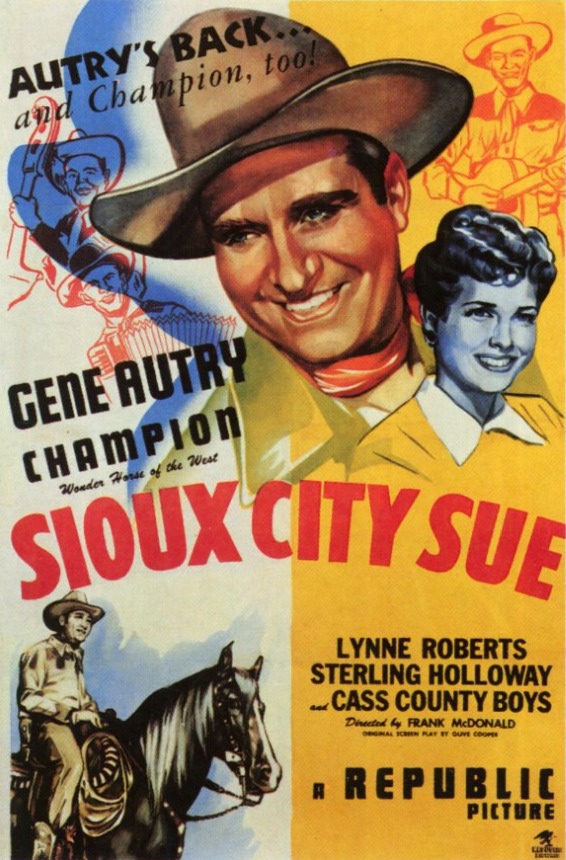
Frank McDonald’s Sioux City Sue repurposes the script from the 1939 comedy She Married a Cop and takes its title from one of the most popular songs of 1946. It was Gene Autry’s first film after he completed his service in the Army Air Corps during World War II.

More comedy than western, Sioux City Sue is lightweight fluff, but if you like Autry’s music, there’s plenty of it. (Although, if you’re like me, you’ll be a little sick of the title song by the end of the picture.)

In a plot that makes no sense if you stop to think about it for longer than half a second, a pretty blond Hollywood talent scout named Sue Warner (Lynne Roberts) casts Autry in an upcoming movie without telling him that he’ll never actually appear onscreen and is in fact voicing a singing donkey in an animated feature.

Things have changed a lot. Now, Hollywood stars regularly lend their voices to animated features. It’s nice work if you can get it; no time in the makeup chair, no difficult location shooting, and you can take your toddlers to the premiere. But in 1946, no star would ever dream of being in a cartoon. It’s hard, though, not to be delighted and amused by the premiere of the cartoon feature in Sioux City Sue. The little donkey with Autry’s voice, singing to his sweetheart on horseback, both of them wearing western duds, is pretty gosh-darned cute.

But Autry’s been lied to, and that rightly doesn’t sit well with the man. Of course, during the making of the film, Sue fell in love with him, so the big question for the second half of the picture is whether or not she’ll be able to convince him she’s sorry. She does her darnedest, quitting her job and coming to work on his ranch as a cook and general menial laborer.

This being a Republic western programmer, there’s an action-packed climax, and it’s up to Autry and his wonder horse Champion to save the day. The last few minutes of the picture, which involve a dynamited dam, a flood, and a cattle stampede, are exciting. But for the most part, Sioux City Sue is a laid-back and easygoing good time.

Santa Fe Uprising (Nov. 15, 1946)

R.G. Springsteen’s Santa Fe Uprising was a bittersweet viewing experience for yours truly. On the one hand, I really enjoy this series, based on Fred Harman’s comic-strip cowboy. It’s solid, fun, Saturday matinée entertainment. On the other hand, a big part of my enjoyment came from the wooden, straight-shooting acting style of “Wild” Bill Elliott as Red. Elliott’s persona was so stolid that it seemed tongue-in-cheek, and he had great chemistry with the child star who played his Indian sidekick Little Beaver (Bobby Blake, who later in life would be known as “defendant Robert Blake [9/18/33], aka Michael Gubitosi”).

After starring in 16 Red Ryder pictures from 1944 to 1946, Elliott bowed out and was replaced by square-jawed matinée idol Allan Lane. In the title sequence of Santa Fe Uprising, in which Red Ryder and Little Beaver appear in motion on the cover of a storybook, Lane bears a striking resemblance to Elliott. Up close, however, he’s more traditionally handsome and less interesting a performer.

Still, director Springsteen is a professional, and he keeps things fast-moving and exciting despite a modest budget and familiar shooting locations.

The film takes place in Bitter Springs, New Mexico, in 1894. The action kicks off when the U.S. Marshal for the territory is murdered by stagecoach robbers. The editor of the Territorial Gazette, a man named Crawford (Barton MacLane), demands that his killers be found. There is a toll road that’s safer to travel on than the main road, but the man who owns the property through which the toll road runs demands $3 a head of cattle to use it, which few ranchers can afford. When old rancher Lafe Dibble (Tom London) is killed by bandits, his son, Sonny Dibble (Pat Michaels), vows revenge.

Red takes over as U.S. Marshal of the territory, but he finds himself in hot water when it turns out that Crawford’s motives might not be as pure as they seem. When a man is murdered, and it looks as if Sonny killed him, Crawford and his boys demand that Sonny be strung up despite the fact that he professes his innocence. Things go from bad to worse when Little Beaver is kidnapped, held as a possible exchange for Sonny, after Crawford’s crew fails to bust Sonny out of jail to lynch him.

During the last part of the picture, Red is sleep-deprived after searching for Little Beaver night and day, which leads to a lot of strange acting from Lane, who keeps opening his eyes wide and half-yawning.

But if you’ve ever seen a western programmer before, you know that neither rain, nor snow, nor sleet, nor sleep deprivation shall keep the heroes from their appointed shoot-outs, from which they will always emerge victorious.

Conquest of Cheyenne (July 29, 1946)

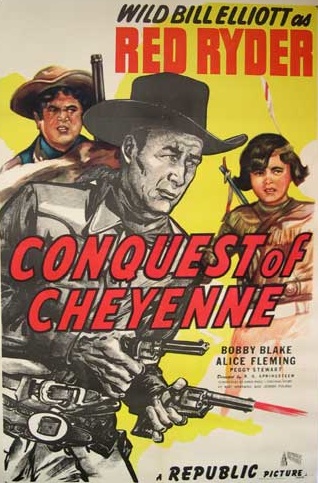
R.G. Springsteen’s Conquest of Cheyenne was the last Red Ryder adventure to star “Wild” Bill Elliott. Bobby Blake, who plays “Little Beaver,” the adorable little Indian boy whose biggest challenge in life is the English language, would stay with the series for seven more films, but after Conquest of Cheyenne, Allan “Rocky” Lane took over as the stalwart comic-strip cowboy Red Ryder.

As last hurrahs go, it’s not much, which is too bad. I really like Elliott’s stolid presence in these western programmers, and looked forward to each new one that came out. Unfortunately, Red Ryder, Little Beaver, and Ryder’s aunt, “The Duchess” (Alice Fleming), are barely characters in this film. For the most part, it focuses on an ambitious young man named Tom Dean (Jay Kirby) and his dream of bringing a big oil-drilling operation to west Texas.

Speaking of locations, the Duchess’s ranch sure did move around a lot. Just look at the list of Red Ryder films with a place name in them: Tucson Raiders (1944), Marshal of Reno (1944), The San Antonio Kid (1944), Cheyenne Wildcat (1944), Vigilantes of Dodge City (1944), Sheriff of Las Vegas (1944), Lone Texas Ranger (1945), Marshal of Laredo (1945), Colorado Pioneers (1945), California Gold Rush (1946), Sheriff of Redwood Valley (1946), and Sun Valley Cyclone (1946). In a lot of cases, of course, the names of the films had nothing to do with where the action actually took place, and that’s the case here. Conquest of Cheyenne takes place in Texas, and Cheyenne refers not to the city in Wyoming, but to a young woman, Cheyenne Jackson (Peggy Stewart).

Is there a conquest of her in this movie? ‘Fraid not.

The movie starts out with plenty of action. With the classic “spinning newspapers flying at the screen” gag, we learn that masked bandits have struck in Lubbock, Amarillo, and Muleshoe, where most of the rest of the action will take place. (I guess Conquest of Muleshoe wasn’t a catchy enough title.)

Cheyenne (the Duchess’s second cousin on her mother’s side) goes missing, and is believed kidnapped by the bandits, but she soon arrives in Muleshoe driving an out-of-control automobile. It turns out she wasn’t kidnapped after all, and the whole bandit subplot is largely forgotten.

Soon, the comic relief character “Daffy” (Emmett Lynn) will be forgotten, too, but at least we are treated to a good old fashioned dousing in a water trough when he falls in while attempting to get out of the way of Cheyenne’s car. And of course he emerges spitting a stream of water out of his mouth like a fountain.

Immediately following this fracas, the sheriff tries to ban cars. Tom Dean angrily tells him that he can’t do that. “Deny their use to the harebrained women drivers, but not to the horseless carriages themselves,” he says. (The movie itself sort of makes a nod towards equality by showing that Tom has some trouble starting the car himself, and by showing that Cheyenne learns to drive just fine by the end.)

Tom believes oil is the future of west Texas. There are already oil wells in east Texas, and he believes the entire state is heading in this direction, but he’ll not only have to convince the townspeople of Muleshoe, he’ll have to contend with an evil banker named Tuttle (Milton Kibbee), who plans to foreclose on Cheyenne’s ranch and take all the oil for himself. He’s aided in his crooked scheme by dependable Republic heavy Kenne Duncan as a geologist named McBride.

As I said, Red Ryder and Little Beaver don’t have much to do in this picture. It’s mostly Tom and Cheyenne’s story. Elliott does get the last words of the picture, however, when he rides in and sees Tom and Cheyenne lying on the ground, both being sprayed with oil gushing from Tom’s well on Cheyenne’s property. “Looks like the preacher’s gonna have to take care of both of ’em!” Red says happily.

OK, maybe that counts as a conquest. For Tom, at least.

Sun Valley Cyclone (May 10, 1946)

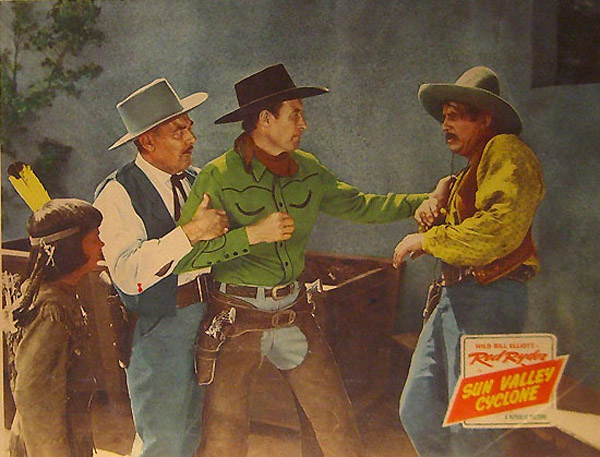
Sun Valley Cyclone, another entry in the Red Ryder film series directed by the dependable R.G. Springsteen, tells the story of how Ryder got his horse, Thunder. These kinds of stories are classic; how Sgt. Preston of the Yukon got his dog King, how the Lone Ranger got Silver, and so on. I don’t know if there was ever a film that told the story of how Roy Rogers got his horse Trigger, but if there wasn’t, then Republic Pictures really dropped the ball.

When Sun Valley Cyclone begins, Ryder (Bill Elliott) is tracking a man who last went by the name of “Blake” in Wyoming, but has probably changed his name several times to evade the law. Ryder is accompanied, as always, by his pint-sized Indian sidekick, Little Beaver (Robert “Bobby” Blake). While discussing the issue with the sheriff of a sleepy Arizona town, Blackie Blake (Roy Barcroft) draws a bead on Ryder from his hiding place. Just in the nick of time, however, the black stallion Thunder rushes to Ryder’s aid, trampling Blake. Blake is basically uninjured, but the townspeople see only a killer horse that must be put down. Ryder intervenes, and says that Thunder must first receive a fair trial.

In the best Saturday matinee tradition, this trial comes in the form of a flashback that takes up most of the running time of the picture, and which tells the story of how Ryder and Thunder came to be acquainted.

When Theodore Roosevelt (played by Ed Cassidy) was putting together his Rough Riders, Ryder headed straight for the recruitment office. In the corral, he saw a black stallion. The horse breaker told Ryder, “He’s got a mean streak in him so deep and wide that nobody’s ever going to be able to ride him. He’s black as a thunder cloud, and as violent as lightning.” Ryder responded, “Well I’ve seen a lot of horses, but not any one of them as ornery as you claim that stallion is. Fact is, horses are like most people. You get to understand them, and they understand you, you get along somehow.”

Colonel Roosevelt arrives just as Ryder is being flung back and forth atop Thunder, but managing to stay in the saddle. Roosevelt admires the man’s bronc-busting ability, and says he’s only known one man in all his years who could break a horse like that. It turns out that Ryder and Roosevelt are old friends (who knew?), and the colonel decides that Ryder’s talents would be better served fighting range outlaws in Wyoming than waging war with the Rough Riders.

I really enjoy the Red Ryder series. Bill Elliott’s moniker of “Wild Bill Elliott” might have helped establish his western bona fides on movie posters, but he’s about the least wild actor I’ve ever seen. In fact, he’s so stolid that after watching him in several films, I can’t help but feel there’s a joke, and that he’s in on it.

For instance, after a long sequence in which the bad guys try to break Thunder, whip him viciously, and then watch him escape with the fancy new saddle belonging to black hat Dow (Kenne Duncan), the scene cuts back to the present, and Elliott, his arms crossed, says, “Of course, some of the things I’m telling you I got second hand. And a considerable time later.” And then it’s back to the flashback. His delivery is perfect, and it’s a funny line. Was it meant to be? It’s hard to say, but I couldn’t help feeling that if Elliott hadn’t died in 1965, he might have found work in Airplane!-style comedies with other deadpan funnymen like Leslie Nielsen, Lloyd Bridges, and Robert Stack.

Sun Valley Cyclone is an enjoyable picture, and not just because of Elliott’s impossibly straight-shooting persona. There’s also a delightful equine love triangle between Thunder, a white mare, and a paint stallion. Their story is told through body language, which means there are plenty of lips curled back from teeth on the part of the guys, and some come-hither hoof pawing on the part of the lady.

Sheriff of Redwood Valley (March 29, 1946)

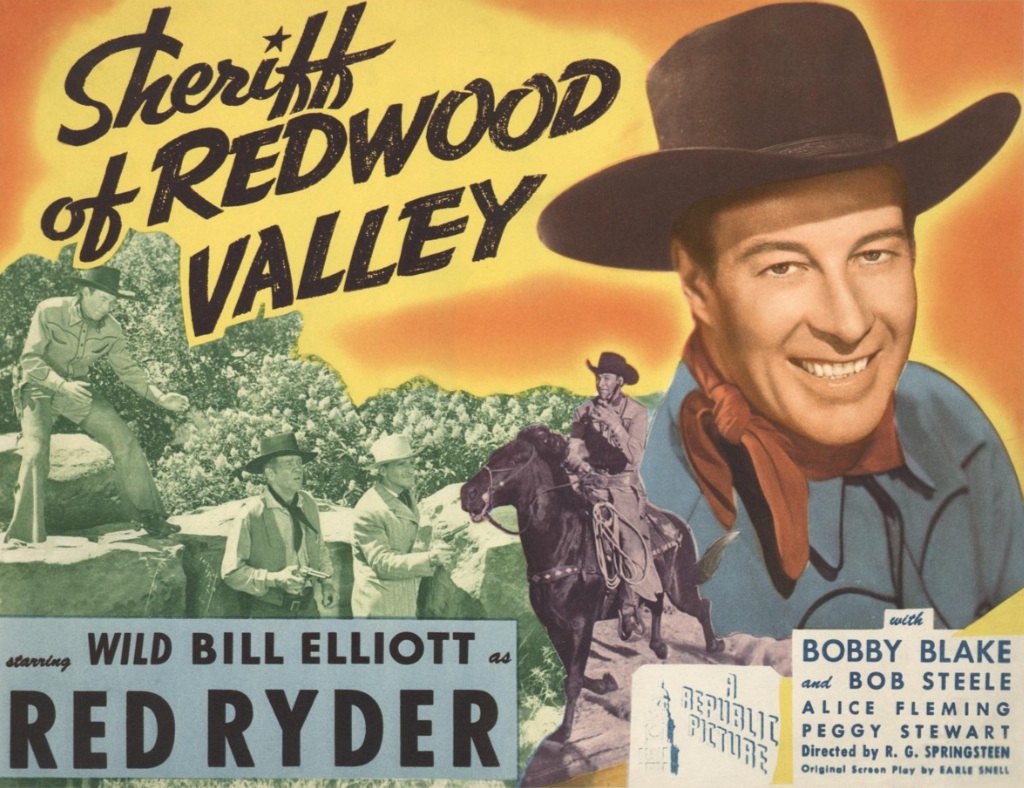
I really like the Red Ryder movies with “Wild” Bill Elliott and Bobby Blake. Sheriff of Redwood Valley is the third one I’ve seen, and watching it after a couple of really bad P.R.C. westerns drove home an opinion I’ve long held; a low budget is no excuse for a bad movie.

I have no idea what the budget was for Sheriff of Redwood Valley, or how it compared with the budgets for contemporaneous P.R.C. (Producers Releasing Corporation) westerns starring actors like Buster Crabbe, Bob Steele, and Eddie Dean. Sheriff of Redwood Valley was released by Republic Pictures, which was a more prestigious outfit than the Poverty Row studio P.R.C., so it’s likely the budget was higher, but it’s still clearly a low-budget programmer.

But Republic specialized in low-budget programmers and weekly chapterplays, and made some of the best ones in the history of Hollywood. Most of their stars weren’t great actors, but they were likable and fun to watch. Most of their scripts weren’t brilliantly written, but they were nicely paced and had enough twists and turns to keep you watching. And, like all low-budget productions, they cut corners and used stock footage, but they used it judiciously. Most importantly, their movies had a sense of fun and excitement, and were tailor-made for Saturday matinée viewing down at the local bijou.

It didn’t hurt that Republic employed directors who could put together a watchable movie, like William Witney and John English. The sheer number of pictures directed by Sam Newfield for P.R.C. should tell you something about the studio. (The name “Sam Newfield” isn’t as well-known among connoisseurs of bad movies as “Ed Wood,” but it probably should be.)

All of this is not to say that Republic Pictures never released a bad movie; they released plenty. And P.R.C. distributed a few very good films (including Edgar G. Ulmer’s Detour, for my money the best film of 1945, and one of the best film noirs of all time). But most Republic films are object lessons in how to make a very entertaining movie in spite of a small budget, actors who aren’t that talented, and a limited shooting schedule.

R.G. Springsteen’s Sheriff of Redwood Valley takes place in 1895. The first shot is of San Quentin at night. A shadowy figure runs along the ramparts and jumps down to safety. We learn from a newspaper headline in the next shot that this man was the notorious stagecoach robber the Reno Kid.

The scene shifts to the Redwood Valley, where the big question on everyone’s mind is whether or not the railroad is going to come through their town. If it does, it will be an economic boon. If it doesn’t, their town just might wither up and die. Red Ryder (Bill Elliott) is presiding over a meeting with town leader Bidwell (James Craven), the sheriff (Tom London), and Red Ryder’s aunt and ranch owner the Duchess (Alice Fleming). The townsfolk have raised the $50,000 necessary to dynamite a tunnel through their mountain and bring the railroad to them, so naturally the best way to deliver it to the right people is to hide it in a cowboy boot and get Red Ryder and the sheriff to transport it in a buckboard.

As you might guess, things go wrong. Red and the sheriff are ambushed, both are badly wounded, and the money is stolen. Circumstantial evidence points to the Reno Kid, but Bidwell and his henchman are actually behind the robbery.

It turns out that the Reno Kid (played by the diminutive cowboy actor Bob Steele, last seen in the P.R.C. cheapie Ambush Trail) isn’t such a bad guy after all. He broke out of prison to see his pretty wife Molly (Peggy Stewart) and their sick child Johnny (John Wayne Wright), and to clear his name.

Red Ryder and the Reno Kid’s paths cross after the robbery, when Red’s adorable, pidgin-English-speaking Indian sidekick Little Beaver (Bobby Blake) trusses the injured Red to his horse Thunder and leads him to Molly’s cabin to recover from his wounds. It doesn’t take long for Red to suss out who Reno really is, but he plays it cool in order to apprehend him with a minimum of bloodshed. Eventually, of course, Red realizes that Reno isn’t the villain he’s reputed to be, but it took a lot longer than I was expecting, which added a good amount of suspense to the story.

The Red Ryder series is clearly aimed at kids. Each film begins with an enormous storybook slowly opening, followed by Elliott and Blake stepping out of its pages, Elliott’s guns blazing. (Red Ryder was a long-running character in the Sunday funnies, so it might have made more sense if they’d stepped out of a newspaper, but what the heck? It works.) Also, little Bobby (later Robert) Blake was a veteran of the Our Gang comedy series, and he’s really cute, although to fully enjoy the Red Ryder movies you have to be O.K. with the ridiculous stereotype that Little Beaver is, as well as put out of your mind for a little while the details of Blake’s tragic and violent personal life.

Elliott is fairly stiff as an actor, but I think he’s great in this role, mostly because he acts like someone who’s stiff and plainspoken in real life, not like someone who’s acting that way because he’s a bad actor. His playful relationship with Blake is especially enjoyable to watch. (There’s a running gag in Sheriff of Redwood Valley about Red getting Little Beaver to take medicine and eat food Red finds distasteful.) While the intended audience was kids, I think the Red Ryder series stands up as great B western entertainment for anyone.

Strange Impersonation (March 16, 1946)

This isn’t the first time I’ve seen Strange Impersonation. Five years ago I went on a big Anthony Mann kick and watched all the movies he’d directed that I could get my hands on. I really like a lot of his work, especially the film T-Men (1947), a docudrama about Treasury agents investigating a counterfeiting ring that incorporates heavy doses of violence and a lot of subjective film noir techniques into its otherwise straightforward story. His noir revenge drama Raw Deal (1948), which, like T-Men, stars Dennis O’Keefe, is great, too. He also made a number of highly regarded westerns starring James Stewart that are worth seeing.

He made plenty of strictly for-hire programmers, too, and Strange Impersonation definitely falls into this category. Of Mann’s pictures that I’ve seen, it’s my least favorite. Not because it’s any worse than any of his other B pictures, like Railroaded! (1947), but because it breaks my first rule for maintaining audience engagement until the very end, and leaves the viewer feeling robbed.

Upon second viewing, however, and with no expectation that the film’s many plot strands would be resolved, I was able to appreciate the enjoyable lunacy of the plot and the subtexts about gender relations and women in the professional sphere. Also, for a humble programmer, Strange Impersonation looks pretty good. It has great lighting and a few really well thought-out compositions.

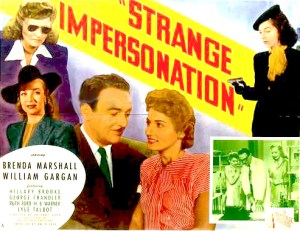
The film begins with a scene at the Wilmott Institute for Chemical Research in New York. Scientist Nora Goodrich (Brenda Marshall) is making a presentation to a roomful of her mostly older, male colleagues. “It’s been my aim to develop a new formula which will combine all the best features of present-day anesthetics,” Nora tells the assemblage. Pointing to a model of a human torso and head, she says, “Here is the section of the brain where the reaction will occur. It will come very quickly, within seconds of injection. The anesthesia should be complete for approximately one hour, during which time the mind may indulge in dreams or fantasies, normal or otherwise. That of course would have to be checked. For my present findings, however, the anesthetic is safe and easy to administer. So until my final report, I think that’s all.”

Remember that speech, and you may have some idea of what to expect from the film’s denouement. Upon a second viewing, Strange Impersonation plays fair, but only in the broadest sense. The journey, at least, isn’t a bad one.

Marshall gives a credible performance in the stereotypical role of the “cold fish” female scientist. She’s very attractive, but with her severe hair style and glasses, she doesn’t look like a glamour puss pretending to be a smarty-pants doctor; she comes off as relatively convincing.

The same can’t be said of all of the ridiculous lines she’s forced to spout. When her fiancé, a fellow scientist named Stephen Lindstrom (played by William Gargan with a little mustache and big, nerdy glasses) tries to kiss her in the lab, Nora blurts out, “Stephen, remember! Science!”

Nora and Stephen are engaged, but she’s putting off the wedding until after her experiment is complete. Not to worry, though. The experiment will be complete soon. Why go through all the red tape of clinical tests when you can experiment on yourself, at home, at night, with just a few pieces of laboratory equipment and your friend Arline Cole (Hillary Brooke) to help?

And that’s just what Nora plans to do, except that she hits a wrinkle on her way home. While backing out of her garage, she knocks down a young woman named Jane Karaski (Ruth Ford). As a bystander notes, Jane is “squiffed” (i.e., very drunk), so Nora offers to drive her home. Before she can engage the clutch, however, a weaselly little ambulance chaser named J.W. Rinse (George Chandler) shoves his card into Jane’s hand and promises he can get her a big settlement, even though she doesn’t appear to be injured. Jane lives in a crummy little place with a Murphy bed above a spot called Joe’s Bar and Grill. While putting Jane to bed, Nora learns that Jane is from Mississippi, and has no friends in the big city or family back home.

Nora heads back to her large, tastefully appointed apartment overlooking the city. Stephen drops in for what he hopes will be a tryst, but before too long, Arline shows up, shoos him away, and it’s time for some science with a capital S.

As Nora is drifting to sleep on the couch after dosing herself with her own experimental anesthetic, she says, “Oh, nothing will go wrong. I’m sure I’ve worked this thing out perfectly. Nothing can go wrong. I’ll just go to sleep for a little while. Just go to sleep. For a little while. Just…”

And guess what? Something goes wrong. As soon as Nora’s passed out, Arline starts a chemical reaction that starts a fire right next to Nora on the couch, then dumps the flaming concoction on Nora’s face.

While Nora is recovering in the hospital, Arline tricks the doctor into keeping Stephen away from her, which leads her to believe that he has abandoned her because of her ruined face. Meanwhile, Arline starts putting her hooks into Stephen. It becomes clear that she destroyed Nora’s face not because of any professional jealousy, but because she had designs on Nora’s man.

Eventually, Nora returns home, wearing a veil and sporting some pretty convincing burn make-up. One night, Jane, the girl Nora hit with her car, shows up with a little automatic, apparently egged on by Rinse’s promises of a big settlement that has yet to materialize. She wants money, and she wants it now. The two women struggle for the gun, and Jane is knocked off of Nora’s balcony and falls to her face-decimating death on the sidewalk below. The stolen ring on Jane’s finger leads people to believe it’s Nora’s corpse. Meanwhile, Nora takes advantage of the confusion to slip away to Los Angeles under the name “Jane Karaski,” where she undergoes a very long course of plastic surgery at the Los Angeles Medical Center.

While reading the latest copy of “Chemical Views” in the hospital, Nora learns that Dr. and Mrs. Lindstrom have just bought a house in White Plains. Realizing Arline’s deception, she begs to leave, but is told it will be another three months before her face is fully restored. (She’s already been there about a year.) Her doctor tells her he can tell she never looked the way she does now, and not to think that changing one’s face can change one’s life. This scene is really weird, because once the bandages come off we learn that she gave her doctor pictures of Jane Karaski, and now supposedly looks exactly like the woman she accidentally killed. However, Nora looks exactly the same as she did before, only with black hair.

Apparently the characters in the film are seeing something very different from the viewers in the audience, because once Nora returns to New York and insinuates herself into the lives of Stephen and Arline under the guise of a new laboratory technician named “Jane Karaski,” neither of them recognizes her. I guess we’re just supposed to take it on faith that Nora’s surgery has left her looking like a dead ringer for Ruth Ford, even though she still looks exactly like Brenda Marshall with a black dye job.

If you can accept all the wackiness, there’s plenty to entertain in Strange Impersonation. The final interrogation scene in the police station, for instance, is a classic of feverish noir subjectivity, with all the characters in the film appearing in superimposition to accuse and admonish Nora as she shakes her head from left to right, screaming for them to stop.

Not to worry, though! The film has a happy ending. Just not for the audience.
Colorado Pioneers (Nov. 14, 1945)

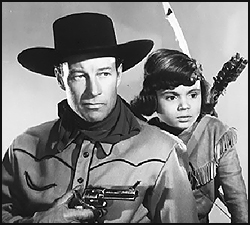
Red Ryder was a comic-strip cowboy created by writer Stephen Slesinger and artist Fred Harman. Red Ryder premiered in the Sunday funnies on November 6, 1938, and soon grew into one of the largest franchises in entertainment history. In the 1940s, there was nary a kid-friendly product that didn’t have a Red Ryder tie-in; comic books, novels, Big Little Books, a radio show, and the infamous Red Ryder BB Gun, which is still in production today despite the fact that Red Ryder hasn’t appeared in newspapers since the 1960s. For thousands of baby boomers, the Red Ryder BB Gun wasn’t the only way to put an eye out, but it was the most universal.

The first appearance of Red Ryder on film was in 1940, in the Republic serial Adventures of Red Ryder, which starred Don “Red” Barry as Red Ryder and Tommy Cook as his young Indian sidekick, Little Beaver. Like all Republic chapterplays, it was quality entertainment, but Barry was a bit of a pipsqueak compared with the tall, square-jawed actor who stepped into the role next, “Wild” Bill Elliott. Starting with Tucson Raiders in 1944, Elliott was paired with future ladykiller Robert Blake (at that time credited as “Bobby Blake”) as Little Beaver in a total of 16 features over the course of two years. (Blake kept appearing as Little Beaver in the series after Elliott left. Starting with Santa Fe Uprising in 1946 he was paired with Allan “Rocky” Lane in seven more Red Ryder films.)

Colorado Pioneers begins in Chicago, where Red Ryder and Little Beaver run afoul of a couple of ragamuffins who today would be called “at-risk youth.” Red Ryder intercedes on their behalf in court, and frees them from a life of petty street crime by taking them back to the Colorado ranch run by his aunt, “The Duchess” (Alice Fleming), where he teaches them the value of hard work and fresh air. Originally planning to take just the two boys who stole his money (Billy Cummings and Freddie Chapman), Red Ryder is convinced by Little Beaver to take the whole gang, including a token black member named “Smokey,” who is played by Billie “Buckwheat” Thomas (yes, he’s the Buckwheat you’re thinking of). The situation may be hokey and formulaic, but Elliott is a strong enough presence to make you believe it when the kids start following his lead. The emotional core of the film is the most recalcitrant boy, who resists Red Ryder’s mentorship, but who can’t resist a frail colt, which he feeds and talks to in secret. The boy’s journey from a hardened little thug to a young man who is able to care for something weaker than himself and tell the truth even when it’s difficult makes for a surprisingly moving story.

Colorado Pioneers is an excellent little B western. While it’s aimed at kids, Elliott is believable and tough enough as Red Ryder for adults to enjoy the film, too. He’s not quite Henry Fonda or Randolph Scott, but he’s one of the better western stars you’ve probably never heard of.

Don’t Fence Me In (Oct. 20, 1945)

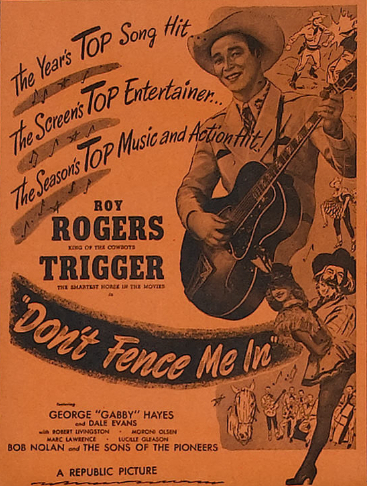
Don’t Fence Me In is a particularly good Roy Rogers picture. Directed by John English (who with William Witney directed some of the best Republic serials of the late ’30s and early ’40s), it’s a well-paced, exciting, and thoroughly enjoyable B western.

The film opens with a western montage, accompanied by the Cole Porter song from which the film gets its title. After the credits roll, we’re treated to a cheap-looking Boot Hill set with a matte painting background that looks as if it’s about two feet away. A narrator tells us that “Once upon a time, as a matter of fact nearly forty years ago, there was a notorious western outlaw named Wildcat Kelly. He didn’t want to be fenced in either. But they stuffed him into a pine box and buried him six feet under the sod, on Boot Hill.” A masked man rises from behind Kelly’s tombstone, carrying a gun and a Wells Fargo case. The narrator, sounding surprised, says, “Wait a minute, that looks like Wildcat Kelly. It is Wildcat Kelly. There’s something mighty strange about this. I think we’d better investigate the story of Mr. Wildcat Kelly.”

And investigate we shall, but the job will fall on the pretty shoulders of a girl reporter named Toni Ames (Dale Evans). Toni has enough moxie to make an 800-pound gorilla stop dead in his tracks. When we first meet her, she’s performing the song “A Kiss Goodnight” while dancing on the table at a hot party in a big city, displaying her shapely gams to maximum effect. She’s doing it all for a story, though. A reporter for a tabloid called Spread magazine, Toni is undercover, secretly snapping shots of the party’s guest of honor, a dirty old cad named Cartwright (Andrew Tombes) who’s running for mayor as an incumbent.

The plot eventually takes Toni out west to the R Barr Dude Ranch to investigate the legend of Wildcat Kelly, who it turns out faked his own death nearly 40 years ago and has been living as a regular western Joe named “Gabby Whittaker.” He’s played by George “Gabby” Hayes, and it’s a good part for him. In a lot of these pictures, Hayes was able to just coast on his ornery persona, but Don’t Fence Me In actually gives him something to do.

Rogers plays that charming and laconic singing cowpoke character called “Roy Rogers” that he played in dozens of movies. Roy is Gabby’s friend, and the only person who knows his secret. He tries to convince Toni not to publish what she knows about Wildcat Kelly, but she goes ahead with her story, and that’s when things get interesting.

There are a group of gangsters whose motives are shadowy, but who clearly want Kelly dead once it’s revealed he is still alive. One of them is played by the great character actor Marc Lawrence, who had a very long career as a sinister-looking hood.

This is a fine showcase for all of the regulars from the ’40s Roy Rogers pictures. Bob Nolan and the Sons of the Pioneers back Rogers up both musically and when it’s time for fisticuffs. And the wonder horse Trigger does a high-stepping dance, with Rogers astride him, to an instrumental version of “Don’t Fence Me In,” and even takes a bow when he’s finished.

Roy and Dale’s relationship is more antagonistic than in many of their other pictures, but it’s still fun to watch. When she first shows up and tries to stow away in the boot of a coach, Roy tosses a hunk of stinky Limburger cheese in the back with her and takes her on a bumpy ride. She later pays him back by pushing him into a swimming pool.

Don’t Fence Me In ends with a delightful rendition of the title song performed by Roy, Dale, and the Sons of the Pioneers, with a few lines added at the beginning about Wildcat Kelly to tie the whole thing together.

Sunset in El Dorado (Sept. 29, 1945)

SunsetElDoradoA lot of men were drafted during World War II. Roy Rogers was one of them. With a 1-A classification, he expected to be shipped out in the spring of 1945. Consequently, screenwriter John K. Butler (working from a story by Leon Abrams) came up with a script to showcase Rogers’s leading lady, Dale Evans. When V-E Day rolled around, however, the draft board exempted men over the age of 30 who had children, so Rogers never had to serve. Director Frank McDonald’s Sunset in El Dorado ended up starring both “The King of the Cowboys” and “The Queen of the West,” but Evans is still the central figure, and it’s a great showcase for her sunny persona.

The film begins in the present day. Evans plays a young woman named Lucille Wiley, who works for a company called “Worldwide Tours.” In the first scene, Lucille shows a filmstrip that illustrates everything visitors will see on their western tour package. As shots of a ghost town appear on screen, Lucille says, “And this is El Dorado, in its day a roaring boomtown. The Golden Nugget, El Dorado’s most famous, or infamous, fandango hall. In its day, it rivaled the halls in Dodge City or the notorious Barbary Coast. The legendary Kansas Kate was the feature attraction here. And what a colorful attraction she was.”

Although she has a good pitch, and Kansas Kate was Lucille’s grandmother, Lucille has never been west of Hoboken. In a fit of pique, she runs off on one of Worldwide’s tour buses, determined to see the little town of El Dorado. She’s having a grand old time, singing “Go West Young Man” with her fellow passengers (Bob Nolan and the Sons of the Pioneers), when her drippy fiancé Cecil Phelps, the president of Worldwide Tours (played by Hardie Albright), and her old-maid aunt Dolly show up to spirit her away. Cecil intends to marry Lucille immediately, in Yuma, but she desperately wants to see El Dorado.

Their car breaks down on the way, and any hope Cecil has of making Lucille his wife pretty much falls off a cliff when Roy Rogers and Trigger ride up to help. He finds Lucille, off on her own, and says to her, “Well, I’ve seen mirages before, but this is the first one that ever talked back. Are you a mirage?”

Trigger tows their car to the nearest town, which happens to be El Dorado. Once there, Lucille explores the remains of the Golden Nugget and discovers a painting of Kansas Kate hanging above the bar. She’s interrupted by an ornery old coot named Gabby (George “Gabby” Hayes) who’s been dropping by the saloon for 40 years to make sure nothing happens to the painting. As Lucille stares at the picture and fantasizes about what her grandmother’s life might have been like, the movie flashes back to the old west, but the narrative continues, as everyone has a counterpart. Evans plays Kansas Kate, Rogers continues to play that character called “Roy Rogers” he played in so many movies, Gabby plays his younger self, and Cecil the drip becomes Cyril the heavy.

The plot moves at a brisk pace, and hinges on the coded map to Gabby’s gold claim being stolen by a group of bandits. Roy suspects that Kate was behind the plan, especially since she originally told him she was a schoolteacher, not a saloon owner, in order to impress him.

After Roy slugs it out with the toughest guy in the bar, a heavy named “Buster” (Roy Barcroft), he takes over Buster’s position as Kate’s bodyguard. Apparently his first duty as her bodyguard is to perform “Belle of the El Dorado” with Kate and her backup singers in a fully choreographed number.

The romantic scenes between Rogers and Evans are, as always, sweet and believable. After they take a break from riding together, she asks him, “What I can’t understand is why you took this job in the first place, particularly when you thought I swindled old Gabby out of his gold mine.”

“That’s why I took the job, to find out if you did,” he responds.

“Did you find out yet?” she asks.

“Oh, just a hunch, that’s about all,” he says, chewing on a piece of alfalfa and smiling.

I won’t be giving anything away if I tell you that everything turns out all right for Roy, Dale, Gabby, and Trigger, both in their present-day incarnations and their rootin’ tootin’ old-west versions. The only question I was left with was, since Lucille looks exactly like Kansas Kate, her own grandmother, and Roy looks exactly like the old-west character “Roy Rogers” who presumably married Kate, does that mean that the modern-day Lucille and Roy are actually cousins? Well, probably not, but it couldn’t help but cross my mind.