Tag Archives: RKO Radio Pictures

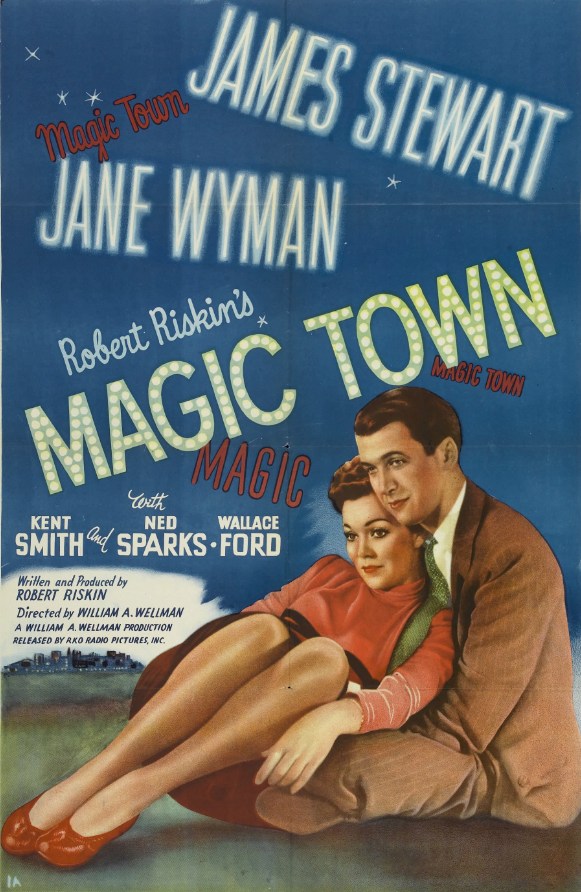
Magic Town (Oct. 7, 1947)

Complaining that William A. Wellman’s Magic Town is built on a faulty premise is kind of like complaining that Cadbury Creme Eggs are too sweet, but I’m going to do it anyway.

Magic Town, which is written by frequent Frank Capra collaborator Robert Riskin, is about a public opinion pollster named Lawrence “Rip” Smith (James Stewart) whose small polling company has just gone out of business because of high overhead costs. To stay afloat, Rip starts looking for a mathematical miracle in order to conduct public opinion polls without nationwide coverage.

He finds the shortcut he’s been looking for in a little town called Grandview.

You see, Grandview has the exact same distribution of Republicans and Democrats, men and women, old and young, farmers and laborers, and so on, as the nation as a whole. In other words, Grandview thinks exactly the same way the entire United States does. Instead of exhaustive telephone polling of representative swaths of the nation, all Rip will need to do is find out what people in Grandview think, and he’ll be able to extrapolate the results.

The catch is that the people of Grandview can’t know what Rip is up to, otherwise they’ll become self-conscious, and it’ll kill the goose that lays golden eggs. So Rip and his partners, Ike (Ned Sparks) and Mr. Twiddle (Donald Meek), head for Grandview, where they pass themselves off as insurance men from Hartford, Connecticut. They’ll engage in stealth polling, pretending to offer insurance policies while they’re really making note of the current issues the citizens of Grandview are all too willing to sound off about.

Rip’s plan hits a snag as soon as he hits town, where he reconnects with an old friend from his days in the service — Mr. Hoopendecker (Kent Smith) — who is now principal of Grandview High School. The snag is pretty local girl Mary Peterman (Jane Wyman), who’s a civic crusader, and is constantly pushing to modernize the town and build a new civic center.

Rip’s “perfect” town and its “perfect” demographics can’t be altered in any way for his covert polling operation to work, so he opposes Mary’s plans. He tells the city council that Grandview is “A sturdy challenge to the evils of the modern era.” He encourages them not to modernize anything and not to change anything.

And herein lies the problem, and the reason I said that Magic Town is built on a faulty premise. Grandview supposedly perfectly mirrors the demographics of the United States as a whole, but it’s consistently represented as an idyllic Utopia, unchanging, and a refuge from the outside world. (It’s also oddly free of blacks and Jews.)

So Magic Town is less about a town that represents America in miniature than it is about one of the most enduring American myths — the sanctity and perfection of small-town life. Grandview doesn’t represent what America actually is, it’s what America wishes it was.

Rip finds happiness in Grandview. He and Mary fall in love. He and Hoopendecker relive old times. Rip coaches the boys’ basketball team and turns them into winners.

All this could have been funny, romantic, and charming, but the film persists with its idiotic plot about opinion polling. Eventually Mary finds out what Rip is really up to and “outs” him in the press. There follows a nationwide rush to move to this “mathematically perfect” town. The civic center is approved and the citizens of Grandview become full of themselves and start forming and selling their own opinions.

And just as Rip predicted, their self-consciousness destroys everything, and results in the following newspaper headline: “GRANDVIEW COMPLETES FIRST POLL. 79% Favor Woman for President. ‘RESULT RIDICULOUS!’ SAYS EXPERT.”

All the newcomers move out of the now not-so-magic town, but things don’t go back to normal. Grandview is in shambles, and it’s up to Rip to fix things.

Despite the weak story, I enjoyed all of the actors in Magic Town, especially Stewart. He’s been parodied and impersonated so many times that it’s easy to forget what a good actor he was. He didn’t always play good guys, but when he did, no one projected the same kind of sweetness, generosity, and earnestness.

Magic Town is sort of a “greatest hits” compilation of earlier, better films that Stewart starred in. There’s the same celebration of small-town life found in It’s a Wonderful Life (1946) and there’s even a scene in which Stewart gives an impassioned speech while being supported by a bunch of kids, just like in Mr. Smith Goes to Washington (1939). It’s nowhere near as good as either of those films, but it’s not without its modest pleasures, as long as you don’t think about it too hard.

Dick Tracy Meets Gruesome (Sept. 26, 1947)

The last of RKO’s four Dick Tracy pictures employs horror icon Boris Karloff to tell a hard-boiled crime story with a sci-fi twist.

Directed by John Rawlins and produced by Herman Schlom, Dick Tracy Meets Gruesome gives top billing to Karloff, not Ralph Byrd, but it hits a lot of the same notes as the first three films.

I was sad to see the last of the Dick Tracy pictures. I thought they were some of the best programmers from the ’40s, second only to Columbia’s Whistler series. I preferred Morgan Conway — who starred in the first two movies — to Byrd, but all the films were action-packed, fast-paced police procedurals with lots of humor. In short, they were great adaptions of Chester Gould’s comic strip.

Dick Tracy Meets Gruesome begins with a dramatic shot of a noose silhouetted on a wall. But then the camera pans to the left and we see that it’s just part of the outdoor decor of a dive bar called “Hangman’s Knot.” (Not to be confused with “The Dripping Dagger,” the waterfront dive in Dick Tracy vs. Cueball.)

The hulking Karloff shambles into the bar, takes a shot without paying, and asks to talk to the disreputable-looking piano player, “Melody” Fiske (Tony Barrett).

Yes, Karloff’s character is really named “Gruesome,” and together with Melody and a Coke bottle glasses-wearing character named “X-Ray” (Skelton Knaggs), he robs banks using a unique nerve gas developed by Dr. A. Tomic (Milton Parsons) and his assistant, I.M. Learned (June Clayworth).

Gruesome learns about the nerve gas firsthand, when he accidentally doses himself and winds up with rigor mortis for about an hour. Gruesome’s “dead” body provides plenty of laughs, especially when Dick Tracy’s partner Pat Patton (Lyle Latell) tries pushing his stiff leg down, and the rest of his body rises up like a corpse rising from the grave.

“I tell you, if I didn’t know better, I’d swear we were doing business with Boris Karloff,” Pat says.

“Looks that way,” Dick Tracy responds.

Even though the gas causes temporary rigor mortis in anyone who breathes it, the scenes in which Gruesome and his crew release the gas into banks are more like one of those “stopping time” bits than anything else, since the body-freezing effect of the gas is achieved by slowing down and then stopping the film.

It’s silly, but so is a taxidermist named “Y. Stuffum” (a throwaway gag in Dick Tracy Meets Gruesome). Chester Gould always delighted in punctuating the violent goings-on in his strips with puns and silly humor, and the RKO Dick Tracy series did the same. While the series never used any of Gould’s original villains, they got the tone of the strip just right.

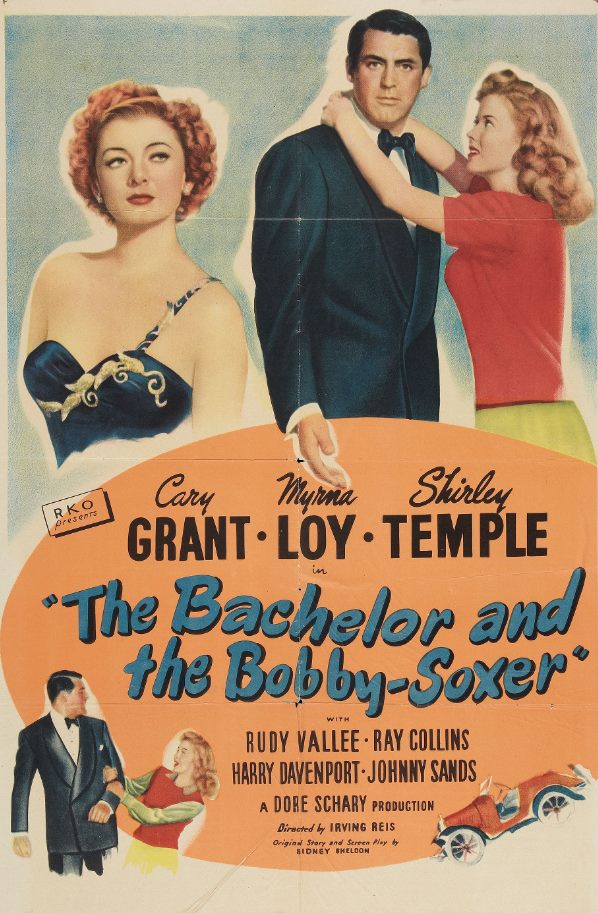
The Bachelor and the Bobby-Soxer (Sept. 1, 1947)

The Bachelor and the Bobby-Soxer was the surprise winner of the Oscar for best original screenplay at the 20th Academy Awards in 1948, beating out the scripts for more “serious” fare like Body and Soul, A Double Life, Monsieur Verdoux, and Sciuscià (Shoeshine).

But just because its win was surprising doesn’t mean it didn’t deserve to win. The Bachelor and the Bobby-Soxer is a very funny film. It’s a latter-day screwball comedy about a handsome artist who is forced — by court order, no less — to date a teenage girl.

Sidney Sheldon’s screenplay treats those jumpin’ and jivin’ post-war kids with affection rather than bemusement or contempt, and he has a keen understanding of the ways teenagers try to act like adults, and how they unwittingly fail.

The dialogue might not be a completely accurate evocation of the way real bobby-soxers and their jalopy-driving boyfriends actually talked (did any kid before this movie came out actually say that they felt “sklonklish”?), but the characterizations all feel right.

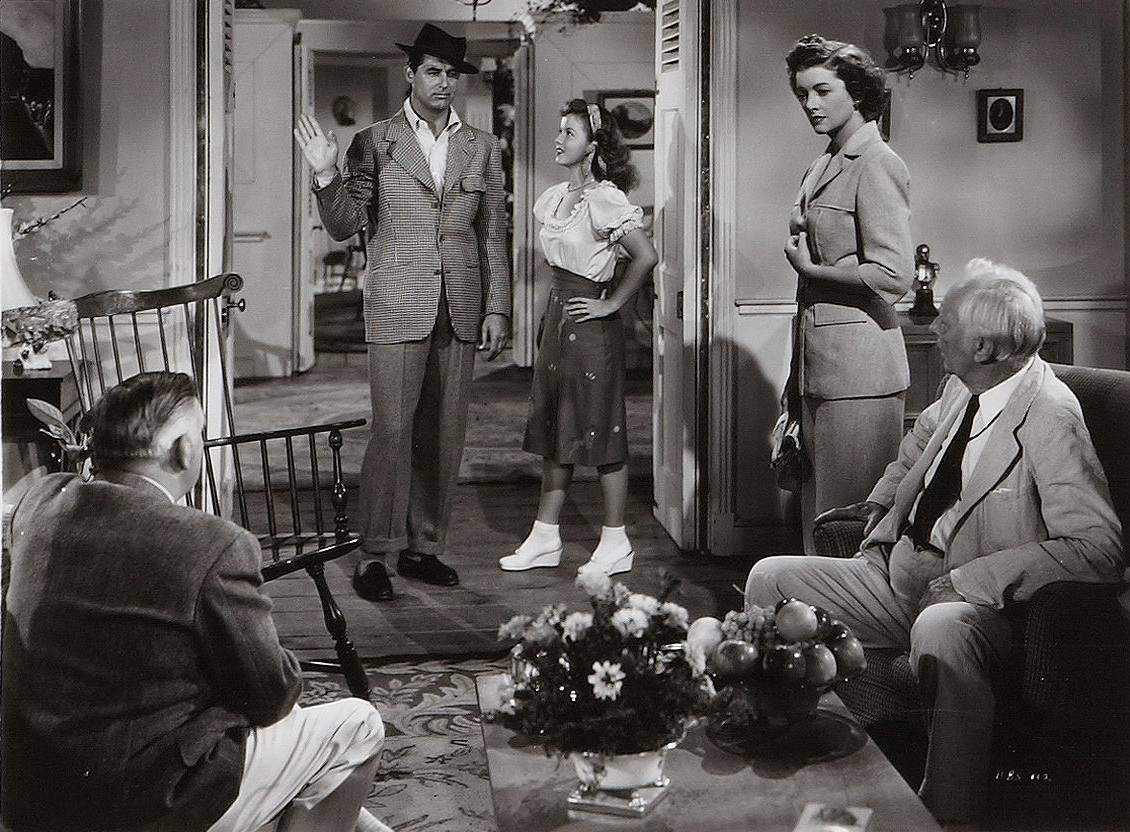
Former child star Shirley Temple — all grown up (sort of) — plays the bobby-soxer of the title, a 17-year-old high school student named Susan who lives with her older sister. Her older sister just happens to be a judge, and when the film begins, the Honorable Margaret Turner (Myrna Loy) is presiding over a case involving a kerfuffle at a nightclub between a couple of brassy gals over the affections of charming artist Richard Nugent (Cary Grant).

Margaret and Susan’s parents are dead, so Margaret is as much of a mother to Susan as she is a big sister. After the initial courtroom scene, the stage is set for the sparks of disapproval to fly as soon as Margaret learns that the object of her little sister’s affection is the same Lothario she saw in court.

Most of the humor in The Bachelor and the Bobby-Soxer comes from the fact that Richard has absolutely no desire to be with Susan, but is ordered by the court, under the recommendation of a psychologist, to take her out on dates so his mature-man forbidden fruit will sooner wither and die, and she’ll go back to her sweet, somewhat dumb high school boyfriend, Jerry (Johnny Sands).

Susan is mature for her age, but she’s still a 17-year-old. Watching Cary Grant suffer through taking her to Sunset High School basketball games and dates at the ice cream shop are some of the funniest bits I’ve seen in a long time.

Cary Grant — no stranger to screwball comedies — has an arch, deadpan comic style that’s perfectly suited to the material. Temple is really great in this movie, too. Like Deanna Durbin, she was an impossibly cute child star who blossomed into an engaging adult performer without missing a beat. And Myrna Loy is wonderful to watch, as always. It doesn’t matter that she was old enough to be Temple’s mother when she made this movie. She barely looks a decade older, and she matches Cary Grant beat for beat in all their scenes together.

The Bachelor and the Bobby-Soxer is a great comedy that stands the test of time.

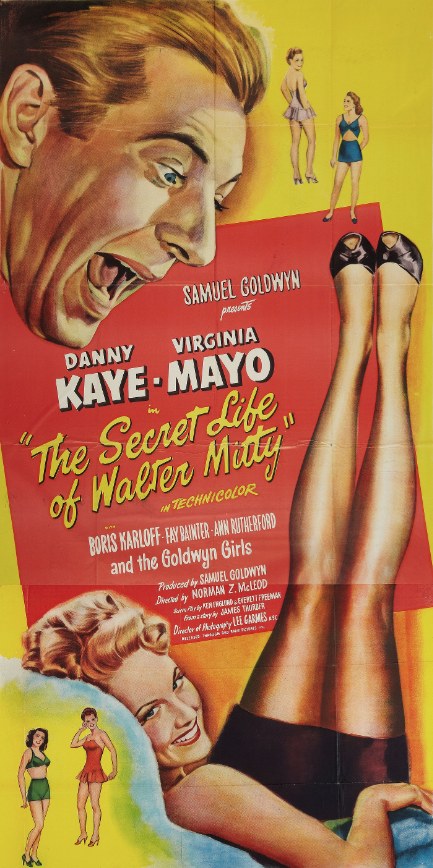
The Secret Life of Walter Mitty (Aug. 14, 1947)

Norman Z. McLeod’s The Secret Life of Walter Mitty is a pretty funny film, and sometimes funny is all you need.

It wasn’t all James Thurber needed at the time the film was made, however. The movie was based on Thurber’s 1939 short story of the same name, and he was extremely unhappy with all the changes made to it. He also hated Danny Kaye’s performance as Mitty, since it was nothing like how he had originally conceived of the character.

I haven’t read Thurber’s short story. If I had, this movie and the liberties it took with the source material might have irritated me.

As it was, the only thing that irritated me was the length of some of the film’s musical interludes. Danny Kaye is an engaging and likable performer, but he milks his musical stand-up comedy bits for such a long time that I had more fun watching the amused extras than I had watching Kaye.

The Secret Life of Walter Mitty is a Technicolor extravaganza that follows the misadventures of a put-upon editor named Walter Mitty (Kaye). Mitty lives with his mother (played by Fay Bainter) and commutes into New York City every morning to his job at a company that publishes pulp magazines. He also has a rich fantasy life, and imagines himself as a sea captain, a brilliant surgeon, a gunslinger in the Old West, a … well, you get the idea.

He’s engaged to a girl who doesn’t really love him named Gertrude Griswold (Ann Rutherford), his mother piles errands on him until packages are literally falling out of his arms, his boss Mr. Pierce (Thurston Hall) steals his ideas, and Mitty takes it all in stride. One day, however, the girl who prominently features in all of his daydreams (Virginia Mayo) suddenly appears in the flesh, and Mitty is drawn into a real-life adventure involving stolen jewels and a spy ring. A grim-looking assassin who masquerades as a psychiatrist named Dr. Hugo Hollingshead (played by a perfectly cast Boris Karloff) dogs Mitty’s every move, first trying to kill him, then trying to convince him that the whole affair was just another one of his daydreams.

It may not be a deep film, but The Secret Life of Walter Mitty is a lot of fun. It’s a production of The Samuel Goldwyn Company, so of course the luscious Goldwyn Girls are on hand for all those department store dressing-room scenes and lingerie-modeling bits that are integral to the film’s story.

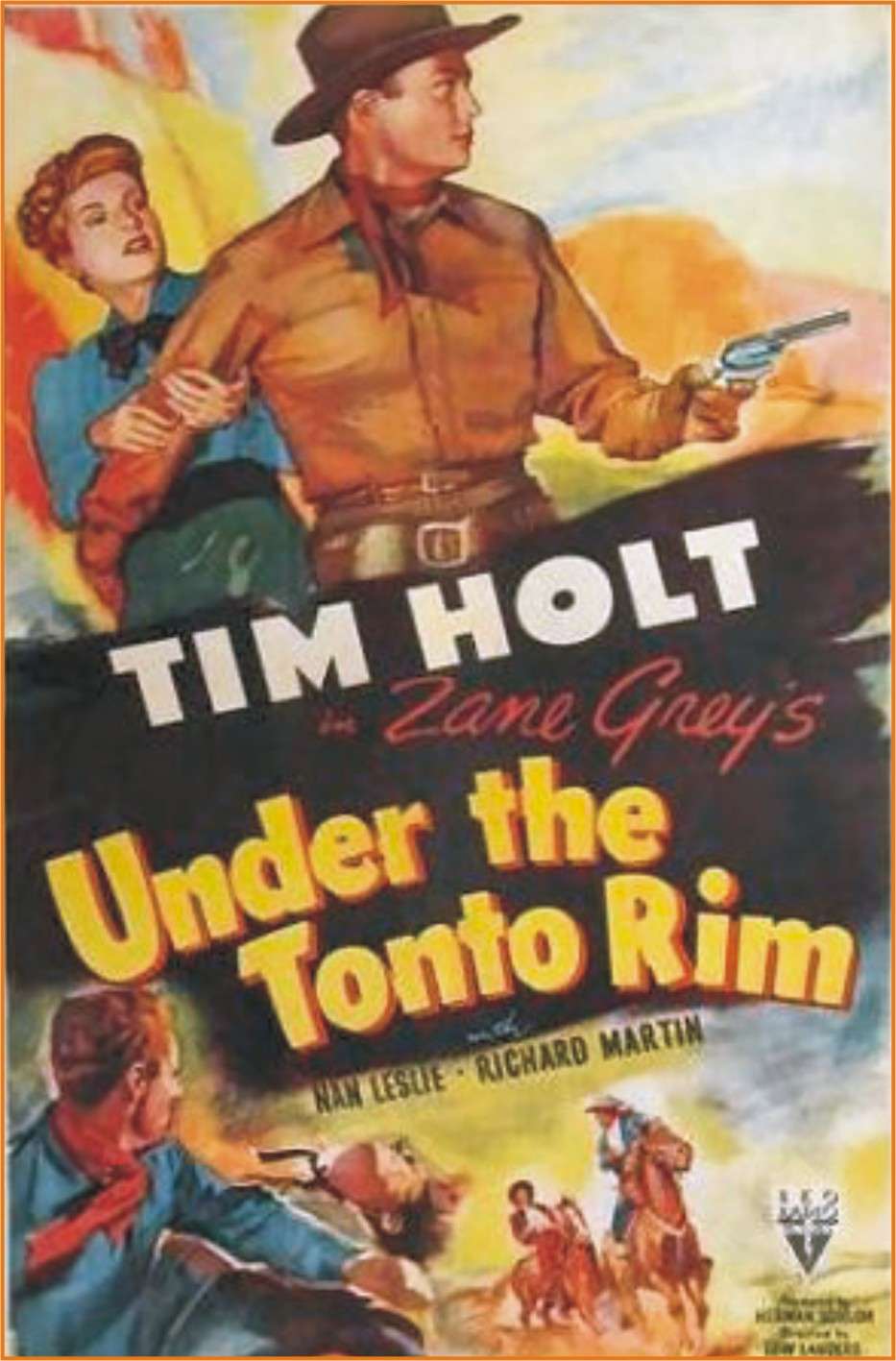
Under the Tonto Rim (Aug. 1, 1947)

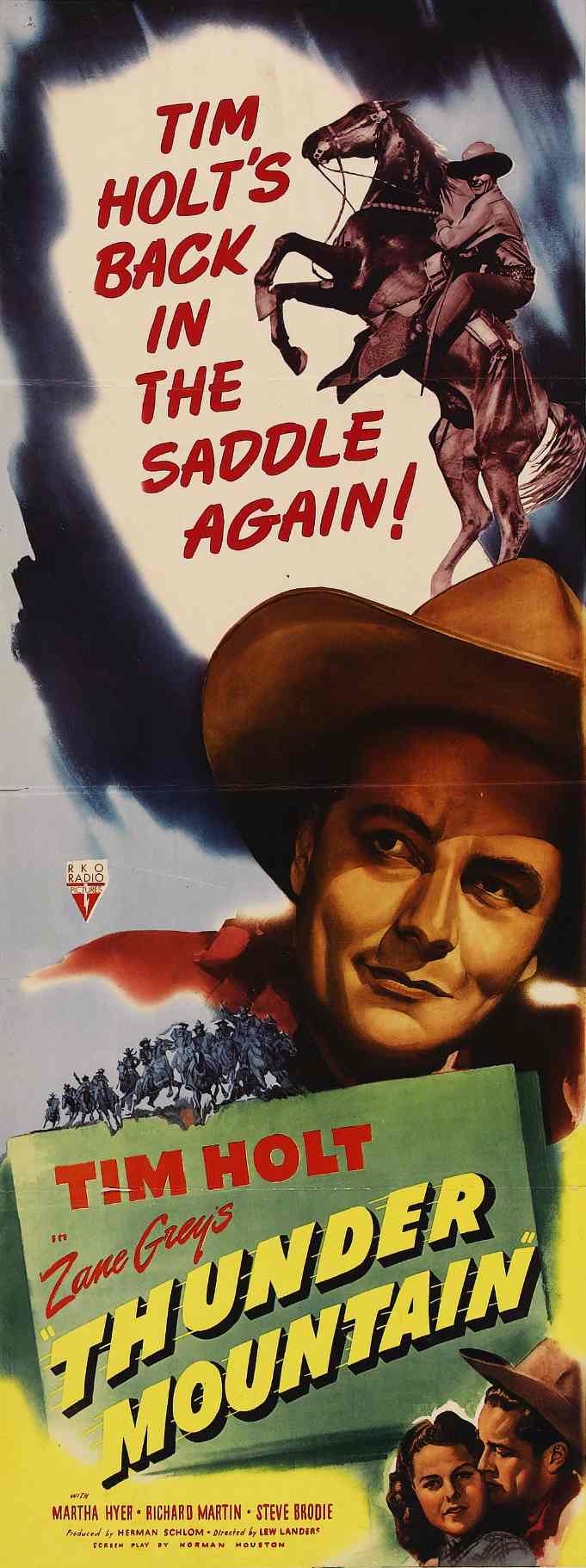
Tim Holt’s second postwar western, Under the Tonto Rim, is a lot like his first postwar western, Thunder Mountain (1947). Both are RKO films produced by Herman Schlom and directed by Lew Landers, with screenplays by Norman Houston that are based on Zane Grey novels.

And even though Tim Holt plays a different character in Under the Tonto Rim than he did in Thunder Mountain, Richard Martin is back as his Irish-Mexican sidekick, Chito Jose Gonzalez Bustamonte Rafferty, the same character he played in Thunder Mountain. Chito is tall and handsome, and has a way with the ladies, but he’s also a barrel of laughs, and has a way with malapropisms like “He swallowed it hook, line, and stinker.”

In Under the Tonto Rim, Tim Holt plays Brad Canfield, the new owner of the Rim Rock Stage Line. In the first reel of the film, one of his stagecoaches is held up by masked bandits who carry off the Wells Fargo box, kidnap Lucy Dennison (Nan Leslie) — a beautiful blonde with a mysterious past — and kill his friend Andy (Jay Norris), a young stage driver who was about to be married.

No one ever said running a stage line in a B western was easy.

Chito and Brad ride into Wicksburg and describe their attackers to Captain McLean of the Arizona Rangers. All the raiders wore black masks, except for the leader, who wore a gray, spotted bandanna

“A gray, spotted bandanna!” exclaims Capt. McLean (Jason Robards). “Sounds like the Tonto Rim Gang!”

Capt. McLean tells Brad and Chito that the Tonto Rim Gang’s hideout is somewhere under the Tonto Rim.

Before you jump to the conclusion that the Tonto Rim Gang are a bunch of clowns, naming themselves after their hideout isn’t quite like a group of criminals on the lam calling themselves “The 285 West Sycamore Street Safe House Gang,” since there are more than a hundred canyons under the Tonto Rim, and the gang could be in any one of them.

Brad and Chito decide to take matters into their own hands. Brad arranges to get himself thrown in jail in Tonto, where one of the captured raiders, Patton (Tony Barrett), is locked up and scheduled to hang. Brad thinks that if he can pass himself off as a criminal with $10,000 buried somewhere, he can escape with Patton, and Patton will lead him to the Tonto Rim Gang. But as they ride into Tonto, Chito expresses his doubts about the plan in his own inimitable way.

Chito: “You know what the word ‘Tonto’ means in Spanish?”
Brad: “No.”
Chito: “It means ‘fool.’ And I bet you that’s what we are.”
Brad: “Ah, keep your shirt on.”
Chito: “I always keep that on. Except on Saturday nights, when I take it back.”
Brad: “Well, this is only Thursday, and I don’t want to attract too much attention yet.”

When they arrive in Tonto, Chito passes himself off as “Ranger Rafferty” to Deputy Joe (Lex Barker), then bends the ear of the sheriff (Harry Harvey) with tales of Brad Canfield the outlaw, and tells him he needs to be taken alive.

Brad’s plan works out, and he and Patton escape together. But Brad’s quickly back in hot water when he finds that Lucy Dennison is part of the gang.

Or is she? And what part will the sultry Juanita (Carol Forman) play?

Under the Tonto Rim is good fun. Before this year, I’d only ever seen Tim Holt as a supporting player in A pictures like My Darling Clementine (1946) and The Treasure of the Sierra Madre (1948). He never made a huge impression on me, and after watching a couple of his starring roles in B westerns, I think I know why. He’s a soft-spoken, unassuming guy with average looks. But he projects a lot of steel when he’s the focus of the film, and gives the impression that he won’t stop fighting until the fight is through.

Crossfire (July 22, 1947)

Crossfire
Crossfire (1947)
Directed by Edward Dmytryk
RKO Radio Pictures

In 1947, social-issue pictures were starting to come out of Hollywood that tackled a formerly taboo subject — antisemitism.

This might not seem like such a big deal today, but it was a big deal at the time.

No matter how artful or moving some of its products are, the film industry is still a business, and any subject that challenges the status quo or that might hurt ticket sales is extremely difficult to make a film about. And despite the fact that in the ’40s the majority of studio heads were Jewish, they preferred to release films that depicted a homogenous, idealized vision of America.

Richard Brook’s 1945 novel The Brick Foxhole is about a homosexual who is beaten to death by his fellow Marines. Producer Adrian Scott convinced the studio bosses at RKO Radio Pictures that an adaptation of the book would pass muster with the production code if the gay character in the novel were changed to a Jewish character.

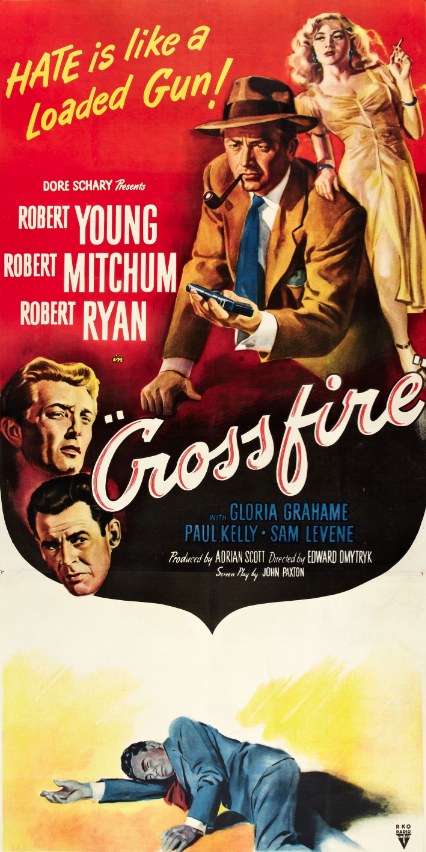
Crossfire is a social-issue picture wrapped in a murder mystery. It’s likely that many ticket buyers didn’t realize the film would contain a message about antisemitism, and were attracted by the “three Bobs” in the credits (Robert Ryan, Robert Young, and Robert Mitchum) or the lurid promise of violent death in the poster.

Whatever drew people into the theater when the film opened, however, nothing kept them away in the weeks that followed. Crossfire was a big hit, and was eventually nominated for five Academy Awards, although it lost out to Elia Kazan’s Gentleman’s Agreement, Twentieth Century-Fox’s more “prestigious” take on antisemitism. (In the case of best picture, best director, and best supporting actress, the awards went to Gentleman’s Agreement. In the case of best supporting actor and best adapted screenplay, the awards went to Miracle on 34th Street.)

Edward Dmytryk, the director of Crossfire, once said in an interview that he used “film noir” techniques primarily to save money, and because he wanted to spend more time working with the actors than doing setups. Dmytryk and his cinematographer, J. Roy Hunt, worked six and a half hours a day, and did about seven setups a day.

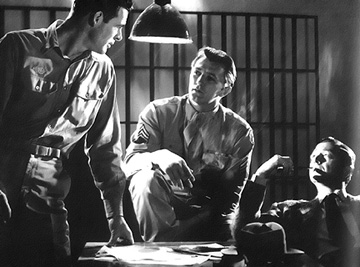
Ryan, Mitchum, and Young

Dmytryk was an excellent director, and Crossfire is an exceedingly well-made film.

He shot Crossfire in 20 days, less than the 22 days he was allowed with his $500,000 B-movie budget. Because of this, RKO was able to beat Twentieth Century-Fox’s Gentleman’s Agreement to the box office. (But not, ultimately, in the Oscar race.)

The darkness and shadows that creep into each shot disguise the simplicity of the sets, and the performances from all the actors are exceptional, especially Robert Ryan as the vicious, Jew-hating soldier named Montgomery, and Gloria Grahame as a lonely B-girl named Ginny.

The beating death of the Jewish man, Samuels (Sam Levene), that opens the film takes place in darkness, so the culprit is not seen. But the mystery doesn’t really persist. Montgomery is the likely suspect right from the beginning. His sneering dismissal of the “kind of guy” Samuels was makes his guilt seem pretty obvious during the scene in which he’s interrogated by the police detective, Finlay (Robert Montgomery).

The film quickly switches gears, however, and focuses on the search for a missing soldier named Mitchell (George Cooper), whom the police suspect of the murder. The jaded and world-weary Sgt. Keeley (Robert Mitchum) helps Detective Finlay, but ultimately shields Mitchell, helping him hide in a movie theater while Keeley and his buddies try to sort out what really happened.

Mitchell was pretty drunk, and can barely remember what happened at the party that evening. But the last words we hear Montgomery say in Mitchell’s flashback to the party — “What’s the matter, Jew boy? You afraid we’ll drink up all your stinking wonderful liquor?” — cement Montgomery’s guilt.

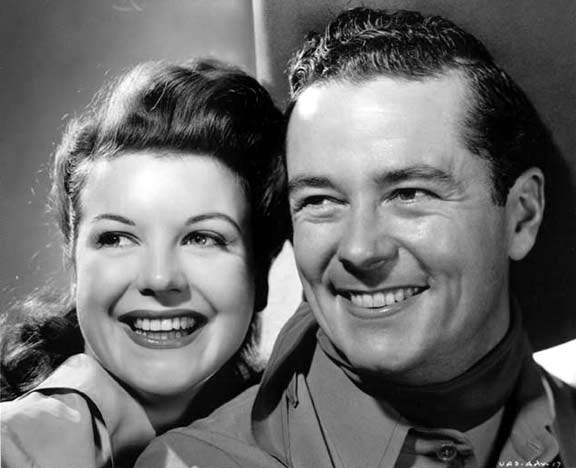
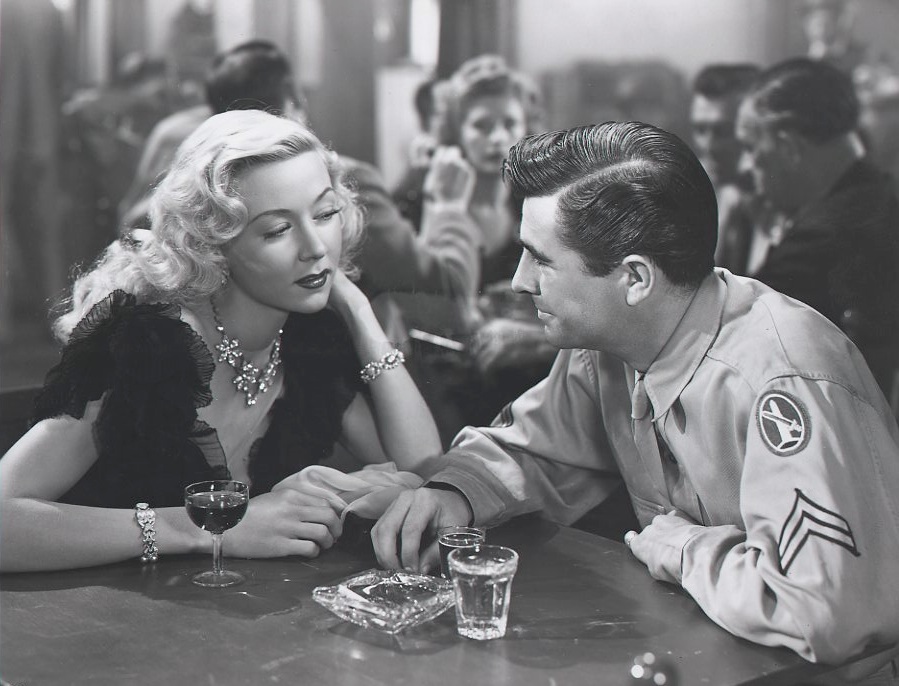
Grahame and Cooper

Mitchell’s sad and lonely journey through the night is classic noir stuff. His strange encounters — like the ones he has with B-girl Ginny and later with her “husband” (played by Paul Kelly), whose name we never learn — are haunting.

While Crossfire is occasionally preachy, this can be forgiven, especially considering the time when the film was released.

Unlike Brute Force (1947), which showed what American fascism could look like at the upper echelons of authority, Crossfire is a portrait of the rank and file of fascism — the dumb, mean, resentful men who “just carry out orders,” and do so happily. Ryan doesn’t overplay his role, and he’s all the more scary for it.

Thunder Mountain (June 1947)

Thunder Mountain, which was directed by Lew Landers, is one of a long line of RKO westerns that were loosely based on Zane Grey novels, including Nevada (1944), Wanderer of the Wasteland (1945), West of the Pecos (1945), Sunset Pass (1946), and Code of the West (1947).

In some cases, a character’s name was all that remained from the source material, and the use of the name “Zane Grey” above the title was just a way to sell the film.

But even when the plots followed Grey’s novels, the RKO westerns based on his books bore little resemblance to Grey’s feverish prose, larger-than-life Romantic heroes, and old-fashioned dime-novel plots. They were straightforward B westerns with straight-shooting heroes, vicious bad guys, comical sidekicks, and beautiful women. They were rarely much longer than an hour, and they were fashioned solely to entertain.

Thunder Mountain, which stars quiet, understated cowboy star Tim Holt (the son of cowboy star Jack Holt and a veteran of World War II — he served in the Army Air Corps as a bombardier), is solidly in this tradition. Its story about greedy land-grabbers and old family feuds is the standard stuff of horse operas, but it’s still a well-made and enjoyable way to spend an hour.

Marvin Hayden (Holt) returns to Grass Valley, and lands smack-dab in the middle of a long-standing feud with the Jorth family. Hayden is the last surviving member of his family, and his romance with the pretty little Ellie Jorth (Martha Hyer) is cut short as soon as they discover each other’s parentage.

Ellie’s brothers, Chick Jorth (Steve Brodie) and Lee Jorth (Robert Clarke), are itching to put Hayden six feet under, but what none of them knows is that the real bad actors in Grass Valley are Trimble Carson (Harry Woods) and his right-hand man Johnny Blue (Tom Keene), who quickly realize how easy it will be to play Hayden against the Jorths.

But like any good western hero, Hayden has a solid group of compadres — the Mexican-Irish Chito Rafferty (Richard Martin), the feisty Irish bar girl Ginger Kelly (Virginia Owen), and the alcoholic and broken-down old lawyer Jim Gardner (Jason Robards Sr.) — not to mention Ellie and her conflicted feelings about Hayden. It’s a foregone conclusion that Hayden will come out on top, just like it’s a foregone conclusion that his vow to never wear a gun will be broken by the end of the picture, but the journey is a fun one, and well worth watching for fans of ’40s B westerns.

Riffraff (June 28, 1947)

Ted Tetzlaff’s Riffraff, which premiered in New York City on June 28, 1947, was Tetzlaff’s first feature film as sole director. (In 1941, he co-directed the John Barrymore comedy World Premiere with the uncredited Otis Garrett and he was the uncredited co-director on Ralph Murphy’s Jackie Cooper comedy Glamour Boy.)

Before he made the leap to directing, Tetzlaff worked as a cinematographer on more than a hundred films. He started working in the silent era, and his last credited film as cinematographer was Alfred Hitchcock’s Notorious (1946). Anyone who’s seen Notorious can attest to how beautifully it’s lighted and shot, and Tetzlaff brings his considerable skill to bear on Riffraff, elevating it from the very run-of-the mill detective story it could have been.

The opening sequence in Riffraff is the most talked-about part of the film. It’s five full minutes of dialogue-free bliss. After the credits roll, the film cuts to an unnerving shot of an iguana placidly lying on a log in the pouring rain. The iguana’s cold, reptilian gaze is a harbinger of things soon to come.

It’s 2:25 in the morning at El Caribe airlines in Peru. A meek, bespectacled man (Fred Essler) boards a cargo plane, the rain sheeting down on him. He sits nervously in the cargo hold, dripping wet and hanging onto his briefcase tightly. He’s sharing the space with a bunch of squawking chickens and an oily, mustachioed fat man with an unnerving smile. (He’s played by Marc Krah, and we’ll find out later in the film that his character’s name is Charles Hasso). The man with glasses watches Hasso fearfully as Hasso stares back at him. Then Hasso stands up and plucks an errant chick from the floor and replaces it gently in its box.

There’s an exterior shot of the cargo plane flying through the rain in the night, then an interior shot of the pilots lighting up a couple of smokes. A warning tone sounds in the cockpit. The co-pilot rushes back into the hold, where the door is wide open and rain is pouring into the plane. “I couldn’t stop him! He jumped!” exclaims Hasso.

Sure he did.

The cargo plane lands in Panama, where Hasso is questioned by the head of the secret police, Major Rues (played by an oddly accent-free George Givot). Hasso is evasive when he’s questioned about his fellow passenger’s death and suggests that the man might have killed himself for love.

Sure he did.

Major Rues’s suspicions (as well as the audience’s suspicions, if they’re awake) are confirmed when Hasso goes to see Dan Hammer (Pat O’Brien), president and sole operative of Zenith Services, a detective agency. Hasso hires Hammer as a bodyguard for his two-day sojourn in Panama City, and while Hammer’s back is turned, he takes the map he stole from the man on the plane and tacks it to Hammer’s cluttered bulletin board, where it will remain for most of the film’s running time (there’s no better place to hide something than in plain sight.)

Eventually we find out that the map shows the locations of a number of unregistered oil wells. Hammer is approached by a shady businessman named Walter Gredson (Jerome Cowan), who wants Hammer to find Hasso for him. Hammer talks Gredson and his assistant up to $5,000 to do the job, and of course never tells them that he already knows exactly who Hasso is and where he is staying.

Hammer is a mixture of hero and con man. In fact, nearly everyone in the film is an operator who is looking out for number one. The beautiful girl in the story is named Maxine Manning (Anne Jeffreys) and even her motives are unclear for awhile. (After a scuffle in a bar, she deliberately pours a drink on her dress just so she can get close to Hammer.)

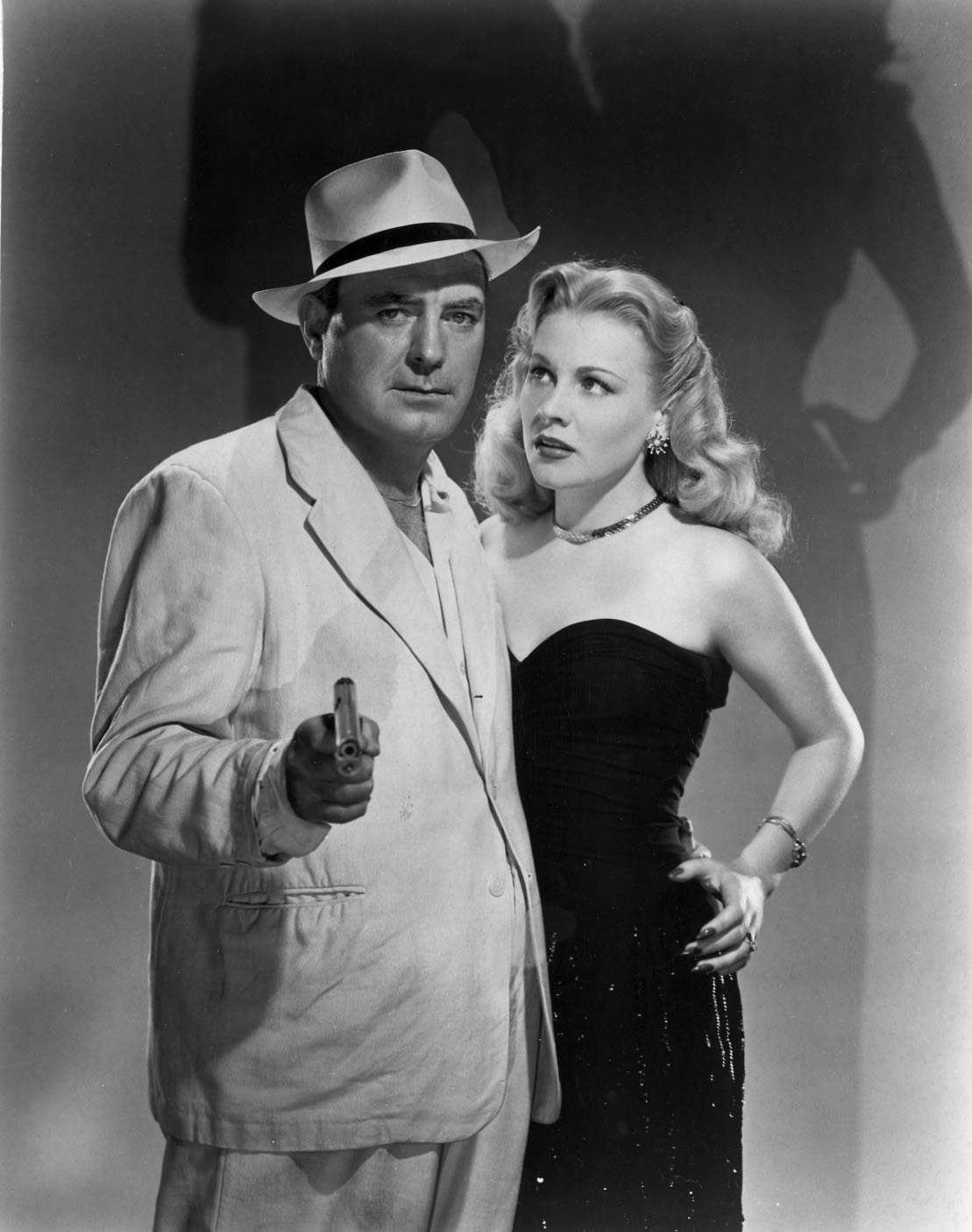
Pat O’Brien is an interesting choice for the protagonist, since he’s a middle-aged character actor with a pear-shaped body. (Although, based on the presence of Marc Krah and Walter Slezak, who plays a vicious killer named Molinar, I suspect Tetzlaff had a fetish for fat guys.)

There’s plenty of violence in Riffraff, and more hard-boiled P.I. clichés than you can shake a stick at, but it’s ultimately not a very dark movie. Aside from all the corpses that pile up, it’s breezy, fast-paced fun in an exotic tropical setting.

Besides the performances, which are all excellent, the film is elevated by Tetzlaff’s direction and the terrific cinematography by George E. Diskant.

It’s too bad there weren’t more Dan Hammer films starring O’Brien. He’s hardly anyone’s picture of a tough-as-nails P.I., but he crafts a great character who I wouldn’t have minded seeing in more pictures. Hammer is the kind of guy who never wears a necktie because someone could choke him out with it, and who says he’s not going to give up on the case not because of any noble conviction, but rather, as he he says, because “I’ve got a lot of time invested in this thing. Plus a good shellacking!”

In case you’re wondering, I looked into it and couldn’t figure out who came first, Dan Hammer or Mike Hammer. (Mickey Spillane’s first novel, I, the Jury, was also published in 1947.) While it’s possible that Spillane took his character’s name from Martin Rackin’s script for Riffraff, or that Rackin cribbed the name from Spillane, it’s equally possible that a P.I. with the last name of “Hammer” was just a good idea whose time had come.

The Woman on the Beach (June 2, 1947)

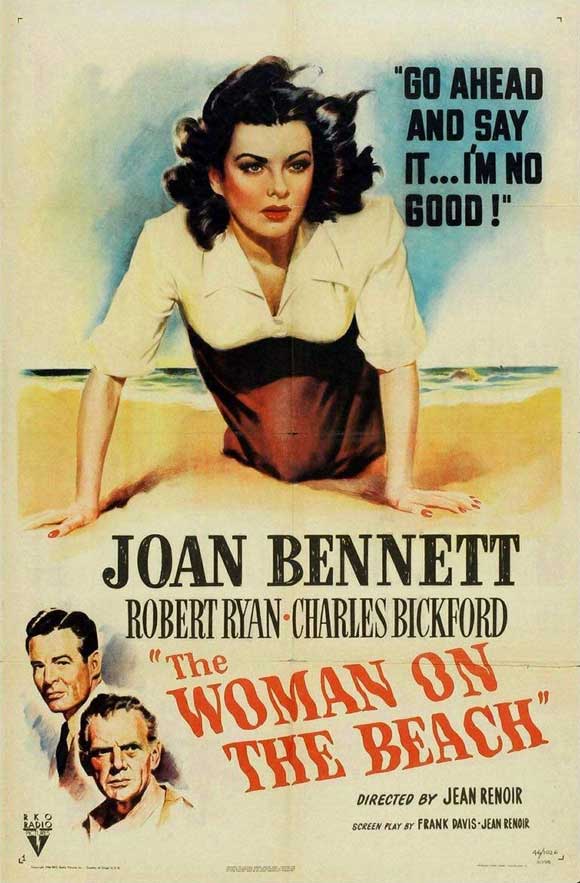
Jean Renoir’s last Hollywood film, The Woman on the Beach, which is based on Mitchell Wilson’s 1945 novel None So Blind, is one of the oddest and most intriguing American films I’ve seen from the ’40s.

On paper, the plot sounds like a perfect vehicle for RKO star Joan Bennett, who was coming off the success of two wonderful noirs that she made with Fritz Lang, The Woman in the Window (1944) and Scarlet Street (1945). Like both of those films, Bennett’s character in The Woman on the Beach is a seductive and alluring woman who may not be what she seems. And paintings — a major theme of both The Woman in the Window and Scarlet Street — figure prominently in The Woman on the Beach.

But the similarities end there. The Woman on the Beach is a film that confounds expectations. It’s sometimes surreal, sometimes suspenseful, and never went in the direction I was expecting. Some of this could be due to studio interference. After a disastrous advance screening in Santa Barbara, the studio forced Renoir to reshoot and recut the film. The final cut is just 71 minutes long. There are numerous plot strands that seem to be left dangling by the end of the film. But overall, it’s still well-made and involving enough for me to recommend it.

Lt. Scott Burnett (Robert Ryan) is a haunted man. He’s sound of body, but he’s plagued by nightmares of the wreck he survived while serving in the Pacific. One of his nightmares opens the film, and it’s a brilliant and surreal juxtaposition of watery peace and fiery, swirling violence.

Scott is grinding through his last week at the U.S. Coast Guard Mounted Patrol Station. (He’s terrified of the ocean, so it makes sense that he’s serving in a Coast Guard station with no ships, just horses.) He’s engaged to be married to a pretty local girl named Eve (Nan Leslie), but as soon as Scott meets the dark and mysterious Peggy Butler (Joan Bennett) while she’s gathering driftwood on the beach, any film noir aficionado can tell you that things aren’t going to go the way Scott and Eve have been planning them.

Peggy instinctively understands Scott’s loneliness and fear. She invites him home to meet her husband, the blind painter Tod Butler (Charles Bickford). Bickford’s performance is masterful, and a key to the success of the film. At first I thought that Bickford was really bad at playing a blind man. He moves about effortlessly, seems to know where everything is, and it frequently seems as if he is making eye contact with the other characters. But it’s hard to tell for certain.

And sure enough, his blindness is called into question before too long. Peggy reveals to Scott that she severed Tod’s optic nerves during a drunken argument, but that sometimes she suspects he has just been feigning blindness ever since. Scott can’t believe that a man whose whole life was devoted to art would just give it up out of spite. Peggy tells Scott that he doesn’t know her husband.

In an unguarded moment when Peggy and Tod are alone, we hear them lay out their entire relationship in a classic exchange: Tod looks at her and says, “So beautiful outside, so rotten inside.” Peggy responds, “You’re no angel,” and Tod says, “No, I guess we’re two of a kind. That’s why we’re so right for each other.”

Scott is drawn into Peggy and Tod’s bitter little world, and begins secretly making love to Peggy while having increasingly tense get-togethers with Tod. In one remarkable scene, Scott walks Tod closer and closer to a cliff edge, trying to make him give himself away and reveal that he can really see.

The presence of Scott’s fiancée Eve seems almost like an afterthought, especially during the second half of the picture, and the way the story ends isn’t completely satisfying. But these are minor quibbles. The Woman on the Beach is a beautifully made film with very interesting performances from its three leads.

The Long Night (May 28, 1947)

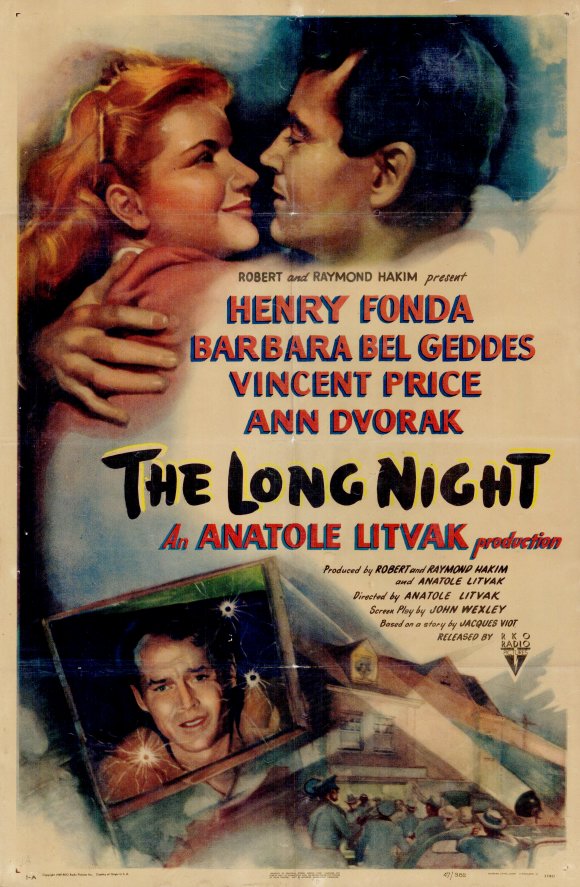
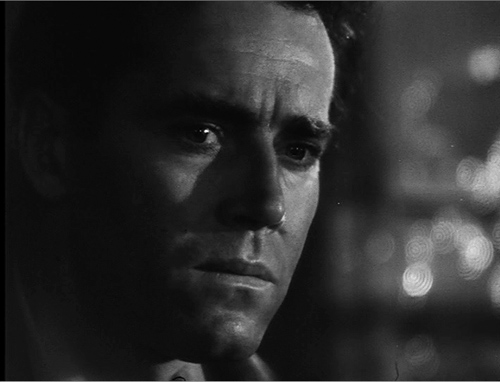
Anatole Litvak’s The Long Night is a remake of Marcel Carné’s 1939 drama Le Jour se lève. It stars Henry Fonda, Ann Dvorak, Vincent Price, and Barbara Bel Geddes in her screen debut.

Litvak, who was born in Kiev, worked in the Soviet cinema system in Leningrad, in the pre-war film industry of Berlin, in France after Hitler’s rise to power, and finally in Hollywood, where he became a contract director for Warner Bros. in 1937. Litvak became an American citizen in 1940, enlisted in the Army, and worked with Frank Capra on his Why We Fight series of short films. Litvak finished the war with the rank of colonel and returned to directing Hollywood features. Two of his most famous films would follow — Sorry, Wrong Number (1948) and The Snake Pit (1948).

The Long Night, his first post-war feature, is less well-known. For a long time, you’d be hard pressed to find anyone who remembered seeing it. But thanks to a pristine print on DVD from Kino Video (released in 2000 along with a VHS version), this flawed but worthwhile drama is now widely available. In the special features section of the Kino DVD, there are a couple of side-by-side comparisons with Le Jour se lève — a murder sequence in a darkened stairwell and the first meeting of the two lovers — that show how heavily Litvak borrowed from Carné’s film, at least stylistically. (The ending of The Long Night is radically different from the ending of Le Jour se lève, however, which is a standard practice in Hollywood remakes of depressing European art films.)

Despite the happy ending, Litvak infuses The Long Night with a pervasive sense of doom. After shooting a man in his apartment building in an unnamed steel town somewhere near the Pennsylvania-Ohio state line, Joe Adams (Henry Fonda) sits alone in his rented room, the door barricaded as police and onlookers swarm the street below his window. Accompanied by a refrain from Beethoven’s 7th Symphony, Joe tells his story through flashbacks, and we learn what brought him to this desperate place. “How can I explain when I don’t understand myself?” he thinks to himself.

Joe Adams grew up in an orphanage. “Class of ’34,” he tells the pretty young Jo Ann (Barbara Bel Geddes) when he meets her. (We must presume that Joe is younger than the man who plays him, since Fonda was 29 years old in 1934.) Jo Ann also came from the orphanage, and her romance with Joe is simple, childlike, and profound. Fonda plays Joe as a sweet-natured boy with no ability to plan long-term or handle disappointment or frustration. Bel Geddes plays Jo Ann in much the same way, but instead of being petulant she is naïve and unworldly, and open to the manipulation of a slimy magician named Maximilian the Great (Vincent Price).

Maximilian is a congenital liar. His relationship with Jo Ann is nebulous for some time in the film. He first tells Joe that Jo Ann is his daughter, but that he had to go on the road for 15 years and leave her in the company of strangers. After another series of flashbacks, however, it becomes clear that Maximilian and Jo Ann were romantically involved. He took her to see the Cleveland Symphony when she had never been as far west as Pittsburgh, and forced himself on her when she had never been kissed. Jo Ann was uncomfortable with Maximilian’s actions, but she was also lonely, and Maximilian offered her a world of excitement and glamor.

The visual style of The Long Night, its doomed protagonist buffeted by forces outside of his control, and its story told through flashbacks are all hallmarks of film noir, but it also has elements of social realism. For instance, Joe befriends Maximilian’s assistant Charlene (played by the always wonderful Ann Dvorak). He lies on her bed on a Sunday afternoon, reading the funnies, in her crummy room full of clutter, next to a couple of big bottles of beer and a bag of pretzels he brought for them to eat. She provides a stack of toast. She’s in the bath when he arrives, and throws on a slinky silk robe. It’s unclear how close Joe and Charlene really are, but the realism of the setting and the intimacy of the situation push the limits of Hays Code acceptability.

Along with the realism and intimacy of some of the interior settings, there’s plenty of artifice in The Long Night. Unlike the typical Hollywood production in which backdrops were either matte paintings or rear-projection film, production designer Eugène Lourié used elaborate sets with tricks of forced perspective in The Long Night. For example, a factory on a hillside in the distance is really a small model that could be lit in whichever way the filmmakers wanted. Lourié and Litvak intended to achieve a kind of “poetic reality,” and they succeeded. At the same time, the artifice sometimes clashes with the realism, and when it does the film feels aimless.

The Long Night was a commercial and critical failure, and lost approximately $1 million, but it was also the springboard for Barbara Bel Geddes’s long onscreen career. After seeing her performance in the film, RKO signed her to a seven-picture deal.