Tag Archives: RKO Radio Pictures

Tomorrow Is Forever (Feb. 20, 1946)

Tomorrow Is Forever
Tomorrow Is Forever (1946)
Directed by Irving Pichel
International Pictures / RKO Radio Pictures

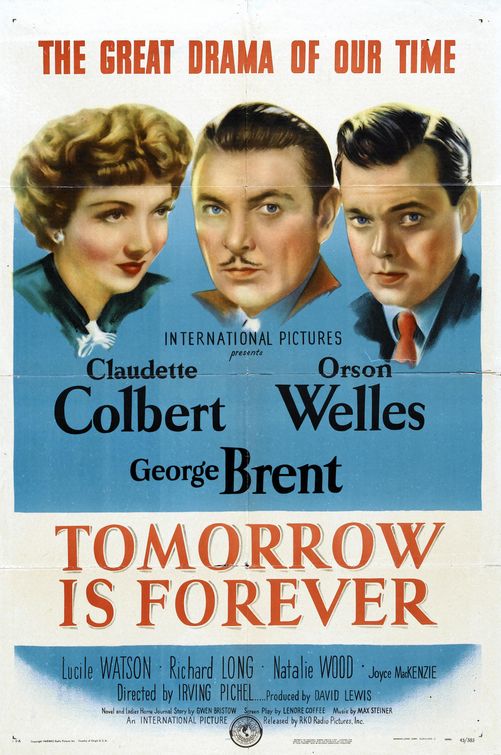
Irving Pichel’s weepy wartime melodrama Tomorrow Is Forever premiered in London on January 18, 1946, and premiered in New York City a month later, on February 20th. If you can suspend your disbelief and accept the convoluted, coincidence-laden plot, it’s quite a fine movie, with excellent performances and a moving story.

The film begins on November 11, 1918, as the First World War is drawing to a close. Charles Hamilton (Douglas Wood), the head of the Hamilton Chemical Works, Inc., in Baltimore, is joined by his son Lawrence (George Brent) and other members of the company in toasting their success. He raises a glass to the part the company played in winning the war, as well as their contribution to the nation’s victories in the Spanish-American War and the Civil War. Lawrence Hamilton walks over to a pretty woman named Elizabeth MacDonald (Claudette Colbert) who is sitting by herself, and offers her a glass. Charles Hamilton drinks to peace and prosperity, and declares the rest of the day a holiday. Lawrence talks to Elizabeth, a research librarian at the chemical works, and learns that her husband, John, who went to war as an officer just four months earlier, is coming home soon. Elizabeth is elated.

A little time passes. Presumably it’s a little more than a month, since there’s snow on the ground, Max Steiner’s lissome score breaks into an orchestral interpretation of “Hark! The Herald Angels Sing,” and Elizabeth is carrying a little Christmas tree. When she get home, however, she receives devastating news; a telegram informing her that her husband, Lt. John Andrew MacDonald, was killed in action on November 5th. She goes to their bedroom, stands in front of the dresser, and he appears behind her in the mirror like a ghost. He’s played by Orson Welles, and he and Colbert play out a touching scene. They were clearly very much in love, and seeing him go away to war was difficult for her. In the end, he holds her tightly and promises her he will come back. (Return he does, and that’s where the audience’s suspension of disbelief will come into play, but more on that later.)

Not only has Elizabeth lost her husband, she learns that she is pregnant with his child. Lawrence Hamilton takes her in, and cares for her and her son, who is named John Andrew after his father. Elizabeth and Lawrence marry, and while it is a marriage based on friendship and respect rather than passionate love, it is also a successful marriage, and they have another son of their own, Brian (Sonny Howe). John Andrew Hamilton grows into a strapping young man (played by Richard Long), whom his parents call “Drew.” They never tell Drew, however, that Lawrence is not his biological father.

Meanwhile, we learn that John didn’t actually die in the war, but he was so badly injured that he didn’t want to live, and refused to identify himself to his attending physician, Dr. Ludwig (John Wengraf). In their scenes together, only Welles’s left eye can be seen through his mass of bandages, and he begs Dr. Ludwig to put him out of his misery. Dr. Ludwig refuses, and tells him that with extensive reconstructive surgery and physical conditioning, he can be made well again. It’s not entirely clear why John wants to be allowed to die and never see his wife again, although it seemed to me that “shattered body” was code for “irrevocably damaged genitals.”

Twenty years pass, and war again conspires to destroy Elizabeth’s happiness. Germany invades Poland, and Drew and his fraternity friends, including his best friend, “Pudge” Davis (Tom Wirick), make up their minds to go to Canada to join the R.A.F. and train as pilots. Drew is a few months away from his 21st birthday, however, and Elizabeth refuses to give her consent. Drew is the image of his father, a man she loved with a passionate intensity, and to lose him to battle would be like losing John all over again.

At this point, an Austrian chemist named Erik Kessler enters the United States as a refugee, along with a little blond girl named Margaret (Natalie Wood). Kessler is played by Orson Welles, and it soon becomes clear that he is John A. MacDonald, even though he has an Austrian accent, a beard, glasses, and walks with a limp. He goes to work for the Hamilton Chemical Works, and enters the lives of the Hamiltons.

It’s at this point that the film began to seem ludicrous to me. Kessler immediately recognizes Elizabeth when he meets her, but she does not recognize him. Welles certainly looks and speaks differently as Kessler, but he was less recognizable in his old-age makeup in Citizen Kane (1941) than he is here. How can she not recognize him? A willing suspension of disbelief is required, as well as an appreciation of the conventions of the stage. It is enough to know that Kessler received a great deal of plastic surgery to reconstruct his face, so while the audience can recognize Welles in his new guise, they have to accept that no one else in the film can. Was I able to do this? Well … sort of.

Tomorrow Is Forever is a story about loss and letting go. The performances in the film are excellent, especially Welles and Wood. Their scenes together were my favorite in the film. Just seven years old when she made this film, her first credited role, Wood was able to project a wide range of emotions and even delivered her lines in German relatively convincingly. Long was also very good in his first film role, even though his performance is pitched mostly at a single tone; earnestness. It was clearly made as a star vehicle for Colbert, however, and it’s her emotional journey that drives the film. As I said, you have to accept all the coincidences in the story and the idea that Elizabeth is not able to recognize who Kessler really is to go along for the ride, but if you can, Tomorrow Is Forever is a pretty good film.

The Spiral Staircase (Feb. 6, 1946)

Robert Siodmak’s The Spiral Staircase was made in 1945, and released into some theaters in December. The earliest confirmed day of release I could find, however, was February 6, 1946, in New York City, so I’m reviewing it here.

Based on Ethel Lina White’s 1933 novel Some Must Watch, The Spiral Staircase is a slick, good-looking thriller with some striking visual choices. White’s novel took place in contemporary England, but the film is set in early 20th century Massachusetts. Some sources I’ve found claim it takes place circa 1916, but the silent film an audience in a movie house is watching in the first scene of the film is D.W. Griffith’s 1912 short The Sands of Dee, and one of the characters has just returned from Paris, about which he waxes rhapsodic, speaking wistfully of all the beautiful women. So it seems to me that the action of the film must take place before the First World War.

The Spiral Staircase doesn’t take long to deliver its terrifying goods. In one of the rooms above the silent movie house, we see a young woman (Myrna Dell) getting undressed. She walks with a slight limp. When the camera moves into her closet as she hangs up her dress, there is a pause, then the camera moves into the thicket of hanging clothes. They part slightly, and suddenly we see an enormous, maniacal eye fill the screen. We then see the girl reflected in the eye, her lower half blurred (why this is will be explained later).

Alfred Hitchcock used a closeup of Anthony Perkin’s eye to great effect in Psycho (1960). And one of the earliest indelible images in the history of cinema was an eyeball being slit open by a straight razor in Luis Buñuel’s short film Un chien andalou (1929). But a close shot of an eye used in the same way as a violin stab on the soundtrack, or a shadow quickly passing across the frame, to make the audience jump out of their seats, is relatively rare. I thought Bob Clark’s Black Christmas (1974) was the first film to do this — when the killer is shockingly revealed as an eyeball peering out from between an open door and a door jamb — but apparently it wasn’t.

Among the patrons of the movie house, none of whom is questioned by the incompetent local constable (James Bell) after the murder, is a mute woman named Helen Capel (Dorothy McGuire). Her friend, the handsome young Dr. Parry (Kent Smith), gives her a ride home, and tells her that he believes her muteness can be overcome. She silently demurs, and goes home to the creepy old mansion where she is employed as a servant to the bedridden but mentally sharp Mrs. Warren (Ethel Barrymore). Also present in the house are the other domestics, Mr. and Mrs. Oates (Rhys Williams and Elsa Lanchester, who looks a lot frumpier than when she played The Bride of Frankenstein in 1935), Mrs. Warren’s two stepsons, Prof. Albert Warren (George Brent) and ne’er-do-well Steve Warren (Gordon Oliver), the professor’s pretty assistant Blanche (Rhonda Fleming), and Mrs. Warren’s crotchety old nurse (Sarah Allgood).

Once the action settles down and focuses on the Warren estate, The Spiral Staircase becomes a more predictable game of whodunnit, as well as a frustrating game of “when will she find the strength to scream for help, already?”

The film is never boring, however, due in no small part to the brilliant cinematography of Nicholas Musuraca. The Spiral Staircase is all shadows and gaslight, which — along with one of the longest thunderstorms on film — hearkens back to spooky haunted house pictures like James Whale’s The Old Dark House (1932).

The Spiral Staircase is not quite a masterpiece, and it never aspires to be more than a pulse-quickening thriller, but it is exceptionally well-made entertainment.

Tarzan and the Leopard Woman (January 1946)

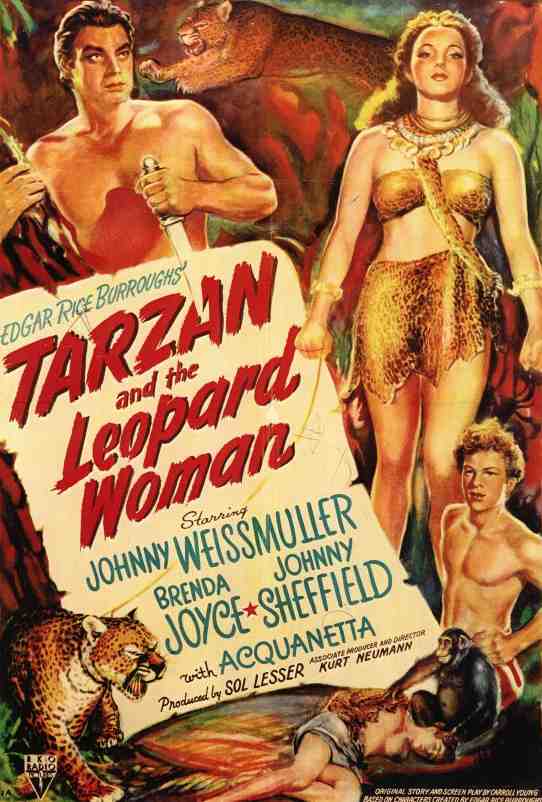
A lot of fans of Johnny Weissmuller’s work as Tarzan in the MGM series of the ’30s like to beat up on the RKO Radio Pictures Tarzan pictures of the ’40s. They’re campier, the production values are cheaper, and Weissmuller was older when he made them. I say, so what? They’re still great Saturday-matinee entertainment, especially this one. Tarzan and the Leopard Woman moves at a good pace, it’s loony without being over-the-top, and Weissmuller is in better shape than he was in the previous few entries in the series.

Weissmuller was a big guy; 6’3″ and 190 pounds in his prime. Like a lot of athletes, he had a tendency to gain weight when he wasn’t competing professionally (when he was making the Jungle Jim series in the ’50s, he was reportedly fined $5,000 for every pound he was overweight). In Tarzan and the Leopard Woman, however, he was 41 years old, and looked better than he had in years. His face looks older and his eyes are a little pouchy, but three divorces (including one from the physically abusive Lupe Velez) will do that do a guy. Even though he was nearing middle age when he made this picture, Weissmuller was still a sight to behold. When he jumps into a river to save four winsome Zambesi maidens (played by Iris Flores, Helen Gerald, Lillian Molieri, and Kay Solinas) from crocodiles, he knifes through the water, and it’s not hard to see why he won five Olympic gold medals for swimming, and was the first man to swim the 100-meter freestyle in less than a minute.

When Tarzan and the Leopard Woman begins, the local commissioner (Dennis Hoey) is speaking to Dr. Ameer Lazar (Edgar Barrier), a native who has been educated and “civilized.” The commissioner is concerned about a spate of attacks by what seem to be leopards. Dr. Lazar appears to share his concern, but we soon learn that Lazar is a wolf in sheep’s clothing. Privately he spouts anti-Western doctrine that sounds suspiciously like Marxism, and is the leader of a tribe of men who worship leopards and wear their skins. Tarzan believes that the “leopard” attacks are really the work of men, so to throw off suspicion, Lazar releases a trio of actual leopards as cannon fodder. Their attack against the caravan is repelled, the leopards are killed, and everyone is satisfied that the terror has passed. Everyone, that is, except Tarzan, who still smells a rat.

The original shooting title of Tarzan and the Leopard Woman was Tarzan and the Leopard Men, which is probably a more accurate title, but definitely a less sexy one, especially once you see the leopard men. The eponymous leopard woman is Dr. Lazar’s sister, Lea, high priestess of the leopard cult. Played by the exotic-looking actress Acquanetta, Lea makes a few memorable appearances in the beginning of the film with her voluptuous breasts barely concealed behind a gauzy wrap, but after the halfway mark she wears a more concealing leopard-print dress, and spends most of her time standing on an altar, goading on the leopard men’s dastardly acts. For the most part, the leopard men are paunchy, pigeon-chested, middle-aged men whose poorly choreographed ritual “dancing” never stops being unintentionally hilarious.

Acquanetta was born Mildred Davenport in Ozone, Wyoming, in 1921. She changed her name to “Burnu Acquanetta,” then to just “Acquanetta,” and starred in films like Rhythm of the Islands (1943), Captive Wild Woman (1943), and Jungle Woman (1944). The raison d’être of most island pictures and jungle movies in the ’40s was to show a whole lot more skin than was considered appropriate in any other genre of the ’40s, and on that count, Tarzan and the Leopard Woman succeeds. Weissmuller’s loincloth is as skimpy as it ever was, and the scene in which he’s scratched all over by the leopard men’s metal claws, then tied tightly to a pillar and menaced by Lea surely excited plenty of future little sadomasochists in the audience.

Former model Brenda Joyce, in her second outing as Jane, has really grown into the role, and looks great. I missed Maureen O’Sullivan when she left the franchise, but Joyce has really grown on me since Tarzan and the Amazons (1945). She’s pretty and charming, not to mention stacked.

There’s a subplot in Tarzan and the Leopard Woman that I’m going to call “Battle of the Boys.” Johnny Sheffield is still playing Tarzan and Jane’s adopted son, “Boy,” but he’s quickly outgrowing the moniker. Sheffield was 14 when he made this film, but he looks older. Unlike a lot of cute child stars to whom puberty was unkind, Sheffield looks like he’s in better shape than anyone else in the movie, and he’s good-looking. Unfortunately, the same cannot be said for Tommy Cook, who’s a year older than Sheffield, but looks younger and weirder. The last time I saw Cook, he played the cute little sidekick named “Kimbu” in the 1941 Republic serial The Jungle Girl. Here, in an enormous thespic stretch, he plays Lea’s younger brother “Kimba,” who insinuates himself into the lives of Tarzan, Jane, and Boy. He might as well have been named “Bad Boy,” since he’s Boy’s evil doppelgänger. Jane takes pity on Kimba and cares for him, but his true intention is to cut out her heart in order to become a full-fledged warrior among the leopard men.

I don’t think I’ll be giving anything away if I say that Tarzan, Jane, Boy, and their pet chimp Cheetah make it through the proceedings relatively unscathed, while the bad guys all die horrible, gruesome deaths. Tarzan and the Leopard Woman might not be the greatest entry in the Tarzan franchise, but it’s far from the worst, and packs plenty of action and thrills into its 72-minute running time.

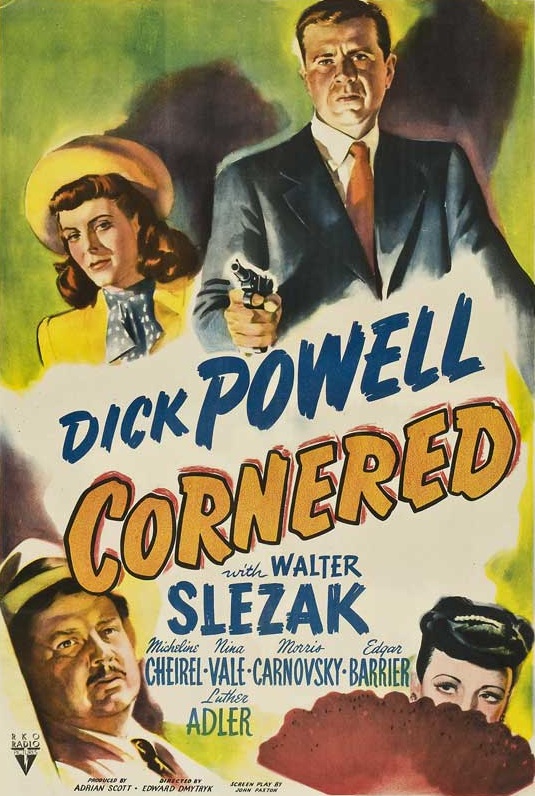
Cornered (Dec. 25, 1945)

Cornered was director Edward Dmytryk’s second film to star Dick Powell. Powell was a boyish crooner and star of musical comedies who made a 180 degree turn into hard-boiled noir territory at the age of 39 when he played detective Philip Marlowe in Dmytryk’s film Murder, My Sweet (1944), an adaptation of Raymond Chandler’s 1940 novel Farewell, My Lovely. Powell jumped into his new, hard-boiled persona with both feet. Between the two films, Powell started appearing every week on the Mutual Broadcasting System as private investigator Richard Rogue in the radio series Rogue’s Gallery. The series was mostly standard P.I. fare, but it featured one unique element; every time Rogue was knocked out (which was nearly every episode) he’d drift off to “Cloud Eight,” where his alter ego, a little white-bearded gnome named “Eugor,” would taunt him, occasionally dropping a clue for Rogue to pick up on later, when he’d regained consciousness.

Cornered has no fanciful elements like that one, and the devil-may-care charm Powell exhibited in Murder, My Sweet has been completely done away with. In Cornered he plays a broken man who will stop at nothing to exact vengeance.

When we first meet Flight Lieutenant Laurence Gerard (Powell), an RCAF pilot, he is in London, receiving £551 back pay for the time he spent as a P.O.W. His next stop is a passport office, where he seeks passage to France. He wants to settle his wife Celeste’s estate. She was a French citizen, and they were married during the German occupation. When Gerard is told that all passports to the continent require investigation, and that it will take at least a month to clear, he walks out of the office without saying another word. In the next scene, he is alone in a rowboat, crossing the English Channel. When he sees land, he chops a hole in the hull, sinks the boat, and swims to shore.

In a muddy French town that is mostly rubble, Gerard meets with Etienne (Louis Mercier), a former resistance leader, and Celeste’s father. Gerard demands to know who is responsible for her death, and who betrayed her. “If there was any betrayal, I betrayed her, by fathering her in a century of violence,” Etienne tells him. Gerard doesn’t accept this circumspect response, and vows to hunt down the Vichy collaborator Marcel Jarnac, who ordered the killing of Celeste and several other members of the resistance. Jarnac supposedly died in a fire, but Gerard refuses to believe he is dead. He sets out with a single goal; to kill Jarnac.

Gerard follows Jarnac’s trail to Buenos Aires, and it is there that most of the film takes place. As soon as Gerard steps off the plane, he is approached by a fat man in a white suit. This man, Melchior Incza (Walter Slezak), is an operator with no clear allegiances. Gerard is quickly drawn into a world where no one is what they seem. Former Nazis and their collaborators have fled to Buenos Aires, biding their time until the next great war, while a loose-knit, clandestine organization seeks to root them out. Incza introduces Gerard to Jarnac’s wife (or possibly widow), Mme. Madeleine Jarnac (Micheline Cheirel), and even her loyalties are unclear.

While it may sound like a globe-trotting adventure film, Cornered is really a claustrophobic film noir with healthy doses of paranoia and tension. The script, by John Paxton (with uncredited assistance from Ben Hecht), from a story by John Wexley, takes a run-of-the-mill manhunt plot and ratchets up the tension with crisp dialogue, excellent pacing, and a brutal finale. Harry J. Wild’s cinematography is classic film noir, with inky nighttime exteriors, close-quartered interiors, and actors’ shadows frequently preceding them into the frame.

Powell plays Gerard as a shell-shocked man who suffers from frequent headaches. He’s on a mission to avenge a woman to whom he was only married for 20 days. He’s an amateur doing the work of a detective, and while he’s clever enough to connect the dots, he’s still just one man at the mercy of forces beyond his comprehension. “You are sick with fear,” Mme. Jarnac tells him. “You’ve been hurt so deeply you cannot trust anyone but yourself.”

Is there a better description of the classic film noir protagonist?

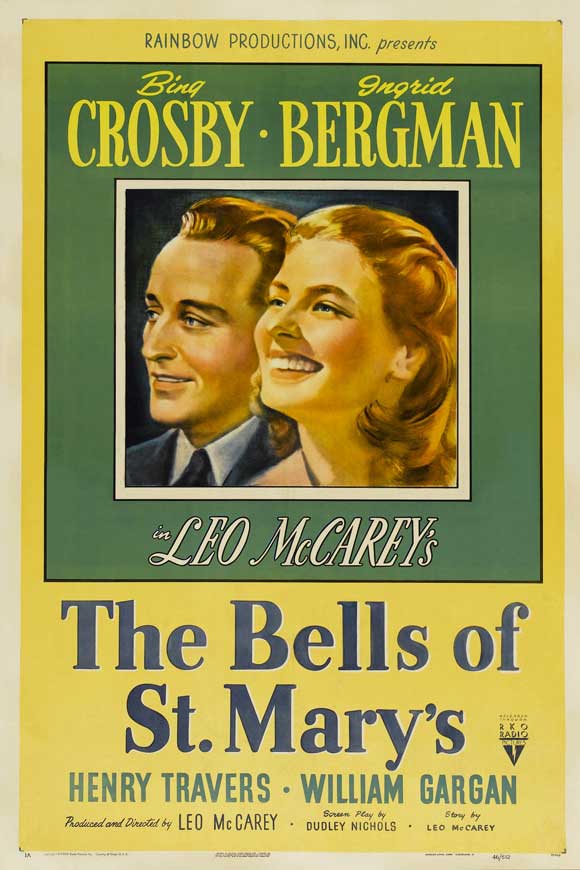
The Bells of St. Mary’s (Dec. 6, 1945)

The Bells of St. Mary’s, Leo McCarey’s follow-up to his smash hit Going My Way (which won the Academy Award for best picture of 1944), premiered in New York City on December 6, 1945. It was one of the first really “respectable” sequels, and, like Going My Way, was nominated for Oscars in all the big categories; best picture, director, actor, and actress. (Billy Wilder’s The Lost Weekend ended up taking home the awards for best picture, director, and actor, and Joan Crawford won the best actress award for Mildred Pierce.)

In The Bells of St. Mary’s, Bing Crosby reprises the role of Father O’Malley, for which he won an Academy Award for best actor of 1944, and he is joined by Ingrid Bergman, the best actress winner of 1944 (for Gaslight). The talent pool might be heavy, but the film itself is pretty light. There’s a disease, but it’s not fatal; there’s a bunch of needy kids running around, but the word “orphan” is never heard; and the sisters are in danger of losing St. Mary’s, but keep your fingers crossed for a Christmas miracle.

Like a lot of sequels, The Bells of St. Mary’s sticks with the formula of its predecessor. Father O’Malley is still the new guy in town, he’s still freewheeling and freethinking, and he butts heads with the other members of the clergy. His foil in Going My Way was Barry Fitzgerald as a crotchety old Irish priest, and in The Bells of St. Mary’s it’s the luminous Ingrid Bergman as Sister Benedict, a nun who was born in Sweden and raised in Minnesota. Bergman projects equal parts wisdom and naivete, and her performance is beatific enough, at least on the surface, to make up for what the role lacks in substance. The scene in which she masters the techniques of boxing by reading a book and then teaches the sweet science to a young boy who is being bullied is both funny and touching.

Crosby builds on his characterization of Father O’Malley. He’s a little older and wiser than he was in Going My Way, but not much else has changed. He’s still a “modern” thinker. He’s still a magnet for young girls in trouble, and if someone has a problem that can be solved with a song, he’s still happy to sit down at a piano and lend his golden pipes to the situation. Crosby will never be mistaken for Laurence Olivier, but he’s believable and charismatic in this picture. Enough so that he can deliver lines like, “If you’re ever in trouble, just dial ‘O’ … for O’Malley,” and not automatically trigger the viewer’s gag reflex.

The world of The Bells of St. Mary’s is much like our own, but the problems in it are solved with broad strokes and last-minute changes of heart instead of time and hard work. All it takes to mend a broken family is simply locating the wayward father, and getting a new parish is no harder than praying for it (and cajoling an old millionaire to donate his latest high-rise condominium).

Going My Way and The Bells of St. Mary’s are both holiday classics, even though neither focuses too much on Christmas. There’s a cute scene in The Bells of St. Mary’s in which some very small children stumble and improvise their way through a rehearsal of a Christmas pageant, but that’s about it. Oh, and a year later, astute viewers will be able to spot The Bells of St. Mary’s on the marquee of the local movie house in Bedford Falls when Jimmy Stewart runs through downtown wishing everyone and everything a Merry Christmas at the end of It’s a Wonderful Life.

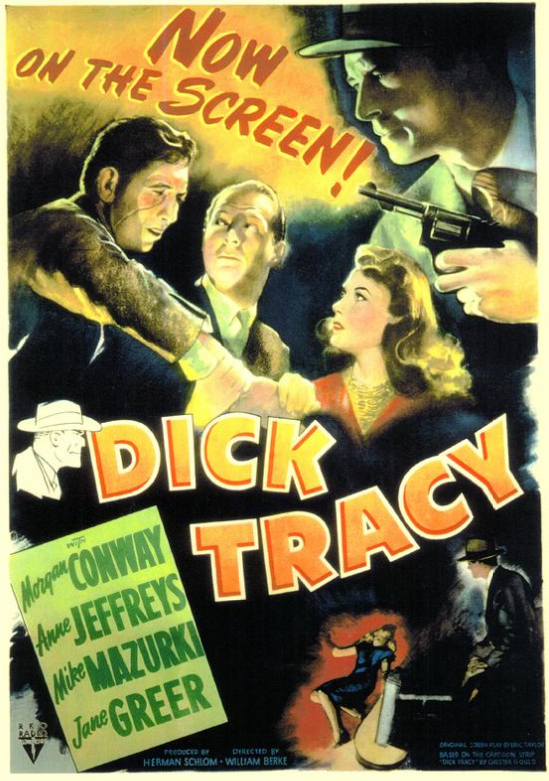
Dick Tracy (Dec. 1, 1945)

Dick Tracy, directed by William Berke and starring Morgan Conway as Dick Tracy, wasn’t the first filmed adaptation of the most famous detective in the funny pages. There had been four serials prior to it, all of which starred Ralph Byrd; Dick Tracy (1937), Dick Tracy Returns (1938), Dick Tracy’s G-Men (1939), and Dick Tracy vs. Crime Inc. (1941). The first one was also re-edited into a feature in 1937, which was a fairly common practice. These were B pictures, after all. If you had the footage, why not repackage it?

This film, however, took the character in a new direction. Played by Morgan Conway, Tracy is more believable as a real person than the way Byrd played him. Both embody aspects of the character, but they look nothing like each other. Byrd literally looked like a cartoon character. He had small, perfect features and intense eyes. But for me, his voice was too high and his nose too small to really convey the toughness of the character. Conway, on the other hand, is ugly and tough as nails. He looks like what I imagine Tracy might look like if he were a real person, although his nose is more of a “schnoz” than Tracy’s “beak.” He’s decent and brave, but still not above underhanded tricks to get his man. When we’re introduced to him, he’s interrogating a sweaty suspect named Johnny (Tommy Noonan). Tracy makes Johnny believe his mother has been killed so he’ll agree to roll over on someone. After Johnny spills the beans, Tracy admits to having tricked him. “It was the only way I could get you to talk and clear yourself at the same time,” he says. “All right boys, clean up Johnny and send him home.”

This film also features the full supporting cast of characters from Chester Gould’s daily newspaper strip, many of whom had been missing from earlier adaptations; Tracy’s sidekick Pat Patton (Lyle Latell), his best girl Tess Trueheart (Anne Jeffreys), his adopted son Junior (Mickey Kuhn), and Chief Brandon (Joseph Crehan). Gould’s violent, gruesome world is handled well in this film. Its opening may be the darkest of any film based on a comic strip character made before 1970. A high-angle shot shows a man with his back to the camera, leaning against a light pole in a quiet, suburban neighborhood at night, smoking a cigarette. When a bus stops and a single, female passenger (Mary Currier) disembarks, he moves into the shadows. A tracking shot follows her as she walks across the street, then cuts to a static shot of the man’s shadow on a wall, and the viewer can see from the movement of his shadow that he is reaching into his breast pocket for something. This is followed by a tracking shot of the woman with the camera directly behind her, presumably showing his point of view. The woman walks down the sidewalk, her heels clacking. She looks nervous. She turns around. There is no one behind her. She keeps walking. Suddenly, a shadow falls across her and she screams. The man attacks her. There is a cut to a long shot of the street, which shows her body lying on the sidewalk and the man running away.

Dick Tracy discovers a note on the woman’s viciously mutilated body, demanding that $500 in small bills be left in a street sweeper’s trash can on the corner of Lakeview and Ash. The note is signed “Splitface.” The next morning, the mayor of the city (William Halligan) receives a similar note, demanding that $10,000 be paid out or the mayor will be “slashed to pieces.”

The murdered schoolteacher, the mayor, and another man who was killed by Splitface seemingly have nothing to connect them. Tracy and Patton investigate, and Tracy comes to the conclusion that Splitface is motivated by something other than money, since the murdered woman didn’t pay, but the murdered man did.

Dick Tracy has plenty of action, with Dick and Pat chasing down suspects on foot and in cars, but it doesn’t skimp on the investigations that lead them there. It’s not rigorous enough to qualify as a police procedural, but it doesn’t gloss over any details, and Conway’s acting style and line delivery are not unlike Jack Webb’s on Dragnet.

Devotees of the daily strip will probably quibble with details, but I thought this picture did a nice job of balancing the violence with over-the-top characters. There is a loony astronomer and fortune teller named Professor Starling (Trevor Bardette), a ghoulish undertaker named Deathridge (Milton Parsons), and of course the great character actor Mike Mazurki as the villain.

Dick Tracy is a one-hour programmer, and there’s no question that it’s a B movie, but it’s an expertly directed, fast-paced, and thoroughly enjoyable one.

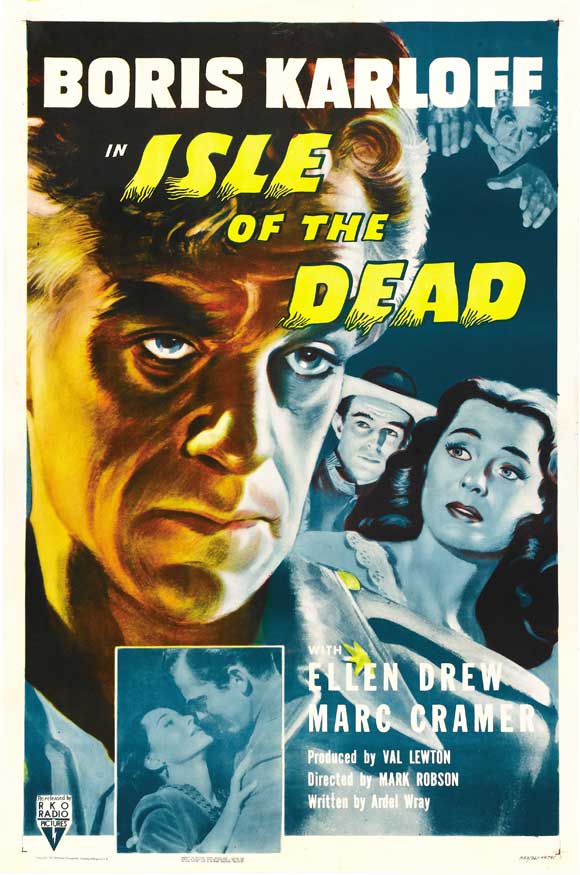
Isle of the Dead (Sept. 1, 1945)

IsleOfTheDead
Isle of the Dead (1945)
Directed by Mark Robson
RKO Radio Pictures

Director Mark Robson’s Isle of the Dead, which was produced by legendary horror filmmaker Val Lewton, takes place in Greece in 1912, during the First Balkan War. In it, Boris Karloff plays a cold and brutal general in the Greek army named Nikolas Pherides. Known as “The Watchdog,” Gen. Pherides is the kind of man who, when faced with an officer who has failed to complete an objective, hands the man a revolver with a single bullet in it and orders him to shoot himself.

When Gen. Pherides and some of his troops are garrisoned in a house on an island, the serving girl, Thea (Ellen Drew), refuses to pour him wine, because he once gunned down people in her district who refused to pay taxes. He confronts her in private. She denounces him for murdering people who were rebelling against unjust taxation. “Who is against the law of Greece is not a Greek,” he says. Not only is he a rigid interpreter of the law, he seems to take pleasure in wielding power. After his encounter with the girl, he tells another man, “When I went up there she wasn’t quite so impudent. She was frightened.” He says it with grim pleasure.

The next day, however, the island is faced with an outbreak of septicemic plague, and Gen. Pherides promises that the quarantine on the island will observed. Having the military, under the command of someone like him, available to enforce order falls under the category, “Be Careful What You Wish For,” and not surprisingly, there are complications. A woman named Mary St. Aubyn (Katherine Emery), who is staying on the island with her husband (Alan Napier), suffers from attacks of catalepsy. Unable to refill her medication on the mainland, she falls into a catatonic state, is presumed dead, and is buried alive.

Compounding this horrific event is a superstitious old woman named Madame Kyra (Helen Thimig), who has the general’s ear. She convinces him that Thea, the young serving girl, is a vorvolaka, a harmful undead creatures from Greek folklore, roughly equivalent to the vampires feared in neighboring Slavic countries, although blood drinking is not something they seem to engage in. In the world of the film, the vorvolakas are sent by the gods to punish humans who offend them. The combination of the plague and the apparent death of Mrs. St. Aubyn gives Kyra’s mad proclamations a certain believability, and Gen. Pherides becomes convinced that Thea was responsible for Mrs. St. Aubyn’s “death.”

After Lewton’s phenomenal success with Cat People in 1942, RKO would give Lewton a title, a maximum running time, and a budget. Most everything else was up to him. He could have been handed a script called Zombie Gut Munchers and ended up making an eerie film about the Silesian weavers’ revolt of 1844 in Prussia that was more about poverty and oppression than it was about the living dead. Starting in 1945, however, the studio also forced Karloff on Lewton, a move he reportedly wasn’t immediately happy about, since Karloff was emblematic of the Gothic and increasingly corny Universal Pictures approach to horror films that Lewton actively resisted. Karloff was an exceedingly good actor, however, and his performances for Lewton are some of the strongest of his career. (Isle of the Dead was the first to start production, but shooting was suspended when Karloff needed to take time off for back surgery, and The Body Snatcher ended up being their first collaboration to be released into theaters.)

Like The Ghost Ship (1943), which was also directed by Robson and produced by Lewton, Isle of the Dead is a meditation on the abuse of power. Unlike The Ghost Ship, however, Isle of the Dead is not just a metaphorical title, and the film delivers some truly stunning and horrific scenes in its final reel. In fine Lewton fashion, Mrs. St. Aubyn is never shown inside her coffin, desperately clawing at the wood that imprisons her. A shot of the coffin sitting on a stone bier accompanied by her screams suffices. Later, the coffin is shown again, with water dripping on it. There is no other sound. The viewer is left to wonder whether or not the woman inside is still alive, being driven mad by the sound of the water.

There is a theory that some people who were buried alive in less scientifically enlightened times may have clawed their way out of their graves and shown up in town filthy and quite possibly raving mad, and that this phenomenon is what led to folk tales and legends about vampires and their ilk. Whether or not this ever actually happened, Robson and Lewton take full advantage of the concept to fashion a denouement that is not supernatural but that still ranks among the most horrifying depictions of a person rising from the grave ever depicted on film.

What leads up to it is sometimes stilted and slow-moving, although a second viewing reveals a lot of well-done foreshadowing. Like a lot of Lewton’s films, the symbolism in this film is overt. Gen. Pherides is known as “The Watchdog.” Several times in the film there are shots of a statue of Cerberus, the three-headed dog who stopped the souls of the dead from escaping Hades back across the River Styx. Which is exactly what the general does. There are many shots of water, and of decaying marble columns and balconies that hearken back to a more enlightened time in Greece.

At the end of the film, someone says of the general, “Back of his madness there was something simple, good. He wanted to protect us.” This is a charitable description that is not entirely supported by what comes before. Karloff’s portrayal of the general is not as overtly malevolent as other roles he has played, such as Cabman John Gray in The Body Snatcher, but he has few redeeming characteristics.

West of the Pecos (Aug. 10, 1945)

WestOfThePecos
West of the Pecos (1945)
Directed by Edward Killy
RKO Radio Pictures

After recently seeing early performances by Robert Mitchum in two top-notch World War II films, Thirty Seconds Over Tokyo (1944) and Story of G.I. Joe (1945), I was a little disappointed by his starring role in West of the Pecos. Mitchum is one of my favorite actors, and he’s always interesting to watch, but this movie is hard to take very seriously.

After small roles in a variety of films (including some Hopalong Cassidy westerns), and a larger role in William Castle’s B noir When Strangers Marry, Mitchum was signed to a contract by RKO, who needed a B western star in the Tim Holt mold. I haven’t seen the first western Mitchum made for RKO, Nevada (1944), which is based on a Zane Grey novel, but if it’s anything like West of the Pecos, I don’t think I’m missing too much. Like Nevada, West of the Pecos is also based on a Grey novel, and is typical “romance of the West” malarkey. In terms of plot and character development, it has more in common with 19th-century stage drama than anything else.

In West of the Pecos, Barbara Hale plays a young Chicagoan named Rill Lambeth, whose father, Col. Lambeth (Thurston Hall), is ordered out west for his health. The two of them travel by stagecoach to Texas with their French maid, Suzanne (Rita Corday). In the course of their travels, they cross paths with Pecos Smith (Mitchum), an outlaw who’s seeking revenge against the corrupt vigilantes who killed his best friend. There are plenty of western tropes in West of the Pecos, like shootouts and unconvincing portrayals of Mexican bandits (Richard Martin plays their leader), but at its heart it’s a light-hearted romance and cross-dressing farce. Soon after her arrival in Texas, Hale decides to dress as a boy to dissuade all the nasty cowboys she meets from sassing her. To say she makes an unconvincing fellow would be an understatement. Her long, flowing hair is simply piled up and pinned under a ten-gallon hat, and all she does to hide her pretty face is rub a little dirt on it.

Part of the problem is Mitchum. Even here, in one of his first roles, he’s simply too world-weary and knowing. Consequently, it’s hard to tell most of the time if his character is supposed to be convinced by Hale’s drag, or if he’s just playing along for his own amusement, like when he rubs her face and says, “You’re just a kid! I bet you haven’t even started shaving. How old are you, anyhow?” Hale petulantly responds, “Old enough.”

Their relationship is based on kidding around, but it’s so flirtatious that I was actually surprised at the end when Mitchum’s character acted shocked when he found out Hale was really a young woman. He plays all their scenes together as if he has every idea what’s going on. Take, for instance, the scene by the campfire in which Mitchum tries to convince Hale to get in his bedroll with him on account of the nighttime chill. He rolls over on his side, faces her, and throws the blanket aside.

“C’mon, kid, get in,” he says.

“But … I want to sleep alone,” she responds.

“Ah, no you don’t. C’mon. Get in and cuddle.”

“Cuddle?!?”

“Sure. Keep each other warm. And I hope you haven’t got cold feet.”

“Cold feet?” she says, too quietly for him to hear. “I got ’em right now.”

It’s interesting to see Mitchum in this type of role. Not too long after appearing in this film, he would receive the only Oscar nomination of his career, for his role in the much better film The Story of G.I. Joe. After that, his days of starring in movies like this were pretty much over. Not every picture he made was great (some of them were even pretty bad), but by 1946 he was on his way to becoming an A-list actor, and eventually a Hollywood legend.

Along Came Jones (July 19, 1945)

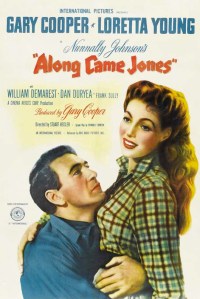
AlongCameJonesAlong Came Jones is a silly little western that verges on being a spoof of the genre, but it’s worth seeing for a couple of reasons. Gary Cooper pokes fun at his stalwart image without devolving into parody, and the gender reversals in some of the action scenes are still surprising.
Cooper plays a singing cowboy (sort of), named Melody Jones. This in itself is funny, because Cooper can barely sing. He’s halfway between a hum and a grumble in the few scenes when he’s called upon to croon a ditty. Along with his crotchety old sidekick, George Fury (played by William Demarest), Jones rolls into the town of Payneville, where he’s mistaken for vicious outlaw Monte Jarrad (played by vicious little squirt Dan Duryea), because his monogrammed saddle has the same initials, “M.J.” The only problem is, it’s not a charade he can keep up very long. Although Jones is tough enough, and can dish out haymakers with the best of them, he can’t handle a gun to save his life (which, by the end of the film, he will be called upon to do more than once). It’s not just that Jones can’t shoot straight, he literally can’t get his revolver out of its holster without it flying out of his hand. At one point, the real Monte Jarrad’s girlfriend, Cherry de Longpre (played by Loretta Young), calls Jones a “butterfingered gun juggler,” and it’s an apt term of derision.

The interesting thing about this film is that Jones never gets any better at handling a gun. Yes, he eventually manages to hold it steady, but he still can’t hit the broad side of a barn. Cherry, on the other hand, is a crack shot who could give Annie Oakley a run for her money. In the climactic showdown, she becomes a distaff John Wayne in The Man Who Shot Liberty Valance (1962), and the effect is stunning. Nevertheless, Cooper never comes off as unmanly, especially since he’s willing to stand up to overwhelming odds with absolutely no shooting skills whatsoever. And he twice kisses Young in what has to be the most macho way I’ve ever seen in a movie. I don’t want to give anything away. Just see it.

Back to Bataan (May 31, 1945)

BackBataan
Back to Bataan (1945)
Directed by Edward Dmytryk
RKO Radio Pictures

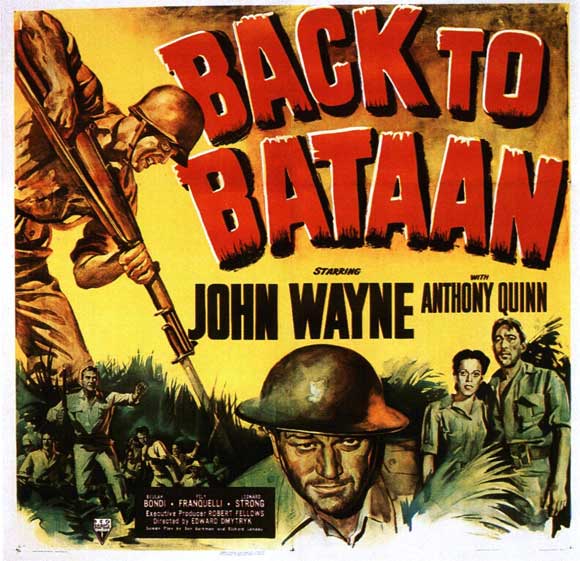
Yes, Back to Bataan is flag-waving agitprop. Yes, it features Anthony Quinn as a Filipino. But under the direction of Edward Dmytryk it’s all done really well. There are a number of gripping battle sequences, and John Wayne in his late 30s was still a lean, mean, ass-kicking machine. The human drama is a little stilted and the politics are simplistic, but when the bullets are flying, Back to Bataan delivers the goods.

The film begins with a battle sequence that depicts the raid at Cabanatuan, a Japanese POW camp, that took place on January 30, 1945. At the time the film was made, the raid was a current event, and was one of the big Allied successes in the Pacific theater. (Filipino guerrillas, Alamo Scouts, and US Army Rangers liberated more than 500 prisoners of war.) After the big opening battle, the film moves back in time to 1942, and tells the story leading up to the raid and the freeing of the POWs. Col. Joseph Madden (Wayne), voluntarily stays in the Philippines after Gen. Douglas MacArthur and his armies pull out. Madden teams up with Filipino guerrilla forces, training them and organizing them. One of his officers, Capt. Andrés Bonifácio (Quinn) is struggling to live up to the reputation of his grandfather, who was a national hero and liberator of the Philippines from Spanish colonial rule. And if that weren’t enough, Capt. Bonifácio’s former fiancée, Dalisay Delgado (Fely Franquelli) has apparently turned traitor, since she now makes regular radio broadcasts radio for the Japanese. Every time he’s near a radio, Capt. Bonifácio has to hear his sweetheart’s mellifluous voice spouting ugly Axis propaganda. Madden, of course, knows that Delgado is actually passing code through these broadcasts, but he’s ordered by his superiors not to tell Bonifácio, so Madden must use all of his skills as a commander to whip Bonifácio into shape and make him a leader of men, no matter how much Bonifácio’s heart may be breaking.

There are conflicting reports of how well Wayne got along with director Dmytryk and screenwriter Ben Barzman, both of whom had communist views. According to Barzman’s wife, they had a humorously antagonistic relationship due to their very different politic views, jokingly calling each other “goddamned communist” and “fascist.” Apparently Barzman and Dmytryk also enjoyed tormenting Wayne, who refused to use a stunt double, by devising scenes that would test his limits. Whether or not this was a friendly game, the results are sometimes stunning. There’s a scene in which Wayne is hugging the ground. A shell explodes right next to him, and his body is flung high into the air and dropped at least 20 feet away. If you rewatch the scene, you can see the wires attached to Wayne’s body, but during the first viewing, when you’re not expecting it, it’s a stunning effect.

The film ends with triumphant footage of some of the real men who were prisoners of war at Cabanatuan. They march together, filmed at low angles, while their names, ranks, and cities of origin are displayed on the screen. After seeing so many Hollywood actors playing soldiers in World War II, it’s interesting to see some of the real men who served. Some of them are handsome enough to have played in the movies. Some aren’t. Almost all of them look relieved and happy, but close to being emaciated. All of them, that is, except for one guy from Chicago who’s really fat and looked deliriously happy. I wonder what his secret was.