Tag Archives: Romance

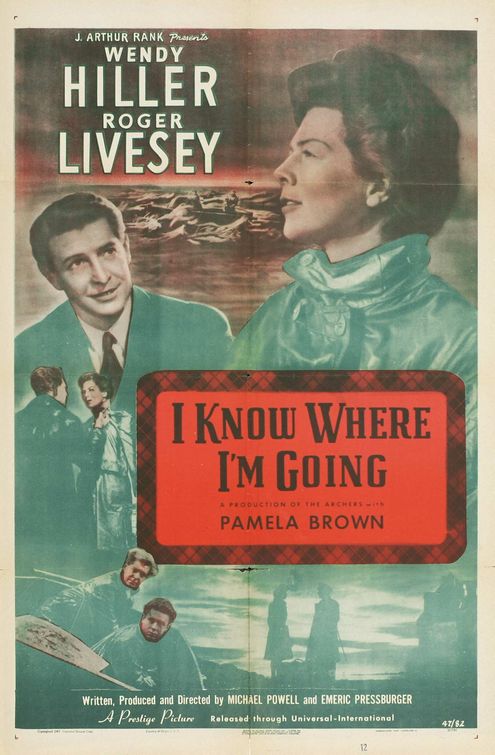
I Know Where I’m Going (Nov. 16, 1945)

Michael Powell and Emeric Pressburger, the talented pair of writers, producers, and directors whose early collaborations included One of Our Aircraft Is Missing (1942), The Life and Death of Colonel Blimp (1943), and A Canterbury Tale (1944), worked together under the name “The Archers” throughout the 1940s and 1950s, and produced some of the most enduring films in British history. Powell was a native-born Englishman. Pressburger was a Hungarian Jew who found refuge in London and who prided himself on being “more English than the English.”

I Know Where I’m Going, which premiered in London on November 16, 1945, is a warm, romantic drama. The film stars Wendy Hiller as Joan Webster, a stubborn young woman who, according the narrator, “always knew where she was going.” After a montage that shows Joan’s growth from headstrong toddler to headstrong teenager to headstrong 25-year-old, we see her dressed in smart clothes, meeting her father (played by George Carney) at a nightclub, where she blithely informs him that she plans to travel to Kiloran island in Scotland to marry Sir Robert Bellinger, a wealthy, middle-aged industrialist whom she has never met. Her father is aghast, but, as always, Joan knows exactly where she’s going and what she’s doing.

Handled differently, this setup could lead to a grim, Victorian melodrama, but I Know Where I’m Going is a playful film with touches of magical realism. On her trek to the Hebrides, Powell and Pressburger delight in each leg of her long journey (and there are many), and pepper the montage with fanciful touches, such as a map with hills made of tartan plaid, a dream sequence in which Joan’s father marries her to the chemical company owned by Bellinger (literally), and an old man’s top hat that becomes the whistling chimney of a steam engine.

On the last leg of her journey, she is forced to put up in the Isle of Mull, as weather conditions do not permit water travel to Kiloran. Joan stays in touch with Bellinger, who is never seen, only heard (as a stuffy voice on the other end of a telephone). While cooling her heels in Mull, Joan meets a charming, soft-spoken serviceman named Torquil MacNeil, who is on an eight-day leave. (Torquil is played by Roger Livesey, in a role originally intended for James Mason.)

The joke implicit in the title becomes more and more clear as Joan and Torquil begin to fall for each other. The closer they become, the more determined she is to reach Kiloran. Eventually willing to risk life and limb to get there, it becomes clear that at least when it comes to love, she has no idea where she is going, and is too hard-headed to see anything clearly.

Livesey, who was in his late thirties when this film was made, was originally told that he was too old and too heavy to play the role of the 33-year-old Torquil, but he very quickly slimmed down to get the part, and he cuts a dashing figure, although not a classically handsome one. Interestingly, Livesey never set foot in the Western Isles of Scotland, where most of the film’s exteriors were shot. He was starring in a play in the West End during filming, so Powell and Pressburger made clever use of a body double for long shots, and filmed all of Livesey’s interior scenes at Denham Studios, in England.

Besides its fine performances and its involving love story, I Know Where I’m Going is enjoyable to watch simply because Powell and Pressburger show such incredible attention to detail. The interiors may be shot on a soundstage, but it’s easy to forget that with effects that perfectly marry them to the location footage, such as rain lashing the windows, subtle lighting, and the shadows of tree branches moving back and forth on the walls of the houses and cottages on the island. There are no short cuts or cut corners in this film. Joan’s dreams don’t appear in a cloud of dry ice or in soft focus, they swirl kaleidoscopically around her head. And elements that might seem silly in another film, such as an ancient curse hanging over Torquil’s head, seem palpably real when they’re embodied by shadowy, decrepit, and glorious real-world locations like Moy Castle.
Les Dames du Bois de Boulogne (Sept. 21, 1945)

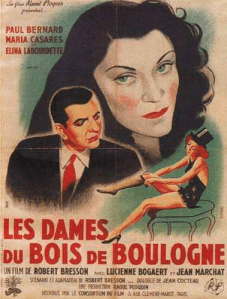
LesdamesduboisdeboulogneFrench film director Robert Bresson is famous for his use of non-professional actors. Prior to watching Les Dames du Bois de Boulogne, I had only seen one Bresson film, Pickpocket (1959), whose protagonist was most certainly not a professional actor. He shambled through the proceedings like a man on a heavy dose of tranquilizers, his movements slow, his eyes haunted. It was an interesting film, and one I may watch again some day, but it didn’t move me.
It wasn’t always this way. Les Dames du Bois de Boulogne, Bresson’s second film, features a cast of professional actors, and is based on a short novel by Denis Diderot with dialogue written by Jean Cocteau. The result is a polished and romantic film that completely engrossed me.

María Casares plays a haughty member of high society named Hélène who has long had a loosely defined relationship with a handsome gentleman named Jean (Paul Bernard). They may have other dalliances, but they are committed to each other, more or less. As the film begins, Hélène is on a date at the opera with a gentleman friend named Jacques (Jean Marchat), who warns her that Jean’s passion for her is cooling. When Jean later shows up at Hélène’s apartment, apologizing for having forgotten her birthday, Hélène tells him she would prefer they end their romance and become simply friends. She says this merely as a ploy, and she is devastated when he tells her he feels the same way, and leaves her apartment unperturbed by the momentous decision to end their affair. Left alone, she vows revenge.

The power of the film comes from Bresson’s ability to depict the emotions that rage behind placid exteriors. He is aided by Casares, whose performance is truly astounding. Without ever raising her voice or engaging in histrionics, she plays the “scorned woman” to the hilt. She is fascinating to watch, and sometimes even frightening. Part of the fascination comes from the fact that Jean and the young woman Hélène befriends, Agnès (Elina Labourdette), are unaware of how they are being manipulated by the cold Hélène. They are preoccupied with each other. More importantly, they are preoccupied with themselves, especially Agnès, who has a sordid past and doesn’t feel worthy of being loved by Jean. She hides her true self from him, but the longer she hides, the more devastating Hélène’s revenge will be.

Les Dames du Bois de Boulogne is a film about the redemptive power of love and the corrosive allure of vengeance. Many modern viewers may find the social mores on display in the film outdated, but if they look past the surface, they may find that the world hasn’t changed as much as they think it has. The lives of the Parisian leisure class may look and feel very different from the lives of most people who view the film today, but the story Bresson tells is timeless.

Christmas in Connecticut (Aug. 11, 1945)

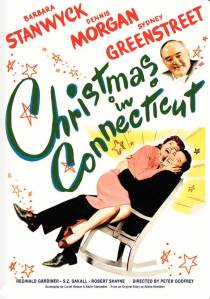
ChristmasInConnecticutBarbara Stanwyck was a superstar of screwball comedies, and she created one of the all-time great femmes fatales in Billy Wilder’s Double Indemnity (1944). Christmas in Connecticut is one of her minor efforts, but it’s amusing enough, and if you’re specifically looking for a holiday film, you could do a lot worse.
Stanwyck plays a renowned magazine food writer named Elizabeth Lane, a woman whose public persona might remind modern viewers of Martha Stewart. She writes about her perfect life in Connecticut, describing her beautiful snow-blanketed farm, her husband, her child, and the lavish meals she prepares. She has a loyal readership of both men and women. Women aspire to be like her and men dream of having a wife like her. In reality, however, Lane lives in a cramped studio apartment in Manhattan, types her columns next to a hissing radiator, and can’t boil an egg. She’s a talented writer, but that’s it. Her recipes all come from her restaurateur friend Felix (S.Z. Sakall). Her editor, Dudley (Robert Shayne), knows her secret, but her publisher, Alexander Yardley (Sydney Greenstreet), does not, and that’s where the trouble starts. Mr. Yardley thinks it would be terrific publicity to reward a handsome but malnourished young sailor named Jefferson Jones (Dennis Morgan), who survived a German U-Boat attack on his ship, with a Christmas dinner hosted by Lane and her husband. Who does not exist. At a country home that does not exist.

In classic screwball comedy fashion, confessing right away and letting the chips fall where they may does not even qualify as Plan C, so Lane enlists the help of an accomplice, her friend John Sloan (Reginald Gardiner), a pompous ass who keeps proposing to her even though she has no interest in marrying him. She agrees to finally get hitched if only he’ll go along with her deception. The fact that he owns a farm in Connecticut is key, as well. He doesn’t have a baby, but they can always borrow one from a neighbor, right?

It should go without saying that Jones and Lane are attracted to each other, but their incipient romance is complicated by the fact that Lane is pretending to be married with a child. When the film first came out, the NY Times review said that “Peter Godfrey, the director, has a good deal to learn about the art of telling a boudoir joke in the parlor and getting away with it.” Modern viewers, however, will probably find most of the jokes fairly tame. Jones’s seeming willingness to cuckold Lane’s “husband” does reach a fever pitch toward the end, but nothing very lascivious comes of it.

Anchors Aweigh (July 14, 1945)

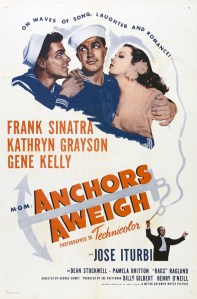
AnchorsAweighI don’t generally like musicals, but I loved Anchors Aweigh. It probably doesn’t hurt that I really like both Frank Sinatra and Gene Kelly, and this movie uses both of them to wonderful effect. Kelly’s dance sequences are all high points, and even Sinatra comports himself well in the one dance in which he has to match Kelly step-for-step. Although I can only imagine how many takes it took to get it right. Unlike today’s hyperkinetic editing styles, most of the dance sequences in Anchors Aweigh are done in what appear to be one take, or just a few at most.

In Anchors Aweigh, Sinatra and Kelly play sailors who are granted a four-day shore leave in Los Angeles due to extraordinary bravery. Kelly is a ladykiller with a woman in every port, while Sinatra is a dope when it comes to love. Kelly just wants to hook up with his beloved Lola, while Sinatra just wants a girl … any girl. Their amorous plans hit a snag, however, when they’re charged with the care of a Navy-worshipping runaway played by the very cute child actor Dean Stockwell. (Viewers familiar with Stockwell’s film and television work as an adult might wonder while watching this movie … what the hell happened to the guy?) Sinatra falls for the boy’s young aunt (Kathryn Grayson), while Kelly find himself drawn to her as well, which he resists, since his buddy has already spoken for her. But the draw is mutual. What’s a guy to do? Not to worry. With the help of orchestra leader José Iturbi (playing himself), everything will turn out O.K. in the end.

Sinatra gets top billing, even though Kelly is clearly the more seasoned performer. Sinatra may have been one of the most popular crooners in the country, but this was only his third real acting role on screen. At points he looks like a kid in a high school play who doesn’t know what to do with his hands. If you’d told anyone in 1945 that he’d win an Academy Award for Best Supporting Actor just eight years later they probably wouldn’t have believed you. But his natural charisma makes up for a lot. Iturbi is clearly not a professional actor, either, but the few scenes in which he has to perform (and not just conduct), he’s charming and fun to watch. He has a wonderful sense of comic timing, and projects warmth and empathy when he needs to.

Clocking in at two hours and 20 minutes, Anchors Aweigh is the kind of candy-colored fantasy that Hollywood just doesn’t make anymore. Everything but the kitchen sink is thrown in … there’s even a fantasy dance sequence in which Kelly dances in a cartoon world with an animated mouse (Jerry of Tom & Jerry fame). Its Bollywood-sized ambitions might turn off some modern viewers, but I thought it was great. At no point was I bored. I was entranced and delighted throughout.

The Clock (May 25, 1945)

TheClockThe Clock is the first film Judy Garland made in which she did not sing. She had specifically requested to star in a dramatic role, since the strenuous shooting schedules of lavish musicals were beginning to fray her nerves. Producer Arthur Freed approached her with the script for The Clock (also known as Under the Clock), which was based on an unpublished short story by Paul and Pauline Gallico. Originally Fred Zinnemann was set to direct, but Garland felt they had no chemistry, and she was disappointed by early footage. Zinnemann was removed from the project, and she requested that Vincente Minnelli be brought in to direct.
The Clock is the second film that Minnelli directed that starred Garland. The first was Meet Me in St. Louis (1944), which is one of the great American musicals, a big, Technicolor production with memorable songs and fine performances. It’s worth seeing, even if you’re not crazy about musicals. Minnelli and Garland were involved romantically during the filming of Meet Me in St. Louis, and they were married on June 15, 1945, shortly after The Clock was released.

The Clock seems like a deliberate attempt to make a film as different from Meet Me in St. Louis as Minnelli was capable of making. Filmed in crisp, luminous black and white, The Clock is an intimate story of two people. Cpl. Joe Allen (Robert Walker) is on leave in New York City for the weekend. While trying to find his way around Pennsylvania Station, he meets Alice Mayberry (Garland), a Manhattan “girl next door” who works in an office and isn’t initially thrilled that Joe takes in interest in her. She breaks her heel and he offers to help her, but he’s so pushy that it’s a bit of a turn-off. He refuses to take “no” for an answer, following her onto a bus, questioning her incessantly, and attempting to arrange to see her again. He also does it in such a naïve, corn-pone manner that it’s obvious that a polite girl like Alice would have a really hard time just telling him to shove off. Part of the problem, for me at least, is that Walker just doesn’t have the necessary charisma to pull off the “aw shucks” persona the script calls for and get away with it. In any case, after some indecision (and after ignoring her roommate’s advice that the young serviceman she met is “just looking for a pick-up”), she goes back to the Astor Hotel to meet him under the clock where they first met. They spend the entire night together, exploring New York City, and even end up helping a milkman (James Gleason) make his appointed rounds after a drunk (Keenan Wynn) punches him in the face, partially blinding him. Over the course of the night, they fall in love, but are separated on a busy subway the next morning. How will they ever find each other in a city of seven million people? (I don’t want to give anything away, but the way they find each other again won’t come as a surprise to anyone who’s been paying attention.) After they reconnect, Joe asks Alice to marry him, and she accepts his proposal, but they have to run through a mess of red tape to get the necessary documentation to get married immediately, before Joe has to ship out again.

The Clock has a lot to recommend it. Garland looks beautiful, and her performance is natural and engaging. Walker only has one mode, “wanting Alice,” but Garland wonderfully expresses confusion, excitement, and ambivalence on her path to falling in love. Also, the film does a good job of playing through the stages of love, from initial infatuation to full-blown romantic love, marriage, and even the quiet vicissitude of the “morning after.” The film looks fantastic. Minnelli recreated New York City on the MGM backlots in Culver City, California, mixing sets with stock footage, but I never realized this while watching the movie, and I live in New York. He reportedly spend almost $70,000 recreating Penn Station, and it certainly doesn’t look like a set. (The original Penn Station was torn down before I was born so I can’t say if it’s perfectly accurate, but it certainly fooled me.) I liked The Clock, and would recommend it to anyone who likes old movies, especially anyone who loves tales of wartime romance, but a more interesting actor than Walker in the lead role might have elevated it to a truly great film.

This is a love story, but it’s a melancholy one, especially during its second half. I’m not sure if the sense of sadness that pervades the film is by design, or is due to the fact that both stars were plagued with personal problems throughout filming. Garland became increasingly addicted to the prescription drugs the studio gave her to control her weight and perk her up, and Walker had recently found out that his wife, actress Jennifer Jones, had been cheating on him with producer David O. Selznick and wanted a divorce. Reportedly, Garland would often find Walker drunk in L.A. bars during filming and she would help him sober up during the night so he could appear in front of the cameras the next day.

I’ll Be Seeing You (Jan. 5, 1945)

I'll Be Seeing You
I’ll Be Seeing You (1944)
Directed by William Dieterle and George Cukor
Selznick International Pictures / United Artists

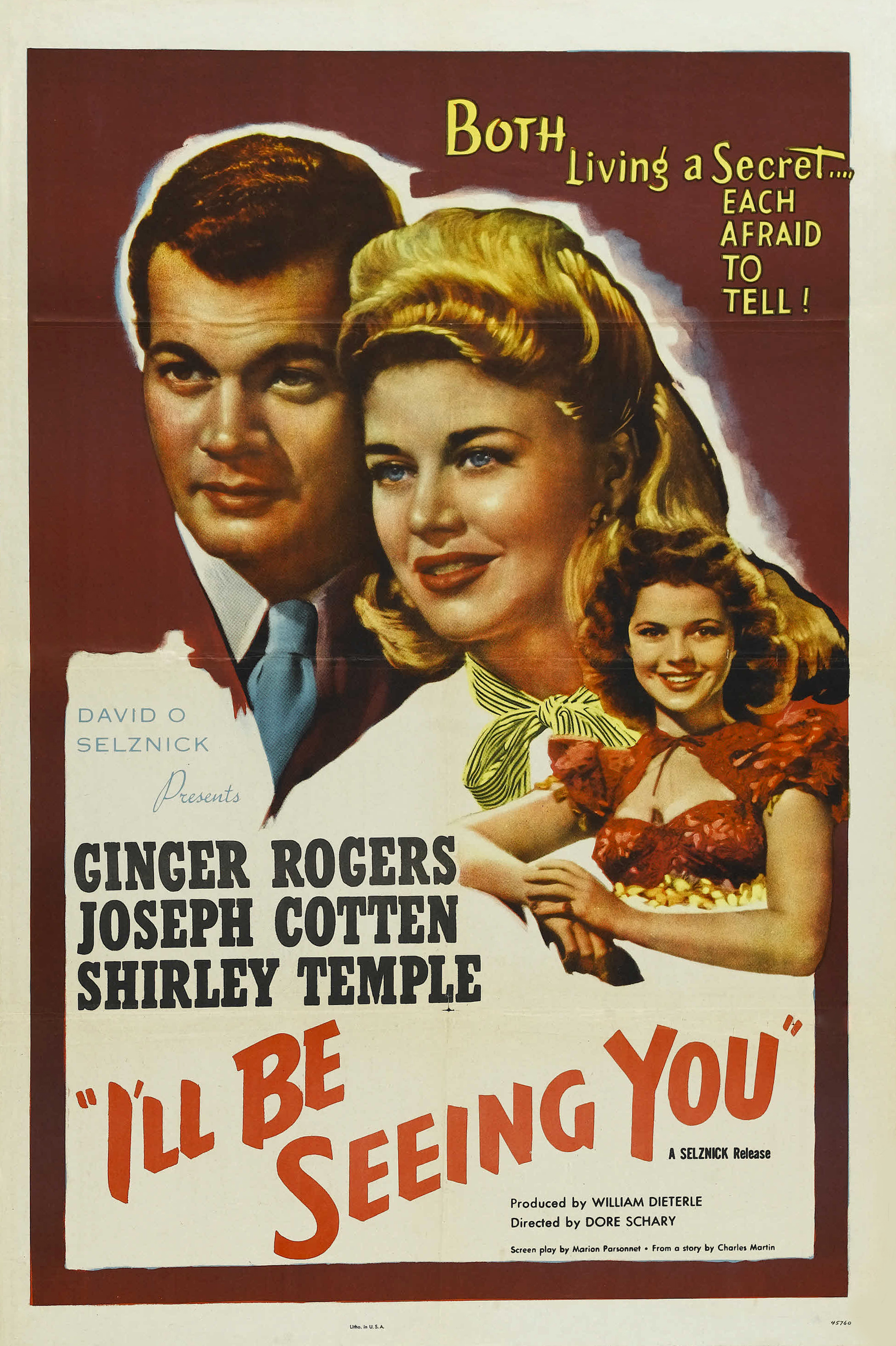
William Dieterle directed this film, which is a David O. Selznick production starring Joseph Cotten as a shellshocked Army officer on leave and Ginger Rogers as a prisoner on an eight-day furlough.

Based on a radio play called “Double Furlough,” I’ll Be Seeing You is bittersweet and beautifully acted. The nature of Rogers’s crime is not explained until well into the film, and Cotten’s mental condition is hinted at, but not made explicit until the viewer has gotten a chance to know the characters.

The film overall is great, but there’s one scene in particular that really stayed with me. Cotten and Rogers go to a flag-waving war movie and the camera stays on his face while the viewer hears the sounds of explosions, gunfire, and screaming. Cotten holds his hand to his chin, desperately trying to keep his composure during the date. It’s an upsetting scene, and it’s surprising to see such a realistic, sensitive portrayal of post-traumatic stress disorder in a film made while American involvement in World War II was at its peak.

I’ll Be Seeing You beautifully depicts a fragile, growing romance between two likable people who each have something they desperately try to hide from the other. Not only is this a beautifully told love story, it’s also a great story about how hard it is to trust someone else, even when your happiness and sanity both depend on it.