Tag Archives: Universal Pictures

The Egg and I (March 21, 1947)

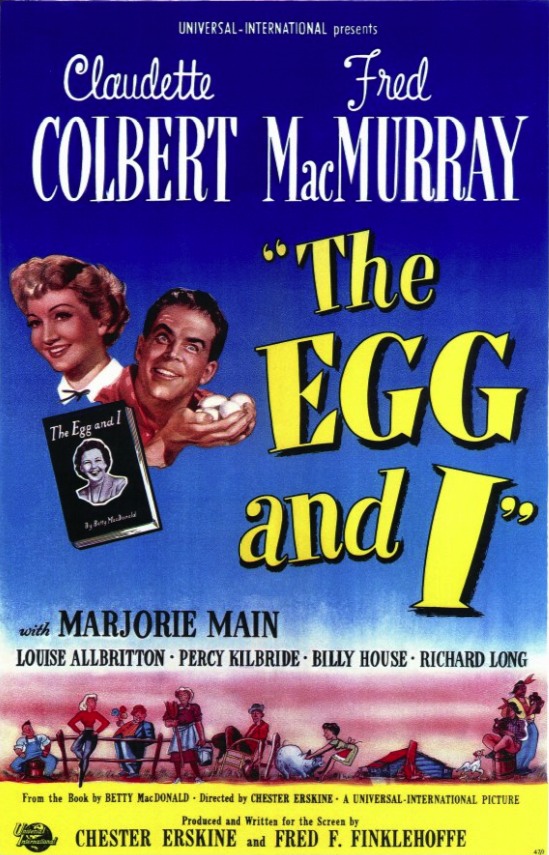
Chester Erskine’s The Egg and I begins with Claudette Colbert dressing down a comical, goggle-eyed Pullman porter. (Was there ever any other kind of Pullman porter in the movies?) The poor fellow drops an egg on the floor of the train car. When he says, “It’s just an egg,” Colbert flips her wig and exclaims, “Just an egg?!?” She asks him if he’s ever stopped to consider how much work it takes to bring an egg into this world. After the chastened porter scurries out, she addresses the camera directly and says, “And I’ll bet you think an egg is something you casually order for breakfast when you can’t think of anything else. Well, so did I once, but that was before the egg and I.”

And then, after the opening credits roll, we’re introduced to Betty MacDonald (played by Colbert), who goes along with her goofily happy, wild-eyed husband Bob’s plan to move out to the country and run a farm.

Bob MacDonald (Fred MacMurray) served in combat in Okinawa, and he’s so happy to be back home that he’s going to make good on his foxhole promise to himself to devote himself to growing things from the soil and raising livestock. Returning to the land. Getting back to basics. The whole nine yards.

Bob actually seems a bit crazy. If this wasn’t a light comedy, I’d say Bob was suffering from post-traumatic stress disorder manifesting as mania. But since it’s a comedy, his zeal is played for laughs. He’s insensitive to everything going on around him. When Betty falls off the roof into a washbucket, he looks down and asks, “What are you doing down there?” He also buys a dog named Sport who’s already bitten everyone in town and can’t be too near livestock. (I hope he didn’t pay too much for him.)

The Egg and I was based on the 1945 best-seller by Betty MacDonald, the author of the popular series of Mrs. Piggle-Wiggle books for children. The Egg and I detailed her real-life experiences as a young woman living on a small chicken farm in Washington State with her first husband, Robert Heskett, from 1927 to 1931. I haven’t read the book, but by all accounts it’s more witty and acerbic than the film adaptation, which suffers from an overabundance of broad comedy.

If you’re in the mood for a slapstick barnyard comedy, however, The Egg and I offers everything you’ll expect — goats eating hats, ramshackle structures, leaky roofs, beds with rusty springs, leaky buckets, rotten boards, Betty sawing off the limb of the tree she’s sitting on, Betty wrestling with a sow and ending up in the mud, and hillbilly stereotypes galore, such as Bob and Betty’s neighbors, “Ma” and “Pa” Kettle, whose front yard has a hand-painted sign that says “beware of the childrun.” When Betty discusses the oldest boy, Tom Kettle (Richard Long) with Ma, and says, “He ought to go to college,” Ma responds, “College?!? What fer?”

Marjorie Main and Percy Kilbride’s earthy performances as Ma and Pa Kettle were so popular in The Egg and I that they went on to star in nine more films as the characters, Ma and Pa Kettle (1949), Ma and Pa Kettle Go to Town (1950), Ma and Pa Kettle Back on the Farm (1951), Ma and Pa Kettle at the Fair (1952), Ma and Pa Kettle on Vacation (1953), Ma and Pa Kettle at Home (1954), Ma and Pa Kettle at Waikiki (1955), The Kettles in the Ozarks (1956), and The Kettles on Old MacDonald’s Farm (1957). Main was even nominated for an Oscar for Best Supporting Actress for her role as Ma Kettle in The Egg and I. (Unsurprisingly, she lost out to Celeste Holm, who co-starred in Gentlemen’s Agreement.)

While The Egg and I was a huge hit in 1947, I can’t say I really enjoyed it. It relied too much on slapstick humor, and Colbert and MacMurray were both much too old for the roles they were playing. I thought it was mostly dumb, and you couldn’t pay me to watch any of the Ma and Pa Kettle films that followed it.*

*This is actually a lie. If you’re interested in paying me to watch any of the Ma and Pa Kettle films, please contact me.
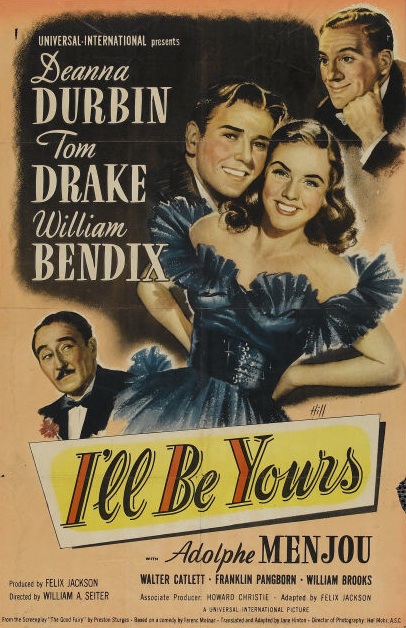
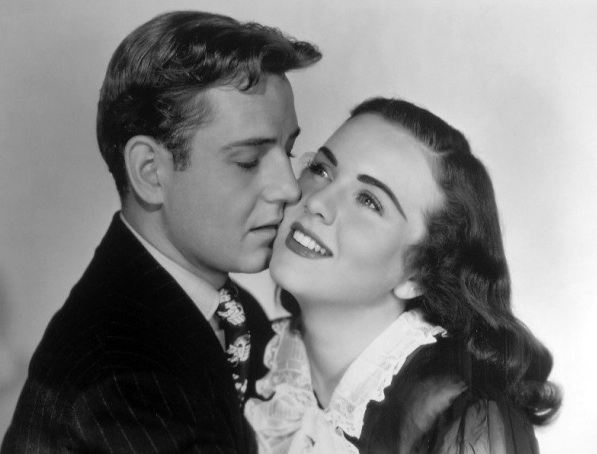
I’ll Be Yours (Feb. 2, 1947)

I really liked I’ll Be Yours, and not just because it stars my time-travel girlfriend, Deanna Durbin. It’s a light and frothy romantic comedy — hardly my favorite genre — but the performers are appealing, the humor is genuinely funny, and the musical numbers are great.

Durbin herself can’t be counted among the film’s fans. She retired from acting at the age of 27, after a 12-year career in the movies, and retired to France with her husband. In an interview with David Shipman in 1983, Durbin called her last four films — I’ll Be Yours, Something in the Wind (1947), Up in Central Park (1948), and For the Love of Mary (1948) — “terrible.”

I imagine that Durbin’s negative assessment of her last several films was at least partly due to her dissatisfaction with Hollywood. If she was yearning for a “normal” life and looking for a sign that she should continue acting, I’ll Be Yours is neither groundbreaking nor artful enough to qualify. But if you’re a fan of Deanna Durbin, I’ll Be Yours is wonderful entertainment. She’s as lovely and appealing in it as she was in everything else, and her singing voice was unparalleled among Hollywood ingenues.

In I’ll Be Yours, Durbin plays a naive, wide-eyed young woman with the unwieldy name of Louise Ginglebusher who leaves her hometown of Cobleskill, NY, for a life of excitement in Fun City. While eating lunch on a ridiculously tight budget, she’s befriended by a cranky but kindhearted waiter named Wechsberg (played by William Bendix, another performer who was able to overcome mediocre material).

She’s given a job as an usherette in a palatial movie house by a fellow native of Cobleskill, Mr. Buckingham (Walter Catlett), and shown kindness by a young and handsome lawyer named George Prescott (Tom Drake) who sports an unfortunate Van Dyke beard.

After Wechsberg sneaks Louise into a swanky party he’s working at the Savoy Ritz, she’s snookered into performing a musical number by a philandering millionaire named J. Conrad Nelson (Adolphe Menjou). Naturally, she pulls it off with aplomb, and the song she sings — “Granada” — is a high point of the film.

This leads to J. Conrad Nelson offering Louise a starring role in the Broadway musical he’s financing, but to fend off his advances she invents a husband for herself. In doing so, she underestimates the tenacity of Nelson’s libido. Nelson demands to know who her husband is so he can be put on his payroll and eventually be bought off and done away with.

Forced to produce a husband, Louise turns to Prescott, but his old-man beard will have to go.

All of this is ridiculous, of course, but it’s a thoroughly entertaining vehicle for a quartet of appealing performers. And the music is wonderful.

Felix Jackson wrote the script, which was adapted from Preston Sturges’s The Good Fairy (1935), which was based on a play by Ferenc Molnár. William A. Seiter directed the film.

Hungry Hill (Jan. 7, 1947)

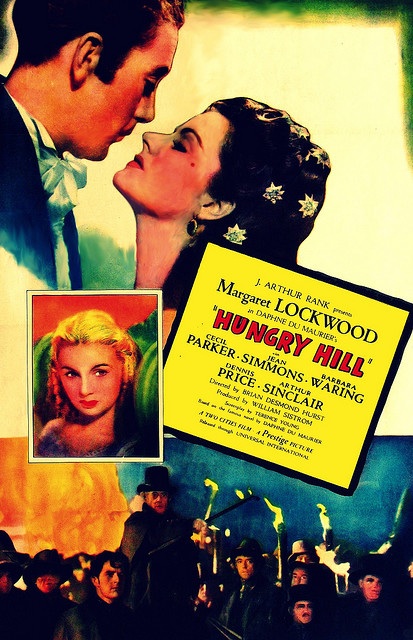
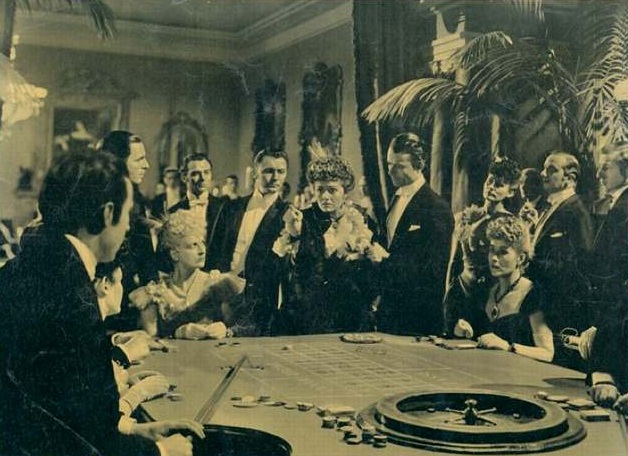
Daphne Du Maurier’s 1943 historical novel Hungry Hill covers a period of 100 years (1820 to 1920) in the lives of five generations of two feuding Irish families. Brian Desmond Hurst’s 1947 film adaptation narrows the scope of the story to three generations and a roughly 50-year timespan, but it’s still a lot to take in over the course of just 100 minutes. If you’re a fan of romantic yet gloomy historical melodramas, Hungry Hill is a filling dish. And if you’re not, Hungry Hill might leave you feeling stuffed and queasy.

Margaret Lockwood gets top billing (and the most time onscreen) as Fanny Rosa, a beautiful and headstrong young woman who marries into the wealthy Brodrick family, who live in a castle called “Clonmere” in County Cork. The patriarch of the clan, John Brodrick (Cecil Parker), has several children, John (Dennis Price), Henry (Michael Denison), and Jane (Jean Simmons). (Honestly, there are a lot of characters in Hungry Hill, and he might have had more children than those three, but they’re the only ones I was able to get a handle on.)

The patriarch of the Donovan clan, old Morty Donovan (Arthur Sinclair), violently objects to John Brodrick’s plans to mine for copper in Hungry Hill, and curses Brodrick and his entire family. (Hungry Hill is located in the beautiful Caha Mountains, which I’ve hiked, so I was disappointed that there wasn’t more location footage — most of the film takes place in drafty old rooms and the bowels of the Brodrick copper mine.)

While the copper mine ends up providing plenty of employment for the Donovan clan and other roustabouts, tensions are always simmering. A labor riot leads to the death of one young man, and a visit of reconciliation leads to a deadly typhoid infection.

Hungry Hill follows a familiar three-generation rise-and-fall story arc. By the time Margaret Lockwood’s hair is brushed through with gray and her face is lined with age makeup, it should come as no surprise to anyone that her handsome son, Johnnie Brodrick (Dermot Walsh), is drinking a bottle of whiskey a day, loving and leaving the ladies, and frittering away his family’s fortune. The scenes between Johnnie and his mother are well-played and affecting, but by that point in the movie I was starting to lose interest in the dismal goings-on.

One thing I can recommend unequivocally is the casting, which is excellent. Not only does Hungry Hill feature the cream of the crop of up-and-coming British actors, but the Brodrick men really do all look like members of the same family, and the Donovans resemble one another, too. Of course, this is a double-edged sword, since it’s sometimes difficult to keep them all straight.

Hurst himself clearly didn’t hold this film in the highest regard. In a letter to John Ford dated April 9, 1951, in which he sang the praises of Siobhan McKenna, who played Kate Donovan in Hungry Hill (Ford was interested in casting her in his film The Quiet Man), Hurst wrote, “There must be a copy of a rather indifferent film I made of Daphne du Maurier’s even more indifferent story ‘Hungry Hill.’ You could get hold of this through Eagle-Lion, but don’t inflict the whole of the picture on yourself. Just see about the last four reels, because she doesn’t come in till then.”

Great Expectations (Dec. 26, 1946)

I’ve never held Charles Dickens in the high esteem that many others do. Granted, I’ve only read one of his novels in its entirety — Hard Times (1854). Based solely on that book and the story “A Christmas Carol,” which I’m pretty sure I’ve read in its original form at least once, Dickens was a splendid caricaturist. I could picture every facet of the grotesque antagonists and tenacious protagonists of Hard Times. They looked and acted like real people. But it was all on the surface. None of them felt like real people, and I was never convinced that they had internal lives or realistic motivations. I’m a big fan of psychological realism and believable characters, so if I’m going to read a Victorian novel, I’d much rather it be by George Eliot or Thomas Hardy than by Dickens.

The only other Dickens novel I’ve ever taken a crack at was Great Expectations (1861), which was assigned reading in my 9th-grade English class. I never finished it. (Sorry, Ms. Lee-Tino.)

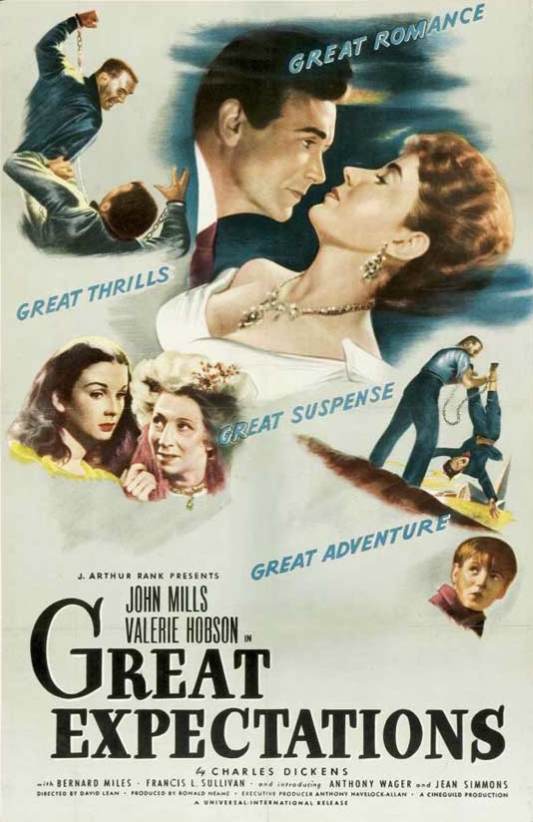
But based on the roughly 25% of the novel that I did read, David Lean’s Great Expectations seems like a pretty solid adaptation. Orphaned boy Phillip “Pip” Pirrip (Anthony Wager) lives with his ill-tempered older sister (Freda Jackson) and her husband, Joe Gargery (Bernard Miles), a kind-hearted blacksmith. One night, out on the moors, Pip is accosted by an escaped convict, Abel Magwitch (Finlay Currie), who makes him promise to return with food and a file with which to saw through his chains. The terrified Pip keeps his promise, but the authorities arrive on the scene, Magwitch attacks another escapee, and they’re both taken back to prison.

Soon, we meet one of Dickens’s great grotesque characters, Miss Havisham (Martita Hunt), a mentally twisted shut-in who is gleefully brainwashing her beautiful young charge Estella (Jean Simmons) to be the ultimate heartbreaker, and punish men who are foolish enough to fall in love with her. Pip is sent to Miss Havisham’s on a regular basis to improve his manners, but it should go without saying that he ends up receiving a very different kind of education.

All of this is very well done, and beautifully filmed — especially the scenes at night on the moors. The problem for me came after about 40 minutes, when several years pass and Anthony Wager is replaced by John Mills — as the adult version of Pip — for the rest of the picture. Although Pip has only supposed to have aged a few years (from boyhood to manhood), Mills was 38 years old, and the effect is jarring. He’s perfectly handsome, but he just doesn’t look like a young man starting out in the world. The other major actor to change is Estella, which is even more jarring. The gorgeous 17 year-old Jean Simmons is replaced by the 29 year-old Valerie Hobson, who is far less charming than Simmons and looks nothing like her.

Great Expectations premiered in the United Kingdom on December 26, 1946, and opened in the United States during the spring of 1947. At the 20th Academy Awards, it was nominated for best picture, David Lean was nominated for best director, and the film was nominated for best adapted screenplay. It won two awards, one for best black and white cinematography and one for best black and white art direction.

I enjoyed it, but the change of actors in midstream and the general Dickensian nonsense of the plot kept me at arm’s length. Great Expectations is beloved by a great many people, however, so if it sounds as if it’s up your alley, by all means check it out.

A Matter of Life and Death (Dec. 25, 1946)

Stairway to Heaven
A Matter of Life and Death (1946)
Directed by Michael Powell and Emeric Pressburger
The Archers / Eagle-Lion / Universal Pictures

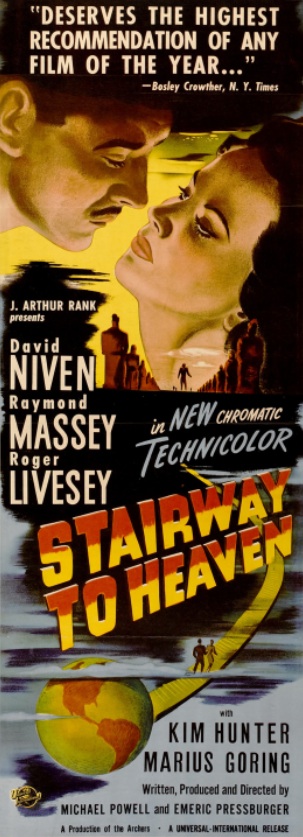
Michael Powell and Emeric Pressburger’s brilliant fantasy A Matter of Life and Death premiered in the United Kingdom on November 1, 1946, and later that year in New York City, on Christmas day, retitled Stairway to Heaven. (After World War II, the word “death” was verboten in film titles for awhile in the United States.)

The film begins with the following statement: “This is a story of two worlds — the one we know and another which exists only in the mind of a young airman whose life and imagination have been violently shaped by war. Any resemblance to any other world, known or unknown, is purely coincidental.” It’s a playful opening, and can be interpreted in more than one way. “The Archers” (the name Powell and Pressburger used for their partnership) had a light touch, and were able to weave magical realism into their stories without ever seeming childish or silly.

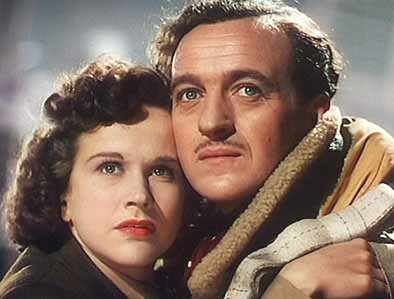
After a cheeky narrated tour through the cosmos, we see Squadron Leader Peter Carter (David Niven), his Lancaster bomber in flames and about to crash. Peter’s parachute is shot too full of holes to function properly, and he is desperately trying to reach someone on the radio. Next to him lies the body of Flying Officer Bob Trubshawe (Robert Coote). Peter manages to get in touch with June (Kim Hunter), an American radio operator, and pours out his heart to her. Finally, he professes his love before leaping out of the bomber without a parachute.

The scene in which Niven wakes up in the pounding surf and believes himself in the afterlife is a masterpiece of subtle humor. He stands, breathes deeply, and walks toward the beach with a beatific gaze, shedding his earthly raiments. The first person he sees is a boy playing a pipe, tending sheep, so why wouldn’t he think he’s passed on to his final reward?

Meanwhile, his mate Bob finds himself in the “other place,” an otherworldly bureacracy in which angel wings arrive en masse on long runners, ready to be attached to newly arrived bodies, and businesslike clerks take names and hand out assignments. Bob is told that there was a clerical error that caused Peter to fall through the cracks, and that he’ll need to be collected forthwith.

The scenes on terra firma are filmed in beautiful Technicolor, while the scenes in the afterlife are filmed in black and white. (Technically it’s “monochrome Technicolor,” not proper black and white, but since I’m not as big of a film nerd as Martin Scorsese, I couldn’t tell the difference.) It’s a simple but brilliant stylistic choice, and it’s way ahead of its time. Films in the ’30s or ’40s that mixed black and white with color film invariably depicted the fantastical world in color and the prosaic world in black and white. To do it the other way around looks forward to the ’80s, when black and white was coming back into vogue, and filmmakers like Scorsese and David Lynch showed just how surreal and otherworldly black and white film could look.

Kim Hunter and David Niven

June and Peter fall in love, but for Peter, time occasionally stops all around him while a ridiculous French aristocrat from the other world known as “Conductor 71” (Marius Goring), pays him visits.

June’s friend Doctor Reeves (Roger Livesey) believes that Peter’s visions aren’t supernatural, but symptoms of a brain injury. Eventually this “matter of life and death” comes to a head as Peter is operated on in our world while simultaneously facing trial in the other.

A Matter of Life and Death is a fantastic film that is satisfying on both a technical level and an emotional level. The performances are all wonderful, and Powell and Pressburger are masterful filmmakers.

Incidentally, in a 2004 poll of 25 film critics in Britain’s Total Film magazine, A Matter of Life and Death was named the second greatest British film of all time, sandwiched between Get Carter (#1) and Trainspotting (#3).

The Brute Man (Oct. 1, 1946)

Actor Rondo Hatton, whose face was so unique that it has been immortalized in bust form as a series of horror awards, was reportedly voted the best-looking boy in his class at Hillsborough High School in Tampa, Florida.

Whether or not this story is apocryphal, we do know that Hatton didn’t always look the way he did when he starred as the hideous “Creeper” in a series of low-budget horror films in the 1940s.

Born on April 22, 1894, Hatton worked as a sportswriter and served in World War I, after which acromegaly began to change his facial features. Acromegaly is a syndrome often associated with gigantism. It usually manifests in adulthood or middle age, and its progression is slow. It involves swelling of the soft tissues — particularly the hands, feet, nose, lips, and ears — general thickening of the skin, the swelling of internal organs, and the pronounced protrusion of the brow and lower jaw.

While working as a reporter for the Tampa Tribune, he was spotted by director Henry King, who was in Florida to make Hell Harbor (1930). King hired Hatton for a bit part, and Hatton eventually moved to Hollywood, where he appeared in a series of small roles, most notably as a contestant in an “ugly man competition” in The Hunchback of Notre Dame (1939) and as a member of the lynch mob in The Ox-Bow Incident (1943). He first appeared as a character called “The Creeper” in the Sherlock Holmes thriller The Pearl of Death (1944), and then twice more in two horror films that were unrelated to the Sherlock Holmes series, House of Horrors and The Brute Man, both of which were directed by Jean Yarbrough.

In House of Horrors, which was released on March 29, 1946, an unsuccessful sculptor saves the Creeper from drowning, and gets him to murder all the critics who have written unfavorably about his cubist “tripe.”

In The Brute Man, a once-handsome B.M.O.C. (big man on campus) who was disfigured in a lab accident prowls the city, killing for revenge. Spinning newspapers with headlines like “Back Breaker Claims Second Victim” fill in the missing details, as the viewer wonders why police can’t find the most unique and strange-looking person in the city, who is spotted in public plenty of times.

After one of his murders, the Creeper takes refuge in the home of a blind piano teacher named Helen Paige (Jane Adams, who unfortunately never appears in that pink satin and white ermine number we see her wearing on the lobby card above). For no reason I could discern, she lies to the police about someone being in her apartment, and the Creeper climbs out her window and makes his escape.

We eventually learn that the Creeper used to be a boy named Hal Moffet, a football star at Hampton University, who was popular and handsome, although his temper made him some enemies. He and his friend Clifford Scott (Tom Neal) were in love with the same girl, Virginia (Jan Wiley). The night before an oral exam in chemistry, Cliff fed the academically impatient Hal the wrong answers so he’d be kept after class and not be able to score with Virginia. Naturally, the professor did what any professor would do with a student who bungled a quiz; he kept him after class working on a complicated and dangerous experiment. After seeing Cliff and Virginia through the window, Hal realized he’d been deliberately crossed up, and smashed a flask of chemicals on the floor. Unfortunately, the cloud of caustic smoke damaged his face, and he’s now hell-bent on getting revenge on everyone he thinks wronged him. Last on his list are Cliff and Virginia, who are now married.

This story is, of course, a burlesque version of reality. Acromegaly, not a lab accident, was responsible for Hatton’s appearance, but he was a football player and handsome young man whose appearance gradually became monstrous. (The publicity department of Universal Studios actually claimed that Hatton’s facial deformities were the result of a mustard gas attack in World War I.)

Hatton died on February 1, 1946, before either House of Horrors or The Brute Man were released. He was 51 years old, and his death was caused by a heart attack that was directly related to his disorder. He wasn’t much of an actor, but his appearance alone telegraphed pathos, and the renewed interest in Universal’s horror films in the ’60s and ’70s eventually turned him into a horror icon.

The Killers (Aug. 28, 1946)

The Killers (a.k.a. Ernest Hemingway’s The Killers) was the screen debut of Hollywood legend Burt Lancaster. It was also an early but significant role for another legend, the beautiful Ava Gardner, who had been appearing onscreen in uncredited parts and small roles since 1941.

Lancaster plays a former boxer named Ole “Swede” Andersen and Gardner plays Kitty Collins, the femme fatale who ensnares him.

The film is based on Hemingway’s 1927 short story “The Killers,” which features his recurring character Nick Adams, who sits in a diner and witnesses two hit men come in and wait for a Swedish boxer, whom they are there to kill for unstated reasons. Nick and the black cook, Sam, are tied up in the kitchen, but eventually the killers leave when the boxer doesn’t show up. Nick gets out of his bonds and runs to the rooming house where the boxer lives. He warns him about the men who are there to kill him, but the boxer is resigned to his fate.

At first glance, the less than 3,000-word short story seems a strange choice to be adapted as a feature-length film. Hemingway once said, “That story probably had more left out of it than anything I ever wrote.”

Instead of just using the title and Hemingway’s name to sell the picture, as many producers would have done, Mark Hellinger’s The Killers takes the story as a jumping-off point, and spends the rest of the picture filling in the details of the boxer’s life, and eventually we learn why he was murdered. The first 12 minutes are a faithful adaptation of Hemingway’s short story, except that the killers (Charles McGraw and William Conrad) don’t constantly use the N-word to describe Sam, the cook. Otherwise the dialogue is largely unchanged. It’s a reminder of how much Hemingway’s clipped prose and naturalistic dialogue influenced the hard-boiled school.

When Nick (Phil Brown) runs to the rooming house to warn the Swede about the killers, we get our first glimpse of Lancaster’s big frame, indolently lying in bed, his face in the shadows. Nick can’t understand his passivity. The Swede refuses to even get out of bed when Nick tells him that he’s about to be murdered. “I did something wrong once,” he mutters.

There’s no twist ending to this section of the tale. Conrad and McGraw walk into the Swede’s room with their revolvers drawn and calmly pump ten bullets into him.

Enter Jim Reardon (Edmond O’Brien), an investigator for the Atlantic Casualty & Insurance Company. Nick and the Swede worked together at a gas station owned by Tri-States Oil, which carries a group policy on its employees. (It’ll be hard for fans of the radio show Yours Truly, Johnny Dollar not to think of O’Brien’s run on the show when he announces his profession, since O’Brien played the insurance investigator with the “action-packed expense account” from 1950 until 1952.)

Reardon’s investigation leads him to a payroll robbery that was masterminded by crime boss Big Jim Colfax (Albert Dekker) and netted more than a quarter of a million dollars. Reardon believes the Swede was involved, and his boss, R.S. Kenyon (Donald MacBride), grudgingly gives him a week to solve the case.

The story stops and starts, which sometimes keeps the viewer at a distance from the Swede, but in exchange we are introduced to one interesting supporting character after another; a chambermaid who once stopped him from committing suicide (Queenie Smith), a Philadelphia police lieutenant named Sam Lubinsky (Sam Levene) who grew up with the Swede and married the girl he left behind, the Swede’s elderly, astronomy-obsessed cellmate Charleston (Vince Barnett), as well as some of his former partners in crime.

Watching this film today, it’s hard to separate Burt Lancaster from the role he is playing. Lancaster had such a long, interesting career, and he was never type-cast (except possibly as a large guy with a square jaw and big teeth). Lancaster portrayed many intelligent and sensitive characters, so it’s easy to forget what a big, dumb brute the Swede is. He feels pain, both physical and emotional, but he has no depth of character. Once he falls for the alluring Kitty, he will do anything to have her, but he probably doesn’t even understand why.

Reardon may appear onscreen for nearly as much time as the Swede, but he makes less of an impression. Lancaster’s tortured performance is the dark soul of the film.

The expanded story of The Killers has a lot of moving parts, and could have been a complete mess, but the screenplay is excellent, and keeps everything moving without becoming confusing. It’s credited to Anthony Veiller, but Richard Brooks and John Huston also worked on it. (Huston’s name was left off the credits because he was under contract to Warner Bros.) Robert Siodmak’s direction is crisp and assured. He and his cinematographer, Elwood Bredell, create a dark, beautifully lit world full of shadows and smoke. Miklós Rózsa’s score is top-notch — free of the treacly strains of neo-Romanticism that dilute the effectiveness of too many film noirs from the ’30 and early ’40s.

This is a must-see for all fans of noir.

Black Angel (Aug. 2, 1946)

Black Angel was directed by Roy William Neill, the dependable craftsman responsible for eleven of Universal’s fourteen Sherlock Holmes pictures. Black Angel isn’t a masterpiece, but it’s slick, well-made entertainment and a nice opportunity to see what Neill was capable of when he stepped outside of the formula of the Basil Rathbone/Nigel Bruce Holmes films.

The screenplay, by Roy Chanslor, is based on Cornell Woolrich’s novel of the same name. Woolrich was a prolific author, and an instrumental figure in film noir, even though his actual work for the film industry occurred only during the silent era and was brief and unhappy. He apparently wrote a few screenplays under the name “William Irish,” which was one of his pseudonyms. (“George Hopley” was the other.) He was also briefly married as a young man, but it was annulled after less than three years. After that, he headed back to New York City, his hometown, and went back to live with his mother.

Woolrich mostly kept to himself. A closeted homosexual with a drinking problem, Woolrich found his niche writing stories for the pulps. He was a frequent contributor to publications like Black Mask and Argosy. More screenplays for film noirs were adapted from Woolrich’s stories and novels than from the the work of any other crime writer, but that’s not the only reason he was instrumental to the genre. The inky darkness of noir is evident in the titles of his books alone; The Bride Wore Black (1940), The Black Curtain (1941), The Black Path of Fear (1944), and Rendezvous in Black (1948) are just a few. The two novels of his I’ve read were not particularly well-written — he wasn’t a great stylist like Raymond Chandler or Dashiell Hammett — but he conveyed in his writing a sense of overwhelming dread and alienation, both emotions that are central to film noir.

Also, perhaps due to his his drinking, Woolrich’s characters frequently suffer from amnesia and alcohol-induced blackouts. In Fright, written in 1950 under the name George Hopley, a young man is convinced he has committed murder while blind drunk, but it’s not clear for most of the novel whether he actually has or not.

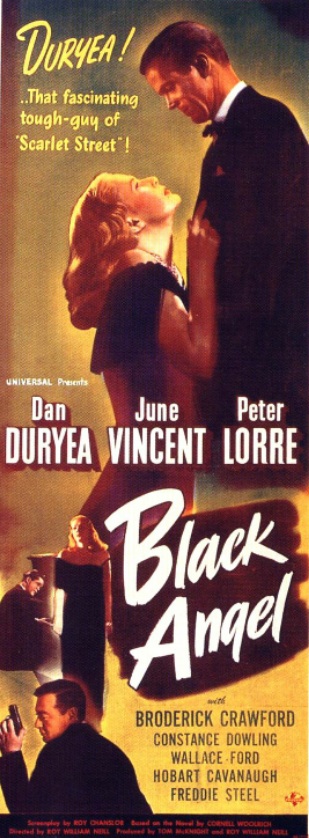
This is a theme that rears its head once again in Black Angel, in which a regular Joe named Kirk Bennett (John Phillips) is convicted of the murder of a blackmailing singer named Mavis Marlowe (Constance Dowling). Bennett’s wife Catherine (June Vincent, who bears a fairly strong resemblance to Dowling) believes he is innocent, and sets out to prove it. She enlists the aid of Martin Blair (Dan Duryea), a composer and piano player who seems like a decent guy despite his alcoholism and unhealthy obsession with the murdered woman. (In the memorable first scene of the picture, we see Duryea leaning against a wall, staring up at the high rise apartment in which Mavis lives.) As Bennett’s execution date looms, the two pose as a professional singer and piano player in order to get closer to their prime suspect, an oily club owner named Marko (Peter Lorre).

One of the things I liked best about Black Angel was the opportunity to see Duryea in a sympathetic role. He wasn’t perpetually cast early in his career as villains and sniveling punks because he lacked charisma, he had plenty. But he was whip-thin and had a perpetual scowl, and he was good at playing nasty characters. The poster for Black Angel calls him “that fascinating tough guy of Scarlet Street,” and that movie and this one were both instrumental in creating his new image as a violent, dangerous, and sexy antihero.

Sadly, this would be Neill’s last film. He died of a heart attack on December 14, 1946, while visiting relatives in England. He was 59 years old. Neill was a superior craftsman, and his Sherlock Holmes films were some of the most entertaining and well-made programmers of the ’40s. He made all kinds of films, including the campy horror movie Frankenstein Meets the Wolf Man (1943) (a personal favorite), but Black Angel showed what he was capable of in the hard-boiled noir/mystery genre. It’s a shame he wasn’t able to make more movies like it.

Dressed to Kill (June 7, 1946)

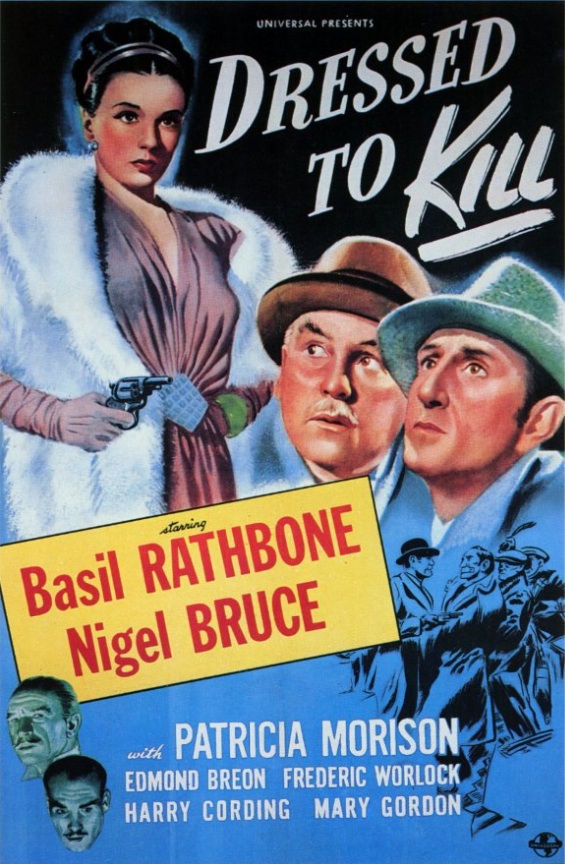
Dressed to Kill was director Roy William Neill’s eleventh Sherlock Holmes film, and the fourteenth and final film starring Basil Rathbone as Holmes and Nigel Bruce as his loyal sidekick Dr. John H. Watson.

This was the year that Rathbone said goodbye to the character. His last appearance on the Mutual Broadcasting System radio program The New Adventures of Sherlock Holmes was in “The Singular Affair of the Baconian Cipher,” broadcast on Monday, May 27, 1946. The next week’s time slot was filled with the summer replacement program The Casebook of Gregory Hood, which starred Gale Gordon as an antique dealer and gourmand living in San Francisco who solved mysteries in his spare time. Like the Sherlock Holmes program, the scripts were written by Holmes aficionados Anthony Boucher and Denis Green. The show was fun, but Gregory Hood was no Sherlock Holmes.

Holmes returned to the airwaves in October, on the American Broadcasting Company. Nigel Bruce reprised his role as Dr. Watson, but Tom Conway took over the role of Sherlock Holmes (although Bruce received top billing). Rathbone, who felt that his association with the character, whom he had played on a regular basis since 1939, was killing his career, so he returned to New York City and the theater. He won a Tony in 1947 for his role in the Broadway play The Heiress, but little significant stage work presented itself to him in the years to come. He had bad luck with films, as well. When The Heiress was made into a film in 1949, Rathbone hoped to appear again as Dr. Sloper, the role for which he had won a Tony, but the part ended up going to Ralph Richardson.

Whatever Rathbone’s feelings about his iconic performances as Holmes, there is no question that he left an indelible mark on the character. (He eventually returned to the role in 1953 when he appeared as Holmes in an episode of the Suspense TV show, as well as starring as Holmes in a play that was written by his wife, Ouida. The play received lukewarm reviews and closed after just three performances.)

In the first scene in Dressed to Kill in which Rathbone and Bruce appear, Rathbone waxes nostalgic about “the woman,” Irene Adler, a character in Sir Arthur Conan Doyle’s 1891 story “A Scandal in Bohemia,” while Watson sits reading The Strand, the magazine in which Conan Doyle’s Sherlock Holmes stories originally appeared. (Later in the film, a smoke bomb will prove the undoing of Watson, and Holmes will taunt him, since Watson described an identical ruse in the story he wrote called “A Scandal in Bohemia.” It’s an enjoyable bit of metafiction of the type Conan Doyle himself engaged in.)

The boys receive a visitor to 221b Baker Street, Julian “Stinky” Emery (Edmund Breon), an old friend of Watson’s. Emery is an avid collector of music boxes, and was robbed the night before. Curiously, the thief (or thieves) knocked him unconscious and then took just one music box, a trifling little thing that Emery had purchased earlier in the day at auction for just £2.

We, the viewers, know that Emery’s music box was one of three manufactured in Dartmoor Prison, so we know that the trio of miscreants tracking them down in London have an ulterior motive, in this case, finding where a pair of original Bank of England plates are hidden, which they will be able to use to produce £5 notes that are not “counterfeit” in the traditional sense. The three music boxes all seem to play the same tune, but with his fine ear for music, Holmes will note minor variations in the melodies, which is the key to the code.

Dressed to Kill features many plot elements that will be familiar to long-time viewers of the series. Mrs. Hilda Courtney (Patricia Morison) is a clever femme fatale in the mold of the eponymous antagonists of The Spider Woman (1944) and The Woman in Green (1945). And the plot device of a number of cheap trinkets holding a code was used before, and to better effect, in The Pearl of Death (1944).

Dressed to Kill is far from the best of Universal’s Sherlock Holmes series, but it’s far from the worst. The Rathbone Holmes pictures are remarkably consistent and terrifically entertaining, however, so the worst picture in the series is still better than most mysteries from the ’40s.

She-Wolf of London (May 17, 1946)

Jean Yarbrough’s She-Wolf of London is a passable way to while away an hour after the A feature has run its course, but that’s about it. By the mid-’40s, Universal’s horror department was looking pretty moribund. The last truly outstanding horror film Universal Pictures released was probably The Wolf Man (1941). After that, there were several Mummy, Dracula, and Invisible Man sequels and spin-offs, as well as a couple of everything-but-the-kitchen-sink monster mashes, House of Frankenstein (1944) and House of Dracula (1945). Most of them were fine, campy entertainment, but none of them approached the truly outstanding horror pictures that Universal produced in the ’30s.

This picture is similar in many ways to Devil Bat’s Daughter (1946), which I watched a few weeks ago. (Incidentally, Jean Yarbrough, who directed She-Wolf of London, also directed the original The Devil Bat in 1940.) Like Devil Bat’s Daughter, She-Wolf of London is a horror film with every last drop of the supernatural squeezed out of it. Sure, there are a few teases here and there, and the foggy atmosphere is thick, but as soon as a young girl in a film who’s set to inherit a fortune starts to think she’s crazy, five’ll get you 10 she’s being manipulated by someone.

She-Wolf of London takes place in turn-of-the-century London. The Allenby Curse has almost been forgotten, but this is a Universal horror picture, so it’s all set to rear its ugly head again. (The curse has something to do with members of the Allenby family assuming the form of wolves, but the film is vague about the details.) Phyllis Allenby (played by June Lockhart, who is best known to legions of baby boomers as the mom on two classic TV series, Lassie and Lost in Space) is a young woman who just wants to marry her sweetheart, Barry Lanfield (Don Porter). When a series of brutal murders committed by a woman wearing a cloak and hood occur in a nearby park, Phyllis fears she is killing people at night and forgetting everything when she wakes up in the morning. All the evidence of cinematic lycanthropy is there — the muddy footprints leading back to the bed, the blood on the hands — but, as I said, she’s an heiress on the verge of inheriting a vast fortune, so you can bet she’s being gaslighted.

Even for what it is, She-Wolf of London is stunningly predictable, right down to its easy-to-spot red herrings. It’s notable only for taking a relatively serious approach to its material long after most of the studio’s horror films were pure camp. But that, in itself, is another problem. As an exploration of the psychosexual motivations that might drive a murderess, the picture falls completely flat. Cat People (1942) this film is not.