Yearly Archives: 2011

It Happened on Fifth Avenue (April 19, 1947)

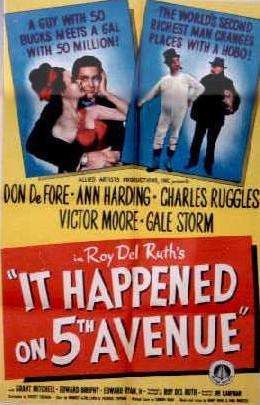
Roy Del Ruth’s It Happened on Fifth Avenue has a small but loyal following. Some people will even tell you that it’s better than It’s a Wonderful Life (1946). They are wrong. It’s a Wonderful Life is the far superior film. But It Happened on Fifth Avenue is still a great picture; warm, human, funny, and perfect for the holiday season.

In a plot inspired by the severe housing shortage that followed World War II, Don DeFore plays an ex-serviceman named Jim Bullock (not to be confused with Jim J. Bullock) who’s thrown out of his rented room under protest. (He’s carried out handcuffed to his bed, wearing only his underwear and his hat.) Dejected, Bullock stews while sitting all alone on a bench in Central Park. He’s approached by Aloysius T. McKeever (Victor Moore), who — with his tuxedo, top hat, and little dog — looks like a gonzo version of Rich Uncle Pennybags (a.k.a. “Mr. Monopoly”). McKeever and his little dog live in one of the stateliest mansions on Fifth Avenue, but they enter through the back, because it’s boarded up while its real owner, multimillionaire Michael J. “Mike” O’Connor, winters in West Virginia.

McKeever lives lightly off O’Connor’s wealth. The only thing he steals is food from the pantry, and he acts as a responsible caretaker. The only downside is that he has to turn off all the lights and make himself scarce every night when security guards sweep the mansion, but it’s a small price to pay.

Bullock settles into McKeever’s way of life quickly, and respects McKeever’s rules, but Bullock can’t help inviting old friends who need housing to join him in the mansion. Eventually, the O’Connors themselves wind up living with McKeever and his big group of friends. The first is the O’Connors’ daughter, Trudy (Gale Storm), who hides the fact that she’s an O’Connor because she likes McKeever’s way of life. Then her father (Charles Ruggles) and her mother (Ann Harding) reluctantly get into the act after their daughter begs them to pass themselves off as destitute people in need of housing.

The O’Connors have been estranged for some time, but their bizarre new living arrangement helps them fall in love with each other again. When Mike O’Connor comes home after a long, hard day of shoveling snow for dimes, he can’t resist the smell of his wife’s slumgullion wafting from the kitchen. It takes him back to better days.

It Happened on Fifth Avenue is a cute movie. Its message is the same as the message of It’s a Wonderful Life, that no man is poor who has friends, and it also ends with a Christmas miracle. It does it in a more contrived and comedic way than It’s a Wonderful Life, but it’s still a sweet, funny, and very enjoyable movie.

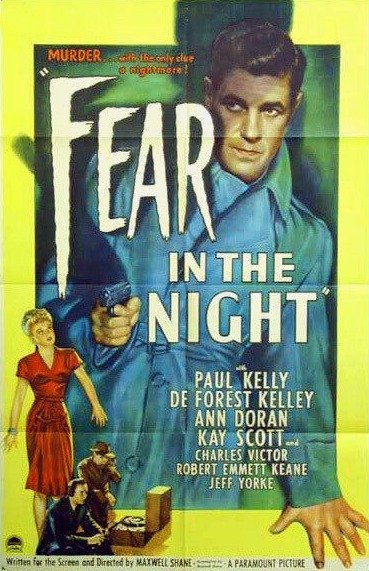
Fear in the Night (April 18, 1947)

Fear in the Night begins with a little floating dot of light dancing around the screen. It’s a will o’ the wisp that flits here and there before it morphs into the title and an odd, pulsating background pattern that is abstract, but vaguely obscene. The background music by Rudy Schrager is high-pitched and eerie.

After the credits roll, the visual abstractions clear away and are replaced by a black screen and the disembodied head of a beautiful woman with upswept hair (Janet Warren) floating toward the viewer. We hear Vince Grayson (DeForest Kelley) narrate his strange vision:

At first, all I could see was this face coming toward me, then I saw the room. A queer, mirrored room. And somehow, I was inside it. There was danger there. I knew that. I wanted to turn and run, but I couldn’t. It seemed as if my brain was handcuffed, and I had to do what I’d come to do.

Vince dreams that he stabs a man (Michael Harvey) in the heart with a steel bore. The man resists, and chokes Vince. One of the buttons on the man’s jacket pops off. The beautiful woman with upswept hair watches and silently screams, then Vince hides the body in one of the closets in the strange octagonal room full of mirrors. He locks the closet and puts the little key in his pocket. He wakes up from his vivid dream. He is relieved, but then he sees in his bathroom mirror that he has thumbprints in his neck. He looks down and sees a spot of blood on his wrist. He reaches in his pocket and pulls out a key and a button.

Distraught, Vince calls in sick to work. He’s a bank teller, and his pretty co-worker Betty Winters (Kay Scott) is happy to take over his window for the day, but she clearly has feelings for Vince, and is worried when she calls his room and no one answers.

Vince walks the streets alone, eager to be in the sunshine, afraid of the shadows and the coming night. He goes to see his brother-in-law, Cliff Herlihy (Paul Kelly), who just happens to be a police detective. Cliff tells Vince that his mind is playing tricks on him — selling him a phony bill of goods — and not to say anything about this to his sister, Lil (Ann Doran), since she’s expecting a baby and high-strung enough already, but Vince insists on following the leads from his dream. He takes out a newspaper ad that says “WANTED—I am interested in buying or leasing a house with an octagonal mirrored-paneled room or alcove. Location, size secondary, provided has this one essential, desired for reason of sentiment. Phone Grayson, FE-7648.”

Nothing pans out until Vince and Betty go on a picnic with Lil and Cliff. Caught in the rain, they take refuge in a large, unoccupied house. Guess what Vince finds upstairs when he starts poking around? You guessed it … an octagonal mirrored room, the same one he dreamed about.

In a nice bit of realism, as soon as it becomes clear that a murder actually was committed, Cliff jumps to the conclusion that Vince has been stringing him along the whole time with a crazy story so he’ll be able to plead insanity when the case goes to trial.

Fear in the Night was the first film that screenwriter Maxwell Shane directed. He also wrote the screenplay, which was based on the story “Nightmare” by Cornell Woolrich (originally published under his “William Irish” pen name). If you’ve seen Roy William Neill’s Black Angel (1946), which was based on a novel by William Irish/Cornell Woolrich, you’ll noticed a few similarities to Fear in the Night. Blackouts and murders possibly committed in hypnagogic states were frequent occurrences in Woolrich’s fiction, which is unsurprising once you know that Woolrich was an alcoholic shut-in.

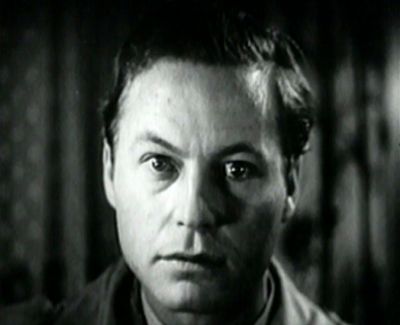
Fear in the Night was DeForest Kelley’s first role in a feature film. If you’ve ever seen an episode of Star Trek, it will be impossible to look at him in this film and not constantly see Dr. “Bones” McCoy and all of his trademark twitches and catchphrases. Even though Kelley was only 26 or 27 when he made Fear in the Night, he doesn’t look that different than he would in the ’60s.

If you can get over that, though, Fear in the Night is a twisty and involving noir with some remarkable subjective camerawork. The bits of straight drama are filmed in a flat, conventional style, but all of the dream stuff (of which there’s plenty) is really effective. I’ve seen numerous other films that the cinematographer, Jack Greenhalgh, worked on, and up until now they’ve all been flat, uninteresting P.R.C. westerns, horror films, and mysteries. Fear in the Night really lets him shine, and there are all kinds of wonderful cinematographic flourishes, such as images that shatter into pieces and then are reassembled, scenes that flutter in and out of focus, and even a freeze frame of Kelley’s face while a murder plays out across his empty eyeballs.

The plot is a little wacky, and the solution to the mystery involves some willing suspension of disbelief on the part of the viewer, but no noir fan will be able to resist the central conceit of the film, which is summed up nicely by Vince when he says, “I’ve got an honest man’s conscience in a murderer’s body.”

New Orleans (April 18, 1947)

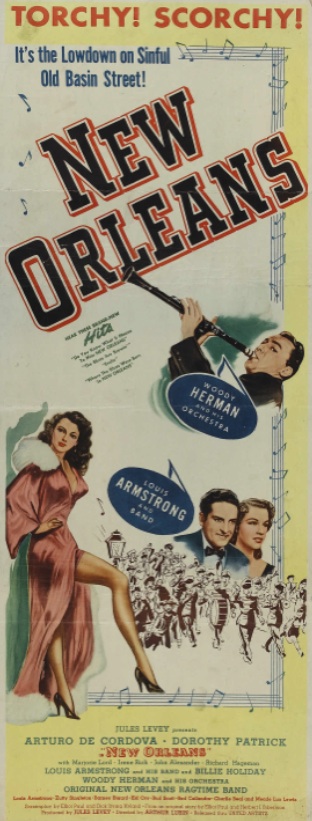
Arthur Lubin’s New Orleans takes place in 1917, the year that Storyville, the notorious red-light district of New Orleans, was shut down.

Like Edgar G. Ulmer’s Carnegie Hall (1947), New Orleans features some of the greatest musicians and performers of the ’40s shoehorned into a flat, uninteresting story.

I had high hopes for New Orleans. In the first scene, we see Nick Duquesne (pronounced “doo-cane”), who’s played by Arturo de Córdova, operate his casino and nightclub with smooth, effortless charm. Duquesne is known as the “King of Basin Street,” and de Córdova plays him well, so I was hoping to see an involving story about vice, graft, and crime.

Alas, the story quickly devolves into a maudlin melodrama about a young blond singer named Miralee Smith (Dorothy Patrick) who falls in love with both Duquesne and the Dixieland jazz she hears played by Louis Armstrong and his ragtime band. Of course, Miralee’s mother, the wealthy Mrs. Rutledge Smith (Irene Rich) doesn’t approve, and wants her daughter to sing opera.

The screenplay and acting in New Orleans are better than they are in Carnegie Hall, but the only reason most people will want to see this movie is for the music. The good news is that there’s plenty of it, especially if you’re a fan of Louis Armstrong and Billie Holiday.

Holiday plays a maid named Endie, and she doesn’t look happy in the outfit, or in the scene in which she’s dressed down by Mrs. Smith for playing the piano and singing while on the job. The strange thing is that her role as a maid is tangential to her role in the rest of the film, and she only appears in a maid’s uniform in her first scene, in which she introduces Miralee to jazz. After that, Holiday loosens up a bit, and her scenes onstage with Louis Armstrong and his band are all fantastic. Together they perform Louis Alter’s “Do You Know What It Means to Miss New Orleans,” “The Blues Are Brewin’,” and “Endie,” as well as Spencer Williams’s “Farewell to Storyville.”

Holiday and Satchmo aren’t the only great performers in the film. Woody Herman, Charlie Beal, Barney Bigard, George “Red” Callender, Meade “Lux” Lewis, Kid Ory, Bud Scott, Lucky Thompson, and Zutty Singleton all play themselves.

Bells of San Angelo (April 15, 1947)

Bells of San Angelo
Bells of San Angelo (1947)
Directed by William Witney
Republic Pictures

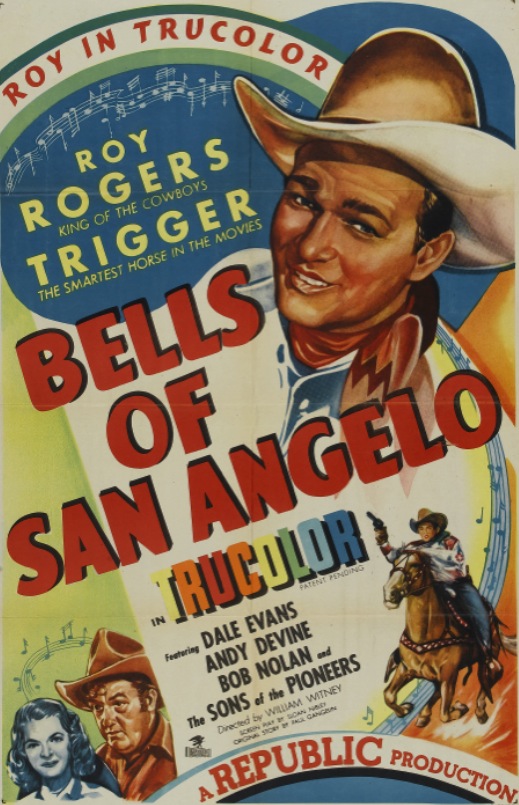
Bells of San Angelo was Roy Rogers’s second western filmed in “Trucolor,” a two-color film process. (The first was Apache Rose, released earlier in 1947.) It was also the fifth film he made with director William Witney, who I’ve been a big fan of since high school. Witney directed my favorite Republic serials (often with John English), such as Adventures of Captain Marvel (1941), Jungle Girl (1941), and Spy Smasher (1942). Witney had a sure hand with pulpy material, and never made a picture that was less than entertaining. The stunt work in his films was always a high point. His action scenes — especially the fights — were incredibly well-staged, and still hold up pretty well.

There are currently a few ways to see Bells of San Angelo online. It’s available on YouTube, at Internet Archive, and on Netflix instant watch. The version on Netflix is the version that was edited for TV. It’s in black and white, not color, and shaves more than 20 minutes off the running time. Among the scenes that are lost is a really good fistfight between Roy and one of the bad guys. So if you want to see this movie, I recommend downloading the version from Internet Archive or watching it on YouTube. (You can click the links above to go directly to this movie.)

In Bells of San Angelo, Roy plays — as usual — a character named “Roy Rogers.” In this one, Roy is a border investigator. There are nefarious goings-on down at the old Monarch mines, which are run by a man named Rex Gridley (John McGuire), a handsome, dark-haired gentleman with a pet bird named “Cinderella.” In the first of many exciting action scenes, Gridley’s right-hand man, Ulrich (David Sharpe), shoots a man fleeing by stagecoach, then plants some silver ore in his pocket. Ulrich’s official story is that he was shooting down a thief, but Roy smells something rotten.

Roy’s comical sidekick in Bells of San Angelo is a big fat guy named Cookie Bullfincher (Andy Devine), who’s San Angelo’s mayor, sheriff, and official dog catcher (but the soft-hearted Cookie is really more of a “dog keeper”). Cookie may have a passel of titles, but Roy is the real authority, and his reach extends down into Mexico.

When Roy learns that western pulp writer Lee Madison is coming to town, and will be observing him work, he exclaims, “I don’t mind chasin’ thieves and murderers, but this is too much.” Madison is the author of numerous western potboilers, including one called Murder on the Border, and Roy thinks Madison will just twist reality to suit the tastes of a bloodthirsty readership.

It should come as absolutely no surprise to anyone when it’s revealed that Madison is actually a woman, or that she will hide her identity from Roy as long as she can, creating all manner of humorous misunderstandings.

Madison is played by Dale Evans, Roy’s real-life wife, and they’re really cute together. They always seem to be having fun in their scenes, which softens things when he’s being a chauvinist and threatening to spank her, or calling her “the nosiest girl I’ve ever met.”

Director Witney is more concerned with packing the film full of entertainment than with narrative coherence. But who cares? There are songs aplenty, subplots galore, and lots of action, some of it pretty rough for a Saturday matinée picture aimed at kids.

Bells of San Angelo was filmed in Valley of Fire State Park in Nevada, and the scenery is spectacular. Of course, it looks nothing like San Angelo, Texas, which — by the way — is in the heart of Texas, not anywhere near the Mexican border. But whatever. If you like Roy Rogers, Dale Evans, and Trigger, you’ll love this movie.

Violence (April 12, 1947)

Violence
Violence (1947)
Directed by Jack Bernhard
Monogram Pictures

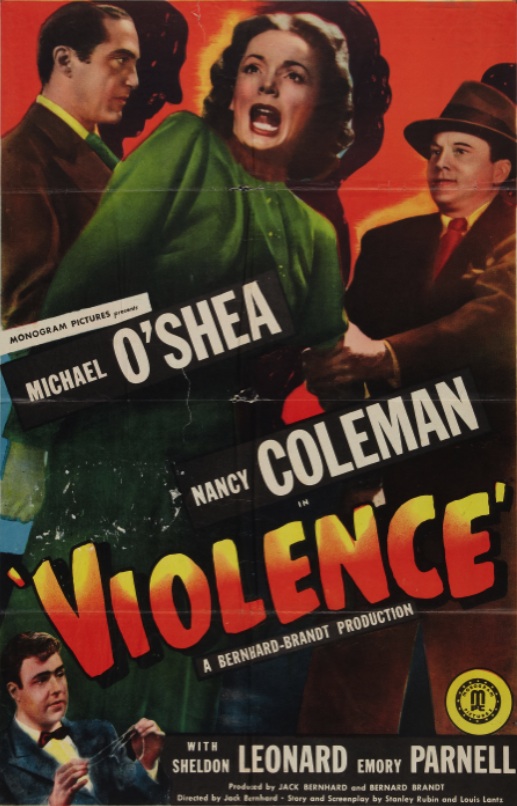
Jack Bernhard’s Violence begins with a stunning freeze frame of the headquarters of the United Defenders, a radical Los Angeles-based group dedicated to preserving “America for Americans.” An American flag stationed above the entrance is captured in mid-billow. The jagged letters of the title shockingly appear: “VIOLENCE.”

After the freeze frame springs to life, we see Fred Stalk (Sheldon Leonard) and the brutal idiot man-child Joker Robinson (Peter Whitney) interrogating and beating a man who has betrayed the United Defenders. The man Stalk and Joker are beating is named Joe Donahue (Jimmy Clark), and his murder is the most violent thing about Violence, which generally doesn’t live up to its sizzling title or the promise of its first reel.

Ann Dwire (Nancy Coleman) is undercover with the United Defenders. She’s operating under the name “Ann Mason” and is preparing material for an exposé of the organization for View magazine. Her methods of subterfuge would get her killed in less than 24 hours in the real world. When she calls in information to Ralph Borden (Pierre Watkin), her managing editor back in Chicago, she calls him from her apartment, even stating Borden’s full name and title to the concierge of her building, a kindly old man called Pop (Frank Reicher). Also, when it comes time to dispose of a letter from Borden, she doesn’t burn it, she just tears it up into smaller pieces (and her delicate fingers don’t do a very good job of it).

The United Defenders recruit disgruntled World War II veterans, promising to fight against housing shortages and unemployment, but they’re really just a fascist organization whose purpose is to sow discord and promote violence. When a young veteran (Richard Irving) stands up at a meeting and tells the organization’s leader, True Dawson (Emory Parnell), that it seems as if his rhetoric only leads in one direction — violence — Dawson has a couple of his followers throw him out on his ear, which proves the young man’s point.

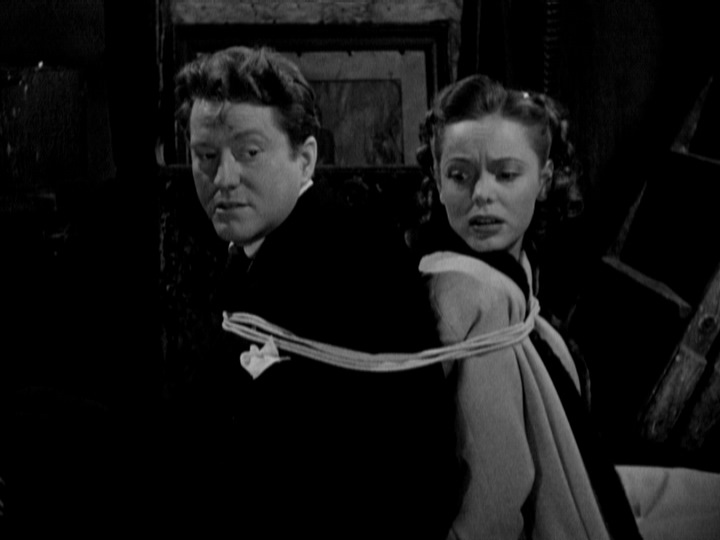
Michael O'Shea and Nancy Coleman

Violence touches on a lot of hot-button issues, but doesn’t delve into them very deeply. (If you wanted deep treatises on post-war intolerance and creeping fascism in America in 1947, you had to be a kid listening to the radio show The Adventures of Superman. Most Hollywood productions just didn’t have the stones to get too specific.) For the most part, Violence uses its serious themes as window dressing for a brisk B movie that only aims to thrill. If Violence had been made a few years earlier, the United Defenders would have been Nazi fifth columnists. If it had been made a few years later, they would have been Communists.

While on a trip back to Chicago to meet with her editor, Ann is in a taxi cab accident and loses her memory. She becomes Ann Mason through and through, even getting up to speak at a meeting and encouraging every man there to recruit friends … friends who aren’t afraid to use violence to get what they want. But to thicken the plot, her fiancé Steve Fuller (Michael O’Shea) accompanies her back to Los Angeles, and he seems to know what’s going on, even though he volunteers to work for the United Defenders.

Coleman’s acting while she’s suffering from memory loss is pretty awful. She keeps looking pained and pressing her fingers to her temples, as though her problem is a bad headache, not post-traumatic retrograde amnesia.

Violence is mildly entertaining, but its low budget and weak performances work against it. The editing is sloppy — there are a lot of jump cuts within scenes — and the amnesia aspect of the story is poorly handled. Violence was directed by Jack Bernhard, who made Decoy (1946), a film noir that has built up quite a reputation in recent years. I’ve seen Decoy twice, and I think it’s overrated, but it does have one thing going for it that is sorely missing in Violence, a truly loony and twisty plot.

Monsieur Verdoux (April 11, 1947)

Monsieur Verdoux
Monsieur Verdoux (1947)
Directed by Charles Chaplin
United Artists

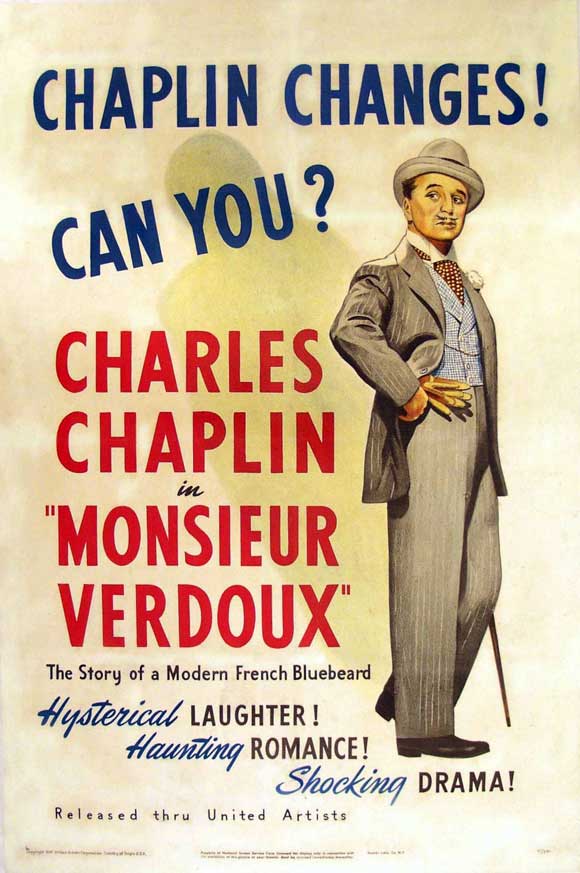
Monsieur Verdoux, “a comedy of murders,” is a product of Charles Chaplin’s Frantic One-Man Band. Besides starring in the film, Chaplin is credited with directing the picture, writing the screenplay, producing the film, and writing the music. Orson Welles wrote the original script and was slated to direct Chaplin in the picture, but at the last minute, Chaplin decided that he didn’t want to be directed by someone else — he’d always been his own director in the past — and bought the script from Welles, crediting him with the “idea” for the film.

The film is based on the career of real-life murderer Henri Désiré Landru, who between 1914 and 1918 seduced a number of women and murdered them after gaining access to their assets. He burned their dismembered bodies in his oven, disposing of them completely, which made prosecuting him a challenge after he was caught. A trail of paperwork and other evidence was enough to eventually convict him of 11 counts of murder (10 women and one of their teenaged sons), and he was executed on the guillotine in 1922.

In Monsieur Verdoux, Chaplin plays a man named Henri Verdoux, who describes himself as an “honest bank clerk.” Honest, that is, until the Depression of 1930, at which point he began his new career, “liquidating members of the opposite sex.” He claims that he began his career as a Bluebeard strictly as a business proposition. This is utter claptrap, as is nearly every other word out of M. Verdoux’s mouth that isn’t plot-advancing dialogue, but we’ll get to that later.

The film takes place in 1932. M. Verdoux had a 30-year career in banking before he began his new career as a murderer, and with his dainty, foppish clothes he looks like a relic of another time. When the film begins, he is living in a villa in the south of France. He’s a tidy little man who loves to garden, but whose incinerator has been going full-blast for the past three days. He’s kind to animals, moving a caterpillar out of his way in the garden path and feeding a cat on the street. M. Verdoux is even a vegetarian.

He is also a lothario with an insatiable appetite for well-heeled widows. But this, M. Verdoux assures us, is just his day job. His heart belongs to his wheelchair-bound wife Mona (Mady Correll) and adorable little boy Peter (Allison Roddan). At home, M. Verdoux lectures Peter when he catches him pulling the cat’s tail that “violence begets violence.” He also tells his son that he has a mean streak. “I don’t know where you get it!” he exclaims.

Aside from the saintly Mme. Verdoux, nearly everyone in the film is a grotesque and obnoxious caricature. In this way, Monsieur Verdoux is a distillation of Chaplin’s career-long vacillation between sentimentality and cruelty. A perfect example of this is the scene in which M. Verdoux brings a girl in off the street to poison her, but thinks better of it after she speaks of how wonderful life can be, and how she loved her husband, crippled in the war. (The girl is played by 20-year-old ingenue Marilyn Nash.)

The few bits of physical comedy in the film are funny, but they’re mostly either too brief or out of character with the rest of the scene in which they take place. Several comedic scenes — such as when M. Verdoux and another man start slapping each other with rapid-fire speed, or when M. Verdoux is romancing the older woman who was going to buy his villa in the beginning of the film, and he’s moving ever closer to her on the couch — fade to black in a quick, unsatisfying way.

When Monsieur Verdoux was released, Chaplin’s reputation was severely tarnished. He hadn’t made a film since The Great Dictator (1940), and he was under attack for both his Leftist political sympathies and his morals (he was the subject of a sensational paternity suit, and was a serial seducer of young women, many of them underage).

Chaplin and Nash

Monsieur Verdoux can be seen as a defiant stand against his critics. It’s the blackest of black comedies, and was a box office disaster in the United States when it was first released (it fared a bit better in Europe), but has built up quite a cult since it was re-released to receptive audiences in the ’60s and ’70s. At the time of its release, however, it polarized critics. James Agee crowned it a masterpiece, and the National Board of Review named it the best English-language film of 1947. Others were less enthusiastic.

I think that Monsieur Verdoux is a deeply flawed film. Chaplin was the preeminent clown of the silent era. He wasn’t quite the master technician of hijinks that Buster Keaton was, but he was able to convey a panoply of emotions through his face and body. His films are not only some of the funniest of the silent era, but are emotionally affecting, too. The ending of City Lights (1931) is still one of the most powerful I have seen in any film.

When he was able to speak onscreen, however, Chaplin was a tedious hack who only thought he was profound. Monsieur Verdoux isn’t as crushingly pretentious and boring as his later film Limelight (1952), but it has its moments.

The end of Monsieur Verdoux is especially problematic. Speaking on his own behalf in court, M. Verdoux says, “I was forced to go into business for myself. As for being a mass killer, does not the world encourage it? Is it not building weapons of destruction for the sole purpose of mass killing? Has it not blown unsuspecting women and little children to pieces? And done it very scientifically? As a mass killer, I am an amateur by comparison. However, I do not wish to lose my temper, because very shortly, I shall lose my head. Nevertheless, upon leaving this spark of earthly existence, I have this to say: I shall see you all… very soon… very soon.”

The problem with this is that the murders of dowdy and grotesque women that we’ve seen M. Verdoux carry out in the film are very different from the mass mechanized killing of the Great War or the genocidal horrors of World War II. They’re intimate crimes, carried out for personal gain, and occasionally hilarious, such as the sequence in which M. Verdoux is repeatedly foiled while attempting to drop a noose around one of his wives’ necks while they are out fishing. It would be one thing if Chaplin were presenting M. Verdoux’s crimes as symptoms of a sick society, but what he seems to be doing is using a sick society as a justification for M. Verdoux’s crimes.

Is M. Verdoux meant to be an unreliable narrator? Perhaps, but he never comes across that way. I think that Chaplin was simply too infatuated with himself to present M. Verdoux as anything but a lovable cad, which makes the entire film uncomfortable and off-putting in ways I’m not sure Chaplin ever intended.
Tarzan and the Huntress (April 5, 1947)

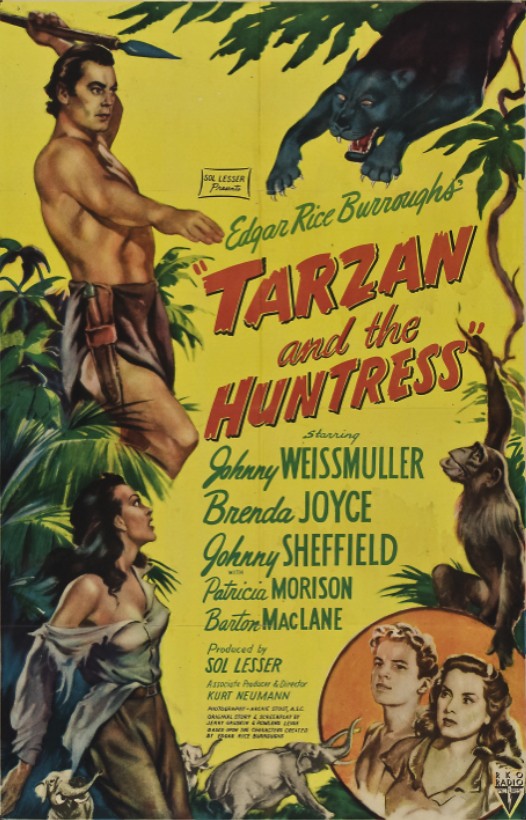
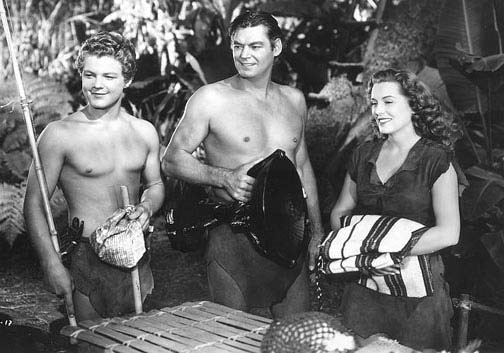
Kurt Neumann’s Tarzan and the Huntress should really be called Tarzan and the Poachers. The word “huntress” conveys more risqué sexiness than the film actually contains (the same can be said of the poster), and seems designed to draw in the same people who shivered at the sight of the muscular Johnny Weissmuller being clawed by the beautiful actress Acquanetta in his previous outing as the King of the Jungle, Tarzan and the Leopard Woman (1946).

When Tarzan and the Huntress begins, we learn that zoos around the world are facing a post-war shortage of animals. (Did lions and monkeys get drafted? I missed that.)

Enter Tanya Rawlins (Patricia Morison, stepping up from Queen of the Amazons to a higher-quality jungle movie). Tanya is an animal trainer leading a safari that also includes her villainous guide, big-game hunter Paul Weir (Barton MacLane), and the moneyman, Carl Marley (John Warburton).

Meanwhile, a half-naked couple who live in a treehouse with their pet chimp and their boy, who calls his adoptive parents by their first names, are preparing to honor local monarch King Farrod (Charles Trowbridge) on the occasion of his birthday. No, they’re not hippies, they’re Tarzan and Jane, played by Weissmuller and Brenda Joyce. Their adopted son, “Boy,” is once again played by Johnny Sheffield, who looks as if he should probably change his name to “Man” sometime soon (or at least “The Artist Formerly Known As ‘Boy'”), since he’s nearly as big as Tarzan. (This was Sheffield’s last role in a Tarzan picture. In 1949 he struck out on his own in the Bomba, the Jungle Boy series.) When Tarzan inspects the fishing pole that Boy has fashioned for King Farrod, he smiles and says, “Everybody like fishing, even kings.” This might be a lesser entry in the Tarzan series, but the playfulness of Tarzan’s little family group and their idyllic life in the jungle is always fun to watch. If you’ve seen one Tarzan movie, however, you’ve seen them all, and you know that something will soon come to threaten their peaceful existence.

In this case, it’s a perfect storm of Tarzan-related problems — hunters and trappers arriving from the “civilized” world, treacherous locals, and Cheeta and Boy’s shared love of shiny objects.

When Weir tells Tanya that King Farrod won’t allow more than two specimens of each animal to be taken out of the jungle, Noah’s-Ark style, she sputters, “You can’t be serious!” So in a back-door deal, the king’s scheming nephew, Prince Ozira (Ted Hecht), offers Weir and Tanya a “no quota, no restrictions” offer on trapping animals, as long as they pay him a bounty per animal.

One of the members of Tanya’s safari offers to trade Boy a hand-crank flashlight for Cheeta. Boy refuses, since Cheeta’s like a member of the family, but he’s not above stealing a pair of lioness’s cubs in exchange for the nearly worthless bauble.

Tarzan returns the two cubs to their mother and draws a line in the sand. Hunters stay on their side of the river, Tarzan stay on his.

The hunting party doesn’t seem overly concerned, but then Tarzan calls all the animals to him with his powerful jungle cry, and they leave the hunters’ side and come to his.

It’s on.

Tarzan knows just how to handle the greedy poachers when they cross the river into his territory. “Hunters without guns like bees without stings. Hunters not so brave now,” he says, after he steals all of their weapons and hides them behind a waterfall.

That would be the end of the story if it weren’t for that darned Cheeta, who wants Tanya’s shiny compact so badly that she shows the hunters the way to the waterfall.

Cheeta gets her compact, the poachers get their guns, and it’s time for Tarzan and Boy to hand out the punishment, one hunter at a time.

Tarzan and the Huntress was Weissmuller’s penultimate turn as Tarzan. After appearing in Tarzan and the Mermaids (1948), he went on to star in the Jungle Jim series and Lex Barker took over starring in the franchise with Tarzan’s Magic Fountain (1949).

Weissmuller appears to have gained some weight since he made the previous picture in the series, Tarzan and the Leopard Woman, but he’s always fun to watch as the character. Brenda Joyce looks beautiful, as always, but I wasn’t sure what to make of her little slip-on pantyhose shoes.

If you’ve never seen a Tarzan picture before, Tarzan and the Huntress probably isn’t the place to start, but it’s solid entertainment for fans of the series, and offers especially good animal action and hijinks.

My Favorite Brunette (April 4, 1947)

Elliott Nugent’s My Favorite Brunette begins with baby photographer Ronnie Jackson (Bob Hope) in the death house at San Quentin. Jackson is set to be executed that night, and he’s hoping for a stay from the governor. When none arrives, Jackson quips, “No word? Well, I’ll know who to vote for next time.”

Jackson takes a look into the chamber where he’s set to die. “Gas,” he scoffs. “You haven’t even put in electricity.”

Like any good film noir protagonist, Jackson gets to tell his story before he takes that last, long, lonely walk. (Of course, Jackson isn’t really a noir protagonist, since My Favorite Brunette is a spoof of hard-boiled detective movies, but he doesn’t know that.)

When Jackson’s story begins, he’s desperately trying to get an adorable little Chinese-American boy to smile for the camera, but he’s hungry for bigger problems. Jackson may be San Francisco’s premier baby photographer, but he idolizes the man who has the office across from him, two-fisted he-man Sam McCloud (an uncredited Alan Ladd, who’s clearly able to laugh at himself). Jackson longs to be a detective, too. “It only took brains, courage, and a gun,” Jackson says. “And I had the gun.”

When McCloud has to run off to Chicago for a few days, Jackson just happens to be sitting in his office when the beautiful and exotic Carlotta Montay (Dorothy Lamour) walks in. When she thinks he’s McCloud, he can’t bear to tell her the truth, and is off on his first case, tracking down Carlotta’s missing husband, the Baron Montay. (Or is he her uncle? The story keeps changing.)

I won’t summarize the plot any further, mostly because it’s beside the point, but also because it’s nearly as convoluted as an actual hard-boiled P.I. story. Also, some of Jackson’s hard-boiled narration is so close to the real thing that it’s remarkable. After he’s knocked out in his office, he says in voiceover, “When I came to, I was playing ‘post office’ with the floor. I had a lump on my head the size of my head. Inside, Toscanini was conducting the Anvil Chorus with real blacksmiths. I looked at the bottle of Old Piledriver and decided to stick to double malts.”

Sure, it’s over-the-top, but so was most of the dialogue in hard-boiled detective films. Threats like, “I’ll fill you so full of holes you’ll look like a fat clarinet,” sound funny when they’re coming out of Bob Hope’s mouth, but they’re no more ridiculous than half of the things Humphrey Bogart and Dick Powell growled at tough guys.

Besides the genuinely funny script and manic direction by Nugent, the casting is key to the success of My Favorite Brunette. Dorothy Lamour is attractive and sleepy-eyed enough to be a real femme fatale, and the hulking Lon Chaney Jr. and the sinister Peter Lorre are both on hand to play bad guys. (All that’s missing is Boris Karloff with an eye patch and a hook for a hand.)

I’m not the biggest fan of Bob Hope, but he’s excellent in this movie, and frequently had me in stitches. The comedy mostly comes from the dialogue, but there are some classic bits of physical humor, too. The scene in which Lorre tries to force a false clue on Hope while hiding in various spots in a room, but Hope just keeps missing it, might be the funniest bit in the film.

My Favorite Brunette has fallen into the public domain, and is available to watch at archive.org. You’ll have to wait until the very end for Bing Crosby’s cameo, but it’s worth it.

Twilight on the Rio Grande (April 1, 1947)

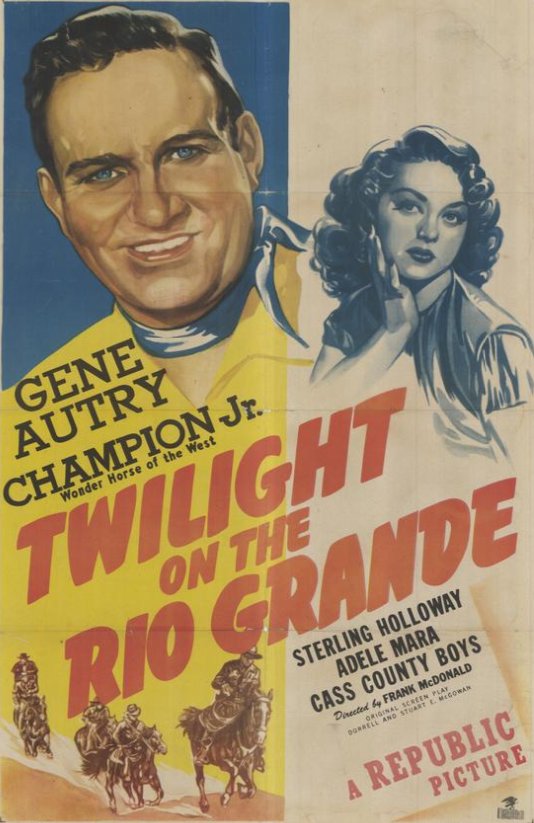
Frank McDonald’s Twilight on the Rio Grande features Gene Autry and his co-stars being put through their B-movie paces south of the border.

Crime melodramas (we call them film noirs nowadays) were very popular Hollywood products in 1947, and Twilight on the Rio Grande incorporates several elements from them, such as the hero investigating the murder of his partner, lots of nighttime photography, a plot about jewel smuggling, and a beautiful knife-throwing señorita. (They showed up in noirs every now and then, didn’t they?)

Gene Autry (played by Gene Autry) and his ranch hands, Dusty Morgan (Bob Steele), Pokie (Sterling Holloway), and the singing trio The Cass County Boys, are all down in Mexico, singing in Spanglish and ogling the ladies. (If there was a deeper purpose to their visit, I missed it.)

The diminutive Bob Steele was a western actor whose star had faded by the mid-’40s, and he picks up a pretty easy paycheck in Twilight on the Rio Grande, since his character is murdered in the first reel, which I thought was a shame. I like Steele, and would have enjoyed seeing him and Autry solve the murder of Sterling Holloway’s character, Pokie, since the loose-limbed, rubber-faced Holloway is more annoying than a barrel of Jim Carreys.

The femme fatale of the film is the beautiful and hot-blooded Elena Del Rio (Adele Mara), who throws knives at Gene while he’s singing “I Tipped My Hat and Slowly Rode Away.” She throws one after the other into the wall behind him, in order to show him how angry she is. She has a steady hand, so she doesn’t hurt him. But then Gene shows her his steady hand when he finishes his song, throws her over his knee, and spanks the bejeezus out of her with the flat of a big knife blade.

Dusty is murdered with a knife in the back, and a smuggler Gene and his boys rope out on the prairie winds up with a knife in his back that could only have been thrown, not thrust at close range, so suspicions fall on Elena.

The title song is a good one, and was never released as a record by Autry, so if you’re a fan of his music, it’s a reason to see this picture. He sings two versions, a slow, mournful version at Dusty’s funeral, and a more upbeat version to close the picture.

If you’re not a fan of Autry’s music, there is really no reason to see this picture. It’s not terrible, but there are plenty of better B westerns out there.

Smash-Up: The Story of a Woman (March 1947)

I suppose this had to happen.

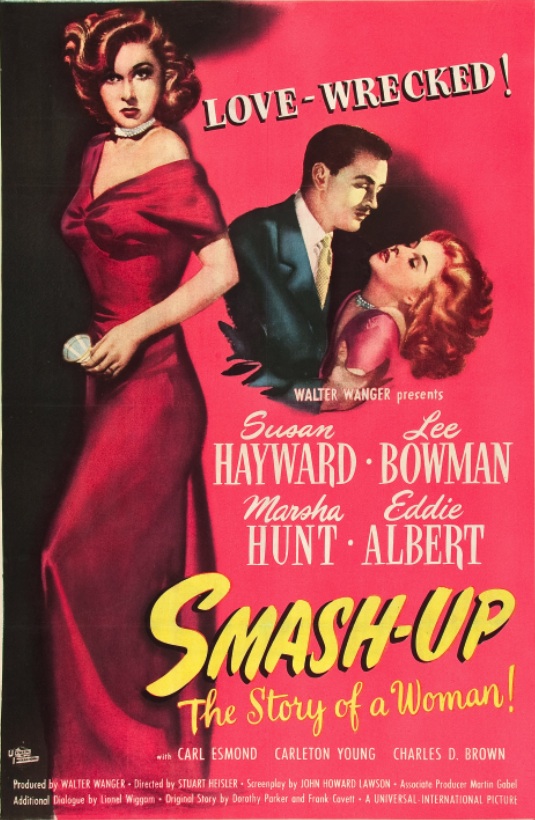
After yesterday’s film, The Farmer’s Daughter, which was an inspirational and heartwarming story of a woman fighting to succeed in a man’s world, I got hit in the face with this wet noodle of a picture. Stuart Heisler’s Smash-Up: The Story of a Woman is a not-so-heartwarming film about a woman slipping into the depths of loneliness, depression, and alcoholism.

Inspired by the tragic life of Bing Crosby’s first wife, singer Dixie Lee, Smash-Up begins with Angelica “Angie” Conway, née Evans (Susan Hayward), lying in a hospital bed, her face and head bandaged, murmuring, “I have to go on in two minutes … I need a drink… I have to go on in two minutes … I need a drink…”

The events that brought her to this place are told in flashback. Angie and her husband, Ken Conway (Lee Bowman), both start out as struggling singers, but after he gets a job performing on the radio as “Ken Conway, the Singing Cowhand,” he grows to be a coast-to-coast sensation, and Angie’s career is derailed.

She turns to drinking to soothe her loneliness and frustration, staying home with their infant daughter while Ken is on the road with his friend and partner Steve Nelson (Eddie Albert), his manager Fred Elliott (Carleton Young), and Elliott’s beautiful secretary, Martha Gray (Marsha Hunt), which drives Angie into a spiral of jealousy and paranoia.

Angie may live in a large, beautiful home with servants (all provided with the money from Ken’s success), but none of it means anything when she’s all alone with her baby, who has a fever, and she’s singing “Hushabye Island” to her while a weighted toy swings back and forth on the dresser by the crib. Its shadow is taunting. It looks like a liquor bottle bobbing to and fro.

It would be easy to call Smash-Up a distaff version of Billy Wilder’s The Lost Weekend (1945). The two films have many similarities, but Smash-Up is as much about a disintegrating marriage as it is about dipsomania.

There’s some nice subjective camerawork in Smash-Up, like the zoom in on Angie’s face when Ken walks out after finding her drunk at her vanity table following the baby’s illness, but it never gets as wildly baroque as the depictions of Ray Milland’s delirium tremens in The Lost Weekend.

The film also sidesteps several issues. For instance, after Ken leaves with their daughter and Angie says, “I’m going to get my baby back,” there is a montage of liquor splashing into glasses, Angie’s unsteady feet on the sidewalk, and neon club signs (including the appropriately named “Club Downbeat”) that ends with Angie passing out on a stoop. She wakes up in a strange room with her clothes and a man’s clothes thrown over a chair. The camera pans up and we see an unattractive middle-aged man in his undershirt working his razor over a strop. Before the audience can get any ideas, however, we see that there is also a woman in the apartment, who tells Angie that she and her husband put her to bed, effectively quashing any hint of booze-fueled promiscuity.

Like The Lost Weekend, Smash-Up ends a little too happily for its own good. But while The Lost Weekend ended with a promise to stop drinking that might be insincere, Smash-Up pulls out all the stops. The film ends not only with Ken and Angie promising to each other that they’ll try to patch things up, but with the revelation that Angie’s face (the result of a fire caused by a half-smoked cigarette and a bellyful of liquor) is going to be fine, and there won’t be any scarring.

Smash-Up isn’t a bad film, just a gloomy one. The melancholy refrain of the song “Life Can Be Beautiful” started to drive me crazy by the end of the picture, but it suits the proceedings. The actors all play their parts well, especially Hayward, who was nominated for an Oscar for best actress.