Category Archives: 1945

I Know Where I’m Going (Nov. 16, 1945)

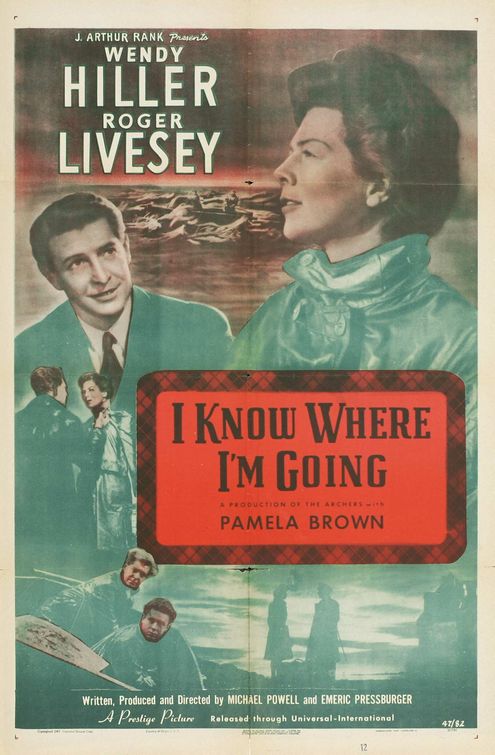
Michael Powell and Emeric Pressburger, the talented pair of writers, producers, and directors whose early collaborations included One of Our Aircraft Is Missing (1942), The Life and Death of Colonel Blimp (1943), and A Canterbury Tale (1944), worked together under the name “The Archers” throughout the 1940s and 1950s, and produced some of the most enduring films in British history. Powell was a native-born Englishman. Pressburger was a Hungarian Jew who found refuge in London and who prided himself on being “more English than the English.”

I Know Where I’m Going, which premiered in London on November 16, 1945, is a warm, romantic drama. The film stars Wendy Hiller as Joan Webster, a stubborn young woman who, according the narrator, “always knew where she was going.” After a montage that shows Joan’s growth from headstrong toddler to headstrong teenager to headstrong 25-year-old, we see her dressed in smart clothes, meeting her father (played by George Carney) at a nightclub, where she blithely informs him that she plans to travel to Kiloran island in Scotland to marry Sir Robert Bellinger, a wealthy, middle-aged industrialist whom she has never met. Her father is aghast, but, as always, Joan knows exactly where she’s going and what she’s doing.

Handled differently, this setup could lead to a grim, Victorian melodrama, but I Know Where I’m Going is a playful film with touches of magical realism. On her trek to the Hebrides, Powell and Pressburger delight in each leg of her long journey (and there are many), and pepper the montage with fanciful touches, such as a map with hills made of tartan plaid, a dream sequence in which Joan’s father marries her to the chemical company owned by Bellinger (literally), and an old man’s top hat that becomes the whistling chimney of a steam engine.

On the last leg of her journey, she is forced to put up in the Isle of Mull, as weather conditions do not permit water travel to Kiloran. Joan stays in touch with Bellinger, who is never seen, only heard (as a stuffy voice on the other end of a telephone). While cooling her heels in Mull, Joan meets a charming, soft-spoken serviceman named Torquil MacNeil, who is on an eight-day leave. (Torquil is played by Roger Livesey, in a role originally intended for James Mason.)

The joke implicit in the title becomes more and more clear as Joan and Torquil begin to fall for each other. The closer they become, the more determined she is to reach Kiloran. Eventually willing to risk life and limb to get there, it becomes clear that at least when it comes to love, she has no idea where she is going, and is too hard-headed to see anything clearly.

Livesey, who was in his late thirties when this film was made, was originally told that he was too old and too heavy to play the role of the 33-year-old Torquil, but he very quickly slimmed down to get the part, and he cuts a dashing figure, although not a classically handsome one. Interestingly, Livesey never set foot in the Western Isles of Scotland, where most of the film’s exteriors were shot. He was starring in a play in the West End during filming, so Powell and Pressburger made clever use of a body double for long shots, and filmed all of Livesey’s interior scenes at Denham Studios, in England.

Besides its fine performances and its involving love story, I Know Where I’m Going is enjoyable to watch simply because Powell and Pressburger show such incredible attention to detail. The interiors may be shot on a soundstage, but it’s easy to forget that with effects that perfectly marry them to the location footage, such as rain lashing the windows, subtle lighting, and the shadows of tree branches moving back and forth on the walls of the houses and cottages on the island. There are no short cuts or cut corners in this film. Joan’s dreams don’t appear in a cloud of dry ice or in soft focus, they swirl kaleidoscopically around her head. And elements that might seem silly in another film, such as an ancient curse hanging over Torquil’s head, seem palpably real when they’re embodied by shadowy, decrepit, and glorious real-world locations like Moy Castle.
Colorado Pioneers (Nov. 14, 1945)

Red Ryder was a comic-strip cowboy created by writer Stephen Slesinger and artist Fred Harman. Red Ryder premiered in the Sunday funnies on November 6, 1938, and soon grew into one of the largest franchises in entertainment history. In the 1940s, there was nary a kid-friendly product that didn’t have a Red Ryder tie-in; comic books, novels, Big Little Books, a radio show, and the infamous Red Ryder BB Gun, which is still in production today despite the fact that Red Ryder hasn’t appeared in newspapers since the 1960s. For thousands of baby boomers, the Red Ryder BB Gun wasn’t the only way to put an eye out, but it was the most universal.

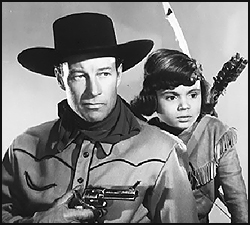
The first appearance of Red Ryder on film was in 1940, in the Republic serial Adventures of Red Ryder, which starred Don “Red” Barry as Red Ryder and Tommy Cook as his young Indian sidekick, Little Beaver. Like all Republic chapterplays, it was quality entertainment, but Barry was a bit of a pipsqueak compared with the tall, square-jawed actor who stepped into the role next, “Wild” Bill Elliott. Starting with Tucson Raiders in 1944, Elliott was paired with future ladykiller Robert Blake (at that time credited as “Bobby Blake”) as Little Beaver in a total of 16 features over the course of two years. (Blake kept appearing as Little Beaver in the series after Elliott left. Starting with Santa Fe Uprising in 1946 he was paired with Allan “Rocky” Lane in seven more Red Ryder films.)

Colorado Pioneers begins in Chicago, where Red Ryder and Little Beaver run afoul of a couple of ragamuffins who today would be called “at-risk youth.” Red Ryder intercedes on their behalf in court, and frees them from a life of petty street crime by taking them back to the Colorado ranch run by his aunt, “The Duchess” (Alice Fleming), where he teaches them the value of hard work and fresh air. Originally planning to take just the two boys who stole his money (Billy Cummings and Freddie Chapman), Red Ryder is convinced by Little Beaver to take the whole gang, including a token black member named “Smokey,” who is played by Billie “Buckwheat” Thomas (yes, he’s the Buckwheat you’re thinking of). The situation may be hokey and formulaic, but Elliott is a strong enough presence to make you believe it when the kids start following his lead. The emotional core of the film is the most recalcitrant boy, who resists Red Ryder’s mentorship, but who can’t resist a frail colt, which he feeds and talks to in secret. The boy’s journey from a hardened little thug to a young man who is able to care for something weaker than himself and tell the truth even when it’s difficult makes for a surprisingly moving story.

Colorado Pioneers is an excellent little B western. While it’s aimed at kids, Elliott is believable and tough enough as Red Ryder for adults to enjoy the film, too. He’s not quite Henry Fonda or Randolph Scott, but he’s one of the better western stars you’ve probably never heard of.

And Then There Were None (Oct. 31, 1945)

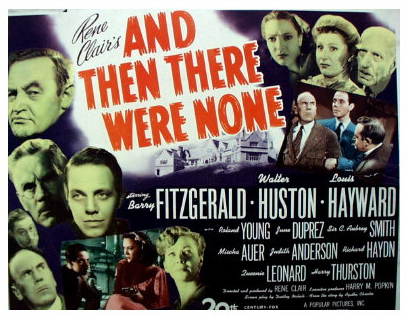
Agatha Christie’s novel And Then There Were None, originally published in England in 1939 under the unfortunate title Ten Little Niggers, is tied with J.R.R. Tolkien’s The Lord of the Rings as the second best-selling novel of all time (only J.K. Rowling’s Harry Potter and the Philosopher’s Stone has sold more copies). This makes it the most widely read mystery novel of all time, so hopefully nothing I say here will be giving much away. (But don’t worry … I’m not going to reveal “whodunnit.”)

In And Then There Were None, eight people are invited to an island off the coast of Devon by a Mr. and Mrs. “U.N. Owen.” (Get it?) When the guests arrive, they are informed that Mr. Owen is away, and that the guests will be attended to by servants Thomas and Ethel Rogers, bringing the cast of characters up to ten.

Even 70 years ago, the N-word was a more sensitive topic in America than it was in England. Presumably because of this, the novel was published in the U.S. as And Then There Were None in 1940, the name of the island was changed from “Nigger Island” to “Indian Island,” and the song that provides the structure of the story was changed from the original, which had been a standard of blackface minstrel shows since 1869, to “Ten Little Indians”:

Ten little Indian boys went out to dine; One choked his little self and then there were nine.
Nine little Indian boys sat up very late; One overslept himself and then there were eight.
Eight little Indian boys travelling in Devon; One said he’d stay there and then there were seven.
Seven little Indian boys chopping up sticks; One chopped himself in half and then there were six.
Six little Indian boys playing with a hive; A bumblebee stung one and then there were five.
Five little Indian boys going in for law; One got in Chancery and then there were four.
Four little Indian boys going out to sea; A red herring swallowed one and then there were three.
Three little Indian boys walking in the zoo; A big bear hugged one and then there were two.
Two Little Indian boys sitting in the sun; One got frizzled up and then there was one.
One little Indian boy left all alone; He went out and hanged himself and then there were none.

Each guest finds a framed copy of this gruesome little poem in his or her room, and is informed over dinner, via a phonograph record, that everyone on the island has gotten away with murder in one way or other, and that all are going to pay. Then the fun begins, as the characters are dispatched in the manner of the rhyme. The first guest drinks cyanide at dinner (choking), the second has an overdose of sleeping pills (oversleeping), the third declares that no one will leave the island and soon after is bludgeoned (one said he’d stay there), and so on.

The novel is a case of truth in advertising. At the end, all the characters are dead. The film is somewhat lighter, and allows a couple of them to escape unharmed. It follows Christie’s own 1943 stage adaptation of her novel, which softened the grim denouement. Given what’s come before, however, the happy ending feels like a bit of a cheat, and modern viewers might find themselves rolling their eyes at the finale.

And Then There Were None is still a great little mystery picture, though, and its cast of veteran character actors play their parts to the hilt. The film occasionally borders on farce, but never in a bad way. I especially enjoyed Walter Huston’s performance as the quietly maniacal Dr. Armstrong, but Louis Hayward as the cat-like Lombard and Barry Fitzgerald as the phlegmatic Judge Quinncannon are both memorable, as well.

Voice of the Whistler (Oct. 30, 1945)

Voice_of_the_Whistler
Voice of the Whistler (1945)
Directed by William Castle
Columbia Pictures

The Whistler, which was first heard on the Columbia Broadcasting System on May 16, 1942, ran for more than 13 years and was one of the best mystery and suspense programs on the radio. It didn’t feature the well-known Hollywood stars of Suspense (also broadcast on CBS), but its scripts were some of the most clever and intriguing that old-time radio had to offer, and its final twists were always satisfying, whether or not you saw them coming.

The program was hosted by a mysterious character embodied only by the sounds of footsteps and an eerie, whistled theme song. Each program began the same way, with the narrator saying, “I am the Whistler and I know many things, for I walk by night. I know many strange tales hidden in the hearts of men and women who have stepped into the shadows. Yes, I know the nameless terrors of which they dare not speak.” There were no recurring characters, but the situations were fairly similar from week to week. Greedy or vengeful people driven by dark impulses endeavored to commit perfect crimes, but were undone by a single overlooked detail or their own overreaching. Quite often, each story would contain more twists than just the one at the end. For instance, one program from October 1945 told the story of a man who killed his underworld partner and got away with it. He always wanted to reveal to the police the details of his clever scheme, but of course could not do so and remain a free man. After inadvertently faking his own death when a drifter steals his car and identification, crashes, dies, and is believed to be him, he changes his name and moves out of town. He then writes a mocking letter to the authorities laying out all the details of how he got away with murder. Immediately after mailing it, he hears on the radio that the police have determined that the body in the car wasn’t him after all, so he goes on a furious chase through the state in an attempt to retrieve the letter. He eventually attracts the attention of the police for tampering with the mail and is caught and confesses, only to find out at the end of the program that his letter was returned to his boarding house because it had incorrect postage.

Like Inner Sanctum Mysteries (another popular CBS suspense program), The Whistler was adapted as a series of B movies after it had been on the air for a couple of years. Starting with The Whistler (1944), which was directed by William Castle, the series continued with The Mark of the Whistler (1944), also directed by Castle, and The Power of the Whistler (1945), which was directed by Lew Landers. Each film starred Richard Dix, although he played a different role in each. The films did a great job of capturing the essence of the radio show. The Whistler was seen only in the shadows, just a man in a coat and a hat haunting alleyways and the dark parts of the city at night. Like the radio show, the Whistler’s voiceover often addressed the characters in the story, speaking in the second person, although he never interacted with them directly. (A typical bit might go, “You’ve really done it now, haven’t you? If you leave, they’ll see you, but if stay here, you’ll perish along with your victim. What are you going to do, George? What are you going to do?”)

Voice of the Whistler, which was directed by William Castle and written by Wilfred H. Petitt and Castle, working from a story by Allan Radar, tells the sad story of a successful industrialist named John Sinclair (Dix), whose fabulous wealth failed to provide him with either friends or health. After a breakdown, Sinclair changes his name to “John Carter” and goes away to lose himself. He sees a doctor who advises him to go to the sea coast, get some fresh air, a job, and enjoy himself. “And above everything, try to make friends,” the doctor tells him. “And never forget, Mr. Carter, that loneliness is a disease that can destroy a man’s mind.”

Sinclair moves to the coast of Maine and takes up residence in a lighthouse that has been converted into a private dwelling. Believing he doesn’t have long to live, he convinces a beautiful young nurse named Joan Martin (Lynn Merrick) to marry him. In exchange for her companionship during his last months, she will inherit all of his wealth. Although Joan is in love with a handsome young intern named Fred Graham (James Cardwell), they have been engaged for four years, and have no plans to be married until Fred can make enough money. Against Fred’s protests, Joan marries John, partly because she likes him and pities him, but mostly because his money can give her and Fred the life they’ve always wanted. After John and Joan have been married and living in the lighthouse with their jovial friend Ernie Sparrow (Rhys Williams) for several months, John’s health dramatically improves, and it looks as if Joan might have trouble collecting on their bargain. Meanwhile, John falls more and more in love with her. Eventually Fred shows up for a friendly visit that will have murderous consequences.

Richard Dix, a Hollywood star since the silent era, is great in each Whistler film I’ve seen him in so far. His glory days were behind him, but he was still a fine actor, and was equally adept at playing sympathetic protagonists and villains.

Pursuit to Algiers (Oct. 26, 1945)

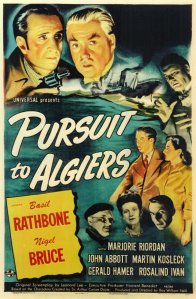
Pursuit_to_AlgiersPursuit to Algiers, the twelfth film to star Basil Rathbone as Sherlock Holmes and Nigel Bruce as his boon companion Dr. John H. Watson, is a minor entry in the series, but a thoroughly enjoyable one. It’s the ninth Holmes picture directed by Roy William Neill, and his sure hand and professionalism are fully in evidence.
The film gets down to business in a wonderfully circuitous fashion, as Holmes and Watson are handed cryptic directions by a series of strangers. In each case, it takes Holmes a few beats to catch on, while Watson is oblivious the whole time. Eventually they are led to a group of men from an unnamed foreign country whose king has just been assassinated. They want Holmes to guard the life of the heir to the throne, Nikolas, who was educated in England. Holmes suggests that Nikolas pose as Watson’s nephew on a steamship voyage to Algiers. Once at sea, the film introduces a worthy cast of drawing room mystery characters, including a trio of sinister but quirky assassins.

Elements of Leonard Lee’s screenplay are taken from an otherwise unrecorded affair mentioned in the beginning of Sir Arthur Conan Doyle’s story “The Adventure of the Norwood Builder,” in particular the use of the steamship Friesland. And at one point in the film, Watson begins to share with his fellow dinner guests aboard the ship his adventure with Holmes that involved the “Giant Rat of Sumatra,” which is mentioned in Doyle’s story “The Adventure of the Sussex Vampire.” These references are similar to what Anthony Boucher and Denis Green would occasionally do in their scripts for the radio show The New Adventures of Sherlock Holmes, which was heard on the Mutual Broadcasting System, and, like the film series, starred Rathbone and Bruce. For instance, in one program, Holmes is willed a patch of land in gratitude for his successful work on a case, and he tells Watson he plans to retire there someday and keep bees. (In Conan Doyle’s stories and novels, the background of Holmes’s retirement in 1903 to the Sussex Downs, where he engaged in beekeeping, was never supplied.)

At times, Pursuit to Algiers comes dangerously close to being a musical, as one of the passengers on the ocean liner is a young and beautiful pianist named Sheila Woodbury (Marjorie Riordan), whom Dr. Watson makes a bit of a fool of himself over. It’s all in good fun, though, and Bruce’s “silly old goat” act is always fun to watch, even if his portrayal of Watson is a bit more ridiculous than Conan Doyle’s original conception of the character. Sheila plays several songs on the piano, including the beautiful “Flow Gently, Sweet Afton.” Watson even joins her at the piano toward the end of the picture for a lovely version of “Loch Lomond.” Director Neill always keeps things moving, however, and despite its minor status, Pursuit to Algiers is still a worthy entry in the Sherlock Holmes series.

Don’t Fence Me In (Oct. 20, 1945)

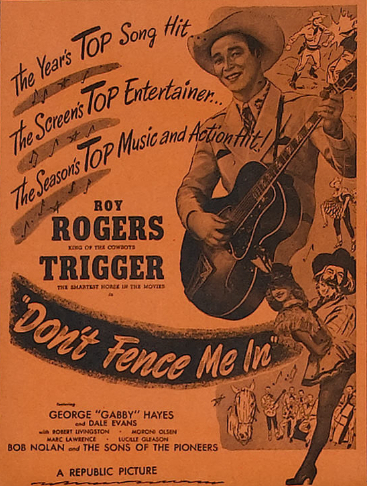
Don’t Fence Me In is a particularly good Roy Rogers picture. Directed by John English (who with William Witney directed some of the best Republic serials of the late ’30s and early ’40s), it’s a well-paced, exciting, and thoroughly enjoyable B western.

The film opens with a western montage, accompanied by the Cole Porter song from which the film gets its title. After the credits roll, we’re treated to a cheap-looking Boot Hill set with a matte painting background that looks as if it’s about two feet away. A narrator tells us that “Once upon a time, as a matter of fact nearly forty years ago, there was a notorious western outlaw named Wildcat Kelly. He didn’t want to be fenced in either. But they stuffed him into a pine box and buried him six feet under the sod, on Boot Hill.” A masked man rises from behind Kelly’s tombstone, carrying a gun and a Wells Fargo case. The narrator, sounding surprised, says, “Wait a minute, that looks like Wildcat Kelly. It is Wildcat Kelly. There’s something mighty strange about this. I think we’d better investigate the story of Mr. Wildcat Kelly.”

And investigate we shall, but the job will fall on the pretty shoulders of a girl reporter named Toni Ames (Dale Evans). Toni has enough moxie to make an 800-pound gorilla stop dead in his tracks. When we first meet her, she’s performing the song “A Kiss Goodnight” while dancing on the table at a hot party in a big city, displaying her shapely gams to maximum effect. She’s doing it all for a story, though. A reporter for a tabloid called Spread magazine, Toni is undercover, secretly snapping shots of the party’s guest of honor, a dirty old cad named Cartwright (Andrew Tombes) who’s running for mayor as an incumbent.

The plot eventually takes Toni out west to the R Barr Dude Ranch to investigate the legend of Wildcat Kelly, who it turns out faked his own death nearly 40 years ago and has been living as a regular western Joe named “Gabby Whittaker.” He’s played by George “Gabby” Hayes, and it’s a good part for him. In a lot of these pictures, Hayes was able to just coast on his ornery persona, but Don’t Fence Me In actually gives him something to do.

Rogers plays that charming and laconic singing cowpoke character called “Roy Rogers” that he played in dozens of movies. Roy is Gabby’s friend, and the only person who knows his secret. He tries to convince Toni not to publish what she knows about Wildcat Kelly, but she goes ahead with her story, and that’s when things get interesting.

There are a group of gangsters whose motives are shadowy, but who clearly want Kelly dead once it’s revealed he is still alive. One of them is played by the great character actor Marc Lawrence, who had a very long career as a sinister-looking hood.

This is a fine showcase for all of the regulars from the ’40s Roy Rogers pictures. Bob Nolan and the Sons of the Pioneers back Rogers up both musically and when it’s time for fisticuffs. And the wonder horse Trigger does a high-stepping dance, with Rogers astride him, to an instrumental version of “Don’t Fence Me In,” and even takes a bow when he’s finished.

Roy and Dale’s relationship is more antagonistic than in many of their other pictures, but it’s still fun to watch. When she first shows up and tries to stow away in the boot of a coach, Roy tosses a hunk of stinky Limburger cheese in the back with her and takes her on a bumpy ride. She later pays him back by pushing him into a swimming pool.

Don’t Fence Me In ends with a delightful rendition of the title song performed by Roy, Dale, and the Sons of the Pioneers, with a few lines added at the beginning about Wildcat Kelly to tie the whole thing together.

Mildred Pierce (Oct. 20, 1945)

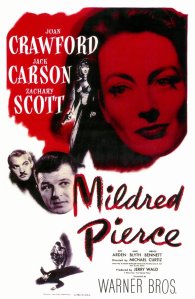
Mildred_PierceIf you’ve only seen the film adaptation of James M. Cain’s 1941 novel Mildred Pierce, you’re forgiven for never wondering whether the striking murder set piece that opens the film and informs the entire picture was an invention of the producer and the screenwriters that never occurred in the novel.
It was. But it’s a brilliant invention. Even though long stretches of Mildred Pierce (told in flashback) are essentially melodrama, the sequence that opens the film is one of the greatest examples of film noir I’ve ever seen. It is nighttime. Heavy shadows fall over caddish playboy Monte Beragon (Zachary Scott), resplendent in a tuxedo, as he is gunned down in a Malibu beach house. Not every shot hits him. A few smash into the mirror behind him. But enough hit him to kill him, and he falls to the floor. Mildred Pierce (Joan Crawford) flees from the house, walks down the boardwalk, and looks as though she is contemplating suicide by jumping into the Pacific Ocean, but is stopped by a policeman. She talks her way out of the situation and later entices the beefy and amorous Wally Fay (Jack Carson) back to the house on the beach and locks him in, with the intention of pinning the murder on him. The scenes in which Wally realizes Mildred has left him alone in a locked house with a corpse and a revolver and he attempts to escape are stunning, and are one of the greatest noir sequences in film history.

Unlike Billy Wilder’s Double Indemnity (1944), another noir classic adapted from a novel by Cain, Michael Curtiz’s Mildred Pierce takes a lot of liberties with its source material. This is partly due to necessity. I loved Cain’s novel, and found it every bit as good as his 1934 crime classic The Postman Always Twice and more believable than his 1937 novel Serenade, which is about a male opera singer who loses his voice after he gives in to homosexual temptation. Cain’s Mildred Pierce contains no murders, just plenty of bad behavior, and the most despicable character waltzes off at the end with no punishment in sight. Apparently the moral tone of the novel was troubling to the Breen Office, so producer Jerry Wald devised a murder plot with a culprit who could be punished, which sufficiently palliated the concerns of producer and studio head Jack L. Warner, and he purchased the rights to the novel in 1944. The script for the film went through eight different versions before Ranald MacDougall’s version was accepted. William Faulkner and Catherine Turney both made uncredited contributions. (And we can all thank our lucky stars that Faulkner’s scene in which Mildred’s maid, played by Butterfly McQueen, consoled Mildred while singing a gospel song was either never filmed or was left on the cutting room floor.)

Mildred Pierce is a fantastic film. Crawford’s longtime nemesis Bette Davis and fellow fading star Rosalind Russell were both considered for the lead role, but both turned it down. It’s impossible for me to imagine anyone but Crawford playing Mildred Pierce. She brings not only her finely controlled histrionics to the role, but her own life history as a woman who crawled up from nothing.

When the picture opened, it was a huge hit, both with critics and audiences. It was nominated for best picture, best actress, best supporting actress (for Eve Arden, who plays Mildred’s wisecracking best friend), best writing, and best black and white cinematography. Joan Crawford won the Academy Award for best actress, and accepted the statuette at home, where she was sick in bed. (Her adopted daughter Christina claims she was faking, but this is hardly the worst accusation she has lobbed at her mother.)

Secret Agent X-9 (13 chapters) (July 24-Oct. 16, 1945)

Secret Agent X-9Republic Pictures is the unassailable king of the cliffhangers after the silent era. Most of the best chapterplays of the ’30s and ’40s were Republic productions. Dick Tracy (1937), The Lone Ranger (1938), Zorro’s Fighting Legion (1939), Adventures of Red Ryder (1940), Mysterious Doctor Satan (1940), Adventures of Captain Marvel (1941), Jungle Girl (1941), Spy Smasher (1942), Perils of Nyoka (1942), The Masked Marvel (1943), and Captain America (1944) are just a few of the more than sixty serials produced by Republic Pictures, most of which are still incredibly entertaining. The best Republic serials combined wild action and elaborate stunts with nicely paced stories that could be strung out over 12 to 15 weekly installments with a few subplots here and there, but nothing too complicated or that viewers couldn’t pick up with in the middle. Each chapter ended with a cliffhanger (like Captain Marvel flying toward a woman falling off a dam, or a wall of fire rushing down a tunnel toward Spy Smasher). The next week’s chapter would begin with a minute or two of the previous week’s climax and the resolution, and the cycle would repeat until the final chapter.
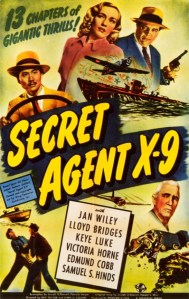
Columbia Pictures and Universal Pictures were the two other major producers of serials in the sound era. Universal ceased production of serials in 1946, leaving only Columbia and Republic to duke it out into the ’50s. One of the last serials made by Universal was Secret Agent X-9, released into theaters starting in July 1945. It was based on a daily newspaper strip created by writer Dashiell Hammett (the author of The Maltese Falcon and The Thin Man) and artist Alex Raymond (who worked on Flash Gordon). Both creators left the project soon after its inception, and the King Features strip continued under various hands, vacillating between espionage and private eye stories.

X-9The first film serial featuring Secret Agent X-9 was made by Universal in 1937, and starred Scott Kolk as Agent X-9, a.k.a. “Dexter,” who sought to recover the crown jewels of Belgravia from a master thief called “Blackstone.” The second featured a boyish-looking 32-year-old Lloyd Bridges as Agent X-9, a.k.a. “Phil Corrigan.” Made toward the end of World War II, the 1945 iteration of the character focused on wartime intrigue and Corrigan’s cat-and-mouse games with Axis spies. Taking a cue from Casablanca (1942), the serial was set in a neutral country called “Shadow Island,” in which Americans, Japanese, Chinese, French, Germans, Australians, and the seafaring riffraff of the world freely intermingle. A fictional island nation off the coast of China, “Shadow Island” has a de facto leader named “Lucky Kamber” (Cy Kendall) who owns a bar called “House of Shadows” and has a finger in every pie, including gambling and espionage. Various German and Japanese military officers, secret agents, and thugs run amuck in this serial, but the one who most stands out is the unfortunately made-up and attired Victoria Horne as “Nabura.” In her role as a Japanese spymaster, Horne is outfitted with eyepieces that cover her upper eyelids, appearing to drag them down from sheer weight. She doesn’t look Asian, she just looks as if her eyes are closed.
While Nabura is played by a white actress in yellowface makeup, the main Chinese character is actually played by a Chinese actor, which was typical in World War II-era Hollywood. Keye Luke, surely one of the hardest working Chinese-American actors in Hollywood history, plays “Ah Fong,” Corrigan’s faithful sidekick. Corrigan is also aided by an Australian double agent named Lynn Moore, played by American actress Jan Wiley. Wiley does nothing to alter her accent, which was also typical for American actors who played Aussies in Hollywood productions during the war.

Secret Agent X-9 has good production values and special effects. The stock footage that shows up in nearly every serial is judiciously used, and integrated well into the newly filmed material. Where this Universal serial just doesn’t measure up to the best Republic offerings is in the pacing and action departments. Republic serials featured stuntwork that still impresses (e.g., Spy Smasher leaping through the air, landing on a mechanic’s creeper chest-first, rolling under a car, and grabbing a goon’s ankles before he can escape). Secret Agent X-9 features ho-hum shootouts, fistfights, and car chases.

Also, instead of a plot that evolves naturally over the course of the series, there is a simple story that seems as if it’s been stretched from a 90-minute feature into 13 chapters, most of which are longer than 20 minutes. Secret Agent X-9 also suffers from poor timing. When the first installment was released, V-E Day had already passed, but the United States was still at war with Japan. By the time the final installment was released, atomic bombs had been dropped on Hiroshima and Nagasaki, Japan had surrendered to the Allies, and a new phase in world history had begun. Secret Agent X-9 is set in 1943, so it’s never out of date, per se, but its MacGuffin, a substitute for aviation fuel called “722,” which everyone in the film is scrambling to secure for themselves, seems like small beer after the advent of the Atomic Age.

White Pongo (Oct. 10, 1945)

WhitePongo

White Pongo (1945)
Directed by Sam Newfield
Sigmund Neufeld Productions / Producers Releasing Corporation (P.R.C.)

If you needed a giant primate in Hollywood in the ’40s, Ray “Crash” Corrigan was your go-to guy. Corrigan would put on any ape costume for a paycheck. And if you didn’t have a particular vision of what your giant primate should look like, Corrigan was happy to wear his own fitted ape suit that was covered with “fur” made of human hair. He even did children’s parties and reportedly terrified some kids.

Nicknamed “Crash” for the way he tackled other football players and for his fighting skills, Corrigan got his start in Hollywood as a physical trainer to the stars, as well as performing stuntwork and acting in bit parts, such as his appearances in an ape costume in Tarzan and His Mate (1934) and as an “Orangopoid” in the Flash Gordon serial (1936). He got his big break playing a human when he was picked to star in the Republic serial Undersea Kingdom in 1936, after which he was signed as a term player for Republic Pictures. He eventually left over a pay dispute and went to Monogram Pictures.

He appeared in more than 50 movies in the late ’30s and early ’40s (including 24 outings as “Tucson Smith” in Republic’s “Three Mesquiteers” series and 20 appearances as “Crash Corrigan” in Monogram’s “Range Busters” series), but even during this fertile period of his career playing humans, he frequently found himself in monkey suits. And no, that’s not a euphemism for tuxedos.

He appeared as a gorilla or ape in Round-Up Time in Texas (1937), the Three Stooges short “Three Missing Links” (1938), the Boris Karloff horror film The Ape (1940), Law of the Jungle (1942), The Strange Case of Doctor Rx (1942), Dr. Renault’s Secret (1942), Captive Wild Woman (1943), She’s for Me (1943), Nabonga (1944), The Monster Maker (1944), and The Monster and the Ape (1945). He even did double duty in some films. In the Three Mesquiteers film Three Texas Steers (1939), he appeared not only as his recurring character Tucson Smith, but also as “Willie the Gorilla.” And in The White Gorilla (1945), he played not only the hero, but also “Konga,” the white gorilla whom the hero fights.

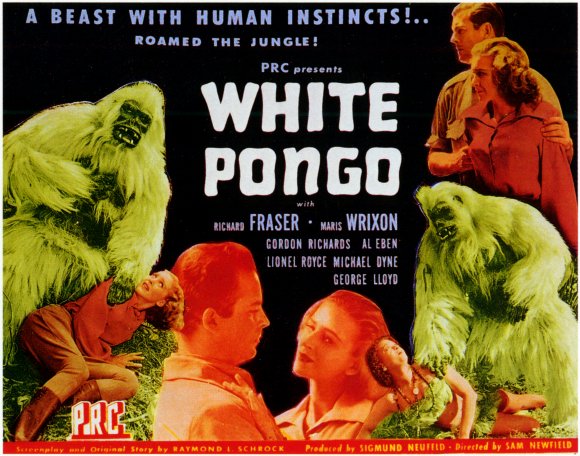
He also appeared as the eponymous White Pongo in this P.R.C. cheapie directed by Sam Newfield. It premiered in Los Angeles on Wednesday, October 10, 1945, and was released nationwide a month later, on Friday, November 2nd. The film is one of the poorer examples of a jungle adventure I’ve seen. After the credits finish rolling over an image of Africa, a pointer stick appears, insouciantly circling an enormous section of the southwestern coast of the continent as the narrator says, “Stretching north and south of the equator in west Africa are vast areas of dense forests and swamplands as yet unexplored by white men. A virgin territory penetrated only by the great Congo river and its tributaries. Here in this wild, steaming portion of the Dark Continent is the home of the ‘ponga,’ native name for the gorilla. It was here on the fringe of gorilla territory, in a nameless native village inhabited by a tribe of fierce Negritos, an incident occurred which was destined to startle the civilized world.”

There’s so much to work with already I don’t know where to start. The combination of the verb “penetrate” with the noun “virgin territory,” the fact that “Negritos” are ethnic groups in Southeast Asia, the idea that any village inhabited by humans would be “nameless.” The only thing the film sort of gets right is the general location where gorillas live. Once the wielder of the pointer calms down and focuses on the area where the Atlantic Ocean feeds into the Congo, that is.

The plot of the film, such as it is, involves a crew of scientists and hunters who are hot to find the white ponga because if he turns out not to be a hoax, he could be the “missing link that will prove Darwin’s theory.” Why they believe this despite having no direct contact with the creature is not explained. Because he has white fur? The mind reels. The leader of the expedition, Sir Harry Bragdon (Gordon Richards), of course brings along his beautiful blond daughter, Pamela (Maris Wrixon). The most watchable scenes in White Pongo are the ones she shares with the great white hunter of the expedition, Geoffrey Bishop (Richard Fraser), who’s believable in his role as a tall, lean, Rhodesian rifleman (even though he’s a Scot with an accent that sounds British). Unfortunately, there’s also an unnecessary triangle involving a twit named Clive Carswell (Michael Dyne) who fancies himself in love with Pamela, even though she has no interest in him.

At just under 72 minutes, the film still drags. There seems to be more stock footage, travelling scenes, and establishing shots than there are scenes that advance the story. Things don’t really pick up until the last 15 minutes, which are fairly brisk, though still not what I would call “action-packed.” For a guy who made wearing an ape costume a vocation, Corrigan doesn’t really move or act like a primate, making his large role in the climax more laughable than anything else. And the frequently interspersed stock footage of actual monkeys doesn’t help. Unless you have a fetish for humans in gorilla suits, you can pass this one up with a clear conscience.

http://www.youtube.com/watch?v=mkQODrJ8wSY

Abbott and Costello in Hollywood (Oct. 5, 1945)

AbbottCostelloHollywoodAbbott and Costello were one of the most popular comedy teams of the ’40s. They’re still famous for their “Who’s on first?” routine, and a lot of their film and radio work is still funny, as long as you’re in the mood for their old-fashioned brand of burlesque antics. If you’re not in the mood for them, or if one of their bits falls flat, Lou Costello is the most irritating man on earth.

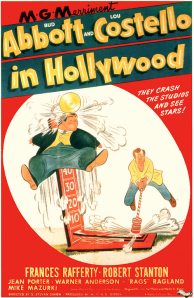
In Abbott and Costello in Hollywood they play a couple of bumbling barbers named Buzz Kurtis (Abbott) and Abercrombie (Costello). Who’s ready for lots of physical humor involving shaving cream and shoe polish?

When we first meet the boys, they’re in the supply room of Hollywood Shop: Barbers to the Stars. Even if you’ve never seen an Abbott and Costello picture before, as soon as you see Abbott instructing Costello on how to shave a customer’s face without cutting him while Costello listens attentively, holding a straight razor poised above a balloon covered with shaving cream, you’ll know the balloon is not long for this world. If you have seen an Abbott and Costello picture before, you’ll know that after the balloon breaks and sprays shaving cream all over Costello’s face, there will be a second balloon. Will there be a third balloon? I don’t want to give anything away.

Thankfully, the movie doesn’t coast on barbering gags, since Abbott and Costello decide they want to be Hollywood agents at around the 30-minute mark. As with any Abbott and Costello picture, however, the plot is secondary to gags and wordplay, so it doesn’t really matter whether they’re playing geologists or Portugese noblemen. A lot of the routines in this movie are clunkers, but a few are laugh-out-loud funny, such as the one in which Costello hides out by pretending to be a dummy on the set of a western, and finds himself being punched in the face and thrown over a balcony in take after take by craggy-faced tough-guy character actor Mike Mazurki.

Most of the “stars” they meet in Hollywood (like Rags Ragland) are long forgotten, but if you keep your eyes peeled, you’ll see a young Lucille Ball in a small role.