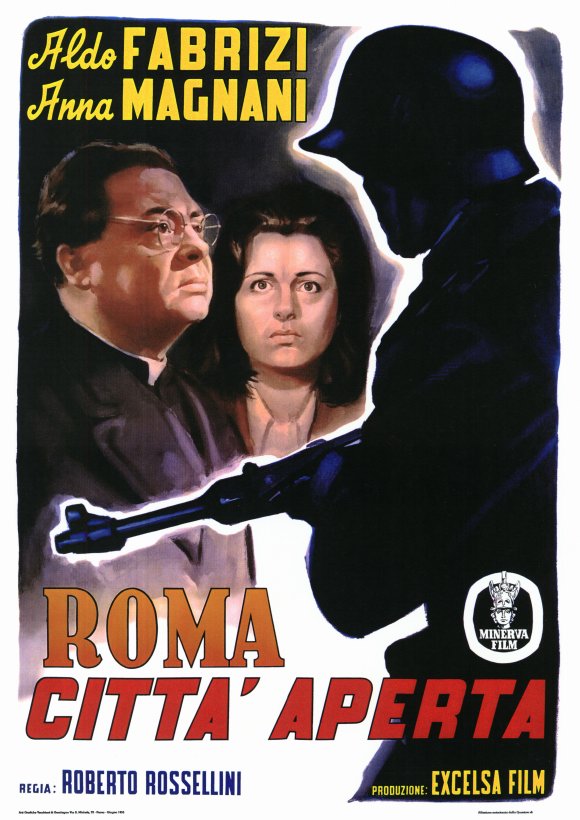
 Roberto Rossellini’s Roma, Città Aperta (Rome, Open City) premiered in Italy on September 27, 1945, and premiered in New York City on February 25, 1946, at the World Theatre on 49th Street, a 300-seat theater where it would continue to play for nearly two years. It was shown at Cannes in September 1946 and won the festival’s grand prize. It also received the New York Film Critics Circle award for best foreign film of 1946. It’s cited as one of the earliest masterpieces of the Italian neorealism movement, and has been generally accepted as a great film since its release. The problem with instant masterpieces is that sometimes they coast for decades on reputations that might not be fully deserved.
Does Roma, Città Aperta fall into this category? Yes and no. The cartoonish villains and black and white morality sometimes skirt the edge of the ridiculous, and the Italian population is painted as victims of the Nazis to such a large degree that a person who saw this film in a vacuum would be forgiven for thinking that Italy was an occupied Allied power. Also, the exteriors are shot in a verité style that sometimes clashes with the more traditional interior shots. For example, a sun-drenched, slightly overexposed street scene with genuinely angry-looking extras might be followed by a carefully lighted interior scene featuring a stereotypically mincing Nazi officer and his right-hand dyke. For the most part, however, Roma, Città Aperta holds up as a suspenseful, well-crafted wartime espionage yarn that inspires and uplifts, even though … spoiler alert … all the good guys die.
Roma, Città Aperta arrived at just the right time for a positive reception. While Mussolini’s Italy was an Axis power, the country had been completely dependent on Germany since the end of 1941. Rome was occupied by the German army, with help from the Mussolini’s fascist blackshirts, but Italy has never been the most organized or politically unified country, and plenty of Rome’s citizens were understandably restive during this time. Roma, Città Aperta is a story of resistance that takes toward the end of the German occupation of Rome. Rossellini began working on the script with Federico Fellini and Sergio Amidei in August 1944, two months after the Allies had forced the Germans out of Rome, and he began shooting the picture about five months later. The picture’s politics (staunch Communist and anti-Fascist) were also perfectly suited to receive a warm reception from audiences immediately following World War II. If it had been shown in America and Britain just a few years later, the picture’s cheerleading for Communist principles would doubtlessly have gone over less well.
The new DVD from the Criterion Collection I watched looks great. It’s the full version, too, with the blowtorch torture sequence in its entirety, and while the subtitles are merely adequate, they do appear for each line of dialogue (a complaint about one available DVD version I’ve seen is that whole sections of conversation weren’t translated). Even the snatches of conversation in German are subtitled, which seemed unnecessary, since the main baddie, Maj. Bergmann, speaks Italian most of the time. (He’s played by the Austrian actor Harry Feist, who lived in Italy most of his adult life.) Visually, the film captured my interest immediately. The sequence in which resistance member Giorgio Manfredi (Marcello Pagliero) eludes the Gestapo by fleeing along the rooftops is thrilling. The human drama took a little longer to jell for me, partly because there are a lot of characters, and since this is a neorealist picture, they don’t appear at the beginning with title cards explaining their relationships. Aldo Fabrizi gets top billing. He plays the priest, Don Pietro Pellegrini, who ties all the characters together. He transmits messages, cash, and weapons for the resistance. Giorgio’s friend Francesco (Francesco Grandjacquet) is a fellow member of the resistance, but seems less dedicated to the cause than Giorgio. Giorgio’s girlfriend, Marina (Maria Michi), works at a nightclub and doesn’t seem to understand the gravity of Giorgio’s situation. Francesco’s fiancée Pina (Anna Magnani) shelters Giorgio and cares for her young son Marcello (Vito Annicchiarico), who gets involved with his own resistance against the Nazis, a sort of children’s crusade that involves blowing shit up really good.
As I said, it’s the cartoonish villains that seem most silly six decades later. Maj. Bergmann is as prissy and effeminate as he is cruel, which would be easier to ignore if he weren’t paired with an evil lesbian named Ingrid (Giovanna Galletti). The scenes in which Ingrid cajoles the easily manipulated Marina are like something out of a ’60s James Bond film.
There’s an oft-repeated story that Roma, Città Aperta was an ad hoc production, and that it was shot on scraps of discarded film, which gave it its distinctive choppy look. According to David Forgacs’s recent book on the film for the British Film Institute, however, when the Cineteca Nazionale restored the film in 1995, they found that the original negative consisted of just three types of film; one for the exteriors and two different, more sensitive, types of film for the interiors. The inconsistencies and changes in brightness are now blamed on poor processing. It’s an alluring legend, though; Rossellini and his crew shooting in a beautiful, ancient city still damaged by war, picking film up out of the gutters, but it’s just that … a legend. There’s another great story about the film, also of questionable veracity. According to Fellini’s essay “Sweet Beginnings,” the American producer of the film, Rod Geiger, was a half-drunk American private stationed in Rome who bungled his way on to the set and misrepresented himself as a producer with connections. With a copy of the film in his barracks bag, Geiger somehow managed a theatrical distribution deal when he got back to the states, even though, according to Fellini, Geiger was “a nobody and didn’t have a dime.” Geiger disputed Fellini’s account, however, and the essay was the subject of a defamation lawsuit that led to the film being banned due to legal reasons in some countries.
Roma, Città Aperta is a very good film, but I think its reputation as a masterpiece is partly due to when and how it was released. In my opinion, Luchino Visconti’s 1943 film Ossessione is just as good, if not better, but it wasn’t shown in the United States until the ’70s, partly because it was produced during the war, but mostly because it was an unauthorized adaptation of James M. Cain’s 1934 novel The Postman Always Rings Twice and legal trouble affected its distribution. It’s a must-see for students of cinema, especially ones interested in both film noir and neorealism.
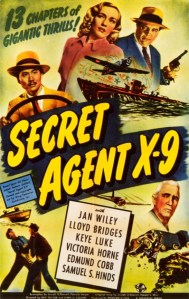 Republic Pictures is the unassailable king of the cliffhangers after the silent era. Most of the best chapterplays of the ’30s and ’40s were Republic productions. Dick Tracy (1937), The Lone Ranger (1938), Zorro’s Fighting Legion (1939), Adventures of Red Ryder (1940), Mysterious Doctor Satan (1940), Adventures of Captain Marvel (1941), Jungle Girl (1941), Spy Smasher (1942), Perils of Nyoka (1942), The Masked Marvel (1943), and Captain America (1944) are just a few of the more than sixty serials produced by Republic Pictures, most of which are still incredibly entertaining. The best Republic serials combined wild action and elaborate stunts with nicely paced stories that could be strung out over 12 to 15 weekly installments with a few subplots here and there, but nothing too complicated or that viewers couldn’t pick up with in the middle. Each chapter ended with a cliffhanger (like Captain Marvel flying toward a woman falling off a dam, or a wall of fire rushing down a tunnel toward Spy Smasher). The next week’s chapter would begin with a minute or two of the previous week’s climax and the resolution, and the cycle would repeat until the final chapter.
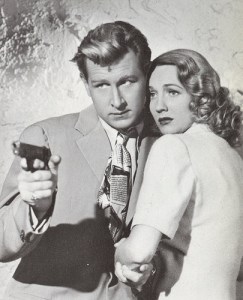 The first film serial featuring Secret Agent X-9 was made by Universal in 1937, and starred Scott Kolk as Agent X-9, a.k.a. “Dexter,” who sought to recover the crown jewels of Belgravia from a master thief called “Blackstone.” The second featured a boyish-looking 32-year-old Lloyd Bridges as Agent X-9, a.k.a. “Phil Corrigan.” Made toward the end of World War II, the 1945 iteration of the character focused on wartime intrigue and Corrigan’s cat-and-mouse games with Axis spies. Taking a cue from Casablanca (1942), the serial was set in a neutral country called “Shadow Island,” in which Americans, Japanese, Chinese, French, Germans, Australians, and the seafaring riffraff of the world freely intermingle. A fictional island nation off the coast of China, “Shadow Island” has a de facto leader named “Lucky Kamber” (Cy Kendall) who owns a bar called “House of Shadows” and has a finger in every pie, including gambling and espionage. Various German and Japanese military officers, secret agents, and thugs run amuck in this serial, but the one who most stands out is the unfortunately made-up and attired Victoria Horne as “Nabura.” In her role as a Japanese spymaster, Horne is outfitted with eyepieces that cover her upper eyelids, appearing to drag them down from sheer weight. She doesn’t look Asian, she just looks as if her eyes are closed.
 A lot of men were drafted during World War II. Roy Rogers was one of them. With a 1-A classification, he expected to be shipped out in the spring of 1945. Consequently, screenwriter John K. Butler (working from a story by Leon Abrams) came up with a script to showcase Rogers’s leading lady, Dale Evans. When V-E Day rolled around, however, the draft board exempted men over the age of 30 who had children, so Rogers never had to serve. Director Frank McDonald’s Sunset in El Dorado ended up starring both “The King of the Cowboys” and “The Queen of the West,” but Evans is still the central figure, and it’s a great showcase for her sunny persona.
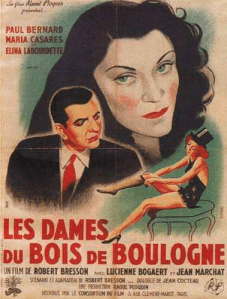 French film director Robert Bresson is famous for his use of non-professional actors. Prior to watching Les Dames du Bois de Boulogne, I had only seen one Bresson film, Pickpocket (1959), whose protagonist was most certainly not a professional actor. He shambled through the proceedings like a man on a heavy dose of tranquilizers, his movements slow, his eyes haunted. It was an interesting film, and one I may watch again some day, but it didn’t move me.
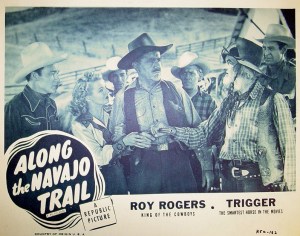 There are no Navajos to be found in this run-of-the-mill Roy Rogers picture, or American Indians of any tribe, for that matter. The title comes from a popular song that was written by Dick Charles (a.k.a. Richard Charles Krieg), Larry Markes, and Edgar De Lange in 1945, and is sung by Rogers, Dale Evans, and the rest of the gang to close the picture. No, the only people of color in Along the Navajo Trail are Spanish-speaking Gypsies, who are portrayed in much the same way Mexicans were in Hollywood westerns except that they wear funny clothes, travel in wagons, and the men wear gold hoop earrings. They also provide George “Gabby” Hayes’s character with a series of comic interludes in which he attempts to cheat the Gypsies, and is in turn cheated himself. These horse trades don’t add much to the plot, but they do result in Hayes sputtering the memorable line, “I sure have gypped that gyppin’ Gypsy!”
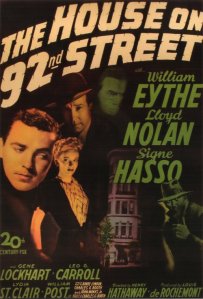 When The House on 92nd Street was released on DVD in 2005, it was as part of the “Fox Film Noir” collection. This is misleading, since it’s more of a docudrama than it is a noir. It’s a historically important film, however, since it was one of the first to feature location shooting for nearly all the exteriors, and one of the first to skillfully blend fact with fiction while presenting itself as essentially factual. (Charles G. Booth won an Academy Award for best original story for his work on this film.)
 Dead of Night is a British anthology of horror stories with many layers and a cyclical story structure. The five segments are based on stories by H.G. Wells, E.F. Benson, John Baines, and Angus MacPhail. Each is great, but the way the stories are told and the way they are linked together is the most interesting thing about the film.
 OCD Viewer