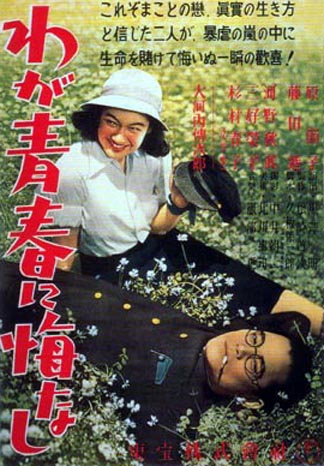
No Regrets for Our Youth (1946)
Directed by Akira Kurosawa
Toho Company
No Regrets for Our Youth was the second film Akira Kurosawa directed after the end of World War II. (The first was Those Who Make Tomorrow, which was released on May 2, 1946. He was forced to direct it by Toho studio bosses. He disliked making the film and never included it in his list of official credits.) No Regrets for Our Youth is an interesting counterpart to two other films I watched this year, Italy’s Roma, città aperta (Rome, Open City) and Germany’s Die Mörder sind unter uns (The Murderers Are Among Us). These three pictures are all early efforts by filmmakers in former Axis powers to come to terms with the enormity of World War II.
Roma, città aperta represents an almost total abnegation of responsibility, which is fair enough, considering the role most Italians played in the war compared with the litany of horrors perpetrated by Germany and Japan. No Regrets for Our Youth is more similar to Die Mörder sind unter uns. Both films are stridently anti-Fascist, but both sidestep the gruesome specifics of what actually went on during the war.
Setsuko Hara stars as Yukie, the daughter of a university professor with leftist leanings. (Hara would only work with Kurosawa once more, when she starred in his film The Idiot in 1951, but she was one of Yasujirô Ozu’s favorite actresses, and starred in six of his films from 1949 to 1961.) The film begins immediately after the 1933 University at Takikawa protests against the Japanese invasion of Manchuria. Yukie is courted by two young men, Ryukichi Noge (Susumu Fujita) and Itokawa (Akitake Kôno). Itokawa is sensible and boring, while Noge is a political firebrand and hot-headed. Yukie is naturally drawn to Noge, but he is arrested after a demonstration and spends four years in prison.
When he is released, he seems to be a changed man; broken in some essential way. Yukie packs up and moves to Tokyo, where she lives for three years, toiling away in a variety of menial jobs. Itokawa and Noge both re-enter her life, and she ends up marrying Noge, who is now involved in espionage. Eventually he is arrested by Imperial forces, and Itokawa, who is now a lawyer, steps in to defend him.
No Regrets for Our Youth is a film with two distinct halves. The second half, in which Yukie goes to visit Noge’s parents, is visually and dramatically stronger than the first. Noge’s parents are both simple farmers living in a remote village. They are terrorized by the other villagers because their son was a spy, and they never go out during the day, only planting at night. Yukie decides to stay with them and fight against adversity, finding value in tilling the land.
It would be decades, of course, before most filmgoers in the West would see this film. The first Kurosawa film to make any impact outside of Japan was Drunken Angel (1948), and Kurosawa didn’t have a true breakout success until Rashomon (1950), which won the Golden Lion at the Venice Film Festival in 1951.
No Regrets for Our Youth is a good film, but it’s not a great one. The performances from the lead actors are excellent, especially from Hara. She ages and grows over the course of the film in a realistic way, which is important when a film covers a period of many years. The story is involving, but not exactly what I would call “gripping.” The scenes in the rural village have a distinctly Soviet flavor to them, and I believe that Kurosawa made this film in an atmosphere of heavy censorship and control by occupying forces.
This is the earliest Kurosawa film I’ve seen, so I don’t know what his pre-war films are like, but it seems to me that he really came into his own as an artist starting in the late ’40s, when he reworked American and European stories and film techniques for pictures like Stray Dog (1949) and High and Low (1963), two of the best police procedurals ever made; Seven Samurai (1954) and Yojimbo (1961), two samurai films that drew heavily from American westerns and were in turn copied over and over by directors making actual westerns; and his reimaginings of Shakespearean dramas set in feudal Japan, Throne of Blood (1957) and Ran (1985).
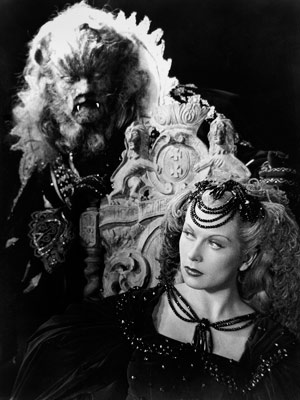
La Belle et la Bête (Beauty and the Beast) (1946)
Directed by Jean Cocteau
DisCina
Jean Cocteau began filming La Belle et la Bête (Beauty and the Beast) almost immediately after the end of the Nazi occupation of France. It wasn’t a quick or an easy shoot. Cocteau had to contend with limited film stock of varying quality, cameras that jammed, aircraft flying overhead that ruined the sound, and the general disarray of post-war France.
The 56-year-old Cocteau was a well-known writer, poet, visual artist, and director of avant-garde films, but this was his first foray into mainstream filmmaking. It begins with an exhortation to audiences to remember what it is to be a child, and to experience magic without the jaundiced eyes of an adult.
This is probably a direct reaction to the critics (most notably Jean-Paul Sartre) who felt that Cocteau was not political enough. Cocteau’s only allegiance in life was to art, and it is appropriate that he made this film as a reaction to critics, since it’s one of the most beautiful and magical pieces of filmmaking I’ve ever seen. His plea to audiences that opens the film seems unnecessary. This is a film that speaks for itself.
In adapting the 18th-century fairy tale, Cocteau used a lot of the same techniques he used when he made his experimental 1930 film Le sang d’un poète (The Blood of a Poet); simple special effects, an obsession with mirrors, statues that come to life, and tricks of speed and perspective.
As in the original story (most famously written by Mme Jeanne-Marie Le Prince de Beaumont in 1756, although she didn’t create the tale), Belle (played by Josette Day) lives with her merchant father (Marcel André) and her two nasty, selfish sisters, here named Félicie (Mila Parély) and Adélaïde (Nane Germon). Cocteau added two male characters, Belle’s brother Ludovic (Michel Auclair) and her handsome but shallow suitor, Avenant (Jean Marais).
The domestic scenes in the film are designed and lighted to look like paintings by Vermeer and Rembrandt. The characters all wear 17th-century costumes, and the interiors are beautiful to look at, even though the human drama is stifling and petty. Félicie and Adélaïde bicker and ridicule Belle, and are indifferent to their father’s rising debts. Meanwhile, Ludovic and Avenant avoid all responsibility and are only interested in the pursuit of leisure.
When Belle’s father rides off into the woods, the mood of the film dramatically shifts. Using a combination of real parks and woodlands with studio sets, Cocteau creates a magical fairy-tale world directly based on 19th-century engravings by Gustave Doré.
When Belle’s father first enters la Bête’s castle — revealed when a gate of tree branches magically parts — his shadow moves against the castle entrance even though he is standing still. Once inside, candelabras held by human arms mounted into the wall magically spring to light. It doesn’t matter that you can see wires holding the candelabras aloft; the simple but painstaking special effects are still breathtaking. When Belle’s father sits down in the banquet hall, sculptures of human faces on the mantel of the fireplace are actually the faces of human actors covered with soot, their bright eyes the only thing about them that looks alive as smoke pours out of their nostrils.
This delineation between fantasy and reality continues throughout the film. When Belle enters the castle to fulfill the punishment meted out to her father for picking one of la Bête’s white flowers, she floats through long corridors full of billowing white curtains in dreamy slow-motion. There are doors and mirrors that speak to her, and a bed with a white fur spread that slithers open. The special effects are simple, and a lot of them are done “in the can” by simply reversing the film.
It’s been awhile since I’ve seen Disney’s 1991 version of this fairy tale, but that film bears an enormous debt to Cocteau’s version. Everything from the look of the beast to the costumes, set design, and subplot about Belle’s jealous suitor are lifted directly from this film. While the Disney version is perfectly competent, it doesn’t have the otherworldly power of Cocteau’s vision. La Bête, in particular, is less cuddly and more uncanny here. He’s played by Jean Marais, who also plays Belle’s suitor, Avenant, which would be distracting if he wasn’t completely unrecognizable under the heavy makeup and mountains of hair. Marais plays la Bête as a noble, leonine creature with a deep nasal monotone. Unlike the lovable furball of the Disney film, there are a few moments in which he is truly frightening; appearing as if by magic when Belle’s father picks a flower, drinking from a brook on all fours like an animal, or standing over the carcass of a deer that he has mutilated.
Given that Cocteau was gay and Marais was his longtime lover, it’s tempting to read a lot into this film. For Freudian readings of heterosexual power dynamics and the vagaries of lust, the Beauty and the Beast myth is second perhaps only to the story of Bluebeard. Are all men beasts who must stifle bloodthirsty and rapacious urges in order to be with women? Did Cocteau, who had begun to suffer from painful eczema, feel like a beast himself?
All theories are welcome, but I prefer to heed Cocteau’s advice in the preface and take this magical film at face value.
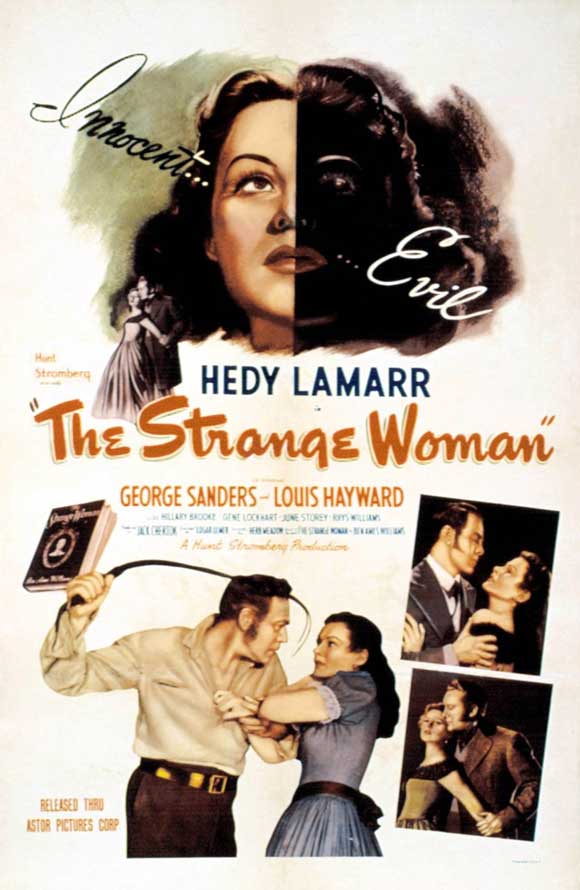
Edgar G. Ulmer’s The Strange Woman, directed with uncredited assistance from Douglas Sirk, is based on the 1945 novel of the same name by Ben Ames Williams.
Born in 1889, Williams was a prolific novelist who is probably best known today for the same reason he was famous in 1946; he wrote the novel Leave Her to Heaven in 1944, which was made into a hit film in 1945 starring Gene Tierney as Ellen Berent, a calculating sociopath with twisted ideas about love.
The Strange Woman was a natural choice to be made into a film following the success of Leave Her to Heaven. Both stories are psychosexual portraits of women with Electra complexes who use their allure to ensnare men and who don’t allow conventional morality to keep them from their goals; even taboos like murder mean nothing to them.
Unlike Leave Her to Heaven, The Strange Woman is a period piece. The film begins in Bangor, Maine, in 1824. Young Jenny Hager (Jo Ann Marlowe) is being raised by a single father (Dennis Hoey) whose only love in life seems to be drink. After Mr. Hager receives stern words from prosperous shop keeper and importer Isaiah Poster (Gene Lockhart) when he once again begs a jug of liquor off of him, the scene switches to a river bank, where young Jenny is tormenting Mr. Poster’s son Ephraim (Christopher Severn), a sickly boy who can’t swim. She pushes him into the river and holds his head under with her bare foot, but when Judge Henry Saladine (Alan Napier) arrives in a carriage, she says, “Poor, poor Ephraim,” and jumps in. She drags him to shore and blames his predicament on the boys she was with.
The judge is disgusted with Mr. Hager for stumbling through life drunk and failing to care for his daughter, but once Jenny and her father are alone, it’s clear that she loves him unconditionally. “Before long we’ll have everything,” she says. “Just as soon as I grow up we’ll have everything we want, because I’m going to be beautiful.” Mr. Hager tosses his empty jug into the river, and when the ripples clear, child actress Marlowe’s reflection has become that of the beautiful Hedy Lamarr.
Jenny may be all grown up, but clearly only a few years have passed. All the adults are played by the same actors, and things are much the same in Bangor. Her father is still a hopeless drunk and Mr. Poster is still the wealthiest, most powerful man in town. Bangor appears to be a little rowdier, however, with more commerce coming through the docks, and more drunken sailors stumbling around. Jenny and her friend Lena (June Storey) hang around the waterfront, attracting the attention of sailors. Lena tells Jenny that, with her looks, she could get the youngest and best-looking men around, but Jenny replies that she’s only interested in snagging the richest.
When her father confronts her, she flaunts her sexuality, bragging that she can make any man want her, and he beats her viciously. The whipping he gives her, while they stand face to face, is a little ambiguous, and more than a little sexual.
She runs away to Mr. Poster’s house, and shows him the stripes on her back, throwing her hair forward and dropping the back of her dress, as if she’s posing for a racy portrait, and his face registers both shock and lust.
It’s not long before Jenny marries Mr. Poster. It’s clear that he is a replacement for her father. Her physical longing, at least for the moment, is focused on her old friend — and new son-in-law — Ephraim, who has been sent away to school. She writes Ephraim a letter telling him how lucky he is to have a “nice young mother” and that she will “demand obedience and love.” She writes that if he refuses her, “I will punish you by not kissing you good night” and ends her letter with the line “…come home and see what a fine parent I can be. I do think families should be close, don’t you? Your loving mother, Jenny.”
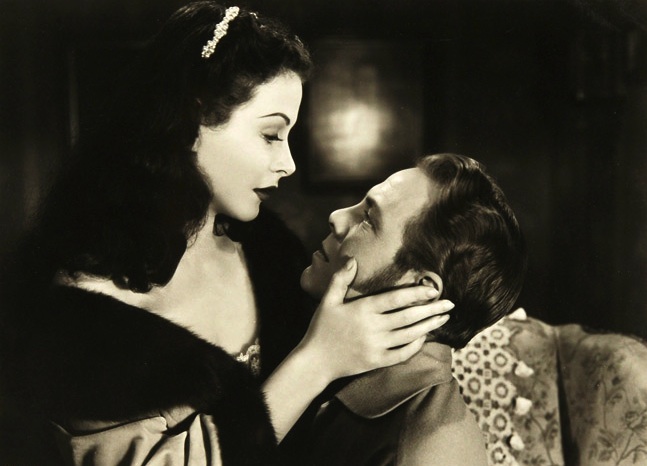
Ephraim (now played by Louis Hayward) returns home, and he and Jenny slowly but surely fall for each other.
As the film poster above rather obviously shows, Jenny has two faces. For instance, when she and Ephraim sit on the banks of the river together, her recollection of pushing him into the river when he was a boy is flawed. She tells him that those rotten boys did it to him, and she tried to save him. Is she lying? Does she know she is lying? Does he know? Does he go along with it because he loves her, or does he truly believe her?
Jenny’s dual nature mirrors the nature of Bangor itself. On the one hand it is a prosperous New England town with an active churchgoing population of well-to-do people (like Mr. Poster and his young wife), but on the other hand it is a seedy little port city full of drunken sailors and “grog shops and low houses” (a.k.a. pubs and brothels). Jenny uses her husband’s money from his shipping and lumber businesses to improve the town, shaming him publicly into contributing large sums to the church. In private, however, she is carrying on with Ephraim, and even encourages him to arrange an “accident” for his father so they can be married.
Ephraim won’t be the last man in Jenny’s trail of conquest, either. As soon as she lays her eyes on John Evered (George Sanders), the tall, strapping foreman of Mr. Poster’s lumber business, it’s clear that the weak-willed Ephraim doesn’t stand a chance.
The Strange Woman is a well-made film with fine performances all around (with perhaps the exception of Gene Lockhart, who as Mr. Poster exhibits some of the most over-the-top reaction shots I’ve seen since watching Grayson Hall on Dark Shadows). Its narrative is sprawling, and clearly adapted from a novel, but the filmmakers keep everything moving along nicely.
Director Ulmer was a talented craftsman who toiled away in Poverty Row for most of his career, producing a few masterpieces, a few awful pictures, and plenty of films in between. The Strange Woman represents the rare film on his résumé with a decent budget and a reasonable shooting schedule. He was lent out by P.R.C. (Producer’s Releasing Corporation) at Lamarr’s insistence (apparently they were friends back in their native Austria-Hungary). He was paid $250 a week for the job. P.R.C. studio boss Leon Fromkess, on the other hand, received roughly $2,500 from United Artists. While he may have gotten the short end of the stick financially, the deal gave Ulmer a chance to work with a professional cinematographer (Lucien Andriot), a major star or two, a well-written script based on a hot property, and major studio distribution.
Crime Doctor’s Man Hunt (1946)
Directed by William Castle
Columbia Pictures
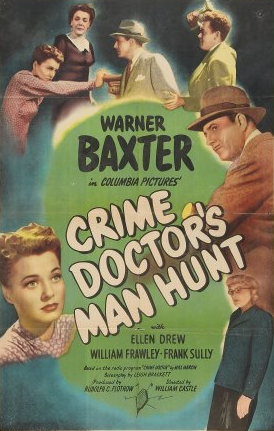
William Castle’s mystery programmer Crime Doctor’s Man Hunt is yet another wacky outing with Warner Baxter as Robert Ordway, M.D., Ph.D. (a.k.a. the Crime Doctor).
The Crime Doctor was a character created by Max Marcin for a Sunday-night mystery radio show that ran from 1940 to 1947 on CBS stations. Like a lot of radio detectives (e.g., Boston Blackie, the Falcon), the Crime Doctor also got his own series of hour-long B movies.
In the first film in the series, Michael Gordon’s Crime Doctor (1943), a Depression-era crook and racketeer named Phil Morgan survives a murder attempt, but suffers from complete amnesia, reinvents himself as “Robert Ordway,” and puts himself through medical school. Once he gets his degree, he focuses on rehabilitating criminals. His past eventually catches up with him, but everything works out all right, and he is able to continue being Dr. Ordway, putting crooks behind bars and helping the helpless.
Crime Doctor is one of the best films in the series. The subsequent films are all a lot of fun, but Dr. Ordway’s checkered past is rarely referred to. Baxter’s performance in the lead role is always top-notch, however, and most of the Crime Doctor pictures are a cut above most other mystery programmers from the ’40s.
In Crime Doctor’s Man Hunt, John Foster (Myron Healey), a young, pencil-mustachioed man suffering from “bomb shock and combat fatigue,” comes to see Dr. Ordway. He’s suffering from fugue states in which he wanders in a daze, always drawn to the same intersection, but he doesn’t know why, and never remembers how he got there. He could get treatment from the Army, but he doesn’t want his fiancée to know about his condition.
His fiancée, Irene Cotter (Ellen Drew), comes to see Dr. Ordway right afterward. (Foster’s attempts to conceal his condition from her were clearly in vain.) Dr. Ordway deflects her questions and tells her that he can’t violate any patient’s confidentiality.
As with most of the Crime Doctor films, things get loonier as the film goes on. We learn that Foster had his fortune cast during a “slumming party” downtown, and was told by a fortuneteller named “Alfredi” (real name “Alfred Hemstead,” played by Ivan Triesault) that he would meet his violent death on the corner of Garth and Davis streets, which is why he is continually drawn there.
There’s also a case of split personality, which I won’t say too much about in order not to give anything away. However, even the dimmer bulbs in the audience will see the “twist” ending coming from a mile away. I’m not even sure it was meant to be a surprise.
Ordway comments at the end of the film that this has been a strange case, first the fugue, then the split personality. “Doctor, I’d like you to come see my wife,” says Police Inspector Harry B. Manning (William Frawley). “Split personality?” asks the doctor. “No personality,” quips the inspector.
In my recent review of Decoy (1946), I mentioned that most of the movies that are now classified as film noirs were originally called “thrillers” or “melodramas.”
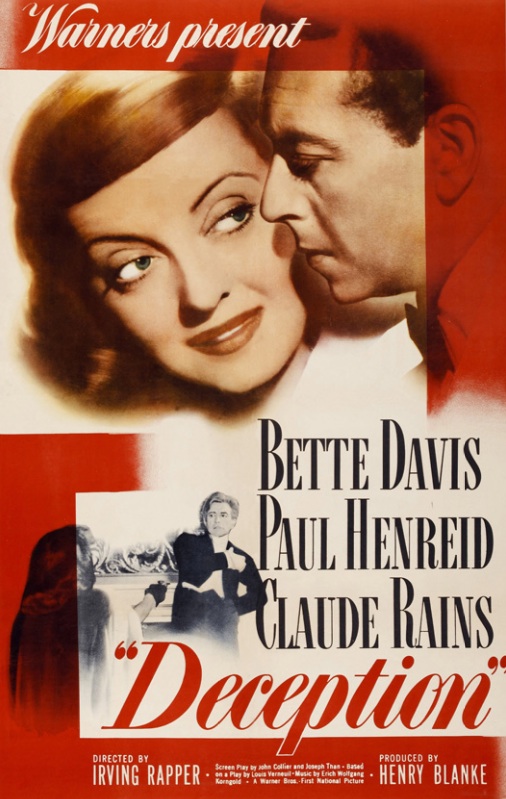
Irving Rapper’s Deception, about a love triangle in the world of classical music, sometimes gets thrown on the film noir pile, but it’s a melodrama through and through. The film reunited the director and all three stars of the popular, classy flick Now, Voyager (1942), which featured one of Bette Davis’s most iconic performances.
Lightning didn’t strike twice. While Deception, which reunited Davis with her fellow Now, Voyager alumni Paul Henreid and Claude Rains, received generally positive reviews, it was the first picture Bette Davis made for Warner Bros. that lost money. It’s a good film, but as melodramas go, it’s not terribly thrilling, and the criminal activity is kept to a minimum.
In the first scene of the film, piano teacher and musician Christine Radcliffe (Bette Davis) rushes through the driving rain to a concert in a small, second-floor performance area. She sees cellist Karel Novak (Paul Henreid), and she begins to cry. Quite by chance, she saw an announcement for the performance and couldn’t believe it, since she believed that Novak, her old flame, had died during World War II.
Their reunion is so emotional that it quickly leads to marriage. Even before the nuptials, however, Novak senses that Christine might be hiding something from him. She lives in an enormous apartment with a spectacular view of Manhattan, and her closets are full of fur coats, all improbabilities in the tight housing market of 1946, especially on a piano teacher’s salary.
Things quickly reach a head at their wedding celebration, with the appearance of Christine’s teacher, the famous composer Alexander Hollenius (Claude Rains). He has witticisms and icy remarks to spare, but he doesn’t really tip his hand until Christine sits down to play Beethoven’s Piano Sonata No. 23 in F minor, Op. 57, the “Appassionata.” Hollenius listens, enthralled, and crushes his champagne glass in his hand. When Christine rushes to tend to him, he says, “Like all women, white as a sheet at the sight of a couple of scratches. Calm and smiling like a hospital nurse in the presence of a mortal wound.”
That’s the first hint he drops about his feelings, but it won’t be the last. When Christine goes to visit him the next day, she walks into Hollenius’s conservatory and calls the piece he is playing “wonderful,” to which he responds, “Extraordinary, isn’t it, that music can exist in the same world as the basest treachery and ingratitude?”
From the beginning, Christine kept Novak in the dark about her relationship with Hollenius. Hollenius goes along with this deception, but never misses an opportunity to drop a hint or needle Novak about something. Compounding the mess is the fact that Hollenius is one of Novak’s favorite composers, and when he offers Novak the chance to be the soloist for the world premiere of his new cello concerto, Novak is ecstatic. Christine, on the other hand, senses that the mercurial Hollenius may be setting a trap for the emotionally fragile Novak.
And it certainly seems that way to the viewer, especially when Hollenius brings in Bertram Gribble (John Abbott), a journeyman cellist, to act as understudy in case Novak’s strained nerves get the better of him. Besides all the barbs and insinuations in social settings, Hollenius the conductor even seems hell-bent on tormenting Novak during the serious work of preparing for their concert, when he forces him to replay the same measure over and over during a dress rehearsal.
I’ve rarely seen a character in a film wield his art as a weapon quite so effectively as Hollenius does. It’s a perfect role for Rains, who as an actor projected a unique mix of effeteness and virility. By the time the climactic world premiere scene rolls around, the audience’s nerves are so thoroughly jangled that merely watching Henreid bow and pluck at his cello’s strings is as suspenseful as watching someone defuse a ticking time bomb. (It helps that Henreid’s pantomiming is nearly perfect. His cello parts were actually played by cellist Eleanor Aller, the wife of Felix Slatkin, when she was pregnant with their son, Frederic Zlotkin. Henreid was coached on how to properly mimic playing the instrument by Aller’s father, Gregory Aller.)
The score of Deception and all of Hollenius’s compositions were written by Erich Wolfgang Korngold (1897-1957), an Austro-Hungarian composer whose stirring, neo-Romantic scores for films like The Adventures of Robin Hood (1938) and The Sea Hawk (1940) presaged the work of John Williams. His style was too old-fashioned and his medium was too populist to attract anything but disdain and indifference from critics and scholars during his lifetime, but he was incredibly talented, even though his music was neither groundbreaking nor avant-garde. In Deception, he seems to be straining against the bonds imposed on him by the conventions of the cinema, and Novak’s cello part in the concerto is especially moving and powerful. At least I thought so.
Wolfgang Staudte’s Die Mörder sind unter uns (The Murderers Are Among Us) premiered on October 15, 1946, in the Soviet sector of Berlin (later to be known as East Berlin). It’s an important film, and not just because it was the first film released in Germany after World War II.
It was the first attempt by German filmmakers to come to terms with the enormity of the war crimes committed during the Third Reich. It’s occasionally heavy-handed, and it doesn’t really address the specifics of who died in the Holocaust or why, but these things can be forgiven. It’s a powerful, well-made film with uniformly fine performances from its lead actors.
Die Mörder sind unter uns was the first “Trümmerfilm” (“rubble film”), which were films that used war-ravaged Berlin as a setting. Other Trümmerfilme that followed include Gerhard Lamprecht’s Irgendwo in Berlin (Somewhere in Berlin) (1946), Helmut Käutner’s In jenen Tagen (In Those Days) (1947), Josef von Báky’s … und über uns der Himmel (…And the Sky Above Us) (1947), and Harald Braun’s Zwischen gestern und morgen (Between Yesterday and Tomorrow) (1947).
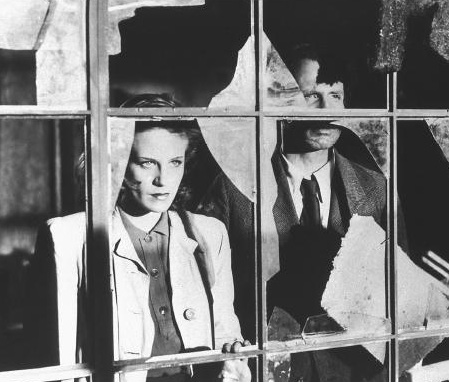
Die Mörder sind unter uns begins with a montage of miserable-looking people slowly making their way through the rubble by train and on foot. Among them is Susanne Wallner (Hildegard Knef), who has just been released from a concentration camp and is going back to the apartment she left in Berlin.
A poster featuring a picturesque castle that says “Das schöne Deutschland” (“beautiful Germany”) hangs askew in a bombed-out train station filled with shabby and emaciated people, including one man, hobbling on crutches, with “PW” stenciled in white on the back of his threadbare topcoat.
Knef is fresh-faced and beautiful, and an unlikely looking camp survivor. (Looks can be deceiving. In reality, the actress fled Berlin toward the end of the war dressed as a boy to avoid being raped by Soviet soldiers. Her ruse worked, and she was sent to a camp for prisoners of war. Eventually, however, her fellow prisoners helped her escape.) Before the end of the war, Knef had acted in a few minor roles in Nazi productions — most of which were released after the war — but as an actress in the post-war years, Knef didn’t try to hide her past. In fact, the crew of Die Mörder sind unter uns was dominated by veterans of the Nazi film industry. The director, Staudte, was involved with making the infamous antisemitic Nazi propaganda film Jud Süß (1940). To make this film, Staudte worked under the auspices of Deutsche Film (DEFA), which was the only production company licensed to operate in the Soviet Zone, and was formed from the ruins of Universum Film AG (Ufa), which was a powerhouse studio in Germany from the silent era through the downfall of the Third Reich.
Early in the film, a kindly old glasses maker named Mondschein (Robert Forsch) tells Susanne, “No, it is easy to forget what happened.” He tells her that she merely needs a goal, and to work.
On the one hand, it’s an ironic statement, since the whole movie is about coming to terms with the past, but it’s a statement that holds true for at least one of the main characters, Ferdinand Brückner (Arno Paulsen), a factory owner who recalls “golden days in gray uniforms,” but who now looks to the future. He wants to rebuild his industry and make a lot of money doing it.
In one memorable scene, Brückner sits at his breakfast table with a newspaper in front of him with a headline that screams, “2 Millionen Menschen vergast!” (“Two million people gassed”), in reference to Auschwitz. The camera tilts up to Brückner taking a sip of coffee or tea, then putting a piece of toast in his mouth and chewing it like a ruminating cow, his face placid and unconcerned.
On the other side of the coin is Dr. Hans Mertens (Ernst Wilhelm Borchert), a man so haunted by the war that he seeks refuge in the bottle but still can’t escape the horrors he carries with him.
Susanne meets the doctor when she comes home to her old apartment, and finds him living in it. She takes pity on him, and allows him to stay until he can find a new situation. Initially it seems that Dr. Mertens must be guilty of greater wartime crimes than anyone else in the film, if his palpable guilt is anything to go by. In a drunken stupor, lolling around backstage with a bunch of showgirls, he blows smoke over a chessboard. “Doesn’t it look like a battlefield?” he says. He smashes the board, and one of the girls says, “It’s just a harmless game of chess.”
Dr. Mertens responds, “A harmless game with tin soldiers leads down a short, perilous track to the harmless air rifle, to the harmless rifle range, and then to a mass grave.”
The film isn’t just about politics. A romance slowly grows between Susanne and Dr. Mertens, budding as he comes to terms with the things he witnessed during the war, culminating in a powerful finale that takes place on Christmas Eve, 1945. He stands outside of the skeletal remains of a cathedral, listening to the congregation singing “Stille Nacht, heilige Nacht” (“Silent Night, Holy Night”) as snow flurries whirl around him. He has a pistol in his pocket, and is determined to make his old captain pay for what he did during the war.
Dr. Mertens recalls Christmas Eve, 1942, in Poland, when he watched as 36 men, 54 women, and 31 children were gunned down as a reprisal for a single shot fired at the German soldiers by partisans. It isn’t the enormity of this crime that makes the biggest impact on the viewer, it’s the banality of the order given by the captain, and his total disregard for human life as he stands inside, untroubled by the mass execution that is occurring outside as he leads his officers in a Christmas carol.
The film was originally to be called Der Mann den ich töten werde (The Man I Will Kill), and to end with Dr. Mertens exacting justice, but instead the ending was softened, and Susanne convinces him to let the courts dispense justice. Apparently the Soviet authorities who granted the film license were worried that Germans would take the original title and ending as a call for vigilante justice and hunt down the former Nazi war criminals who lived in their midst.
The Jolson Story (1946)
Directed by Alfred E. Green
Columbia Pictures
Alfred E. Green’s Technicolor extravaganza The Jolson Story purports to tell the story of Al Jolson, one of the most popular singers in the United States in the 1920s and ’30s.
What it actually does is take the bare bones of Jolson’s life story and tell a mostly fictionalized show-biz story of a man’s unalloyed love of music and his tireless quest to touch the hearts of every man, woman, and child in America. That he often touches their hearts while wearing blackface makes The Jolson Story a tricky movie to watch and review in the 21st century.
Apologists for Jolson’s use of blackface usually point to two things; one, Jolson was Jewish, a minority group that itself suffered a great deal of discrimination in the U.S., especially before World War II; two, he genuinely loved the black musical forms that he appropriated. (There are also claims that he fought against segregation on Broadway, but I was unable to find any hard evidence of what he did or when he did it. If anyone has more information, please let me know.)
Unlike the white actors in blackface in D.W. Griffith’s The Birth of a Nation (1915), who blacked up to portray their characters as brutes, villains, and rapists, or the minstrel-show comedians who used burnt cork on their faces to portray “those funny little darkies” as shiftless and uneducated objects of ridicule, Jolson used blackface strictly in the context of musical performance, and there was never anything deliberately mean-spirited about it.
But no matter what the context, it’s hard today to look at a white person with black makeup covering every part of their face except a wide area around the mouth meant to convey the impression of big fat lips and not cringe.
Born Asa Yoelson in 1886, Jolson emigrated from his native Lithuania with his mother and his siblings in 1894. They joined Jolson’s father, Moses Yoelson, who had been rabbi and cantor at the Talmud Torah Synagogue in Washington, D.C., since 1891. Late in 1894, Jolson’s mother died, which had a profound effect on him, and he reportedly became completely withdrawn for seven months. In 1895, however, he was introduced to show business by entertainer Al Reeves, and by 1897, he and his brother Hirsch (whose stage name was “Harry”) were singing on street corners. The brothers continued in show business for several years, but eventually “Al” and “Harry” had a falling out.
Jolson first appeared in blackface in 1904 in a show at Keeney’s Theatre in Brooklyn. According to John Kenrick, blacking up created in Jolson “a sense of freedom and spontaneity he had never known before.” His blackface performances, and his black character, “Gus,” became wildly popular. Jolson probably wasn’t the first American popular musician who ironically experienced feelings of “freedom” by appropriating the appearance and attitude of a black man, but he was the first and perhaps most significant of the century that also gave us Benny Goodman, Elvis Presley, the Beastie Boys, Vanilla Ice, and Justin Timberlake.
Jolson’s popularity grew and grew in the ‘teens and ’20s, culminating in his appearance in the film The Jazz Singer (1927), which was the first “talkie,” or film with a synchronized soundtrack. There wasn’t much dialogue in The Jazz Singer, and most of the sound came from Jolson’s songs, but when he said, “You ain’t heard nothin’ yet” (a phrase he had already made famous in his stage performances), Jolson carved his place into history.
The Jazz Singer tells a fictionalized version of Jolson’s own life. Jolson’s character, Jake Rabinowitz, sings jazz music as “Jack Robin,” and even debuts on Broadway, but he is forever in conflict with his deeply traditional father, who wants Jake to be the sixth generation of Rabinowitz men to sing as cantors in the synagogue. The dramatic conflict is eventually resolved when he nearly misses his Broadway debut to sing the Kol Nidre in the synagogue, allowing his father to die a happy man, and then follows it up with his appearance on the stage, in blackface, in which he goes down on one knee to sing “My Mammy” to his mother, who is sitting in the front row.
In his book Black Like You, John Strausbaugh writes of this scene that, “there’s barely a hint of the racist mockery that’s supposed to be the corrupt heart of blackface entertainment. It’s much more like watching Mick Jagger or Eminem — not mockery, but the sincere mimicry of a non-Black artist who loves Black culture (or what he thinks is Black culture) so dearly he can’t resist imitating it, even to the ridiculous point of blacking up.”
As I said earlier, The Jolson Story takes a lot of liberties with the facts. It begins in Washington, D.C., at the turn of the century. Little Asa Yoelson (Scotty Beckett) is the only boy in the audience at a burlesque theater who sings along with the vaudevillian Steve Martin (William Demarest) when he asks the audience to sing along with him as he performs “On the Banks of the Wabash.” Martin cries, “Give that boy a spotlight!”
Of course, Asa’s Old World parents don’t approve of his love of popular song, especially his father, the cantor (Ludwig Donath). His mother (Tamara Shayne) is a little more understanding.
Little Asa hops a train to Baltimore to follow Martin, who wanted to make him a part of his act, but he gets picked up by a copper and taken to St. Mary’s Home for Boys. His parents come up to collect him, but when they hear him singing “Ave Maria” in the boy’s choir at the orphanage, their hearts soften.
“Singing without his cap on,” Cantor Yoelson tsks-tsks. “It’s not so much what’s on the head, as what’s in the heart,” says Father McGee (Ernest Cossart).
With his parents’ support, Asa goes on the road with Steve Martin. “Give that boy a spotlight” becomes the whole act, with Asa as Martin’s ringer in the audience. When his voice breaks during a performance, Jolson turns it into a whistling performance. He’s a consummate performer, and the show must go on.
The transition from childhood to adulthood in The Jolson Story is nicely done. Scotty Beckett and Larry Parks (who plays Jolson as an adult) look eerily alike, which helps. There’s a montage of Jolson’s performances across the nation represented as postcards sent home to his parents. He performs in all the big cities, as well as smaller towns, like Walla Walla, Washington, “the town so nice they named it twice.” Less than a half hour has gone by, and already his parents (both of whom remain living for the entire picture) are completely supportive of his musical career. The Jolson Story is pretty short on dramatic conflict.
At the half hour mark, we finally see Parks as Jolson black up when he substitutes for a performer named Tom Baron (Bill Goodwin) in Churchill Downs, Kentucky, after Tom wins a “snootful” at the tracks and gets good and drunk. This is Jolson’s breakout moment, and it’s worth noting that the blackface and nappy wig make him anonymous, and indistinguishable from a completely different-looking white performer once he corks up.
Only one person, Lew Dockstader (John Alexander) realizes the deception, and offers him a place in Dockstader’s Minstrels. (A real performing group that Jolson worked with early in his career.)
It’s not long before Jolson bristles against the mawkish and old-fashioned music he performs for Dockstader as part of the chorus. When the group performs in New Orleans, Jolson wanders off into the black part of town. This sequence features the only real black people you’ll see in The Jolson Story, although none of them have speaking parts. Jolson hears genuine ragtime music as he sits in with a band (sans blackface, of course) loving what he is hearing. He goes back to Dockstader and says, “I heard some music tonight called ‘jazz.'” But Dockstader is happy with the show the way it is. “Son, minstrels have been doing fine for fifty years, and we take pride in doing it the way it’s always been done,” Dockstader tells him.
Jolson goes off on his own, and enters a period of creative exploration. He calls the music he’s been listening to and working on, “Music nobody ever heard of before, but the only kind I want to sing.”
By “nobody,” he means, of course, no white people, since the (presumably black) composers and musicians he refers to are never shown. It could have been interesting to see Jolson work with and collaborate with black artists, but after that brief scene in New Orleans, we never see another black person.
Jolson gets a call from good old Tom Baron, and Jolson tells him he has all kinds of music that just needs to be “polished up” a little (no pun intended) and makes his debut on Broadway, singing “Mammy,” in blackface, down on one knee. Interestingly, he does so without a nappy wig — just his dark hair slicked back — and he sounds “blacker” than he ever did before.
Jolson is depicted as a man who is always desperate to make a connection with his audience. During his show “Honeymoon Express,” he even has the house lights turned up, so he can see everyone in the audience. This was also the scene in which I felt that his blackface looked the most insane. There’s a superimposition of his face singing over a left-to-right pan of the crowd, and the closeup shows just how crazy his blackface looks, with a wide area around his lips un-made up, showing the white skin around his mouth, his pink lips, and his small yellow teeth. His eyes are nearly maniacal, he’s clearly sweating under his makeup, and he’s superimposed over a crowd of laughing, happy white people. It’s the stuff of nightmares.
When it comes to Jolson’s personal life, this picture makes Jolson seem like a singing monk, when in reality he was an inveterate womanizer. In The Jolson Story, he has no relationships with women except for his lifelong chaste romance with childhood friend Ann (Jo-Carroll Dennison).
As soon as she marries another man, however, he meets his future wife, producer Florenz Ziegfeld’s newest female sensation, Julie Benson (Evelyn Keyes). He spots her in the audience at one of his shows, and asks her to request a song. After she says, “April Showers,” he practically lies down on the stage in front of her and sings his heart out. Interestingly, this is the first time in the picture he sings a really heartfelt number without blackface on. Maybe it would have been too strange for audiences of the time to see him romance a white woman while blacked up.
After the show, he finds her mimicking his performance of “California, Here I Come,” perfectly copying his resonant voice and wild arm and leg gesticulations, and he falls, hook, line, and sinker.
Even though “Julie Benson” is a complete fabrication, I would have liked to have seen even more of her. Keyes only gets one proper musical number, showing her in action as part of the Ziegfeld Follies, but her dancing and singing were impressive, not to mention the fact that she has one of the best pair of gams I’ve ever seen.
As I said, there’s not much dramatic tension in this picture. Marrying a shiksa doesn’t raise an eyebrow on either one of his parents’ faces, and the only real conflict comes later in the film, as Julie encourages Jolson to quit show business so they can have a quiet life together, but he clearly misses the limelight, even though he claims he is happy.
Jolson was something of a has-been in 1946, and he was no longer one of the most popular singers in America, but this film was a huge hit, and revitalized interest in his music. It even spawned a sequel, Jolson Sings Again (1949). Larry Parks was nominated for an Academy Award for best actor, but didn’t win. Parks was a relatively unknown B-movie actor before he was cast in this role, which launched him into stardom. Not too many years later, however, his career would be destroyed by the House Un-American Affairs Committee, when he admitted under pressure that he had once been a member of the Communist Party. He testified against his will in 1951, and was never officially blacklisted, but his career hit the skids.
His performance in The Jolson Story really is excellent. He lip-synched all of the songs to recordings of Jolson’s voice, and the effect is seamless. He plays Jolson as a man who is pathologically addicted to stardom, but never makes him seem maniacal or inhuman.
The Jolson Story took home two Oscars in 1947. Morris Stoloff won one for best musical score, and the film also won an Oscar for best sound recording. William Demarest for nominated for best supporting actor, and Joseph Walker was nominated for best color cinematography (the only other nominee in this category, The Yearling, ended up winning).
Actor Rondo Hatton, whose face was so unique that it has been immortalized in bust form as a series of horror awards, was reportedly voted the best-looking boy in his class at Hillsborough High School in Tampa, Florida.
Whether or not this story is apocryphal, we do know that Hatton didn’t always look the way he did when he starred as the hideous “Creeper” in a series of low-budget horror films in the 1940s.
Born on April 22, 1894, Hatton worked as a sportswriter and served in World War I, after which acromegaly began to change his facial features. Acromegaly is a syndrome often associated with gigantism. It usually manifests in adulthood or middle age, and its progression is slow. It involves swelling of the soft tissues — particularly the hands, feet, nose, lips, and ears — general thickening of the skin, the swelling of internal organs, and the pronounced protrusion of the brow and lower jaw.
While working as a reporter for the Tampa Tribune, he was spotted by director Henry King, who was in Florida to make Hell Harbor (1930). King hired Hatton for a bit part, and Hatton eventually moved to Hollywood, where he appeared in a series of small roles, most notably as a contestant in an “ugly man competition” in The Hunchback of Notre Dame (1939) and as a member of the lynch mob in The Ox-Bow Incident (1943). He first appeared as a character called “The Creeper” in the Sherlock Holmes thriller The Pearl of Death (1944), and then twice more in two horror films that were unrelated to the Sherlock Holmes series, House of Horrors and The Brute Man, both of which were directed by Jean Yarbrough.
In House of Horrors, which was released on March 29, 1946, an unsuccessful sculptor saves the Creeper from drowning, and gets him to murder all the critics who have written unfavorably about his cubist “tripe.”
In The Brute Man, a once-handsome B.M.O.C. (big man on campus) who was disfigured in a lab accident prowls the city, killing for revenge. Spinning newspapers with headlines like “Back Breaker Claims Second Victim” fill in the missing details, as the viewer wonders why police can’t find the most unique and strange-looking person in the city, who is spotted in public plenty of times.
After one of his murders, the Creeper takes refuge in the home of a blind piano teacher named Helen Paige (Jane Adams, who unfortunately never appears in that pink satin and white ermine number we see her wearing on the lobby card above). For no reason I could discern, she lies to the police about someone being in her apartment, and the Creeper climbs out her window and makes his escape.
We eventually learn that the Creeper used to be a boy named Hal Moffet, a football star at Hampton University, who was popular and handsome, although his temper made him some enemies. He and his friend Clifford Scott (Tom Neal) were in love with the same girl, Virginia (Jan Wiley). The night before an oral exam in chemistry, Cliff fed the academically impatient Hal the wrong answers so he’d be kept after class and not be able to score with Virginia. Naturally, the professor did what any professor would do with a student who bungled a quiz; he kept him after class working on a complicated and dangerous experiment. After seeing Cliff and Virginia through the window, Hal realized he’d been deliberately crossed up, and smashed a flask of chemicals on the floor. Unfortunately, the cloud of caustic smoke damaged his face, and he’s now hell-bent on getting revenge on everyone he thinks wronged him. Last on his list are Cliff and Virginia, who are now married.
This story is, of course, a burlesque version of reality. Acromegaly, not a lab accident, was responsible for Hatton’s appearance, but he was a football player and handsome young man whose appearance gradually became monstrous. (The publicity department of Universal Studios actually claimed that Hatton’s facial deformities were the result of a mustard gas attack in World War I.)
Hatton died on February 1, 1946, before either House of Horrors or The Brute Man were released. He was 51 years old, and his death was caused by a heart attack that was directly related to his disorder. He wasn’t much of an actor, but his appearance alone telegraphed pathos, and the renewed interest in Universal’s horror films in the ’60s and ’70s eventually turned him into a horror icon.
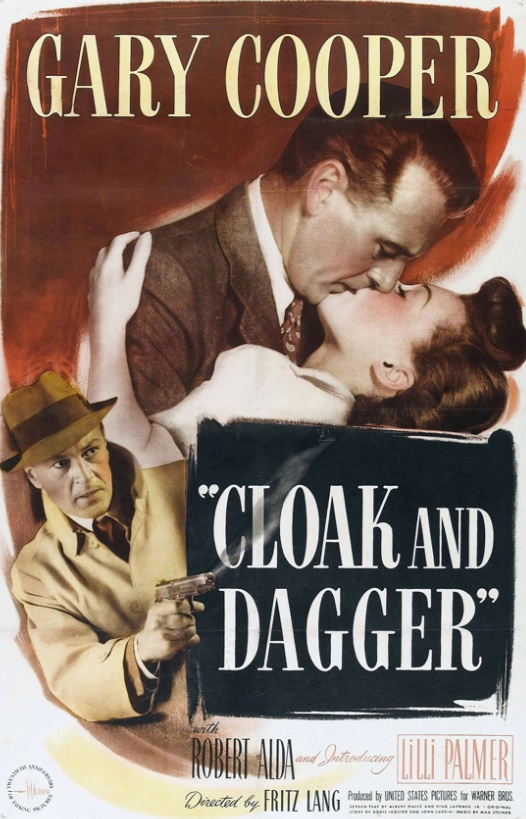
Fritz Lang’s Cloak and Dagger is the best espionage thriller I’ve seen since Alfred Hitchcock’s Foreign Correspondent (1940). Like that film, it doesn’t have the over-the-top stunts or pyrotechnics of a modern action movie, but its pacing, plot, and music create a spectacle that is every bit as suspenseful and exciting.
Gary Cooper, who is best known for playing stoic men of action, gives a credible performance as bookish physicist Alvah Jesper, a man who finds himself in over his head, but is smart enough and tough enough to find a way out of one tight situation after another.
Professor Jesper is recruited by the O.S.S. (the Office of Strategic Services, the U.S. intelligence agency formed during World War II that would eventually become the C.I.A.) and sent to Switzerland to bring his former colleague Dr. Katerin Lodor (Helen Thimig) back to the United States. Dr. Lodor, an elderly woman, escaped through the Alps from Germany, where she was being forced to work on an atomic bomb project for the Nazis. Switzerland is a neutral country, but it’s lousy with agents of the Gestapo, and Dr. Lodor’s life is in peril.
Immediately, there are two implausible aspects of the plot that you have to get over to suspend your disbelief and enjoy the picture. One is that the O.S.S. would recruit a college professor with no experience in the intelligence field to act as an undercover agent merely because he has a personal connection to their target and speaks conversational German. The other is that, by this point in 1946, it was common knowledge that any nuclear research being conducted by the Nazis was mostly smoke and mirrors, and the Third Reich was never close to developing an atomic bomb.
Neither of these issues proved a stumbling block for me. Every spy thriller needs a plot hook, and plenty of these hooks prove either factually inaccurate or completely ridiculous after five or ten years have passed. Also, the O.S.S. was a young organization, and they did some pretty wild stuff during the war. Recruiting a college professor in his mid-40s for dangerous undercover work doesn’t seem completely outside the realm of possibility. (Cooper’s role is loosely inspired by the exploits of Michael Burke, president of the N.Y. Yankees from 1966 to 1973, who briefly played with the Philadelphia Eagles in 1941 before leaving to serve with the O.S.S., where he worked behind the lines in Italy and later in France, where he helped the Resistance prepare for D-Day.)
There are some great touches, too. When Jesper disembarks in Switzerland, he thinks he’s being smart by casually covering his face with his hand when he walks by a photographer, but it is precisely this action that alerts the Gestapo to the fact that he might be a man worth watching.
After Jesper makes contact with Dr. Lodor, she leads him to Dr. Giovanni Polda (Vladimir Sokoloff), another physicist who is being forced by the Nazis to work on their atomic bomb program. Jesper travels to Italy, where he is aided by Italian partisans led by Pinkie (Robert Alda) and the beautiful Gina (Lilli Palmer).
Luckily, Jesper is able to pose as a German doctor because the Italian fascist thugs keeping Dr. Polda prisoner in a beautiful villa clearly don’t recognize American-accented German when they hear it. Viewers with an ear for languages probably will.
The Italian baddies are led by a man named Luigi, who is played by veteran character actor Marc Lawrence, who had a very long career playing gangsters in Hollywood. His first film role was an uncredited part as a henchman in If I Had a Million (1932), and one of his last was playing Carlo Gambino in the 1996 TV movie Gotti.
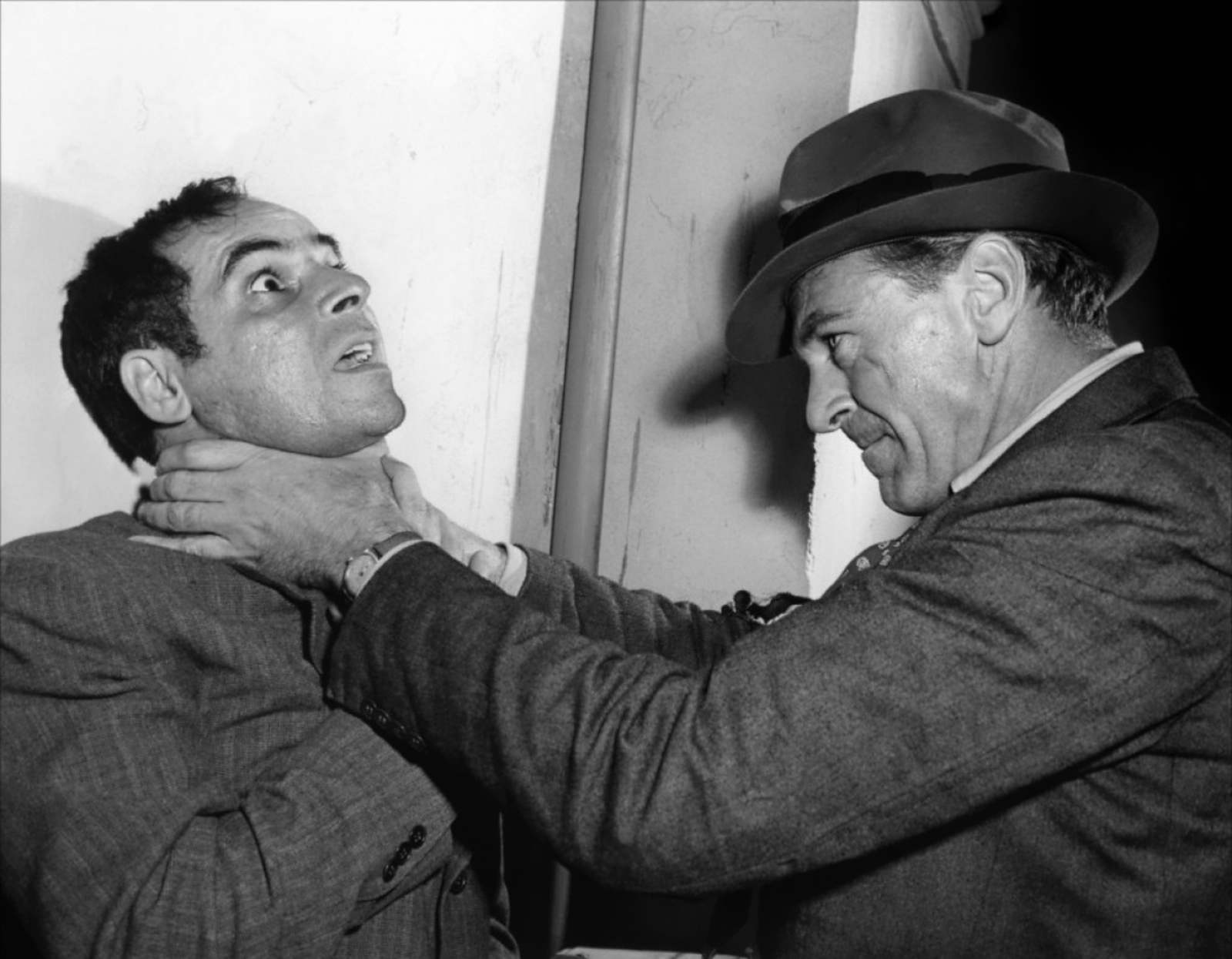
Toward the end of the movie, Cooper and Lawrence square off in the most brutal and realistic fight I’ve seen in a movie from the 1940s. The James Cagney thriller Blood on the Sun (1945) features a great judo fight that was way ahead of its time, but the combat between Jesper and Luigi is a desperate fight to the death, pure and simple. There’s nothing flashy about it, and it’s not overly choreographed. The two men hold each other close, clawing at each other’s faces, choking each other, kicking at weak points, and twisting back fingers and arms. It’s over in less than 90 seconds, but its impact lasts for the rest of the movie.
The screenplay for Cloak and Dagger was written by Albert Maltz and Ring Lardner, Jr., based on a story by Boris Ingster and John Larkin, and “suggested” by the 1946 nonfiction book Cloak and Dagger: The Secret Story of O.S.S., by Corey Ford and Alastair MacBain.
Director Lang is best known for the films he made when he still lived in Germany, such as the silent science fiction opus Metropolis (1927), the chilling portrait of a child killer M (1931), and the crime thriller The Testament of Dr. Mabuse (1933), but Lang was a master craftsman at every stage of his career, even when doing for-hire work like this.
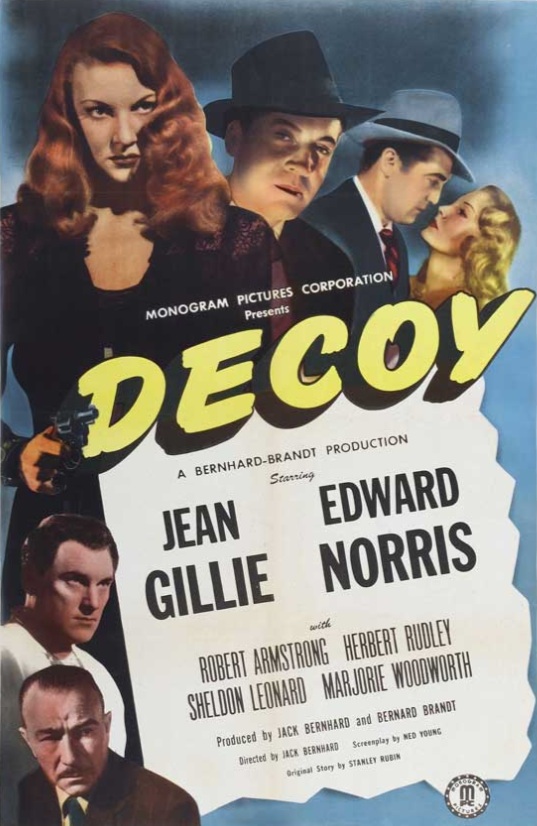
Jack Bernhard’s Decoy has built up quite a reputation in recent years. Considered a “lost” film for decades, it was written about in several books about film noir, and its perversity and violence were marveled over, as well as the coldness of its femme fatale.
When a print of the film was unearthed and shown as part of the Second Annual Festival of Film Noir in March 2000 at the Egyptian Theatre in Los Angeles, the audience reportedly went wild.
Film critic Glenn Erickson (who also does a commentary track on the DVD) wrote that “as far as violence goes, Decoy was to 1946 what Pulp Fiction is to 1994.” I’m not sure if this is true. Certainly in terms of cultural impact, Quentin Tarantino’s films made a much larger splash in the ’90s than this picture did at the time of its release. And it’s hard to compare Tarantino’s films — which are incredibly self-aware, and which owe so much to every decade of film history that preceded them — to this unselfconscious programmer.
Decoy is based on a story by Stanley Rubin, who wrote it after he got out of the Air Corps in an attempt to make some money. He first sold it to radio, and then, with a few changes, to director Bernhard at Monogram Pictures. The screenplay is by Nedrick Young. It stars British actress Jean Gillie as Margot Shelby, surely one of the most heartless femme fatales in the history of noir. (Gillie was married to the director. They met in England, and they divorced shortly after the film was finished, and she only starred in one other film before she died of complications from pneumonia at the age of 33.)
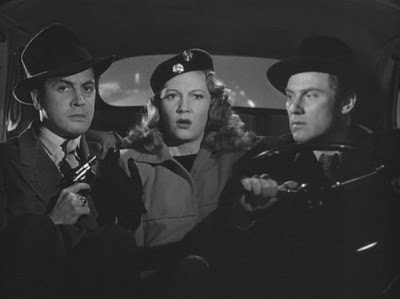
When the film begins, we see Dr. L.L. “Lloyd” Craig (Herbert Rudley) staggering out of a gas station washroom in the early dawn hours. He hitches a ride into town, and heads for a particular room in a hotel. Once he’s inside, we hear shots. Police sergeant Joe “Jo Jo” Portugal (Sheldon Leonard) rushes down the corridor. The doctor is dead, there’s a wooden box with the lock shot off (MacGuffin alert!), and Margot is lying on the couch, wounded. When Jo Jo hands her the box, she laughs and weeps, and generally acts like a petulant child.
In classic noir fashion, she narrates her own story as she lies dying. Her boyfriend, gangster Frankie Olins (Robert Armstrong) was set to die in the gas chamber, which didn’t make Margot happy. Not because she was going to miss him after he was dead, but because only he knew where the $400,000 take from a robbery was hidden.
In a convoluted scheme, Margot seduces gangster Jim Vincent (Edward Norris), who has already sunk $45,000 into an appeal for Olins that failed, and gets him to engineer the removal of Frankie’s body from the prison immediately after he dies in the gas chamber. She also seduces Dr. Craig, cajoling him away from his free clinic and his nurse (and possibly girlfriend), who is played by Marjorie Woodworth, whose acting is delightfully terrible.
Dr. Craig is also in charge of autopsies at the prison, so Margot has cooked up a plan in which Dr. Craig will administer methylene blue to Frankie to counteract the hydrocyanic acid he’ll receive in the gas chamber. (Large doses of methylene blue were actually used as an antidote to potassium cyanide poisoning as early as 1933, so kudos to Rubin for making his pseudoscience at least semi-believable.)
After he’s brought back to life, Frankie staggers around like Frankenstein’s monster, even lighting a match at one point and staring at it as though he’s never seen fire before. By the time he breaks down and says, “I’m alive,” it feels as if an hour has gone by.
While Margot not only seduces but murders nearly every man who crosses her path, I didn’t find any of it that shocking, mostly because the tone of the picture is so campy, and Gillie isn’t really a very good actress. The murder that gets talked about the most is the one she commits by running a man over with her car, but the effect of the scene may be softened in the DVD. In Arthur Lyons’s book Death on the Cheap: The Lost B Movies of Film Noir, he writes that “she runs him over repeatedly,” but in the DVD version she only runs him over once. She puts the selector in drive, steps on the gas, guns the accelerator, and that’s it. Apparently there are two different cuts of Decoy, and people who saw the print at the Egyptian Theatre in 2000 got to see the more brutal version of this murder, but most at-home viewers are going to feel that it’s rather ho-hum, as far as brutal murder scenes go.*
Movies like this all get lumped into a big pile now labeled “film noir,” which is a good designation, and one that’s stood the test of time. It was first used by French critic Nino Frank in 1946, but was completely unknown in Hollywood when “film noirs” were actually being made. Movies like Decoy were called “melodramas” (or sometimes “thrillers” or “suspense” movies) and melodrama is actually a better term to describe this movie than noir, which implies a grander style than Decoy exhibits. The sets are bare bones, the plot is ridiculous, and the acting is campy. There are plenty of night scenes and a few shadows lurking around corners, but in general, the lighting is more utilitarian than chiaroscuro.
This is not to say that Decoy isn’t a lot of fun. It is. And the plotting is clever, especially the “gotcha” ending. But it’s far from a masterpiece, and it’s too silly to be taken very seriously.
—
*Although both Erickson and Lyons make the claim that Margot runs her victim over with her car “repeatedly,” I’m not 100% convinced that there are two different prints of this film in circulation. The power of suggestion in horrific or violent scenes is a powerful thing, and it can trick the audience, especially after a single viewing of a film. There are critics who swore up and down that they saw the knife slashing Janet Leigh’s skin in Psycho (1960), even though it never actually does, and several critics have memories of seeing a horrific demon baby at the end of Rosemary’s Baby (1968), even though the baby is never shown.




 OCD Viewer