Category Archives: April 1947

Tarzan and the Huntress (April 5, 1947)

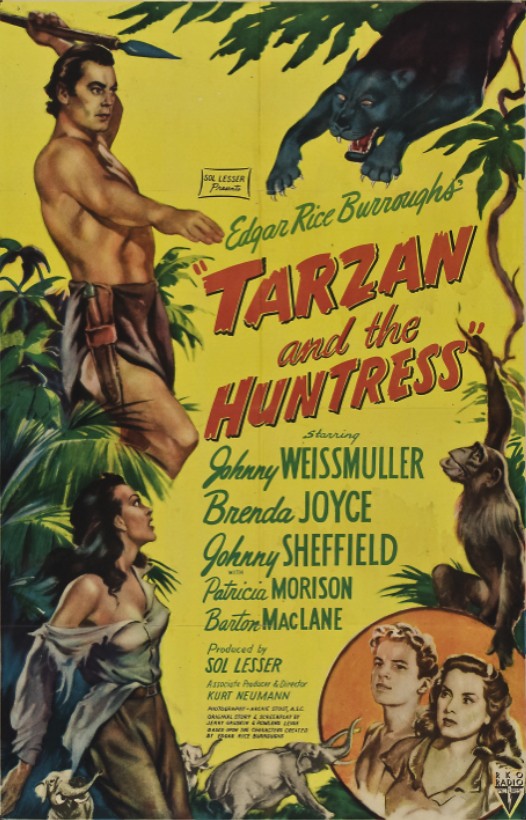
Kurt Neumann’s Tarzan and the Huntress should really be called Tarzan and the Poachers. The word “huntress” conveys more risqué sexiness than the film actually contains (the same can be said of the poster), and seems designed to draw in the same people who shivered at the sight of the muscular Johnny Weissmuller being clawed by the beautiful actress Acquanetta in his previous outing as the King of the Jungle, Tarzan and the Leopard Woman (1946).

When Tarzan and the Huntress begins, we learn that zoos around the world are facing a post-war shortage of animals. (Did lions and monkeys get drafted? I missed that.)

Enter Tanya Rawlins (Patricia Morison, stepping up from Queen of the Amazons to a higher-quality jungle movie). Tanya is an animal trainer leading a safari that also includes her villainous guide, big-game hunter Paul Weir (Barton MacLane), and the moneyman, Carl Marley (John Warburton).

Meanwhile, a half-naked couple who live in a treehouse with their pet chimp and their boy, who calls his adoptive parents by their first names, are preparing to honor local monarch King Farrod (Charles Trowbridge) on the occasion of his birthday. No, they’re not hippies, they’re Tarzan and Jane, played by Weissmuller and Brenda Joyce. Their adopted son, “Boy,” is once again played by Johnny Sheffield, who looks as if he should probably change his name to “Man” sometime soon (or at least “The Artist Formerly Known As ‘Boy'”), since he’s nearly as big as Tarzan. (This was Sheffield’s last role in a Tarzan picture. In 1949 he struck out on his own in the Bomba, the Jungle Boy series.) When Tarzan inspects the fishing pole that Boy has fashioned for King Farrod, he smiles and says, “Everybody like fishing, even kings.” This might be a lesser entry in the Tarzan series, but the playfulness of Tarzan’s little family group and their idyllic life in the jungle is always fun to watch. If you’ve seen one Tarzan movie, however, you’ve seen them all, and you know that something will soon come to threaten their peaceful existence.
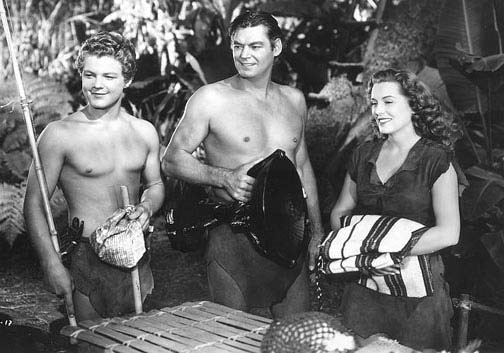
In this case, it’s a perfect storm of Tarzan-related problems — hunters and trappers arriving from the “civilized” world, treacherous locals, and Cheeta and Boy’s shared love of shiny objects.

When Weir tells Tanya that King Farrod won’t allow more than two specimens of each animal to be taken out of the jungle, Noah’s-Ark style, she sputters, “You can’t be serious!” So in a back-door deal, the king’s scheming nephew, Prince Ozira (Ted Hecht), offers Weir and Tanya a “no quota, no restrictions” offer on trapping animals, as long as they pay him a bounty per animal.

One of the members of Tanya’s safari offers to trade Boy a hand-crank flashlight for Cheeta. Boy refuses, since Cheeta’s like a member of the family, but he’s not above stealing a pair of lioness’s cubs in exchange for the nearly worthless bauble.

Tarzan returns the two cubs to their mother and draws a line in the sand. Hunters stay on their side of the river, Tarzan stay on his.

The hunting party doesn’t seem overly concerned, but then Tarzan calls all the animals to him with his powerful jungle cry, and they leave the hunters’ side and come to his.

It’s on.

Tarzan knows just how to handle the greedy poachers when they cross the river into his territory. “Hunters without guns like bees without stings. Hunters not so brave now,” he says, after he steals all of their weapons and hides them behind a waterfall.

That would be the end of the story if it weren’t for that darned Cheeta, who wants Tanya’s shiny compact so badly that she shows the hunters the way to the waterfall.

Cheeta gets her compact, the poachers get their guns, and it’s time for Tarzan and Boy to hand out the punishment, one hunter at a time.

Tarzan and the Huntress was Weissmuller’s penultimate turn as Tarzan. After appearing in Tarzan and the Mermaids (1948), he went on to star in the Jungle Jim series and Lex Barker took over starring in the franchise with Tarzan’s Magic Fountain (1949).

Weissmuller appears to have gained some weight since he made the previous picture in the series, Tarzan and the Leopard Woman, but he’s always fun to watch as the character. Brenda Joyce looks beautiful, as always, but I wasn’t sure what to make of her little slip-on pantyhose shoes.

If you’ve never seen a Tarzan picture before, Tarzan and the Huntress probably isn’t the place to start, but it’s solid entertainment for fans of the series, and offers especially good animal action and hijinks.

My Favorite Brunette (April 4, 1947)

Elliott Nugent’s My Favorite Brunette begins with baby photographer Ronnie Jackson (Bob Hope) in the death house at San Quentin. Jackson is set to be executed that night, and he’s hoping for a stay from the governor. When none arrives, Jackson quips, “No word? Well, I’ll know who to vote for next time.”

Jackson takes a look into the chamber where he’s set to die. “Gas,” he scoffs. “You haven’t even put in electricity.”

Like any good film noir protagonist, Jackson gets to tell his story before he takes that last, long, lonely walk. (Of course, Jackson isn’t really a noir protagonist, since My Favorite Brunette is a spoof of hard-boiled detective movies, but he doesn’t know that.)

When Jackson’s story begins, he’s desperately trying to get an adorable little Chinese-American boy to smile for the camera, but he’s hungry for bigger problems. Jackson may be San Francisco’s premier baby photographer, but he idolizes the man who has the office across from him, two-fisted he-man Sam McCloud (an uncredited Alan Ladd, who’s clearly able to laugh at himself). Jackson longs to be a detective, too. “It only took brains, courage, and a gun,” Jackson says. “And I had the gun.”

When McCloud has to run off to Chicago for a few days, Jackson just happens to be sitting in his office when the beautiful and exotic Carlotta Montay (Dorothy Lamour) walks in. When she thinks he’s McCloud, he can’t bear to tell her the truth, and is off on his first case, tracking down Carlotta’s missing husband, the Baron Montay. (Or is he her uncle? The story keeps changing.)

I won’t summarize the plot any further, mostly because it’s beside the point, but also because it’s nearly as convoluted as an actual hard-boiled P.I. story. Also, some of Jackson’s hard-boiled narration is so close to the real thing that it’s remarkable. After he’s knocked out in his office, he says in voiceover, “When I came to, I was playing ‘post office’ with the floor. I had a lump on my head the size of my head. Inside, Toscanini was conducting the Anvil Chorus with real blacksmiths. I looked at the bottle of Old Piledriver and decided to stick to double malts.”

Sure, it’s over-the-top, but so was most of the dialogue in hard-boiled detective films. Threats like, “I’ll fill you so full of holes you’ll look like a fat clarinet,” sound funny when they’re coming out of Bob Hope’s mouth, but they’re no more ridiculous than half of the things Humphrey Bogart and Dick Powell growled at tough guys.

Besides the genuinely funny script and manic direction by Nugent, the casting is key to the success of My Favorite Brunette. Dorothy Lamour is attractive and sleepy-eyed enough to be a real femme fatale, and the hulking Lon Chaney Jr. and the sinister Peter Lorre are both on hand to play bad guys. (All that’s missing is Boris Karloff with an eye patch and a hook for a hand.)

I’m not the biggest fan of Bob Hope, but he’s excellent in this movie, and frequently had me in stitches. The comedy mostly comes from the dialogue, but there are some classic bits of physical humor, too. The scene in which Lorre tries to force a false clue on Hope while hiding in various spots in a room, but Hope just keeps missing it, might be the funniest bit in the film.

My Favorite Brunette has fallen into the public domain, and is available to watch at archive.org. You’ll have to wait until the very end for Bing Crosby’s cameo, but it’s worth it.

Twilight on the Rio Grande (April 1, 1947)

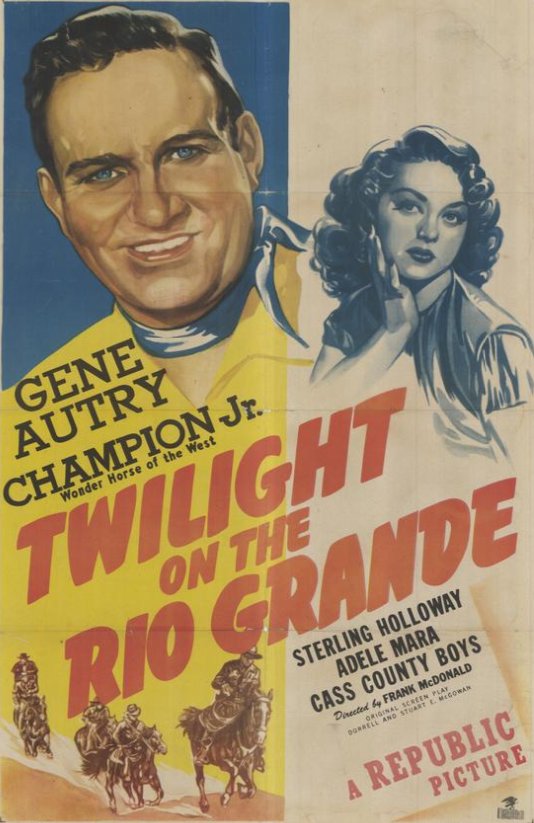
Frank McDonald’s Twilight on the Rio Grande features Gene Autry and his co-stars being put through their B-movie paces south of the border.

Crime melodramas (we call them film noirs nowadays) were very popular Hollywood products in 1947, and Twilight on the Rio Grande incorporates several elements from them, such as the hero investigating the murder of his partner, lots of nighttime photography, a plot about jewel smuggling, and a beautiful knife-throwing señorita. (They showed up in noirs every now and then, didn’t they?)

Gene Autry (played by Gene Autry) and his ranch hands, Dusty Morgan (Bob Steele), Pokie (Sterling Holloway), and the singing trio The Cass County Boys, are all down in Mexico, singing in Spanglish and ogling the ladies. (If there was a deeper purpose to their visit, I missed it.)

The diminutive Bob Steele was a western actor whose star had faded by the mid-’40s, and he picks up a pretty easy paycheck in Twilight on the Rio Grande, since his character is murdered in the first reel, which I thought was a shame. I like Steele, and would have enjoyed seeing him and Autry solve the murder of Sterling Holloway’s character, Pokie, since the loose-limbed, rubber-faced Holloway is more annoying than a barrel of Jim Carreys.

The femme fatale of the film is the beautiful and hot-blooded Elena Del Rio (Adele Mara), who throws knives at Gene while he’s singing “I Tipped My Hat and Slowly Rode Away.” She throws one after the other into the wall behind him, in order to show him how angry she is. She has a steady hand, so she doesn’t hurt him. But then Gene shows her his steady hand when he finishes his song, throws her over his knee, and spanks the bejeezus out of her with the flat of a big knife blade.

Dusty is murdered with a knife in the back, and a smuggler Gene and his boys rope out on the prairie winds up with a knife in his back that could only have been thrown, not thrust at close range, so suspicions fall on Elena.

The title song is a good one, and was never released as a record by Autry, so if you’re a fan of his music, it’s a reason to see this picture. He sings two versions, a slow, mournful version at Dusty’s funeral, and a more upbeat version to close the picture.

If you’re not a fan of Autry’s music, there is really no reason to see this picture. It’s not terrible, but there are plenty of better B westerns out there.