Category Archives: 1947

The Ghost and Mrs. Muir (June 26, 1947)

The Ghost and Mrs. Muir
The Ghost and Mrs. Muir (1947)
Directed by Joseph L. Mankiewicz
20th Century-Fox

Gene Tierney is one of my favorite actresses from the ’40s. (What can I say? I’m a sucker for a cute overbite.) She’s often criticized for being more of a pretty face than a talented performer, but I think that’s unfair. Maybe some of these criticisms spring from her most famous role — Laura (1944) — in which she literally played a painting. I don’t know. What I do know is that when she was given good material and paired with a good director and co-stars, she really shone.

The Ghost and Mrs. Muir was directed by Joseph L. Mankiewicz, who made another wonderful film starring Tierney, Dragonwyck (1946). Mankiewicz clearly cared about helping Tierney craft a fully realized character. And it doesn’t hurt that in this film, she is paired with the great Rex Harrison, who plays the ghost of the title.

Harrison’s scenes with Tierney are the highlights of the film, and the two actors play off each other beautifully. Their relationship runs the gamut of human emotion, from fear to amusement, anger to warmth, reproach to acceptance, and eventually even into the uncharted territory of human-spectral love.

The Ghost and Mrs. Muir takes place in England at the turn of the century. Tierney plays a widow named Lucy Muir who moves with her young daughter Anna (Natalie Wood) and her maid Martha Huggins (Edna Best) to Gull Cottage at Whitecliff-by-the-Sea. Unlike her real estate agent, Mr. Coombe (Robert Coote), who flees from ghostly laughter when showing Lucy the house, Mrs. Muir is sanguine about the prospect of moving in with a ghost. “Haunted,” she says. “How perfectly fascinating.”

Gene Tierney and Rex Harrison

Of course, she’s also a skeptic who doesn’t believe that medieval nonsense like ghosts and hauntings could ever exist in the 20th century. The painting of the fearsome-looking former owner of the house — Capt. Daniel Gregg — is certainly lifelike, but it takes the appearance of the salty old seaman “in the flesh” to convince Lucy that she’s not imagining things.

Philip Dunne’s screenplay for The Ghost and Mrs. Muir is based on a novel by Josephine Leslie, who published it under the masculine-sounding pseudonym “R.A. Dick.” (I’m not sure if that pen name is supposed to be as funny as I find it.) In the novel, Capt. Gregg was just a voice inside Mrs. Muir’s head. He manifests more literally in the film, but in many ways he still symbolizes Lucy’s personal journey from a black crepe-wearing widow bound by convention to a liberated woman who writes and publishes a very unladylike book entitled Blood and Swash (with Capt. Gregg’s help, of course).

Ironically, the ghost of the Captain has no use for superstition or fear, and his plain, unvarnished speech, peppered with curses, speaks the truths that everyone in Lucy’s life has been too straitlaced to ever acknowledge. Also, because he has no corporeal form, the film is able to get away with things that otherwise wouldn’t have been acceptable under the Hay’s Code, such as a widow and a virile man sharing a room and intimate talk. He insists she call him by his Christian name, “Daniel,” and he decides her name should be something more exotic than Lucy, so he calls her “Lucia.”

“Keep on believing in me, and I’ll always be real,” Capt. Gregg tells Lucy, but eventually a real man enters her life — a slippery lothario named Miles Fairley (George Sanders) who writes children’s books under the name “Uncle Neddy” — and the jealous ghost must fade away.

The scene in which he says goodbye to her might be the most weirdly erotic and deeply romantic scenes of all time. She lies down in bed, her eyes close, and he sits down next to her, his face very close to hers as he says, “It’s been a dream, Lucia. And in the morning, and the years after, you’ll only remember it as a dream, and it’ll die, as all dreams must die at waking.”

Mankiewicz’s able direction is aided by the brilliant cinematography of Charles Lang and the luscious musical score of the great Bernard Herrmann. Together, they craft a film that nimbly moves from horror film to comedy, and then from romance to drama. I can’t recommend The Ghost and Mrs. Muir highly enough for lovers of classic cinema.
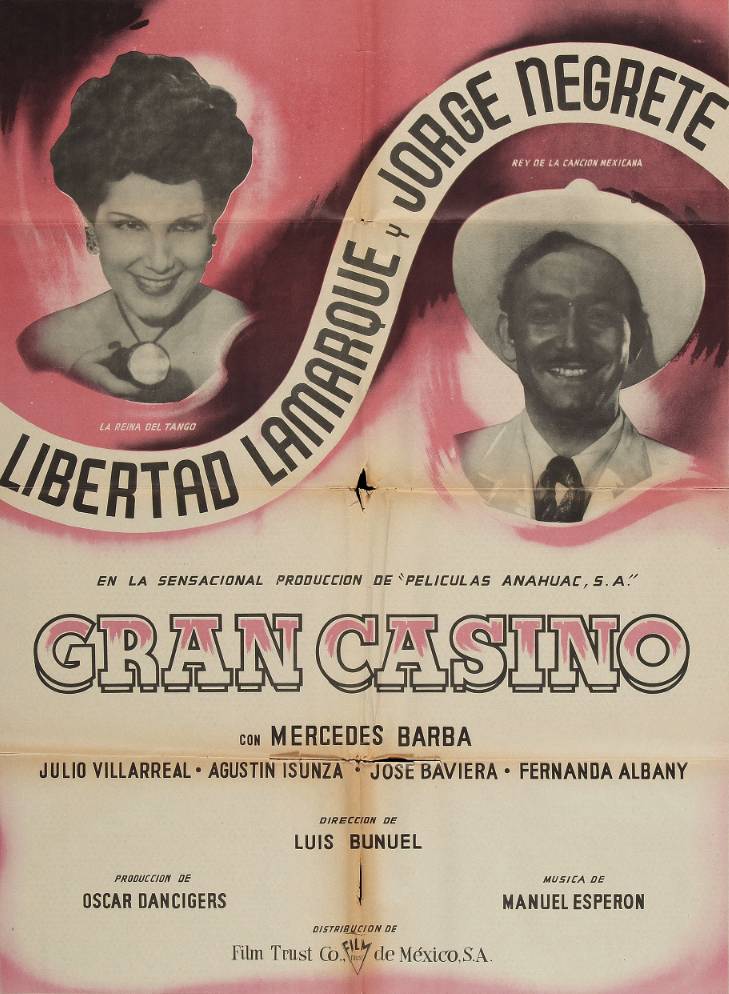
Gran Casino (June 12, 1947)

Gran Casino
Gran Casino (1947)
Directed by Luis Buñuel
Películas Anahuac S.A.

When the Spanish surrealist filmmaker Luis Buñuel made Gran Casino, his career was in a downswing. His 16-minute silent short Un chien andalou (1929), which he made with Salvador Dalí, had an impact on film and on the French surrealists that can’t be overstated.

His first feature, L’âge d’or (1930), was even more scandalous, and was widely seen as an attack on Catholicism.

He returned to his native Spain and made a semi-documentary, Las Hurdes: Tierra Sin Pan (1933), that depicted abysmal poverty in the mountainous region of Las Hurdes. The film was immediately banned in Spain.

In 1939, with the defeat of the Republican government and the end of the Spanish Civil War imminent, Buñuel moved to Hollywood with his family, hoping to make propaganda films about the war. This came to nothing, however. According to Buñuel, an order came from Washington D.C. forbidding Hollywood to make any films about the Spanish Civil War, no matter which side the film supported.

He worked for MoMA in New York, and was under contract with Warner Bros. from 1942 to 1946. What Buñuel wanted more than anything was to make his own films, but he was continually thwarted. It didn’t help that in 1942, Salvador Dalí had published his autobiography, The Secret Life of Salvador Dalí, in which he accused Buñuel of Marxism and anti-Catholicism.

When Buñuel’s contract with Warner Bros. was up in 1946, he moved to Mexico. He had no interest in Latin America, and didn’t like living in Mexico, but he wanted to make films. Better to make them in Mexico than not to make them at all. (And it’s likely that Buñuel saw the handwriting on the wall in Hollywood, and realized that hard times were coming for leftists in the American film industry.)

Producer Óscar Dancigers, an old Communist colleague of Buñuel’s from Paris who had used his labor connections to enter the Mexican movie industry, helped Buñuel get the job of directing Gran Casino. It was the first feature Buñuel made in Mexico. Despite his reputation as a brilliant artist, Buñuel had never really made a linear film with a story, so despite its shortcomings, Gran Casino is an important film in Buñuel’s career.

According to film historian Philip Kemp, when Buñuel recalled being offered the chance to direct a star vehicle for Jorge Negrete, he said that he thought to himself, “This is a little adventure-romance. Is there anything in it that betrays my conscience? No? Well then, let’s get going.”

Is Gran Casino a must-see for aficionados of Buñuel? No. The only way it could ever be mistaken for a surreal film is if you smoked a fat joint beforehand and were wholly unfamiliar with the conventions of movie musicals. But just because it’s not a must-see doesn’t mean it’s not worth seeing.

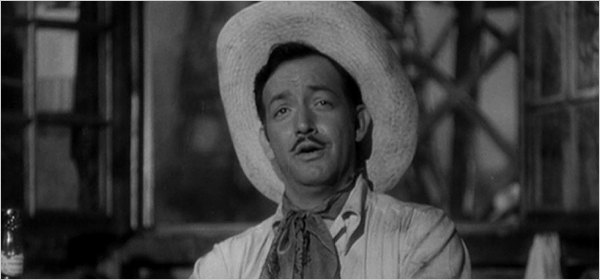
Jorge Negrete, the star of the film, started out as an opera singer, and his good looks and rich voice made him one of Mexico’s most popular leading men. (The only other actor who gave him a run for his money was Pedro Infante). Negrete starred in his first movie in 1937. He most often played a “charro,” or horseman, and just like the singing horsemen of Hollywood matinees, Negrete’s character usually rode into town, set things right, rode away with the girl, and sang a bunch of songs along the way.

Gran Casino follows this formula. Negrete plays a freewheeling charro named Gerardo Ramírez who escapes from jail and goes to work for José Enrique Irigoyen (Francisco Jambrina), the Argentinian owner of three oil wells in Tampico, on the Gulf of Mexico.

Señor Fabio (José Baviera), the owner of the casino of the film’s title, wants the oil wells for himself, and will stop at nothing to get them.

After José Enrique disappears, an apparent victim of foul play, his sister Mercedes arrives to take his place as patrona of the little oil field, but there’s a case of mistaken identity, and she’s able to go undercover in the casino as a singer named “Raquela Ortiz.” Mercedes is played by Libertad Lamarque, who was the “Queen of Tango” in her native Argentina, and her acting might be wooden, but her vocal performances are great.

Unfortunately, she and Negrete have no onscreen chemistry, and they don’t even sing any duets together.

If you’re a fan of Buñuel and you’re paying attention, there are a few surreal bits in Gran Casino, like the blurred reflection of the old Frenchwoman Nanette (Fernande Albany) in a champagne bucket that Negrete turns slowly in a way that seems to demonstrate his boredom at her long-winded story as the scene fades to black.

The best surreal bit comes toward the end, when Negrete approaches a bad guy hiding behind a curtain and smashes his head in with a statuette. There’s a brief, inexplicable shot of a mirror being smashed by the statuette in slow motion. Blink and you’ll miss it, but if you’re paying attention, it’s a jarring and memorably weird moment.

Gran Casino was a flop despite its popular stars, and it would be two years before Buñuel made another film. But as I said, it was an important film in his career. It allowed him to establish a foothold in the Mexican film industry, which led to him making the brilliant Los Olvidados (1950), which is one of the best and most powerful films I have ever seen. If you haven’t seen it, I can’t recommend it highly enough.

Fiesta (June 12, 1947)

And introducing Ricardo Montalban.

When I sat down to watch Fiesta, those words in the credits floored me. I can’t conceive of what it was like to grow up in a world without Ricardo Montalban. His suave, white-suit-wearing Mr. Roarke, from Fantasy Island (1977-1984), is a mysterious character who was burned into my mind at a young age. Ditto for his insane and weirdly brilliant role as the villain of Star Trek II: The Wrath of Khan (1982). Or his dapper and hilarious bad guy, Vincent Ludwig, in The Naked Gun (1988). Or his work as the pitchman for Maxwell House Decaf.

Maybe it was just the movies and TV shows that I watched, but Montalban seemed ubiquitous.

By the ’80s, he always appeared to be having fun with his “Latin lover” image, but he was never parodying himself. His smooth charm was undeniable, no matter what kind of ridiculous lines were coming out of his mouth. (Like claiming that decaffeinated coffee was “good to the last drop.”)

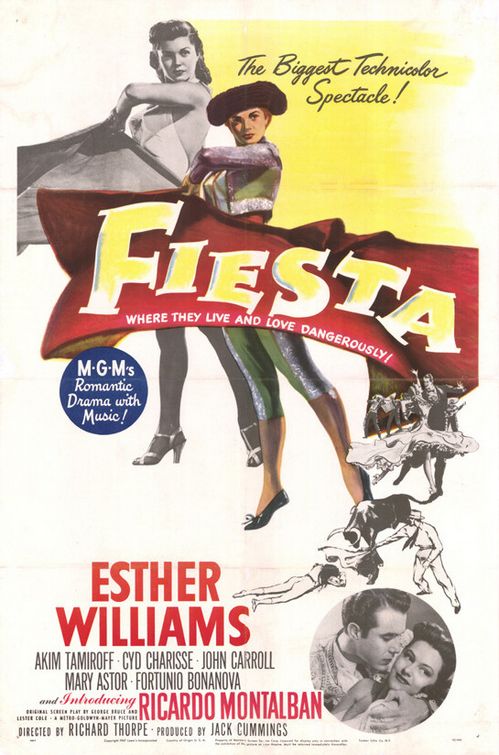
Richard Thorpe’s Fiesta wasn’t the first film to star Montalban. He’d already appeared in more than a dozen films in his native Mexico. But it was his first Hollywood film, and it was his introduction to American audiences. It was also an opportunity for Esther Williams to perform in a dramatic role that was very different from the roles that had made her famous in MGM’s “aquatic musicals.”

Williams and Montalban play twins, Maria and Mario Morales. Their father, Antonio Morales (Fortunio Bonanova), a former matador, always wanted a son to carry on his work in the ring. After confirming that he is indeed not going to have just a daughter, but rather twins, Morales proclaims his son “The future greatest matador in the whole world!”

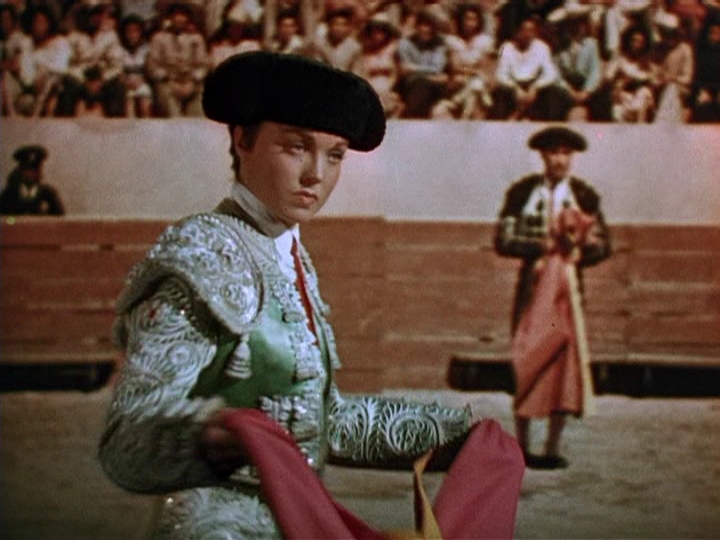
Of course, things don’t work out the way Señor Morales expects. His son Mario is a gifted musician and composer who would much rather make music than wear the traje de luces (“suit of lights”) and fight bulls (even though he’s good at it). His daughter Maria, of course, is the one with the real desire to be a torero, but her gender makes such a thing unthinkable.

Mario is torn between his father’s plans for him and the interest that conductor Maximino Contreras (Hugo Haas) shows in his music. Eventually, Mario flees the ring when he finds out his father lied to him about a visit Señor Contreras made to their house. He does so out of anger, but his action is viewed as cowardice by the spectators. Naturally, Maria comes up with a plan to don the traje de luces and impersonate her brother in the ring.

Fiesta has the kind of shopworn plot and lifeless dialogue that one can suffer through if they’re merely the framework for a musical packed with great songs and exciting dance numbers. But while Fiesta is often classified as a musical, it’s not a really a musical. It’s a turgid, woodenly acted drama whose only high points are a handful of dance sequences.

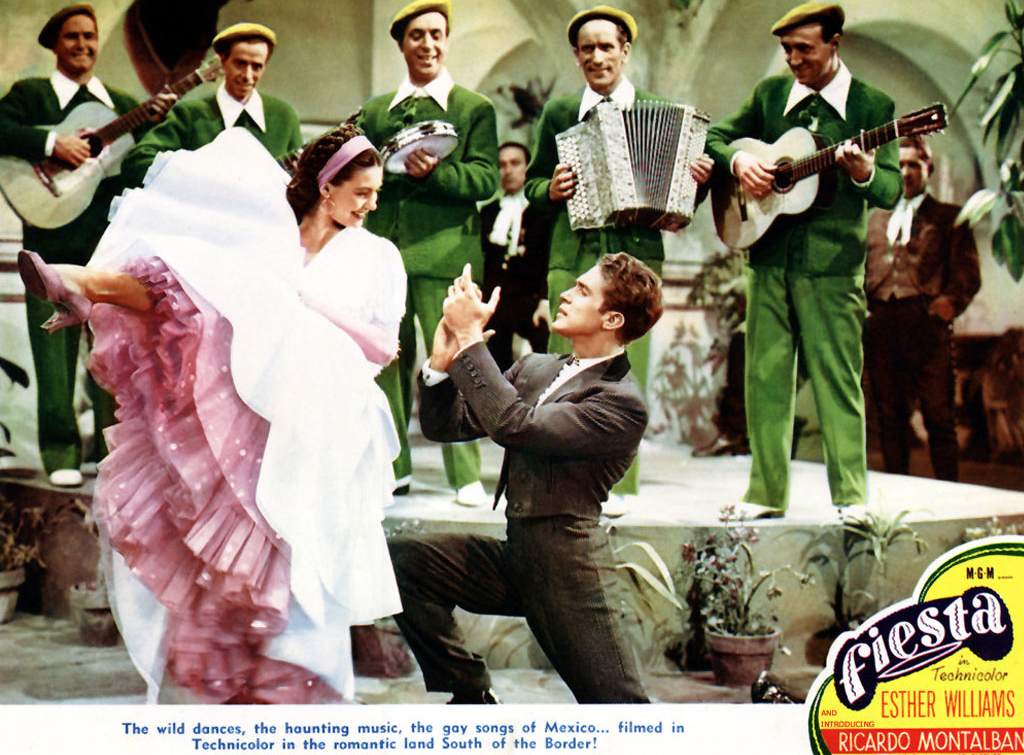
If you like dancing, then Montalban’s numbers with Cyd Charisse (playing a character named Conchita) are worth seeing. (I especially liked the number they stomped out to “La Bamba,” the traditional Mexican song that Ritchie Valens later made famous.) The scene in which Mario hears one of his compositions played on the radio by Señor Contreras’s orchestra and listens in rapture before sitting down at the piano in the cantina to play along would be at home in a musical, but it’s an organic moment. There are no scenes in Fiesta in which the characters just break into song.

In short, it’s pretty lifeless, especially when compared with other Technicolor extravaganzas from MGM. Most of the cast isn’t very interesting to watch. The great silent star Mary Astor is wasted in a thankless role as Señora Morales. Montalban is enjoyable to watch, but Williams is terribly miscast. It’s not that she doesn’t look “Mexican” (you can see plenty of women who look like Esther Williams if you watch Spanish-language television). It’s that she looks nothing like Montalban, yet the audience is asked to believe that she is a convincing double for him when she dons the traje de luces and enters the ring. Her own stunt double is also a completely unconvincing facsimile of Williams during the bullfighting sequences. His muscular buttocks, lack of breasts, crotch bulge, muscular neck, and big ears are pretty difficult to confuse with Williams’s slightly different attributes.

I like Esther Williams a lot. She’s beautiful and appealing, not to mention a hell of a swimmer. But this was just the wrong role for her. Also, her “romantic” scenes with Jose “Pepe” Ortega (John Carroll) are dead on arrival.

Although the film begins with a statement of sincere thanks to the Mexican people, the production was a troubled one. The cinematographer, Sidney Wagner, and another crew member both died of cholera after eating contaminated street food. Esther Williams’s husband, Ben Gage, and makeup artist George Lane were both expelled from Mexico after a fight with a hotel employee. And a stuntman died of an infection he contracted after being gored in the groin by a bull.

The largest problem the production ran into had to do with bullfighting, which director Thorpe chose to depict in a sanitized fashion. For example, the first time we see Mario’s moves in the ring, he skirmishes with an uninjured bull who charges at him over and over as he dances around the ring and flourishes his cape, avoiding several near misses. Eventually the bull gets too tired to continue, and the fight is over.

During the bullfights in Fiesta, only the bullfighter’s life seems to be in danger. It is presented as a dangerous sport. In reality, the outcome of a bullfight is rarely in question, and it is less a sport than an artistic, ritualized slaughter in which the torero is judged according to his grace and style, not whether or not he kills the bull. (According to this article, which was published last year in The Guardian, only 52 matadors have been killed in the ring since the year 1700. There are myriad injuries, of course, which range from minor to spectacular. If you have a strong stomach, click here.) In Fiesta there are no banderilleros jamming spikes into the bull’s back, bleeding it out and tiring it. There is no taunting of the bull or clownish antics on the part of the other toreadors in the ring, like grabbing the bull’s tail and skiing through the dirt as the bull circles. And, most important of all, there is no killing of the bull with a single sword thrust — the estocada.

Bullfighting is inextricable from the national identity of most Spanish-speaking countries. The people of Mexico were already angry that their own toreadors could not star in the film, so the depiction of bullfighting as a bloodless spectacle added insult to injury. When Thorpe had finished shooting Fiesta, his unit manager Walter Strohm convinced him that the bulls used in the film should all be killed to assuage the anger of the Mexican people. Thorpe acquiesced, even though the bulls had cost $1,000 each, which is nearly $10,000 in today’s dollars.

Bush Pilot (June 7, 1947)

There are two kinds of bad movies, watchable and unwatchable. Sterling Campbell’s Bush Pilot is a watchable bad movie, but just barely. The acting and sound editing are atrocious, but the plot is decent — if predictable — and the whole thing moves along at a nice clip and doesn’t overstay its welcome. Also, if you have a deep and abiding love of Canada like I do, it’s worth checking out, because there just aren’t that many Canadian features from the 1940s.

Bush Pilot takes place in the little village of Nouvelle, Ontario. Red North (Austin Willis) is the hotshot bush pilot of the title. He flies people and cargo where they need to go in the vast north country, and also performs altruistic feats of derring-do, as we see in the first scene of the film.

Red lands his pontoon plane in the water next to a signal fire and flies a little girl with two broken legs back to civilization. When he approaches Nouvelle, however, he’s told by his ground crew that there is zero visibility. No way in. But Red and his gigantic aviator shades always get the job done, especially when a little girl who needs medical attention is in his care, so he looks for the smallest opening in the clouds, and when he finds it, he dives.

Red North’s got it all figured out. He’s built his charter from the ground up, and runs it alongside a sweet old lady named Mrs. Ward (played by Florence Kennedy, who despite her gray hair and makeup looks like she’s about 35). Mrs. Ward runs a summer resort with her daughter Hilary (Rochelle Hudson) and younger son Chuck (Frank Perry). Hilary loves Red, and doesn’t understand why he won’t take a nice, stable job flying for Trans-Canada Airlines. Chuck, a mechanic who sometimes works on Red’s floatplane, idolizes Red, and wants to be a bush pilot himself.

Trouble comes to town in the form of Red’s half brother, Paul Girard (Jack La Rue), who plans to start his own charter. Red tells Paul that he’s put in a lot of work here, and if Paul comes in with a slick new plane and sets up another charter across the lake then he’ll just be skimming off the cream.

Later, Red tells Hilary that Paul has always been a thorn in his side. When they were in the service together Paul would deliberately fly out of formation just to make Red look bad … and a couple of Red’s buddies were shot down over the English Channel because of it.

Brother vs. brother is a classic story, and while not quite enough ever comes of it in Bush Pilot, it’s a decent enough plot to buoy the film for its one-hour running time. Paul tries to move in on Hilary, Red’s girl, and needles her younger brother Chuck into flying a dangerous mission that he’s not ready for. Even the least astute viewer will be able to see the handwriting on the wall when the inexperienced Chuck and his bruised ego take a dangerous shipment of nitroglycerin for a ride.

Rochelle Hudson and Jack La Rue, who get top billing, were both born in the United States, but Austin Willis, who plays Red North, is Canadian through and through. He was born in Halifax, Nova Scotia, and was awarded the Member of the Order of Canada (C.M.) in 2002, two years before his death, for his contribution to the performing arts in Canada.

Willis and La Rue are both good actors, and their scenes together are well-played, except when they’re called on to fight each other and none of their punches connect. Rochelle Hudson (not to be confused with the other “Rock” Hudson) isn’t a very good actress, but who can deliver lines like “You know how I feel about nitro. You should…” and not sound silly?

Frank Perry, who plays Chuck, is the worst actor of the bunch, and delivers his lines as though someone pointed a gun at him and told him to “act natural.”

Bush Pilot is a low-budget B movie — all the plane crashes occur off screen, natch — but it’s passable entertainment, all things considered. The trivia section of the film’s IMDb page says that it was filmed in 1945, but not released in the U.S. until 1947. It certainly seems as if it was filmed in 1946, though. That’s what the copyright of the film says, and if you look closely at the newspapers when they fill the screen with plot-advancing details, you’ll see that it takes place over the course of that crazy summer in 1946 when Red and his half brother Paul dueled over the skies of Canada.

Cheyenne (June 6, 1947)

Cheyenne
Cheyenne (1947)
Directed by Raoul Walsh
Warner Bros.

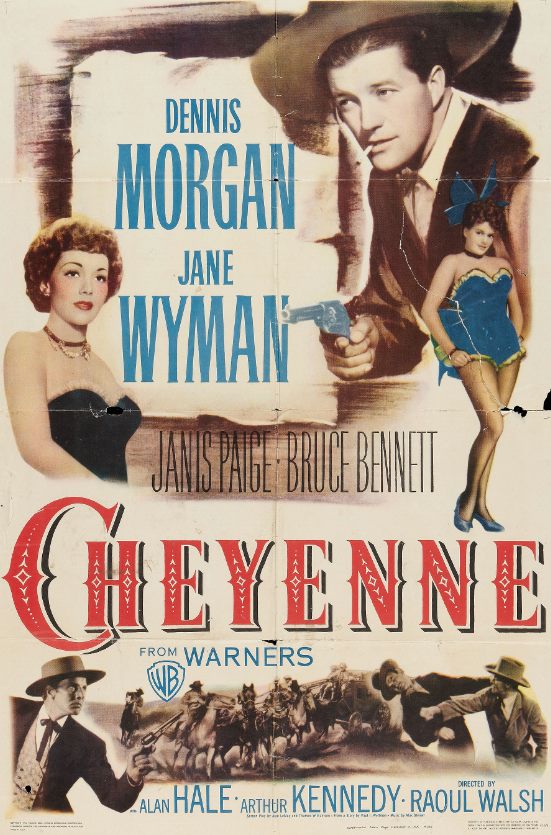
Most of the time, when people say “adult western,” they’re talking about the more psychologically realistic western dramas that stood apart from the fray of Saturday matinee singing cowboys. They’re talking about the films of John Ford and Anthony Mann, and TV series like Gunsmoke (1955-1975). Raoul Walsh’s Cheyenne is a different kind of adult western.

While tame by the standards of today’s R-rated movies and cable TV, Cheyenne is a feast of double entendres and sexually suggestive scenes and dialogue. The film stars Dennis Morgan — doing his best impression of George Sanders — as James Wylie, a gentleman gambler who’s impressed into the service of the law by private detective Webb Yancey (Barton MacLane).

Yancey offers to cut Wylie in on the $20,000 reward being offered for “The Poet,” who’s responsible for a series of stagecoach robberies along the Wells Fargo line. Wherever the Poet strikes, he leaves a piece of paper with a few lines of verse, such as “I’m happy the frontier is settling down / With a thriving bank in every town / Let the riders and nesters deposit their pay / So I and my gun can take it away.”

Cheyenne co-stars Jane Wyman (back when she was still Mrs. Ronald Reagan) as a woman named Ann Kincaid. Ann is married to a Wells Fargo banker named Ed Landers (Bruce Bennett), but their marriage is on the rocks, and she’s clearly attracted to the dashing and roguish Wylie. Of course, for the sake of propriety (and the Hays Code), she acts as though she can’t stand Wylie.

There’s plenty of lighthearted, sexy banter, and great lines like, “How did I know she was the sheriff’s daughter? I couldn’t find a badge.” Or my personal favorite, “You know how women are. Like bears. They never get enough honey.”

Ann and Wylie’s situation is complicated when they fall in with a gang led by the Sundance Kid (Arthur Kennedy). Kennedy plays his role with brio. Sundance is a snarling badass who shoots first and thinks later. When a young punk in his gang stands up to him, and says that the Sundance Kid may have all the other members of his gang buffaloed but he doesn’t fool him, Sundance kicks him to the ground and shoots him dead.

Wylie tells Sundance that he is in fact the Poet, and offers to cut him in on the take from his robberies. He also claims that Ann is his wife, which leads to some sexy playacting. Maybe too sexy. As one of Sundance’s gang says, “He kissed the gal like he liked it. That ain’t like no husband.”

When they go to bed in the same room because some of Sundance’s gang are outside watching, Wylie says, “I’ll sleep with one eye open.” Ann responds, “What do you think I’m gonna do?”

The sexual suggestions aren’t limited to the dialogue. The old spinster housekeeper’s look of regret when Ann says “You know how men are” is priceless. And even I couldn’t believe the scene in which Ann complains about back pain after the night she spends with Wylie.

Janis Paige

The sexiness doesn’t stop with Jane Wyman. Janis Paige gives a good performance as a voluptuous saloon singer named Emily Carson. The two songs she performs in a black bustier, dark stockings, and high heels — M.K. Jerome & Ted Koehler’s “I’m So in Love” and Max Steiner & Ted Koehler’s “Going Back to Old Cheyenne” — were a high point of the picture for me.

I enjoyed Cheyenne quite a bit, but it’s not as interesting as Raoul Walsh’s previous western, Pursued (1947), and it suffers from wild shifts in tone. Most of the film is sexy and playful, but the action scenes are surprisingly dark and violent.

Cheyenne is definitely worth seeing for fans of westerns and aficionados of its prolific and talented director. The actors are all fun to watch, especially Arthur Kennedy, and Max Steiner’s bombastic score does a nice job of propelling the action during the film’s shootouts and chase scenes.

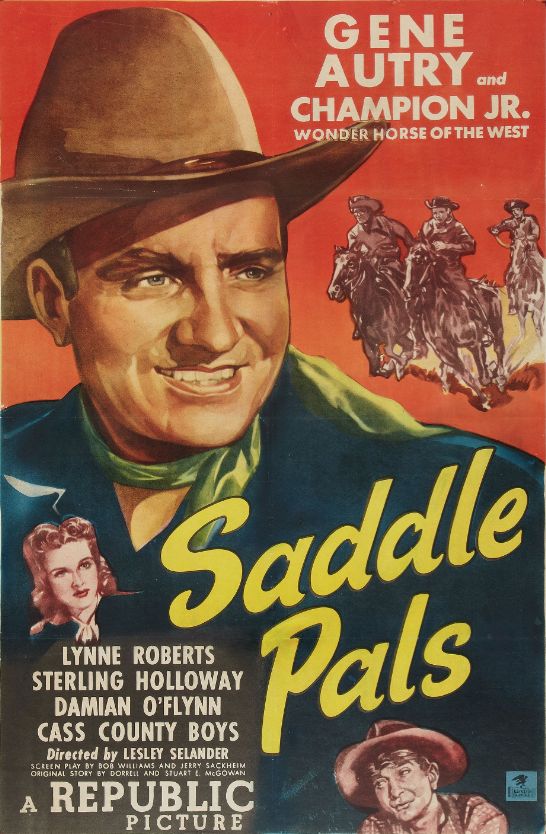
Saddle Pals (June 6, 1947)

Of the movies Gene Autry made after serving in the Army Air Corps during World War II, Saddle Pals is my favorite so far.

That’s not to say that I loved the picture. I think Gene Autry is a great country singer, but as a leading man, I find him flat. But Saddle Pals is funnier and generally more entertaining than the last few Autry pictures I’ve seen, and it wasn’t a chore to sit through.

The picture begins when the beautiful, wealthy, and devil-may-care Shelly Brooks (Lynne Roberts) buzzes Gene, his boys, and their cows with her brand-new Lincoln. Of course, she blows a tire not long after, and Gene’s such a gentleman that he doesn’t hold her bad behavior against her, and changes the tire for her.

Shelly’s brother Waldo T. Brooks Jr. is raising rents on all the ranches in the valley so his wealthy family can be even wealthier. Not only is it unfair, it’s downright illegal, says attorney Thaddeus Bellweather (Irving Bacon), and he’ll handle the case for Gene just as soon as he gets back from trout season … which is going to last a long time.

So Gene and the Cass County boys (his backup band/ranch hands) head to the Brooks ranch to talk to Waldo, who turns out to be an effeminate, hysterical, rubber-faced hypochondriac played by Sterling Holloway. It turns out that Waldo is barely in control. It’s the Brooks Land Corporation that’s raising rents, under the direction of their evil leader Bradford Collins (Damian O’Flynn).

Waldo gives Gene control of his money. Gene tells Collins that he wants to buy into the corporation. Gene is then forced to come up with $50,000 in 30 days. He comes up with most of the money by selling off the Brooks’s show horses, and then decides to throw a rodeo to raise the rest of the money.

Shelly and Waldo have an adorable little sister, Robin (Jean Van), who wants desperately to be a cowgirl. She’s got the skills to pay the bills, so Gene puts her in the rodeo, but Collins uses the fact that she’s a minor to get Gene in trouble with the law.

Collins doesn’t stop there. If you’ve ever seen a B western from the ’30s or ’40s before, you know those greedy land-grabbing real estate barons never stop at legal malarkey, and sure enough, by the end of the picture there’s an out-of-control wagon on fire with Robin inside, and Gene and his horse Champion Jr. in hot pursuit.

The songs in Saddle Pals are generally good, even though there’s no single stand-out number. The songs include “You Stole My Heart,” “Which Way’d They Go,” “The Covered Wagon Rolled Right Along,” “Amapola,” and “I Wish I Never Had Met Sunshine.” Also, Sterling Holloway, who’s sort of like a less-funny, more-irritating version of Jim Carrey, is used judiciously in the picture, and most of his scenes are humorous, if not exactly hilarious.

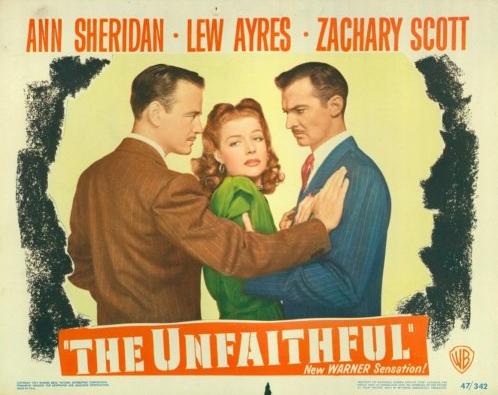
The Unfaithful (June 5, 1947)

The opening narration of The Unfaithful informs us that while the film takes place in Southern California, it deals not with a problem of a particular place, but with a problem of our times. At first, this problem seems to be rampant divorce, but it ends up being more about wartime infidelity (or possibly the widespread problem of married women committing murder in self-defense and then having to lie about it to cover up an affair).

It’s hard not to compare The Unfaithful with Nora Prentiss, which was released earlier the same year. Both were directed by Vincent Sherman, both star the beautiful Ann Sheridan, and both have infidelity as their subject. But while Nora Prentiss indulged in some truly outré and baroque excesses by the time the credits rolled, The Unfaithful goes in the opposite direction, and slowly peters out to an anticlimax. It’s a good film — well-acted and directed with assurance — but when it was over, I couldn’t help feeling as if the filmmakers wanted to make a melodrama about an “issue of the day,” but weren’t sure how to fold it into the murder investigation and blackmail story that dominate the film.

The picture opens with a party being thrown by a character named Paula (played by Eve Arden) to celebrate her divorce. (Interestingly, Arden herself divorced her husband — Ned Bergen — in 1947 after eight years of marriage. Her next marriage would be more successful. She married actor Brooks West in 1952, and they stayed married until his death in 1984 from a heart ailment. She and West had four children together.)

In attendance at the party is Paula’s friend Christine “Chris” Hunter (played by Ann Sheridan, who was also no stranger to divorce. She and her second husband, George Brent, divorced in 1943 on their one-year anniversary.) After the party, a mysterious figure attacks Chris as she unlocks the front door of her home. He pushes her inside and a struggle ensues, which we see play out through the living room windows of the Hunters’ suburban home as two silhouettes locked in a life-or-death struggle.

Chris’s husband, Robert “Bob” Hunter (Zachary Scott), a big-time house builder and real-estate developer, arrives home and comforts his wife, who’s understandably shaken up after killing the intruder in self-defense. The couple’s friend and lawyer Larry Hannaford (Lew Ayres) is also on hand to comfort Chris.

Det. Lt. Reynolds (John Hoyt) questions Chris, and doesn’t seem to really believe her story of a stranger attacking her in her home and demanding jewels, but he doesn’t accuse her of anything … yet. The detective also questions Hannaford about the couple, and Hannaford tells him he’d be hard pressed to find a couple as happy as the Hunters.

To summarize the plot any further would be to give away too much. It should suffice to say that there’s more to the story than Chris originally reveals to the police, and the film ends with a sensational trial and plenty of wagging tongues.

The Unfaithful takes place mostly indoors, but there are a lot of great Los Angeles exteriors, too. If you’re a fan of vintage street cars, this movie is worth checking out just for them.

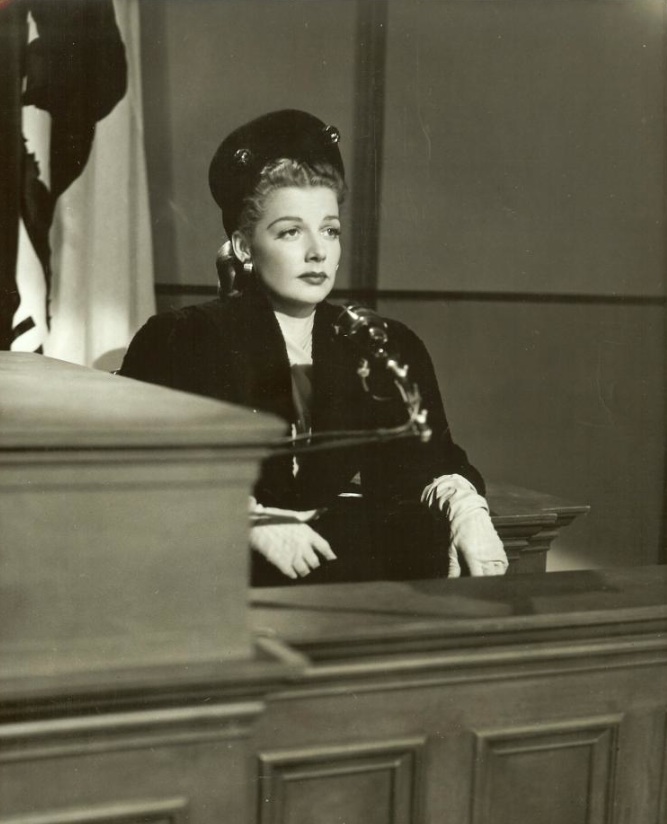
Ernest Haller’s cinematography is especially memorable. I really liked the dark, low-angle shot of Zachary Scott parking his car in his driveway and striding along the front walk of his home after receiving some terrible news. And during the trial, there’s a wonderful shot of a bloody knife being held over the murder photograph, then quickly moved to the left as an exhibit — but for just a moment it seems as if we are seeing a gruesome murder scene with a bloody knife poised over a corpse.

The screenplay of The Unfaithful, by James Gunn and crime novelist David Goodis, is excellently written, with realistic dialogue and characterizations, especially in Ann Sheridan’s scenes with Zachary Scott. As I said, it’s a bit anticlimactic, but the journey is worth it, and The Unfaithful is worth seeing despite a weak final reel. Incidentally, it’s an uncredited remake of William Wyler’s The Letter (1940), which was based on the 1927 play of the same name by W. Somerset Maugham.

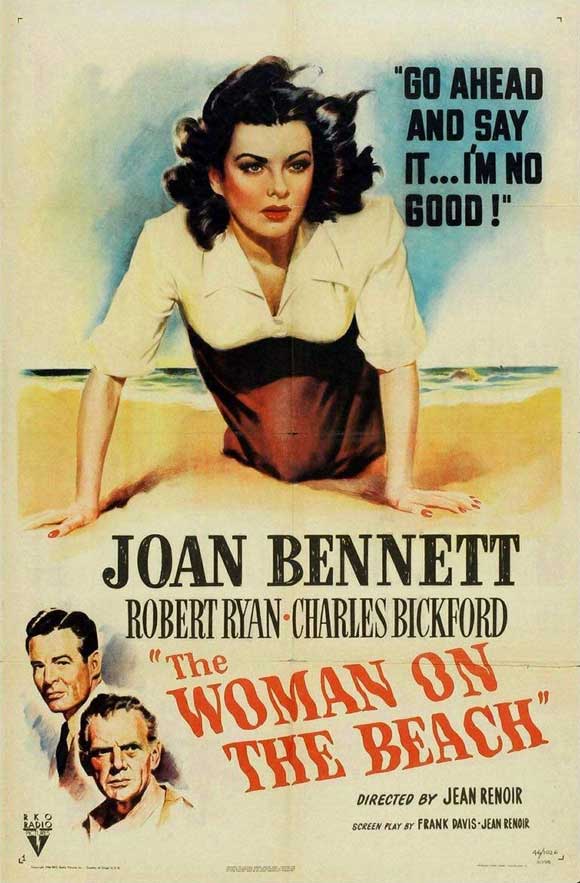
The Woman on the Beach (June 2, 1947)

Jean Renoir’s last Hollywood film, The Woman on the Beach, which is based on Mitchell Wilson’s 1945 novel None So Blind, is one of the oddest and most intriguing American films I’ve seen from the ’40s.

On paper, the plot sounds like a perfect vehicle for RKO star Joan Bennett, who was coming off the success of two wonderful noirs that she made with Fritz Lang, The Woman in the Window (1944) and Scarlet Street (1945). Like both of those films, Bennett’s character in The Woman on the Beach is a seductive and alluring woman who may not be what she seems. And paintings — a major theme of both The Woman in the Window and Scarlet Street — figure prominently in The Woman on the Beach.

But the similarities end there. The Woman on the Beach is a film that confounds expectations. It’s sometimes surreal, sometimes suspenseful, and never went in the direction I was expecting. Some of this could be due to studio interference. After a disastrous advance screening in Santa Barbara, the studio forced Renoir to reshoot and recut the film. The final cut is just 71 minutes long. There are numerous plot strands that seem to be left dangling by the end of the film. But overall, it’s still well-made and involving enough for me to recommend it.

Lt. Scott Burnett (Robert Ryan) is a haunted man. He’s sound of body, but he’s plagued by nightmares of the wreck he survived while serving in the Pacific. One of his nightmares opens the film, and it’s a brilliant and surreal juxtaposition of watery peace and fiery, swirling violence.

Scott is grinding through his last week at the U.S. Coast Guard Mounted Patrol Station. (He’s terrified of the ocean, so it makes sense that he’s serving in a Coast Guard station with no ships, just horses.) He’s engaged to be married to a pretty local girl named Eve (Nan Leslie), but as soon as Scott meets the dark and mysterious Peggy Butler (Joan Bennett) while she’s gathering driftwood on the beach, any film noir aficionado can tell you that things aren’t going to go the way Scott and Eve have been planning them.

Peggy instinctively understands Scott’s loneliness and fear. She invites him home to meet her husband, the blind painter Tod Butler (Charles Bickford). Bickford’s performance is masterful, and a key to the success of the film. At first I thought that Bickford was really bad at playing a blind man. He moves about effortlessly, seems to know where everything is, and it frequently seems as if he is making eye contact with the other characters. But it’s hard to tell for certain.

And sure enough, his blindness is called into question before too long. Peggy reveals to Scott that she severed Tod’s optic nerves during a drunken argument, but that sometimes she suspects he has just been feigning blindness ever since. Scott can’t believe that a man whose whole life was devoted to art would just give it up out of spite. Peggy tells Scott that he doesn’t know her husband.

In an unguarded moment when Peggy and Tod are alone, we hear them lay out their entire relationship in a classic exchange: Tod looks at her and says, “So beautiful outside, so rotten inside.” Peggy responds, “You’re no angel,” and Tod says, “No, I guess we’re two of a kind. That’s why we’re so right for each other.”

Scott is drawn into Peggy and Tod’s bitter little world, and begins secretly making love to Peggy while having increasingly tense get-togethers with Tod. In one remarkable scene, Scott walks Tod closer and closer to a cliff edge, trying to make him give himself away and reveal that he can really see.

The presence of Scott’s fiancée Eve seems almost like an afterthought, especially during the second half of the picture, and the way the story ends isn’t completely satisfying. But these are minor quibbles. The Woman on the Beach is a beautifully made film with very interesting performances from its three leads.

High Barbaree (May 1947)

High Barbaree

High Barbaree (1947)
Directed by Jack Conway
Metro-Goldwyn-Mayer

Jack Conway’s High Barbaree pairs America’s boy next door, Van Johnson, with America’s girl next door, June Allyson.

It wasn’t the first time they appeared in a film together. In Two Girls and a Sailor (1944), Johnson played the sailor of the title and Allyson played one of the pair of sisters who were in love with him. (They also both appeared in the 1946 Jerome Kern biopic Till the Clouds Roll By. I haven’t seen it, but I know that it features a cast of thousands, and I’m not sure if they shared any scenes.)

High Barbaree puts the two of them front and center. Their characters’ romance is unencumbered by comedy or contrived stumbling blocks. The title of the film and the poster art imply an exotic tale set in the South Seas, and the tagline of the poster — He wanted to stay in the arms of his first true love — but another woman claimed him! — implies that the film will be about a torrid love triangle. It’s neither of these things. It’s a sweet, earnest love story about two childhood sweethearts.

It’s a story told mostly in flashback. It’s WWII, and Lt. Alec Brooke (Johnson) and Lt. Joe Moore (Cameron Mitchell) are drifting in the Pacific, their plane shot down during a bombing run. Every other man in the crew is dead, and Alec and Joe will soon join them if they’re not picked up.

Their water supply dwindling and their bodies weakening, Alec reminisces with Joe about his childhood. Alec is a corn-fed all-American type from Iowa, and Joe ribs him about it, since he’s a typical cynical kid from Brooklyn. Alec recalls the girl he loved when he was little, Nancy Frazer (played by Gigi Perreau as a child, and by Joan Wells as a young girl). She fearlessly climbed the water tower with him when they were children, and later ran away with him to the circus, and witnessed his brief career as a bicycle-riding daredevil. (Alec is played as a child by Jimmy Hunt, and as a 14-year-old by Claude Jarman Jr., fresh off his success as the lead in The Yearling.)

By time passed, as it must, and Nancy and Alec lost touch. He abandoned his plans to become a doctor like his father, Dr. William G. Brooke (Henry Hull), and went into aviation. He got engaged to the wealthy blond heiress Diana Case (Marilyn Maxwell) and went to work for her father’s airplane manufacturing company. Everything seemed to be going his way until Nancy (played as an adult by June Allyson, natch) re-entered his life, and he realized how lost and unhappy he really was.

At some point in the midst of his recollections, Alec realizes that he and Joe and the wreckage of their PBY Catalina are drifting toward a spot marked on a map long ago by Alec’s vagabond uncle, Capt. Thad Vail (Thomas Mitchell). The spot marks a fabulous island called “High Barbaree.” Uncle Thad described it as a mysterious place that was always just over the horizon, but that was perfectly beautiful and serene. If only they can make it to High Barbaree, Alec says, they’ll be saved.

While the exotic island of High Barbaree gives the film its title, it’s not a central part of the story, the way Shangri-La is central to Lost Horizon. Most of the story takes place in Alec and Nancy’s hometown of Westview, Iowa, which is its own kind of dreamlike phantasmagoria. I’ve never been crazy about Van Johnson (I think his stage name really should have been Bland Johnson), but he and Allyson make an appealing couple, and his earnestness is hard to resist in this picture.

High Barbaree isn’t a great film, but it’s pretty good, and is recommended for anyone who’s craving an old-fashioned romance. It’s based on a novel by Charles Nordhoff and James Norman Hall. The review of the novel in the October 29, 1945, edition of Time magazine said that “It is plainly designed as a refuge for readers who have had enough of wartime realism.” The same can be said of the film.

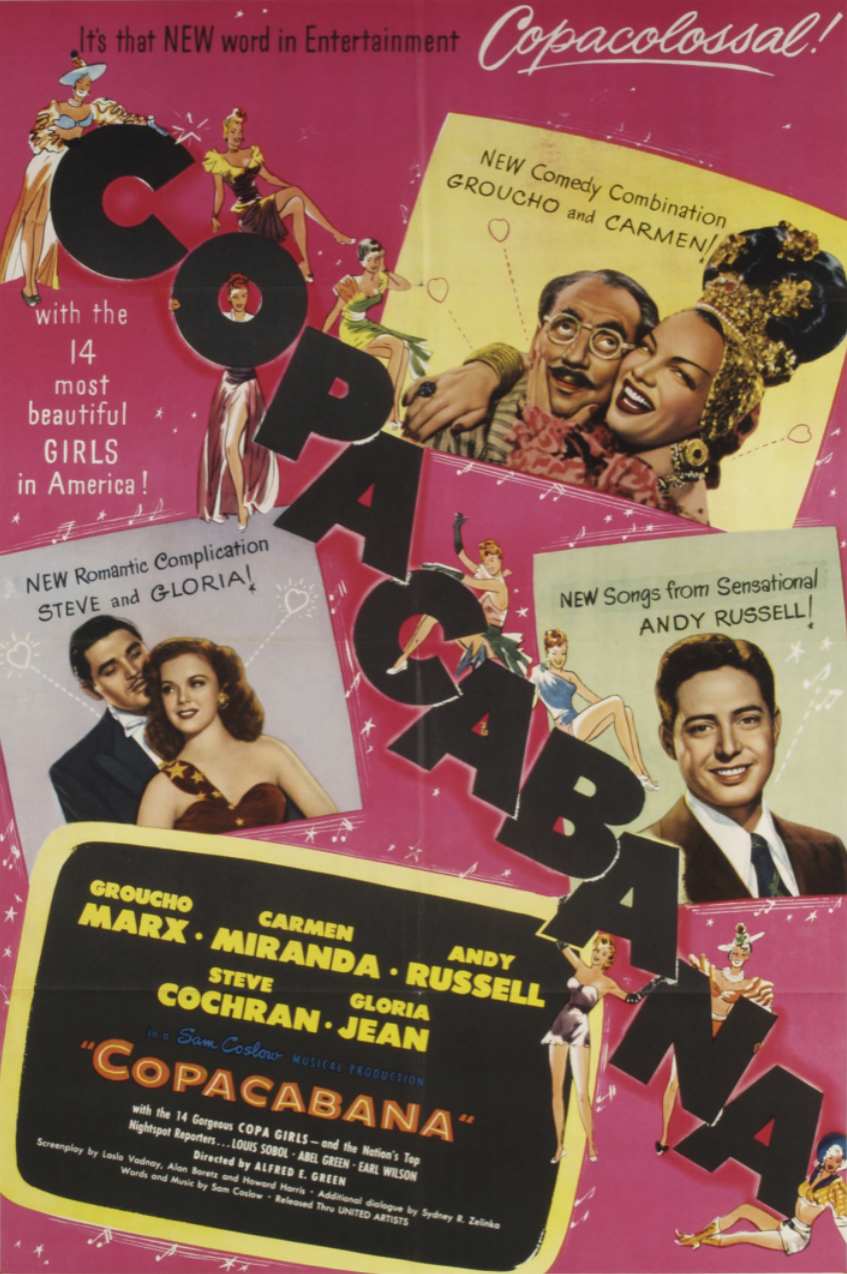
Copacabana (May 30, 1947)

Hey there! Do you like the comedy of Groucho Marx? Do you like the music of Carmen Miranda? Do you like the sweet song stylings of Andy Russell? Do you like beautiful women with nice legs?

You do? Well then, brother, have I got a picture for you.

Alfred E. Green’s Copacabana is a classic example of a Hollywood product that is designed for only one purpose — to entertain.

The plot of the film is little more than an excuse to showcase Groucho Marx’s wordplay and fast-paced comedic line deliveries, Carmen Miranda’s mesmerizing vocal performances, big musical numbers featuring the 14 beautiful “Copa” girls, and Andy Russell’s syrupy, sentimental songs.

The plot, which can summarized on the back of a cocktail napkin, is this: wildly unsuccessful nightclub performer Lionel Q. Deveraux (Groucho Marx) and his fiancée of 10 years, equally unsuccessful nightclub singer Carmen Navarro (Carmen Miranda), decide that desperate measures are called for. Deveraux has been kicked out of more clubs than he can count, and threats like, “This is an outrage. You’ll hear from my lawyer, as soon as he gets a telephone,” clearly aren’t getting him anywhere.

So Deveraux decides to pass himself off as a top talent agent. He arranges for Carmen to perform for Steve Hunt (Steve Cochran), the owner of the most glamorous nightclub in Manhattan, the Copacabana. Without Deveraux onstage with her, Carmen makes a positive impression, but Steve wants to see more of Deveraux’s acts. Naturally, he has only one act — Carmen — but some quick thinking produces a second act, the beautiful and mysterious “Mademoiselle Fifi.”

Mlle. Fifi is of course just Carmen with a white costume straight out of the Arabian Nights, a blond wig piled atop her head, and a heavy veil to cover her face. Deveraux explains to Steve why she never takes the veil off. “No one but her lover is allowed to gaze upon her face,” he says. “Not even her husband.”

Meanwhile, the starry-eyed Anne Stuart (Gloria Jean) toils away in the office of the Copacabana as Steve Hunt’s gal Friday, unable to tell Steve how she really feels. Will she ever be able tell him? Will the wide-eyed, golly-gee naïveté of singer Andy Russell (played by singer Andy Russell) and his encouragement that she express herself through song help? Will that song be called “Stranger Things Have Happened”? You’ll just have to see Copacabana to find out.

I’m not the biggest fan of musicals, but I’m perfectly willing to sit back and be entertained by one if it’s well put together, and Copacabana features plenty of entertainment bang for your buck. It’s especially entertaining if you’re as much of a sucker for great gams as I am. The Copa girls are blessed with pretty faces, good singing voices (although I’m not sure if they were actually singing during their numbers), dancing ability, and — most of all — shapely getaway sticks, which are on display even when they’re in the background. When Mlle. Fifi sings her first number at the Copa, “Je Vous Aime,” the Copa girls are draped all over the place like leggy cats, listening in rapture.

And speaking of perfect pins, I’d be remiss if I didn’t mention Gloria Jean’s final song and dance with Groucho Marx and Carmen Miranda, in which she wears a shorts and high heels outfit that might be the cutest thing I’ve seen in a movie from 1947 so far.

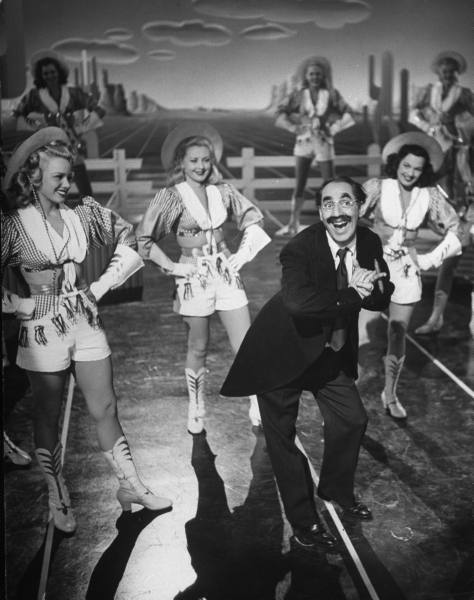
I believe this was the first film in which Groucho Marx appeared without his classic greasepaint mustache and thick glasses get-up. (His actual mustache and regular glasses aren’t wildly different, of course.) Also, his brothers, Harpo, Chico, and sometimes Zeppo, are nowhere to be seen in Copacabana, but it’s still worth seeing if you’re a Marx Brothers fan. It’s not as sublime as Duck Soup (1933) or A Night at the Opera (1935), but it’s still a funny, entertaining film, and offers the last chance to see Groucho in his classic get-up, when he performs Bert Kalmar and Harry Ruby’s song “Go West, Young Man” in a slightly surreal scene. (Click the name of the song to watch the performance.)

Most of the music in Copacabana is written by Sam Coslow. It’s uniformly good, but for my money, the best song in the picture is Carmen Miranda’s performance of “Tico Tico No Fubá,” which was written by Zequinha de Abreu and Aloysio de Oliveira.