Category Archives: 1948

I Love Trouble (Jan. 10, 1948)

Are there any fans of the old ABC TV series 77 Sunset Strip (1958-1964) out there?

If you have fond memories of that hepper than hep private eye show, you might be interested to know that this little mystery programmer is where it all started.

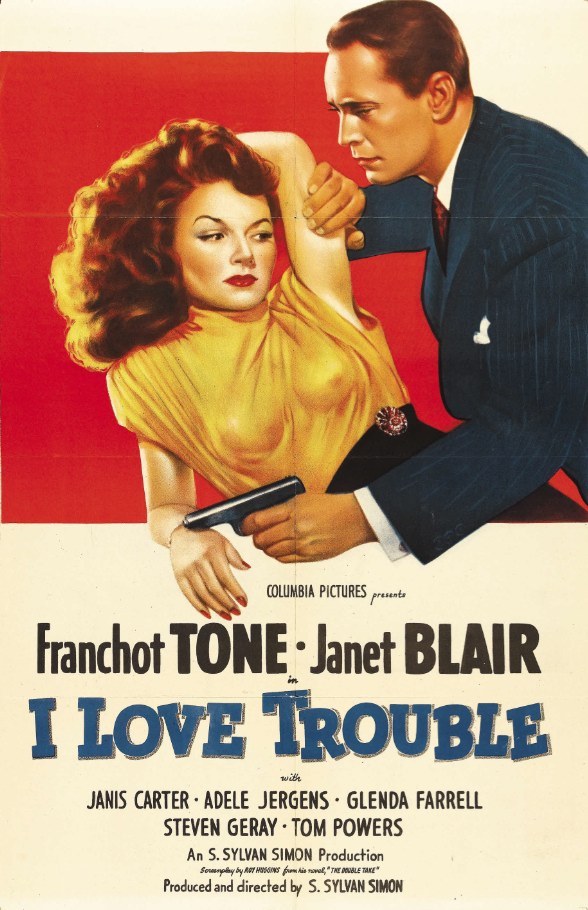
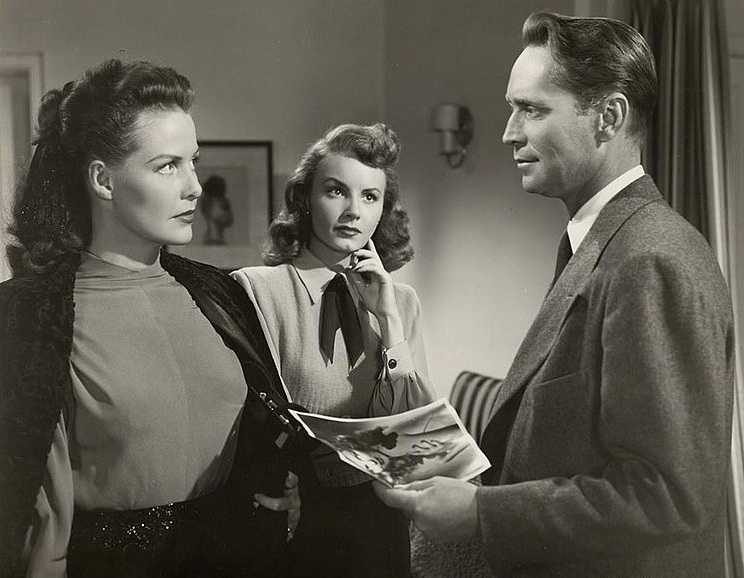
S. Sylvan Simon’s I Love Trouble is based on Roy Huggins’s novel The Double Take, and stars Franchot Tone as Stuart Bailey, a pencil-necked P.I. with a high forehead and an eye for the ladies.

Bailey was later (and more famously) played by Efrem Zimbalist Jr. — first in “Anything for Money,” an episode of the ABC series Conflict (1956-1957), and then in the ongoing series 77 Sunset Strip, where he was paired with a partner, Jeff Spencer (Roger Smith).

I haven’t read any novels by Roy Huggins, but if I Love Trouble is any indication, he was a writer firmly in the mold of Dashiell Hammett and Raymond Chandler. With a title like I Love Trouble, I was expecting a lighthearted mystery-comedy, so I was pleasantly surprised when it turned out to be a hard-boiled mystery with crisp dialogue and a well-rendered Los Angeles backdrop.

Ralph Johnston (Tom Powers), a wealthy gentleman who used to run with “a pretty rugged crowd,” hires Stuart Bailey to find out more about his wife Jane, who has been receiving threatening letters. Johnston says Jane is sheltered, unaccustomed to trouble, and couldn’t possibly be mixed up with anything shady. He believes one of his old friends resents Jane, got plastered, and sent her a threatening letter. Bailey responds that Jane spotted him tailing her, and that’s pretty uncommon for someone who was just a “nice quiet sorority girl at UCLA.”

Although he suspects there’s more to the story than Johnston is telling him, Bailey heads for Portland, Jane’s hometown, where he finds out that a high school diploma wasn’t the only piece of paper she picked up. She also got a work permit to dance at “Keller’s Carousel,” a seedy little club on South Broadway.

Keller (Steven Geray) and his henchman Reno (John Ireland) don’t take kindly to snoopers, and they send Bailey home with a few black-and-blue souvenirs.

Back in Los Angeles, Bailey is approached by a woman named Norma Shannon (Janet Blair), who claims to be Jane’s sister from Portland. But she doesn’t recognize the theatrical head shot of Jane sitting in Bailey’s apartment. What’s going on?

I Love Trouble is a solid B movie from Columbia Pictures. It’s chock-full of beautiful actresses (Adele Jergens doesn’t even rate a mention in my plot summary, but I sure was happy to see her in a swimsuit). It’s sometimes hard to distinguish one from another, but if you’re paying attention (and have ever read Chandler’s Lady in the Lake), you’ll realize why that actually works in the film’s favor.

As played by Tone, Stuart Bailey isn’t a very memorable character. Tone is simply too gangly and effete to be fully believable as a hard-boiled P.I, but the story is good, the dialogue is hard-boiled, and the action is tough and fast-paced. I especially enjoyed Bailey’s wisecracking secretary, Hazel “Bix” Bixby (Glenda Farrell).
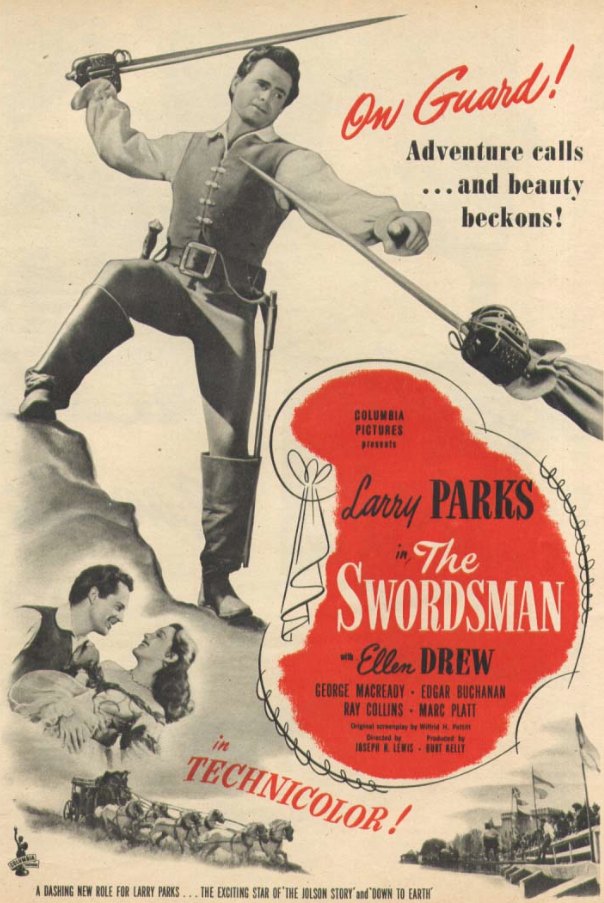
The Swordsman (Jan. 2, 1948)

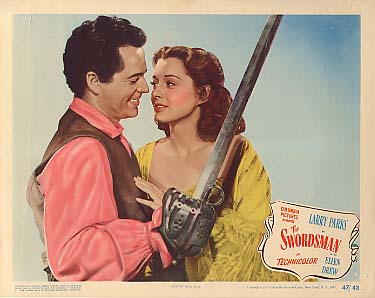
Joseph H. Lewis’s Technicolor spectacle The Swordsman takes place in the Scottish highlands toward the end of the 17th century. Clan warfare is what the highlanders live and breathe, and no clan war is as bitter as the one between the MacArdens and the Glowans.

So when Alexander MacArden (Larry Parks) falls into the skirts of the beautiful Barbara Glowan (Ellen Drew) after leaping onto her moving coach (as swashbuckling heroes in Technicolor spectacles are wont to do) he naturally tells her his name is “Duncan Fraser.”

This little deception allows him to go “undercover” amongst the Glowans along with his rotund, Falstaffian sidekick Angus MacArden (Edgar Buchanan).

After the obligatory sequence of highland games (including a javelin throwing competition that I’m not sure is culturally accurate as well as a “walk the greased plank to grab a caged piglet” competition that you probably won’t be seeing at your local highland games anytime soon), Alexander is found out by the Glowans and has to flee.

The rest of the film is a well-paced and exciting adventure story. Alexander and Barbara’s star-crossed love suffers the predictable travails, but I liked that there were few contrived misunderstandings between the two.

Alexander attempts to broker peace between the Glowans and the MacArden, and there’s nothing like a marriage to do it.

But restive elements in both clans work against a truce, and there’s plenty of double-dealing and murder afoot.

Wilfred H. Petitt’s script doesn’t always jibe with what we see on screen. For all the talk of “claymores” I never saw one of those fearsome two-handed Scottish long swords, only rapiers.

Larry Parks will never be mistaken for swashbuckling superstars like Errol Flynn or Tyrone Power, but at this point I can’t remember the last swashbuckling film Flynn made, and while I love Power, there’s no question that The Swordsman contains more thrills per minute than the ambitious but flawed Captain From Castile (1947).

The Swordsman is a really fun adventure picture. The pacing of the film is excellent, and Hugo Friedhofer’s score is rousing and exciting. I wasn’t bored for a single moment of the film’s 80-minute running time.

The Lady From Shanghai (Dec. 24, 1947)

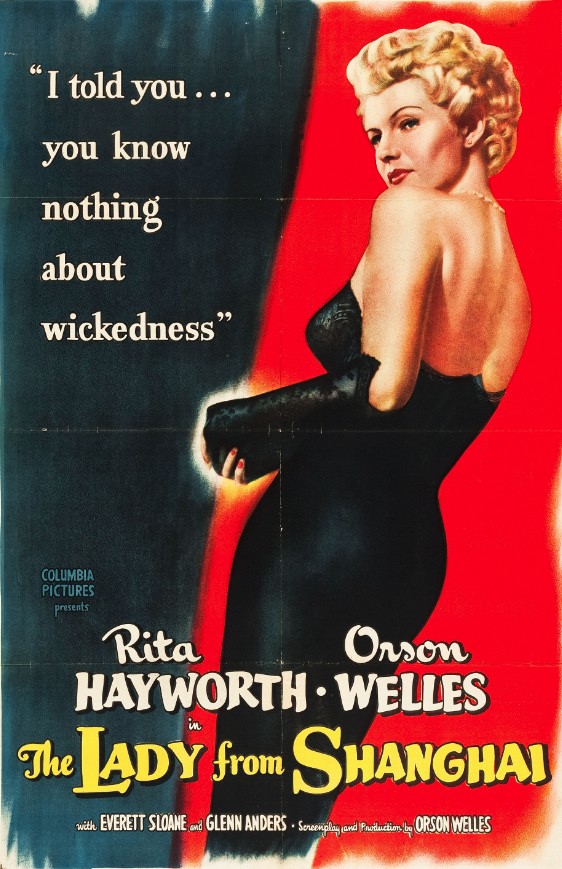
Orson Welles’s The Lady From Shanghai premiered in France on Christmas Eve, 1947, and in the United States nearly half a year later, on June 9, 1948.

The film is something of a minor classic now, but at the time of its release it was generally a disappointment; a disappointment to critics, to the studio, to audiences, and to Welles himself, who had little control over the final product released into theaters.

The Lady From Shanghai was filmed in 1946, and the original cut ran more than two and a half hours. Executives at Columbia Pictures made numerous cuts, and the final musical score was not to Welles’s liking. The litany of complaints from all sides were legion, and are outside the scope of this review.

But before I get into a discussion of the film itself, I need to mention the complaint that I find most mystifying. Welles chose to radically alter the looks of his leading lady, Rita Hayworth (to whom he was married from 1943 to 1948), by chopping her long tresses and dying her hair platinum blond. This decision caused a whirlwind of controversy, and was blamed by some in Hollywood for the dismal box office performance of The Lady From Shanghai.

Was the movie-going public in 1948 composed entirely of people whose tonsorial proclivities were identical to the Son of Sam’s? I think that Rita Hayworth is stunningly beautiful and alluring no matter what her hairstyle, and The Lady From Shanghai is all the proof I need.

The Lady From Shanghai stars Welles as a “black Irish” rascal and drifter named Michael O’Hara who saves a beautiful young woman named Elsa Bannister (Hayworth) from a group of muggers in Central Park, and then becomes embroiled in a byzantine scheme that involves a faked death.

The plan is hatched by her husband’s law partner, George Grisby (Glenn Anders), who wants O’Hara to confess to murdering him after Grisby leaves the country, never to return. The rub is that without a body, the authorities won’t be able to convict O’Hara, and he’ll pocket a lump sum of cash for his trouble while Grisby pockets the insurance money. But Elsa’s husband, Arthur Bannister (Everett Sloane), has noticed the way Elsa and O’Hara make eyes at each other, and he’s got his own wild scheme.

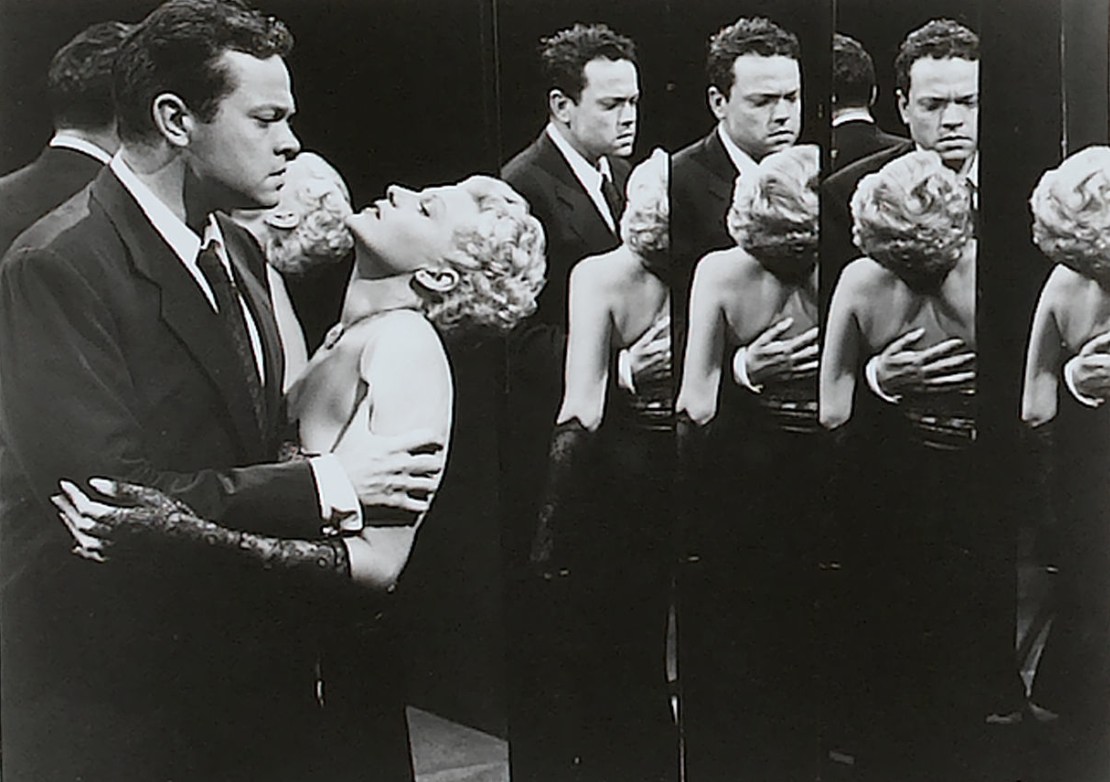
Even for a movie that was hacked down from 155 minutes to just 87, The Lady From Shanghai covers a lot of ground, and much of it is crazy. O’Hara accompanies the Bannisters and their entourage on a yacht tour of Mexico on their way from New York to San Francisco before the plot really gets rolling. Then, after the triple-cross scheme plays out, there’s a farcical courtroom scene that is genuinely funny and truly bizarre. Finally, there is a wild and phantasmagoric journey through San Francisco’s Chinatown that culminates in a chase through an abandoned fairground, and the film’s famous climax in the hall of mirrors of The Crazy House.

Given the studio-imposed cuts in the film’s running time, it’s probably not Welles’s fault that the plot is full of holes. But it’s hard to imagine any additional footage or story elements that would make the wild shifts in tone and byzantine plot any more digestible.

Ultimately, though, it really doesn’t matter. If you can get over Welles’s bad Irish accent and the general confusion of ideas in The Lady From Shanghai, it’s a brilliant, engrossing film that’s a joy to watch. Besides the gorgeous black and white cinematography and wonderful performances from Sloane, Hayworth, and Anders (and Welles, more or less), Welles is a director who was decades ahead of his time in terms of action and pacing. The slightly sped-up camerawork during fight scenes and the rapid editing isn’t like anything else you’ll see from the mid- to late-’40s.

There are a lot of things about The Lady From Shanghai that are totally unlike anything else in cinema at the time of its release. Welles’s reach usually exceeded his grasp, but as a director I think he was without parallel. The Lady From Shanghai may not be a perfectly formed work of art like Citizen Kane (1941), but it’s a fascinating and incredibly entertaining film.