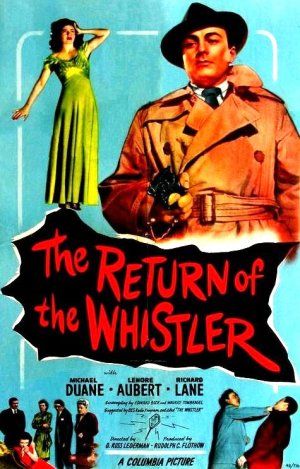
The Return of the Whistler (March 18, 1948)

The Return of the Whistler
The Return of the Whistler (1948)
Directed by D. Ross Lederman
Columbia Pictures

The Return of the Whistler was the final entry in the Columbia Pictures series based on the CBS radio show. It’s the only Whistler film that doesn’t star Richard Dix, who was in poor health when it was made (he died on September 20, 1949, at the age of 56).

Not only were the Whistler films excellent B-movie programmers, they were remarkably faithful to their source material. Just like the radio show, The Return of the Whistler begins with the eerie whistled theme music. The camera tracks the shadow of a walking man as he narrates in voiceover: I am the Whistler, and I know many things, for I walk by night. I know many strange tales hidden in the hearts of men and women who have stepped into the shadows. Yes, I know the nameless terrors of which they dare not speak.

Michael Duane and Lenore Aubert star as Ted Nichols and his fiancée Alice, who — when the film begins — are driving through a dark and story night to be married by a justice of the peace. Alice is a Frenchwoman, and Ted has only known her for two weeks. He found her under mysterious circumstances, limping through the woods near his summer cabin, running away from someone or something. There’s a lot about her past that he doesn’t know, but he does know one thing — he loves her more than anything in the world.

Naturally, things don’t go according to plan. First their car breaks down, then they discover that the justice of the peace is out of town, trapped by bad weather. Ted and Alice can’t stay in a hotel room together for the night because they aren’t legally married yet, so Ted leaves Alice at the hotel alone and walks to a nearby garage to have his car fixed. The shadow of the Whistler follows him.

This isn’t just the way you’d planned your honeymoon is it, Ted? But don’t be too unhappy, it’s only a few more hours before you and Alice will be united forever.

Like most things the Whistler says, those words drip with sardonic irony, because when Ted returns to the hotel the next morning Alice is gone, and the cranky night clerk (played by Olin Howland) claims not to know anything.

The Return of the Whistler is a fine capper to the series. The pacing is excellent and the actors all turn in solid performances. The mystery of what happened to Alice isn’t attenuated unnecessarily, and the movie is more suspenseful because of it, getting us involved in her predicament and Ted’s desperate fight to find out what’s going on before it’s too late.

The Return of the Whistler was directed by D. Ross Lederman, produced by Rudolph C. Flothow, and written by Edward Bock and Maurice Tombragel, based on a story by Cornell Woolrich. There are currently a few uploads of The Return of the Whistler on YouTube. You can watch one of them below:

The Miracle of the Bells (March 16, 1948)

How do you like your schmaltz? Extra fatty, thick, and glopped all over the place?

You do? Well, Irving Pichel’s The Miracle of the Bells should satisfy your appetite, provided you don’t require nauseating Technicolor or weepy musical numbers. Everything else is in place; soft-focus feel-good spirituality, a tragic love story, and a town coming together for the greater good.

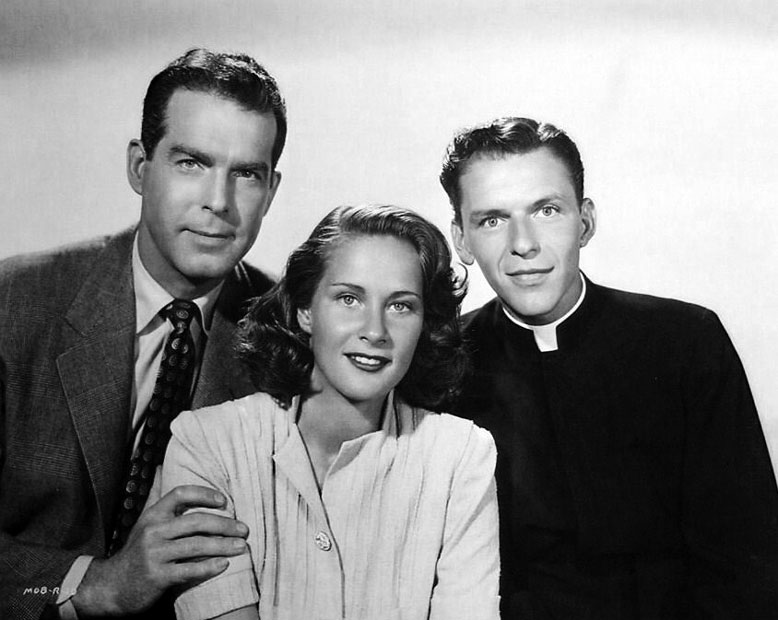
Fred MacMurray plays Hollywood press agent extraordinaire Bill Dunnigan, an affable regular guy with a killer instinct when it comes to a promotional angle. One day he meets a struggling actress named Olga Treskovna (played by Italian actress Alida Valli, who’s credited as just “Valli”) and helps her get a break in a low-rent chorus line.

A year later, they meet again in a small town on Christmas Eve. They have a warm and romantic meal at a Chinese restaurant run by a venerable wise man named Ming Gow (Philip Ahn). Olga coughs when Dunnigan gets up to put some Christmas carols on the jukebox, which — if you’re a connoisseur of movie clichés — means you’ve already figured out that she will die of tuberculosis.

I’m not giving anything away, since the film begins with Dunnigan transporting Olga’s coffin back to her hometown of Coaltown, PA, and the rest of the film recounts her life and death through his eyes. She literally killed herself playing Joan of Arc in her first starring role, refusing to drop out even though she had TB, and her dying wish was to be buried on a hill in St. Michael’s Cathedral in Coaltown, next to her parents.

To thicken the plot, Marcus Harris (Lee J. Cobb), the big-time Hollywood producer of Olga’s star turn as Joan of Arc, doesn’t want to release the film because it stars a dead woman no one’s ever heard of. Too morbid, Harris declares.

Dunnigan has a reputation as a press agent who pulls stunts to put over crummy shows and lousy movies, so when he arranges all the bells in Coaltown to ring for three days for Olga, people think it’s a cheap ploy to get her final picture released. (It is, but Dunnigan’s motives are pure.)

Dunnigan also has to fight to have her body interred in St. Michael’s Cathedral, which is the smaller, poorer Catholic church in Coaltown, and the more popular his PR campaign becomes, the more pressure there is to have Olga’s funeral services held in the larger cathedral.

Frank Sinatra plays Father Paul, the young priest who presides over St. Michael’s, and it’s tempting to draw comparisons with another crooner who famously played a priest — Bing Crosby in Going My Way (1944) and The Bells of St. Mary’s (1945) — but Sinatra’s performance is more understated. In The Miracle of the Bells he plays a character, not a song-and-dance version of himself.

Despite its overwhelming sentimentality, I didn’t hate The Miracle of the Bells. It’s OK for what it is, and it could have been much worse. (The great Ben Hecht wrote the screenplay with Quentin Reynolds, adapting Russell Janney’s best-selling novel. I haven’t read it, but the review in the September 16, 1946, issue of Time said that “as a novel, The Miracle of the Bells is one of the worst ever published.”)

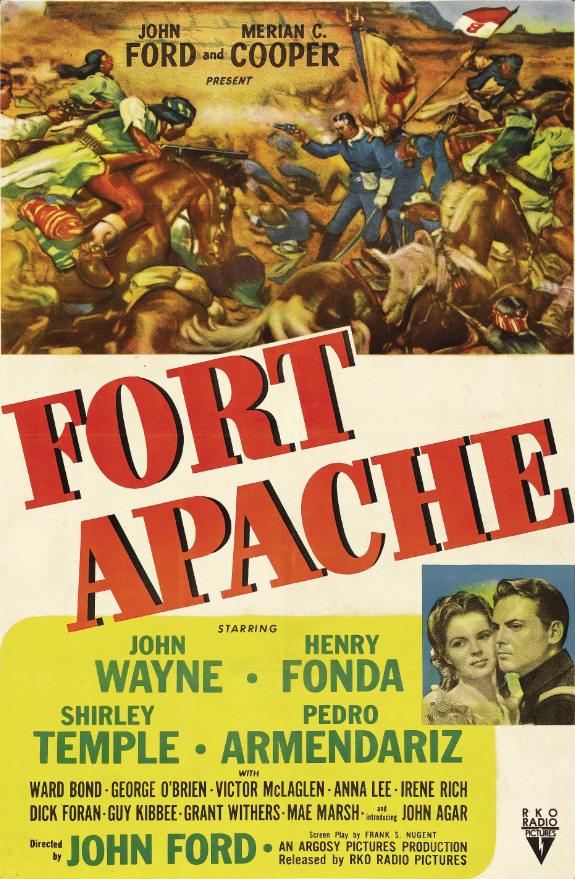
Fort Apache (March 9, 1948)

Understand me, gentleman. I am not a martinet, but I do want to take pride in my command. We here have little chance for glory or advancement. While some of our brother officers are leading their well-publicized campaigns against the great Indian nations — the Sioux and the Cheyenne — we are asked to ward off the gnat stings and flea bites of a few cowardly digger Indians.

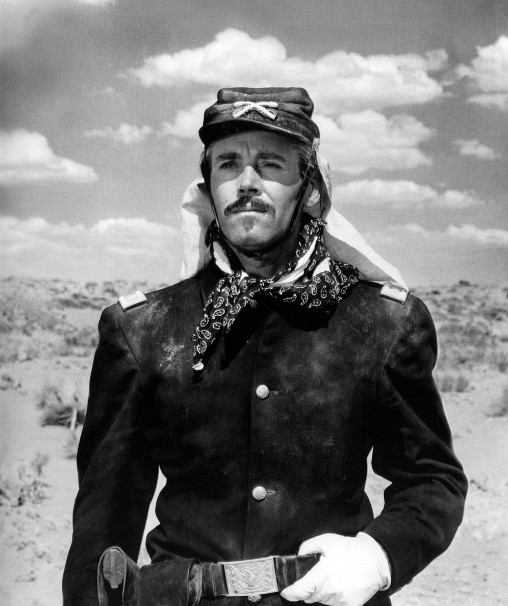
This irony-laden speech by Lieutenant Colonel Owen Thursday (Henry Fonda) occurs early in the second reel of John Ford’s Fort Apache. It foreshadows the tragic and violent finale of the film, and firmly establishes what kind of man Thursday is. Not only is he the dictionary definition of a martinet, but his underestimation of the Apache will be fatal.

When Captain Kirby York (John Wayne) protests that Cochise and his Apache warriors are far from “digger Indians,” Thursday refuses to listen, and the conflict between Capt. York and Lt. Col. Thursday only intensifies as the film goes on. When York, who is familiar with the customs of the Apaches, arranges a meeting with Cochise (played by Miguel Inclán), Thursday refuses to honor the agreement Kirby makes with Cochise. “There is no question of honor, sir, between an American officer and Cochise,” Thursday says. Kirby simply responds, “There is to me, sir.”

In a lesser film, Thursday’s rigid adherence to discipline would mask cowardice, but Thursday isn’t a coward. He isn’t vainglorious either. When York, who remembers Thursday as a general from Civil War, addresses him as “general,” Thursday curtly corrects him. “I’m not a general, Captain,” he says. “A man is what he’s paid for. I’m paid in the rank of Lieutenant Colonel.”

Fonda’s performance in Fort Apache is remarkable. His character is so clearly in the wrong so much of the time that it would be easy for him to be a stock villain, but he never is.

Fort Apache is a study in heroism and myth-making, and a story of how the messiness of real life will always end up either forgotten or completely remade.

Of course, since it’s a film directed by John Ford, it’s also a film full of broad comedy, mawkish Irish sentimentalism, and lionizations of the common man.

And no matter how much Ford ever deconstructed the idea of heroism and myth-making in any of his films, he couldn’t resist engaging in his own larger-than-life artistry. Just like My Darling Clementine (1946), Ford shot Fort Apache in Monument Valley because it looked good, not because it was where the real events of his story took place.

Fort Apache isn’t a perfect film, but it’s damned close. It’s an excellent western, and a great film about the U.S. Cavalry that doesn’t paint the Apache as mindless savages. There are references to men tied to wagon wheels, roasted alive (off screen, of course), but Cochise and his warriors are never two-dimensional villains.

Fonda and Wayne are the stars of the film, but they have excellent support from the rest of the cast, especially Ward Bond, who plays Sergeant Major Michael O’Rourke, and Pedro Armendáriz, who plays Sergeant Beaufort.

If there’s a weak link for me in the film, it’s John Agar, who plays Second Lieutenant Michael Shannon O’Rourke. When Agar appeared in Fort Apache he was the real-life husband of Shirley Temple, who plays Lt. Col. Thursday’s daughter, Philadelphia Thursday. (Agar and Temple married on September 19, 1945, and were divorced on December 5, 1949. They had one child together.)

In terms of action, Fort Apache is stately and fetishistic. There are no real skirmishes that lead up to the final battle — as there would be in any picture made today — there is only the aftermath of Apache raiding parties.

And in the charge that begins the final battle, the bugler is the first to be killed by Cochise and his men, putting an end to the stirring patriotic music, which is perfectly fitting. The final battle is accompanied only by Apache war whoops, gunshots, and the thunder of hoof beats.

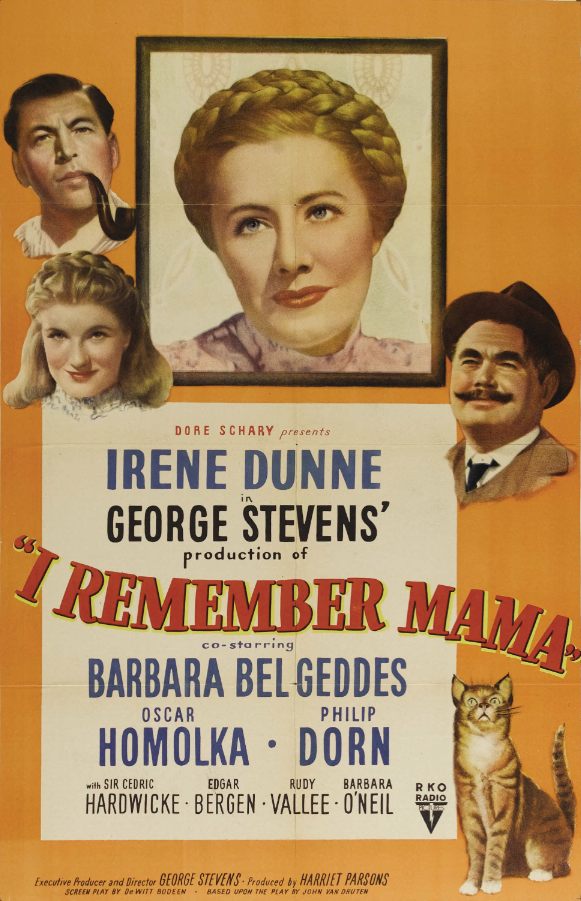
I Remember Mama (March 9, 1948)

During World War II, director George Stevens served as a Lieutenant Colonel in charge of combat photography. He filmed D-Day, the Battle of the Bulge, the liberation of Paris, and the horrors of the concentration camps.

When he returned home to America he started a production company, Liberty Films, with William Wyler and Frank Capra. For his first film, Stevens chose to look back to the time and place of his own boyhood — early 20th-century California — rather than the uncertain post-war future.

I Remember Mama is the story of a Norwegian immigrant family living in San Francisco. It’s based on the 1944 play by John Van Druten, which was adapted from Kathryn Forbes’s book Mama’s Bank Account, which was published in 1943.

The film opened in limited release on March 9, 1948. At 11:55 AM on that day, director Michael Curtiz sent Stevens a telegram that read:

Dear George: Without exception I think “I Remember Mama” is the most perfect picture that Ive [sic] seen in years. Direction was magnificent and I think all of us can learn [a] great lesson from it. My deepest admiration goes to you and everyone who had any part in this production. Warmest regards. Mike Curtiz.

While I wouldn’t go so far as to say that I Remember Mama is the most perfect film I’ve seen in years, it’s a wonderful movie that’s heart-warming without being saccharine and that’s beautifully acted and filmed, much of it on location in San Francisco.

Of course, Stevens had the benefit of wonderful source material. I’ve never seen the play by John Van Druten that the film is based on, but I read Kathryn Forbes’s Mama’s Bank Account in sixth grade, and so much about it has stayed with me. It’s warm, humorous, and there’s pure magic in its evocation of ordinary life.

Mama’s Bank Account is a fictionalized memoir written from the point of view of a young woman who aspires to be a writer. (Much of the book was inspired not by Forbes’s mother but by her Norwegian immigrant grandmother.)

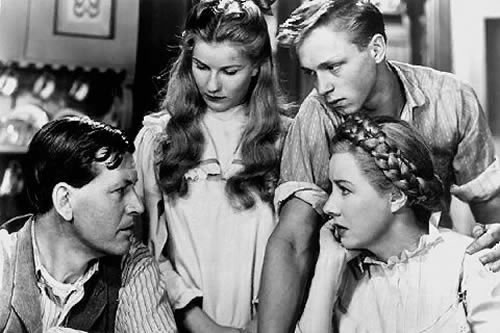
Barbara Bel Geddes plays Katrin, the young writer who finds her subject when she decides to write about her mother, and she sometimes addresses the camera directly. Irene Dunne plays “Mama” (we never learn her real name, which is as it should be).

Like the book, the film is a series of vignettes. There is the tale of the family’s roomer, Mr. Hyde (Cedric Hardwicke), whom Mama’s sisters warn her might be putting something over on her when he’s always late with the rent, but Mama doesn’t mind so much, because Mr. Hyde reads to the family every night from the classics — A Tale of Two Cities, The Hound of the Baskervilles, and Hamlet. Like most of the stories that comprise I Remember Mama, the tale of Mr. Hyde has a bittersweet end, but it’s more sweet than bitter, since his enthralling nightly storytelling sessions kept Katrin’s brother Nels (Steve Brown) off the street the night his friends were arrested for breaking into a shop, and were Katrin’s inspiration to become a writer.

My favorite vignette from both the book and the movie is about Katrin’s Uncle Chris (Oskar Homolka), with his loud voice and his fierce black mustache, who would come down from his ranch in the north and descend upon San Francisco in his automobile, charging up Market Street with ferocious speed, compensating, perhaps, for the limp he still carries from a childhood accident. When Katrin writes a story about her uncle Chris, her teacher scolds her and tells her it’s not nice to write that kind of story about a family member.

I Remember Mama occasionally gets a little schmaltzy, like when Mama impersonates a scrubwoman to get into the children’s ward of a hospital to see her youngest child, Dagmar (June Hedin), and then sings a lullaby that puts all the little girls in the ward to sleep. But for the most part Stevens avoids easy sentiment. Dunne’s performance as Mama is really wonderful, and her line delivery is great. When Katrin asks her mother, “Wouldn’t you like to be rich?,” Mama responds, “I would like to be rich the way I would like to be ten feet high. Is good for some things, is bad for others.”

I Remember Mama was nominated for a bunch of Academy Awards, but it didn’t win any — Best Actress (Irene Dunne), Best Supporting Actor (Oskar Homolka), Best Supporting Actress (Barbara Bel Geddes), Best Supporting Actress (Ellen Corby), and Best Cinematography, Black and White (Nicholas Musuraca).

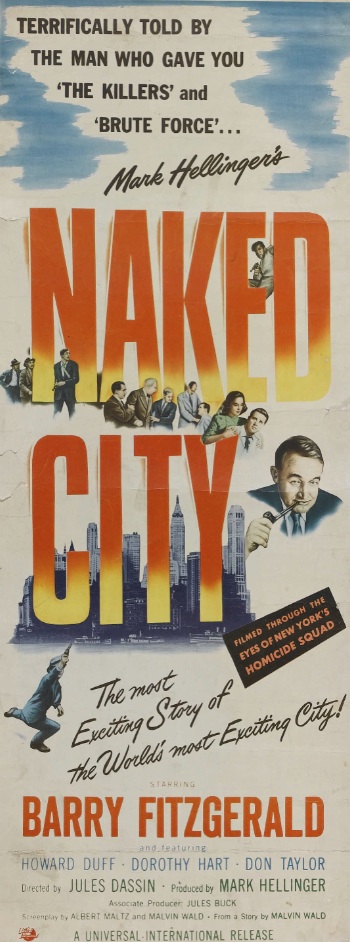
The Naked City (March 4, 1948)

The Naked City
The Naked City (1948)
Directed by Jules Dassin
Universal Pictures

The Naked City was — sadly — the second and final collaboration between producer Mark Hellinger and director Jules Dassin. Their first collaboration was the hard-hitting prison drama Brute Force (1947), and we can only imagine what their third collaboration might have been had Hellinger not died on December 21, 1947, at the age of 44.

Hellinger was a hard-living, hard-drinking newspaper columnist. At the height of his popularity, he reportedly had 18 million readers. Like his friend Walter Winchell, Hellinger had an instinctive knack for writing what people wanted to read, and his insight into the criminal demimonde was unparalleled.

Unparalleled except, perhaps, for his love of New York City and all its inhabitants, from Lower East Side deliverymen to Park Avenue titans of industry. In his review of The Naked City in the March 5, 1948, issue of the NY Times, Bosley Crowther wrote that the film was “a virtual Hellinger column on film. It is a rambling, romantic picture-story based on a composite New York episode, the detailed detection of a bath-tub murder by the local Homicide Squad. And it is also a fancifully selective observation of life in New York’s streets, police stations, apartments, tenements, playgrounds, docks, bridges and flashy resorts.”

By “fancifully selective,” of course, Crowther meant that the film was Hellinger’s vision, and Hellinger was more drawn to mugs, thugs, and crooks than he was to schoolteachers or veterinarians. On the other hand, The Naked City is a police procedural (arguably the very first of its genre), and cops spend more time rousting crooks than they do schoolmarms.

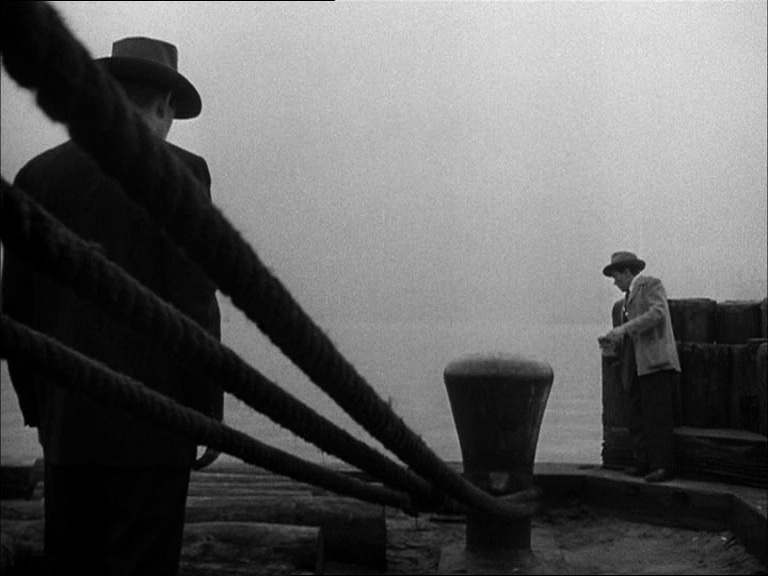
The film is so thoroughly Hellinger’s vision that he narrates the film himself. After a guided nighttime tour of the city that never sleeps, full of his trademark witticisms and wry observations, he tells the viewer that his film will attempt to show “…the buildings in their naked stone, the people without makeup.”

The opening sequence introduces us to most of the film’s major players. (Whether or not the first-time viewer will catch everything, however, is another matter.) The two mugs murdering a beautiful young woman at 52 West 83rd Street, the charming Frank Niles (Howard Duff) and his fiancée Ruth Morrison (Dorothy Hart) out at a nightclub, young NYPD detective Jimmy Halloran (Don Taylor) and his wife Jane (Anne Sargent) and their young children at home in Jackson Heights, Queens, and the crotchety old Detective Lieutenant Dan Muldoon (Barry Fitzgerald), whom we see in his undershirt and suspenders, preparing breakfast.

Most of Hellinger’s narration is engaging and fun to listen to. Some of it is even necessary, especially considering that The Naked City was released before Dragnet existed, even on the radio, and the finer points of police procedure might have been unknown to the average viewer. But there are aspects of his narration that don’t play so well. For instance, the images of the city and its inhabitants are powerful on their own. The overlay of Hellinger’s voice-over “thoughts” and “dialogue” for a variety of average New Yorkers captured on film just comes off as hokey.

The film’s biggest weakness, however, is its two leads. Some people find Barry Fitzgerald charming, but I find his whole grumpy leprechaun shtick as Det. Lt. Muldoon — essentially the same role he played as a priest in Going My Way (1944) — annoying. But at least he has a personality, unlike Don Taylor, who plays Muldoon’s young partner and protégé Det. Halloran. Taylor has a “golly gee shucks” attitude and not much else. He also doesn’t seem to know what to do with his face when he’s on camera but doesn’t have any lines.

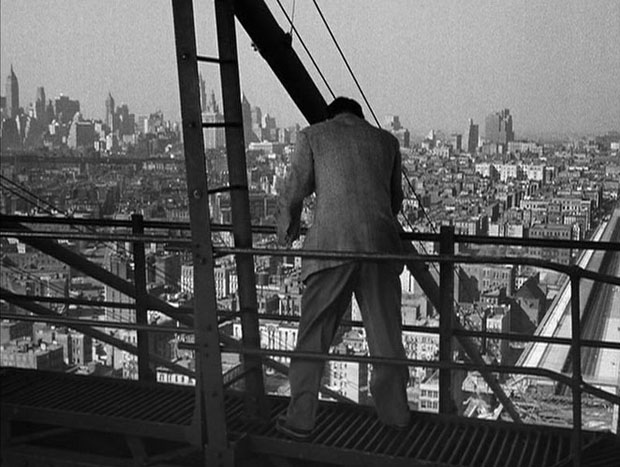
Taylor and Fitzgerald and their dialogue undercut much of the vérité quality of the film, but certainly don’t ruin anything. As a cinematic experience, I don’t think The Naked City is as satisfying as Brute Force, but it’s still a tremendously entertaining, well-made picture. When Dassin and Hellinger allow the action to speak for itself, as they do in the final, bravura chase along the Williamsburg Bridge, the film is untouchable.

The Naked City was nominated for three Academy Awards; Best Story (Malvin Wald), Best Cinematography, Black and White (William H. Daniels), and Best Film Editing (Paul Weatherwax). It won in the categories of Best Cinematography and Best Film Editing.

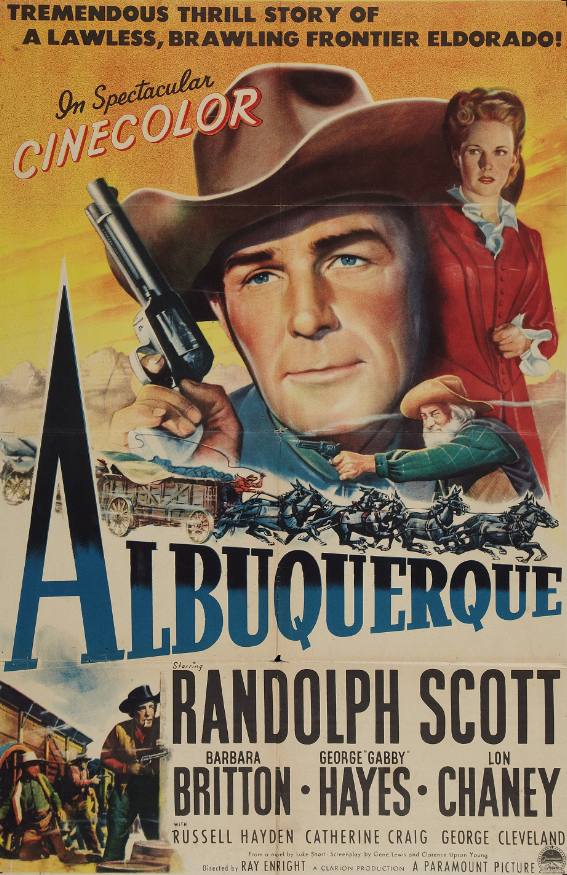
Albuquerque (Feb. 20, 1948)

Like Randolph Scott’s last western, Gunfighters (1947), director Ray Enright’s Albuquerque was filmed in Cinecolor, which was a two-color film process that was less expensive than Technicolor.

Unlike Gunfighters, it’s punchy and fast-moving, which could have something to do with the source material. Gunfighters was based on a novel by the long-winded Zane Grey, while Albuquerque is based on the 1939 novel Dead Freight for Piute, which was written by the terse, hard-boiled western author Luke Short.

Albuquerque isn’t quite on the level of André de Toth’s Ramrod (1947), which was the best adaptation of a Luke Short book I’ve seen to date, but it’s a well-made B western.

The lean, weather-beaten Randolph Scott plays Cole Armin, a man coming to Albuquerque to do a job. On the way there, he and his fellow stagecoach passengers are robbed by a group of masked bandits. Celia Wallace (Catherine Craig) loses $10,000 to them, and a young girl named Myrtle (Karolyn Grimes, best known for playing little Zuzu in It’s a Wonderful Life), is put in a perilous position when the stage goes out of control with spooked horses and no driver.

It quickly becomes clear that more pernicious forces are at work in Albuquerque than just a few stagecoach robbers preying on wayfarers. John Armin (George Cleveland), Cole’s uncle and the man he’s come to Albuquerque to work for, turns out to have a stranglehold on the territory, and he expects Cole to help him carry out all manner of dirty business.

So the honest Cole Armin goes into business with Celia and her brother Ted Wallace (Russell Hayden), forming Wallace & Armin Freighting. Their freighting company moves ore from the Half-High Mine down a steep, twisting, treacherous trail. (Even higher up the mountain is Angel’s Roost Mine, but it’s so high up that no one’s sure if it’s even possible to get the ore down from there.)

Naturally, none of this makes John Armin very happy, and he dispatches forces both foul and fair — a hulking henchman named Steve Murkill (Lon Chaney Jr.), who appears to have been hired not only for his great strength and mercilessness, but also his ability to get hit in the face without losing the cigarette clenched between his teeth; and a beautiful young woman named Letty Tyler (Barbara Britton), who ingratiates herself to our heroes with her feminine charms and a revolver that secretly contains blanks.

Albuquerque is a B western through and through (look no further than the presence of the rootin’, tootin’ Gabby Hayes as “Juke”), but its production values are solid and it’s pretty entertaining, especially for fans of Randolph Scott, who for my money is the most archetypal western star of all time.

Blanche Fury (Feb. 19, 1948)

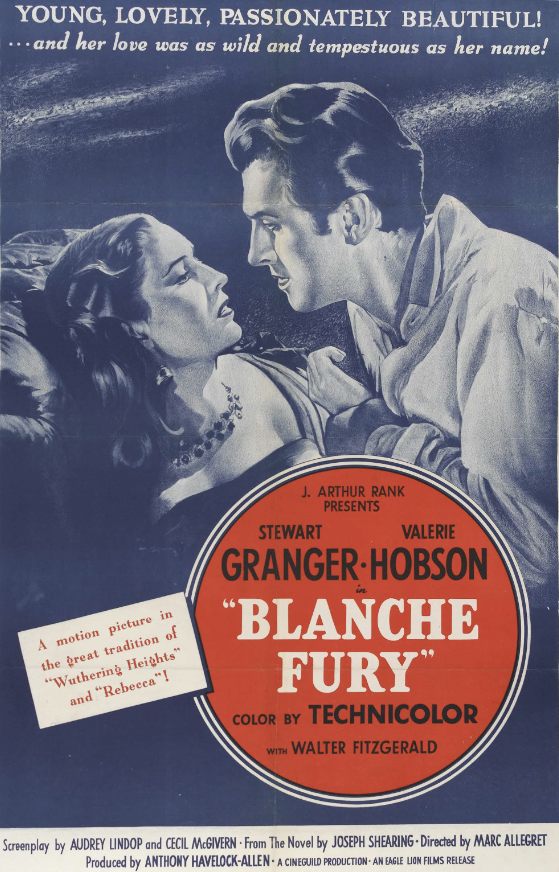
Marc Allégret’s Blanche Fury is a brilliantly made bodice-ripper. It’s based on the 1939 historical romance by Marjorie Bowen (published under Bowen’s pseudonym “Joseph Shearing”), and it strikes the perfect balance between high-minded Victorian drama and tawdry escapism.

The attractive and imperious English actress Valerie Hobson is perfectly cast as Blanche, a proud young woman forced to labor as a servant after the deaths of her parents.

When the film begins, it is 1853, and Blanche Fuller is continually being sacked from her domestic positions for her acid tongue and independent manner. She is 25 years old, ambitious, and has no desire to live the rest of her life as a paid companion to bedridden old ladies.

So when she accepts a position at Clare Hall from her uncle, Simon Fury (Walter Fitzgerald), she has her sights set on bigger things than room, board, and a small salary.

Her uncle Simon’s son, Laurence Fury (Michael Gough), is a widower with a young daughter, Lavinia (Susanne Gibbs), who has had neither suitable companionship nor adequate tuition since her mother’s death.

Blanche and the young girl have an easy rapport and grow to love each other. The same cannot be said of Blanche and Laurence, even though Blanche marries him to secure her position as an aristocratic lady.

The viewer gets the sense that there wouldn’t be much of an erotic spark between them even without the presence of Philip Thorn (Stewart Granger), the illegitimate offspring of the late Adam Thorn and an Italian woman.

Thorn is the squire of Clare Hall, and a servant, but he is as desperate to take his “rightful place” as Blanche is to take hers.

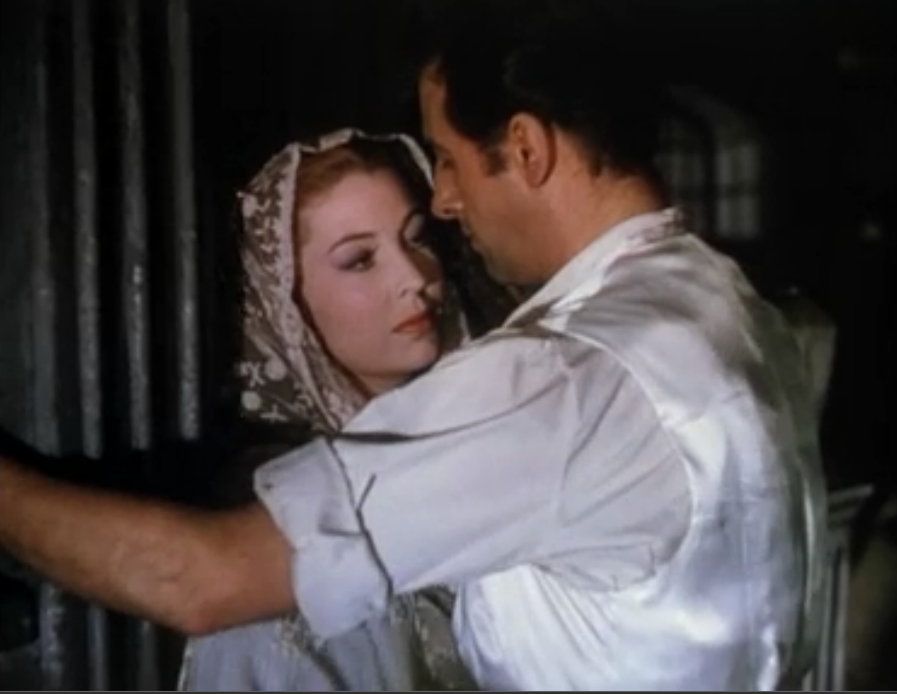
Still photographs don’t fully convey Stewart Granger’s erotic power in this film. His performance as Thorn is as pitch-perfect as Hobson’s performance as Blanche. He perfectly captures Thorn’s ambition and seductive power, as well as the violence and malevolence that swirls below his icy surface.

Blanche Fury has a faster pace than a lot of historical melodramas. There are fires, murders, dastardly schemes, and even dangerous bands of Gypsies. Clifton Parker’s music is full of drama and passion. The Technicolor cinematography is gorgeous. Victorian romances aren’t always to my liking, but it didn’t take long for Blanche Fury to completely engross me.

It’s currently streaming on Netflix. The color looks a little washed out and the print is a little softer than I’d like, but it’s a decent copy. There’s also — at least for the time being — a full version of the film on YouTube, which you can watch below:

Sleep, My Love (Feb. 18, 1948)

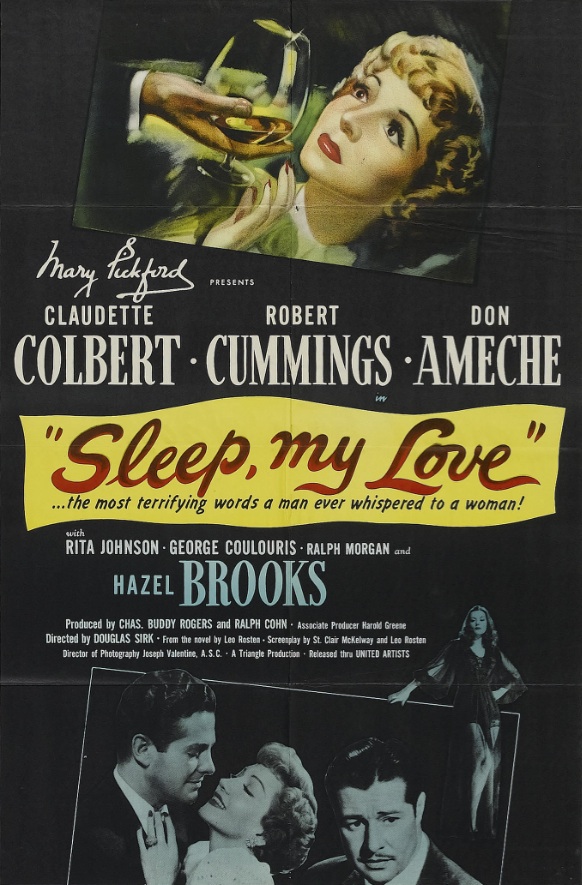
Sleep, My Love is a slick, classy thriller from the slickest, classiest director of all time, Douglas Sirk.

Granted, his greatest work was a few years ahead of him, but even when he was making run-of-the-mill potboilers like Sleep, My Love and Lured (1947), Sirk applied not only his considerable skill as a filmmaker to the material, but also his fetishistic attention to details, and his love of the sumptuous and the glamorous.

The film starts with a bang. Alison Courtland (Claudette Colbert) wakes up from a nightmare on a train, screaming. She doesn’t have any memory of how she got there. The last thing she remembers is going to sleep next to her husband in their palatial home on Sutton Place and East 57th Street.

Oh, and there’s a small pistol in her bag that she doesn’t remember having, either.

Sirk introduces all the players in his mystery early in the film — Alison’s husband, Richard Courtland (Don Ameche), her friend Barby (Rita Johnson), Barby’s brother Bruce (Robert Cummings), Detective Sgt. Strake (Raymond Burr), a mysterious man with horn-rimmed glasses named Charles Vernay (George Coulouris), and the leggy, beautiful Daphne (Hazel Brooks) — but it’s not immediately clear how they all relate to one another.

Much of the pleasure in watching Sleep, My Love comes from seeing how Sirk moves all of his chess pieces around the board. It’s clear from the outset that someone is gaslighting Alison, but who is doing it? And why are they doing it?

This isn’t the kind of mystery in which the solution comes as a complete surprise and is explained by a brilliant detective who gathers all the suspects together in a drawing room; rather, it evolves and reveals itself naturally over the course of the film. It won’t take an astute viewer long to figure out what’s going on, but Sirk isn’t trying to pull the wool over anyone’s eyes. He’s simply making a thrilling film that’s beautiful to look at, and succeeding with aplomb.

Arch of Triumph (Feb. 17, 1948)

Lewis Milestone’s Arch of Triumph has all the elements of a great film, but they never quite coalesce. It’s based on a novel by Erich Maria Remarque, the writer of All Quiet on the Western Front (which was director Milestone’s greatest film success). It stars the patrician Charles Boyer, the beautiful Ingrid Bergman, and the grotesque Charles Laughton, all of whom are well cast. And its setting — Paris in 1939 — is atmospheric. The city was still a refuge for people fleeing the Nazis, but dark clouds were gathering over France, and everyone knew it.

The review of the film in the May 10, 1948, issue of Time called it an “outstanding misfire,” and that’s as good a description as any. Why? At a little more than two hours, is the movie too long? Is it too short? (The rough cut ran about four hours.)

I could go on and on with this kind of equivocation. Is the film too melodramatic? Not melodramatic enough? And so on. Suffice it to say that the film had a budget of $5 million, but doesn’t look nearly that expensive, and that it began filming in 1946 but didn’t make it to movie theaters until 1948.

Boyer plays a Central European medical doctor named Ravic who doesn’t exist on paper. He is in Paris without a passport, and if he’s caught he’ll be deported … or worse. (It is ironic but not disconcertingly dissonant to watch Boyer, the archetypal Frenchman, play a refugee in Paris.)

One night Ravic meets a despondent young woman named Joan Madou (Bergman), standing on a bridge, possibly contemplating suicide. They embark on a love affair that is as doomed as it is long-winded; they leave Paris on holiday, they return, Ravic is caught by the police, Joan attaches herself to another man, Ravic returns to Paris, etc.

For the most part, Arch of Triumph is an overlong, soapy melodrama. Every time Charles Laughton is on screen, however, it feels like a thriller. Laughton plays Ivon Haake, the Nazi officer who tortured and interrogated Ravic and murdered Ravic’s former lover. Ravic has vowed to avenge her death, and the scenes in which he stalks Haake through the nighttime streets of Paris generate the most excitement in the film, and lead to an exciting and violent conclusion (although the violence as originally written in the script had to be toned down for the Breen Office).

After Ravic’s arrest at about the midpoint of the film, his fellow refugee, the White Russian “Col.” Boris Morosov (Louis Calhern), tells Joan, “History has no special accommodations for lovers.”

It’s this sense of the great weight of history bearing down on people’s lives that is my most lasting impression of the film. Arch of Triumph is a much less hopeful film than the similarly themed Casablanca, but its dour tone suits the proceedings well. I certainly didn’t hate Arch of Triumph, and for the most part I liked it. There’s just the sense that something’s missing from the overall experience when the credits roll.

Call Northside 777 (Feb. 1, 1948)

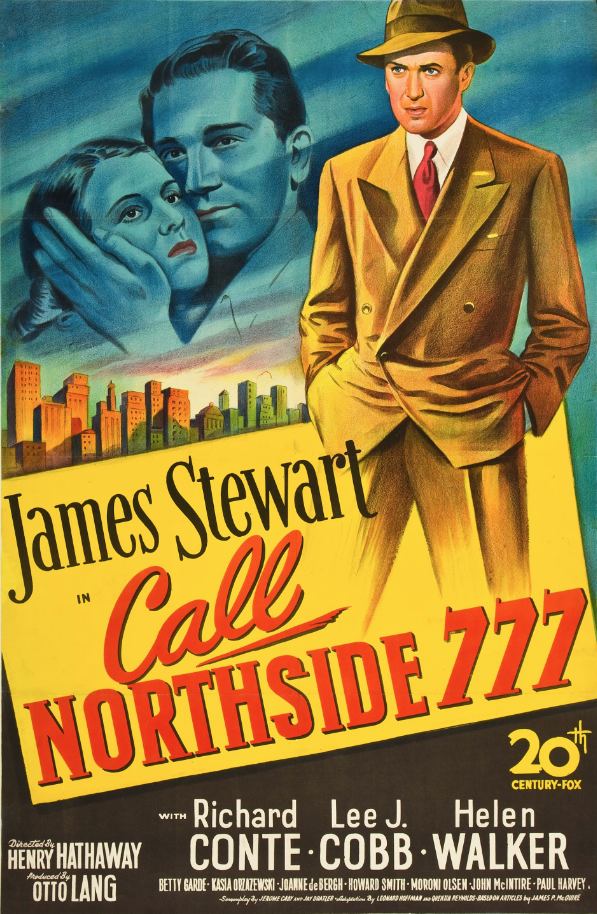
Call Northside 777 is the latest in director Henry Hathaway’s series of fact-based dramas.

Together with producer Louis de Rochemont, the creator of the March of Time series of newsreels, Hathaway made The House on 92nd Street (1945) and 13 Rue Madeleine (1947), which were both based on the wartime exploits of the OSS.

Unlike Hathaway’s previous film, Kiss of Death (1947), which was fiction, but made in a verité style and filmed on location, Call Northside 777 is more in line with Louis de Rochemont’s Boomerang (1947), which was directed by Elia Kazan.

Like Boomerang, Call Northside 777 is about a miscarriage of justice.

In 1933, Joseph Majczek and another man, Theodore Marcinkiewicz, were convicted of killing a Chicago police officer the previous year. In 1944, their convictions were overturned when a crusading reporter named James McGuire helped prove that the eyewitness who gave the testimony that sent the two men to prison had perjured herself under pressure from the police.

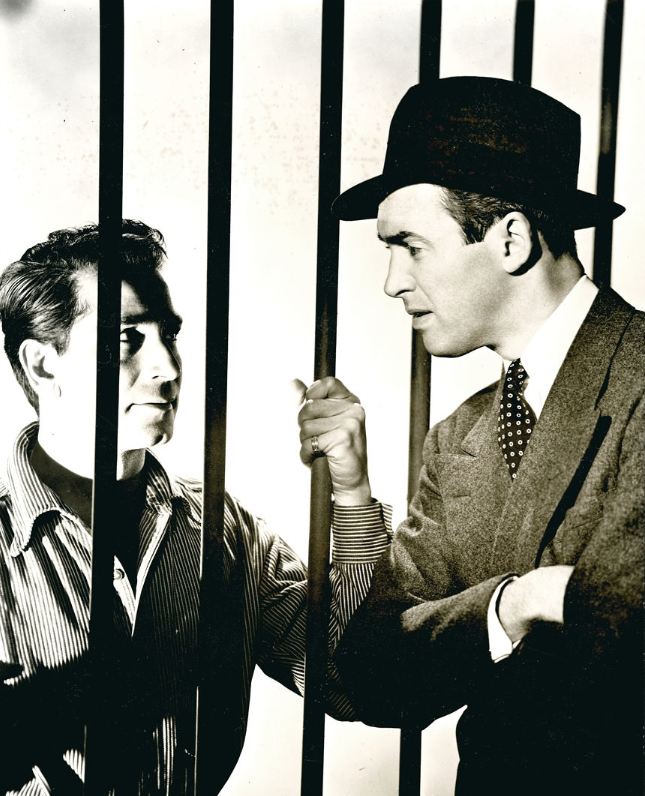
Majczek is renamed “Frank Wiecek,” and he’s played by Richard Conte. The crusading Chicago Times reporter is renamed “Jim McNeal” and he’s played by James Stewart.

McNeal’s editor, Brian Kelly (Lee J. Cobb), spots a notice in the classified section of the Times — “$5000 reward for killers of Officer Bundy on Dec. 9, 1932. Call Northside 777. Ask for Tillie Wiecek 12-7 p.m.” — and sends McNeal to investigate.

Tillie Wiecek (Kasia Orzazewski) is the convicted man’s mother. She earned the $5,000 by scrubbing floors.

After McNeal interviews Mrs. Wiecek, his wife Laura (Helen Walker) says to him, “I wasn’t thinking about the boy, I was thinking about his mother. You know what it is? It catches your imagination. Nobody knows whether she’s right or not. She’s worked so hard, she’s had such faith that, well, I want her to be right.”

McNeal, on the other hand, is hard-nosed and unsentimental about the case. As he tells Wiecek when he goes to prison to interview him, “She believes you. I need proof. This thing’s gotta have sock — mass appeal. It’s the only way we’ll be able to help you.”

Eventually, though, the evidence begins to pile up, and even the cynical McNeal is convinced of Wiecek’s innocence.

Call Northside 777 was released on DVD in 2004 as part of the Fox Film Noir collection, but there’s very little thematically that marks it as “noir.” The closest the film gets stylistically to being a film noir is toward the end of the picture, when McNeal scours the Polish neighborhoods of Chicago in search of the eyewitness in the Wiecek case, Wanda Skutnik (Betty Garde). These scenes are bathed in shadows and shot through with suspense.

For the most part, though, Call Northside 777 is lit and shot in a neutral, docudrama fashion, which is a shame, since it was the first big Hollywood production filmed in Chicago. There are a few shots of the Merchandise Mart, the Loop, and Holy Trinity Polish Mission, but most of the film takes place indoors.

It’s a good film, but since it’s mostly a hidebound retelling of established facts, it’s never as thrilling or suspensful as a piece of pure fiction like Kiss of Death. It’s interesting, for instance, that Leonarde Keeler, the co-inventor of the polygraph, plays himself in the scene in which Wiecek is given a lie detector test, but it’s not really the stuff of great drama.

The best thing about the film is Jimmy Stewart’s performance. He handles his character’s progression from a cynical reporter who’s “just doing his job” to a man who’s finally found a cause worth fighting for wholly believable and thoroughly involving.