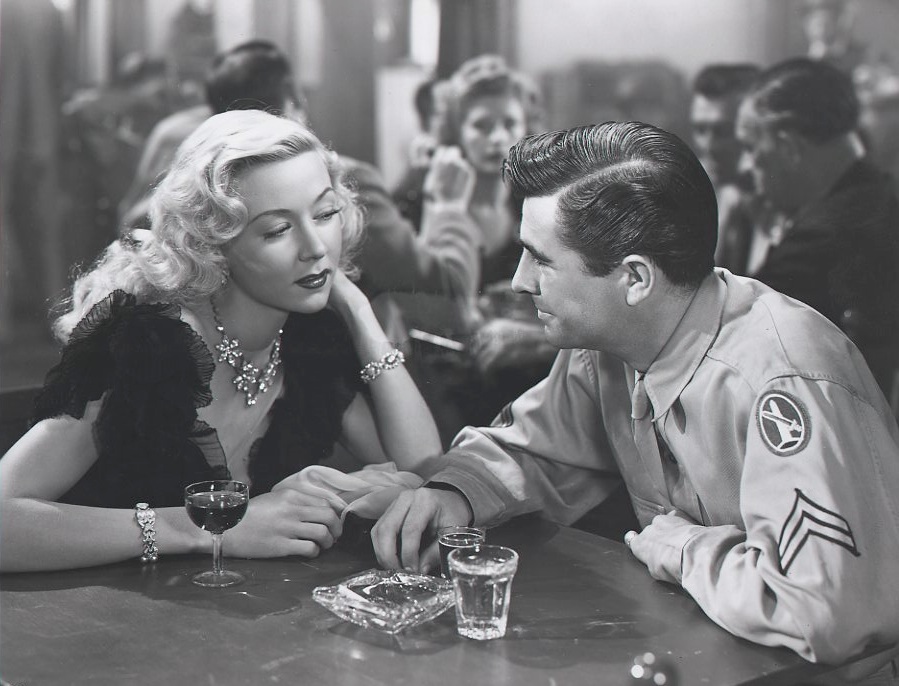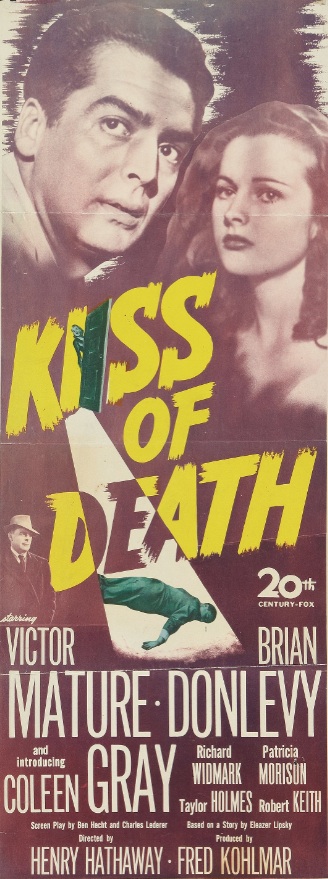
Kiss of Death (Aug. 27, 1947)

Kiss of Death is director Henry Hathaway’s greatest film noir. It’s a mix of the semi-documentary style of his earlier films The House on 92nd Street (1945) and 13 Rue Madeleine (1947) with the hard-boiled conventions of his private eye flick The Dark Corner (1946).

The film begins with the following words: “All scenes in this motion picture, both exterior and interior, were photographed in the State of New York on the actual locale associated with the story.”

Unlike The House on 92nd Street and 13 Rue Madeleine, however, this commitment to veracity isn’t in service of a true-ish retelling of World War II-era espionage, but of a hard-boiled crime drama about a three-time loser facing 15 years in stir after being nabbed for a jewel robbery.

His name is Nick Bianco (Victor Mature), and if he wants to watch his two little girls grow up, he’s going to have to stool for the district attorney’s office.

Bianco has been in this position before, and he took the full four-year rap instead of squealing.

“I’m the same guy now I was then. Nothin’ has changed. Nothin’,” he tells Assistant District Attorney Louis D’Angelo (Brian Donlevy).

On his way up the river to Sing Sing, Nick meets a cackling, sociopathic hood named Tommy Udo (Richard Widmark). Udo won’t show up again for awhile, but he’ll play a major role in Nick’s life when he does.

For awhile, Nick stays clammed up, but then his wife Maria commits suicide and he starts to rethink matters. When a pretty girl from his old neighborhood, Nettie (Coleen Gray), comes to visit him in Sing Sing and tells him that the driver on the jewelry job, a guy named Pete Rizzo, was responsible for Mrs. Bianco putting her head in the oven, Nick decides he wants to talk to the D.A. and secure his release in exchange for information. (In the original story, it was implied that Rizzo raped Nick’s wife, but that’s sidestepped in the final version, making it seem more as if she was having an affair with Rizzo.)

Nick trusts Assistant D.A. D’Angelo enough to tumble to a job in his past that he got away with — the Thompson Fur Company heist — to provide a cover for his trips to the D.A.’s office. D’Angelo promises that he’ll drop the charges later for insufficient evidence.

Things are looking up for Nick. He’s able to care for his daughters, and he’s eventually paroled, leaving him free to marry Nettie.

But as soon as Tommy Udo — Nick’s old pal from the trip up to Sing Sing — re-enters his life, things go very bad very quickly. Udo is the kind of guy who thinks nothing of wrapping up an older wheelchair-bound woman (played by Mildred Dunnock) in electrical cord and pushing her down a long flight of stairs, in one of the most enduring scenes of cinematic sociopathy.
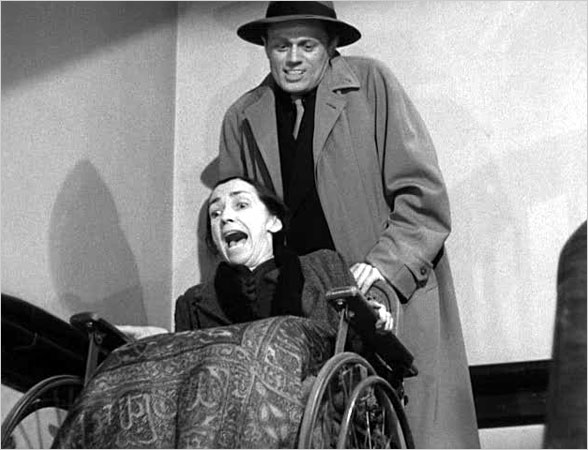
Kiss of Death was Richard Widmark’s film debut, and his balls-out crazy performance is something to behold. The filmmakers thought that Widmark’s high forehead made him look too intelligent, so they outfitted him with a low-browed hairpiece. Like Heath Ledger’s performance as the Joker in The Dark Knight (2008), Widmark’s performance as Tommy Udo straddles the line between gangster movie and monster movie. Director Hathaway had toyed with the idea of casting the manic Harry “The Hipster” Gibson, who sang the 1944 druggie classic “Who Put the Benzedrine in Mrs. Murphy’s Ovaltine?” as Udo, but it’s impossible now to imagine anyone but Widmark in the role.

The screenplay for Kiss of Death was adapted by Ben Hecht and Charles Lederer from a story by Eleazar Lipsky originally called “Stoolpigeon.” Lipsky was a novelist who worked as a Manhattan assistant district attorney. He was also legal counsel for the Mystery Writers of America. Perhaps because of Lipsky’s day job, the realism of the setting of Kiss of Death is matched by the actions of its characters. Brian Donlevy, in the role of Assistant D.A. D’Angelo, is neither a hero nor a villain. When he tells Nick that he’s going to have to testify in court after all, and later that it was all for nothing, and that Tommy Udo was acquitted and is probably coming after Nick, the viewer gets the sense that D’Angelo genuinely cares for Nick, but that at the same time, putting Nick’s life in danger is just part of the job. D’Angelo might not like it, but he accepts it as a necessary evil.

Interestingly, the fictional Kiss of Death comes off as a more realistic film than either The House on 92nd Street (1945) or 13 Rue Madeleine (1947), both of which touted the “true” stories that were their inspirations. Although not every scene in Kiss of Death was shot on the actual locale associated with the story, as the title card promises (some of the interiors were clearly shot in a studio), the use of real New York City and Upstate New York locations coupled with realistic dialogue, understated performances from all the cast besides Widmark, and extremely sparse use of background music makes for a powerful, engrossing drama. There are standout set pieces, like the jewel heist in the Chrysler Building that opens the film, and spectacular shots of the Manhattan Criminal Courts Building, the Tombs, and the Triborough Bridge from the Queens side of the East River, but there are also lots of little touches that give the film its sense of realism. When Nick watches his daughters during their music lesson at the Academy of the Holy Angels in Fort Lee, New Jersey, the piano is slightly out of tune. When Nick sits in his cell at Sing Sing, the toilet in the cell is clearly visible, which is something you’d never see in a prison cell built on a Hollywood soundstage in the ’40s. (Incidentally, prior to shooting the scenes in Sing Sing, Hathaway had both Victor Mature and Richard Widmark processed through the system to give them a better sense of the characters they were playing.)

Kiss of Death isn’t a perfect movie, but it stands up to repeated viewings, and its use of music and location are both revolutionary. If you don’t believe me, take it from Walter Winchell…
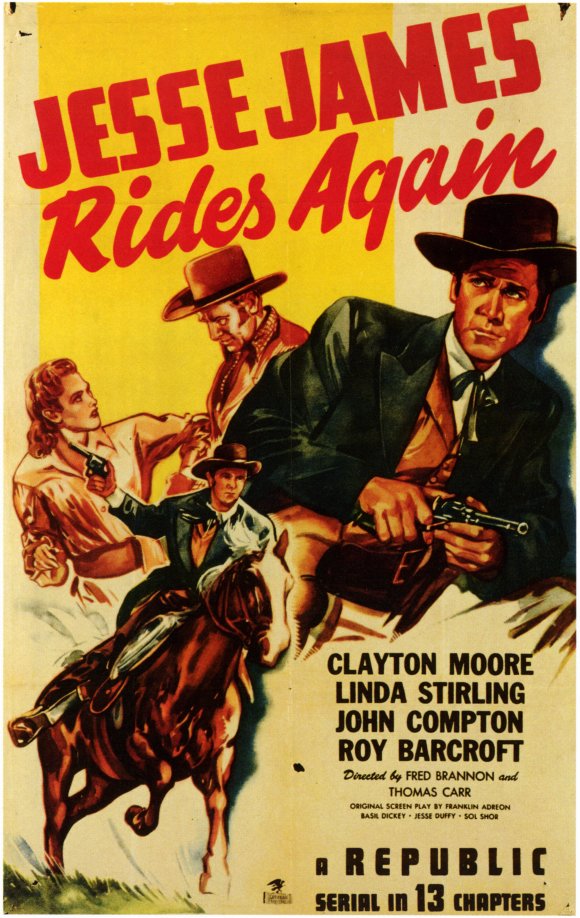
Jesse James Rides Again (13 chapters) (June 2-Aug. 25, 1947)

I’ve said it before and I’ll say it again. Republic Pictures made the best serials in the business. While you could sometimes find better acting in the Saturday-afternoon chapterplays from Universal and Columbia, neither could top Republic when it came to pure slam-bang entertainment. They employed the best stuntmen in Hollywood, and their serials were action packed.

Jesse James Rides Again, which was directed by Fred C. Brannon and Thomas Carr, could have gone the Poverty-Row route and used its western setting as an excuse to deliver a cheap finished product. They had the Iverson Ranch and plenty of reusable costumes, after all. Throw in some chases on horseback, some fistfights, some gunfights, and you’re golden.

Instead, Brannon and Carr delivered a fast-moving serial with lots of pyrotechnics. Some chapters are more exciting than others, obviously, but I still wasn’t expecting so many blown-up barns, flaming logs pushed down hills, exploding riverboats, and burning oil derricks.

Every chapter opens with a shot of men on horseback. They’re all wearing black robes and black hoods. The exciting theme music by Mort Glickman incorporates elements of Stephen Foster’s “Oh! Susanna.” The black-robed riders look exactly like members of the Ku Klux Klan in photo-negative, and they’re called — not terribly creatively — the Black Raiders.

The Black Raiders are secretly working for a man named James Clark, who’s played by Tristram Coffin, a dependable Republic villain playing the most dependable villainous archetype in westerns, the greedy land baron. Clark knows that the farmers who live in Peaceful Valley, Tennessee, are sitting on a rich vein of oil, and it’s only a matter of time before they find out about it.

Clark’s plan is to have the Black Raiders drive all the farmers out of Peaceful Valley by using violence and intimidation; good, salt-of-the-earth people like Ann Bolton (Linda Stirling) and her crippled father Sam Bolton (Tom London).

So in classic western fashion, into the Boltons’ lives rides Jesse James (Clayton Moore). The ex-Confederate outlaw is on the lam for a crime he didn’t commit (the robbery of a bank in Northfield, Minnesota) along with his buddy Steve Long (John Compton).

Jesse James is traveling under the name “J.C. Howard,” and he’s a modern-day paladin, ready to take up arms in defense of the helpless, like Mr. Bolton and his daughter.

If you know anything about the real-life Jesse James, you’ve probably already realized that Jesse James Rides Again plays fast and loose with the facts.

But who cares? It’s all just an excuse for action and feats of derring-do, and as such, it succeeds admirably. Most of the chapters follow a predictable arc — J.C. Howard ( Jesse James) gets out of whatever scrape the previous chapter left him in, then it’s off to the James Clark Land Office, where Clark and his beefy henchman Frank Lawton (Roy Barcroft) discuss their nefarious plans for the oil under Peaceful Valley, just in case any of the kids in the audience are seeing the serial for the first time. Then Jesse James, Steve Long, and Ann Bolton become embroiled in another of Clark and Lawton’s plans, and have to fight their way out. (Clark’s role as villain is unknown to the protagonists until the last chapter.) And finally, each chapter ends with a cliffhanger, like Ann Bolton unconscious inside a cotton compress, or Jesse James knocked out and left behind in the boiler room of a riverboat that’s about to explode.

As the weeks go by, Jesse James and the farmers eventually discover the oil they’re sitting on, and it becomes a race to register their land, sink wells, and get the oil out of the valley. All the while, Lawton and his boys commit one act of sabotage after another.

The most explosive and exciting chapter is the penultimate one, “Chapter Twelve: Black Gold,” in which Steve Long leads a wagon train carrying barrels of oil through a prairie set afire by Lawton and his boys. There are crackups and explosions galore. It’s not quite The Road Warrior, but it’s still an impressive set piece.

Clayton Moore, who plays Jesse James, is probably best known for playing the Lone Ranger on TV from 1949 to 1957. His role in Jesse James Rides Again sometimes seems like a dry run for playing the Lone Ranger.

Moore isn’t the greatest actor in the world, but he’s a solid choice to play a stalwart western hero. Also, I really like the outfit he wore in this serial. Unlike the leather vests and dungarees favored by plenty of B western heroes, Jesse James wears a black hat, a black top coat, a black long string tie, and a dark vest over a white shirt. It’s what every Southern gentleman with a price on his head should be wearing.

Republic would make two more serials featuring Jesse James as a character; The Adventures of Frank and Jesse James (1948), which again starred Moore as Jesse and co-starred Steve Darrell as his brother Frank, and The James Brothers of Missouri (1949), which starred Robert Bice as Frank James and Keith Richards as Jesse James. (No, not the Keith Richards you’re thinking of.)

Desert Fury (Aug. 15, 1947)

For me, Lewis Allen’s Desert Fury is currently running neck and neck with Felix Feist’s The Devil Thumbs a Ride for the honor of “wackiest movie of 1947.”

But maybe I’m comparing apples to oranges. While The Devil Thumbs a Ride was a zany thrill ride with oddball characters and a lot of unexpected humor, Desert Fury is a ridiculously campy melodrama in which most of the humor seems unintentional.

Also, it has gay undertones that are strong enough to power a small city for a year.

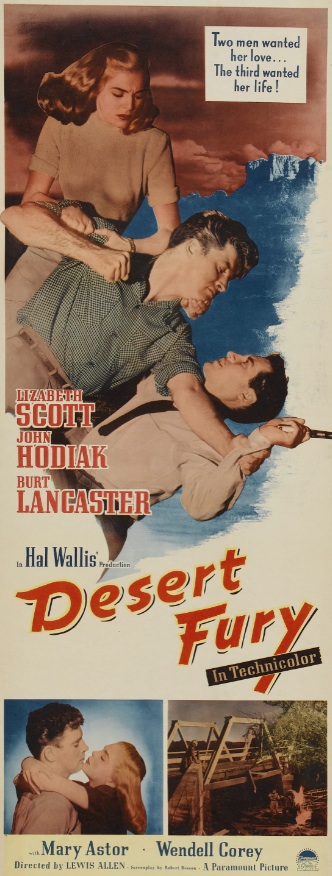
The poster on the right implies that Burt Lancaster and John Hodiak spend the movie fighting for Lizabeth Scott’s love, but that’s not the case. More accurate is the tagline: “Two men wanted her love … The third wanted her life!”

Scott plays a beautiful 19-year-old girl who lives in a “cactus graveyard” in the middle of nowhere — Chuckawalla, Nevada. She lives with her mother, Fritzi, who’s played by Mary Astor (an actress from Hollywood’s Golden Age who was just 16 years older than Lizabeth Scott). Fritzi always calls Paula “baby.” Not in a sweet, maternal way, but the way a barfly might say, “Hey, baby! C’mere!”

Fritzi wants Paula to go back to school, but Paula wants to help her mother run the Purple Sage Casino. (Paula’s father was a bootlegger who was killed when Paula was very young.)

Burt Lancaster plays Tom Hanson, a former bronco buster who barnstormed around the country, but washed out of the rodeo and now works as a sheriff’s deputy in Chuckawalla. Fritzi wants Tom to marry Paula and make an honest woman out of her. He’d like nothing more than to marry Paula, but he doesn’t push, because he knows that her love for him is strictly platonic.

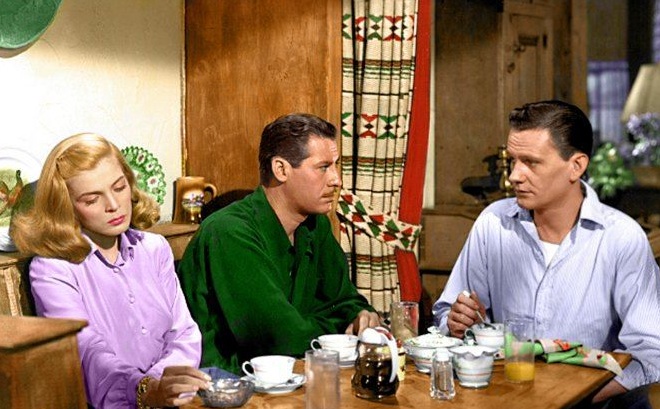
Into their lives comes runty, mustachioed gangster Eddie Bendix (John Hodiak) and his gunsel Johnny (Wendell Corey), and Paula — quite inexplicably — falls head over heels in love with Eddie.

The love triangle formed by Paula, Eddie, and Tom is weak sauce compared with the love triangle formed by Paula, Eddie, and Johnny.

Johnny is more than just Eddie’s “muscle.” He’s his longtime companion, his best friend, and — just possibly — his lover.

Is he or isn’t he? Let’s look at the evidence. Eddie and Johnny form a tight unit, and seem to both know what really happened to Eddie’s first wife, who died in a car accident. Johnny hates Paula, and seems insanely jealous of her relationship with Eddie.

And how does Eddie explain to Paula how he first hooked up with Johnny?

“I was your age, maybe a year older. I was in the automat off Times Square about two o’clock in the morning on a Saturday. I was broke, he had a couple of dollars, we got to talking. He ended up paying for my ham and eggs,” he says, a note of shameful resignation creeping into his voice.

“And then?” Paula asks.

“I went home with him that night. I was locked out. Didn’t have a place to stay. His old lady ran a boarding house in the Bronx. There were a couple of vacant rooms. We were together from then on.”

The relationship between Eddie and Johnny isn’t the only hint of a gay union. Paula and Fritzi are so close in age, and Fritzi’s attitude toward her daughter lacking so much maternal warmth, that they seem more like a lesbian couple than anything else. Fritzi seems like the older, more dominant one, and Paula seems like the younger, more restive one, who might also be interested in men. (In further defense of this reading, Lizabeth Scott and Burt Lancaster might walk off into the sunset at the end of the picture, but their lips never meet. The final — and most passionate — kiss of the film is the one Fritzi plants on Paula’s lips.)

There’s a lot of talent in front of and behind the camera, but that only counts for so much. For instance, compare Miklós Rózsa’s brilliant score for Brute Force (1947) with his score for Desert Fury. His score for Desert Fury is powerful, but without the dramatic underpinning of a great film, it just writhes and flails all over the place, seemingly in search of a better movie, or at least a more lively one.

The script by Robert Rossen (with uncredited assistance from A.I. Bezzerides), which is based on Ramona Stewart’s novel Desert Town, has a lot of snappy dialogue, but the story just doesn’t move with much intensity. Also, the Technicolor cinematography really undercuts some of the noir elements of the story and the situation.

Desert Fury is campy, and worth seeing if you’re into camp, but that’s about it. Also, if you’re a connoisseur of face-slapping, there’s plenty of that going around, too.

The Secret Life of Walter Mitty (Aug. 14, 1947)

Norman Z. McLeod’s The Secret Life of Walter Mitty is a pretty funny film, and sometimes funny is all you need.

It wasn’t all James Thurber needed at the time the film was made, however. The movie was based on Thurber’s 1939 short story of the same name, and he was extremely unhappy with all the changes made to it. He also hated Danny Kaye’s performance as Mitty, since it was nothing like how he had originally conceived of the character.

I haven’t read Thurber’s short story. If I had, this movie and the liberties it took with the source material might have irritated me.

As it was, the only thing that irritated me was the length of some of the film’s musical interludes. Danny Kaye is an engaging and likable performer, but he milks his musical stand-up comedy bits for such a long time that I had more fun watching the amused extras than I had watching Kaye.

The Secret Life of Walter Mitty is a Technicolor extravaganza that follows the misadventures of a put-upon editor named Walter Mitty (Kaye). Mitty lives with his mother (played by Fay Bainter) and commutes into New York City every morning to his job at a company that publishes pulp magazines. He also has a rich fantasy life, and imagines himself as a sea captain, a brilliant surgeon, a gunslinger in the Old West, a … well, you get the idea.

He’s engaged to a girl who doesn’t really love him named Gertrude Griswold (Ann Rutherford), his mother piles errands on him until packages are literally falling out of his arms, his boss Mr. Pierce (Thurston Hall) steals his ideas, and Mitty takes it all in stride. One day, however, the girl who prominently features in all of his daydreams (Virginia Mayo) suddenly appears in the flesh, and Mitty is drawn into a real-life adventure involving stolen jewels and a spy ring. A grim-looking assassin who masquerades as a psychiatrist named Dr. Hugo Hollingshead (played by a perfectly cast Boris Karloff) dogs Mitty’s every move, first trying to kill him, then trying to convince him that the whole affair was just another one of his daydreams.

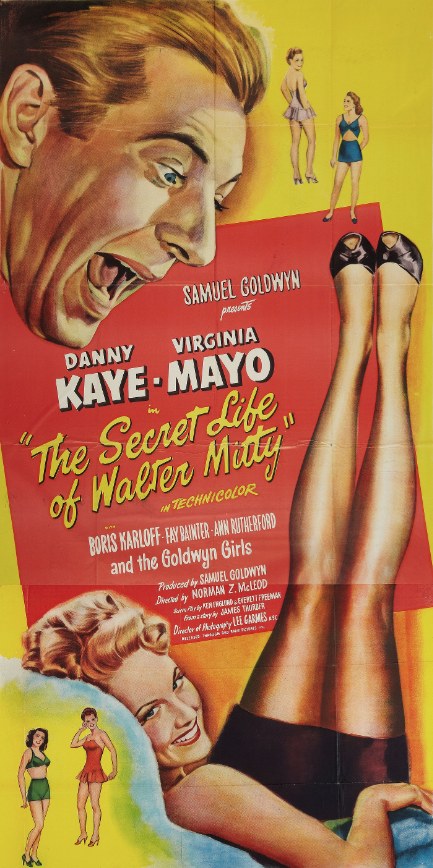
It may not be a deep film, but The Secret Life of Walter Mitty is a lot of fun. It’s a production of The Samuel Goldwyn Company, so of course the luscious Goldwyn Girls are on hand for all those department store dressing-room scenes and lingerie-modeling bits that are integral to the film’s story.

Singapore (Aug. 13, 1947)

Note to aspiring makers of B movies — if you’re going to blatantly rip off Casablanca (1942), take a page from director John Brahm’s book. Don’t just change the characters’ names and tack on a happy ending. Do it with real panache and also change the hero’s occupation to “pearl smuggler” and spice up the love triangle by giving the heroine a case of amnesia.

True to its title, Singapore is steeped in the exoticism and heat of the Pacific Rim, but like the film noir techniques Brahm uses to tell his story, it’s mostly just window dressing for a run-of-the-mill potboiler. But that’s not entirely a bad thing. Brahm keeps things moving along nicely, and Singapore is a lot of fun if you’re in the mood for a melodrama and you can overlook some contrivances.

When Matt Gordon (MacMurray) returns to Singapore after World War II, it’s clear as soon as he steps off the plane that he has a history there. Deputy Commissioner Hewitt (Richard Haydn) has Gordon brought to his office, and he reminds him that the penalty for removing illegally obtained pearls from a British colony is a minimum of 10 years in prison.

“Before the war it was only eight,” Gordon quips. “But I guess everything’s gone up, huh?”

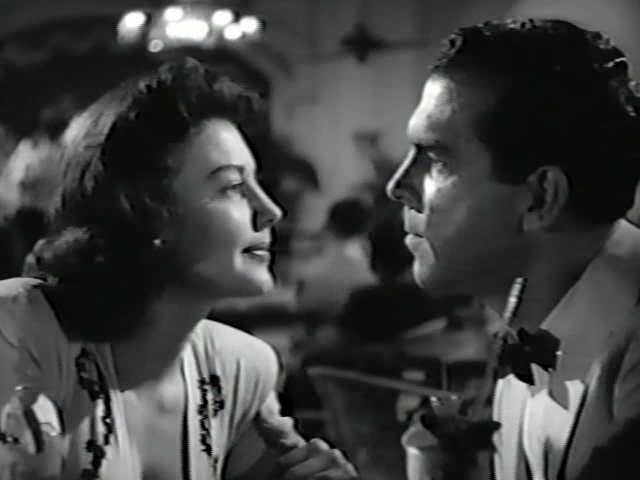
Gordon sits down in the hotel bar, orders two gin slings, and sits alone, reminiscing about life in Singapore before the war. He fell in love with a beautiful young woman named Linda Grahame (Ava Gardner), but their whirlwind romance was cut short by the beginning of hostilities with the Japanese.

They were engaged to be married, but before they could tie the knot she was killed in a bombing raid, and Allied forces had occupied his hotel room, where his $250,000 worth of pearls were secreted in the motor of the ceiling fan in his room.

He made it out of Singapore with his life, but that’s all, and now that the war is over he’s intent on retrieving his pearls. (It’s established that Gordon has a service record, and saw combat during the war, perhaps to engender audience sympathy.)

Of course, Linda didn’t really die in a bombing raid. She was injured and stricken with total amnesia. Unable to remember any details of her former life, she was interned in a Japanese concentration camp, where she met Michael Van Leyden (Roland Culver), a British plantation owner who saved her life many times during the war. Now they are married, and her name is Ann Van Leyden. No matter how many times Gordon calls her “Linda,” she just can’t remember their time together, or the love they shared.

So Gordon has two problems — winning back Linda/Ann, and somehow getting his pearls out of the ceiling fan of a hotel room that is now occupied by an obnoxious married couple. The problem of the pearls is compounded not only by the watchful eye of Deputy Commissioner Hewitt, but also by the corpulent gangster Mr. Mauribus (Thomas Gomez), who wants the pearls for himself.

There are a lot of ceiling fans in Singapore, and none of them move quickly. It’s all part of the languorous, overheated atmosphere of the film, but like I said above, it’s all just window dressing. The Asian extras in the background and the crowded streets of the port city add ambiance, but not much else. The action could be moved to any other “exotic” locale, and few details of the plot would have to be changed. (And that’s exactly what happened in 1957 when director Joseph Pevney remade Singapore as a vehicle for Errol Flynn called Istanbul.)

I liked Singapore despite its flaws, and it’s always enjoyable to watch the beautiful Ava Gardner do anything. I didn’t completely buy her relationship with the hulking, thuggish Fred MacMurray — I’ve always thought MacMurray was better in comedic roles than dramatic ones — but it works well enough to keep the film moving.

Under the Tonto Rim (Aug. 1, 1947)

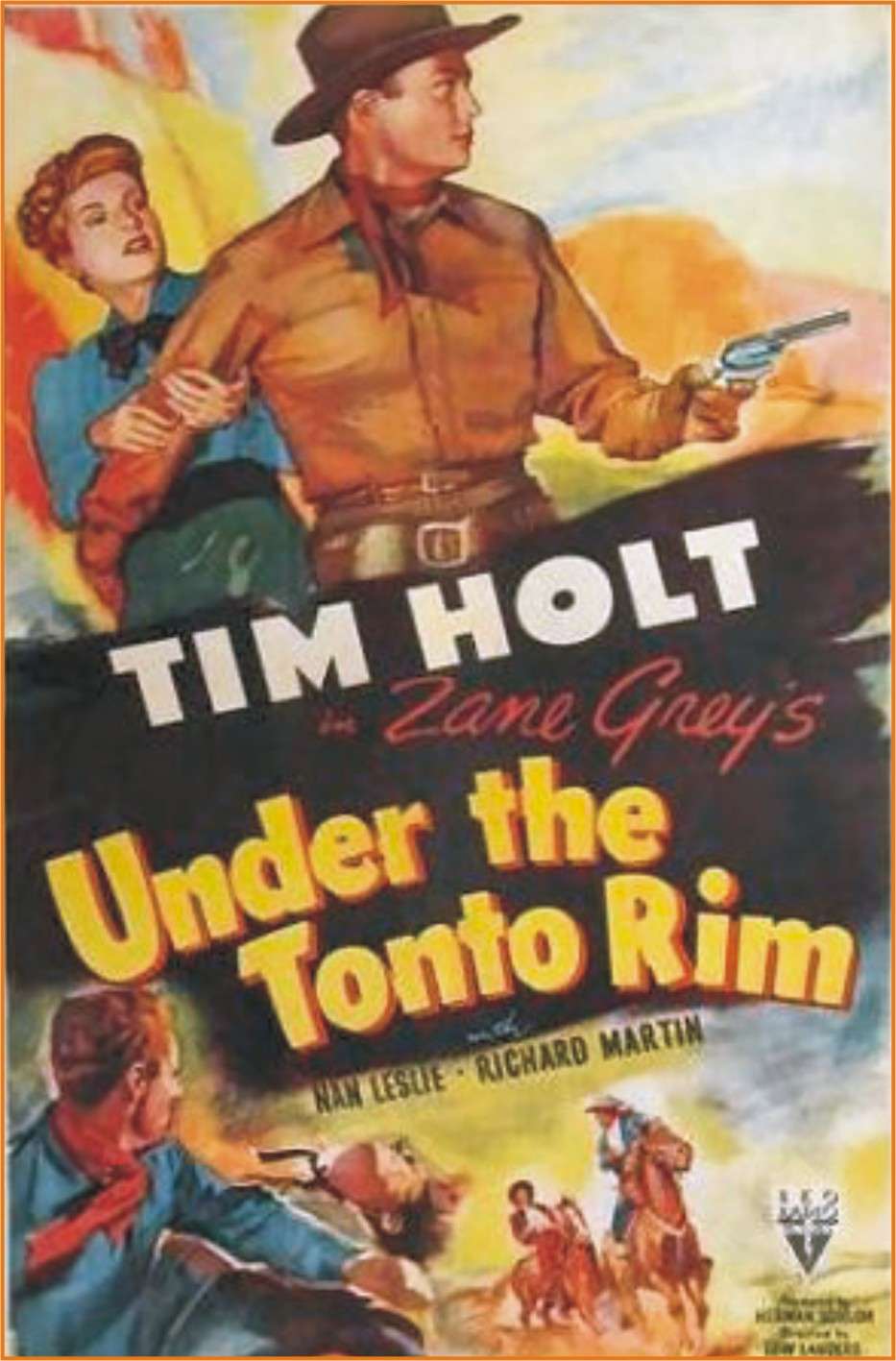
Tim Holt’s second postwar western, Under the Tonto Rim, is a lot like his first postwar western, Thunder Mountain (1947). Both are RKO films produced by Herman Schlom and directed by Lew Landers, with screenplays by Norman Houston that are based on Zane Grey novels.

And even though Tim Holt plays a different character in Under the Tonto Rim than he did in Thunder Mountain, Richard Martin is back as his Irish-Mexican sidekick, Chito Jose Gonzalez Bustamonte Rafferty, the same character he played in Thunder Mountain. Chito is tall and handsome, and has a way with the ladies, but he’s also a barrel of laughs, and has a way with malapropisms like “He swallowed it hook, line, and stinker.”

In Under the Tonto Rim, Tim Holt plays Brad Canfield, the new owner of the Rim Rock Stage Line. In the first reel of the film, one of his stagecoaches is held up by masked bandits who carry off the Wells Fargo box, kidnap Lucy Dennison (Nan Leslie) — a beautiful blonde with a mysterious past — and kill his friend Andy (Jay Norris), a young stage driver who was about to be married.

No one ever said running a stage line in a B western was easy.

Chito and Brad ride into Wicksburg and describe their attackers to Captain McLean of the Arizona Rangers. All the raiders wore black masks, except for the leader, who wore a gray, spotted bandanna

“A gray, spotted bandanna!” exclaims Capt. McLean (Jason Robards). “Sounds like the Tonto Rim Gang!”

Capt. McLean tells Brad and Chito that the Tonto Rim Gang’s hideout is somewhere under the Tonto Rim.

Before you jump to the conclusion that the Tonto Rim Gang are a bunch of clowns, naming themselves after their hideout isn’t quite like a group of criminals on the lam calling themselves “The 285 West Sycamore Street Safe House Gang,” since there are more than a hundred canyons under the Tonto Rim, and the gang could be in any one of them.

Brad and Chito decide to take matters into their own hands. Brad arranges to get himself thrown in jail in Tonto, where one of the captured raiders, Patton (Tony Barrett), is locked up and scheduled to hang. Brad thinks that if he can pass himself off as a criminal with $10,000 buried somewhere, he can escape with Patton, and Patton will lead him to the Tonto Rim Gang. But as they ride into Tonto, Chito expresses his doubts about the plan in his own inimitable way.

Chito: “You know what the word ‘Tonto’ means in Spanish?”
Brad: “No.”
Chito: “It means ‘fool.’ And I bet you that’s what we are.”
Brad: “Ah, keep your shirt on.”
Chito: “I always keep that on. Except on Saturday nights, when I take it back.”
Brad: “Well, this is only Thursday, and I don’t want to attract too much attention yet.”

When they arrive in Tonto, Chito passes himself off as “Ranger Rafferty” to Deputy Joe (Lex Barker), then bends the ear of the sheriff (Harry Harvey) with tales of Brad Canfield the outlaw, and tells him he needs to be taken alive.

Brad’s plan works out, and he and Patton escape together. But Brad’s quickly back in hot water when he finds that Lucy Dennison is part of the gang.

Or is she? And what part will the sultry Juanita (Carol Forman) play?

Under the Tonto Rim is good fun. Before this year, I’d only ever seen Tim Holt as a supporting player in A pictures like My Darling Clementine (1946) and The Treasure of the Sierra Madre (1948). He never made a huge impression on me, and after watching a couple of his starring roles in B westerns, I think I know why. He’s a soft-spoken, unassuming guy with average looks. But he projects a lot of steel when he’s the focus of the film, and gives the impression that he won’t stop fighting until the fight is through.

Deep Valley (July 30, 1947)

Every student of film noir knows that the genre owes its style to German Expressionism, and to the influx of European directors to the U.S. during World War II.

Jean Negulesco’s Deep Valley doesn’t really qualify as a film noir, although it has some hallmarks of the noir style. Instead, it seems as if Negulesco is drawing from an earlier German artistic movement — Sturm und Drang.

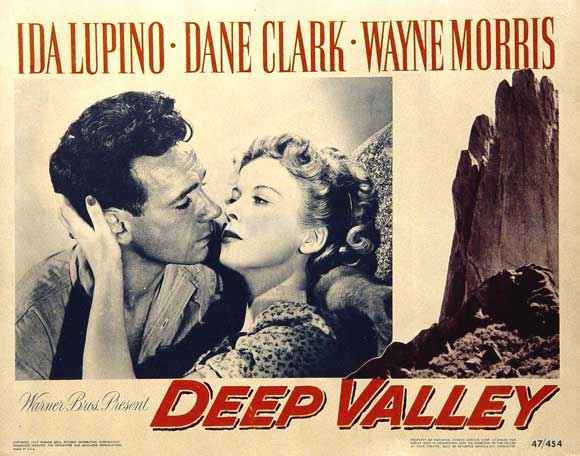
The high emotions of the film are expressed physically — often through the turbulence of the natural world. Ida Lupino plays a simple country girl named Libby Saul who lives in a broken-down old farmhouse deep in the California wilderness with her parents, Cliff Saul (Henry Hull) and Ellie Saul (Fay Bainter). One night, long ago, Libby’s father beat her mother, and her mother has never forgiven him or spoken to him again. Libby speaks with a stutter, and it is implied that it is directly related to the traumatic memory of seeing her father hit her mother.

The rift between Libby’s parents is absolute. Mrs. Saul never leaves her upstairs bedroom, and relies on Libby to wait on her. Mr. Saul never goes upstairs, and roams the ramshackle property in a perpetual foul mood.

Libby has no friends, and is isolated from the world. Her father is cruel to her and her mother, who is an invalid by choice, lives in a fantasy world and has never let go of the idea that she is an aristocratic lady. Libby’s only solace is her dog, Joe, and the woods that surround the Sauls’ property. Her only happy moments are when she is roaming the forest with Joe and communicating with nature and wild animals.

One day, she discovers a crew of prisoners working on a chain gang along the ocean, excavating and dynamiting the coastline in preparation for a highway. This destruction and remaking of the natural world will bring a steady flow of people past the Sauls’ farm, and radically change Libby’s life.

But her life is changed almost immediately when she spots a dark, handsome convict named Barry Burnette (Dane Clark) working on the line.

Naturally, fate contrives to bring them together.

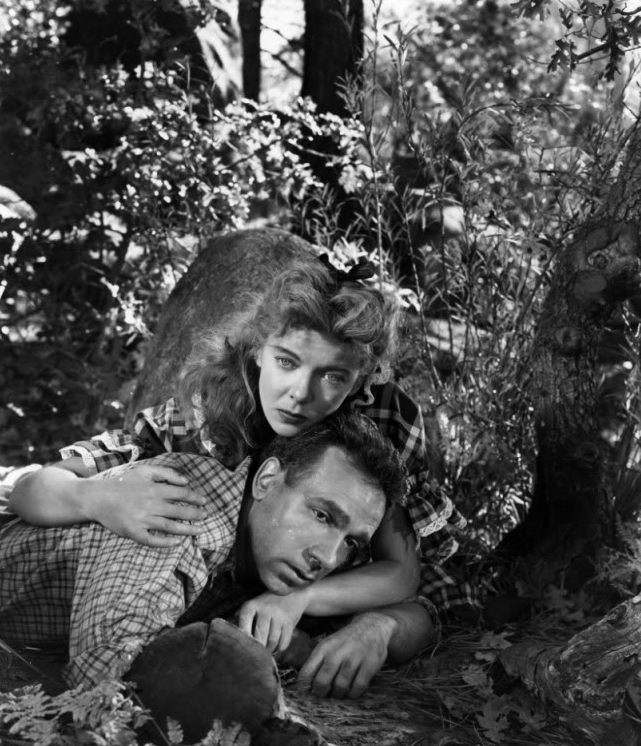
During a dark and stormy night, a landslide destroys the toolshed in which Barry and a couple of other prisoners are locked up. Libby finds Barry in the woods and helps him stay hidden from the posses that are searching for him, as well as from the good-natured but black-hearted Sheriff Akers (Willard Robertson) and the blandly handsome engineer running the highway project, Jeff Barker (Wayne Morris), who has an eye for Libby.

Libby and Barry’s romance begins in an idyllic fashion, but the weight of doom slowly crushes it. It’s not just because he’s an escaped convict. He’s also a violent hothead — never towards Libby or someone who hasn’t provoked him, but when faced with a problem, his first instinct is to lash out and break through, with no thought of what he’ll do next.

But Barry is always a likable character. Dane Clark’s performance is soulful and tortured, and his big eyes and open countenance make him sympathetic, even when he’s crouching in the second floor of a barn with a scythe, ready to kill whoever comes up the ladder.

We root for Barry and Libby, even though we know their love is impossible. As the film progresses, the shots become increasingly full of shadows and menace, and Barry and Libby are forced into smaller and smaller spaces, symbolizing the world closing in on them.

Deep Valley is based on a novel by Dan Totheroh. The screenplay is by Salka Viertel and Stephen Morehouse Avery, with uncredited assistance from William Faulkner.

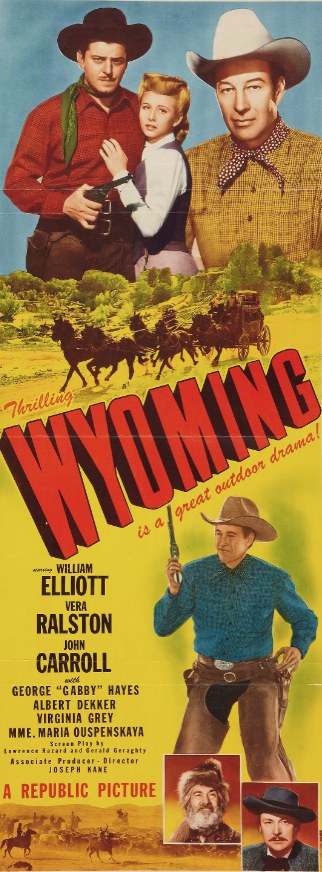
Wyoming (July 28, 1947)

The last time I saw cowboy star Bill Elliott was in the Red Ryder movie Conquest of Cheyenne (1946), in which he was credited as “Wild” Bill Elliott.

I missed the next picture he made, Plainsman and the Lady (1946), but in both that film and this one, he’s listed in the credits with the more mature moniker “William Elliott.”

Like Elliott’s name change, Wyoming reflects a B-grade product’s aspirations to A-level status.

It’s about halfway successful.

Director Joseph Kane knows how to shoot a western, and Wyoming looks great. It’s full of snowstorms, big cattle drives, and beautiful wide open spaces. Legendary stuntman Yakima Canutt is credited as the second unit director, and the fistfights, shootouts, and horse action are all well-done. (One fight in particular is more brutal than I ever expected from a Republic western.)

But the script by prolific screenwriters Lawrence Hazard and Gerald Geraghty never rises to A quality. It’s full of big ideas and grand themes, but the treatment of those themes is muddled, and the dialogue is hackneyed.

In Wyoming, Elliott plays Charles Alderson, an intrepid pioneer who settles in the territory of Wyoming with his pregnant wife. When she dies in childbirth, Alderson sends his daughter to Europe for an education. While she is away, he builds up an enormous cattle herd, and becomes rich. He does so with the help of his friend Thomas Jefferson “Windy” Gibson (George “Gabby” Hayes), a grizzled old mountain man who says that while he may not look it, he was originally a lawyer from Vermont. But he got too involved with another “bar.” Get it?

Alderson’s daughter Karen returns to Wyoming in 1890, soon after it has been admitted to the union. (Karen is played by Vera Ralston, who also played her own mother in the opening portion of the film.) Alderson is now a cattle baron, but all is not well. Much of his range is now open to homesteaders, who are led by John “Duke” Lassiter (Albert Dekker). Lassiter is a shady character who is involved in rustling cattle, and who is exploiting the homesteaders for his own purposes.

Alderson’s foreman, Glenn Forrester (John Carroll), cautions Alderson that resorting to violence will only make things worse, but Alderson is a prideful, tyrannical man who shoots first and thinks later.

If all of this sounds a lot like Howard Hawks’s Red River (which was filmed in 1946 but wasn’t released until 1948), that’s because it is. But Wyoming never achieves the same impact as Red River.

The biggest problem with Wyoming is Elliott himself. The character he plays, Charles Alderson, is a complicated man who is nearly undone by his own ambition and propensity for violence, but Elliott is not a nuanced actor. I loved him in the Red Ryder westerns because he was so wooden that it added to the comic-book stalwartness of the character, but in Wyoming he seems to be overreaching, and it’s a little like watching Leslie Nielsen play Othello.

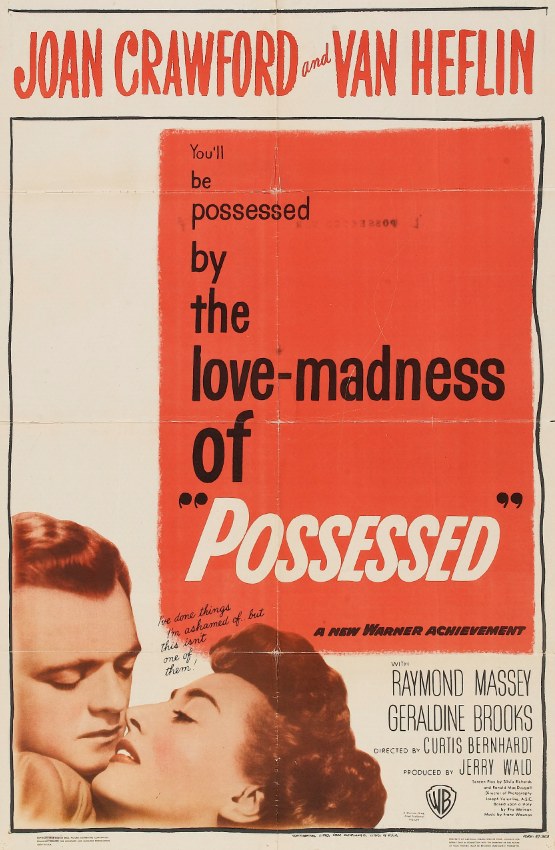
Possessed (July 26, 1947)

If you like to see Joan Crawford get her crazy on as much as I do, then you’ll love Possessed.

Curtis Bernhardt’s fevered noir melodrama begins with a surprisingly unglamorous-looking Crawford wandering the streets of Los Angeles in a daze, asking everyone she passes if they’ve seen “David.”

Crawford isn’t wearing any makeup, and her journey through the early dawn streets reminded me of a similar scene that appeared a decade later in Louis Malle’s Ascenseur pour l’échafaud (Elevator to the Gallows) (1958), in which Jeanne Moreau wanders the streets of Paris without makeup. (Was Malle influenced by Possessed? It’s certainly possible.)

The character Crawford plays, Louise Howell, is taken by ambulance to the psychopathic ward of the Los Angeles Municipal Hospital, where she is cared for by Dr. Willard (Stanley Ridges). He gives her narcosynthesis to lift her out of her catatonic stupor, and the tale of what brought Louise to this place is told through a haze of flashbacks and psychobabble.

Louise was a nurse in the employ of wealthy Dean Graham (Raymond Massey). Her job was to care for Graham’s infirm wife.

After a brief love affair with an average-looking but very charming architect named David Sutton (Van Heflin), Louise became hopelessly attached to him. When David told her that he wasn’t the marrying kind, and that he had to break things off with her, it began her spiral into madness. She was convinced that there was another woman, but he assured her there wasn’t.

“Louise, don’t hang onto me. You’ll get hurt,” he said in exasperation, and his words were prescient. The straitlaced, self-possessed Louise began to unravel.

Dr. Willard diagnoses her with a persecution complex. She thought that David breaking up with her was all part of a plan. Everyone was against her. Dr. Willard calls it “typical schizoid detachment … split personality.”

Despite its sometimes overheated story and dialogue, Possessed is a stylistic feast. Franz Waxman’s musical score perfectly underscores every one of Joan Crawford’s scenes, and Joseph A. Valentine’s cinematography visually expresses her madness.

There are recurring visual motifs, most notably water. For instance, when David gets into his boat and leaves Louise sobbing on the dock, the churning water symbolizes her inner turmoil. The doctors hovering over Louise’s bed discuss her case, then the scene cuts to a shot of the carafe of water by her hospital bed that dissolves into a shot of the water around Dean Graham’s home.

When Louise stops the little pendulum of her bedside clock from ticking because it’s “driving her crazy” the sound is replaced by the sound of dripping water outside her open window. She slams the window shut, trying to control her madness.

Possessed could never be called a realistic film. But that’s not its goal. It subjectively depicts an unraveling psyche, and isn’t afraid to veer into territory that sometimes seems as if it would be more at home in a horror movie than in a melodrama.

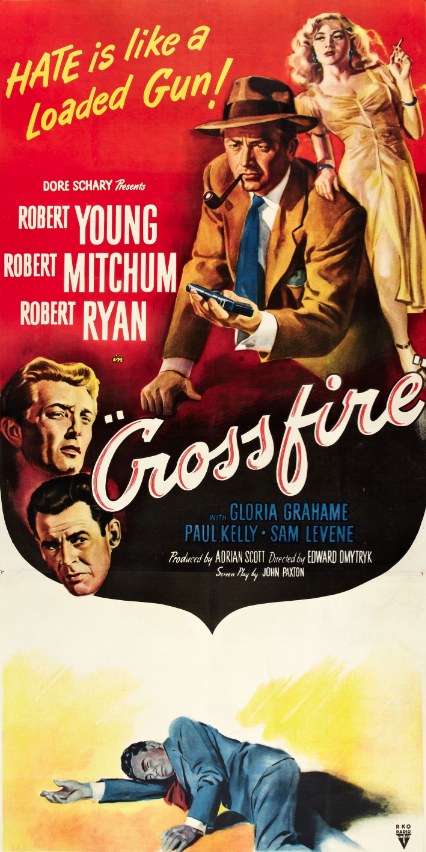
Crossfire (July 22, 1947)

Crossfire
Crossfire (1947)
Directed by Edward Dmytryk
RKO Radio Pictures

In 1947, social-issue pictures were starting to come out of Hollywood that tackled a formerly taboo subject — antisemitism.

This might not seem like such a big deal today, but it was a big deal at the time.

No matter how artful or moving some of its products are, the film industry is still a business, and any subject that challenges the status quo or that might hurt ticket sales is extremely difficult to make a film about. And despite the fact that in the ’40s the majority of studio heads were Jewish, they preferred to release films that depicted a homogenous, idealized vision of America.

Richard Brook’s 1945 novel The Brick Foxhole is about a homosexual who is beaten to death by his fellow Marines. Producer Adrian Scott convinced the studio bosses at RKO Radio Pictures that an adaptation of the book would pass muster with the production code if the gay character in the novel were changed to a Jewish character.

Crossfire is a social-issue picture wrapped in a murder mystery. It’s likely that many ticket buyers didn’t realize the film would contain a message about antisemitism, and were attracted by the “three Bobs” in the credits (Robert Ryan, Robert Young, and Robert Mitchum) or the lurid promise of violent death in the poster.

Whatever drew people into the theater when the film opened, however, nothing kept them away in the weeks that followed. Crossfire was a big hit, and was eventually nominated for five Academy Awards, although it lost out to Elia Kazan’s Gentleman’s Agreement, Twentieth Century-Fox’s more “prestigious” take on antisemitism. (In the case of best picture, best director, and best supporting actress, the awards went to Gentleman’s Agreement. In the case of best supporting actor and best adapted screenplay, the awards went to Miracle on 34th Street.)

Edward Dmytryk, the director of Crossfire, once said in an interview that he used “film noir” techniques primarily to save money, and because he wanted to spend more time working with the actors than doing setups. Dmytryk and his cinematographer, J. Roy Hunt, worked six and a half hours a day, and did about seven setups a day.

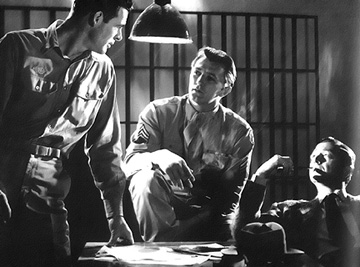
Ryan, Mitchum, and Young

Dmytryk was an excellent director, and Crossfire is an exceedingly well-made film.

He shot Crossfire in 20 days, less than the 22 days he was allowed with his $500,000 B-movie budget. Because of this, RKO was able to beat Twentieth Century-Fox’s Gentleman’s Agreement to the box office. (But not, ultimately, in the Oscar race.)

The darkness and shadows that creep into each shot disguise the simplicity of the sets, and the performances from all the actors are exceptional, especially Robert Ryan as the vicious, Jew-hating soldier named Montgomery, and Gloria Grahame as a lonely B-girl named Ginny.

The beating death of the Jewish man, Samuels (Sam Levene), that opens the film takes place in darkness, so the culprit is not seen. But the mystery doesn’t really persist. Montgomery is the likely suspect right from the beginning. His sneering dismissal of the “kind of guy” Samuels was makes his guilt seem pretty obvious during the scene in which he’s interrogated by the police detective, Finlay (Robert Montgomery).

The film quickly switches gears, however, and focuses on the search for a missing soldier named Mitchell (George Cooper), whom the police suspect of the murder. The jaded and world-weary Sgt. Keeley (Robert Mitchum) helps Detective Finlay, but ultimately shields Mitchell, helping him hide in a movie theater while Keeley and his buddies try to sort out what really happened.

Mitchell was pretty drunk, and can barely remember what happened at the party that evening. But the last words we hear Montgomery say in Mitchell’s flashback to the party — “What’s the matter, Jew boy? You afraid we’ll drink up all your stinking wonderful liquor?” — cement Montgomery’s guilt.

Grahame and Cooper

Mitchell’s sad and lonely journey through the night is classic noir stuff. His strange encounters — like the ones he has with B-girl Ginny and later with her “husband” (played by Paul Kelly), whose name we never learn — are haunting.

While Crossfire is occasionally preachy, this can be forgiven, especially considering the time when the film was released.

Unlike Brute Force (1947), which showed what American fascism could look like at the upper echelons of authority, Crossfire is a portrait of the rank and file of fascism — the dumb, mean, resentful men who “just carry out orders,” and do so happily. Ryan doesn’t overplay his role, and he’s all the more scary for it.