Tag Archives: Comedy

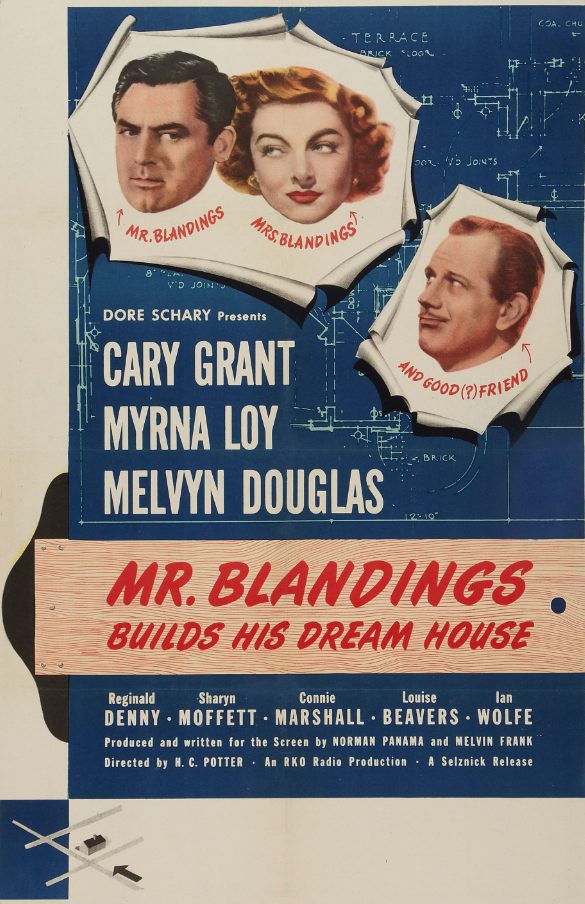
Mr. Blandings Builds His Dream House (June 4, 1948)

I don’t know about you, but comedies like H.C. Potter’s Mr. Blandings Builds His Dream House really stress me out.

When the subject of “things I could never laugh at” comes up, most people think of things like the death of a beloved family pet or ethnic cleansing, but while I don’t find either of those subjects fertile ground for comedy, one subject stands above all others as something I can never laugh at — chasing good money after bad.

I don’t know if Mr. Blandings Builds His Dream House is the first comedy in which most of the “comedy” involves someone making terrible decision after terrible decision and throwing vast sums of money into a disastrous project, but it’s one of the best-known and most well-loved.

The first movie like this I saw was the 1986 Tom Hanks “comedy” The Money Pit, which even as a kid I found stressful and unfunny.

The second was the Joe McDoakes “comedy” short So You Want to Move (1950), in which every bad decision the main character makes and every accident he has is flashed on screen in dollar amounts. As the one-reeler continues, and he drops things and crashes into things, his financial responsibility grows and grows. As an argument for using professional movers, So You Want to Move is a persuasive infomercial, but as a comedy it’s totally devoid of laughs. At least for me.

At least Mr. Blandings Builds His Dream House is enjoyable in the early going, and stars Cary Grant and Myrna Loy, who previously starred together in Wings in the Dark (1935) and The Bachelor and the Bobby-Soxer (1947), and who are both attractive, charming, and a lot of fun to watch.
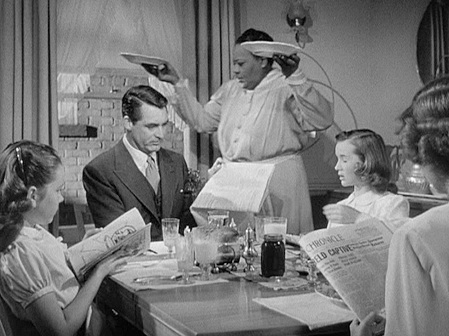
Grant plays Jim Blandings, a college graduate who lives in Manhattan, works in advertising, and makes about $15,000 a year. We learn all this from the film’s omniscient narrator, who also calls Mr. Blandings a “modern-day cliff dweller,” since he lives in a high-rise apartment building with his beautiful wife Muriel (Myrna Loy), their two daughters, and their housekeeper Gussie (Louise Beavers).

Here’s a case where inflation doesn’t tell you everything, since $15,000 is roughly $145,000 in 2012 dollars, but I don’t think even that salary today would be nearly enough to support a wife who doesn’t work, two kids in private school, and a Manhattan apartment big enough to fit a family and a live-in servant.

Granted, the Blandings live in cramped quarters. Everything in their apartment is full to bursting and ready to explode like Fibber McGee’s hall closet, and as the narrator tells us, “just getting shaved in the morning entitles a man to the Purple Heart.” But that’s just Manhattan living, folks. Even for the relatively well-to-do.

One day Mr. Blandings is enticed by a brochure from a Connecticut real estate firm that encourages him to “trade city soot for sylvan charm.”

I can’t even talk about what happens next. It’s just too painful.

I will say this, however. Mr. Blandings Builds His Dream House was funny enough to entertain even someone like me, and Mr. Blandings is presented as just enough of a screwball idiot to make his terrible decisions a little easier to laugh at. For instance, when his lawyer Bill Cole (Melvyn Douglas) asks what his engineer said about the foundation of the house he just purchased, Mr. Blandings responds, “Who needs engineers? This isn’t a train, you know.”
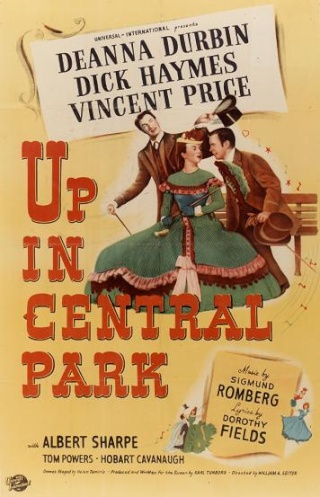
Up in Central Park (May 26, 1948)

If you’re a regular reader of this blog, you know that I have a special place in my heart for Deanna Durbin.

I think Durbin is one of the most charming, talented, and attractive performers to ever appear on screen. If some of the material she appeared in was beneath her, it’s hard to tell, since she brought the same vivacity, humor, and clear-as-a-bell singing voice to every one of her roles.

Durbin — a.k.a. “Winnipeg’s Sweetheart” — went from nearly single-handedly saving Universal Pictures from bankruptcy at the age of 14 with her first feature, Three Smart Girls (1936), to permanently retiring from acting in 1948 after appearing in her last film, For the Love of Mary.

Up in Central Park was Durbin’s penultimate picture. She was nearly 27 years old, and was tired of working within a stultifying studio system and playing the same type of character she’d been playing since she was 14. After appearing in For the Love of Mary, Durbin married producer Charles David and settled in a small village in rural France. She never appeared in another film.

Up in Central Park was based on the successful Broadway musical of the same name that opened in 1945. It takes place in 19th-century New York and stars another of my all-time favorite actors — Vincent Price — as the notoriously corrupt Boss Tweed.

Wide-eyed Irish immigrant Rosie Moore (Durbin) and her father, Timothy Moore (Albert Sharpe), come to New York with dreams of a better life and are quickly ensnared by the agents of Boss Tweed, who set up Mr. Moore with a plum position as Central Park zookeeper, as well as a little house in the park to call their own.

When things seem too good to be true, they usually are. But Rosie loves her new life, so when a crusading reporter for The New York Times named John Matthews (played by crooner Dick Haymes) tries to convince her that Boss Tweed and his Tammany Hall cronies are no good, she refuses to believe him.

Up in Central Park is an entertaining little musical, but my favorite thing about it was watching the louche Price woo the naive Durbin, as well as chew the scenery on his own. For instance, when Tweed gives his puppet mayor Oakley (Hobart Cavanaugh) his cigar to dispose of and Oakley can’t find a spittoon, Tweed says — in a withering, condescending tone — “We use ashtrays here, Mayor. This isn’t the city hall.”

On an Island With You (May 3, 1948)

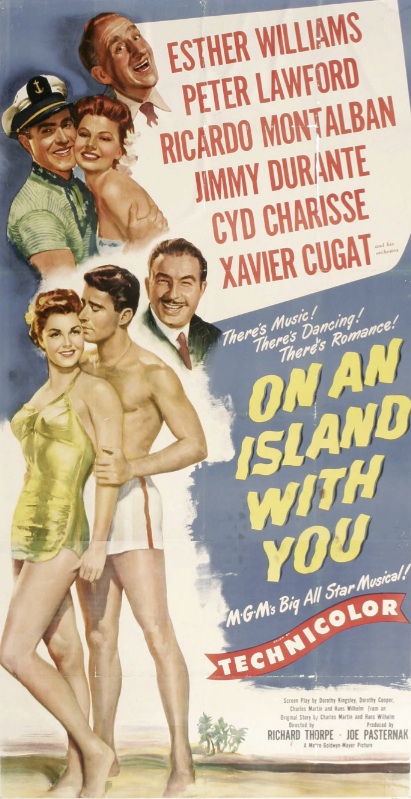
On an Island With You was director Richard Thorpe’s fourth film to star the shimmering sea creature Esther Williams.

I didn’t get a chance to see the last film they made together, This Time for Keeps (1947), but I enjoyed On an Island With You a lot more than their second collaboration, the disappointing bullfighting drama Fiesta (1947), mostly because On an Island With You allows Williams to do what she did best — look stunning in and out of the water, and perform some spectacular water ballet numbers. (I’ve also never seen Thorpe’s first film starring Williams, Thrill of a Romance (1945) … what kind of an Esther Williams fan am I?!?)

In On an Island With You, she’s again paired with Mexican heartthrob Ricardo Montalban — her co-star in Fiesta (1947) — and also with Peter Lawford, who comes off as a real drip compared to the dashing Montalban.

This is too bad, since the audience is supposed to be rooting for Lt. Lawrence Y. Kingslee (Lawford), who fell in love with movie star Rosalind Rennolds (Williams) when he was serving in the South Pacific in World War II. Rosalind was doing a USO tour to raise the boys’ morale, and doesn’t even remember meeting Lt. Kingslee. She had too many brief romantic dalliances during the war to remember one more than any of the others, but for him it was the single most important event of his life.

As is all too common in movies from the ’40s, his romantic brio is so excessive it borders on stalking. During a break in the filming of Rosalind’s latest picture, Lt. Kingslee flies her away to the island where they met against her will. The rub is that real islands aren’t like islands in the movies. There are leeches and sinkholes, and when they’re away from the plane the natives steal the wheels. On the plus side, he remembers where he buried all the cans of Spam around the old Quonset hut where he used to bunk.

There’s a metafictional element to On an Island With You, since the film Rosalind is making with her fiancé, Ricardo Montez (played by Ricardo Montalban), is also called “On an Island With You,” and in all the spectacular dance numbers there are at least a few shots of the cameramen filming the action to remind you that they’re making a movie.

While I thought Lawford was miscast, there’s plenty of entertainment to be had in On an Island With You. Besides Williams’s luminescent screen presence and big water ballet numbers, Ricardo Montalban has some wonderful dances with Cyd Charisse — all high points of the film — and Xavier Cugat and his Orchestra are on hand for some good musical numbers. I especially liked Cugat’s tiny chihuahua.

Jimmy Durante has a big role in On an Island With You, too. He might even have more screen time than Lawford. I like Durante, but he’s not exactly the first person I want to see when I sit down to watch a Technicolor musical that takes place in the South Pacific.

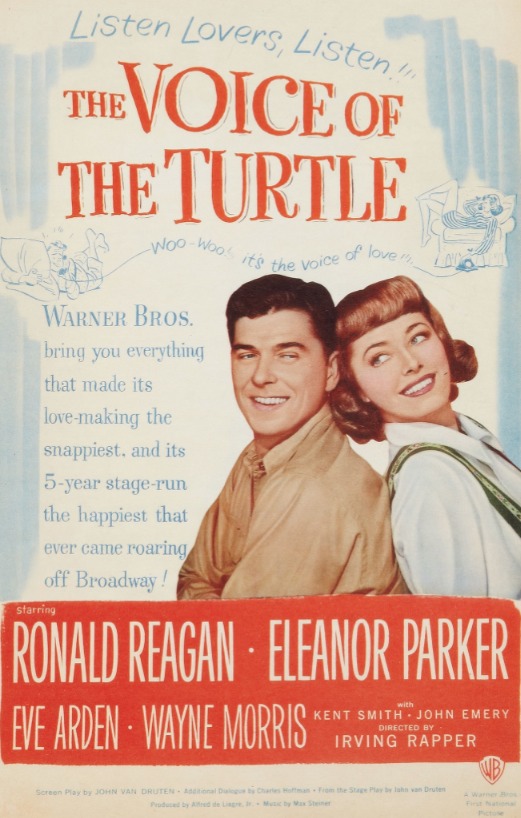
The Voice of the Turtle (Dec. 25, 1947)

The first thing you should know before you watch Irving Rapper’s The Voice of the Turtle (or One for the Book, its title when it’s shown on TV) is that in 1947, the phrase “make love to” didn’t mean “have sexual intercourse with,” which is more or less what it means today. In the ’40s it was a nebulous expression that could mean anything from “pitching woo” to “heavy petting,” but didn’t explicitly refer to P to V contact.

So when pretty young struggling actress Sally Middleton (Eleanor Parker) says, “I was raised to think no nice girl let a man make love to her unless … unless it was serious — I mean, sort of marriage — otherwise you’d be cheapening yourself,” she’s not talking about making the beast with two backs.

Or is she?

It’s hard to say, because Rapper’s film is a sanitized version of one of the longest running plays in Broadway history. The Voice of the Turtle opened in 1943 and was nearly at the end of its run when the film version came out. John Van Druten’s play was a funny and frank look at the sexual lives of young New Yorkers during World War II. Clearly the story of a nice young man and a nice young woman who decided to go to bed together couldn’t be made into a Hollywood film without some alterations. Or, as the review of the film in the December 15, 1947, issue of Time put it, “The movie is most coyly prurient where the play was most pleasantly candid.”

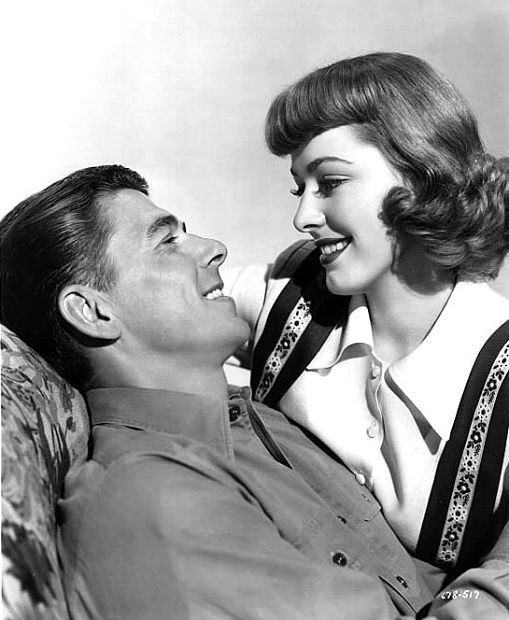
Van Druten adapted his play for the screen, and even though it contains the obligatory concessions to the Hays Code, I found it enjoyable, funny, and charming. As someone who grew up with President Reagan, it’s always a little weird seeing him as a younger man, since there are so many things about his physical appearance and line delivery that literally never changed over the course of four decades.

Even though he was 36 when he appeared in The Voice of the Turtle, Reagan still had the slightly high voice, nervous smile, and “aw shucks” attitude that exemplified youthful masculinity in the ’40s.

Other than that and a few missing wrinkles, however, I felt as if he could have been telling Mr. Gorbachev to “tear down that wall” or explaining the Strategic Defense Initiative to his fellow Americans.

But I digress. In any case, I liked Reagan as the good-natured Sgt. Bill Page, who’s pushed aside at the last moment by the worldly Olive Lashbrooke (Eve Arden) for the lunkheaded Commander Ned Burling (Wayne Morris). Bill ends up staying at Sally’s apartment over the long Christmas weekend after he can’t find a hotel in Manhattan. (Eve Arden played the heroine’s best gal pal in more movies than Randolph Scott played cowboys or Keye Luke played Chinamen, but here she gets to play a role with a little bite. She’s not a total jerk, but she clearly cares more about herself than she does about her friend.)

Despite a few inserted scenes that are meant to imply that Bill and Sally don’t really engage in any heavy hanky-panky (those scenes can easily be ignored, if you so wish), I thought The Voice of the Turtle was a funny and enjoyable look at two likable young people who fall in love with each other despite each having a broken heart and a reluctance to mend it.

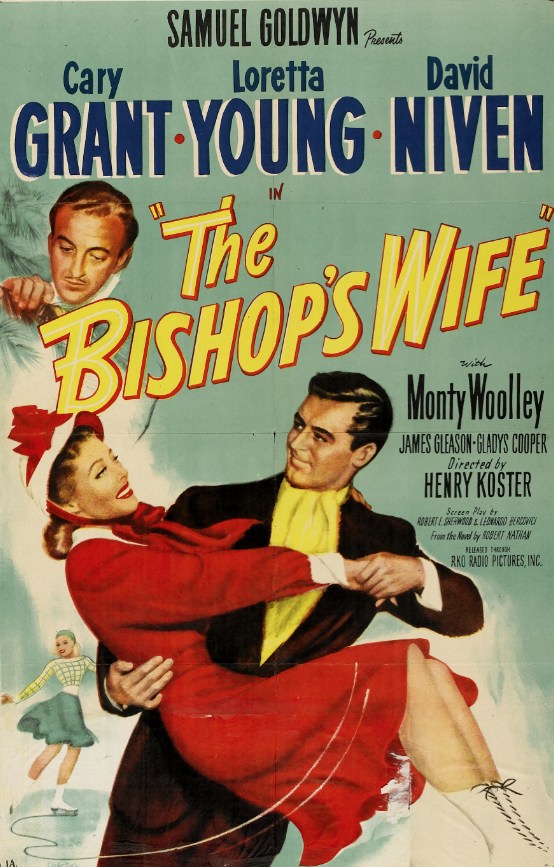
The Bishop’s Wife (Dec. 9, 1947)

Some people will tell you that movies made by committee are what’s wrong with Hollywood.

They’re wrong. Movies made by committee have always been around, and like everything else made by committee, they occasionally turn out just fine.

Henry Koster’s The Bishop’s Wife, for instance, is a sweet little Christmas confection. It won’t fill you up, and it will possibly leave you wanting more, but for what it is, it’s delicious.

The original director was William A. Seiter, but producer Samuel Goldwyn didn’t care for what he came up with, so he replaced him with Henry Koster. (Koster’s version had its own problems, so Billy Wilder and Charles Brackett made some uncredited revisions to the script.)

The biggest change from Seiter’s version was that David Niven and Cary Grant switched roles, but there were several other changes. For one, Teresa Wright — who originally played the bishop’s wife — was replaced by Loretta Young.

But Niven and Grant’s role-switching is the big change that everyone talks about, and with good reason.

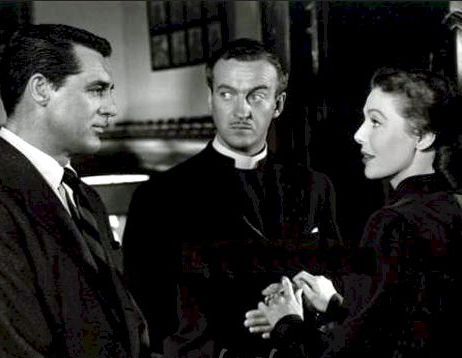
The priggish but always likable Niven is perfect as Henry Brougham, the Episcopal bishop whose cathedral-building project is destroying his personal life, and Grant is perfect as Dudley, the angel who’s sent to put Henry back on the right track.

It’s as difficult for me to imagine anyone but the ageless and effortlessly charming Grant as Dudley as it is for me to imagine anyone but Edmund Gwenn as Kris Kringle in Miracle on 34th Street.

Dudley shows up on earth in answer to Henry’s prayer for guidance, but he’s not an unearthly angel who waves a magic wand that sets everything right. While he can move objects with his mind, stop busy traffic on Madison Avenue while helping a blind man cross the street, and presumably do pretty much anything he wants, he mostly just puts ideas in people’s minds … good ideas that they end up thinking are their own.

Dudley is also not an ethereal, androgynous angel whose feet never touch the ground. He’s Cary Freakin’ Grant, and his good lucks and charm have quite an effect on Henry’s neglected wife Julia (Loretta Young). One afternoon — after Henry’s forced to cancel yet another date with his wife due to his work on the cathedral — Dudley takes her to lunch at Michel’s, the French restaurant where Henry proposed to her.

After Dudley orders, Julia tells him, “You speak French beautifully.”

“I’ve had quite a bit of work to do in Paris,” Dudley responds.

And when Dudley takes Julia’s hand to read her palm, oh how the old bluenose biddies tut-tut.

The Bishop’s Wife takes place around Christmas, and it’s a wonderful holiday film. It’s also an excellent comedy, even though its broadly humorous moments are rare. Mostly its just a heartwarming, romantic, and delightful film.

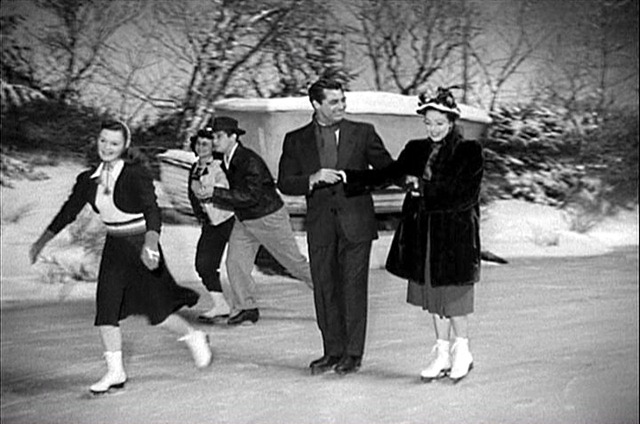
And the scene in which Dudley takes Julia ice-skating and uses his magical powers to make them both glide around the ice like Olympic champions is one of the most enjoyable bits I’ve seen in a long, long time.

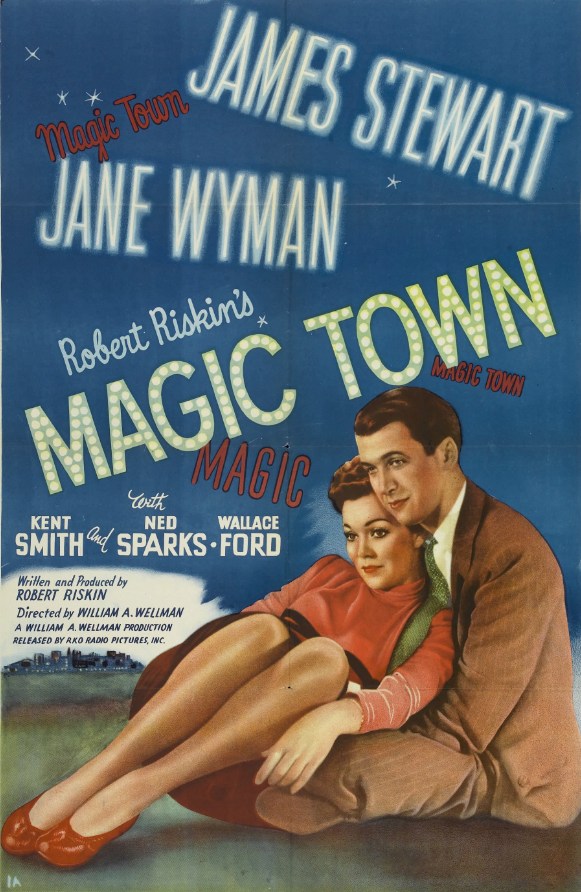
Magic Town (Oct. 7, 1947)

Complaining that William A. Wellman’s Magic Town is built on a faulty premise is kind of like complaining that Cadbury Creme Eggs are too sweet, but I’m going to do it anyway.

Magic Town, which is written by frequent Frank Capra collaborator Robert Riskin, is about a public opinion pollster named Lawrence “Rip” Smith (James Stewart) whose small polling company has just gone out of business because of high overhead costs. To stay afloat, Rip starts looking for a mathematical miracle in order to conduct public opinion polls without nationwide coverage.

He finds the shortcut he’s been looking for in a little town called Grandview.

You see, Grandview has the exact same distribution of Republicans and Democrats, men and women, old and young, farmers and laborers, and so on, as the nation as a whole. In other words, Grandview thinks exactly the same way the entire United States does. Instead of exhaustive telephone polling of representative swaths of the nation, all Rip will need to do is find out what people in Grandview think, and he’ll be able to extrapolate the results.

The catch is that the people of Grandview can’t know what Rip is up to, otherwise they’ll become self-conscious, and it’ll kill the goose that lays golden eggs. So Rip and his partners, Ike (Ned Sparks) and Mr. Twiddle (Donald Meek), head for Grandview, where they pass themselves off as insurance men from Hartford, Connecticut. They’ll engage in stealth polling, pretending to offer insurance policies while they’re really making note of the current issues the citizens of Grandview are all too willing to sound off about.

Rip’s plan hits a snag as soon as he hits town, where he reconnects with an old friend from his days in the service — Mr. Hoopendecker (Kent Smith) — who is now principal of Grandview High School. The snag is pretty local girl Mary Peterman (Jane Wyman), who’s a civic crusader, and is constantly pushing to modernize the town and build a new civic center.

Rip’s “perfect” town and its “perfect” demographics can’t be altered in any way for his covert polling operation to work, so he opposes Mary’s plans. He tells the city council that Grandview is “A sturdy challenge to the evils of the modern era.” He encourages them not to modernize anything and not to change anything.

And herein lies the problem, and the reason I said that Magic Town is built on a faulty premise. Grandview supposedly perfectly mirrors the demographics of the United States as a whole, but it’s consistently represented as an idyllic Utopia, unchanging, and a refuge from the outside world. (It’s also oddly free of blacks and Jews.)

So Magic Town is less about a town that represents America in miniature than it is about one of the most enduring American myths — the sanctity and perfection of small-town life. Grandview doesn’t represent what America actually is, it’s what America wishes it was.

Rip finds happiness in Grandview. He and Mary fall in love. He and Hoopendecker relive old times. Rip coaches the boys’ basketball team and turns them into winners.

All this could have been funny, romantic, and charming, but the film persists with its idiotic plot about opinion polling. Eventually Mary finds out what Rip is really up to and “outs” him in the press. There follows a nationwide rush to move to this “mathematically perfect” town. The civic center is approved and the citizens of Grandview become full of themselves and start forming and selling their own opinions.

And just as Rip predicted, their self-consciousness destroys everything, and results in the following newspaper headline: “GRANDVIEW COMPLETES FIRST POLL. 79% Favor Woman for President. ‘RESULT RIDICULOUS!’ SAYS EXPERT.”

All the newcomers move out of the now not-so-magic town, but things don’t go back to normal. Grandview is in shambles, and it’s up to Rip to fix things.

Despite the weak story, I enjoyed all of the actors in Magic Town, especially Stewart. He’s been parodied and impersonated so many times that it’s easy to forget what a good actor he was. He didn’t always play good guys, but when he did, no one projected the same kind of sweetness, generosity, and earnestness.

Magic Town is sort of a “greatest hits” compilation of earlier, better films that Stewart starred in. There’s the same celebration of small-town life found in It’s a Wonderful Life (1946) and there’s even a scene in which Stewart gives an impassioned speech while being supported by a bunch of kids, just like in Mr. Smith Goes to Washington (1939). It’s nowhere near as good as either of those films, but it’s not without its modest pleasures, as long as you don’t think about it too hard.

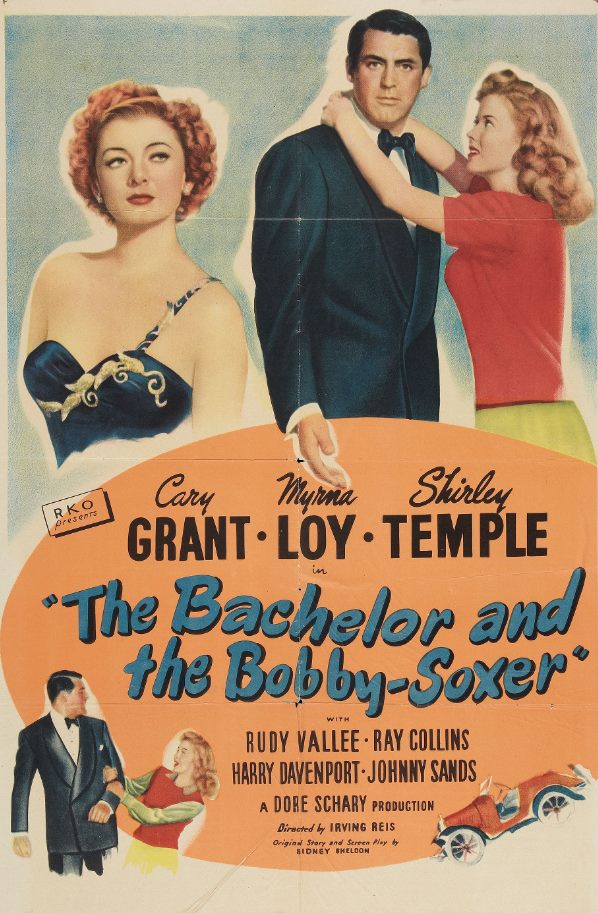
The Bachelor and the Bobby-Soxer (Sept. 1, 1947)

The Bachelor and the Bobby-Soxer was the surprise winner of the Oscar for best original screenplay at the 20th Academy Awards in 1948, beating out the scripts for more “serious” fare like Body and Soul, A Double Life, Monsieur Verdoux, and Sciuscià (Shoeshine).

But just because its win was surprising doesn’t mean it didn’t deserve to win. The Bachelor and the Bobby-Soxer is a very funny film. It’s a latter-day screwball comedy about a handsome artist who is forced — by court order, no less — to date a teenage girl.

Sidney Sheldon’s screenplay treats those jumpin’ and jivin’ post-war kids with affection rather than bemusement or contempt, and he has a keen understanding of the ways teenagers try to act like adults, and how they unwittingly fail.

The dialogue might not be a completely accurate evocation of the way real bobby-soxers and their jalopy-driving boyfriends actually talked (did any kid before this movie came out actually say that they felt “sklonklish”?), but the characterizations all feel right.

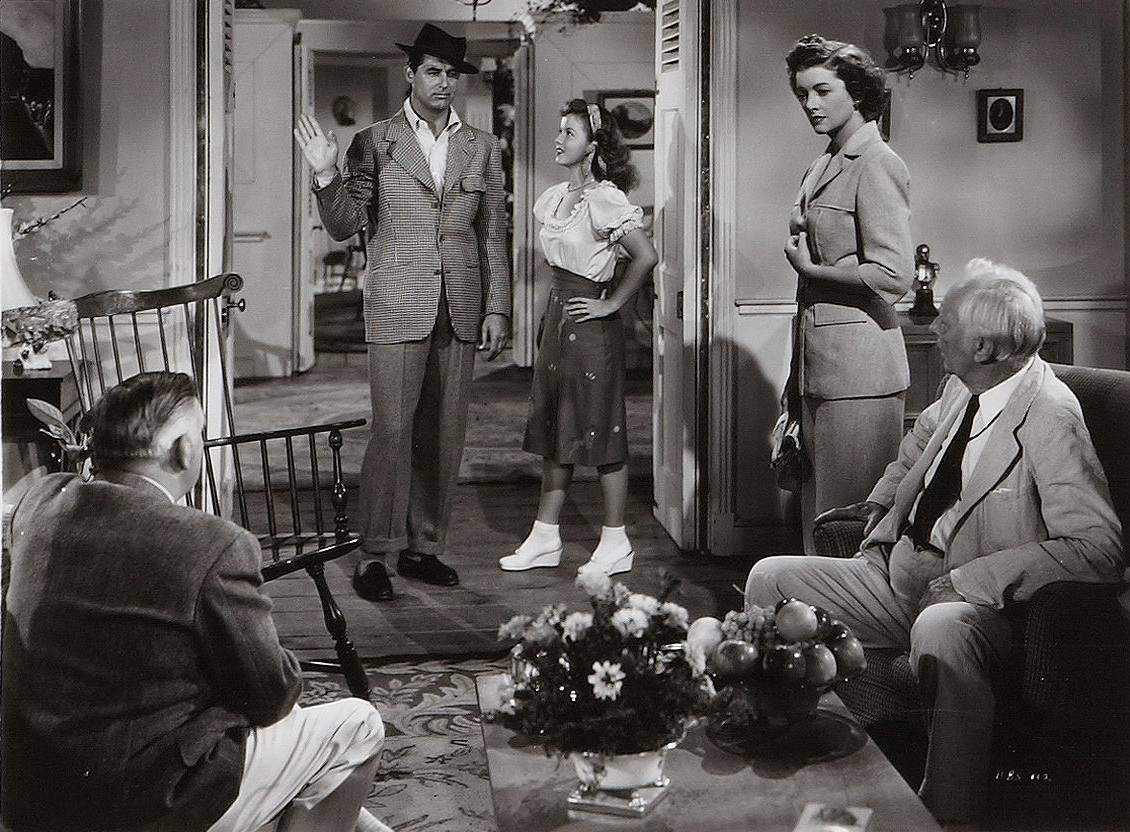
Former child star Shirley Temple — all grown up (sort of) — plays the bobby-soxer of the title, a 17-year-old high school student named Susan who lives with her older sister. Her older sister just happens to be a judge, and when the film begins, the Honorable Margaret Turner (Myrna Loy) is presiding over a case involving a kerfuffle at a nightclub between a couple of brassy gals over the affections of charming artist Richard Nugent (Cary Grant).

Margaret and Susan’s parents are dead, so Margaret is as much of a mother to Susan as she is a big sister. After the initial courtroom scene, the stage is set for the sparks of disapproval to fly as soon as Margaret learns that the object of her little sister’s affection is the same Lothario she saw in court.

Most of the humor in The Bachelor and the Bobby-Soxer comes from the fact that Richard has absolutely no desire to be with Susan, but is ordered by the court, under the recommendation of a psychologist, to take her out on dates so his mature-man forbidden fruit will sooner wither and die, and she’ll go back to her sweet, somewhat dumb high school boyfriend, Jerry (Johnny Sands).

Susan is mature for her age, but she’s still a 17-year-old. Watching Cary Grant suffer through taking her to Sunset High School basketball games and dates at the ice cream shop are some of the funniest bits I’ve seen in a long time.

Cary Grant — no stranger to screwball comedies — has an arch, deadpan comic style that’s perfectly suited to the material. Temple is really great in this movie, too. Like Deanna Durbin, she was an impossibly cute child star who blossomed into an engaging adult performer without missing a beat. And Myrna Loy is wonderful to watch, as always. It doesn’t matter that she was old enough to be Temple’s mother when she made this movie. She barely looks a decade older, and she matches Cary Grant beat for beat in all their scenes together.

The Bachelor and the Bobby-Soxer is a great comedy that stands the test of time.

Song of the Thin Man (Aug. 28, 1947)

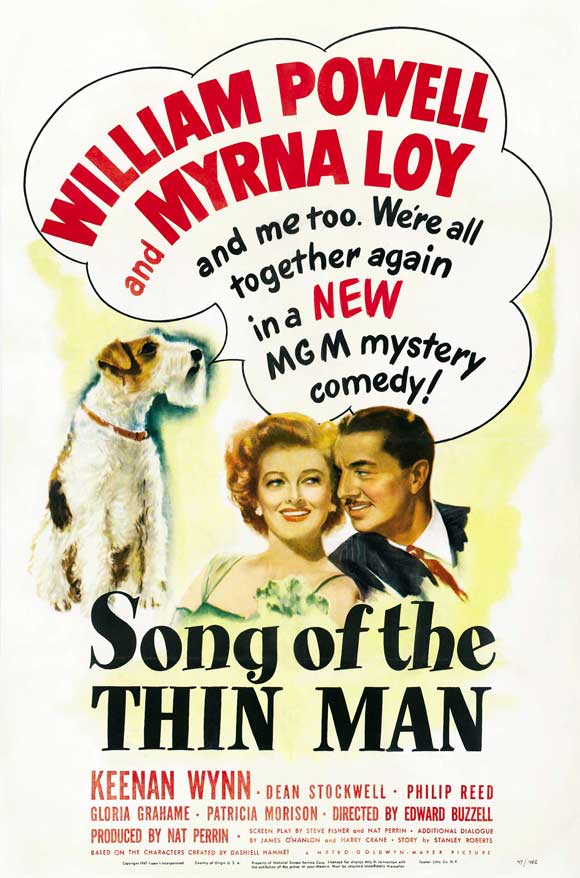
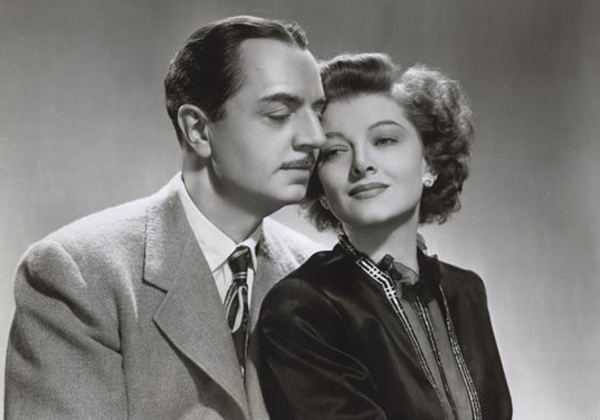
Edward Buzzell’s Song of the Thin Man was a bittersweet viewing experience for me. I’ve been a huge fan of the Thin Man series since the first film, The Thin Man (1934), so it was a little sad to know that Song of the Thin Man would be the last new film I’d see with William Powell and Myrna Loy as everyone’s favorite dipsomaniacal mystery-solving married couple, Nick and Nora Charles.

While some films in the Thin Man series are better than others, all of them are funny, well-made mysteries featuring two of the most appealing actors from Hollywood’s Golden Age.

As always, their little dog Asta is around for yuks, along with a brand new adorable little son, played by Dean Stockwell. (Yes, kids, Dean Stockwell was adorable once.)

But not to worry. Having a young son doesn’t stop Nick and Nora from continuing to booze it up and skulk around at night with flashlights, looking for clues.

The mystery they’re trying to solve this time around is the murder of a jazz band leader named Tommy Drake (Phillip Reed), who is shot aboard the S.S. Fortune, a gambling ship run by a man named Phil Brant (Bruce Cowling).

True to its title, Song of the Thin Man is all about music. Specifically jazz music, and the wacky nightclub performers who jam till dawn, like Drake’s former bandleader Buddy Hollis (Don Taylor) and his famous clarinet. Hollis is a talented musician, but he’s all whacked out from carrying a torch for the hot little cookie Fran Ledue Page (Gloria Grahame), a singer.

Keenan Wynn is also on hand as musician Clarence “Clinker” Krause, and he proves that his incredibly annoying character in The Hucksters (1947) wasn’t a case of lightning striking once.

The mystery in Song of the Thin Man isn’t that clever or involving. But as always with the Thin Man movies, the mystery and its solution is less important than all the fun Nick and Nora have carousing their way through it.

Powell and Loy were 41 years old and 28 years old, respectively, when the series began, so by the time they made Song of the Thin Man together they were starting to get on in years, but Loy looks just as beautiful as she did in 1934, and I don’t think anyone ever went to see the Thin Man movies for Powell’s looks.

All good things must come to an end, but I wish there could have been just a few more Thin Man movies with Powell and Loy.

The Secret Life of Walter Mitty (Aug. 14, 1947)

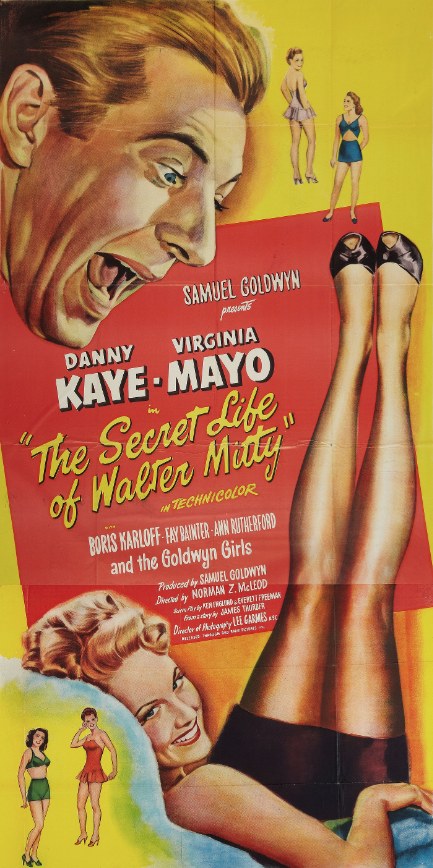
Norman Z. McLeod’s The Secret Life of Walter Mitty is a pretty funny film, and sometimes funny is all you need.

It wasn’t all James Thurber needed at the time the film was made, however. The movie was based on Thurber’s 1939 short story of the same name, and he was extremely unhappy with all the changes made to it. He also hated Danny Kaye’s performance as Mitty, since it was nothing like how he had originally conceived of the character.

I haven’t read Thurber’s short story. If I had, this movie and the liberties it took with the source material might have irritated me.

As it was, the only thing that irritated me was the length of some of the film’s musical interludes. Danny Kaye is an engaging and likable performer, but he milks his musical stand-up comedy bits for such a long time that I had more fun watching the amused extras than I had watching Kaye.

The Secret Life of Walter Mitty is a Technicolor extravaganza that follows the misadventures of a put-upon editor named Walter Mitty (Kaye). Mitty lives with his mother (played by Fay Bainter) and commutes into New York City every morning to his job at a company that publishes pulp magazines. He also has a rich fantasy life, and imagines himself as a sea captain, a brilliant surgeon, a gunslinger in the Old West, a … well, you get the idea.

He’s engaged to a girl who doesn’t really love him named Gertrude Griswold (Ann Rutherford), his mother piles errands on him until packages are literally falling out of his arms, his boss Mr. Pierce (Thurston Hall) steals his ideas, and Mitty takes it all in stride. One day, however, the girl who prominently features in all of his daydreams (Virginia Mayo) suddenly appears in the flesh, and Mitty is drawn into a real-life adventure involving stolen jewels and a spy ring. A grim-looking assassin who masquerades as a psychiatrist named Dr. Hugo Hollingshead (played by a perfectly cast Boris Karloff) dogs Mitty’s every move, first trying to kill him, then trying to convince him that the whole affair was just another one of his daydreams.

It may not be a deep film, but The Secret Life of Walter Mitty is a lot of fun. It’s a production of The Samuel Goldwyn Company, so of course the luscious Goldwyn Girls are on hand for all those department store dressing-room scenes and lingerie-modeling bits that are integral to the film’s story.

Something in the Wind (July 21, 1947)

I mentioned in my review of I’ll Be Yours, which was released earlier in 1947, that Deanna Durbin called the last four films she made “terrible,” and permanently retired from acting in 1948.

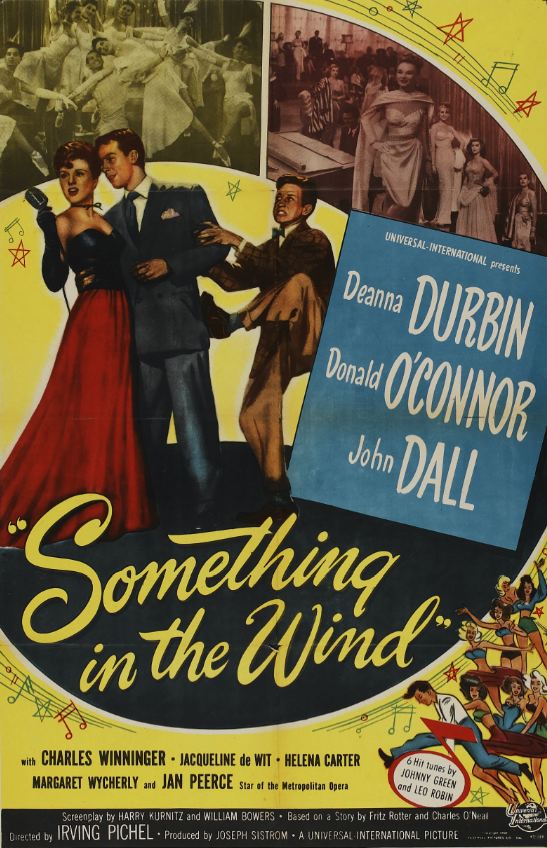
But just like I’ll Be Yours, I found Something in the Wind thoroughly enjoyable. The songs are great, the dancing is spectacular, and for the most part, it’s genuinely funny.

I think that Durbin’s retirement from acting had less to do with the quality of the films she was starring in and more to do with her desire for privacy and a normal life. (She apparently hated the public persona she’d been saddled with since she appeared in her first musical comedy, Three Smart Girls, in 1936 at the age of 14.)

Something in the Wind is by no means a great film, but Durbin’s impish sense of humor, beautiful singing voice, and perfect comic timing make up for a lot. It’s also a lot of fun to see tall drink of water John Dall in a light role. (Something in the Wind was made shortly before he would stake his place in cinematic history in 1948 as one of the thrill killers in Alfred Hitchcock’s Rope and again in 1950 as the firearms-fancying protagonist of the noir classic Gun Crazy.)

Dall plays Donald Read, the scion of the wealthy Read family. When he attempts to “make things right” with the woman to whom his recently deceased grandfather has been making regular payments, he confuses Mary Collins (Durbin) with her aunt (Jean Adair), who is also named Mary Collins. Mary Collins (the younger) is a struggling radio DJ with a beautiful voice, and she has no idea what Donald is talking about, but she’s offended by the very nature of his proposal. When she finds out that her aunt has been receiving payments from the Read family after a failed love affair with the late patriarch of the family, she’s doubly offended, and sets out to ruin the Reads.

The Reads are a pleasantly screwball family — the kind that regularly engages in hilarious kidnappings and fun-loving extortion.

Donald is the straight man of the bunch, his cousin Charlie (Donald O’Connor) is the wacky cut-up, and his uncle Chester (Charles Winninger) is the blackmailing con man who will screw over anyone for a buck.

All of this is just an excuse for laughs, music, and dance, of course, but who cares? Donald O’Connor’s wild, no-holds-barred performance of Johnny Green & Leo Robin’s “I Love a Mystery” is the stuff of legend, and must be seen to be believed. And Durbin is a one-of-a-kind star, and as far as I’m concerned, every film she appeared in is worth watching.